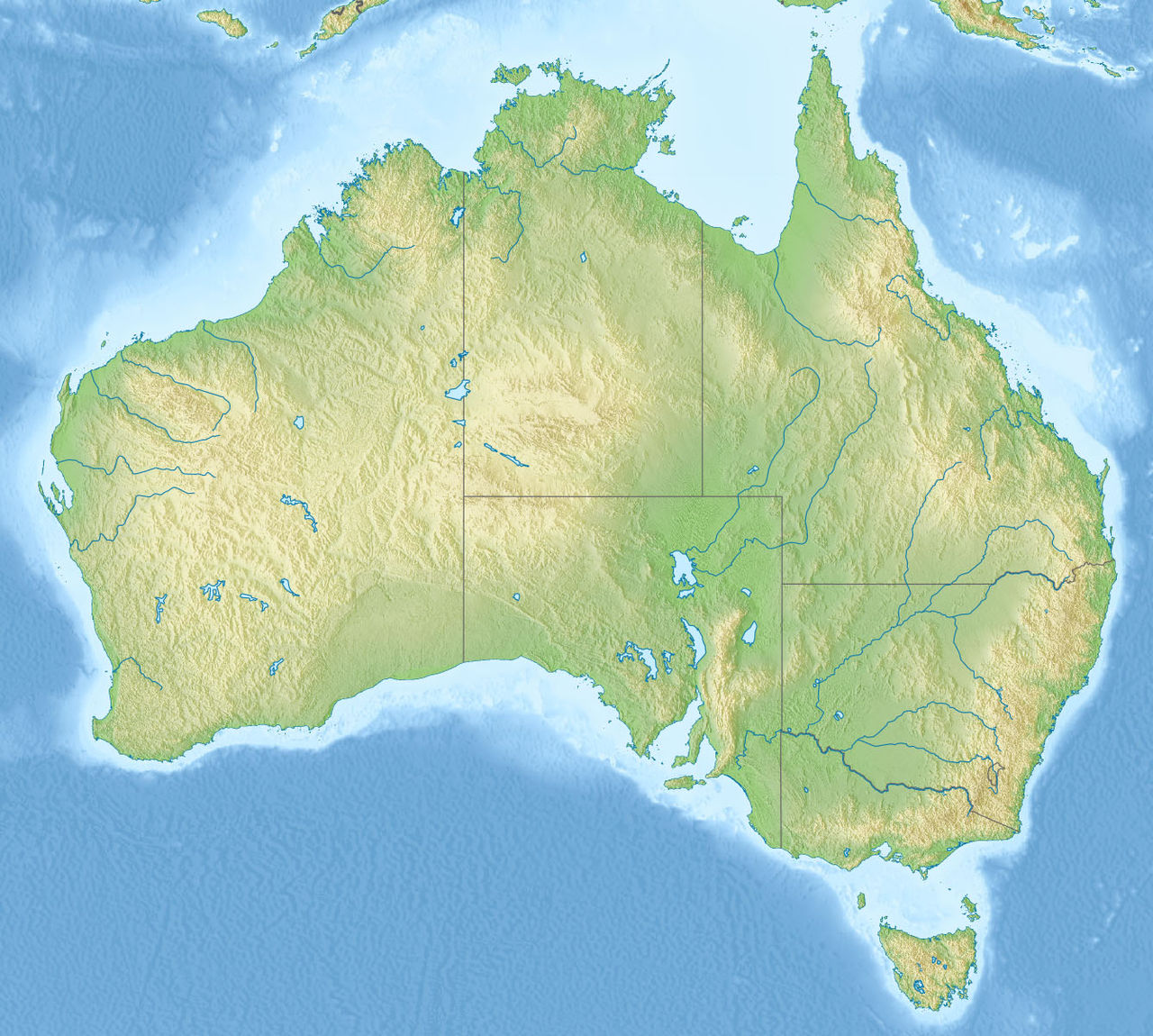
It is the lowermost unit in the Marree Subgroup, overlying the Cadna-owie Formation and is overlain by the Coorikiana Sandstone. The formation dates to the Aptian to Albian stages of the Early Cretaceous.[3] The Bulldog Shale is composed of finely laminatedcarbonaceous and pyritic mudstone and claystone beds. Weathering has caused heavy leaching and bleaching in some regions of the Bulldog Shale, including those around Coober Pedy, so that the rocks are white or multicolored. These horizons contain rich opal deposits. Horizons without this bleaching are primarily composed of organic-rich shale. Gypsum, in addition to carbonatelimestoneconcretions rich in fossils are common in these unbleached shaly horizons.[4]
Fossil content
The Bulldog Shale has yielded fossils of plants, invertebrates, fish, and reptiles.[5] The macroinvertebrate fauna of this formation includes several molluscs, such belemnites, gastropods, and bivalves. Fish are represented by chimaeras[6] and ray-finned fish (these include teleosts)[6] and a lungfish. Sharks are conspicuously absent in the Bulldog Shale.[4] Many plesiosaurs are known from the formation, including leptocleidids, elasmosaurids,[4]pliosaurids, and possible polycotylids. Ichthyosaurs are also present.[7]Archosaur fossils from the Bulldog Shale are rare, and are represented mostly indeterminate specimens, some of which can be assigned to Dinosauria.[8] Due to the coastal location of the Bulldog Shale, large amounts of wood have also been recovered in this formation.[4]
^Geoscience Australia. "Stratigraphic Unit Details: Bulldog Shale". Australian Stratigraphic Units Database. Retrieved 26 June 2020.
^ a bKear, Benjamin P.; Schroeder, Natalie I.; Lee, Michael S.Y. (2006). "An archaic crested plesiosaur in opal from the Lower Cretaceous high-latitude deposits of Australia". Biology Letters. 2 (4): 615–619. doi:10.1098/rsbl.2006.0504. PMC1833998. PMID 17148303.
^ a b c d e f g hKear, Benjamin P. (2006). "Marine reptiles from the Lower Cretaceous of South Australia: elements of a high-latitude cold-water assemblage". Palaeontology. 49 (4): 837–856. Bibcode:2006Palgy..49..837K. doi:10.1111/j.1475-4983.2006.00569.x. S2CID 128232205.
^ a bZammit, Maria; Kear, Benjamin P. (2011). "Healed bite marks on a Cretaceous ichthyosaur" (PDF). Acta Palaeontologica Polonica. 56 (4): 859–863. doi:10.4202/app.2010.0117.
^ a bMcHenry, Colin R. (2009). Devourer of Gods: The palaeoecology of the Cretaceous pliosaur Kronosaurus queenslandicus (Thesis). The University of Newcastle.
^ a b c dKear, Benjamin P. (2016). "Cretaceous marine amniotes of Australia: perspectives on a decade of new research" (PDF). Memoirs of Museum Victoria. 74: 17–28. doi:10.24199/j.mmv.2016.74.03.
^ a b cBarrett, Paul M.; Kear, Benjamin P.; Benson, Roger B.J. (2010). "Opalized archosaur remains from the Bulldog Shale (Aptian: Lower Cretaceous) of South Australia" (PDF). Alcheringa. 34 (3): 1–9. Bibcode:2010Alch...34..293B. doi:10.1080/03115511003664440. ISSN 0311-5518.
^Parrilla-Bel, Jara; Canudo, José Ignacio (2015). "On the presence of plesiosaurs in the Blesa Formation (Barremian) in Teruel (Spain)". Neues Jahrbuch für Geologie und Paläontologie, Abhandlungen. 278 (2): 213–227. doi:10.1127/njgpa/2015/0526.
^Kear, Benjamin P. (2011). Dinosaurs in Australia: Mesozoic life from the Southern Continent. Robert J. Hamilton-Bruce, CSIRO Publishing. Collingwood, Vic.: CSIRO Pub. p. 86. ISBN978-0-643-10169-2. OCLC 692219338.
^Popov, Evgeny V. (2020-12-10). "Systematic reassessment of Edaphodon eyrensis Long, 1985 (Holocephali, Chimaeroidei) from the Early Cretaceous of South Australia". Journal of Vertebrate Paleontology. 40 (6) e1884564. Bibcode:2020JVPal..40E4564P. doi:10.1080/02724634.2020.1884564. ISSN 0272-4634.
^ a bKear, Benjamin P. (2011). Dinosaurs in Australia: Mesozoic life from the Southern Continent. Robert J. Hamilton-Bruce, CSIRO Publishing. Collingwood, Vic.: CSIRO Pub. p. 82. ISBN978-0-643-10169-2. OCLC 692219338.
^ a bKear, Benjamin P. (2011). Dinosaurs in Australia: Mesozoic life from the Southern Continent. Robert J. Hamilton-Bruce, CSIRO Publishing. Collingwood, Vic.: CSIRO Pub. p. 83. ISBN978-0-643-10169-2. OCLC 692219338.
Further reading
B. P. Kear. 2007. A juvenile pliosauroid plesiosaur (Reptilia: Sauropterygia) from the Lower Cretaceous of South Australia. Journal of Paleontology 81(1):154-162
R. E. Molnar. 1991. Fossil reptiles in Australia. In P. Vickers-Rich, J. M. Monaghan, R. F. Baird, & T. H. Rich (eds.), Vertebrate Paleontology of Australasia 605-702
R. E. Molnar. 1980. Australian late Mesozoic continental tetrapods: some implications. Mémoires de la Société Géologique de France, Nouvelle Série 139:131-143