ポータル:宇宙
コンテンツへジャンプ


導入
宇宙空間、あるいは単に宇宙とは、地球の大気圏外、天体間に存在する広大な空間である。宇宙空間は極めて低密度の粒子で構成され、主に水素とヘリウムのプラズマからなるほぼ完全な真空状態にある。この真空には、電磁放射線、宇宙線、ニュートリノ、磁場、そして塵が浸透している。ビッグバンからの背景放射によって決まる宇宙空間の基準温度は、 2.7ケルビン(-270℃、-455℉)である。
銀河間のプラズマは、宇宙のバリオン(通常)物質の約半分を占めると考えられており、その数密度は1立方メートルあたり水素原子1個未満、運動温度は数百万ケルビンである。物質の局所的な集中は、星や銀河へと凝縮している。銀河間空間は宇宙の体積の大部分を占めているが、銀河や恒星系でさえ、ほぼ完全に空間で構成されている。観測可能な宇宙に残る質量エネルギーの大部分は、暗黒物質および暗黒エネルギーと呼ばれる未知の形態で構成されている。
宇宙空間は、地球の表面から特定の高度で始まるわけではない。宇宙条約や航空宇宙記録の保管では、高度100 km (62 mi) のカルマンラインが宇宙空間の始まりとして慣例的に用いられている。上層成層圏と中間圏の特定の部分は、「近宇宙」と呼ばれることもある。国際宇宙法の枠組みは、1967年10月10日に発効した宇宙条約によって確立された。この条約は国家主権の主張を排除し、すべての国が宇宙空間を自由に探査することを認めている。宇宙空間の平和利用に関する国連決議が起草されているにもかかわらず、地球軌道上で対衛星兵器のテストが行われてきた。
地球と月の間の空間は真空でなければならないという概念は、科学者が高度とともに気圧が低下することを発見した後、17 世紀に初めて提唱されました。宇宙空間の広大なスケールが把握されたのは、アンドロメダ銀河までの距離が初めて測定された 20 世紀です。人類は、同世紀後半、高高度気球飛行の出現により、物理的な宇宙探査を開始しました。これに続いて有人ロケット飛行が行われ、さらに1961 年にソ連のユーリ・ガガーリンが初めて達成した有人地球周回軌道に到達しました。人間を含む物体を宇宙に送り込む経済的コストは非常に高く、有人宇宙飛行は低地球軌道と月に限定されています。一方、無人宇宙船は太陽系の既知の惑星のすべてに到達しています。宇宙空間は、真空と放射線の危険性があるため、有人探査には厳しい環境です。微小重力は人体生理に悪影響を及ぼし、筋萎縮と骨粗鬆症の両方を引き起こします。 (記事全文はこちら...)
選択された記事

国際宇宙ステーション(ISS)は宇宙ステーション、すなわち低地球軌道上にある居住可能な人工衛星である。ソビエト連邦および後のロシアのサリュート、アルマース、ミール宇宙ステーション、そしてアメリカのスカイラブに続く、9番目の有人宇宙ステーションである。ISSはモジュール構造であり、その最初の構成要素は1998年に打ち上げられた。現在では軌道上にある最大の人工物体であり、適当な時期には地球から肉眼で見ることができる。ISSは、与圧モジュール、外部トラス、太陽電池アレイおよびその他の構成要素で構成される。ISSの構成要素は、アメリカのスペースシャトルやロシアのプロトンロケットおよびソユーズロケットによって打ち上げられている。予算の制約により、3つの宇宙ステーション計画が日本の「きぼう」モジュールとカナダの「ロボティクス」と統合された。1993年、ソ連/ロシアの宇宙ステーション「ミール2」の部分的に建造された構成要素、提案されているアメリカの「フリーダム」および提案されているヨーロッパの「コロンバス」が、単一の多国間プログラムに統合された。 ISS はおそらく、これまでに建造された単一物の中で最も高価なものでしょう。
選択した画像
- 「地球が微笑んだ日」とは、2013年7月19日に土星探査機カッシーニが土星とその環全体、そして土星が太陽を覆う位置から地球を撮影した日を指します。カッシーニ撮影チームのリーダーであり惑星科学者でもあるキャロリン・ポーコ氏は、世界中の人々に、宇宙における人類の立場を改めて考え、地球上の生命に驚嘆し、そして空を見上げて祝福の微笑みを浮かべるよう呼びかけました。ここに示す最終的なモザイク画像は、4か月後に公開され、地球、火星、金星、そして土星の衛星の群れが含まれています。

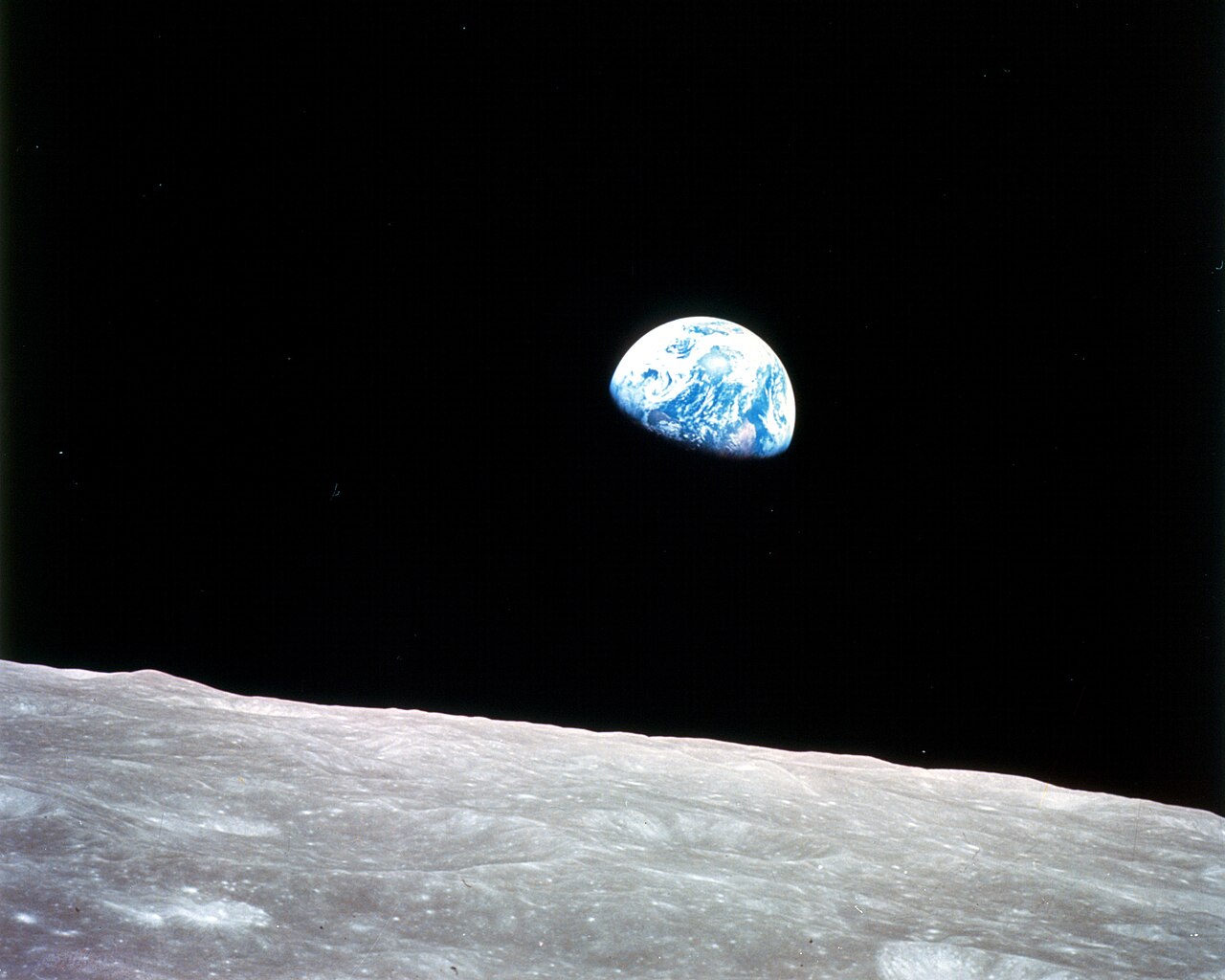
アポロ8号から見た地球の出 クレジット: ウィリアム・アンダース「地球の出」は、人類が初めて地球が月面から昇るのを目撃した瞬間で、1968年12月24日のアポロ8号ミッション中に撮影されました。この光景は、月を4周目の周回軌道に乗せ始めた乗組員によって目撃されましたが、最初の写真は白黒でした。地球が影になっていることに注目してください。完全に照らされた地球の写真は、アポロ17号ミッションまで撮影されませんでした。- An animation of the phases of the Moon. As the Moon revolves around the Earth, the Sun lights the Moon from a different side, creating the different phases. In the image, the Moon appears to get bigger as well as "wobble" slightly. Tidal locking synchronizes the Moon's rotation period on its axis to match its orbital period around the earth. These two periods nearly cancel each other out, except that the Moon's orbit is elliptical. This causes its orbital motion to speed up when closer to the Earth, and slow down when farther away, causing the Moon's apparent diameter to change, as well as the wobbling motion observed.
- Photo credit: Spirit roverA 360° panorama taken during the descent from the summit of Husband Hill, one of the Columbia Hills in Gusev crater, Mars. This stitched image is composed of 405 individual images taken with five different filters on the panoramic camera over the course of five Martian days.
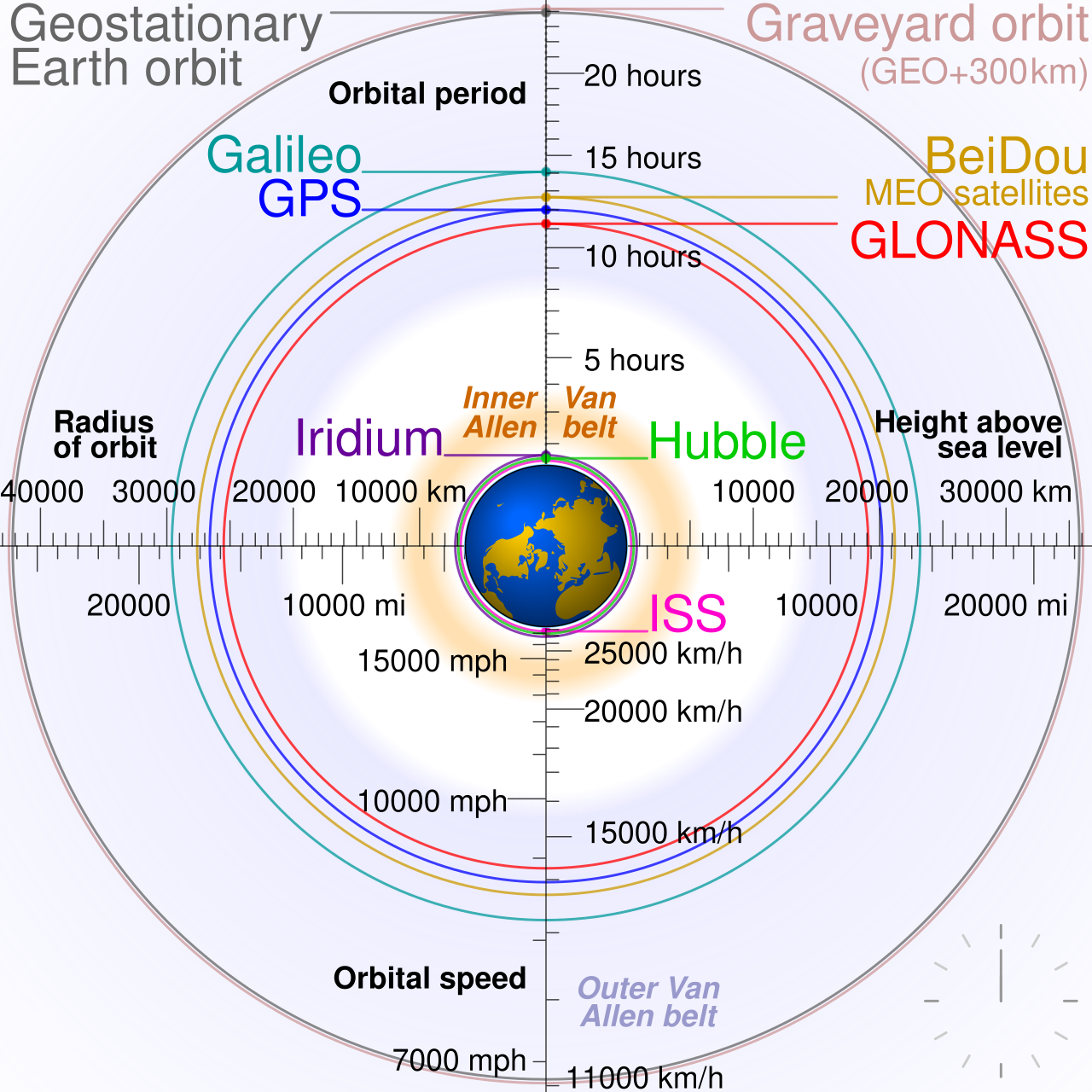
- Animation credit: CmgleeThis is an animation showing geocentric satellite orbits, to scale with the Earth, at 3,600 times actual speed. The second-outermost (shown in grey) is a geostationary orbit, 35,786 kilometres (22,236 miles) above Earth's equator and following the direction of Earth's rotation, with an orbital period matching the planet's rotation period (a geosynchronous orbit). An object in such an orbit will appear to occupy a fixed position in the sky. Some 300 kilometres (190 miles) farther away is the graveyard orbit (brown), used for satellites at the end of their operational lives. Nearer to the Earth are the orbits of navigational satellites, such as Galileo (turquoise), BeiDou (beige), GPS (blue) and GLONASS (red), in medium Earth orbits. Much closer to the planet, and within the inner Van Allen belt, are satellites in low Earth orbit, such as the Iridium satellite constellation (purple), the Hubble Space Telescope (green) and the International Space Station (magenta).
- The Pillars of Creation, a series of elephant trunks of interstellar gas and dust in the Eagle Nebula, are the subject of a famous Hubble Space Telescope photograph taken in 1995. They are so named because the depicted gas and dust, while being eroded by the light from nearby stars, are in the process of creating new stars. Shown here is a 2014 rephotograph, which was unveiled in 2015 as part of the telescope's 25th anniversary celebrations.
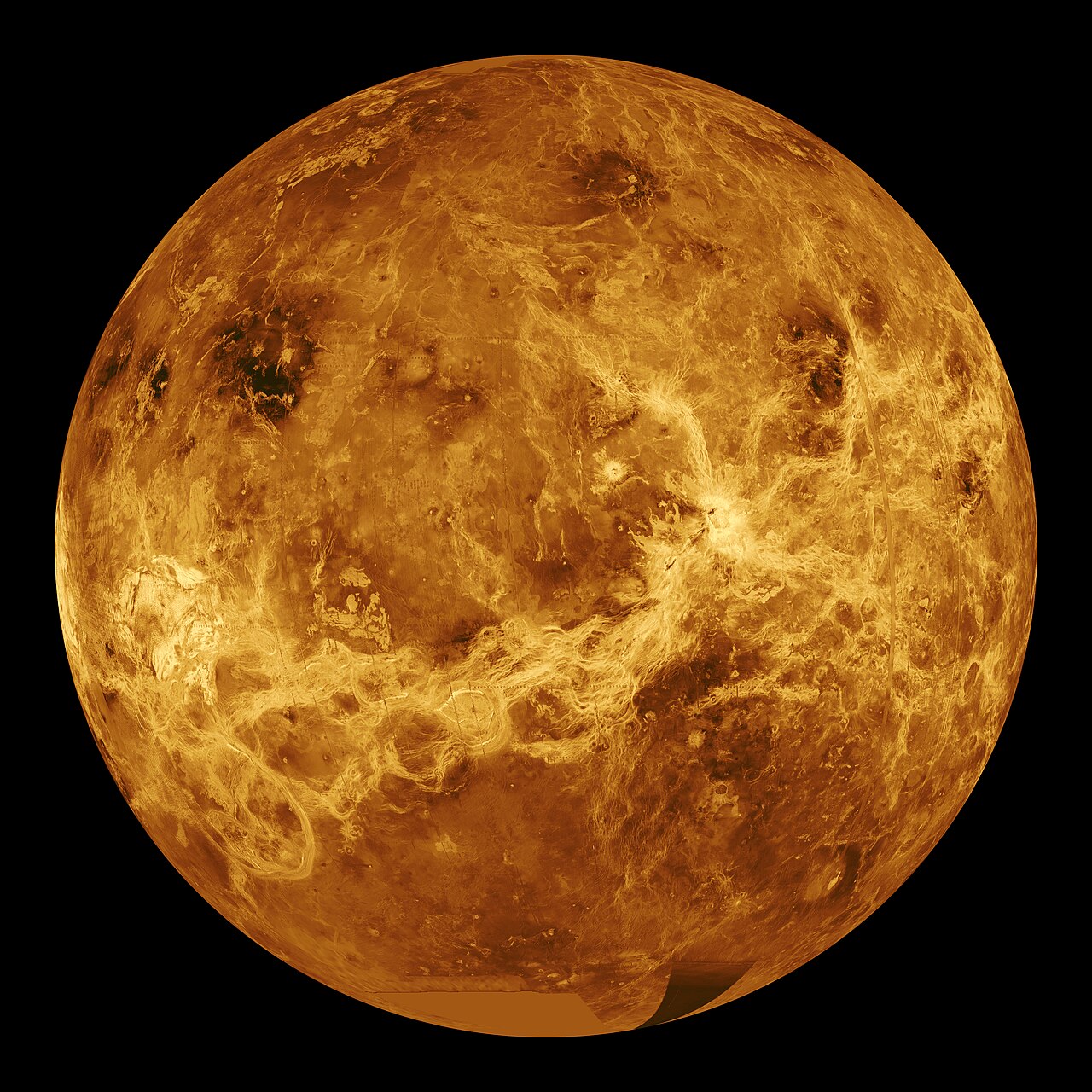
- Image credit: NASAA radar image of the surface of Venus, centered at 180 degrees east longitude. This composite image was created from mapping by the Magellan probe, supplemented by data gathered by the Pioneer orbiter, with simulated hues based on color images recorded by Venera 13 and 14. No probe has been able to survive more than a few hours on Venus's surface, which is completely obscured by clouds, because the atmospheric pressure is some 90 times that of the Earth's, and its surface temperature is around 450 °C (842 °F).
- Map credit: Ignace-Gaston PardiesIgnace-Gaston Pardies (1636–1673) was a French Catholic priest and scientist. His celestial atlas, entitled Globi coelestis in tabulas planas redacti descriptio, comprised six charts of the night sky and was first published in 1674. The atlas uses a gnomonic projection so that the plates make up a cube of the celestial sphere. The constellation figures are drawn from Uranometria, but were carefully reworked and adapted to a broader view of the sky. This is the second plate from a 1693 edition of Pardies's atlas, featuring constellations including Pegasus and Andromeda, visible in the northern sky.
- Photograph credit: NASA / JPL / Space Science InstituteThe Cassini–Huygens space-research project involved a collaboration between NASA, the European Space Agency, and the Italian Space Agency to send a probe to study the planet Saturn and its system, including its rings and its natural satellites.
This natural-color mosaic image, combining thirty photographs, was taken by the Cassini orbiter over the course of approximately two hours on 23 July 2008 as it panned its wide-angle camera across Saturn and its ring system as the planet approached equinox. Six moons are pictured in the panorama, with the largest, Titan, visible at the bottom left. - Image credit: SeavAn animated image showing the apparent retrograde motion of Mars in 2003 as seen from Earth. All the true planets appear to periodically switch direction as they cross the sky. Because Earth completes its orbit in a shorter period of time than the planets outside its orbit, we periodically overtake them, like a faster car on a multi-lane highway. When this occurs, the planet will first appear to stop its eastward drift, and then drift back toward the west. Then, as Earth swings past the planet in its orbit, it appears to resume its normal motion west to east.
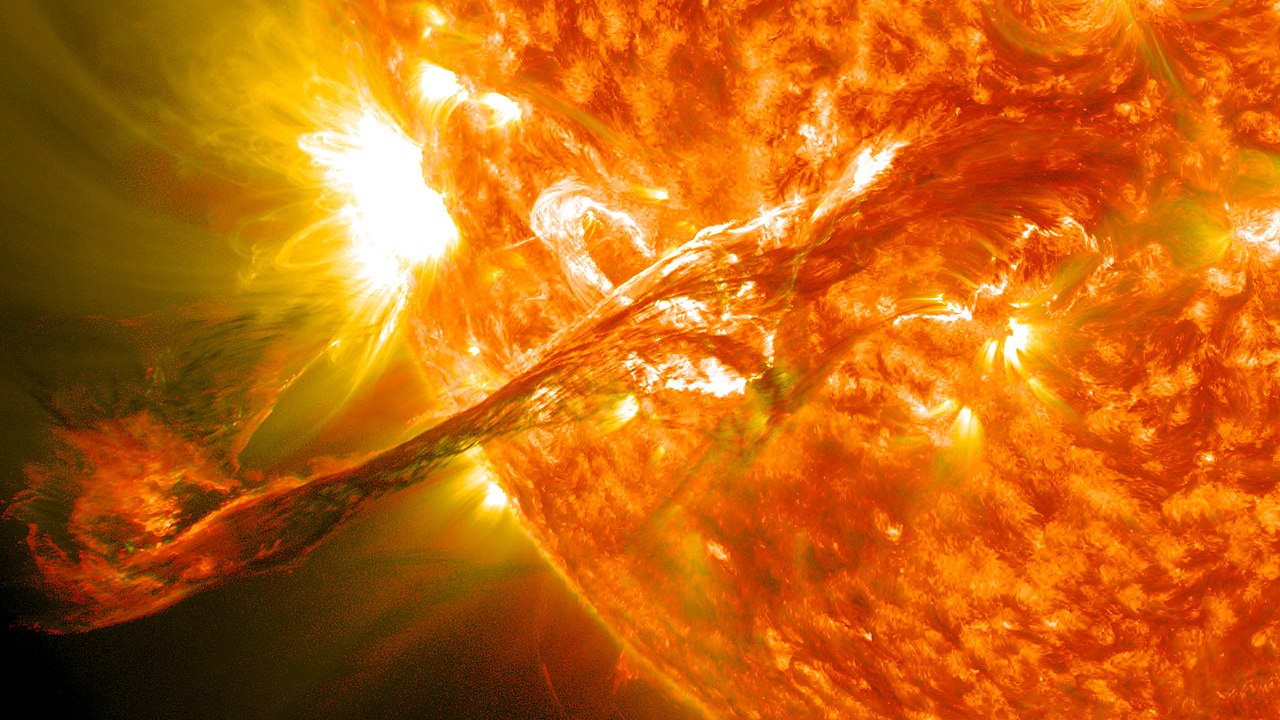
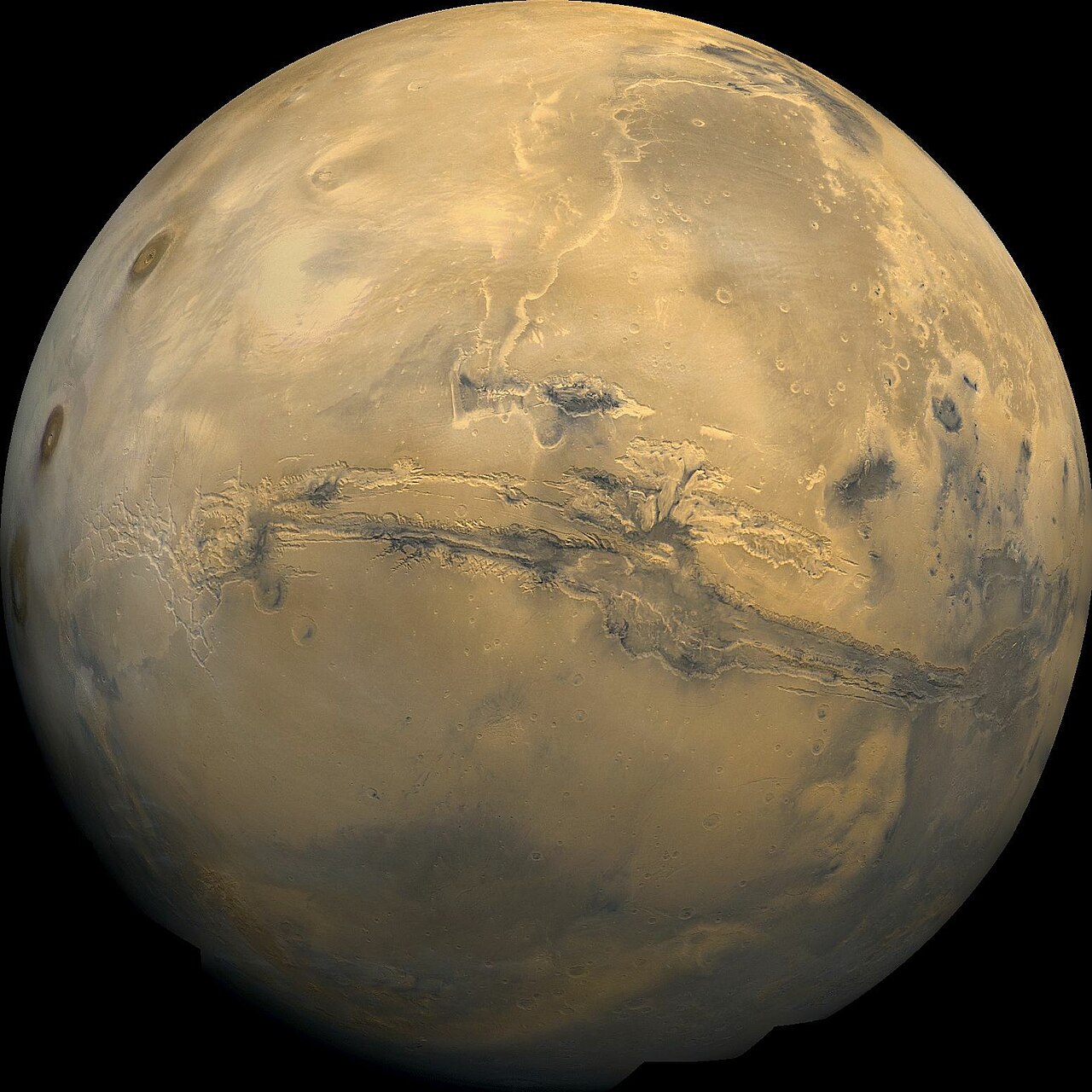
Planet Mars Credit: NASAMars, the fourth planet from the Sun, is named after the Roman god of war because of its blood red color. Mars has two small, oddly-shaped moons, Phobos and Deimos, named after the sons of the Greek god Ares. At some point in the future Phobos will be broken up by gravitational forces. The atmosphere on Mars is 95% carbon dioxide. In 2003 methane was also discovered in the atmosphere. Since methane is an unstable gas, this indicates that there must be (or have been within the last few hundred years) a source of the gas on the planet.- A solar flare, a sudden flash of brightness observed over the Sun's surface or the solar limb which is interpreted as a large energy release, recorded on August 31, 2012. Such flares are often, but not always, followed by a colossal coronal mass ejection; in this instance, the ejection traveled at over 900 miles (1,400 km) per second.
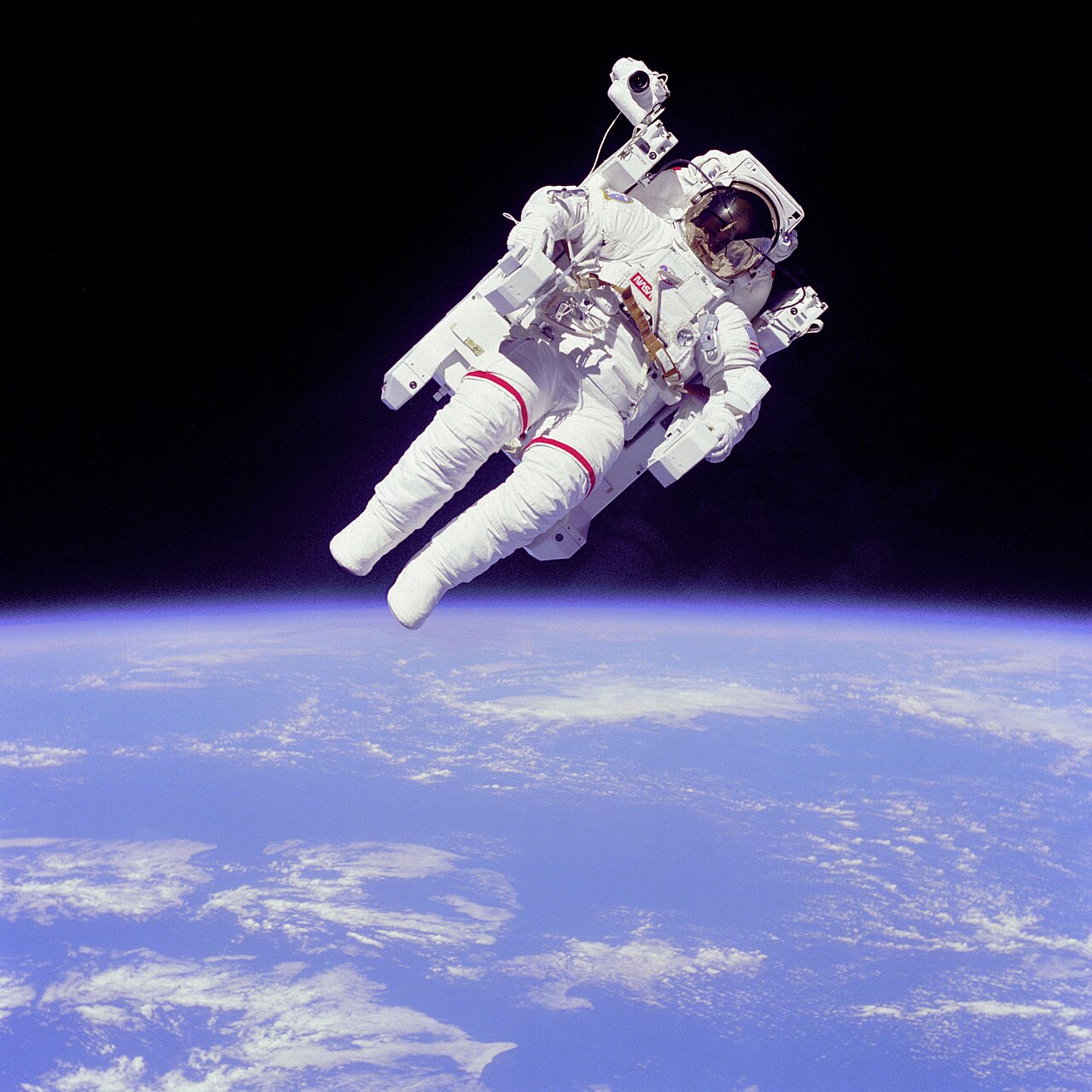
Astronaut Bruce McCandless using a Manned Maneuvering Unit Credit: NASAA Manned Maneuvering Unit (MMU) is a jet pack (propulsion backpack that snaps onto the back of the space suit) which has been used on untethered spacewalks from NASA's Space Shuttle, allowing an astronaut to move independently from the shuttle. The MMU was used on three Shuttle missions in 1984. It was first tested on February 7 during mission STS-41-B by astronauts Bruce McCandless II (seen here) and Robert L. Stewart.- Image credit: Dave JarvisAn illustration of relative astronomical orders of magnitude, starting with the terrestrial planets of the Solar System in image 1 (top left) and ending with the largest known star, VY Canis Majoris, at the bottom right. The biggest celestial body in each image is shown on the left of the next frame.
- A composite photo of the Orion Nebula, the closest region of star formation to Earth. It is composed of 520 separate images and NASA calls it "one of the most detailed astronomical images ever produced". The nebula is located below Orion's Belt and is visible to the naked eye at night. It is one of the most scrutinized and photographed objects in the night sky, and is among the most intensely-studied celestial features.
- An animated view of Voyager I's approach to Jupiter. One frame of this image was taken each Jupiter day (approximately 10 hours) between January 6 and February 9, 1979, as the space probe flew from 58 million to 31 million kilometers from Jupiter during that time. The small, round, dark spots appearing in some frames are the shadows cast by the moons passing between Jupiter and the Sun, while the small, white flashes around the planet, are the moons themselves.
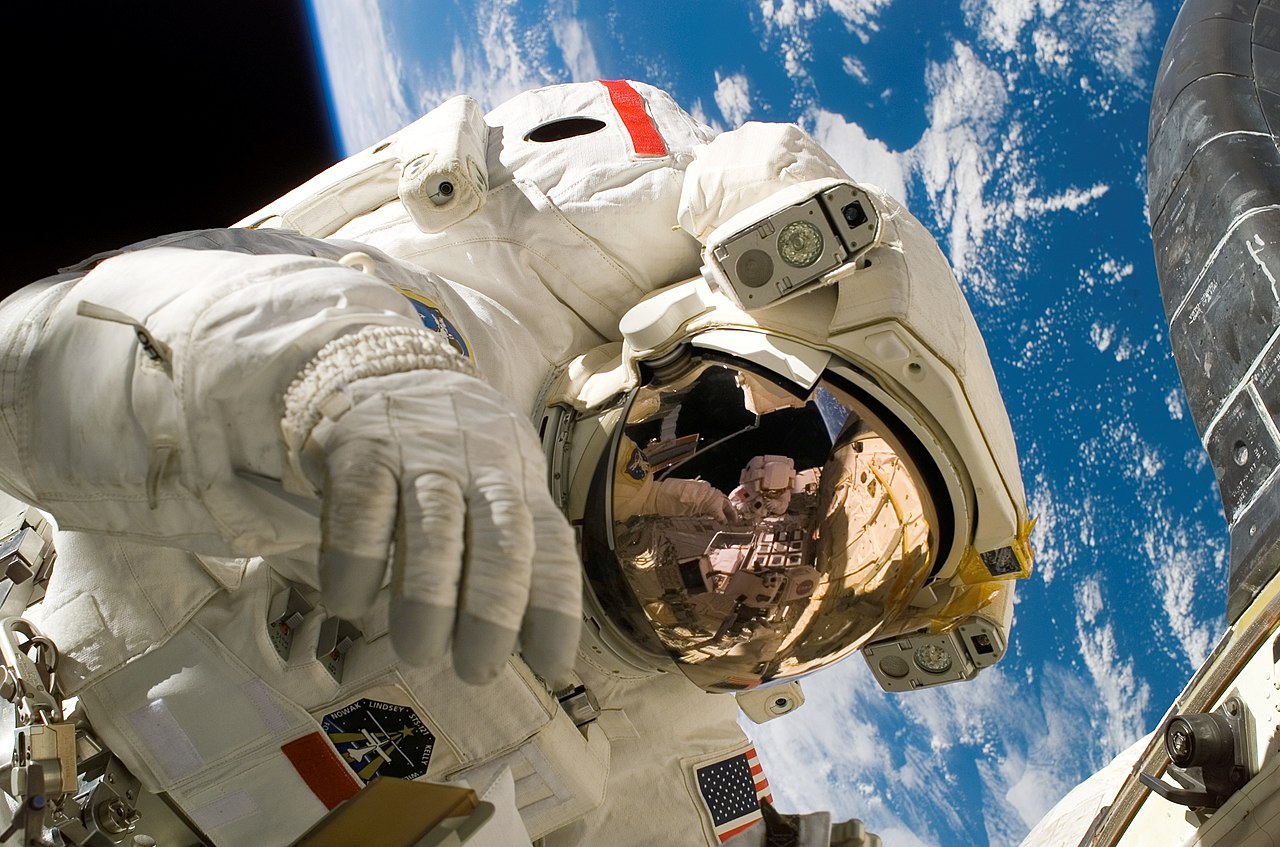
Astronaut Steve Robinson on a spacewalk, August 2005 Credit: NASAExtra-vehicular activity (EVA) is work done by an astronaut away from the Earth and outside of his or her spacecraft. EVAs may be made outside a craft orbiting Earth (a spacewalk) or on the surface of the Moon (a moonwalk). Shown here is Steve Robinson on the first EVA to perform an in-flight repair of the Space Shuttle (August 3 2005).- Photograph: NASA/JPL-Caltech/University of ArizonaThe Helix Nebula is a large planetary nebula located in the constellation Aquarius. Discovered by Karl Ludwig Harding, probably before 1824, it is one of the closest to Earth of all the bright planetary nebulae, about 215 parsecs (700 light-years) away. It is similar in appearance to the Cat's Eye Nebula and the Ring Nebula.
- "The Blue Marble" is a famous photograph of Earth. NASA officially credits the image to the entire Apollo 17 crew — Eugene Cernan, Ronald Evans and Jack Schmitt — all of whom took photographic images during the mission. Apollo 17 passed over Africa during daylight hours and Antarctica is also illuminated. The photograph was taken approximately five hours after the spacecraft's launch, while en route to the Moon. Apollo 17, notably, was the last manned lunar mission; no humans since have been at a range where taking a "whole-Earth" photograph such as "The Blue Marble" would be possible.
- Photo: Yuri Beletsky, ESOA laser shoots towards the centre of the Milky Way from the Very Large Telescope facility in Chile, to provide a laser guide star, a reference point in the sky for the telescope's adaptive optics (AO) system. AO technology improves the performance of optical systems by reducing the effect of atmospheric distortion. AO was first envisioned by Horace W. Babcock in 1953, but did not come into common usage until advances in computer technology during the 1990s made the technique practical.
- The asteroid 433 Eros was named after the Greek god of love Eros. This S-type asteroid is the second-largest near-Earth asteroid. This image shows the view looking from one end of the asteroid across the gouge on its underside and toward the opposite end.
- Pale Blue Dot is the name given to this 1990 photo of Earth taken from Voyager 1 when its vantage point reached the edge of the Solar System, a distance of roughly 3.7 billion miles (6 billion kilometres). Earth can be seen as a blueish-white speck approximately halfway down the brown band to the right. The light band over Earth is an artifact of sunlight scattering in the camera's lens, resulting from the small angle between Earth and the Sun. Carl Sagan came up with the idea of turning the spacecraft around to take a composite image of the Solar System. Six years later, he reflected, "All of human history has happened on that tiny pixel, which is our only home."


.gif)







.jpg/1280px-Comets_Kick_up_Dust_in_Helix_Nebula_(PIA09178).jpg)


宇宙関連ポータル


一般的な画像
- WT1190Fと特定された宇宙ゴミがスリランカ上空で火球となって燃えている(宇宙ゴミより)
- ベイカー・ナンカメラは宇宙ゴミの研究に広く使われました。(宇宙ゴミより)
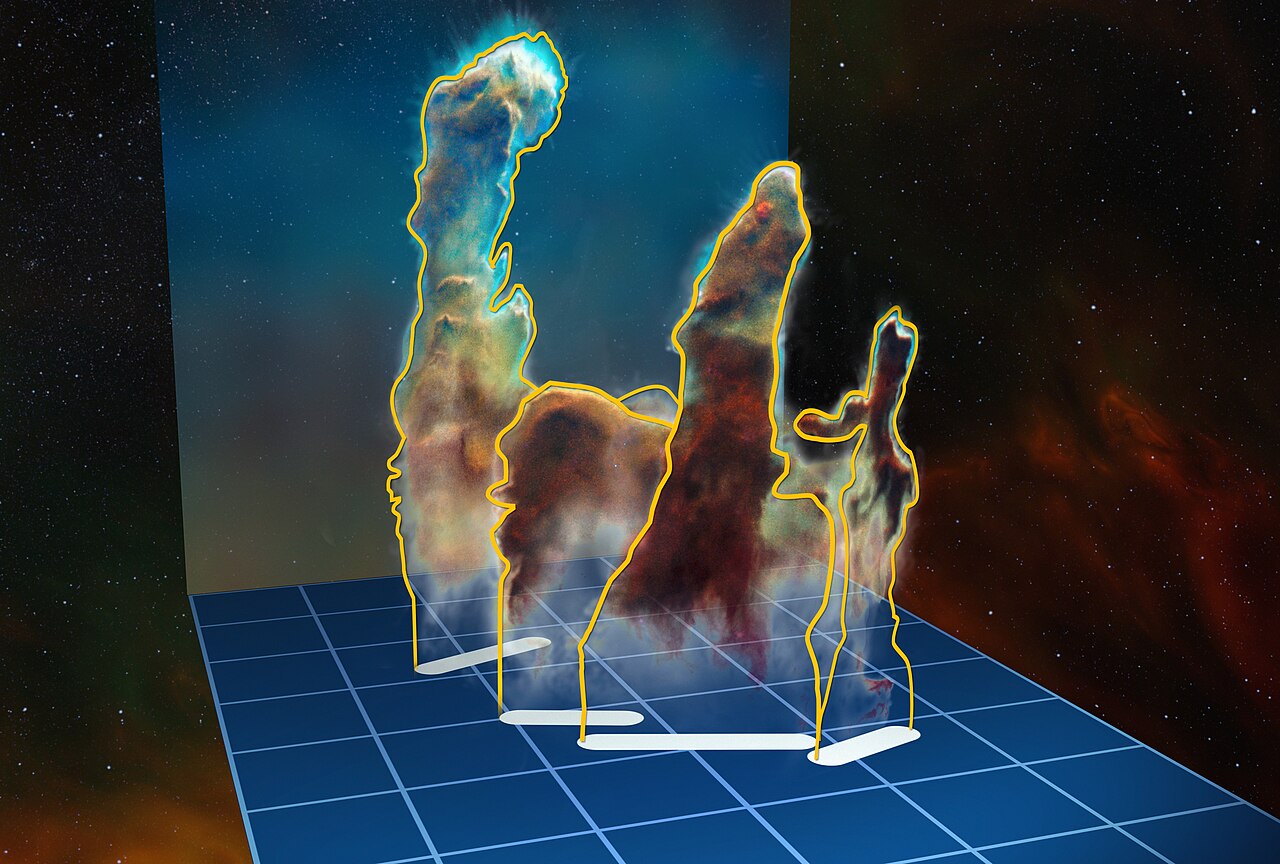
- 『Pillars of Creation』の3次元構造。(星間物質より)
- 2001年1月、サウジアラビア当局が墜落したPAM-Dモジュールを検査している。(宇宙ゴミより)
- ESA MASTER-2001に基づく高度別の宇宙ゴミの空間密度(中国のASATおよび2009年の衝突事故によるゴミを除く)(宇宙ゴミより)
- 天体の種類や規模の多様性により、研究分野はますます専門化しています。(宇宙科学概論より)
- ジェゼロクレーターの表面に直立したパーセベランスのバックシェル(宇宙ゴミより)
- 破片の破片を含む地球軌道上の物体、2020年11月、NASA: ODPO(宇宙ゴミより)
- 再突入後、デルタ2第2段の破片が南アフリカで発見されました。(宇宙ゴミより)
- 2005年現在、地球を周回する物体のコンピュータ生成地図。約95%は宇宙からの人工衛星ではなく、デブリである。
- 月周回軌道上のアポロ司令・機械船(宇宙探査より)
- 2011年にNASAが国連宇宙部へ提出した報告書に基づく、高度別のLEO宇宙ゴミの空間密度(宇宙ゴミより)
- 2022年のアルテミス1号ミッションで地球と月が地球の周囲から見える様子(宇宙から)
- 成層圏惑星間塵粒子200個の主成分。(宇宙塵より)
- 高高度で衛星が複数の破片に分解する様子を示すイラスト(宇宙ゴミより)
- ボストーク宇宙船の模型(宇宙探査より)
- ウィスコンシンHαマッパー( Haffner et al. 2003)で観測された、地球の北半球から見える銀河系星間物質の部分におけるイオン化水素(天文学者には古い分光学用語からHIIとして知られています)の分布。(星間物質より)
- 低軌道上のデブリ密度(宇宙デブリ)
- EHF帯における周波数の関数としての大気減衰(dB /km)。水蒸気(H 2 O)や二酸化炭素(CO 2 )などの大気成分の影響により、特定の周波数における吸収ピークが問題となる。(星間物質より)
- NASA がコンピューター生成した地球軌道上のデブリ画像、2005 年頃(宇宙デブリより)
- メッセンジャーが18,000 km上空から撮影した、直径約500 kmの領域を示す画像(2008年)(宇宙探査より)
- 初期の太陽系から今日の炭素質塵までの塵の軌跡。(宇宙塵より)
- 軌道上の追跡物体の増加および関連事象。宇宙のグローバルコモンズを管理するための努力は、これまでのところ、デブリや軌道上の物体の増加を削減していない(宇宙デブリより)
- 103P/ハートレー彗星(2010年)(宇宙探査より)
- 地球の大気が徐々に宇宙空間へと移行していく様子を示すイラスト(宇宙空間より)
- 土星の衛星から打ち上げられるロケットの芸術的なイメージ(宇宙探査より)
- 打ち上げ時の衝突回避策は、打ち上げ中の潜在的な衝突を回避するために宇宙船の打ち上げを遅らせることにつながります。これは、2024年のSPADEX打ち上げに4分間の遅延を義務付けた衝突回避分析です。(宇宙デブリより)
- 2000年3月11日、中国の長征4号ロケットの第3段ロケットが5か月前に分解し、約300個の破片が見つかったガバード図(宇宙ゴミより)
- 超新星爆発の周囲に形成される塵の想像図。(宇宙塵より)
- オットー・フォン・ゲーリケの真空ポンプ(右)のデモンストレーションに使用されたオリジナルのマクデブルク半球(左)
- 地球の周りのさまざまな軌道における宇宙ゴミの状況を示すインフォグラフィック(宇宙ゴミより)
- 滑らかなコンドライトの惑星間塵粒子。(宇宙塵より)
- ミールの太陽電池パネルは、デブリの衝突によって性能が低下しました。損傷は、カメラに面した右側のパネル(コントラストが高い)で最も顕著です。下の小さなパネルは、プログレス宇宙船との衝突により大きな損傷を受けています。(宇宙デブリより)
- 真空の危険性のため、宇宙飛行士は宇宙船の外にいる間は加圧宇宙服を着用しなければなりません。
- 中国の長征4号ロケット第3段の崩壊による破片のギャバード図(宇宙ゴミより)
- 11,400年間の太陽活動の再現。8,000年以上前に、同様に活発な活動が見られた時期が記録されている。(宇宙気候より)
- NASA / ESA /カナダ宇宙庁/ジェイムズ・ウェッブ宇宙望遠鏡は、初めて、赤方偏移z ≈ 7における炭素を豊富に含む塵粒子の化学的特徴を観測しました。これは、宇宙誕生からおよそ10億年に相当するもので、この観測は、宇宙塵の生成と宇宙における最古の恒星集団の両方について、刺激的な調査の道を示唆しています。(宇宙塵より)
- NASA Vision ミッションのコンセプト アート (宇宙探査より)
- 地球近傍空間。低地球軌道(青)、中地球軌道(緑)、高地球軌道(赤)を示す。高地球軌道は静止軌道の半径を超えて広がる(宇宙から見た場合)。






.jpg/1280px-A_Man_on_the_Moon,_AS11-40-5903_(cropped).jpg)


.jpg/1280px-Black_Knight_Satellite_(cropped).jpg)


.jpg/1280px-Night_Sky_from_Hawai%E2%80%98i_and_Chile_(iotw2225c).jpg)




.png)


.tif/lossy-page1-1280px-Herbig-Haro_110_(captured_by_the_Hubble_Space_Telescope).tif.jpg)


.jpg/1280px-Webb_inspects_dusty_debris_disc_around_Fomalhaut_(weic2312a).jpg)

_(53057957393).jpg/1280px-Galaxy_JADES-GS-z6_in_the_GOODS-S_field-_JADES_(NIRCam_image)_(53057957393).jpg)


.jpg/1280px-AS11-40-5964_(21037459754).jpg)
ご存知ですか?(自動生成)

- ...スペース 220 レストランのために、ディズニーは NASA のエンジニアに連絡を取り、宇宙エレベーターがどのようなものになるかを理解しようとしたそうです。
- ウクライナ侵攻による深刻な環境影響が宇宙から見えるということをご存知ですか?
- インドの宇宙産業は、 100 基以上の国内衛星と 300 基以上の外国衛星の打ち上げを支援してきたことをご存知ですか?
- 微生物ベースの肉代替品を製造するNature's Fynd 社が、宇宙旅行で使用するためのバイオリアクターの開発にNASAと協力していることをご存知ですか?
- アポロ計画が進行中だった当時、ルイス・W・ロバーツはNASAの宇宙計画スタッフの中で最高位のアフリカ系アメリカ人の一人だったことをご存知ですか?
宇宙ニュース
2025年の宇宙 | |||
|---|---|---|---|
宇宙探査機の打ち上げ  |
| ||
| 選択されたNEO | |||
| 発見 |
| ||
| 彗星 | |||
| 新星 | |||
| 宇宙探査 | |||
| その他のイベント | |||


今後の宇宙飛行打ち上げ
天文現象

トピック


宇宙の2020年 | ||
|---|---|---|
| 宇宙探査機の 打ち上げ | ||
| 衝撃イベント | ||
| 選択された NEO | ||
| 太陽系外惑星 | ||
| 発見 |
| |
| 彗星 | ||
| 宇宙 探査 | ||


_on_Jul_14_2020_aligned_to_stars.jpg/1280px-Comet_2020_F3_(NEOWISE)_on_Jul_14_2020_aligned_to_stars.jpg)
宇宙の2019年 | ||
|---|---|---|
| 宇宙探査機の 打ち上げ |
| |
| 衝撃イベント | ||
| 選択されたNEO | ||
| 太陽系外惑星 | ||
| 発見 |
| |
| 彗星 | ||
| 宇宙探査 |
| |


宇宙の2018年 | ||
|---|---|---|
| 宇宙探査機の 打ち上げ | ||
| 衝撃イベント | ||
| 選択されたNEO | ||
| 太陽系外惑星 | ||
| 発見 |
| |
| 新星 |
| |
| 彗星 | ||
| 宇宙探査 | ||


.png)
宇宙の2017年 | ||
|---|---|---|
| 宇宙探査機の打ち上げ |
| |
| 衝撃イベント | ||
| 選択されたNEO | ||
| 太陽系外惑星 | ||
| 発見 | ||
| 彗星 | ||
| 宇宙探査 |
| |


宇宙の2016年 | ||
|---|---|---|
| 宇宙探査機の打ち上げ |
| |
| 衝撃イベント | ||
| 選択されたNEO | ||
| 太陽系外惑星 |
| |
| 発見 |
| |
| 新星 | ||
| 彗星 | ||
| 宇宙探査 | ||


宇宙の2015年 | ||||||
|---|---|---|---|---|---|---|
| 宇宙探査機の打ち上げ |
| |||||
| 衝撃イベント | ||||||
| 選択されたNEO | ||||||
| 太陽系外惑星 | ||||||
| 発見 | ||||||
| 彗星 | ||||||
| 宇宙探査 | ||||||


カテゴリー

ウィキメディア
ウィキメディア財団の以下の姉妹プロジェクトでは、この主題についてさらに詳しい情報を提供しています。
- コモンズ
無料メディアリポジトリ - Wikibooks
無料の教科書とマニュアル - Wikidata
無料知識ベース - ウィキニュース
無料コンテンツニュース - ウィキクォート
引用集 - Wikisource
フリーコンテンツライブラリ - Wikiversity
無料学習ツール - ウィクショナリー
辞書とシソーラス


導入
宇宙空間、あるいは単に宇宙とは、地球の大気圏外、天体間に存在する広大な空間である。宇宙空間は極めて低密度の粒子で構成され、主に水素とヘリウムのプラズマからなるほぼ完全な真空状態にある。この真空には、電磁放射線、宇宙線、ニュートリノ、磁場、そして塵が浸透している。ビッグバンからの背景放射によって決まる宇宙空間の基準温度は、 2.7ケルビン(-270℃、-455℉)である。
銀河間のプラズマは、宇宙のバリオン(通常)物質の約半分を占めると考えられており、その数密度は1立方メートルあたり水素原子1個未満、運動温度は数百万ケルビンである。物質の局所的な集中は、星や銀河へと凝縮している。銀河間空間は宇宙の体積の大部分を占めているが、銀河や恒星系でさえ、ほぼ完全に空間で構成されている。観測可能な宇宙に残る質量エネルギーの大部分は、暗黒物質および暗黒エネルギーと呼ばれる未知の形態で構成されている。
宇宙空間は、地球の表面から特定の高度で始まるわけではない。宇宙条約や航空宇宙記録の保管では、高度100 km (62 mi) のカルマンラインが宇宙空間の始まりとして慣例的に用いられている。上層成層圏と中間圏の特定の部分は、「近宇宙」と呼ばれることもある。国際宇宙法の枠組みは、1967年10月10日に発効した宇宙条約によって確立された。この条約は国家主権の主張を排除し、すべての国が宇宙空間を自由に探査することを認めている。宇宙空間の平和利用に関する国連決議が起草されているにもかかわらず、地球軌道上で対衛星兵器のテストが行われてきた。
地球と月の間の空間は真空でなければならないという概念は、科学者が高度とともに気圧が低下することを発見した後、17 世紀に初めて提唱されました。宇宙空間の広大なスケールが把握されたのは、アンドロメダ銀河までの距離が初めて測定された 20 世紀です。人類は、同世紀後半、高高度気球飛行の出現により、物理的な宇宙探査を開始しました。これに続いて有人ロケット飛行が行われ、さらに1961 年にソ連のユーリ・ガガーリンが初めて達成した有人地球周回軌道に到達しました。人間を含む物体を宇宙に送り込む経済的コストは非常に高く、有人宇宙飛行は低地球軌道と月に限定されています。一方、無人宇宙船は太陽系の既知の惑星のすべてに到達しています。宇宙空間は、真空と放射線の危険性があるため、有人探査には厳しい環境です。微小重力は人体生理に悪影響を及ぼし、筋萎縮と骨粗鬆症の両方を引き起こします。 (記事全文はこちら...)
選択された記事
国際宇宙ステーション(ISS)は宇宙ステーション、すなわち低地球軌道上にある居住可能な人工衛星である。ソビエト連邦および後のロシアのサリュート、アルマース、ミール宇宙ステーション、そしてアメリカのスカイラブに続く、9番目の有人宇宙ステーションである。ISSはモジュール構造であり、その最初の構成要素は1998年に打ち上げられた。現在では軌道上にある最大の人工物体であり、適当な時期には地球から肉眼で見ることができる。ISSは、与圧モジュール、外部トラス、太陽電池アレイおよびその他の構成要素で構成される。ISSの構成要素は、アメリカのスペースシャトルやロシアのプロトンロケットおよびソユーズロケットによって打ち上げられている。予算の制約により、3つの宇宙ステーション計画が日本の「きぼう」モジュールとカナダの「ロボティクス」と統合された。1993年、ソ連/ロシアの宇宙ステーション「ミール2」の部分的に建造された構成要素、提案されているアメリカの「フリーダム」および提案されているヨーロッパの「コロンバス」が、単一の多国間プログラムに統合された。 ISS はおそらく、これまでに建造された単一物の中で最も高価なものでしょう。
選択した画像
- 「地球が微笑んだ日」とは、2013年7月19日に土星探査機カッシーニが土星とその環全体、そして土星が太陽を覆う位置から地球を撮影した日を指します。カッシーニ撮影チームのリーダーであり惑星科学者でもあるキャロリン・ポーコ氏は、世界中の人々に、宇宙における人類の立場を改めて考え、地球上の生命に驚嘆し、そして空を見上げて祝福の微笑みを浮かべるよう呼びかけました。ここに示す最終的なモザイク画像は、4か月後に公開され、地球、火星、金星、そして土星の衛星の群れが含まれています。
Earthrise, as seen by Apollo 8 Credit: William Anders"Earthrise," the first occasion in which humans saw the Earth seemingly rising above the surface of the Moon, taken during the Apollo 8 mission on December 24, 1968. This view was seen by the crew at the beginning of its fourth orbit around the Moon, although the very first photograph taken was in black-and-white. Note that the Earth is in shadow here. A photo of a fully lit Earth would not be taken until the Apollo 17 mission.- Image: Tom RuenAn animation of the phases of the Moon. As the Moon revolves around the Earth, the Sun lights the Moon from a different side, creating the different phases. In the image, the Moon appears to get bigger as well as "wobble" slightly. Tidal locking synchronizes the Moon's rotation period on its axis to match its orbital period around the earth. These two periods nearly cancel each other out, except that the Moon's orbit is elliptical. This causes its orbital motion to speed up when closer to the Earth, and slow down when farther away, causing the Moon's apparent diameter to change, as well as the wobbling motion observed.
- Photo credit: Spirit roverA 360° panorama taken during the descent from the summit of Husband Hill, one of the Columbia Hills in Gusev crater, Mars. This stitched image is composed of 405 individual images taken with five different filters on the panoramic camera over the course of five Martian days.
- Animation credit: CmgleeThis is an animation showing geocentric satellite orbits, to scale with the Earth, at 3,600 times actual speed. The second-outermost (shown in grey) is a geostationary orbit, 35,786 kilometres (22,236 miles) above Earth's equator and following the direction of Earth's rotation, with an orbital period matching the planet's rotation period (a geosynchronous orbit). An object in such an orbit will appear to occupy a fixed position in the sky. Some 300 kilometres (190 miles) farther away is the graveyard orbit (brown), used for satellites at the end of their operational lives. Nearer to the Earth are the orbits of navigational satellites, such as Galileo (turquoise), BeiDou (beige), GPS (blue) and GLONASS (red), in medium Earth orbits. Much closer to the planet, and within the inner Van Allen belt, are satellites in low Earth orbit, such as the Iridium satellite constellation (purple), the Hubble Space Telescope (green) and the International Space Station (magenta).
- The Pillars of Creation, a series of elephant trunks of interstellar gas and dust in the Eagle Nebula, are the subject of a famous Hubble Space Telescope photograph taken in 1995. They are so named because the depicted gas and dust, while being eroded by the light from nearby stars, are in the process of creating new stars. Shown here is a 2014 rephotograph, which was unveiled in 2015 as part of the telescope's 25th anniversary celebrations.
- Image credit: NASAA radar image of the surface of Venus, centered at 180 degrees east longitude. This composite image was created from mapping by the Magellan probe, supplemented by data gathered by the Pioneer orbiter, with simulated hues based on color images recorded by Venera 13 and 14. No probe has been able to survive more than a few hours on Venus's surface, which is completely obscured by clouds, because the atmospheric pressure is some 90 times that of the Earth's, and its surface temperature is around 450 °C (842 °F).
- Map credit: Ignace-Gaston PardiesIgnace-Gaston Pardies (1636–1673) was a French Catholic priest and scientist. His celestial atlas, entitled Globi coelestis in tabulas planas redacti descriptio, comprised six charts of the night sky and was first published in 1674. The atlas uses a gnomonic projection so that the plates make up a cube of the celestial sphere. The constellation figures are drawn from Uranometria, but were carefully reworked and adapted to a broader view of the sky. This is the second plate from a 1693 edition of Pardies's atlas, featuring constellations including Pegasus and Andromeda, visible in the northern sky.
- Photograph credit: NASA / JPL / Space Science InstituteThe Cassini–Huygens space-research project involved a collaboration between NASA, the European Space Agency, and the Italian Space Agency to send a probe to study the planet Saturn and its system, including its rings and its natural satellites.
This natural-color mosaic image, combining thirty photographs, was taken by the Cassini orbiter over the course of approximately two hours on 23 July 2008 as it panned its wide-angle camera across Saturn and its ring system as the planet approached equinox. Six moons are pictured in the panorama, with the largest, Titan, visible at the bottom left. - Image credit: SeavAn animated image showing the apparent retrograde motion of Mars in 2003 as seen from Earth. All the true planets appear to periodically switch direction as they cross the sky. Because Earth completes its orbit in a shorter period of time than the planets outside its orbit, we periodically overtake them, like a faster car on a multi-lane highway. When this occurs, the planet will first appear to stop its eastward drift, and then drift back toward the west. Then, as Earth swings past the planet in its orbit, it appears to resume its normal motion west to east.
Planet Mars Credit: NASAMars, the fourth planet from the Sun, is named after the Roman god of war because of its blood red color. Mars has two small, oddly-shaped moons, Phobos and Deimos, named after the sons of the Greek god Ares. At some point in the future Phobos will be broken up by gravitational forces. The atmosphere on Mars is 95% carbon dioxide. In 2003 methane was also discovered in the atmosphere. Since methane is an unstable gas, this indicates that there must be (or have been within the last few hundred years) a source of the gas on the planet.- A solar flare, a sudden flash of brightness observed over the Sun's surface or the solar limb which is interpreted as a large energy release, recorded on August 31, 2012. Such flares are often, but not always, followed by a colossal coronal mass ejection; in this instance, the ejection traveled at over 900 miles (1,400 km) per second.
Astronaut Bruce McCandless using a Manned Maneuvering Unit Credit: NASAA Manned Maneuvering Unit (MMU) is a jet pack (propulsion backpack that snaps onto the back of the space suit) which has been used on untethered spacewalks from NASA's Space Shuttle, allowing an astronaut to move independently from the shuttle. The MMU was used on three Shuttle missions in 1984. It was first tested on February 7 during mission STS-41-B by astronauts Bruce McCandless II (seen here) and Robert L. Stewart.- Image credit: Dave JarvisAn illustration of relative astronomical orders of magnitude, starting with the terrestrial planets of the Solar System in image 1 (top left) and ending with the largest known star, VY Canis Majoris, at the bottom right. The biggest celestial body in each image is shown on the left of the next frame.
- A composite photo of the Orion Nebula, the closest region of star formation to Earth. It is composed of 520 separate images and NASA calls it "one of the most detailed astronomical images ever produced". The nebula is located below Orion's Belt and is visible to the naked eye at night. It is one of the most scrutinized and photographed objects in the night sky, and is among the most intensely-studied celestial features.
- An animated view of Voyager I's approach to Jupiter. One frame of this image was taken each Jupiter day (approximately 10 hours) between January 6 and February 9, 1979, as the space probe flew from 58 million to 31 million kilometers from Jupiter during that time. The small, round, dark spots appearing in some frames are the shadows cast by the moons passing between Jupiter and the Sun, while the small, white flashes around the planet, are the moons themselves.
Astronaut Steve Robinson on a spacewalk, August 2005 Credit: NASAExtra-vehicular activity (EVA) is work done by an astronaut away from the Earth and outside of his or her spacecraft. EVAs may be made outside a craft orbiting Earth (a spacewalk) or on the surface of the Moon (a moonwalk). Shown here is Steve Robinson on the first EVA to perform an in-flight repair of the Space Shuttle (August 3 2005).- Photograph: NASA/JPL-Caltech/University of ArizonaThe Helix Nebula is a large planetary nebula located in the constellation Aquarius. Discovered by Karl Ludwig Harding, probably before 1824, it is one of the closest to Earth of all the bright planetary nebulae, about 215 parsecs (700 light-years) away. It is similar in appearance to the Cat's Eye Nebula and the Ring Nebula.
- "The Blue Marble" is a famous photograph of Earth. NASA officially credits the image to the entire Apollo 17 crew — Eugene Cernan, Ronald Evans and Jack Schmitt — all of whom took photographic images during the mission. Apollo 17 passed over Africa during daylight hours and Antarctica is also illuminated. The photograph was taken approximately five hours after the spacecraft's launch, while en route to the Moon. Apollo 17, notably, was the last manned lunar mission; no humans since have been at a range where taking a "whole-Earth" photograph such as "The Blue Marble" would be possible.
- Photo: Yuri Beletsky, ESOA laser shoots towards the centre of the Milky Way from the Very Large Telescope facility in Chile, to provide a laser guide star, a reference point in the sky for the telescope's adaptive optics (AO) system. AO technology improves the performance of optical systems by reducing the effect of atmospheric distortion. AO was first envisioned by Horace W. Babcock in 1953, but did not come into common usage until advances in computer technology during the 1990s made the technique practical.
- The asteroid 433 Eros was named after the Greek god of love Eros. This S-type asteroid is the second-largest near-Earth asteroid. This image shows the view looking from one end of the asteroid across the gouge on its underside and toward the opposite end.
- Pale Blue Dot is the name given to this 1990 photo of Earth taken from Voyager 1 when its vantage point reached the edge of the Solar System, a distance of roughly 3.7 billion miles (6 billion kilometres). Earth can be seen as a blueish-white speck approximately halfway down the brown band to the right. The light band over Earth is an artifact of sunlight scattering in the camera's lens, resulting from the small angle between Earth and the Sun. Carl Sagan came up with the idea of turning the spacecraft around to take a composite image of the Solar System. Six years later, he reflected, "All of human history has happened on that tiny pixel, which is our only home."
.gif/1280px-Lunar_libration_with_phase_Oct_2007_(continuous_loop).gif)



宇宙関連ポータル


一般的な画像
- WT1190Fと特定された宇宙ゴミがスリランカ上空で火球となって燃えている(宇宙ゴミより)
- ベイカー・ナンカメラは宇宙ゴミの研究に広く使われました。(宇宙ゴミより)
- 『Pillars of Creation』の3次元構造。(星間物質より)
- 2001年1月、サウジアラビア当局が墜落したPAM-Dモジュールを検査している。(宇宙ゴミより)
- ESA MASTER-2001に基づく高度別の宇宙ゴミの空間密度(中国のASATおよび2009年の衝突事故によるゴミを除く)(宇宙ゴミより)
- 天体の種類や規模の多様性により、研究分野はますます専門化しています。(宇宙科学概論より)
- ジェゼロクレーターの表面に直立したパーセベランスのバックシェル(宇宙ゴミより)
- 破片の破片を含む地球軌道上の物体、2020年11月、NASA: ODPO(宇宙ゴミより)
- 再突入後、デルタ2第2段の破片が南アフリカで発見されました。(宇宙ゴミより)
- 2005年現在、地球を周回する物体のコンピュータ生成地図。約95%は宇宙からの人工衛星ではなく、デブリである。
- 月周回軌道上のアポロ司令・機械船(宇宙探査より)
- 2011年にNASAが国連宇宙部へ提出した報告書に基づく、高度別のLEO宇宙ゴミの空間密度(宇宙ゴミより)
- 2022年のアルテミス1号ミッションで地球と月が地球の周囲から見える様子(宇宙から)
- 成層圏惑星間塵粒子200個の主成分。(宇宙塵より)
- 高高度で衛星が複数の破片に分解する様子を示すイラスト(宇宙ゴミより)
- ボストーク宇宙船の模型(宇宙探査より)
- 低軌道上のデブリ密度(宇宙デブリ)
- EHF帯における周波数の関数としての大気減衰(dB /km)。水蒸気(H 2 O)や二酸化炭素(CO 2 )などの大気成分の影響により、特定の周波数における吸収ピークが問題となる。(星間物質より)
- NASA がコンピューター生成した地球軌道上のデブリ画像、2005 年頃(宇宙デブリより)
- メッセンジャーが18,000 km上空から撮影した、直径約500 kmの領域を示す画像(2008年)(宇宙探査より)
- 初期の太陽系から今日の炭素質塵までの塵の軌跡。(宇宙塵より)
- 軌道上の追跡物体の増加および関連事象。宇宙のグローバルコモンズを管理するための努力は、これまでのところ、デブリや軌道上の物体の増加を削減していない(宇宙デブリより)
- 103P/ハートレー彗星(2010年)(宇宙探査より)
- 地球の大気が徐々に宇宙空間へと移行していく様子を示すイラスト(宇宙空間より)
- 土星の衛星から打ち上げられるロケットの芸術的なイメージ(宇宙探査より)
- 打ち上げ時の衝突回避策は、打ち上げ中の潜在的な衝突を回避するために宇宙船の打ち上げを遅らせることにつながります。これは、2024年のSPADEX打ち上げに4分間の遅延を義務付けた衝突回避分析です。(宇宙デブリより)
- 2000年3月11日、中国の長征4号ロケットの第3段ロケットが5か月前に分解し、約300個の破片が見つかったガバード図(宇宙ゴミより)
- 超新星爆発の周囲に形成される塵の想像図。(宇宙塵より)
- オットー・フォン・ゲーリケの真空ポンプ(右)のデモンストレーションに使用されたオリジナルのマクデブルク半球(左)
- 地球の周りのさまざまな軌道における宇宙ゴミの状況を示すインフォグラフィック(宇宙ゴミより)
- 滑らかなコンドライトの惑星間塵粒子。(宇宙塵より)
- ミールの太陽電池パネルは、デブリの衝突によって性能が低下しました。損傷は、カメラに面した右側のパネル(コントラストが高い)で最も顕著です。下の小さなパネルは、プログレス宇宙船との衝突により大きな損傷を受けています。(宇宙デブリより)
- 真空の危険性のため、宇宙飛行士は宇宙船の外にいる間は加圧宇宙服を着用しなければなりません。
- 中国の長征4号ロケット第3段の崩壊による破片のギャバード図(宇宙ゴミより)
- 11,400年間の太陽活動の再現。8,000年以上前に、同様に活発な活動が見られた時期が記録されている。(宇宙気候より)
- NASA / ESA /カナダ宇宙庁/ジェイムズ・ウェッブ宇宙望遠鏡は、初めて、赤方偏移z ≈ 7における炭素を豊富に含む塵粒子の化学的特徴を観測しました。これは、宇宙誕生からおよそ10億年に相当するもので、この観測は、宇宙塵の生成と宇宙における最古の恒星集団の両方について、刺激的な調査の道を示唆しています。(宇宙塵より)
- NASA Vision ミッションのコンセプト アート (宇宙探査より)
- 地球近傍空間。低地球軌道(青)、中地球軌道(緑)、高地球軌道(赤)を示す。高地球軌道は静止軌道の半径を超えて広がる(宇宙から見た場合)。


.png/1280px-The_growth_of_all_tracked_objects_in_space_over_time_(space_debris_and_satellites).png)


知っていましたか(自動生成)

- ...スペース 220 レストランのために、ディズニーは NASA のエンジニアに連絡を取り、宇宙エレベーターがどのようなものになるかを理解しようとしたそうです。
- ウクライナ侵攻による深刻な環境影響が宇宙から見えるということをご存知ですか?
- インドの宇宙産業は、 100 基以上の国内衛星と 300 基以上の外国衛星の打ち上げを支援してきたことをご存知ですか?
- 微生物ベースの肉代替品を製造するNature's Fynd 社が、宇宙旅行で使用するためのバイオリアクターの開発にNASAと協力していることをご存知ですか?
- アポロ計画が進行中だった当時、ルイス・W・ロバーツはNASAの宇宙計画スタッフの中で最高位のアフリカ系アメリカ人の一人だったことをご存知ですか?
宇宙ニュース
2025年の宇宙 | |||
|---|---|---|---|
| |||
宇宙探査機の打ち上げ  |
| ||
| 選択されたNEO | |||
| 発見 |
| ||
| 彗星 | |||
| 新星 | |||
| 宇宙探査 | |||
| その他のイベント | |||


今後の宇宙飛行打ち上げ
天文現象
トピック
| 分子 |
| |||||||||||||||||||
|---|---|---|---|---|---|---|---|---|---|---|---|---|---|---|---|---|---|---|---|---|
| 重水素化 分子 | ||||||||||||||||||||
| 未確認 | ||||||||||||||||||||
| 関連している | ||||||||||||||||||||
| ||||||||||||||||||||


宇宙の2020年 | ||
|---|---|---|
| 宇宙探査機の 打ち上げ | ||
| 衝撃イベント | ||
| 選択された NEO | ||
| 太陽系外惑星 | ||
| 発見 |
| |
| 彗星 | ||
| 宇宙 探査 | ||
宇宙の2019年 | ||
|---|---|---|
| 宇宙探査機の 打ち上げ |
| |
| 衝撃イベント | ||
| 選択されたNEO | ||
| 太陽系外惑星 | ||
| 発見 |
| |
| 彗星 | ||
| 宇宙探査 |
| |

宇宙の2018年 | ||
|---|---|---|
| 宇宙探査機の 打ち上げ | ||
| 衝撃イベント | ||
| 選択されたNEO | ||
| 太陽系外惑星 | ||
| 発見 |
| |
| 新星 |
| |
| 彗星 | ||
| 宇宙探査 | ||
.png/1280px-Bennu_at_300_pixels_(wide).png)
宇宙の2017年 | ||
|---|---|---|
| 宇宙探査機の打ち上げ |
| |
| 衝撃イベント | ||
| 選択されたNEO | ||
| 太陽系外惑星 | ||
| 発見 | ||
| 彗星 | ||
| 宇宙探査 |
| |
宇宙の2016年 | ||
|---|---|---|
| 宇宙探査機の打ち上げ |
| |
| 衝撃イベント | ||
| 選択されたNEO | ||
| 太陽系外惑星 |
| |
| 発見 |
| |
| 新星 | ||
| 彗星 | ||
| 宇宙探査 | ||
宇宙の2015年 | ||||||
|---|---|---|---|---|---|---|
| 宇宙探査機の打ち上げ |
| |||||
| 衝撃イベント | ||||||
| 選択されたNEO | ||||||
| 太陽系外惑星 | ||||||
| 発見 | ||||||
| 彗星 | ||||||
| 宇宙探査 | ||||||
カテゴリー

ウィキメディア
ウィキメディア財団の以下の姉妹プロジェクトでは、この主題についてさらに詳しい情報を提供しています。
- コモンズ
無料メディアリポジトリ - Wikibooks
無料の教科書とマニュアル - Wikidata
無料知識ベース - ウィキニュース
無料コンテンツニュース - ウィキクォート
引用集 - Wikisource
フリーコンテンツライブラリ - Wikiversity
無料学習ツール - ウィクショナリー
辞書とシソーラス





.jpg)


.jpg)


.jpg)


.jpg)


.jpg)
_(53057957393).jpg)


.jpg)


_on_Jul_14_2020_aligned_to_stars.jpg)


