System of complete and orthogonal polynomials
最初の6つのルジャンドル多項式 数学 において 、 ルジャンドル多項式は、 アドリアン=マリー・ルジャンドル (1782)にちなんで名付けられた、完全な 直交多項式 の体系であり 、多くの数学的性質と多様な応用を持つ。ルジャンドル多項式は様々な方法で定義することができ、様々な定義は異なる側面を強調するだけでなく、一般化や様々な数学的構造、物理的・数値的応用への関連性を示唆する。
ルジャンドル多項式に密接に関連しているものとしては、 ルジャンドル随伴多項式 、 ルジャンドル関数 、第 2 種ルジャンドル関数、 大 q-ルジャンドル多項式 、 ルジャンドル随伴関数 などがあります。
定義と表現
直交系としての構成による定義 このアプローチでは、多項式は区間 上の 重み関数に関する直交系として定義されます 。つまり、 は次数 の多項式であり 、 w ( x ) = 1 {\displaystyle w(x)=1} [ − 1 , 1 ] {\displaystyle [-1,1]} P n ( x ) {\displaystyle P_{n}(x)} n {\displaystyle n} ∫ − 1 1 P m ( x ) P n ( x ) d x = 0 if n ≠ m . {\displaystyle \int _{-1}^{1}P_{m}(x)P_{n}(x)\,dx=0\quad {\text{if }}n\neq m.}
追加の標準化条件 を用いることで 、すべての多項式を一意に決定できます。次に、構築プロセスを開始します。は、 正しく標準化された 0 次多項式の唯一のものです。 は に直交する必要があり、 が 導かれます。また、 は、 および に直交することを要求することで決定されます 。以下同様です。は、 の すべて の に直交することを要求することで固定されます 。これにより 、 の標準化と相まって、 のすべての 係数が固定される条件が得られます 。 を作用させることで、あらゆる多項式のすべての係数を体系的に決定でき、以下に示す のべき乗の明示的な表現が得られます 。 P n ( 1 ) = 1 {\displaystyle P_{n}(1)=1} P 0 ( x ) = 1 {\displaystyle P_{0}(x)=1} P 1 ( x ) {\displaystyle P_{1}(x)} P 0 {\displaystyle P_{0}} P 1 ( x ) = x {\displaystyle P_{1}(x)=x} P 2 ( x ) {\displaystyle P_{2}(x)} P 0 {\displaystyle P_{0}} P 1 {\displaystyle P_{1}} P n {\displaystyle P_{n}} P m {\displaystyle P_{m}} m < n {\displaystyle m<n} n {\displaystyle n} P n ( 1 ) = 1 {\displaystyle P_{n}(1)=1} n + 1 {\displaystyle n+1} P n ( x ) {\displaystyle P_{n}(x)} x {\displaystyle x}
のこの定義は 最も単純なものである。これは微分方程式の理論には当てはまらない。第二に、多項式の完全性は、べき乗 1, の完全性から直接導かれる。最後に、 上の ルベーグ測度 に関する直交性を介してそれらを定義することにより 、ルジャンドル多項式は3つの 古典的な直交多項式系 の 1つとなる。他の2つは、 重み を持つ 半直線上で直交する ラゲール多項式 と、 重み を持つ 全直線上で直交する エルミート多項式 である。 P n {\displaystyle P_{n}} x , x 2 , x 3 , … {\displaystyle x,x^{2},x^{3},\ldots } [ − 1 , 1 ] {\displaystyle [-1,1]} [ 0 , ∞ ) {\displaystyle [0,\infty )} e − x {\displaystyle e^{-x}} ( − ∞ , ∞ ) {\displaystyle (-\infty ,\infty )} e − x 2 {\displaystyle e^{-x^{2}}}
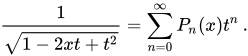
生成関数による定義 ルジャンドル多項式は、生成関数 の べき乗の形式展開における係数として定義することもできる [1] t {\displaystyle t}
1 1 − 2 x t + t 2 = ∑ n = 0 ∞ P n ( x ) t n . {\displaystyle {\frac {1}{\sqrt {1-2xt+t^{2}}}}=\sum _{n=0}^{\infty }P_{n}(x)t^{n}\,.} 2
の係数は の次数 の 多項式である 。 まで展開すると が 得られる
。 高次の展開は次第に面倒になるが、体系的に行うことは可能であり、これも以下に示す明示的な形式のいずれかにつながる。 t n {\displaystyle t^{n}} x {\displaystyle x} n {\displaystyle n} | x | ≤ 1 {\displaystyle |x|\leq 1} t 1 {\displaystyle t^{1}} P 0 ( x ) = 1 , P 1 ( x ) = x . {\displaystyle P_{0}(x)=1\,,\quad P_{1}(x)=x.}
しかし、テイラー級数 を直接展開しなくても、 より高い を得ることは可能です 。 式 2 は両辺を t について微分し、整理すると次の式が得られます。 式 2 の平方根 の商を その定義に 置き換え、 結果として得られる展開で t のべき乗の 係数を等しくする と、 ボネットの再帰式 が得られます
。 この関係と最初の 2 つの多項式 P 0 と P 1 により、残りはすべて再帰的に生成できます。 P n {\displaystyle P_{n}} x − t 1 − 2 x t + t 2 = ( 1 − 2 x t + t 2 ) ∑ n = 1 ∞ n P n ( x ) t n − 1 . {\displaystyle {\frac {x-t}{\sqrt {1-2xt+t^{2}}}}=\left(1-2xt+t^{2}\right)\sum _{n=1}^{\infty }nP_{n}(x)t^{n-1}\,.} ( n + 1 ) P n + 1 ( x ) = ( 2 n + 1 ) x P n ( x ) − n P n − 1 ( x ) . {\displaystyle (n+1)P_{n+1}(x)=(2n+1)xP_{n}(x)-nP_{n-1}(x)\,.}
生成関数アプローチは、以下で説明するように、静電気学における 多重極展開 に直接関連しており、1782 年にルジャンドルによって多項式が初めて定義された方法です。
微分方程式による定義 3番目の定義はルジャンドルの微分方程式 の解に基づいている 。
( 1 − x 2 ) P n ″ ( x ) − 2 x P n ′ ( x ) + n ( n + 1 ) P n ( x ) = 0. {\displaystyle (1-x^{2})P_{n}''(x)-2xP_{n}'(x)+n(n+1)P_{n}(x)=0.} 1
この 微分方程式は x = ±1 に 正則特異点 を持つ ため、標準的な フロベニウス 法または べき級数 法を使用して解を求める場合、一般に、 原点の周りの級数は | x | < 1でのみ収束します。 n が整数のとき、 x = 1 で正則な 解 P n ( x )は x = −1 でも正則であり、この解の級数は終了しています(つまり、多項式です)。 これらの解の直交性と完全性は 、ストゥルム・リウヴィル理論 の観点から最もよく理解されます。 の代わりに 固有値を使用して 、微分方程式を固有値問題として書き直します 。 これは を持つストゥルム・リウヴィル方程式です 。 d d x ( ( 1 − x 2 ) d d x P ( x ) ) = − λ P ( x ) , {\displaystyle {\frac {d}{dx}}\left(\left(1-x^{2}\right){\frac {d}{dx}}P(x)\right)=-\lambda P(x)\,,} λ {\displaystyle \lambda } n ( n + 1 ) {\displaystyle n(n+1)} p = 1 − x 2 , q = 0 , w = 1 {\displaystyle p=1-x^{2},q=0,w=1}
解が において正則であることを要求すると 、 左辺の 微分作用素は エルミート となる。固有値は n ( n + 1) の形をとり、 となり 、固有関数は となる 。この解の集合の直交性と完全性は、シュトゥルム・リウヴィル理論のより大きな枠組みから直ちに導かれる。 x = ± 1 {\displaystyle x=\pm 1} n = 0 , 1 , 2 , … {\displaystyle n=0,1,2,\ldots } P n ( x ) {\displaystyle P_{n}(x)}
微分方程式には、 第二種ルジャンドル関数という、多項式ではない別の解が存在する。(式 1 )の2パラメータ一般化は ルジャンドルの 一般 微分方程式と 呼ばれ、 ルジャンドル多項式 によって解かれる。 ルジャンドル関数は 、ルジャンドル微分方程式(一般化または非一般)の 非整数 パラメータ解である。 Q n {\displaystyle Q_{n}}
物理的な設定では、 ラプラス方程式 (および関連する 偏微分方程式)を 球面座標 で変数分離して解くときはいつでも、ルジャンドルの微分方程式が自然に生じます 。この観点から、ラプラス演算子の角度部分の固有関数は 球面調和関数 であり、そのルジャンドル多項式は(乗法定数を除いて)極軸の周りの回転で不変のままになる部分集合です。多項式は のように表されます。 ここでは極角です。ルジャンドル多項式へのこのアプローチは、回転対称性との深いつながりを提供します。解析手法を通じて苦労して見つけられるルジャンドル多項式の特性の多く(たとえば加法定理)は、対称性および 群論 の方法を使用するとより簡単に見つけられ 、深い物理的および幾何学的意味を持ちます。 P n ( cos θ ) {\displaystyle P_{n}(\cos \theta )} θ {\displaystyle \theta }
ルジャンドル多項式の特に簡潔な表現は ロドリゲスの公式 で与えられる: P n ( x ) = 1 2 n n ! d n d x n ( x 2 − 1 ) n . {\displaystyle P_{n}(x)={\frac {1}{2^{n}n!}}{\frac {d^{n}}{dx^{n}}}(x^{2}-1)^{n}\,.}
この公式は、の多数の性質を導出することを可能にする 。その中には、以下のような明示的な表現がある。 P n {\displaystyle P_{n}} P n ( x ) = 1 2 n ∑ k = 0 n ( n k ) 2 ( x − 1 ) n − k ( x + 1 ) k , P n ( x ) = ∑ k = 0 n ( n k ) ( n + k k ) ( x − 1 2 ) k , P n ( x ) = 1 2 n ∑ k = 0 ⌊ n / 2 ⌋ ( − 1 ) k ( n k ) ( 2 n − 2 k n ) x n − 2 k , P n ( x ) = 2 n ∑ k = 0 n x k ( n k ) ( n + k − 1 2 n ) , P n ( x ) = 1 2 n ∑ k = ⌈ n / 2 ⌉ n ( − 1 ) k + n ( 2 k ) ! ( 2 k − n ) ! ( n − k ) ! k ! x 2 k − n , P n ( x ) = { 1 π ∫ 0 π ( x + x 2 − 1 ⋅ cos ( t ) ) n d t if | x | > 1 , x n if | x | = 1 , 2 π ⋅ x n ⋅ | x | ⋅ ∫ | x | 1 t − n − 1 t 2 − x 2 ⋅ cos ( n ⋅ arccos ( t ) ) sin ( arccos ( t ) ) d t if 0 < | x | < 1 , ( − 1 ) n / 2 ⋅ 2 − n ⋅ ( n n / 2 ) if x = 0 and n even , 0 if x = 0 and n odd . {\displaystyle {\begin{aligned}P_{n}(x)&={\frac {1}{2^{n}}}\sum _{k=0}^{n}{\binom {n}{k}}^{\!2}(x-1)^{n-k}(x+1)^{k},\\[1ex]P_{n}(x)&=\sum _{k=0}^{n}{\binom {n}{k}}{\binom {n+k}{k}}\left({\frac {x-1}{2}}\right)^{\!k},\\[1ex]P_{n}(x)&={\frac {1}{2^{n}}}\sum _{k=0}^{\left\lfloor n/2\right\rfloor }\left(-1\right)^{k}{\binom {n}{k}}{\binom {2n-2k}{n}}x^{n-2k},\\[1ex]P_{n}(x)&=2^{n}\sum _{k=0}^{n}x^{k}{\binom {n}{k}}{\binom {\frac {n+k-1}{2}}{n}},\\[1ex]P_{n}(x)&={\frac {1}{2^{n}}}\sum _{k=\lceil n/2\rceil }^{n}{\frac {(-1)^{k+n}(2k)!}{(2k-n)!(n-k)!k!}}x^{2k-n},\\[1ex]P_{n}(x)&={\begin{cases}\displaystyle {\frac {1}{\pi }}\int _{0}^{\pi }{\left(x+{\sqrt {x^{2}-1}}\cdot \cos(t)\right)}^{n}\,dt&{\text{if }}|x|>1,\\x^{n}&{\text{if }}|x|=1,\\\displaystyle {\frac {2}{\pi }}\cdot x^{n}\cdot |x|\cdot \int _{|x|}^{1}{\frac {t^{-n-1}}{\sqrt {t^{2}-x^{2}}}}\cdot {\frac {\cos \left(n\cdot \arccos(t)\right)}{\sin \left(\arccos(t)\right)}}\,dt&{\text{if }}0<|x|<1,\\\displaystyle (-1)^{n/2}\cdot 2^{-n}\cdot {\binom {n}{n/2}}&{\text{if }}x=0{\text{ and }}n{\text{ even}},\\0&{\text{if }}x=0{\text{ and }}n{\text{ odd}}.\end{cases}}\end{aligned}}}
多項式をべき級数として表すと 、のべき乗の係数は 再帰を使って計算することもできる。 P n ( x ) = ∑ a n , k x k {\textstyle P_{n}(x)=\sum a_{n,k}x^{k}} x {\displaystyle x}
a n , k = − ( n − k + 2 ) ( n + k − 1 ) k ( k − 1 ) a n , k − 2 . {\displaystyle a_{n,k}=-{\frac {(n-k+2)(n+k-1)}{k(k-1)}}a_{n,k-2}.} または
a n , k = − n + k − 1 n − k a n − 2 , k . {\displaystyle a_{n,k}=-{\frac {n+k-1}{n-k}}a_{n-2,k}.}
ルジャンドル多項式は、2つの定数と の値によって決定されます 。ここで、 が奇数の 場合は、 が 偶数です。 [2] a n , 0 {\textstyle a_{n,0}} a n , 1 {\textstyle a_{n,1}} a n , 0 = 0 {\textstyle a_{n,0}=0} n {\displaystyle n} a n , 1 = 0 {\textstyle a_{n,1}=0} n {\displaystyle n}
4番目の表現では、は 以下の最大の整数 を表します 。5番目の表現も再帰式から直接得られ、ルジャンドル多項式を単純な単項式で表し、 二項係数 の一般化形 を含みます。 ⌊ n / 2 ⌋ {\displaystyle \lfloor n/2\rfloor } n / 2 {\displaystyle n/2}
冪級数表現の反転は [3] [4]
x m = ∑ s = 0 ⌊ m / 2 ⌋ ( 2 m − 4 s + 1 ) ( 2 s + 2 ) ( 2 s + 4 ) ⋯ 2 ⌊ m / 2 ⌋ ( 2 m − 2 s + 1 ) ( 2 m − 2 s − 1 ) ( 2 m − 2 s − 3 ) ⋯ ( 1 + 2 ⌊ ( m + 1 ) / 2 ⌋ ) P m − 2 s ( x ) . {\displaystyle x^{m}=\sum _{s=0}^{\lfloor m/2\rfloor }(2m-4s+1){\frac {(2s+2)(2s+4)\cdots 2\lfloor m/2\rfloor }{(2m-2s+1)(2m-2s-1)(2m-2s-3)\cdots (1+2\lfloor (m+1)/2\rfloor )}}P_{m-2s}(x).}
の場合 、分子 の空積 (最後の因数が最初の因数より小さい)は 1 と評価されます。 m = 0 , 1 , 2 , … {\displaystyle m=0,1,2,\ldots }
最初のいくつかのルジャンドル多項式は次のとおりです。
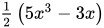
n {\displaystyle n} P n ( x ) {\displaystyle P_{n}(x)} 0 1 {\textstyle 1} 1 x {\textstyle x} 2 1 2 ( 3 x 2 − 1 ) {\textstyle {\tfrac {1}{2}}\left(3x^{2}-1\right)} 3 1 2 ( 5 x 3 − 3 x ) {\textstyle {\tfrac {1}{2}}\left(5x^{3}-3x\right)} 4 1 8 ( 35 x 4 − 30 x 2 + 3 ) {\textstyle {\tfrac {1}{8}}\left(35x^{4}-30x^{2}+3\right)} 5 1 8 ( 63 x 5 − 70 x 3 + 15 x ) {\textstyle {\tfrac {1}{8}}\left(63x^{5}-70x^{3}+15x\right)} 6 1 16 ( 231 x 6 − 315 x 4 + 105 x 2 − 5 ) {\textstyle {\tfrac {1}{16}}\left(231x^{6}-315x^{4}+105x^{2}-5\right)} 7 1 16 ( 429 x 7 − 693 x 5 + 315 x 3 − 35 x ) {\textstyle {\tfrac {1}{16}}\left(429x^{7}-693x^{5}+315x^{3}-35x\right)} 8 1 128 ( 6435 x 8 − 12012 x 6 + 6930 x 4 − 1260 x 2 + 35 ) {\textstyle {\tfrac {1}{128}}\left(6435x^{8}-12012x^{6}+6930x^{4}-1260x^{2}+35\right)} 9 1 128 ( 12155 x 9 − 25740 x 7 + 18018 x 5 − 4620 x 3 + 315 x ) {\textstyle {\tfrac {1}{128}}\left(12155x^{9}-25740x^{7}+18018x^{5}-4620x^{3}+315x\right)} 10 1 256 ( 46189 x 10 − 109395 x 8 + 90090 x 6 − 30030 x 4 + 3465 x 2 − 63 ) {\textstyle {\tfrac {1}{256}}\left(46189x^{10}-109395x^{8}+90090x^{6}-30030x^{4}+3465x^{2}-63\right)}
これらの多項式のグラフ( n = 5 まで)を以下に示します。
最初の 6 つのルジャンドル多項式のプロット。
主な特性
直交性と正規化 標準化は、ルジャンドル多項式の正規化を固定します( 区間 −1 ≤ x ≤ 1における L 2 ノルム に関して )。ロドリゲスの公式を用いて正規化積分を求めることができます。 正規化と直交性の記述は、1つの式で簡潔に表すことができます。 ここで、 δ mn は クロネッカーのデルタ を表します 。 P n ( 1 ) = 1 {\displaystyle P_{n}(1)=1} ∫ − 1 1 P n ( x ) 2 d x = 2 2 n + 1 . {\displaystyle \int _{-1}^{1}P_{n}(x)^{2}\,dx={\frac {2}{2n+1}}.} ∫ − 1 1 P m ( x ) P n ( x ) d x = 2 2 n + 1 δ m n , {\displaystyle \int _{-1}^{1}P_{m}(x)P_{n}(x)\,dx={\frac {2}{2n+1}}\delta _{mn},}
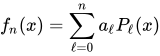
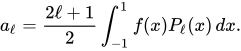
完全 多項式が完全であるということは、次のことを意味する。 区間 [−1, 1]に有限個の不連続点を持つ 任意の区分 連続関数が与えられた とき 、和の列は 平均で に収束する 。ただし、 f ( x ) {\displaystyle f(x)} f n ( x ) = ∑ ℓ = 0 n a ℓ P ℓ ( x ) {\displaystyle f_{n}(x)=\sum _{\ell =0}^{n}a_{\ell }P_{\ell }(x)} f ( x ) {\displaystyle f(x)} n → ∞ {\displaystyle n\to \infty } a ℓ = 2 ℓ + 1 2 ∫ − 1 1 f ( x ) P ℓ ( x ) d x . {\displaystyle a_{\ell }={\frac {2\ell +1}{2}}\int _{-1}^{1}f(x)P_{\ell }(x)\,dx.}
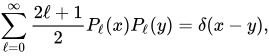
この完全性プロパティは、この記事で説明するすべての展開の基礎となり、多くの場合、 −1 ≤ x ≤ 1 および −1 ≤ y ≤ 1 の形式
で表現されます 。 ∑ ℓ = 0 ∞ 2 ℓ + 1 2 P ℓ ( x ) P ℓ ( y ) = δ ( x − y ) , {\displaystyle \sum _{\ell =0}^{\infty }{\frac {2\ell +1}{2}}P_{\ell }(x)P_{\ell }(y)=\delta (x-y),}
アプリケーション
逆距離ポテンシャルの拡大 ルジャンドル多項式は、 ニュートン力学ポテンシャル の展開における係数として、 1782年に アドリアン・マリー・ルジャンドル [5] によって初めて導入されました。
ここで 、r と r ′ はそれぞれ ベクトル x と x ′の長さ、 γ はこれら2つのベクトル間の角度です。この級数は r > r ′のときに収束します。この式は、 質点 に関連する 重力ポテンシャル 、または 点電荷 に関連する クーロンポテンシャル を与えます 。ルジャンドル多項式を用いた展開は、例えば、この式を連続的な質量分布や電荷分布にわたって積分する場合に役立ちます。 1 | x − x ′ | = 1 r 2 + r ′ 2 − 2 r r ′ cos γ = ∑ ℓ = 0 ∞ r ′ ℓ r ℓ + 1 P ℓ ( cos γ ) , {\displaystyle {\frac {1}{\left|\mathbf {x} -\mathbf {x} '\right|}}={\frac {1}{\sqrt {r^{2}+{r'}^{2}-2r{r'}\cos \gamma }}}=\sum _{\ell =0}^{\infty }{\frac {{r'}^{\ell }}{r^{\ell +1}}}P_{\ell }(\cos \gamma ),}
ルジャンドル多項式は、 電荷 のない空間領域における ラプラス方程式 の静的 ポテンシャル ∇ 2 Φ( x ) = 0の解に、 変数分離 法を用いて現れる。この場合、 境界条件は軸対称性を持つ( 方位角 に依存しない )。ここで 、ẑ は対称軸、 θは観測者の位置と ẑ 軸(天頂角)の間の角度である 。ポテンシャルの解は、 Φ ( r , θ ) = ∑ ℓ = 0 ∞ ( A ℓ r ℓ + B ℓ r − ( ℓ + 1 ) ) P ℓ ( cos θ ) . {\displaystyle \Phi (r,\theta )=\sum _{\ell =0}^{\infty }\left(A_{\ell }r^{\ell }+B_{\ell }r^{-(\ell +1)}\right)P_{\ell }(\cos \theta )\,.}
A l と B l は各問題の境界条件に応じて決定される。 [6]
これらは、中心力について 3 次元の シュレーディンガー方程式 を解くときにも現れます。
多重極展開において 電位の多重極展開の図。 ルジャンドル多項式は、(前述と同じで、少し書き方が異なりますが)形式の関数を展開する際にも役立ちます。
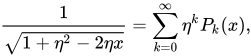
これは 多重極展開 で自然に生じます 。方程式の左辺は、ルジャンドル多項式の 生成関数 です。 1 1 + η 2 − 2 η x = ∑ k = 0 ∞ η k P k ( x ) , {\displaystyle {\frac {1}{\sqrt {1+\eta ^{2}-2\eta x}}}=\sum _{k=0}^{\infty }\eta ^{k}P_{k}(x),}
例えば、 z = a (右図参照) の z 軸上の 点電荷 による 電位 Φ( r , θ ) ( 球座標)は次のように変化する。 Φ ( r , θ ) ∝ 1 R = 1 r 2 + a 2 − 2 a r cos θ . {\displaystyle \Phi (r,\theta )\propto {\frac {1}{R}}={\frac {1}{\sqrt {r^{2}+a^{2}-2ar\cos \theta }}}.}
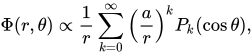
観測点 P の半径 rが a より大きい場合 、ポテンシャルはルジャンドル多項式で展開される可能性があり 、 η = Φ ( r , θ ) ∝ 1 r ∑ k = 0 ∞ ( a r ) k P k ( cos θ ) , {\displaystyle \Phi (r,\theta )\propto {\frac {1}{r}}\sum _{k=0}^{\infty }\left({\frac {a}{r}}\right)^{k}P_{k}(\cos \theta ),} 1つの / r < 1 かつ x = cos θ 。この展開は、通常の 多重極展開 を展開するために使用されます。
逆に、観測点 P の半径 rが a より小さい場合 、ポテンシャルは上記と同様にルジャンドル多項式で展開できるが、 a と r は入れ替えられる。この展開は内部多重極展開の基礎となる。
三角法では 三角関数 cos nθ は 、チェビシェフ多項式 T n (cos θ ) ≡ cos nθ とも表記され 、ルジャンドル多項式 P n (cos θ ) によって多重極展開することもできる。最初のいくつかの次数は以下の通りである。 T 0 ( cos θ ) = 1 = P 0 ( cos θ ) , T 1 ( cos θ ) = cos θ = P 1 ( cos θ ) , T 2 ( cos θ ) = cos 2 θ = 1 3 ( 4 P 2 ( cos θ ) − P 0 ( cos θ ) ) , T 3 ( cos θ ) = cos 3 θ = 1 5 ( 8 P 3 ( cos θ ) − 3 P 1 ( cos θ ) ) , T 4 ( cos θ ) = cos 4 θ = 1 105 ( 192 P 4 ( cos θ ) − 80 P 2 ( cos θ ) − 7 P 0 ( cos θ ) ) , T 5 ( cos θ ) = cos 5 θ = 1 63 ( 128 P 5 ( cos θ ) − 56 P 3 ( cos θ ) − 9 P 1 ( cos θ ) ) , T 6 ( cos θ ) = cos 6 θ = 1 1155 ( 2560 P 6 ( cos θ ) − 1152 P 4 ( cos θ ) − 220 P 2 ( cos θ ) − 33 P 0 ( cos θ ) ) . {\displaystyle {\begin{alignedat}{2}T_{0}(\cos \theta )&=1&&=P_{0}(\cos \theta ),\\[4pt]T_{1}(\cos \theta )&=\cos \theta &&=P_{1}(\cos \theta ),\\[4pt]T_{2}(\cos \theta )&=\cos 2\theta &&={\tfrac {1}{3}}{\bigl (}4P_{2}(\cos \theta )-P_{0}(\cos \theta ){\bigr )},\\[4pt]T_{3}(\cos \theta )&=\cos 3\theta &&={\tfrac {1}{5}}{\bigl (}8P_{3}(\cos \theta )-3P_{1}(\cos \theta ){\bigr )},\\[4pt]T_{4}(\cos \theta )&=\cos 4\theta &&={\tfrac {1}{105}}{\bigl (}192P_{4}(\cos \theta )-80P_{2}(\cos \theta )-7P_{0}(\cos \theta ){\bigr )},\\[4pt]T_{5}(\cos \theta )&=\cos 5\theta &&={\tfrac {1}{63}}{\bigl (}128P_{5}(\cos \theta )-56P_{3}(\cos \theta )-9P_{1}(\cos \theta ){\bigr )},\\[4pt]T_{6}(\cos \theta )&=\cos 6\theta &&={\tfrac {1}{1155}}{\bigl (}2560P_{6}(\cos \theta )-1152P_{4}(\cos \theta )-220P_{2}(\cos \theta )-33P_{0}(\cos \theta ){\bigr )}.\end{alignedat}}}
これをまとめると 、 n > 0 {\displaystyle n>0}
T n ( x ) = 2 2 n − n ′ n ^ ! ∑ t = 0 n ^ ( n − 2 t + 1 / 2 ) ( n − t − 1 ) ! 2 2 t t ! ( n − 1 ) ! × ( − 1 ) ⋅ 1 ⋅ 3 ⋯ ( 2 t − 3 ) ( 1 + 2 n ′ ) ( 3 + 2 n ′ ) ⋯ ( 2 n − 2 t + 1 ) P n − 2 t ( x ) . {\displaystyle T_{n}(x)=2^{2n-n'}{\hat {n}}!\sum _{t=0}^{\hat {n}}(n-2t+1/2){\frac {(n-t-1)!}{2^{2t}t!(n-1)!}}\times {\frac {(-1)\cdot 1\cdot 3\cdots (2t-3)}{(1+2n')(3+2n')\cdots (2n-2t+1)}}P_{n-2t}(x).}
ここで 、、、 および、分子と分母のステップが 2 である積は、空の場合、つまり最後の因数が最初の因数よりも小さい場合は 1 と解釈されます。 n ^ ≡ ⌊ n / 2 ⌋ {\displaystyle {\hat {n}}\equiv \lfloor n/2\rfloor } n ′ ≡ ⌊ ( n + 1 ) / 2 ⌋ {\displaystyle n'\equiv \lfloor (n+1)/2\rfloor }
もう一つの性質はsin ( n + 1) θ の式であり 、 sin ( n + 1 ) θ sin θ = ∑ ℓ = 0 n P ℓ ( cos θ ) P n − ℓ ( cos θ ) . {\displaystyle {\frac {\sin(n+1)\theta }{\sin \theta }}=\sum _{\ell =0}^{n}P_{\ell }(\cos \theta )P_{n-\ell }(\cos \theta ).}
リカレントニューラルネットワークでは d 次元のメモリベクトル を含む リカレント ニューラルネットワークは 、そのニューラル活動が次の 状態空間表現によって与えられる 線形時間不変システム に従うように最適化できます 。 m ∈ R d {\displaystyle \mathbf {m} \in \mathbb {R} ^{d}} θ m ˙ ( t ) = A m ( t ) + B u ( t ) , {\displaystyle \theta {\dot {\mathbf {m} }}(t)=A\mathbf {m} (t)+Bu(t),} A = [ a ] i j ∈ R d × d , a i j = ( 2 i + 1 ) { − 1 i < j ( − 1 ) i − j + 1 i ≥ j , B = [ b ] i ∈ R d × 1 , b i = ( 2 i + 1 ) ( − 1 ) i . {\displaystyle {\begin{aligned}A&=\left[a\right]_{ij}\in \mathbb {R} ^{d\times d}{\text{,}}\quad &&a_{ij}=\left(2i+1\right){\begin{cases}-1&i<j\\(-1)^{i-j+1}&i\geq j\end{cases}},\\B&=\left[b\right]_{i}\in \mathbb {R} ^{d\times 1}{\text{,}}\quad &&b_{i}=(2i+1)(-1)^{i}.\end{aligned}}}
この場合、 過去 の時間単位にわたる のスライディングウィンドウは、 の時点における の要素で重み付けされた 最初のシフトされたルジャンドル多項式の 線形結合 によって 最もよく近似されます 。 u {\displaystyle u} θ {\displaystyle \theta } d {\displaystyle d} m {\displaystyle \mathbf {m} } t {\displaystyle t} u ( t − θ ′ ) ≈ ∑ ℓ = 0 d − 1 P ~ ℓ ( θ ′ θ ) m ℓ ( t ) , 0 ≤ θ ′ ≤ θ . {\displaystyle u(t-\theta ')\approx \sum _{\ell =0}^{d-1}{\widetilde {P}}_{\ell }\left({\frac {\theta '}{\theta }}\right)\,m_{\ell }(t),\quad 0\leq \theta '\leq \theta .}
ディープラーニング 手法と組み合わせることで、これらのネットワークは 、より少ない計算リソースで、 長期短期記憶 ユニットや関連アーキテクチャよりも優れたパフォーマンスを発揮するようにトレーニングすることができます。 [7]
追加のプロパティ ルジャンドル多項式は明確な偶奇性を持つ。つまり
、 偶数か奇数か である 。 [8] P n ( − x ) = ( − 1 ) n P n ( x ) . {\displaystyle P_{n}(-x)=(-1)^{n}P_{n}(x)\,.}
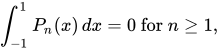
もう一つの有用な性質は、 との直交関係を考慮することで得られる である 。これは、 関数や実験データを近似するためにルジャンドル級数を用いる場合に便利である。区間 [−1, 1] における級数の 平均 は、単に展開係数 によって与えられる 。 ∫ − 1 1 P n ( x ) d x = 0 for n ≥ 1 , {\displaystyle \int _{-1}^{1}P_{n}(x)\,dx=0{\text{ for }}n\geq 1,} P 0 ( x ) = 1 {\displaystyle P_{0}(x)=1} ∑ i a i P i {\textstyle \sum _{i}a_{i}P_{i}} a 0 {\displaystyle a_{0}}
反微分は [9]
∫ P n ( x ) d x = 1 2 n + 1 [ P n + 1 ( x ) − P n − 1 ( x ) ] , n ≥ 1. {\displaystyle \int P_{n}(x)dx={\frac {1}{2n+1}}[P_{n+1}(x)-P_{n-1}(x)],\quad n\geq 1.}
微分方程式と直交性はスケーリングに依存しないため、ルジャンドル多項式の定義は「標準化」(「正規化」と呼ばれることもあるが、実際のノルムは1ではない)され、 P n ( 1 ) = 1 . {\displaystyle P_{n}(1)=1\,.}
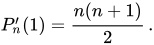
終点における導関数は次のように与えられる。 P n ′ ( 1 ) = n ( n + 1 ) 2 . {\displaystyle P_{n}'(1)={\frac {n(n+1)}{2}}\,.}
製品の拡張は [10]
P m ( x ) P n ( x ) = ∑ r = 0 min ( m , n ) A r A m − r A n − r A m + n − r 2 m + 2 n − 4 r + 1 2 m + 2 n − 2 r + 1 P m + n − 2 r ( x ) {\displaystyle P_{m}(x)P_{n}(x)=\sum _{r=0}^{\min(m,n)}{\frac {A_{r}A_{m-r}A_{n-r}}{A_{m+n-r}}}{\frac {2m+2n-4r+1}{2m+2n-2r+1}}P_{m+n-2r}(x)}
どこ 。 A r ≡ ( 2 r − 1 ) ! ! / r ! {\displaystyle A_{r}\equiv (2r-1)!!/r!}
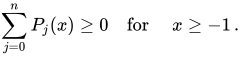
ルジャンドル多項式に対するアスキー・ガスパー不等式は次のように なる 。 ∑ j = 0 n P j ( x ) ≥ 0 for x ≥ − 1 . {\displaystyle \sum _{j=0}^{n}P_{j}(x)\geq 0\quad {\text{for }}\quad x\geq -1\,.}
単位ベクトル の スカラー積 のルジャンドル多項式は、 球面調和関数 を使用して 展開できます。 ここで、単位ベクトル r と r ′ は、それぞれ 球面座標 ( θ 、 φ ) と ( θ ′、 φ ′) を持ちます 。 P ℓ ( r ⋅ r ′ ) = 4 π 2 ℓ + 1 ∑ m = − ℓ ℓ Y ℓ m ( θ , φ ) Y ℓ m ∗ ( θ ′ , φ ′ ) , {\displaystyle P_{\ell }\left(r\cdot r'\right)={\frac {4\pi }{2\ell +1}}\sum _{m=-\ell }^{\ell }Y_{\ell m}(\theta ,\varphi )Y_{\ell m}^{*}(\theta ',\varphi ')\,,}
2つのルジャンドル多項式[11] の積は、 第一種完全楕円積分 で ある 。 ∑ p = 0 ∞ t p P p ( cos θ 1 ) P p ( cos θ 2 ) = 2 π K ( 2 t sin θ 1 sin θ 2 t 2 − 2 t cos ( θ 1 + θ 2 ) + 1 ) t 2 − 2 t cos ( θ 1 + θ 2 ) + 1 , {\displaystyle \sum _{p=0}^{\infty }t^{p}P_{p}(\cos \theta _{1})P_{p}(\cos \theta _{2})={\frac {2}{\pi }}{\frac {\mathbf {K} \left(2{\sqrt {\frac {t\sin \theta _{1}\sin \theta _{2}}{t^{2}-2t\cos \left(\theta _{1}+\theta _{2}\right)+1}}}\right)}{\sqrt {t^{2}-2t\cos \left(\theta _{1}+\theta _{2}\right)+1}}}\,,} K ( ⋅ ) {\displaystyle K(\cdot )}
ディリクレ・メーラーの公式: [12] [13] [14] : 86、式4.8.6、式4.8.7 [15] は、ルジャンドル多項式にも一般化されている。 [16] [17] P n ( cos θ ) = 2 π ∫ 0 θ cos ( n + 1 2 ) ϕ ( 2 cos ϕ − 2 cos θ ) 1 2 d ϕ = 2 π ∫ θ π sin ( n + 1 2 ) ϕ ( 2 cos θ − 2 cos ϕ ) 1 2 d ϕ {\displaystyle P_{n}(\cos \theta )={\frac {2}{\pi }}\int _{0}^{\theta }{\frac {\cos \left(n+{\frac {1}{2}}\right)\phi }{(2\cos \phi -2\cos \theta )^{\frac {1}{2}}}}d\phi ={\frac {2}{\pi }}\int _{\theta }^{\pi }{\frac {\sin \left(n+{\frac {1}{2}}\right)\phi }{(2\cos \theta -2\cos \phi )^{\frac {1}{2}}}}d\phi }
フーリエ・ルジャンドル級数: [18] ここで 第一種ベッセル関数 である 。 e i t x = ∑ n = 0 ∞ ( 2 n + 1 ) i n π 2 t J n + 1 2 ( t ) P n ( x ) {\displaystyle e^{itx}=\sum _{n=0}^{\infty }(2n+1)i^{n}{\sqrt {\frac {\pi }{2t}}}J_{n+{\frac {1}{2}}}(t)P_{n}(x)} J {\displaystyle J}
再帰関係 上で述べたように、ルジャンドル多項式は、ボネの再帰式として知られる3項再帰関係に従う。これは
、 また 、別の表現で、端点においても成り立つ。 ( n + 1 ) P n + 1 ( x ) = ( 2 n + 1 ) x P n ( x ) − n P n − 1 ( x ) {\displaystyle (n+1)P_{n+1}(x)=(2n+1)xP_{n}(x)-nP_{n-1}(x)} x 2 − 1 n d d x P n ( x ) = x P n ( x ) − P n − 1 ( x ) {\displaystyle {\frac {x^{2}-1}{n}}{\frac {d}{dx}}P_{n}(x)=xP_{n}(x)-P_{n-1}(x)} d d x P n + 1 ( x ) = ( n + 1 ) P n ( x ) + x d d x P n ( x ) . {\displaystyle {\frac {d}{dx}}P_{n+1}(x)=(n+1)P_{n}(x)+x{\frac {d}{dx}}P_{n}(x)\,.}
ルジャンドル多項式の積分に便利なのは ( 2 n + 1 ) P n ( x ) = d d x ( P n + 1 ( x ) − P n − 1 ( x ) ) . {\displaystyle (2n+1)P_{n}(x)={\frac {d}{dx}}{\bigl (}P_{n+1}(x)-P_{n-1}(x){\bigr )}\,.}
上記から、 または等価的
に、 ‖ P n ‖ は区間 −1 ≤ x ≤ 1 上のノルムである
ことがわかる 。より一般的には、すべての次数の微分はルジャンドル多項式の和として表すことができる。 [19] d d x P n + 1 ( x ) = ( 2 n + 1 ) P n ( x ) + ( 2 ( n − 2 ) + 1 ) P n − 2 ( x ) + ( 2 ( n − 4 ) + 1 ) P n − 4 ( x ) + ⋯ {\displaystyle {\frac {d}{dx}}P_{n+1}(x)=(2n+1)P_{n}(x)+{\bigl (}2(n-2)+1{\bigr )}P_{n-2}(x)+{\bigl (}2(n-4)+1{\bigr )}P_{n-4}(x)+\cdots } d d x P n + 1 ( x ) = 2 P n ( x ) ‖ P n ‖ 2 + 2 P n − 2 ( x ) ‖ P n − 2 ‖ 2 + ⋯ {\displaystyle {\frac {d}{dx}}P_{n+1}(x)={\frac {2P_{n}(x)}{\left\|P_{n}\right\|^{2}}}+{\frac {2P_{n-2}(x)}{\left\|P_{n-2}\right\|^{2}}}+\cdots } ‖ P n ‖ = ∫ − 1 1 ( P n ( x ) ) 2 d x = 2 2 n + 1 . {\displaystyle \|P_{n}\|={\sqrt {\int _{-1}^{1}{\bigl (}P_{n}(x){\bigr )}^{2}\,dx}}={\sqrt {\frac {2}{2n+1}}}\,.} d q d x q P q + 2 j ( x ) = 2 q − 1 ( q − 1 ) ! ∑ i = 0 j ( 4 i + 1 ) ( q + j − i − 1 ) ! Γ ( q + j + i + 1 2 ) ( j − i ) ! Γ ( j + i + 3 / 2 ) P 2 i ( x ) = 1 2 q − 2 ( q − 1 ) ! ∑ i = 0 j ( 4 i + 1 ) ( q + j − i − 1 ) ! ( 2 q + 2 j + 2 i − 1 ) ! ( j − i ) ! ( 2 j + 2 i + 2 ) ! ( j + i + 1 ) ! ( q + j + i − 1 ) ! P 2 i ( x ) d q d x q P q + 2 j + 1 ( x ) = 2 q − 1 ( q − 1 ) ! ∑ i = 0 j ( 4 i + 3 ) ( q + j − i − 1 ) ! Γ ( q + j + i + 3 / 2 ) ( j − i ) ! Γ ( j + i + 5 / 2 ) P 2 i + 1 ( x ) = 1 2 q − 2 ( q − 1 ) ! ∑ i = 0 j ( 4 i + 3 ) ( q + j − i − 1 ) ! ( 2 q + 2 j + 2 i + 1 ) ! ( j − i ) ! ( 2 j + 2 i + 4 ) ! ( j + i + 2 ) ! ( q + j + i ) ! P 2 i + 1 ( x ) {\displaystyle {\begin{aligned}&{\begin{aligned}&{\frac {d^{q}}{dx^{q}}}P_{q+2j}(x)={\frac {2^{q-1}}{(q-1)!}}\sum _{i=0}^{j}(4i+1){\frac {(q+j-i-1)!\Gamma \left(q+j+i+{\frac {1}{2}}\right)}{(j-i)!\Gamma (j+i+3/2)}}P_{2i}(x)\\&\quad ={\frac {1}{2^{q-2}(q-1)!}}\sum _{i=0}^{j}(4i+1){\frac {(q+j-i-1)!(2q+2j+2i-1)!}{(j-i)!(2j+2i+2)!}}{\frac {(j+i+1)!}{(q+j+i-1)!}}P_{2i}(x)\end{aligned}}\\&{\begin{aligned}&{\frac {d^{q}}{dx^{q}}}P_{q+2j+1}(x)={\frac {2^{q-1}}{(q-1)!}}\sum _{i=0}^{j}(4i+3){\frac {(q+j-i-1)!\Gamma (q+j+i+3/2)}{(j-i)!\Gamma (j+i+5/2)}}P_{2i+1}(x)\\&\quad ={\frac {1}{2^{q-2}(q-1)!}}\sum _{i=0}^{j}(4i+3){\frac {(q+j-i-1)!(2q+2j+2i+1)!}{(j-i)!(2j+2i+4)!}}{\frac {(j+i+2)!}{(q+j+i)!}}P_{2i+1}(x)\end{aligned}}\end{aligned}}}
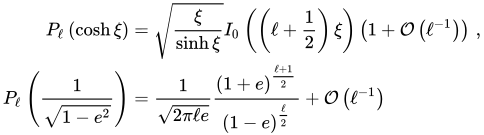
漸近解析 漸近的に、 に対して 、ルジャンドル多項式は ヒルブの公式 として表すことができます: [14] : 194、定理8.21.2 および より大きい引数に対して [20] となります。
ここで、 J 0 、 J 1 、および I 0 はベッセル関数 です 。 ℓ → ∞ {\displaystyle \ell \to \infty } P ℓ ( cos θ ) = θ sin ( θ ) { J 0 [ ( ℓ + 1 2 ) θ ] − ( 1 θ − cot θ ) 8 ( ℓ + 1 2 ) J 1 [ ( ℓ + 1 2 ) θ ] } + O ( ℓ − 2 ) = 2 π ℓ sin ( θ ) cos [ ( ℓ + 1 2 ) θ − π 4 ] + O ( ℓ − 3 / 2 ) , θ ∈ ( 0 , π ) , {\displaystyle {\begin{aligned}P_{\ell }(\cos \theta )&={\sqrt {\frac {\theta }{\sin \left(\theta \right)}}}\left\{J_{0}{\left[\left(\ell +{\tfrac {1}{2}}\right)\theta \right]}-{\frac {\left({\frac {1}{\theta }}-\cot \theta \right)}{8(\ell +{\frac {1}{2}})}}J_{1}{\left[\left(\ell +{\tfrac {1}{2}}\right)\theta \right]}\right\}+{\mathcal {O}}\left(\ell ^{-2}\right)\\[1ex]&={\sqrt {\frac {2}{\pi \ell \sin \left(\theta \right)}}}\cos \left[\left(\ell +{\tfrac {1}{2}}\right)\theta -{\tfrac {\pi }{4}}\right]+{\mathcal {O}}\left(\ell ^{-3/2}\right),\quad \theta \in (0,\pi ),\end{aligned}}} P ℓ ( cosh ξ ) = ξ sinh ξ I 0 ( ( ℓ + 1 2 ) ξ ) ( 1 + O ( ℓ − 1 ) ) , P ℓ ( 1 1 − e 2 ) = 1 2 π ℓ e ( 1 + e ) ℓ + 1 2 ( 1 − e ) ℓ 2 + O ( ℓ − 1 ) {\displaystyle {\begin{aligned}P_{\ell }\left(\cosh \xi \right)&={\sqrt {\frac {\xi }{\sinh \xi }}}I_{0}\left(\left(\ell +{\frac {1}{2}}\right)\xi \right)\left(1+{\mathcal {O}}\left(\ell ^{-1}\right)\right)\,,\\P_{\ell }\left({\frac {1}{\sqrt {1-e^{2}}}}\right)&={\frac {1}{\sqrt {2\pi \ell e}}}{\frac {(1+e)^{\frac {\ell +1}{2}}}{(1-e)^{\frac {\ell }{2}}}}+{\mathcal {O}}\left(\ell ^{-1}\right)\end{aligned}}}
ゼロ のすべての 零点は 実数で、互いに異なり、区間 内にあります 。さらに、これらを区間を 部分区間 に分割するものとみなすと、各部分区間には の零点がちょうど1つ含まれます。これはインターレース性として知られています。パリティ性により、 が の零点であれば も の零 点であることは明らかです。これらの零点は、 ガウス積分法 に基づく 数値積分 において重要な役割を果たします 。 の に基づく特定の積分法は、 ガウス・ルジャンドル積分法 として知られています 。 n {\displaystyle n} P n ( x ) {\displaystyle P_{n}(x)} ( − 1 , 1 ) {\displaystyle (-1,1)} [ − 1 , 1 ] {\displaystyle [-1,1]} n + 1 {\displaystyle n+1} P n + 1 {\displaystyle P_{n+1}} x k {\displaystyle x_{k}} P n ( x ) {\displaystyle P_{n}(x)} − x k {\displaystyle -x_{k}} P n {\displaystyle P_{n}}
の零点は の範囲にわたってほぼ均一に分布しており、 ごとに 1つの零点があるという意味である 。 [21] これはディリクレ・メーラーの第一公式を見ることで証明できる。 [22] P n ( cos θ ) {\displaystyle P_{n}(\cos \theta )} θ ∈ ( 0 , π ) {\displaystyle \theta \in (0,\pi )} θ ∈ ( π ( k + 1 / 2 ) n + 1 / 2 , π ( k + 1 ) n + 1 / 2 ) {\displaystyle \theta \in \left({\frac {\pi (k+1/2)}{n+1/2}},{\frac {\pi (k+1)}{n+1/2}}\right)} k = 0 , 1 , … , n − 1 {\displaystyle k=0,1,\dots ,n-1}
この性質と という事実から、 は において極小値と極大値を 持つ ことがわかります 。同様に、は においてゼロを 持ちます 。 P n ( ± 1 ) ≠ 0 {\displaystyle P_{n}(\pm 1)\neq 0} P n ( x ) {\displaystyle P_{n}(x)} n − 1 {\displaystyle n-1} ( − 1 , 1 ) {\displaystyle (-1,1)} d P n ( x ) / d x {\displaystyle dP_{n}(x)/dx} n − 1 {\displaystyle n-1} ( − 1 , 1 ) {\displaystyle (-1,1)}
ポイントごとの評価 パリティと正規化により、境界における値は 次のように
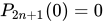
表される。 原点においては 、値は次のように表される。 x = ± 1 {\displaystyle x=\pm 1} P n ( 1 ) = 1 , P n ( − 1 ) = ( − 1 ) n {\displaystyle P_{n}(1)=1\,,\quad P_{n}(-1)=(-1)^{n}} x = 0 {\displaystyle x=0} P 2 n ( 0 ) = ( − 1 ) n 4 n ( 2 n n ) = ( − 1 ) n 2 2 n ( 2 n ) ! ( n ! ) 2 = ( − 1 ) n ( 2 n − 1 ) ! ! ( 2 n ) ! ! {\displaystyle P_{2n}(0)={\frac {(-1)^{n}}{4^{n}}}{\binom {2n}{n}}={\frac {(-1)^{n}}{2^{2n}}}{\frac {(2n)!}{\left(n!\right)^{2}}}=(-1)^{n}{\frac {(2n-1)!!}{(2n)!!}}} P 2 n + 1 ( 0 ) = 0 {\displaystyle P_{2n+1}(0)=0}
シフトルジャンドル多項式 シフトされたルジャンドル多項式は 次 のように定義されます。 ここで、「シフト」関数 x ↦ 2 x − 1 は 区間 [0, 1] を区間 [−1, 1]に 全単射に写像する アフィン変換 であり 、多項式 P̃ n ( x )が [0, 1] で直交することを意味します 。 P ~ n ( x ) = P n ( 2 x − 1 ) . {\displaystyle {\widetilde {P}}_{n}(x)=P_{n}(2x-1)\,.} ∫ 0 1 P ~ m ( x ) P ~ n ( x ) d x = 1 2 n + 1 δ m n . {\displaystyle \int _{0}^{1}{\widetilde {P}}_{m}(x){\widetilde {P}}_{n}(x)\,dx={\frac {1}{2n+1}}\delta _{mn}\,.}
シフトされたルジャンドル多項式の明示的な表現は次のように与えられる。 P ~ n ( x ) = ( − 1 ) n ∑ k = 0 n ( n k ) ( n + k k ) ( − x ) k . {\displaystyle {\widetilde {P}}_{n}(x)=(-1)^{n}\sum _{k=0}^{n}{\binom {n}{k}}{\binom {n+k}{k}}(-x)^{k}\,.}
シフトされたルジャンドル多項式に対する ロドリゲスの公式 の類似は P ~ n ( x ) = 1 n ! d n d x n ( x 2 − x ) n . {\displaystyle {\widetilde {P}}_{n}(x)={\frac {1}{n!}}{\frac {d^{n}}{dx^{n}}}\left(x^{2}-x\right)^{n}\,.}
最初のいくつかのシフトされたルジャンドル多項式は次のとおりです。
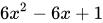
n {\displaystyle n} P ~ n ( x ) {\displaystyle {\widetilde {P}}_{n}(x)} 0 1 {\displaystyle 1} 1 2 x − 1 {\displaystyle 2x-1} 2 6 x 2 − 6 x + 1 {\displaystyle 6x^{2}-6x+1} 3 20 x 3 − 30 x 2 + 12 x − 1 {\displaystyle 20x^{3}-30x^{2}+12x-1} 4 70 x 4 − 140 x 3 + 90 x 2 − 20 x + 1 {\displaystyle 70x^{4}-140x^{3}+90x^{2}-20x+1} 5 252 x 5 − 630 x 4 + 560 x 3 − 210 x 2 + 30 x − 1 {\displaystyle 252x^{5}-630x^{4}+560x^{3}-210x^{2}+30x-1}
ルジャンドル有理関数 ルジャンドル 有理関数は、[0, ∞)上の 直交関数 の列である。ルジャンドル多項式と ケーリー変換を 組み合わせることで得られる 。
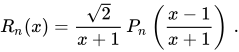
n 次の有理ルジャンドル関数 は次のように定義されます。 R n ( x ) = 2 x + 1 P n ( x − 1 x + 1 ) . {\displaystyle R_{n}(x)={\frac {\sqrt {2}}{x+1}}\,P_{n}\left({\frac {x-1}{x+1}}\right)\,.}
これらは 、 特異 シュトゥルム・リウヴィル問題の 固有関数 であり、固有値は ( x + 1 ) d d x ( x d d x [ ( x + 1 ) v ( x ) ] ) + λ v ( x ) = 0 {\displaystyle \left(x+1\right){\frac {d}{dx}}\left(x{\frac {d}{dx}}\left[\left(x+1\right)v(x)\right]\right)+\lambda v(x)=0} λ n = n ( n + 1 ) . {\displaystyle \lambda _{n}=n(n+1)\,.}
参照
注記 ^ アルフケン&ウェーバー 2005, p.743 ^ Boas, Mary L. (2006). 『物理科学における数学的手法』 (第3版). ホーボーケン, ニュージャージー: Wiley. ISBN 978-0-471-19826-0 。 ^ マグナス、ヴィルヘルム;オーバーヘッティンガー、フリッツ (1943)。 フォルメルンとサッツェの毛皮は、数学物理学の特別な機能を備えています 。アインゼルダーシュテルルンゲンの Die Grundlehren der mathematischen Wissenschaften。 Vol. 52.スプリンガー。 ISBN 978-3-662-41656-3 . MR 0022272. OCLC 1026897547. ^ Gradshteyn, IS; Ryzhik, IM (2015). 積分、級数、積の表 . Elsevier. ISBN 978-0-12-384933-5 . MR 3307944。 ^ ルジャンドル、A.-M. (1785) [1782]。 「球状物の均質性の魅力に関する研究」 (PDF) 。 Mémoires de Mathématiques et de Physique、présentés à l'Académie Royale des Sciences、par divers savans、et lus dans ses Assemblées (フランス語)。 Vol. X.パリ。 pp. 411–435。2009 年 9 月 20 日のオリジナル (PDF) からアーカイブ。 ^ ジャクソン、JD (1999). 古典電気力学 (第3版). Wiley & Sons. p. 103. ISBN 978-0-471-30932-1 。 {{cite book }}: CS1 maint: location missing publisher (link )^ Voelker, Aaron R.; Kajić, Ivana; Eliasmith, Chris (2019). ルジャンドル記憶単位:リカレントニューラルネットワークにおける連続時間表現 (PDF) . ニューラル情報処理システムの進歩. ^ アルフケン&ウェーバー 2005, p.753 ^ Ciftja, Orion (2022). 「半値域におけるルジャンドル多項式の積分と半球形状における静電ポテンシャルとの関係」. Results in Physics . 40 105838. Bibcode :2022ResPh..4005838C. doi : 10.1016/j.rinp.2022.105838 . ^ Carlitz, L. (1961). 「ルジャンドル多項式の積を含む積分」. Archiv Mathem . 12 : 334–340 . doi :10.1007/BF01650571. ^ レナード・C・マキシモン (1957)。 「2 つのルジャンドル多項式の積の生成関数」。 Norske Videnskabers Selskab Forhandlinger 。 29 : 82~ 86。 ^ "シリーズ全体は、一般的な角度に依存せず、機能の解釈を決定するために使用されます。" . Journal für die reine und angewandte Mathematik (Crelles Journal) 。 1837 (17): 35–56。1837 年 7 月 1 日。doi : 10.1515/crll.1837.17.35。 ISSN 0075-4102。 ^ メーラー、FG (1881 年 6 月)。 「クーゲルとシリンダー機能を組み合わせて、電気理論における関数と情報を分析します 。 」 Mathematische Annalen (ドイツ語)。 18 (2): 161–194 。 土井 :10.1007/BF01445847。 ISSN 0025-5831。 ^ ab セーグー、ガボール (1975)。 直交多項式 (第 4 版)。プロビデンス: アメリカ数学協会。 ISBN 0-8218-1023-5 . OCLC 1683237。 ^ 「DLMF: §18.10 積分表現 ‣ 古典直交多項式 ‣ 第18章 直交多項式」. dlmf.nist.gov . 2025年 3月18日 閲覧 。 ^ 「II. 次数、順序、引数に制限のない球面調和関数の一種について」. ロンドン王立協会紀要 . 59 ( 353–358 ): 189–196 . 1896年12月31日. doi :10.1098/rspl.1895.0075. ISSN 0370-1662. ^ Gasper, George (1975), Ross, Bertram (ed.), "Formulas of the dirichlet-mehler type" , Fractional Calculus and Its Applications , Lecture Notes in Mathematics, vol. 457, Berlin, Heidelberg: Springer Berlin Heidelberg, pp. 207– 215, doi :10.1007/bfb0067105, ISBN 978-3-540-07161-7 、 2025年3月18日 取得 ^ レイリー卿『音響理論』第2巻、273ページ ^ Doha, EH (1991-01-01). 「超球面多項式の微分展開と導関数の係数」. Computers & Mathematics with Applications . 21 (2): 115– 122. doi :10.1016/0898-1221(91)90089-M. ISSN 0898-1221. ^ 「DLMF: 14.15 一様漸近近似」。 ^ Askey, Richard (1969年11月). 「P_n (cos θ) のメーラー積分」 . アメリカ数学月刊誌 . 76 (9): 1046–1049 . doi :10.1080/00029890.1969.12000407. ISSN 0002-9890. ^ ブランズ、H. (1881)。 「クーゲル機能の理論」 。 CRLL 。 1881 (90): 322–328。doi : 10.1515 /crll.1881.90.322。 ISSN 1435-5345。
参考文献 アブラモウィッツ、ミルトン 、 ステガン、アイリーン・アン 編 (1983) [1964年6月]。「第8章」。 『数式、グラフ、数表付き数学関数ハンドブック』 。応用数学シリーズ。第55巻(1972年12月発行の第10刷に訂正を加えた第9刷、初版)。ワシントンD.C.、ニューヨーク:米国商務省国立標準局、ドーバー出版。332、773頁 。ISBN 978-0-486-61272-0 LCCN 64-60036. MR 0167642. LCCN 65-12253 . 第22章も参照してください。 アーフケン, ジョージ・B. ; ウェーバー, ハンス・J. (2005). 物理学者のための数学的手法 . エルゼビア・アカデミック・プレス. ISBN 0-12-059876-0 。 Bayin, SS (2006). 科学と工学における数学的手法 . Wiley. 第2章. ISBN 978-0-470-04142-0 。 ベルーソフ, SL (1962). 正規化準ルジャンドル多項式表 . 数学表. 第18巻. ペルガモン出版. ISBN 978-0-08-009723-7 。 クーラント、リチャード 、 ヒルベルト、デイヴィッド (1953). 『数理物理学の方法 』第1巻. ニューヨーク、ニューヨーク: インターサイエンス. ISBN 978-0-471-50447-4 。 Dunster, TM (2010)、「Legendre and Related Functions」、 Olver, Frank WJ ; Lozier, Daniel M.; Boisvert, Ronald F.; Clark, Charles W. (eds.)、 NIST Handbook of Mathematical Functions 、Cambridge University Press、 ISBN 978-0-521-19225-5 、 MR 2723248 。 El Attar, Refaat (2009). ルジャンドル多項式と関数 . CreateSpace. ISBN 978-1-4414-9012-4 。 Koornwinder, Tom H. ; Wong, Roderick SC; Koekoek, Roelof; Swarttouw, René F. (2010)「直交多項式」、 Olver, Frank WJ ; Lozier, Daniel M.; Boisvert, Ronald F.; Clark, Charles W. (eds.)、 NIST Handbook of Mathematical Functions 、Cambridge University Press、 ISBN 978-0-521-19225-5 、 MR 2723248 。
外部リンク ウィキメディア・コモンズには、ルジャンドル多項式 に関連するメディアがあります 。
水素の量子力学の文脈におけるルジャンドル多項式の簡単な非公式導出 「ルジャンドル多項式」 数学百科事典 、 EMSプレス 、2001 [1994] Wolfram MathWorldのルジャンドル多項式に関するエントリ ジェームズ・B・カルバート博士の個人数学コレクションからのルジャンドル多項式に関する論文 カーライル・E・ムーア著『ルジャンドル多項式』 超物理学からのルジャンドル多項式


![{\displaystyle [-1,1]}](https://wikimedia.org/api/rest_v1/media/math/render/svg/51e3b7f14a6f70e614728c583409a0b9a8b9de01)

















![{\displaystyle {\begin{aligned}P_{n}(x)&={\frac {1}{2^{n}}}\sum _{k=0}^{n}{\binom {n}{k}}^{\!2}(x-1)^{nk}(x+1)^{k},\\[1ex]P_{n}(x)&=\sum _{k=0}^{n}{\binom {n}{k}}{\binom {n+k}{k}}\left({\frac {x-1}{2}}\right)^{\!k},\\[1ex]P_{n}(x)&={\frac {1}{2^{n}}}\sum _{k=0}^{\left\lfloor n/2\right\rfloor }\left(-1\right)^{k}{\binom {n}{k}}{\binom {2n-2k}{n}}x^{n-2k},\\[1ex]P_{n}(x)&=2^{n}\sum _{k=0}^{n}x^{k}{\binom {n}{k}}{\binom {\frac {n+k-1}{2}}{n}},\\[1ex]P_{n}(x)&={\frac {1}{2^{n}}}\sum _{k=\lceil n/2\rceil }^{n}{\frac {(-1)^{k+n}(2k)!}{(2k-n)!(nk)!k!}}x^{2k-n},\\[1ex]P_{n}(x)&={\begin{cases}\displaystyle {\frac {1}{\pi }}\int _{0}^{\pi }{\left(x+{\sqrt {x^{2}-1}}\cdot \cos(t)\right)}^{n}\,dt&{\text{if }}|x|>1、\\x^{n}&{\text{if }}|x|=1、\\\displaystyle {\frac {2}{\pi }}\cdot x^{n}\cdot |x|\cdot \int _{|x|}^{1}{\frac {t^{-n-1}}{\sqrt {t^{2}-x^{2}}}}\cdot {\frac {\cos \left(n\cdot \arccos(t)\right)}{\sin \left(\arccos(t)\right)}}\,dt&{\text{if }}0<|x|<1、\\\displaystyle (-1)^{n/2}\cdot 2^{-n}\cdot {\binom {n}{n/2}}&{\text{if }}x=0{\text{ and }}n{\text{ even}},\\0&{\text{if }}x=0{\text{ and }}n{\text{ odd}}.\end{cases}}\end{aligned}}}](https://wikimedia.org/api/rest_v1/media/math/render/svg/de651ced89283de1a87f20db53eae5b1619974bf)

















![{\displaystyle {\begin{alignedat}{2}T_{0}(\cos \theta )&=1&&=P_{0}(\cos \theta ),\\[4pt]T_{1}(\cos \theta )&=\cos \theta &&=P_{1}(\cos \theta ),\\[4pt]T_{2}(\cos \theta )&=\cos 2\theta &&={\tfrac {1}{3}}{\bigl (}4P_{2}(\cos \theta )-P_{0}(\cos \theta ){\bigr )},\\[4pt]T_{3}(\cos \theta )&=\cos 3\theta &&={\tfrac {1}{5}}{\bigl (}8P_{3}(\cos \theta )-3P_{1}(\cos \theta ){\bigr )},\\[4pt]T_{4}(\cos \theta )&=\cos 4\theta &&={\tfrac {1}{105}}{\bigl (}192P_{4}(\cos \theta )-80P_{2}(\cos \theta )-7P_{0}(\cos \theta ){\bigr )},\\[4pt]T_{5}(\cos \theta )&=\cos 5\theta &&={\tfrac {1}{63}}{\bigl (}128P_{5}(\cos \theta )-56P_{3}(\cos \theta )-9P_{1}(\cos \theta ){\bigr )},\\[4pt]T_{6}(\cos \theta )&=\cos 6\theta &&={\tfrac {1}{1155}}{\bigl (}2560P_{6}(\cos \theta )-1152P_{4}(\cos \theta )-220P_{2}(\cos \theta )-33P_{0}(\cos \theta ){\bigr )}.\end{alignedat}}}](https://wikimedia.org/api/rest_v1/media/math/render/svg/f7e0b02dbbd2db6e0abec28a3b06a823bde40bd7)



![{\displaystyle {\begin{aligned}A&=\left[a\right]_{ij}\in \mathbb {R} ^{d\times d}{\text{,}}\quad &&a_{ij}=\left(2i+1\right){\begin{cases}-1&i<j\\(-1)^{i-j+1}&i\geq j\end{cases}},\\B&=\left[b\right]_{i}\in \mathbb {R} ^{d\times 1}{\text{,}}\quad &&b_{i}=(2i+1)(-1)^{i}.\end{aligned}}}](https://wikimedia.org/api/rest_v1/media/math/render/svg/e2deeca1a4b6b67ef03ce04d77937b944acede3b)





![{\displaystyle \int P_{n}(x)dx={\frac {1}{2n+1}}[P_{n+1}(x)-P_{n-1}(x)],\quad n\geq 1.}](https://wikimedia.org/api/rest_v1/media/math/render/svg/5bb9b400a4602285b7ab5461e6bd358b03e22adb)















![{\displaystyle {\begin{aligned}P_{\ell }(\cos \theta )&={\sqrt {\frac {\theta }{\sin \left(\theta \right)}}}\left\{J_{0}{\left[\left(\ell +{\tfrac {1}{2}}\right)\theta \right]}-{\frac {\left({\frac {1}{\theta }}-\cot \theta \right)}{8(\ell +{\frac {1}{2}})}}J_{1}{\left[\left(\ell +{\tfrac {1}{2}}\right)\theta \right]}\right\}+{\mathcal {O}}\left(\ell ^{-2}\right)\\[1ex]&={\sqrt {\frac {2}{\pi \ell \sin \left(\theta \right)}}}\cos \left[\left(\ell +{\tfrac {1}{2}}\right)\theta -{\tfrac {\pi }{4}}\right]+{\mathcal {O}}\left(\ell ^{-3/2}\right),\quad \theta \in (0,\pi ),\end{aligned}}}](https://wikimedia.org/api/rest_v1/media/math/render/svg/4a3aacc753d52d946f0e9b73eb26496cebf0cc2a)

















![{\displaystyle \left(x+1\right){\frac {d}{dx}}\left(x{\frac {d}{dx}}\left[\left(x+1\right)v(x)\right]\right)+\lambda v(x)=0}](https://wikimedia.org/api/rest_v1/media/math/render/svg/96f71c3d958438966c10eb4e75a55b9e209a8162)



