Idempotent linear transformation from a vector space to itself
変換 P は線分 m へ の 直交投影です 。 線型代数学 と 関数解析 において 、 射影とは ベクトル空間 からそれ自身への 線型変換 ( 自己準同型 ) であり、 を満たす 。つまり、 任意のベクトルに を2回適用すると、1回適用した場合と同じ結果が得られる(つまり、 はべき等性 で ある )。その 像は 変化しない。 [1]この「射影」の定義は、 グラフィカル射影 の概念を形式化し、一般化したものである。また、射影が幾何学的オブジェクトに与える影響は、オブジェクト内の 点 に対する射影の影響を調べることによって考察することもできる 。 P {\displaystyle P} P ∘ P = P {\displaystyle P\circ P=P} P {\displaystyle P} P {\displaystyle P}
定義 ベクトル空間への 射影 は 、 となる 線形演算子です 。 V {\displaystyle V} P : V → V {\displaystyle P\colon V\to V} P 2 = P {\displaystyle P^{2}=P}
が内積を 持ち 、 完備 、すなわち が ヒルベルト空間 である とき、 直交性 の概念を用いることができる。 ヒルベルト空間への 射影は、 すべての に対して を満たすとき、 直交射影 と呼ばれる 。直交しないヒルベルト空間への射影は、 斜射影 と呼ばれる。 V {\displaystyle V} V {\displaystyle V} P {\displaystyle P} V {\displaystyle V} ⟨ P x , y ⟩ = ⟨ x , P y ⟩ {\displaystyle \langle P\mathbf {x} ,\mathbf {y} \rangle =\langle \mathbf {x} ,P\mathbf {y} \rangle } x , y ∈ V {\displaystyle \mathbf {x} ,\mathbf {y} \in V}
投影行列 正方 行列は 、その平方に等しい場合、すなわち の場合、 射影行列 と呼ばれます 。 [2] : p. 38 P {\displaystyle P} P 2 = P {\displaystyle P^{2}=P} 正方行列は、 実行 行列 の 場合には 直交射影行列 と呼ばれ 、 複素 行列の場合にはそれぞれ と呼ばれます 。ここで は の 転置 行列 、 は の随伴転置行列または エルミート転置行列 を表します 。 [2] : p. 223 P {\displaystyle P} P 2 = P = P T {\displaystyle P^{2}=P=P^{\mathrm {T} }} P 2 = P = P ∗ {\displaystyle P^{2}=P=P^{*}} P T {\displaystyle P^{\mathrm {T} }} P {\displaystyle P} P ∗ {\displaystyle P^{*}} P {\displaystyle P} 直交投影行列ではない投影行列を 斜投影行列 と呼びます。 投影行列の固有値は 0 または 1 でなければなりませ ん 。
例
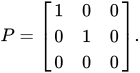
正射影 例えば、 3次元空間の点 を点に写す関数は、 xy 平面への直交射影である 。この関数は行列で表される。 ( x , y , z ) {\displaystyle (x,y,z)} R 3 {\displaystyle \mathbb {R} ^{3}} ( x , y , 0 ) {\displaystyle (x,y,0)} P = [ 1 0 0 0 1 0 0 0 0 ] . {\displaystyle P={\begin{bmatrix}1&0&0\\0&1&0\\0&0&0\end{bmatrix}}.}
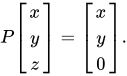
この行列の任意のベクトル への作用 は P [ x y z ] = [ x y 0 ] . {\displaystyle P{\begin{bmatrix}x\\y\\z\end{bmatrix}}={\begin{bmatrix}x\\y\\0\end{bmatrix}}.}
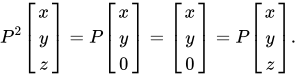
が実際に射影である ことを確認するために、すなわち 、 を計算する。 P {\displaystyle P} P = P 2 {\displaystyle P=P^{2}} P 2 [ x y z ] = P [ x y 0 ] = [ x y 0 ] = P [ x y z ] . {\displaystyle P^{2}{\begin{bmatrix}x\\y\\z\end{bmatrix}}=P{\begin{bmatrix}x\\y\\0\end{bmatrix}}={\begin{bmatrix}x\\y\\0\end{bmatrix}}=P{\begin{bmatrix}x\\y\\z\end{bmatrix}}.}
これを観察すると 、投影が正射影であることがわかります。 P T = P {\displaystyle P^{\mathrm {T} }=P}
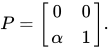
斜投影 非直交(斜交)投影の簡単な例は P = [ 0 0 α 1 ] . {\displaystyle P={\begin{bmatrix}0&0\\\alpha &1\end{bmatrix}}.}
行列の乗算 により、それが 確かに投影である
ことを 示す ことがわかります
。 P 2 = [ 0 0 α 1 ] [ 0 0 α 1 ] = [ 0 0 α 1 ] = P . {\displaystyle P^{2}={\begin{bmatrix}0&0\\\alpha &1\end{bmatrix}}{\begin{bmatrix}0&0\\\alpha &1\end{bmatrix}}={\begin{bmatrix}0&0\\\alpha &1\end{bmatrix}}=P.} P {\displaystyle P}
投影 が直交するの は、その 場合のみである。 P {\displaystyle P} α = 0 {\displaystyle \alpha =0} P T = P . {\displaystyle P^{\mathrm {T} }=P.}
特性と分類 変換 Tは kに沿った m への 射影である 。T の値域 は m 、核は k である。
冪等性 定義により、射影は べき等性 (つまり) があります 。 P {\displaystyle P} P 2 = P {\displaystyle P^{2}=P}
地図を開く すべての投影は その像への 開写像であり、 領域 内の各 開集合を 像 の 部分空間位相 内の開集合に写像することを意味します 。 [ 要出典 ] つまり、任意のベクトルと を中心とする 任意の球体(正の半径を持つ)に対して、 を中心とし、 像 に完全に含まれる球体 (正の半径を持つ) が存在します 。 x {\displaystyle \mathbf {x} } B x {\displaystyle B_{\mathbf {x} }} x {\displaystyle \mathbf {x} } B P x {\displaystyle B_{P\mathbf {x} }} P x {\displaystyle P\mathbf {x} } P ( B x ) {\displaystyle P(B_{\mathbf {x} })}
イメージとカーネルの相補性 を 有限次元ベクトル空間とし、 を への射影とする 。 部分空間 と をそれぞれ の 像 と 核 と 仮定する。すると、 は以下の性質を持つ。 W {\displaystyle W} P {\displaystyle P} W {\displaystyle W} U {\displaystyle U} V {\displaystyle V} P {\displaystyle P} P {\displaystyle P}
P {\displaystyle P} は の 恒等演算子 です : I {\displaystyle I} U {\displaystyle U} ∀ x ∈ U : P x = x . {\displaystyle \forall \mathbf {x} \in U:P\mathbf {x} =\mathbf {x} .} 直和 が成り立ちます 。すべてのベクトルは と を用い て一意に分解でき 、ここで W = U ⊕ V {\displaystyle W=U\oplus V} x ∈ W {\displaystyle \mathbf {x} \in W} x = u + v {\displaystyle \mathbf {x} =\mathbf {u} +\mathbf {v} } u = P x {\displaystyle \mathbf {u} =P\mathbf {x} } v = x − P x = ( I − P ) x {\displaystyle \mathbf {v} =\mathbf {x} -P\mathbf {x} =\left(I-P\right)\mathbf {x} } u ∈ U , v ∈ V . {\displaystyle \mathbf {u} \in U,\mathbf {v} \in V.} 射影 の像と核は 相補的 であり、 と も同様です 。 の像と核は の 核と像になり、その逆もまた同様であるため、 も射影です。 は (核/像) へ の射影であり、 は へ の射影であると 言えます 。 P {\displaystyle P} Q = I − P {\displaystyle Q=I-P} Q {\displaystyle Q} P {\displaystyle P} Q {\displaystyle Q} P {\displaystyle P} V {\displaystyle V} U {\displaystyle U} Q {\displaystyle Q} U {\displaystyle U} V {\displaystyle V}
スペクトラム 無限次元ベクトル空間において、 射影の スペクトル は に含まれます。射影の 固有値は 0 または 1 のみと なります。これは、直交射影が 常に 半正定値行列 で あることを意味します。一般に、対応する 固有空間は 、それぞれ射影の核と値域です。ベクトル空間の直和への分解は一意ではありません。したがって、部分空間 が与えられた場合 、値域(または核)が である射影は多数存在する可能性があります 。 { 0 , 1 } {\displaystyle \{0,1\}} ( λ I − P ) − 1 = 1 λ I + 1 λ ( λ − 1 ) P . {\displaystyle (\lambda I-P)^{-1}={\frac {1}{\lambda }}I+{\frac {1}{\lambda (\lambda -1)}}P.} P {\displaystyle P} V {\displaystyle V} V {\displaystyle V}
射影が自明でない場合は、 最小の多項式 が存在し、これは異なる線形因子に因数分解されるため、 対角化可能 です 。 x 2 − x = x ( x − 1 ) {\displaystyle x^{2}-x=x(x-1)} P {\displaystyle P}
投影の積 射影の積は、たとえ直交していても、一般に射影とはならない。2つの射影が 可換で あれば、それらの積は射影となるが、その 逆 は真である。つまり、2つの可換でない射影の積は、射影となる場合もあれば、そうでない場合もある。
2つの直交射影が可換であれば、それらの積は直交射影となる。2つの直交射影の積が直交射影であれば、2つの直交射影は可換となる(より一般的には、2つの自己随伴自己準 同型 が可換となるのは、それらの積が自己随伴となる場合のみである)。
直交投影 ベクトル空間 が 内積を 持ち 、完備( ヒルベルト空間)である場合、 直交性 の概念を用いることができる。 直交射影 とは、値域 と核が 直交 部分空間 となる 射影である。したがって、における任意の および に対して 、 が成り立つ 。これは等価である。 W {\displaystyle W} U {\displaystyle U} V {\displaystyle V} x {\displaystyle \mathbf {x} } y {\displaystyle \mathbf {y} } W {\displaystyle W} ⟨ P x , ( y − P y ) ⟩ = ⟨ ( x − P x ) , P y ⟩ = 0 {\displaystyle \langle P\mathbf {x} ,(\mathbf {y} -P\mathbf {y} )\rangle =\langle (\mathbf {x} -P\mathbf {x} ),P\mathbf {y} \rangle =0} ⟨ x , P y ⟩ = ⟨ P x , P y ⟩ = ⟨ P x , y ⟩ . {\displaystyle \langle \mathbf {x} ,P\mathbf {y} \rangle =\langle P\mathbf {x} ,P\mathbf {y} \rangle =\langle P\mathbf {x} ,\mathbf {y} \rangle .}
射影が直交する場合、かつその場合のみ、それが 自己随伴で ある。 の自己随伴性とべき等性を用いること で 、 における任意の およびに対して 、 、 、 が
成り立ち、 は に関連付けられた内積である 。したがって、 および は直交射影である。 [3] もう一方の方向、すなわち が直交する場合にそれが自己随伴であるという方向は、 および における任意 の に対してから へ の含意から導かれる 。したがって 。 P {\displaystyle P} x {\displaystyle \mathbf {x} } y {\displaystyle \mathbf {y} } W {\displaystyle W} P x ∈ U {\displaystyle P\mathbf {x} \in U} y − P y ∈ V {\displaystyle \mathbf {y} -P\mathbf {y} \in V} ⟨ P x , y − P y ⟩ = ⟨ x , ( P − P 2 ) y ⟩ = 0 {\displaystyle \langle P\mathbf {x} ,\mathbf {y} -P\mathbf {y} \rangle =\langle \mathbf {x} ,\left(P-P^{2}\right)\mathbf {y} \rangle =0} ⟨ ⋅ , ⋅ ⟩ {\displaystyle \langle \cdot ,\cdot \rangle } W {\displaystyle W} P {\displaystyle P} I − P {\displaystyle I-P} P {\displaystyle P} ⟨ ( x − P x ) , P y ⟩ = ⟨ P x , ( y − P y ) ⟩ = 0 {\displaystyle \langle (\mathbf {x} -P\mathbf {x} ),P\mathbf {y} \rangle =\langle P\mathbf {x} ,(\mathbf {y} -P\mathbf {y} )\rangle =0} ⟨ x , P y ⟩ = ⟨ P x , P y ⟩ = ⟨ P x , y ⟩ = ⟨ x , P ∗ y ⟩ {\displaystyle \langle \mathbf {x} ,P\mathbf {y} \rangle =\langle P\mathbf {x} ,P\mathbf {y} \rangle =\langle P\mathbf {x} ,\mathbf {y} \rangle =\langle \mathbf {x} ,P^{*}\mathbf {y} \rangle } x {\displaystyle x} y {\displaystyle y} W {\displaystyle W} P = P ∗ {\displaystyle P=P^{*}}
ヒルベルト射影定理 から、閉部分空間への直交射影の存在が分かります 。
プロパティと特殊なケース 直交射影は 有界演算子 です。これは 、ベクトル空間の任意の に対して、 コーシー・シュワルツの不等式 より が成り立つためです。 したがって 。 v {\displaystyle \mathbf {v} } ‖ P v ‖ 2 = ⟨ P v , P v ⟩ = ⟨ P v , v ⟩ ≤ ‖ P v ‖ ⋅ ‖ v ‖ {\displaystyle \left\|P\mathbf {v} \right\|^{2}=\langle P\mathbf {v} ,P\mathbf {v} \rangle =\langle P\mathbf {v} ,\mathbf {v} \rangle \leq \left\|P\mathbf {v} \right\|\cdot \left\|\mathbf {v} \right\|} ‖ P v ‖ ≤ ‖ v ‖ {\displaystyle \left\|P\mathbf {v} \right\|\leq \left\|\mathbf {v} \right\|}
有限次元の複素ベクトル空間または実ベクトル空間の場合、の代わりに 標準の内積 を使用できます 。 ⟨ ⋅ , ⋅ ⟩ {\displaystyle \langle \cdot ,\cdot \rangle }
単純なケースとして、直交射影が直線上に投影されるケースがあります。 が直線上の 単位ベクトル である場合 、射影は 外積 で与えられます
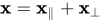
( が複素数値である場合、上式の転置はエルミート転置に置き換えられます)。この演算子は u を 不変のままにし、 に直交するすべてのベクトルを消去します。これは、 が確かに u を 含む直線上への直交射影であることを証明しています 。 [4] これを理解する簡単な方法は、任意のベクトルを直線上の成分(つまり、求める射影ベクトル)とそれに垂直な別の成分 との和として 考えることです 。射影を適用すると、 平行ベクトルと垂直ベクトルの ドット積 の特性によって次式が得られます。 u {\displaystyle \mathbf {u} } P u = u u T . {\displaystyle P_{\mathbf {u} }=\mathbf {u} \mathbf {u} ^{\mathsf {T}}.} u {\displaystyle \mathbf {u} } u {\displaystyle \mathbf {u} } x {\displaystyle \mathbf {x} } x = x ∥ + x ⊥ {\displaystyle \mathbf {x} =\mathbf {x} _{\parallel }+\mathbf {x} _{\perp }} P u x = u u T x ∥ + u u T x ⊥ = u ( sgn ( u T x ∥ ) ‖ x ∥ ‖ ) + u ⋅ 0 = x ∥ {\displaystyle P_{\mathbf {u} }\mathbf {x} =\mathbf {u} \mathbf {u} ^{\mathsf {T}}\mathbf {x} _{\parallel }+\mathbf {u} \mathbf {u} ^{\mathsf {T}}\mathbf {x} _{\perp }=\mathbf {u} \left(\operatorname {sgn} \left(\mathbf {u} ^{\mathsf {T}}\mathbf {x} _{\parallel }\right)\left\|\mathbf {x} _{\parallel }\right\|\right)+\mathbf {u} \cdot \mathbf {0} =\mathbf {x} _{\parallel }}
この式は、任意の次元 の部分空間への直交射影に一般化できる 。 整数 を仮定して、 部分空間 の 直交基底 を とし、を列 、すなわち と する 行列 とすると 、射影は次のように与えられる: [5] 。
これは次のように書き直すことができる
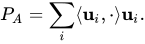
。 u 1 , … , u k {\displaystyle \mathbf {u} _{1},\ldots ,\mathbf {u} _{k}} U {\displaystyle U} k ≥ 1 {\displaystyle k\geq 1} A {\displaystyle A} n × k {\displaystyle n\times k} u 1 , … , u k {\displaystyle \mathbf {u} _{1},\ldots ,\mathbf {u} _{k}} A = [ u 1 ⋯ u k ] {\displaystyle A={\begin{bmatrix}\mathbf {u} _{1}&\cdots &\mathbf {u} _{k}\end{bmatrix}}} P A = A A T {\displaystyle P_{A}=AA^{\mathsf {T}}} P A = ∑ i ⟨ u i , ⋅ ⟩ u i . {\displaystyle P_{A}=\sum _{i}\langle \mathbf {u} _{i},\cdot \rangle \mathbf {u} _{i}.}
行列 はの 直交補 空間 上で消える 部分等長行列 であり 、 はを基礎ベクトル空間に 埋め込む等長行列である。 したがって、 の値域は の 最終的な空間 である。また、が 上の恒等作用素である ことも明らかである 。 A T {\displaystyle A^{\mathsf {T}}} U {\displaystyle U} A {\displaystyle A} U {\displaystyle U} P A {\displaystyle P_{A}} A {\displaystyle A} A A T {\displaystyle AA^{\mathsf {T}}} U {\displaystyle U}
直交性条件は省略することもできる。 が (必ずしも直交とは限らない) 基底 で が これらのベクトルを列とする行列である場合、射影は次のように表される: [6] [7] u 1 , … , u k {\displaystyle \mathbf {u} _{1},\ldots ,\mathbf {u} _{k}} k ≥ 1 {\displaystyle k\geq 1} A {\displaystyle A} P A = A ( A T A ) − 1 A T . {\displaystyle P_{A}=A\left(A^{\mathsf {T}}A\right)^{-1}A^{\mathsf {T}}.}
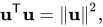
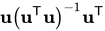
行列は 依然として 基底ベクトル空間に埋め込まれますが、もはや一般に等長行列ではありません。行列は ノルムを回復する「正規化因子」です。例えば、 階数 -1の演算子は 、 を で割った後、 が張る部分空間への 射影が得られる 場合、射影ではありません 。 A {\displaystyle A} U {\displaystyle U} ( A T A ) − 1 {\displaystyle \left(A^{\mathsf {T}}A\right)^{-1}} u u T {\displaystyle \mathbf {u} \mathbf {u} ^{\mathsf {T}}} ‖ u ‖ ≠ 1. {\displaystyle \left\|\mathbf {u} \right\|\neq 1.} u T u = ‖ u ‖ 2 , {\displaystyle \mathbf {u} ^{\mathsf {T}}\mathbf {u} =\left\|\mathbf {u} \right\|^{2},} u ( u T u ) − 1 u T {\displaystyle \mathbf {u} \left(\mathbf {u} ^{\mathsf {T}}\mathbf {u} \right)^{-1}\mathbf {u} ^{\mathsf {T}}} u {\displaystyle u}
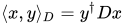
一般的な場合、内積を定義する任意の 正定値 行列 があり 、その射影 は で与えられる 。すると、 D {\displaystyle D} ⟨ x , y ⟩ D = y † D x {\displaystyle \langle x,y\rangle _{D}=y^{\dagger }Dx} P A {\displaystyle P_{A}} P A x = argmin y ∈ range ( A ) ‖ x − y ‖ D 2 {\textstyle P_{A}x=\operatorname {argmin} _{y\in \operatorname {range} (A)}\left\|x-y\right\|_{D}^{2}} P A = A ( A T D A ) − 1 A T D . {\displaystyle P_{A}=A\left(A^{\mathsf {T}}DA\right)^{-1}A^{\mathsf {T}}D.}
射影の値域空間が フレーム によって生成される場合(つまり、生成元の数がその次元よりも大きい場合)、射影の式は の形になります。 ここで は ムーア・ペンローズ擬逆行列 を表します 。これは、射影演算子を構成する多くの方法のうちの1つにすぎません。 P A = A A + {\displaystyle P_{A}=AA^{+}} A + {\displaystyle A^{+}}
が非特異行列であり、 (すなわち、が の 零空間 行列 である ) 場合、 [8] 以下が成り立ちます。 [ A B ] {\displaystyle {\begin{bmatrix}A&B\end{bmatrix}}} A T B = 0 {\displaystyle A^{\mathsf {T}}B=0} B {\displaystyle B} A {\displaystyle A} I = [ A B ] [ A B ] − 1 [ A T B T ] − 1 [ A T B T ] = [ A B ] ( [ A T B T ] [ A B ] ) − 1 [ A T B T ] = [ A B ] [ A T A O O B T B ] − 1 [ A T B T ] = A ( A T A ) − 1 A T + B ( B T B ) − 1 B T {\displaystyle {\begin{aligned}I&={\begin{bmatrix}A&B\end{bmatrix}}{\begin{bmatrix}A&B\end{bmatrix}}^{-1}{\begin{bmatrix}A^{\mathsf {T}}\\B^{\mathsf {T}}\end{bmatrix}}^{-1}{\begin{bmatrix}A^{\mathsf {T}}\\B^{\mathsf {T}}\end{bmatrix}}\\&={\begin{bmatrix}A&B\end{bmatrix}}\left({\begin{bmatrix}A^{\mathsf {T}}\\B^{\mathsf {T}}\end{bmatrix}}{\begin{bmatrix}A&B\end{bmatrix}}\right)^{-1}{\begin{bmatrix}A^{\mathsf {T}}\\B^{\mathsf {T}}\end{bmatrix}}\\&={\begin{bmatrix}A&B\end{bmatrix}}{\begin{bmatrix}A^{\mathsf {T}}A&O\\O&B^{\mathsf {T}}B\end{bmatrix}}^{-1}{\begin{bmatrix}A^{\mathsf {T}}\\B^{\mathsf {T}}\end{bmatrix}}\\[4pt]&=A\left(A^{\mathsf {T}}A\right)^{-1}A^{\mathsf {T}}+B\left(B^{\mathsf {T}}B\right)^{-1}B^{\mathsf {T}}\end{aligned}}}
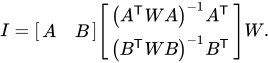
直交条件が 非特異 に拡張された場合、次の式が成り立ちます。 A T W B = A T W T B = 0 {\displaystyle A^{\mathsf {T}}WB=A^{\mathsf {T}}W^{\mathsf {T}}B=0} W {\displaystyle W} I = [ A B ] [ ( A T W A ) − 1 A T ( B T W B ) − 1 B T ] W . {\displaystyle I={\begin{bmatrix}A&B\end{bmatrix}}{\begin{bmatrix}\left(A^{\mathsf {T}}WA\right)^{-1}A^{\mathsf {T}}\\\left(B^{\mathsf {T}}WB\right)^{-1}B^{\mathsf {T}}\end{bmatrix}}W.}
これらの式はすべて、転置の代わりに共役転置 を用いる限り、複素内積空間にも成り立ちます 。射影和に関する詳細は、Banerjee and Roy (2014) を参照してください。 [9]また、基本的な 球面三角法 における射影和の応用については、 Banerjee (2004) [10] を参照してください。
斜め投影 斜投影 法という用語は 、非直交投影法を指すために使用されることがあります。これらの投影法は、2次元図面における空間図形の表現にも使用されます( 斜投影法 を参照)が、直交投影法ほど頻繁ではありません。 通常の最小二乗回帰の適合値を計算するには直交投影法が必要ですが、 操作変数回帰 の適合値を計算するには 斜投影法が必要です。
投影は、その核と、その範囲を特徴付ける基底ベクトル(核の補ベクトル)によって定義されます。これらの基底ベクトルが核に直交する場合、投影は直交投影と呼ばれます。これらの基底ベクトルが核に直交しない場合、投影は斜投影、または単なる投影と呼ばれます。
を となる線型演算子とし、 は零演算子ではない と仮定する 。ベクトル が の値域の基底を形成し 、これらのベクトルを 行列にまとめるとする 。 そうでない場合、 と は 零演算子である。値域と核は相補空間であるため、核の次元は となる 。したがって、 核の 直交補 空間は となる。 が 射影の核の直交補空間の基底を形成し、これらのベクトルを行列 にまとめるとする 。すると、射影 (条件 )は次式で与えられる。 P : V → V {\displaystyle P\colon V\to V} P 2 = P {\displaystyle P^{2}=P} P {\displaystyle P} u 1 , … , u k {\displaystyle \mathbf {u} _{1},\ldots ,\mathbf {u} _{k}} P {\displaystyle P} n × k {\displaystyle n\times k} A {\displaystyle A} k ≥ 1 {\displaystyle k\geq 1} k = 0 {\displaystyle k=0} P {\displaystyle P} n − k {\displaystyle n-k} k {\displaystyle k} v 1 , … , v k {\displaystyle \mathbf {v} _{1},\ldots ,\mathbf {v} _{k}} B {\displaystyle B} P {\displaystyle P} k ≥ 1 {\displaystyle k\geq 1} P = A ( B T A ) − 1 B T . {\displaystyle P=A\left(B^{\mathsf {T}}A\right)^{-1}B^{\mathsf {T}}.}
この表現は、上に示した直交射影の式を一般化したものである。 [11] [12] この表現の標準的な証明は以下の通り。 ベクトル空間 内の任意のベクトルに対して 、 を分解することができる 。ここでベクトル は の像にあり 、ベクトル なので となり、 は の核にあり 、これは の零空間である 言い換えれば、ベクトルは の 列空間にある ので、ある 次元ベクトルに対して となり 、ベクトルは の構築により を満たします 。これらの条件をまとめると、 となるベクトルが見つかります 。 行列 および は 構築により フルランクである ため、 -行列 は逆行列である。そのため、方程式は ベクトルを与える。 このように、 任意のベクトルに対して となり 、したがって となる 。 x {\displaystyle \mathbf {x} } V {\displaystyle V} x = x 1 + x 2 {\displaystyle \mathbf {x} =\mathbf {x} _{1}+\mathbf {x} _{2}} x 1 = P ( x ) {\displaystyle \mathbf {x} _{1}=P(\mathbf {x} )} P {\displaystyle P} x 2 = x − P ( x ) . {\displaystyle \mathbf {x} _{2}=\mathbf {x} -P(\mathbf {x} ).} P ( x 2 ) = P ( x ) − P 2 ( x ) = 0 {\displaystyle P(\mathbf {x} _{2})=P(\mathbf {x} )-P^{2}(\mathbf {x} )=\mathbf {0} } x 2 {\displaystyle \mathbf {x} _{2}} P {\displaystyle P} A . {\displaystyle A.} x 1 {\displaystyle \mathbf {x} _{1}} A , {\displaystyle A,} x 1 = A w {\displaystyle \mathbf {x} _{1}=A\mathbf {w} } k {\displaystyle k} w {\displaystyle \mathbf {w} } x 2 {\displaystyle \mathbf {x} _{2}} B T x 2 = 0 {\displaystyle B^{\mathsf {T}}\mathbf {x} _{2}=\mathbf {0} } B {\displaystyle B} w {\displaystyle \mathbf {w} } B T ( x − A w ) = 0 {\displaystyle B^{\mathsf {T}}(\mathbf {x} -A\mathbf {w} )=\mathbf {0} } A {\displaystyle A} B {\displaystyle B} k {\displaystyle k} k × k {\displaystyle k\times k} B T A {\displaystyle B^{\mathsf {T}}A} B T ( x − A w ) = 0 {\displaystyle B^{\mathsf {T}}(\mathbf {x} -A\mathbf {w} )=\mathbf {0} } w = ( B T A ) − 1 B T x . {\displaystyle \mathbf {w} =(B^{\mathsf {T}}A)^{-1}B^{\mathsf {T}}\mathbf {x} .} P x = x 1 = A w = A ( B T A ) − 1 B T x {\displaystyle P\mathbf {x} =\mathbf {x} _{1}=A\mathbf {w} =A(B^{\mathsf {T}}A)^{-1}B^{\mathsf {T}}\mathbf {x} } x ∈ V {\displaystyle \mathbf {x} \in V} P = A ( B T A ) − 1 B T {\displaystyle P=A(B^{\mathsf {T}}A)^{-1}B^{\mathsf {T}}}
が直交射影である 場合 、 とすれば が成り立ちます 。この公式を用いることで、 が容易に確認できます 。一般に、ベクトル空間が複素数体上にある場合、 エルミート転置を 用いてが成り立ちます 。 は列フルランクな ので 、 の ムーア・ペンローズ逆行列 は で表せることを思い出してください 。 P {\displaystyle P} A = B {\displaystyle A=B} P = A ( A T A ) − 1 A T {\displaystyle P=A\left(A^{\mathsf {T}}A\right)^{-1}A^{\mathsf {T}}} P = P T {\displaystyle P=P^{\mathsf {T}}} A ∗ {\displaystyle A^{*}} P = A ( A ∗ A ) − 1 A ∗ {\displaystyle P=A\left(A^{*}A\right)^{-1}A^{*}} A {\displaystyle A} A + = ( A ∗ A ) − 1 A ∗ {\displaystyle A^{+}=(A^{*}A)^{-1}A^{*}} A {\displaystyle A} P = A A + {\displaystyle P=AA^{+}}
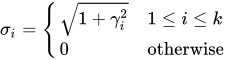
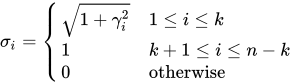
特異値 I − P {\displaystyle I-P} も斜射影である。と の特異値は の 直交基底 によって計算できる 。 を の直交基底とし 、 を の 直交補行列 とする 。 行列の特異値を 正の値 で表す 。これにより、 の特異値は次 のようになる: [13] 。 の
特異値は 次のようになる。
これは、 と の最大特異値が 等しいこと、したがって斜射影の 行列ノルム が同じであることを意味する。しかし、 条件数は 関係 を満たす ため、必ずしも等しいとは限らない。 P {\displaystyle P} I − P {\displaystyle I-P} A {\displaystyle A} Q A {\displaystyle Q_{A}} A {\displaystyle A} Q A ⊥ {\displaystyle Q_{A}^{\perp }} Q A {\displaystyle Q_{A}} Q A T A ( B T A ) − 1 B T Q A ⊥ {\displaystyle Q_{A}^{T}A(B^{T}A)^{-1}B^{T}Q_{A}^{\perp }} γ 1 ≥ γ 2 ≥ … ≥ γ k {\displaystyle \gamma _{1}\geq \gamma _{2}\geq \ldots \geq \gamma _{k}} P {\displaystyle P} σ i = { 1 + γ i 2 1 ≤ i ≤ k 0 otherwise {\displaystyle \sigma _{i}={\begin{cases}{\sqrt {1+\gamma _{i}^{2}}}&1\leq i\leq k\\0&{\text{otherwise}}\end{cases}}} I − P {\displaystyle I-P} σ i = { 1 + γ i 2 1 ≤ i ≤ k 1 k + 1 ≤ i ≤ n − k 0 otherwise {\displaystyle \sigma _{i}={\begin{cases}{\sqrt {1+\gamma _{i}^{2}}}&1\leq i\leq k\\1&k+1\leq i\leq n-k\\0&{\text{otherwise}}\end{cases}}} P {\displaystyle P} I − P {\displaystyle I-P} κ ( I − P ) = σ 1 1 ≥ σ 1 σ k = κ ( P ) {\displaystyle \kappa (I-P)={\frac {\sigma _{1}}{1}}\geq {\frac {\sigma _{1}}{\sigma _{k}}}=\kappa (P)}
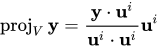
内積による射影の計算 直交ベクトル が張るベクトル空間(この場合は平面)を とします 。 を ベクトルとします。 の への射影を と定義できます。 ここ で、繰り返し添字は 上で合計されます( アインシュタインの和記法 )。 ベクトル は となる直交和として表すことができます 。 は と表記されることもあります。線形代数には、 から への 最小距離( 直交距離 )は である という定理があり、 機械学習 などの分野でよく用いられています 。 V {\displaystyle V} u 1 , u 2 , … , u p {\displaystyle \mathbf {u} _{1},\mathbf {u} _{2},\dots ,\mathbf {u} _{p}} y {\displaystyle y} y {\displaystyle \mathbf {y} } V {\displaystyle V} proj V y = y ⋅ u i u i ⋅ u i u i {\displaystyle \operatorname {proj} _{V}\mathbf {y} ={\frac {\mathbf {y} \cdot \mathbf {u} ^{i}}{\mathbf {u} ^{i}\cdot \mathbf {u} ^{i}}}\mathbf {u} ^{i}} y {\displaystyle \mathbf {y} } y = proj V y + z {\displaystyle \mathbf {y} =\operatorname {proj} _{V}\mathbf {y} +\mathbf {z} } proj V y {\displaystyle \operatorname {proj} _{V}\mathbf {y} } y ^ {\displaystyle {\hat {\mathbf {y} }}} z {\displaystyle \mathbf {z} } y {\displaystyle \mathbf {y} } V {\displaystyle V}
y はベクトル空間 V に投影されます。
体 上の 次元ベクトル空間への任意の 射影は 対角化可能な行列 である 。なぜなら、その 最小多項式 は を割り切り、 は異なる線型因子に分解されるからである。したがって、 には 次の形を持つ 基底が存在する。 P = P 2 {\displaystyle P=P^{2}} d {\displaystyle d} x 2 − x {\displaystyle x^{2}-x} P {\displaystyle P}
P = I r ⊕ 0 d − r {\displaystyle P=I_{r}\oplus 0_{d-r}} ここでは の 階数 である 。ここで は サイズ の 単位行列 、 は サイズ の 零行列 、は 直和演算 子である 。ベクトル空間が複素数で内積 を持つ場合 、 P の行列 が [14]となるよう な直交 基底が存在する。 r {\displaystyle r} P {\displaystyle P} I r {\displaystyle I_{r}} r {\displaystyle r} 0 d − r {\displaystyle 0_{d-r}} d − r {\displaystyle d-r} ⊕ {\displaystyle \oplus }
P = [ 1 σ 1 0 0 ] ⊕ ⋯ ⊕ [ 1 σ k 0 0 ] ⊕ I m ⊕ 0 s . {\displaystyle P={\begin{bmatrix}1&\sigma _{1}\\0&0\end{bmatrix}}\oplus \cdots \oplus {\begin{bmatrix}1&\sigma _{k}\\0&0\end{bmatrix}}\oplus I_{m}\oplus 0_{s}.} ここで 、 整数 と実数は 一意に決定されます。 因子は、が 直交 射影として作用する 最大不変部分空間に対応します (したがって、 P 自体が直交する場合のみ )、 -ブロックは 斜交成 分に対応します 。 σ 1 ≥ σ 2 ≥ ⋯ ≥ σ k > 0 {\displaystyle \sigma _{1}\geq \sigma _{2}\geq \dots \geq \sigma _{k}>0} k , s , m {\displaystyle k,s,m} σ i {\displaystyle \sigma _{i}} 2 k + s + m = d {\displaystyle 2k+s+m=d} I m ⊕ 0 s {\displaystyle I_{m}\oplus 0_{s}} P {\displaystyle P} k = 0 {\displaystyle k=0} σ i {\displaystyle \sigma _{i}}
ノルムベクトル空間への射影 基底ベクトル空間 が (必ずしも有限次元ではない) ノルムベクトル空間 である場合、有限次元の場合には無関係な解析的な問題を考慮する必要がある。ここで が バナッハ空間 であると仮定する 。 X {\displaystyle X} X {\displaystyle X}
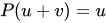
上で議論した代数的結果の多くは、この文脈に至るまで有効である。 を 相補部分空間に直和分解すると、依然として射影が与えられ、逆もまた同様である。 が 直和 である場合 、 で定義される演算子は依然として範囲 と核 を 持つ射影である 。また、 であることも明らかである 。逆に、 が への射影 、すなわち である場合 、 は容易に検証できる 。言い換えれば、 も射影である。 という関係式は 、 と が直和 であることを 意味する 。 X {\displaystyle X} X {\displaystyle X} X = U ⊕ V {\displaystyle X=U\oplus V} P ( u + v ) = u {\displaystyle P(u+v)=u} U {\displaystyle U} V {\displaystyle V} P 2 = P {\displaystyle P^{2}=P} P {\displaystyle P} X {\displaystyle X} P 2 = P {\displaystyle P^{2}=P} ( 1 − P ) 2 = ( 1 − P ) {\displaystyle (1-P)^{2}=(1-P)} 1 − P {\displaystyle 1-P} P 2 = P {\displaystyle P^{2}=P} 1 = P + ( 1 − P ) {\displaystyle 1=P+(1-P)} X {\displaystyle X} rg ( P ) ⊕ rg ( 1 − P ) {\displaystyle \operatorname {rg} (P)\oplus \operatorname {rg} (1-P)}
しかし、有限次元の場合とは異なり、射影は一般に 連続で ある必要はありません。の 部分空間が ノルム位相において閉じていない場合、 への射影は 連続ではありません。言い換えれば、連続射影の値域は 閉部分空間でなければなりません。さらに、連続射影(実際には、一般に連続線型作用素)の核は閉じています。したがって、 連続 射影はを2つの相補的な 閉部 分空間 に 分解します 。 U {\displaystyle U} X {\displaystyle X} U {\displaystyle U} P {\displaystyle P} P {\displaystyle P} X {\displaystyle X} X = rg ( P ) ⊕ ker ( P ) = ker ( 1 − P ) ⊕ ker ( P ) {\displaystyle X=\operatorname {rg} (P)\oplus \ker(P)=\ker(1-P)\oplus \ker(P)}
逆もまた成り立ちますが、追加の仮定があります。 が の閉部分空間であるとします。 X = U ⊕ V となる 閉部分空間が存在する場合、 値域 と核を持つ 射影は 連続です。これは、 閉グラフ定理 から従います。 x n → x 、 Px n → y とします。 であることを示す必要があります 。 は閉じており、 { Px n } ⊂ U であるため、 は 、すなわち Py = y に含まれます 。また、 x n − Px n = ( I − P ) x n → x − y です。 は閉じており、 {( I − P ) x n } ⊂ V であるため、 、すなわち となり 、主張を証明します。 U {\displaystyle U} X {\displaystyle X} V {\displaystyle V} P {\displaystyle P} U {\displaystyle U} V {\displaystyle V} P x = y {\displaystyle Px=y} U {\displaystyle U} U {\displaystyle U} V {\displaystyle V} x − y ∈ V {\displaystyle x-y\in V} P ( x − y ) = P x − P y = P x − y = 0 {\displaystyle P(x-y)=Px-Py=Px-y=0}
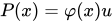
上記の議論は、 と が両方とも閉じている という仮定を利用しています 。一般に、閉部分空間 が与えられた場合 、相補閉部分空間 が存在する必要はありませんが、 ヒルベルト空間 の場合は、 直交相補 を取ることで常にこれを行うことができます 。バナッハ空間の場合、1 次元部分空間には必ず閉相補部分空間が存在します。これは、 ハーン・バナッハの定理 の直接的な帰結です。 を の線型スパンとします。ハーン・バナッハの定理により、 φ ( u ) = 1 となるような有界 線型汎関数 が存在する 。演算子 はを 満たし 、つまり射影である。 が有界であることは の連続性を意味し 、したがって は の 閉相補部分空間である 。 U {\displaystyle U} V {\displaystyle V} U {\displaystyle U} V {\displaystyle V} U {\displaystyle U} u {\displaystyle u} φ {\displaystyle \varphi } P ( x ) = φ ( x ) u {\displaystyle P(x)=\varphi (x)u} P 2 = P {\displaystyle P^{2}=P} φ {\displaystyle \varphi } P {\displaystyle P} ker ( P ) = rg ( I − P ) {\displaystyle \ker(P)=\operatorname {rg} (I-P)} U {\displaystyle U}
応用とさらなる検討 投影(直交投影など)は、 特定の線形代数問題の アルゴリズムで重要な役割を果たします。
上述のように、射影は冪等性の特殊なケースです。解析的には、直交射影は 特性関数 の非可換な一般化です。冪等性は例えば 半単純代数の 分類に用いられ、 測度論は 可測集合 の特性関数の考察から始まります 。したがって、ご想像のとおり、射影は 作用素代数 の文脈で非常に頻繁に登場します。特に、 フォン・ノイマン代数は、その射影の完全 格子 によって生成されます 。
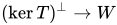
一般化 より一般的には、ノルムベクトル空間間の写像が与えられた場合、 同様にこの写像が核の直交補写像上の等長写像となるように求めることができる。すなわち、等長写像となる( 部分等長写像 を参照 )。特に、それは 上に 写像されなければならない。直交射影となるのは、 Wが V の部分空間である場合である 。リーマン幾何学 において、これは リーマン浸漬 の定義に用いられる 。 T : V → W , {\displaystyle T\colon V\to W,} ( ker T ) ⊥ → W {\displaystyle (\ker T)^{\perp }\to W}
参照
注記 ^ マイヤー、386+387ページ ^ ab Horn, Roger A.; Johnson, Charles R. (2013). Matrix Analysis, second edition . Cambridge University Press. ISBN 9780521839402 。 ^ マイヤー、433ページ ^ マイヤー、431ページ ^ マイヤー、式 (5.13.4) ^ Banerjee, Sudipto; Roy, Anindya (2014), 統計のための線形代数と行列分析, Texts in Statistical Science (第1版), Chapman and Hall/CRC, ISBN 978-1420095388 ^ マイヤー、式 (5.13.3) ^ 線形最小二乗法(数学)§ 最小二乗推定値の性質 も参照してください 。 ^ Banerjee, Sudipto; Roy, Anindya (2014), 統計のための線形代数と行列分析, Texts in Statistical Science (第1版), Chapman and Hall/CRC, ISBN 978-1420095388 ^ Banerjee, Sudipto (2004)、「直交射影法による球面三角法の再考」、 The College Mathematics Journal 、 35 (5): 375– 381、 doi :10.1080/07468342.2004.11922099、 S2CID 122277398 ^ Banerjee, Sudipto; Roy, Anindya (2014), 統計のための線形代数と行列分析, Texts in Statistical Science (第1版), Chapman and Hall/CRC, ISBN 978-1420095388 ^ マイヤー、式 (7.10.39) ^ Brust, JJ; Marcia, RF; Petra, CG (2020)、「斜投影行列の計算効率の高い分解」、 SIAM Journal on Matrix Analysis and Applications 、 41 (2): 852– 870、 doi :10.1137/19M1288115、 OSTI 1680061、 S2CID 219921214 ^ ドコヴィッチ、D. Ž. (1991年8月)。 「プロジェクターの単一類似性」。 数学の方程式 。 42 (1): 220–224 。 土井 :10.1007/BF01818492。 S2CID 122704926。
参考文献 Banerjee, Sudipto; Roy, Anindya (2014), Linear Algebra and Matrix Analysis for Statistics , Texts in Statistical Science (第1版), Chapman and Hall/CRC, ISBN 978-1420095388 ダンフォード, N.; シュワルツ, JT (1958). 線型作用素 第1部 一般理論 . インターサイエンス. マイヤー、カール・D. (2000). 行列解析と応用線形代数. 産業応用数学協会. ISBN 978-0-89871-454-8 。 Brezinski, Claude: Projection Methods for Systems of Equations 、North-Holland、ISBN 0-444-82777-3 (1997)。
外部リンク





















































![{\displaystyle {\begin{aligned}I&={\begin{bmatrix}A&B\end{bmatrix}}{\begin{bmatrix}A&B\end{bmatrix}}^{-1}{\begin{bmatrix}A^{\mathsf {T}}\\B^{\mathsf {T}}\end{bmatrix}}^{-1}{\begin{bmatrix}A^{\mathsf {T}}\\B^{\mathsf {T}}\end{bmatrix}}\\&={\begin{bmatrix}A&B\end{bmatrix}}\left({\begin{bmatrix}A^{\mathsf {T}}\\B^{\mathsf {T}}\end{bmatrix}}{\begin{bmatrix}A&B\end{bmatrix}}\right)^{-1}{\begin{bmatrix}A^{\mathsf {T}}\\B^{\mathsf {T}}\end{bmatrix}}\\&={\begin{bmatrix}A&B\end{bmatrix}}{\begin{bmatrix}A^{\mathsf {T}}A&O\\O&B^{\mathsf {T}}B\end{bmatrix}}^{-1}{\begin{bmatrix}A^{\mathsf {T}}\\B^{\mathsf {T}}\end{bmatrix}}\\[4pt]&=A\left(A^{\mathsf {T}}A\right)^{-1}A^{\mathsf {T}}+B\left(B^{\mathsf {T}}B\right)^{-1}B^{\mathsf {T}}\end{aligned}}}](https://wikimedia.org/api/rest_v1/media/math/render/svg/0d5ac3d05451825c162acf531a9416503f4a580e)