Measure in measure theory
確率論 において 、 ランダム測度とは 測度 値を持つ ランダム要素 である 。 [1] [2] ランダム測度は例えば ランダム過程 の理論で使用され、 ポアソン点過程 や コックス過程 などの多くの重要な 点過程 を形成する。
意味 ランダム測度は、遷移核 または ランダム元 として定義できます 。どちらの定義も同値です。定義において、 は 可分 完備 計量空間 、 は その ボレル 代数 とします。(可分完備計量空間の最も一般的な例は です 。) E {\displaystyle E} E {\displaystyle {\mathcal {E}}} σ {\displaystyle \sigma } R n {\displaystyle \mathbb {R} ^{n}}
遷移カーネルとして ランダム測度とは、 抽象的な 確率空間 からへの ( としての ) 局所有限 遷移カーネル である。 [3] ζ {\displaystyle \zeta } ( Ω , A , P ) {\displaystyle (\Omega ,{\mathcal {A}},P)} ( E , E ) {\displaystyle (E,{\mathcal {E}})}
遷移カーネルとは、
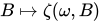
任意の固定された に対して 、写像 B ∈ E {\displaystyle B\in {\mathcal {\mathcal {E}}}} ω ↦ ζ ( ω , B ) {\displaystyle \omega \mapsto \zeta (\omega ,B)} から 測定 可能 ( Ω , A ) {\displaystyle (\Omega ,{\mathcal {A}})} ( R , B ( R ) ) {\displaystyle (\mathbb {R} ,{\mathcal {B}}(\mathbb {R} ))} 固定されたすべての に対して 、マッピング ω ∈ Ω {\displaystyle \omega \in \Omega } B ↦ ζ ( ω , B ) ( B ∈ E ) {\displaystyle B\mapsto \zeta (\omega ,B)\quad (B\in {\mathcal {E}})} は 、 ( E , E ) {\displaystyle (E,{\mathcal {E}})} 局所的に有限であるということは、測度が
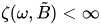
B ↦ ζ ( ω , B ) {\displaystyle B\mapsto \zeta (\omega ,B)} すべての有界測定可能集合に対して、および 一部を除く すべての有界測定可能集合に対して 満たす - 空集合 ζ ( ω , B ~ ) < ∞ {\displaystyle \zeta (\omega ,{\tilde {B}})<\infty } B ~ ∈ E {\displaystyle {\tilde {B}}\in {\mathcal {E}}} ω ∈ Ω {\displaystyle \omega \in \Omega } P {\displaystyle P}
確率過程 の文脈では、 確率カーネル、確率カーネル、マルコフカーネル という関連概念があります 。
ランダム要素として 定義する
M ~ := { μ ∣ μ is measure on ( E , E ) } {\displaystyle {\tilde {\mathcal {M}}}:=\{\mu \mid \mu {\text{ is measure on }}(E,{\mathcal {E}})\}} そして局所有限測度のサブセットは
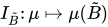
M := { μ ∈ M ~ ∣ μ ( B ~ ) < ∞ for all bounded measurable B ~ ∈ E } {\displaystyle {\mathcal {M}}:=\{\mu \in {\tilde {\mathcal {M}}}\mid \mu ({\tilde {B}})<\infty {\text{ for all bounded measurable }}{\tilde {B}}\in {\mathcal {E}}\}} すべての有界測定可能に対して 、マッピングを定義する B ~ {\displaystyle {\tilde {B}}}
I B ~ : μ ↦ μ ( B ~ ) {\displaystyle I_{\tilde {B}}\colon \mu \mapsto \mu ({\tilde {B}})} から へ 。 を への 写像によって誘導される -代数 、 への 写像によって誘導される -代数 と する 。 に注意してください 。 M ~ {\displaystyle {\tilde {\mathcal {M}}}} R {\displaystyle \mathbb {R} } M ~ {\displaystyle {\tilde {\mathbb {M} }}} σ {\displaystyle \sigma } I B ~ {\displaystyle I_{\tilde {B}}} M ~ {\displaystyle {\tilde {\mathcal {M}}}} M {\displaystyle \mathbb {M} } σ {\displaystyle \sigma } I B ~ {\displaystyle I_{\tilde {B}}} M {\displaystyle {\mathcal {M}}} M ~ | M = M {\displaystyle {\tilde {\mathbb {M} }}|_{\mathcal {M}}=\mathbb {M} }
ランダム測度とは、からからほぼ確実に[3] [4] [5]の値を取るランダム な 要素 で ある 。 ( Ω , A , P ) {\displaystyle (\Omega ,{\mathcal {A}},P)} ( M ~ , M ~ ) {\displaystyle ({\tilde {\mathcal {M}}},{\tilde {\mathbb {M} }})} ( M , M ) {\displaystyle ({\mathcal {M}},\mathbb {M} )}
強度測定 ランダム測度の 場合 、 ζ {\displaystyle \zeta } E ζ {\displaystyle \operatorname {E} \zeta }
E [ ∫ f ( x ) ζ ( d x ) ] = ∫ f ( x ) E ζ ( d x ) {\displaystyle \operatorname {E} \left[\int f(x)\;\zeta (\mathrm {d} x)\right]=\int f(x)\;\operatorname {E} \zeta (\mathrm {d} x)} あらゆる正の測定可能な関数 に対する は の強度測度と呼ばれる 。強度測度はあらゆるランダム測度に対して存在し、 s-有限測度 である。 f {\displaystyle f} ζ {\displaystyle \zeta }
支援策 ランダム測度の 場合 、 ζ {\displaystyle \zeta } ν {\displaystyle \nu }
∫ f ( x ) ζ ( d x ) = 0 a.s. iff ∫ f ( x ) ν ( d x ) = 0 {\displaystyle \int f(x)\;\zeta (\mathrm {d} x)=0{\text{ a.s. }}{\text{ iff }}\int f(x)\;\nu (\mathrm {d} x)=0} すべての正の測定可能な関数に対する支持測度は、の 支持測度 と呼ばれます 。支持測度はすべてのランダム測度に対して存在し、有限になるように選ぶことができます。 ζ {\displaystyle \zeta }
ランダム測度の場合 、 ラプラス変換は 次のように定義される。 ζ {\displaystyle \zeta }
L ζ ( f ) = E [ exp ( − ∫ f ( x ) ζ ( d x ) ) ] {\displaystyle {\mathcal {L}}_{\zeta }(f)=\operatorname {E} \left[\exp \left(-\int f(x)\;\zeta (\mathrm {d} x)\right)\right]} あらゆる正の測定可能な関数に対して 。 f {\displaystyle f}
基本的なプロパティ
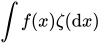
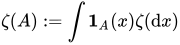
積分の測定可能性 ランダム測度の場合 、積分 ζ {\displaystyle \zeta }
∫ f ( x ) ζ ( d x ) {\displaystyle \int f(x)\zeta (\mathrm {d} x)} そして ζ ( A ) := ∫ 1 A ( x ) ζ ( d x ) {\displaystyle \zeta (A):=\int \mathbf {1} _{A}(x)\zeta (\mathrm {d} x)}
正の - 測定可能なものは測定可能なので、 ランダム変数 です 。 E {\displaystyle {\mathcal {E}}} f {\displaystyle f}
ユニークさ ランダムな測定の分布は、以下の分布によって一意に決定される。
∫ f ( x ) ζ ( d x ) {\displaystyle \int f(x)\zeta (\mathrm {d} x)} 上の コンパクト台を持つすべての連続関数に対して成り立つ。 の意味で 生成する 固定 半環に対しても、ランダム測度の分布はすべての正の 単純 -可測関数 上の積分によって一意に決定される 。 [6] f {\displaystyle f} E {\displaystyle E} I ⊂ E {\displaystyle {\mathcal {I}}\subset {\mathcal {E}}} E {\displaystyle {\mathcal {E}}} σ ( I ) = E {\displaystyle \sigma ({\mathcal {I}})={\mathcal {E}}} I {\displaystyle {\mathcal {I}}} f {\displaystyle f}
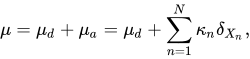
分解 一般的に、メジャーは次のように分解されます。
μ = μ d + μ a = μ d + ∑ n = 1 N κ n δ X n , {\displaystyle \mu =\mu _{d}+\mu _{a}=\mu _{d}+\sum _{n=1}^{N}\kappa _{n}\delta _{X_{n}},} ここで は原子なしの拡散測定ですが、 は純粋に原子の測定です。 μ d {\displaystyle \mu _{d}} μ a {\displaystyle \mu _{a}}
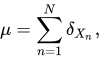
ランダムカウント測定 次の形式のランダム測定:
μ = ∑ n = 1 N δ X n , {\displaystyle \mu =\sum _{n=1}^{N}\delta _{X_{n}},} ここで 、は ディラック測度 であり、は確率変数であり、 点過程 [1] [2] または ランダム計数測度 と呼ばれる。このランダム測度は 、(一般的にベクトル値の)ランダム変数によって位置が与えられる N 個の粒子の集合を記述する。 計数測度では 拡散成分はゼロである。 δ {\displaystyle \delta } X n {\displaystyle X_{n}} X n {\displaystyle X_{n}} μ d {\displaystyle \mu _{d}}
上記の正式な記法において、ランダム計数測度は確率空間から 測定空間 ( , ) N X {\displaystyle N_{X}} B ( N X ) {\displaystyle {\mathfrak {B}}(N_{X})} への写像である。ここでは、すべての有限な整数値測度 ( 計数測度 と呼ばれる)の空間が表される 。 N X {\displaystyle N_{X}} N ∈ M X {\displaystyle N\in M_{X}}
期待値測度、ラプラス関数、モーメント測度、およびランダム測度の定常性の定義は、 点過程の定義に従う。ランダム測度は、 モンテカルロ数値積分法 や 粒子フィルタ などの モンテカルロ法 の記述と解析に役立つ 。 [7]
参照
参考文献 ^ ab Kallenberg, O. , Random Measures , 第4版. Academic Press, New York, London; Akademie-Verlag, Berlin (1986). ISBN 0-12-394960-2 MR 0854102。権威ある参考文献だが、やや難解。 ^ ab Jan Grandell, Point processes and random measurements, Advances in Applied Probability 9 (1977) 502-526. MR 0478331 JSTOR 分かりやすく素晴らしい入門書。 ^ ab Kallenberg, Olav (2017). ランダム測定、理論と応用 . 確率理論と確率モデル化. 第77巻. スイス: Springer. p. 1. doi :10.1007/978-3-319-41598-7. ISBN 978-3-319-41596-3 。 ^ クレンケ、アヒム (2008). 確率論 . ベルリン: シュプリンガー. p. 526. doi :10.1007/978-1-84800-048-3. ISBN 978-1-84800-047-6 。 ^ Daley, DJ; Vere-Jones, D. (2003). 点過程理論入門 . 確率とその応用. doi :10.1007/b97277. ISBN 0-387-95541-0 。 ^ カレンバーグ、オラフ (2017). ランダム測定、理論と応用 . 確率理論と確率モデル. 第77巻. スイス: シュプリンガー. p. 52. doi :10.1007/978-3-319-41598-7. ISBN 978-3-319-41596-3 。 ^ Crisan, D., 粒子フィルタ:理論的観点 、 Sequential Monte Carlo in Practice、 Doucet, A.、de Freitas, N.、Gordon, N.(編)、Springer、2001年、 ISBN 0-387-95146-6










![{\displaystyle \operatorname {E} \left[\int f(x)\;\zeta (\mathrm {d} x)\right]=\int f(x)\;\operatorname {E} \zeta (\mathrm {d} x)}](https://wikimedia.org/api/rest_v1/media/math/render/svg/7da0659cf22a04c804da5ccb36f5e0d8bb90f8ef)



![{\displaystyle {\mathcal {L}}_{\zeta }(f)=\operatorname {E} \left[\exp \left(-\int f(x)\;\zeta (\mathrm {d} x)\right)\right]}](https://wikimedia.org/api/rest_v1/media/math/render/svg/68953540667c5a207e052251d944bb9bab578672)