Unix-like
Jump to content


A Unix-like (sometimes referred to as UN*X, *nix or *NIX) operating system is one that behaves in a manner similar to a Unix system, although not necessarily conforming to or being certified to any version of the Single UNIX Specification. A Unix-like application is one that behaves like the corresponding Unix command or shell. Although there are general philosophies for Unix design, there is no technical standard defining the term, and opinions can differ about the degree to which a particular operating system or application is Unix-like. Some well-known examples of Unix-like operating systems include Linux, FreeBSD and OpenBSD. These systems are often used on servers as well as on personal computers and other devices. Many popular applications, such as the Apache web server and the Bash shell, are also designed to be used on Unix-like systems.
Definition
[edit]The Open Group owns the UNIX trademark and administers the Single UNIX Specification, with the "UNIX" name being used as a certification mark. They do not approve of the construction "Unix-like", and consider it a misuse of their trademark. Their guidelines require "UNIX" to be presented in uppercase or otherwise distinguished from the surrounding text, strongly encourage using it as a branding adjective for a generic word such as "system", and discourage its use in hyphenated phrases.[1]
Other parties frequently treat "Unix" as a genericized trademark. Some add a wildcard character to the name to make an abbreviation like "Un*x"[2] or "*nix", since Unix-like systems often have Unix-like names such as AIX, A/UX, HP-UX, IRIX, Linux, Minix, Ultrix, Xenix, and XNU. These patterns do not literally match many system names, but are still generally recognized to refer to any UNIX system, descendant, or work-alike, even those with completely dissimilar names such as Darwin/macOS, illumos/Solaris or FreeBSD.
In 2007, Wayne R. Gray sued to dispute the status of UNIX as a trademark, but lost his case, and lost again on appeal, with the court upholding the trademark and its ownership.[3][4]
History
[edit]
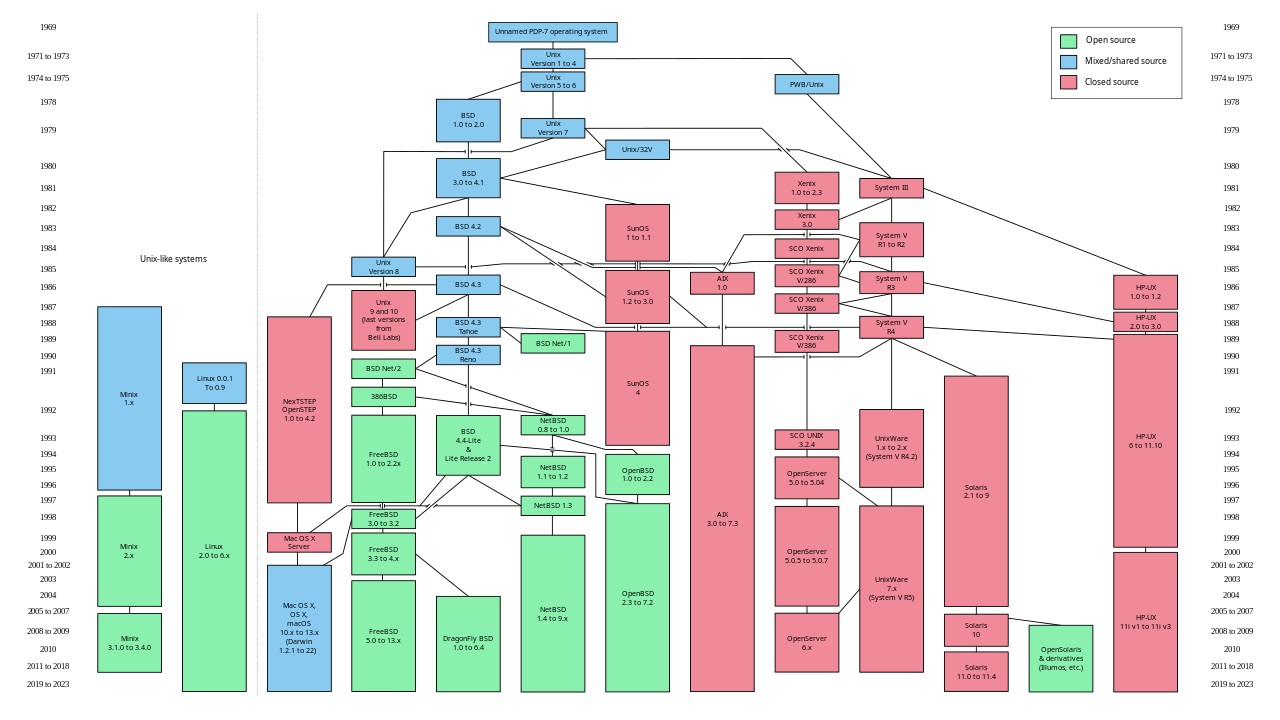
"Unix-like" systems started to appear in the late 1970s and early 1980s. Many proprietary versions, such as Idris (1978), UNOS (1982), Coherent (1983), and UniFlex (1985), aimed to provide businesses with the functionality available to academic users of UNIX.
When AT&T allowed relatively inexpensive commercial binary sublicensing of UNIX in 1979, a variety of proprietary systems were developed based on it, including AIX, HP-UX, IRIX, SunOS, Tru64, Ultrix, and Xenix. These largely displaced the proprietary clones. Growing incompatibility among these systems led to the creation of interoperability standards, including POSIX and the Single UNIX Specification.
Various free, low-cost, and unrestricted substitutes for UNIX emerged in the 1980s and 1990s, including 4.4BSD, Linux, and Minix. Some of these have in turn been the basis for commercial "Unix-like" systems, such as BSD/OS and macOS. Several versions of (Mac) OS X/macOS running on Intel-based and Apple silicon-based Mac computers have been certified under the Single UNIX Specification.[5][6][7][8][9][10][11][12] The BSD variants are descendants of UNIX developed by the University of California at Berkeley, with UNIX source code from Bell Labs. However, the BSD code base has evolved since then, replacing all the AT&T code. Since the BSD variants are not certified as compliant with the Single UNIX Specification, they are referred to as "UNIX-like" rather than "UNIX".
Categories
[edit]Eric S. Raymond and Rob Landley have suggested that there are three kinds of Unix-like systems: "genetic UNIX" derived from the original Bell Labs UNIX, "trademark UNIX" (or "branded UNIX") for which the Open Group have licensed the UNIX trademark, and a third category of operating systems that are not in either of those categories but that are patterned after the original Bell Labs UNIX.[13]
Genetic UNIX
[edit]Those systems with a historical connection to the AT&T codebase. Most commercial UNIX systems fall into this category. So do the BSD systems, which are descendants of work done at the University of California, Berkeley in the late 1970s and early 1980s. Some of these systems have no original AT&T code but can still trace their ancestry to AT&T designs.
Trademark or branded UNIX
[edit]これらのシステムは、その性質上大部分が商用であり、Open GroupによってSingle UNIX Specificationを満たしていると判断され、UNIXの名称を使用することが許可されています。こうしたシステムのほとんどは、System Vコードベースの商用派生製品ですが、Apple macOS 10.5以降は認定済みのBSD派生版であり、EulerOS [ 14 ] [ 15 ]とInspur K-UX [ 16 ]は認定済みのLinuxディストリビューションです。他のいくつかのシステム(IBM z/OSなど)は、POSIX互換レイヤーを通じて商標を取得しましたが、それ以外は本質的にUnixシステムではありません。多くの古いUNIXシステムは、もはやこの定義を満たしていません。
その他のUNIX
[編集]広義には、UNIX仕様とほぼ一致する動作をするUNIXライクなシステムを指し、「ログインとコマンドラインセッションを管理するプログラム」を持つことも含まれます。[ 17 ]より具体的には、 UNIXシステムと同様に動作するものの、AT&Tコードベースとの関連性や商標上の関連性がないLinuxやMinixなどのシステムを指します。UNIX設計のフリー/オープンソース実装のほとんどは、それがUNIXであるかどうかに関わらず、Open Group認証の取得に数千ドルかかるため、この3番目のカテゴリの限定的な定義に該当します。[ 18 ]
Unixのオリジナル開発者の一人であるデニス・リッチーは、LinuxはUnixの原則に強く準拠しているため、直接的なUnix派生の中で最も健全なものの一つであると述べています。[ 19 ]
2001年頃、Linuxは1ドルという象徴的な価格で、POSIX議長Andrew Joseyから無料の支援を含む認証を受ける機会が与えられました。[引用が必要] LinuxをPOSIX準拠にするための活動がいくつか行われ、JoseyはPOSIX標準とLinux Standard Base仕様の相違点のリストを作成しましたが、[ 20 ] 2005年8月に、このプロジェクトはLSB作業グループでの関心の低下により停止しました。[引用が必要] § 商標またはブランドUNIXに従って、いくつかのLinuxディストリビューションは認証されています。
互換性レイヤー
[編集]一部の非 Unix 系オペレーティング システムでは、Unix 系互換性レイヤーが提供されており、Unix 系機能の程度はさまざまです。
- IBM z/OS's UNIX System Services is sufficiently complete as to be certified as trademark UNIX.
- Cygwin, MSYS, and MSYS2 each provide a GNU environment on top of the Microsoft Windows user API, sufficient for most common open source software to be compiled and run.
- The MKS Toolkit and UWIN are comprehensive interoperability tools which allow the porting of Unix programs to Windows.
- Windows NT-type systems have a POSIX environmental subsystem.
- Subsystem for Unix-based Applications (previously Interix) provides Unix-like functionality as a Windows NT subsystem (discontinued).
- Windows Subsystem for Linux provides a Linux-compatible kernel interface developed by Microsoft and containing no Linux code, with Ubuntu user-mode binaries running on top of it.[21]
- Windows Subsystem for Linux version 2 (WSL2) provides a fully functional Linux environment running in a virtual machine.
- OpenHarmony employs the third-party musl libc library and native APIs ports, providing support on POSIX for Linux syscalls within the Linux kernel and LiteOS default kernels side of the system multi-kernel Kernel Abstract Layer subsystem for vendor and developers interoperability.
- HarmonyOS with HarmonyOS NEXT system has OpenHarmony user mode that contains musl libc library and native APIs ports, providing support with POSIX for Linux syscalls within the default kernels of the Linux kernel standard system and LiteOS small and lightweight system side of the system multi-kernel Kernel Abstract Layer subsystem for interoperability on legacy Unix-like functionalities.
Other means of Windows-Unix interoperability include:
- The above Windows packages can be used with various X servers for Windows
- Hummingbird Connectivity provides several ways for Windows machines to connect to Unix and Linux machines, from terminal emulators to X clients and servers, and others
- The Windows Resource Kits for versions of Windows NT include a Bourne Shell, some command-line tools, and a version of Perl
- Hamilton C shell is a version of csh written specifically for Windows.
See also
[edit]- List of Unix-like systems
- Berkeley Software Distribution
- Linux kernel and Linux distribution
- List of Linux distributions
- List of Unix commands
- List of operating systems
- Free Software Foundation and GNU Project
References
[edit]- ^ "Trademarks | www.opengroup.org". www.opengroup.org. Retrieved August 26, 2025.
- ^ Eric S. Raymond; Guy L. Steele Jr. "UN*X". The Jargon File. Retrieved January 22, 2009.
- ^ Gray v. Novell, X/Open Company, The SCO Group (11th Cir. January 7, 2011), Text.
- ^ "More Wayne Gray. No! Again? Still?! Yes. He Wants to Reopen Discovery in the USPTO Dispute". Groklaw. April 22, 2011. Archived from the original on June 18, 2022. Retrieved September 26, 2022.
- ^ "Mac OS X Version 10.5 on Intel-based Macintosh computers". The Open Group. Retrieved December 4, 2014.
- ^ "Mac OS X Version 10.6 on Intel-based Macintosh computers". The Open Group. Retrieved December 4, 2014.
- ^ "Mac OS X Version 10.8 on Intel-based Macintosh computers". The Open Group. Retrieved December 4, 2014.
- ^ "OS X Version 10.9 on Intel-based Macintosh computers". The Open Group. Retrieved December 4, 2014.
- ^ "OS X version 10.10 Yosemite on Intel-based Mac computers". The Open Group. Retrieved October 23, 2015.
- ^ "OS X version 10.11 El Capitan on Intel-based Mac computers". The Open Group. Retrieved October 23, 2015.
- ^ "macOS version 10.12 Sierra on Intel-based Mac computers". The Open Group. Retrieved October 13, 2016.
- ^ "macOS version 15.0 Sequoia on Apple silicon-based Mac computers". The Open Group. Retrieved April 24, 2025.
- ^ Raymond, Eric; Landley, Rob. "OSI Position Paper on the SCO-vs.-IBM Complaint". The meaning of 'Unix'.
- ^ 「Huawei KunLun EulerOS 2.0オペレーティングシステムがUNIX認証を取得」(プレスリリース). Huawei . 2016年9月9日. 2016年10月29日閲覧。
- ^ The Open Group. 「UNIX 03、EulerOS」。
- ^ 「オープンブランド認定製品登録簿」 The Open Group、2014年5月29日。 2014年5月29日閲覧。
- ^ 「UNIX入門 – パート1:基本概念」 。 2018年4月5日時点のオリジナルよりアーカイブ。2014年4月4日閲覧。
- ^ 「The Open Brand Fee Schedule」 The Open Group、2003年11月6日。 2022年7月22日閲覧。
- ^ 「Dennis M. Ritchie氏へのインタビュー」LinuxFocus(インタビュー)。Manuel Benet氏によるインタビュー。1999年7月。
- ^ Andrew Josey (2005年8月20日). 「ISO/IEC 9945 (POSIX) と Linux Standard Base の矛盾」 . The Open Group . 2012年7月23日閲覧。
- ^ 「Windows Subsystem for Linuxとは?」 Microsoft Docs . 2023年7月18日.
外部リンク
[編集]- Unix ライクな定義、Linux 情報プロジェクト (LINFO) による
- UNIXの歴史 - エリック・レヴェネスによるUNIXとUnix系システムのほとんどの歴史のタイムライングラフ
- Grokline の UNIX 所有権履歴プロジェクト – Wayback MachineでUNIX および Unix 系システムの技術史をマップするプロジェクト(2004 年 6 月 22 日アーカイブ)


Unix系( UN*X、 *nix、*NIXと呼ばれることもある)のオペレーティング システムとは、 Unixシステムと同様に動作しますが、 Single UNIX Specificationのいずれのバージョンにも準拠または認定されている必要はありません。Unix 系アプリケーションとは、対応するUnix コマンドまたはシェルのように動作するアプリケーションのことです。Unix の設計には一般的な理念がありますが、この用語を定義する技術標準はなく、特定のオペレーティング システムまたはアプリケーションがどの程度 Unix 系であるかについては意見が分かれることがあります。Unix 系オペレーティング システムのよく知られた例としては、Linux、FreeBSD、OpenBSDなどがあります。これらのシステムは、サーバーだけでなく、パーソナル コンピューターやその他のデバイスでもよく使用されます。Apache Web サーバーやBashシェルなど、多くの一般的なアプリケーションも、Unix 系システムで使用するように設計されています。
意味
Open GroupはUNIX 商標を所有し、Single UNIX Specific(単一UNIX仕様)を管理しています。「UNIX」という名称は認証マークとして使用されています。Open Groupは「Unix-like(Unix風)」という表現を承認しておらず、商標の誤用であると考えています。Open Groupのガイドラインでは、「UNIX」は大文字で表記するか、周囲の文字と区別できるようにする必要があると規定されており、「system(システム)」などの一般的な単語のブランド形容詞として使用することを強く推奨し、ハイフンでつながれたフレーズでの使用は推奨されていません。[1]
他者はしばしば「Unix」を一般的な商標として扱っています。Unix系システムはAIX、A/UX 、HP-UX 、 IRIX 、 Linux 、 Minix 、Ultrix、 Xenix、XNUなどUnixに似た名前を持つことが多いため、名前にワイルドカード文字を追加して「Un*x」[ 2]や「*nix」のような略語を作る人もいます。これらのパターンは多くのシステム名に文字通り一致するわけではありませんが、Darwin / macOS、illumos / Solaris、FreeBSDなど、名前が全く異なるシステムであっても、UNIXシステム、その派生システム、または類似システムを指すものとして一般的に認識されています。
In 2007, Wayne R. Gray sued to dispute the status of UNIX as a trademark, but lost his case, and lost again on appeal, with the court upholding the trademark and its ownership.[3][4]
History

"Unix-like" systems started to appear in the late 1970s and early 1980s. Many proprietary versions, such as Idris (1978), UNOS (1982), Coherent (1983), and UniFlex (1985), aimed to provide businesses with the functionality available to academic users of UNIX.
When AT&T allowed relatively inexpensive commercial binary sublicensing of UNIX in 1979, a variety of proprietary systems were developed based on it, including AIX, HP-UX, IRIX, SunOS, Tru64, Ultrix, and Xenix. These largely displaced the proprietary clones. Growing incompatibility among these systems led to the creation of interoperability standards, including POSIX and the Single UNIX Specification.
Various free, low-cost, and unrestricted substitutes for UNIX emerged in the 1980s and 1990s, including 4.4BSD, Linux, and Minix. Some of these have in turn been the basis for commercial "Unix-like" systems, such as BSD/OS and macOS. Several versions of (Mac) OS X/macOS running on Intel-based and Apple silicon-based Mac computers have been certified under the Single UNIX Specification.[5][6][7][8][9][10][11][12] The BSD variants are descendants of UNIX developed by the University of California at Berkeley, with UNIX source code from Bell Labs. However, the BSD code base has evolved since then, replacing all the AT&T code. Since the BSD variants are not certified as compliant with the Single UNIX Specification, they are referred to as "UNIX-like" rather than "UNIX".
Categories
Eric S. Raymond and Rob Landley have suggested that there are three kinds of Unix-like systems: "genetic UNIX" derived from the original Bell Labs UNIX, "trademark UNIX" (or "branded UNIX") for which the Open Group have licensed the UNIX trademark, and a third category of operating systems that are not in either of those categories but that are patterned after the original Bell Labs UNIX.[13]
Genetic UNIX
Those systems with a historical connection to the AT&T codebase. Most commercial UNIX systems fall into this category. So do the BSD systems, which are descendants of work done at the University of California, Berkeley in the late 1970s and early 1980s. Some of these systems have no original AT&T code but can still trace their ancestry to AT&T designs.
Trademark or branded UNIX
These systems—largely commercial in nature—have been determined by the Open Group to meet the Single UNIX Specification and are allowed to carry the UNIX name. Most such systems are commercial derivatives of the System V code base in one form or another, although Apple macOS 10.5 and later is a BSD variant that has been certified, and EulerOS[14][15] and Inspur K-UX[16] are Linux distributions that have been certified. A few other systems (such as IBM z/OS) earned the trademark through a POSIX compatibility layer and are not otherwise inherently Unix systems. Many ancient UNIX systems no longer meet this definition.
Other UNIXes
Broadly, any Unix-like system that behaves in a manner roughly consistent with the UNIX specification, including having a "program which manages your login and command line sessions";[17] more specifically, this can refer to systems such as Linux or Minix that behave similarly to a UNIX system but have no genetic or trademark connection to the AT&T code base. Most free/open-source implementations of the UNIX design, whether genetic UNIX or not, fall into the restricted definition of this third category due to the expense of obtaining Open Group certification, which costs thousands of dollars.[18]
Dennis Ritchie, one of the original creators of Unix, mentioned Linux as one of the healthiest of the direct Unix derivatives due to its strong adherence to Unix principles.[19]
Around 2001 Linux was given the opportunity to get a certification including free help from the POSIX chair Andrew Josey for the symbolic price of one dollar.[citation needed] There have been some activities to make Linux POSIX-compliant, with Josey having prepared a list of differences between the POSIX standard and the Linux Standard Base specification,[20] but in August 2005, this project was shut down because of missing interest at the LSB work group.[citation needed] As per § Trademark or branded UNIX, some Linux distributions have been certified.
Compatibility layers
Some non-Unix-like operating systems provide a Unix-like compatibility layer, with varying degrees of Unix-like functionality.
- IBM z/OS's UNIX System Services is sufficiently complete as to be certified as trademark UNIX.
- Cygwin, MSYS, and MSYS2 each provide a GNU environment on top of the Microsoft Windows user API, sufficient for most common open source software to be compiled and run.
- The MKS Toolkit and UWIN are comprehensive interoperability tools which allow the porting of Unix programs to Windows.
- Windows NT-type systems have a POSIX environmental subsystem.
- Subsystem for Unix-based Applications (previously Interix) provides Unix-like functionality as a Windows NT subsystem (discontinued).
- Windows Subsystem for Linux provides a Linux-compatible kernel interface developed by Microsoft and containing no Linux code, with Ubuntu user-mode binaries running on top of it.[21]
- Windows Subsystem for Linux version 2 (WSL2) provides a fully functional Linux environment running in a virtual machine.
- OpenHarmony employs the third-party musl libc library and native APIs ports, providing support on POSIX for Linux syscalls within the Linux kernel and LiteOS default kernels side of the system multi-kernel Kernel Abstract Layer subsystem for vendor and developers interoperability.
- HarmonyOS with HarmonyOS NEXT system has OpenHarmony user mode that contains musl libc library and native APIs ports, providing support with POSIX for Linux syscalls within the default kernels of the Linux kernel standard system and LiteOS small and lightweight system side of the system multi-kernel Kernel Abstract Layer subsystem for interoperability on legacy Unix-like functionalities.
Other means of Windows-Unix interoperability include:
- The above Windows packages can be used with various X servers for Windows
- Hummingbird Connectivity provides several ways for Windows machines to connect to Unix and Linux machines, from terminal emulators to X clients and servers, and others
- The Windows Resource Kits for versions of Windows NT include a Bourne Shell, some command-line tools, and a version of Perl
- Hamilton C shell is a version of csh written specifically for Windows.
See also
- List of Unix-like systems
- Berkeley Software Distribution
- Linux kernel and Linux distribution
- List of Linux distributions
- List of Unix commands
- List of operating systems
- Free Software Foundation and GNU Project
References
- ^ "Trademarks | www.opengroup.org". www.opengroup.org. Retrieved August 26, 2025.
- ^ Eric S. Raymond; Guy L. Steele Jr. "UN*X". The Jargon File. Retrieved January 22, 2009.
- ^ Gray v. Novell, X/Open Company, The SCO Group (11th Cir. January 7, 2011), Text.
- ^ "More Wayne Gray. No! Again? Still?! Yes. He Wants to Reopen Discovery in the USPTO Dispute". Groklaw. April 22, 2011. Archived from the original on June 18, 2022. Retrieved September 26, 2022.
- ^ "Mac OS X Version 10.5 on Intel-based Macintosh computers". The Open Group. Retrieved December 4, 2014.
- ^ "Mac OS X Version 10.6 on Intel-based Macintosh computers". The Open Group. Retrieved December 4, 2014.
- ^ "Mac OS X Version 10.8 on Intel-based Macintosh computers". The Open Group. Retrieved December 4, 2014.
- ^ "OS X Version 10.9 on Intel-based Macintosh computers". The Open Group. Retrieved December 4, 2014.
- ^ "OS X version 10.10 Yosemite on Intel-based Mac computers". The Open Group. Retrieved October 23, 2015.
- ^ "OS X version 10.11 El Capitan on Intel-based Mac computers". The Open Group. Retrieved October 23, 2015.
- ^ "macOS version 10.12 Sierra on Intel-based Mac computers". The Open Group. Retrieved October 13, 2016.
- ^ "macOS version 15.0 Sequoia on Apple silicon-based Mac computers". The Open Group. Retrieved April 24, 2025.
- ^ Raymond, Eric; Landley, Rob. "OSI Position Paper on the SCO-vs.-IBM Complaint". The meaning of 'Unix'.
- ^ "Huawei KunLun EulerOS 2.0 Operating System Passes UNIX Certification" (Press release). Huawei. September 9, 2016. Retrieved October 29, 2016.
- ^ The Open Group. "UNIX 03, EulerOS".
- ^ "The Open Brand Register of Certified Products". The Open Group. May 29, 2014. Retrieved May 29, 2014.
- ^ "Introduction to UNIX – Part 1: Basic Concepts". Archived from the original on April 5, 2018. Retrieved April 4, 2014.
- ^ "The Open Brand Fee Schedule". The Open Group. November 6, 2003. Retrieved July 22, 2022.
- ^ "Interview with Dennis M. Ritchie". LinuxFocus (Interview). Interviewed by Manuel Benet. July 1999.
- ^ Andrew Josey (August 20, 2005). "Conflicts between ISO/IEC 9945 (POSIX) and the Linux Standard Base". The Open Group. Retrieved July 23, 2012.
- ^ "What is the Windows Subsystem for Linux?". Microsoft Docs. July 18, 2023.
External links
- Unix-like Definition, by The Linux Information Project (LINFO)
- UNIX history – a history time line graph of most UNIX and Unix-like systems by Éric Lévénez
- Grokline's UNIX Ownership History Project – a project to map out the technical history of UNIX and Unix-like systems at the Wayback Machine (archived June 22, 2004)
| Operating systems |
| ||||||||
|---|---|---|---|---|---|---|---|---|---|
| Compatibility layers | |||||||||
| |||||||||


| File system | |
|---|---|
| Processes | |
| User environment | |
| Text processing | |
| Shell builtins | |
| Searching | |
| Documentation | |
| Software development | |
| Miscellaneous | |

