ノーベリウム(元素記号:No、原子番号:102)は、自然界には存在せず、人工的にのみ生成される合成元素です。ダイナマイトの発明者であり、科学の発展に多大な貢献をしたアルフレッド・ノーベルにちなんで名付けられました。この元素はアクチノイド系列の14番目のメンバーであり、非常に不安定な放射性金属に分類されます。
原子番号が100を超える超重元素であるため、ノーベリウムを生成するには粒子加速器を用いて、より軽い元素に荷電粒子を衝突させるという高度なプロセスが必要です。その希少性と短寿命な性質から、化学的な研究は極めて限定的な条件下で行われています。
Key Facts
- 正体: 人工的に合成される放射性金属(超重元素)。
- 原子番号: 102(第7周期、fブロック)。
- 最安定同位体: No-262(半減期 約58分)。
- 主な用途: 基礎科学研究(特に超重元素の化学的性質の解明)。
- 発見の認定: 1992年にIUPACがソ連のドゥブナ共同研究所の成果を認定。
物理的・化学的特性
ノーベリウムの物理的性質の多くは、その短寿命ゆえに理論的な予測に基づいています。標準状態では固体であると考えられており、予測される融点は約800°C(1100 K)、密度は約9.9 g/cm³とされています。結晶構造は面心立方格子(fcc)をとると予測されています。
化学的には、主に+2および+3の酸化状態を示します。特に2価の状態が安定していることが特徴的であり、これはランタノイド系列のユーロピウムやイッテルビウムと同様の傾向です。この電子配置の特性により、3価のアクチノイドとは異なる化学的挙動を示します。
![Energy required to promote an f electron to the d subshell for the f-block lanthanides and actinides. Above around 210 kJ/mol, this energy is too high to be provided for by the greater crystal energy of the trivalent state and thus einsteinium, fermium, and mendelevium form divalent metals like the lanthanides europium and ytterbium. Nobelium is also expected to form a divalent metal, but this has not yet been confirmed.[60]](/images/1e/fe/1efeb81e7e43b8e919c49a33ecb38f0dc5d5e3ef4716e22a245c36cb2fcd2183.png)
電気化学的性質
標準還元電位の推定値は研究によって異なりますが、No3+からNo2+への還元電位は約+0.75 Vとされており、これはノーベリウムが比較的強い酸化剤として機能することを示唆しています。
同位体と合成プロセス
現在までに14種類の同位体(質量数248〜260および262)と、17種類の核異性体が確認されています。最も寿命が長いのはNo-262(半減期58分)ですが、化学実験ではより大量に生成可能なNo-255(半減期 約3.5分)が頻繁に利用されます。
合成には、ウラン、プルトニウム、キュリウム、カリフォルニウム、アインシュタイニウムなどのアクチノイド標的に対して、炭素などのイオンを衝突させる手法が用いられます。例えば、カリフォルニウム-249に炭素-12イオンを照射することで、No-255を生成させることが可能です。
発見を巡る国際的な論争
ノーベリウムの発見権を巡っては、1950年代から60年代にかけてスウェーデン、アメリカ、ソ連の研究機関の間で激しい論争が繰り広げられました。
- スウェーデンの主張: 1957年にキュリウムへの炭素イオン照射により発見したと発表し、「ノーベリウム」という名称を提案しました。しかし、後の検証でこの結果は背景ノイズや他の元素(トリウムなど)による誤認であった可能性が高く、後に撤回されました。
- アメリカの主張: バークレー研究所が1958年から61年にかけて合成を試み、いくつかの同位体を検出しましたが、その割り当てに不正確な点がありました。
- ソ連の主張: ドゥブナ共同研究所が1965年に発表した成果が、最も正確に原子番号102の崩壊を検出し、割り当てたものであると評価されました。
1992年、国際純正・応用化学連合(IUPAC)は、最終的にソ連のチームに発見の優先権を認めました。ただし、名称については、すでに学術文献で広く定着していたため、スウェーデン側が提案した「ノーベリウム」という名前がそのまま採用されました。
ノーベリウムの基本データまとめ
| 項目 | 詳細・予測値 |
|---|---|
| 原子番号 | 102 |
| 元素記号 | No |
| 標準状態の相 | 固体(予測) |
| 予測融点 | 800 °C (1100 K) |
| 予測密度 | 9.9 g/cm³ |
| 主な酸化数 | +2, +3 |
| 最安定同位体 | No-262 (t1/2 = 58分) |
Frequently Asked Questions
ノーベリウムは自然界に存在しますか?
いいえ、存在しません。ノーベリウムは非常に不安定な放射性元素であるため、自然界では崩壊して消失しており、粒子加速器を用いた人工的な合成によってのみ得ることができます。
なぜ「ノーベリウム」という名前になったのですか?
ダイナマイトの発明者であり、ノーベル賞の創設者であるアルフレッド・ノーベルを記念して名付けられました。発見の優先権はソ連のチームにありましたが、名称は慣習的に定着していたスウェーデン側の提案が採用されました。
最も安定した同位体は何ですか?
現在知られている中で最も半減期が長いのはノーベリウム-262で、その半減期は約58分です。ただし、理論的にはさらに寿命の長いNo-266(約3時間)が存在すると予測されています。
化学的な特徴で特筆すべき点はありますか?
多くのアクチノイドが+3の酸化状態を好むのに対し、ノーベリウムは+2の状態が比較的安定している点が特徴です。これは、f電子からdサブシェルへの電子遷移エネルギーに関連しています。
どのようにして作られますか?
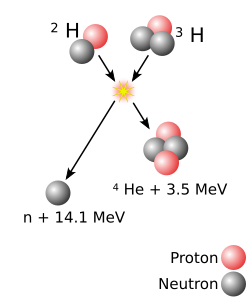
主にカリフォルニウム-249などの重いアクチノイド標的に、炭素-12などの軽いイオンを高速で衝突させる核融合反応によって合成されます。
References
- The density is calculated from the predicted metallic radius (Silva 2008, p. 1639) and the predicted close-packed crystal structure (Fournier 1976).
- In , an element is called if its atomic number is high; (element 82) is one example of such a heavy element. The term "superheavy elements" typically refers to elements with atomic number greater than (although there are other definitions, such as atomic number greater than or ; sometimes, the term is presented an equivalent to the term "transactinide", which puts an upper limit before the beginning of the hypothetical series). Terms "heavy isotopes" (of a given element) and "heavy nuclei" mean what could be understood in the common language—isotopes of high mass (for the given element) and nuclei of high mass, respectively.
- In 2009, a team at the JINR led by Oganessian published results of their attempt to create hassium in a symmetric 136Xe + 136Xe reaction. They failed to observe a single atom in such a reaction, putting the upper limit on the cross section, the measure of probability of a nuclear reaction, as 2.5 . In comparison, the reaction that resulted in hassium discovery, 208Pb + 58Fe, had a cross section of ~20 pb (more specifically, 19+19
-11 pb), as estimated by the discoverers. - The amount of energy applied to the beam particle to accelerate it can also influence the value of cross section. For example, in the 28
14Si + 1
0n → 28
13Al + 1
1p reaction, cross section changes smoothly from 370 mb at 12.3 MeV to 160 mb at 18.3 MeV, with a broad peak at 13.5 MeV with the maximum value of 380 mb. - This figure also marks the generally accepted upper limit for lifetime of a compound nucleus.
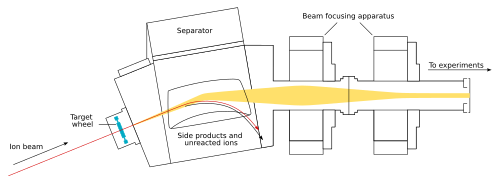
- This separation is based on that the resulting nuclei move past the target more slowly then the unreacted beam nuclei. The separator contains electric and magnetic fields whose effects on a moving particle cancel out for a specific velocity of a particle. Such separation can also be aided by a and a recoil energy measurement; a combination of the two may allow to estimate the mass of a nucleus.
- Not all decay modes are caused by electrostatic repulsion. For example, is caused by the .
- It was already known by the 1960s that ground states of nuclei differed in energy and shape as well as that certain magic numbers of nucleons corresponded to greater stability of a nucleus. However, it was assumed that there was no nuclear structure in superheavy nuclei as they were too deformed to form one.
- Since mass of a nucleus is not measured directly but is rather calculated from that of another nucleus, such measurement is called indirect. Direct measurements are also possible, but for the most part they have remained unavailable for superheavy nuclei. The first direct measurement of mass of a superheavy nucleus was reported in 2018 at LBNL. Mass was determined from the location of a nucleus after the transfer (the location helps determine its trajectory, which is linked to the mass-to-charge ratio of the nucleus, since the transfer was done in presence of a magnet).
- If the decay occurred in a vacuum, then since total momentum of an isolated system before and after the decay , the daughter nucleus would also receive a small velocity. The ratio of the two velocities, and accordingly the ratio of the kinetic energies, would thus be inverse to the ratio of the two masses. The decay energy equals the sum of the known kinetic energy of the alpha particle and that of the daughter nucleus (an exact fraction of the former). The calculations hold for an experiment as well, but the difference is that the nucleus does not move after the decay because it is tied to the detector.
📸 フォトギャラリー