私たちの日常生活に欠かせない「塩」の正体は、化学的に塩化ナトリウム(NaCl)と呼ばれる化合物です。単なる調味料としての枠を超え、工業、医療、光学、そして環境維持に至るまで、この単純な組成の物質は驚くほど幅広い役割を担っています。本記事では、塩化ナトリウムの基礎的な化学構造から、現代社会を支える多様な用途までを詳しく解説します。
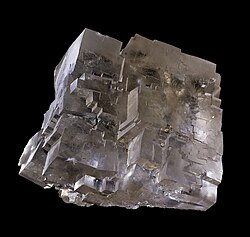
主要な事実(Key Facts)
- 化学式: NaCl(ナトリウムイオンと塩化物イオンが1:1で結合)
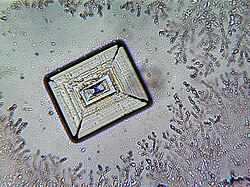
- 外観: 無色透明の立方晶系結晶
- 融点: 800.7 °C / 沸点: 1,413 °C
- 水溶性: 25 °Cにおいて1リットルあたり約360gが溶解
- 主な用途: 食品、化学工業(塩素・苛性ソーダ製造)、道路の凍結防止、赤外線光学素子
結晶構造と物理的性質
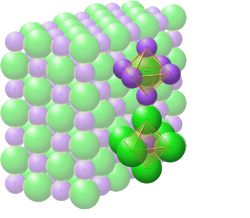
塩化ナトリウムは、面心立方格子(fcc)と呼ばれる非常に規則正しい構造を持っています。具体的には、大きな塩化物イオン(半径167 pm)が立方体状に配列し、その隙間を小さなナトリウムイオン(半径116 pm)が埋める形となっています。この構造により、各イオンは反対の電荷を持つ6つのイオンに囲まれた正八面体形状を形成しています。
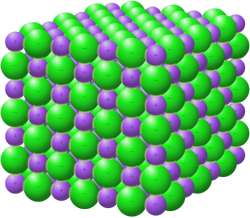
この強固な静電的結合により、固体状態では高い融点(800.7 °C)を維持しますが、水に溶解すると構造が崩壊します。水分子の極性によってナトリウムイオンと塩化物イオンがそれぞれ取り囲まれ(水和)、自由なイオンとして振る舞うため、水溶液は電気を通す性質を持ちます。
![View of one slab of hydrohalite, NaCl·2H2O. (red = O, white = H, green = Cl, purple = Na).[28]](/images/34/9b/349b41b14f5902965d1849313b379642f0f65aeece6208eb9ebfae36c418f220.png)
産業および実用的な用途
化学工業における基幹原料
塩化ナトリウムは、現代化学工業の心臓部とも言えるクロルアルカリ工業の主原料です。電解槽を用いて塩水を電気分解することで、塩素(Cl₂)、水素(H₂)、および水酸化ナトリウム(NaOH)を同時に製造します。また、ソーダ灰の製造や水質浄化(水軟化)にも不可欠な物質です。
冬期の道路維持と凍結防止
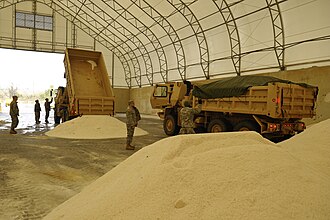
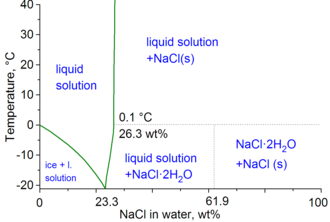
寒冷地では、路面の凍結を防ぐために大量の塩(ロードソルト)が散布されます。これは塩化ナトリウムが水の凝固点を下げる性質を持つためです。物理化学的な理論値では、塩分濃度が23.31重量%のときに最低凝固点である−21.12 °Cに達します。
特殊な光学用途
意外な用途として、赤外線光学素子が挙げられます。塩化ナトリウムの結晶は、波長0.2〜18 μmの赤外線を90%以上の高い透過率で通すため、窓やレンズに使用されてきました。ただし、吸湿性が高く空気中の水分で表面が曇るため、真空封止された環境や乾燥した条件下での利用に限定されます。
その他の利用分野
- 農業: 適切な濃度(1〜3g/L)で肥料として利用されますが、過剰になると毒性を示すため注意が必要です。
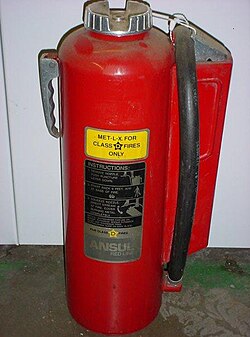
- 消防: 特定の金属火災(クラスD火災)に対する消火剤として利用されます。
- 医療: 生理食塩水などの形態で、体液の浸透圧調整や洗浄に使用されます。
塩化ナトリウムの基本データまとめ
| 項目 | 数値・特性 |
|---|---|
| モル質量 | 58.44 g/mol |
| 密度 | 2.17 g/cm³ |
| 屈折率 (n D) | 1.5441 (589 nm) |
| 水への溶解度 (25 °C) | 360 g/L |
| 標準生成エンタルピー | −411.120 kJ/mol |
| NFPA 704危険度 | 0-0-0(低危険性) |

生産と分布
世界的な生産量は年間約2億8,000万トンに達し、主な供給源は海水の蒸発、塩湖からの抽出、および岩塩の採掘です。生産量では中国が世界最大の供給国であり、次いで米国、インド、ドイツ、カナダが主要な生産国となっています。
Frequently Asked Questions
塩化ナトリウムが氷を溶かす仕組みは何ですか?
塩化ナトリウムが水に溶けると、水分子の規則的な配列を乱し、凝固点(凍る温度)を下げる「凝固点降下」という現象が起こります。これにより、0 °C以下になっても凍らない溶液となり、路面の氷を溶かすことができます。
食塩以外の名前で呼ばれることはありますか?
はい。鉱物学的な名称では岩塩(halite)と呼ばれ、用途に応じて食卓塩(table salt)、海塩(sea salt)、あるいは医療用の生理食塩水(saline)などと使い分けられています。
塩化ナトリウムに毒性はありますか?
一般的に安全な物質ですが、過剰摂取は健康に影響を与えます。ラットを用いた経口投与の半数致死量(LD₅₀)は3 g/kgと報告されています。また、植物に対しても高濃度では毒性を示すため、肥料として使用する際は濃度管理が重要です。
なぜ赤外線レンズに塩化ナトリウムが使われるのですか?
多くの物質が吸収してしまう赤外線領域(0.2〜18 μm)において、塩化ナトリウムの結晶は非常に高い透過率を持つためです。安価で加工しやすい点もメリットですが、湿気に弱いため取り扱いには注意が必要です。
References
- "Sodium Chloride (NaCl) Crystal". PhysicsOpenLab. Archived from the original on 8 February 2018. Retrieved 23 August 2021.
- Haynes, 4.89
- Haynes, 4.135
- Haynes, 10.241
- Haynes, 4.148
- Haynes, 5.8
- Tucker, R. K.; Haegele, M. A. (1971). "Comparative acute oral toxicity of pesticides to six species of birds". Toxicology and Applied Pharmacology. 20 (1): 57–65. :1971ToxAP..20...57T. :10.1016/0041-008x(71)90088-3. 0041-008X. 5110827.
- Wells, John C. (2008), Longman Pronunciation Dictionary (3rd ed.), Longman, pp. 143 and 755,
- Westphal, Gisbert et al. (2002) "Sodium Chloride" in Ullmann's Encyclopedia of Industrial Chemistry, Wiley-VCH, Weinheim :10.1002/14356007.a24_317.pub4.
- Kostick, Dennis S. (October 2010). "Salt" (PDF). U.S. Geological Survey, 2008 Minerals Yearbook. Archived (PDF) from the original on 1 July 2017. Retrieved 4 May 2011.
- Caenn, Ryen; Darley, H. C. H.; Gray, George Robert; Gray, George Robert (2011). Composition and properties of drilling and completion fluids (6th ed.). Amsterdam ; Boston, MA: Gulf Professional Pub. .
- Partal, Recep; Basturk, Irfan; Murat Hocaoglu, Selda; Baban, Ahmet; Yilmaz, Ecem (2022). "Recovery of water and reusable salt solution from reverse osmosis brine in textile industry: A case study". Water Resources and Industry. 27 100174. :2022WRI....2700174P. :10.1016/j.wri.2022.100174.
- Elvers, B. et al. (ed.) (1991) Ullmann's Encyclopedia of Industrial Chemistry, 5th ed. Vol. A24, Wiley, p. 319, .
- Rastogi, Nina Shen (16 February 2010). "Salting the Earth". Slate. 1091-2339. Archived from the original on 11 March 2023. Retrieved 11 March 2023.
- "Saltier waterways are creating dangerous 'chemical cocktails'". phys.org. Archived from the original on 3 December 2018. Retrieved 3 December 2018.
- "Most Road Salt Is Making It into Lakes And Rivers". www.sciencedaily.com. University of Minnesota. 20 February 2009. Archived from the original on 14 February 2009. Retrieved 27 September 2015.
- Casey, Michael. "Turning to beet juice and beer to address road salt danger". phys.org. Archived from the original on 29 January 2018. Retrieved 3 December 2018.
- "EASA Cautions on Organic Salt Deicing Fluid". MRO Network. 9 December 2016. Archived from the original on 10 January 2018. Retrieved 3 December 2018.
- Flowers, Timothy J.; Munns, Rana; Colmer, Timothy D. (1 December 2014). "Sodium chloride toxicity and the cellular basis of salt tolerance in halophytes". Annals of Botany. 115 (3): 419–431. :10.1093/aob/mcu217. 4332607. 25466549.
- Maathuis, Frans J. M. (22 October 2013). "Sodium in plants: Perception, signalling, and regulation of sodium fluxes". Journal of Experimental Botany. 65 (3): 849–858. :10.1093/jxb/ert326. 24151301.
- Lee, M. Kate; Van Iersel, Marc W. (2008). "Sodium Chloride Effects on Growth, Morphology, and Physiology of Chrysanthemum (Chrysanthemum ×morifolium)". HortScience. 43 (6): 1888–1891. :10.21273/HORTSCI.43.6.1888.
- "Sodium Chloride for oral solution". Cleveland Clinic. Archived from the original on 9 March 2024. Retrieved 9 March 2024.
- Bagot, Keith; Subbotin, Nicholas; Kalberer, Jennifer (November 2006). "Evaluation of a New Liquid Fire-Extinguishing Agent for Combustible Metal Fires" (PDF). . . Archived (PDF) from the original on 2 May 2024. Retrieved 1 May 2024.
- Waynant, Ronald W.; Ediger, Marwood N. (2000). "Chapter 11: Optical Materials: Visible and Infrared". Electro-optics Handbook. New York: McGraw-Hill Professional Publishing. p. 11.20. . Archived from the original on 1 May 2024. Retrieved 1 May 2024.
- R. D. Shannon (1976). "Revised effective ionic radii and systematic studies of interatomic distances in halides and chalcogenides". Acta Crystallogr A. 32 (5): 751–767. :1976AcCrA..32..751S. :10.1107/S0567739476001551.
- Nakamuro, Takayuki; Sakakibara, Masaya; Nada, Hiroki; Harano, Koji; Nakamura, Eiichi (2021). "Capturing the Moment of Emergence of Crystal Nucleus from Disorder". Journal of the American Chemical Society. 143 (4): 1763–1767. :2021JAChS.143.1763N. :10.1021/jacs.0c12100. 33475359.
- Sirdeshmukh, Dinker B.; Sirdeshmukh, Lalitha & Subhadra, K. G. (2001). Alkali halides: a handbook of physical properties. Springer. pp. 65, 68. .
- Klewe, B; Pedersen (1974). "The crystal structure of sodium chloride dihydrate". Acta Crystallogr. B30 (10): 2363–2371. :1974AcCrB..30.2363K. :10.1107/S0567740874007138.
- Water-NaCl phase diagram. Lide, CRC Handbook of Chemistry and Physics, 86 ed (2005-2006), CRC pages 8-71, 8-116
- University of Washington. "Newly discovered form of salty ice could exist on surface of extraterrestrial moons". Phys.org. Archived from the original on 21 February 2023. Retrieved 21 February 2023.
- Lincoln, S. F.; Richens, D. T. and Sykes, A. G. (2003) "Metal Aqua Ions" Comprehensive Coordination Chemistry II Volume 1, pp. 515–555. :10.1016/B0-08-043748-6/01055-0.
- "Acidic, Basic, and Neutral Salts". Flinn Scientific Chem Fax. 2016. Archived from the original on 19 September 2018. Retrieved 18 September 2018.
Neutralization of a strong acid and a strong base gives a neutral salt.
- Burgess, J (1978). Metal Ions in Solution. New York: Ellis Horwood. .
- Tikhomirova, K. A.; Tantardini, C.; Sukhanova, E. V.; Popov, Z. I.; Evlashin, S. A.; Tarkhov, M. A.; Zhdanov, V. L. (2020). "Exotic Two-Dimensional Structure: The first case of Hexagonal NaCl". The Journal of Physical Chemistry Letters. 11 (10): 3821–3827. :2020JPCL...11.3821T. :10.1021/acs.jpclett.0c00874. 32330050. 216130640.
- Zhang, W.; Oganov, A. R.; Goncharov, A. F.; Zhu, Q.; Boulfelfel, S. E.; Lyakhov, A. O.; Stavrou, E.; Somayazulu, M.; Prakapenka, V. B.; Konôpková, Z. (2013). "Unexpected Stable Stoichiometries of Sodium Chlorides". Science. 342 (6165): 1502–1505. :1310.7674. :2013Sci...342.1502Z. :10.1126/science.1244989. 24357316. 15298372.
- Finlayson-Pitts, Barbara J.; Hemminger, John C. (1 December 2000). "Physical Chemistry of Airborne Sea Salt Particles and Their Components". The Journal of Physical Chemistry A. 104 (49): 11463–11477. :2000JPCA..10411463F. :10.1021/jp002968n. 1089-5639. Archived from the original on 7 May 2023. Retrieved 20 July 2024.
- Mason, B. J. (2006). "The role of sea-salt particles as cloud condensation nuclei over the remote oceans". Quarterly Journal of the Royal Meteorological Society. 127 (576): 2023–32. :2001QJRMS.127.2023M. :10.1002/qj.49712757609. 121846285.
- Bolen, Wallace P. (January 2018). "Salt" (PDF). U.S. Geological Survey, 2018 Mineral Commodity Summaries. Archived (PDF) from the original on 22 September 2018. Retrieved 22 September 2018.
📸 フォトギャラリー