Diagram of the early Solar System's protoplanetary disk, out of which Earth and other Solar System bodies formed
← ホームへ戻る

太陽系構造から構成天体までを網羅する宇宙の旅

私たちが暮らす地球を含む太陽系は、約45億6800万年前に誕生しました。中心に位置する恒星である太陽の強力な重力に束縛された、惑星、衛星、準惑星、そして無数の小天体からなる壮大なシステムです。天の川銀河のオリオン・キグナス腕に位置し、局所星間雲という領域の中に浮かんでいます。

太陽系の形成は、巨大なガスと塵の雲が重力で崩壊し、回転する円盤状の構造(原始惑星系円盤)ができたことから始まりました。この円盤の中で物質が衝突・合体を繰り返すことで、現在の惑星や小惑星が形作られました。
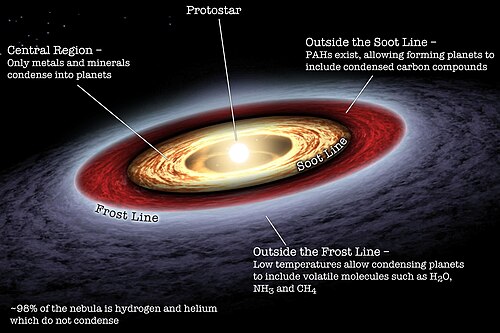
Diagram of the early Solar System's protoplanetary disk, out of which Earth and other Solar System bodies formed

Key Facts

  • 年齢:約45億6800万年
  • 中心星:太陽(スペクトル型 G2V)
  • 主要構成:8つの惑星、複数の準惑星、750以上の天然衛星
  • 銀河系での位置:天の川銀河中心から約24,000〜28,000光年
  • 公転速度:銀河中心に対し時速約72万kmで移動

太陽:システムの心臓部

太陽系全体の質量の大部分を占める太陽は、光と熱を供給する唯一の恒星です。現在は主系列星という安定した段階にありますが、将来的に寿命を迎えると赤色巨星へと進化し、そのサイズは現在の比ではないほど巨大化すると予測されています。
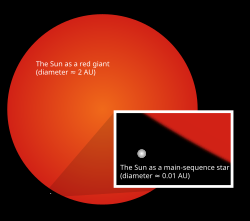
The current Sun compared to its peak size in the red-giant phase

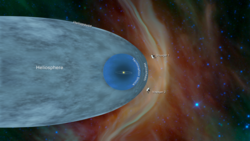
太陽から放出される太陽風や放射圧は、太陽系の境界であるヘリオポーズ(太陽圏界面)まで影響を及ぼしており、この領域が太陽系の実質的な物理的境界となっています。
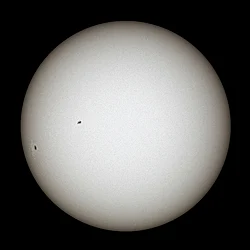
White ball of plasma
Diagram of the Sun's magnetosphere and helioshealth

内太陽系:岩石の世界

太陽に近い領域には、主に岩石や金属で構成された地球型惑星(水星、金星、地球、火星)が存在します。これらの惑星はサイズが比較的小さく、密度が高いのが特徴です。
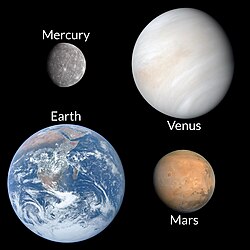
Venus and Earth about the same size, Mars is about 0.55 times as big and Mercury is about 0.4 times as big

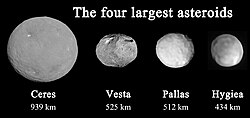
内惑星の公転周期は短く、水星のようにわずか88日で太陽を一周するものから、火星のように約687日かかるものまであります。また、火星と木星の間には、数多くの小惑星が密集する小惑星帯(アステロイドベルト)が広がっています。ここにはケレスやベスタといった比較的大きな小惑星が含まれています。
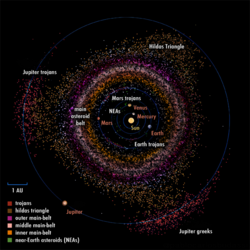
Asteroid populations depicted: near-Earth asteroids, Earth trojans, Mars trojans, main asteroid belt, Jupiter trojans, Jupiter Greeks, Jupiter Hilda's triangle
The four largest asteroids: Ceres, Vesta, Pallas, Hygiea. Only Ceres and Vesta have been visited by a spacecraft and thus have a detailed picture.
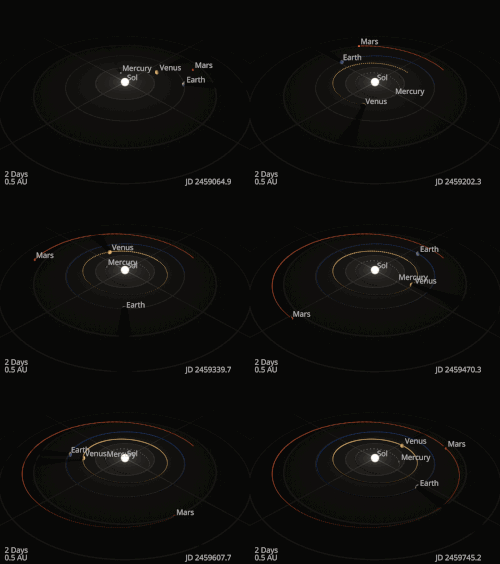
Animations of the Solar System's inner planets orbiting. Each frame represents 2 days of motion.

外太陽系:巨大惑星の領域

小惑星帯よりも外側には、水素やヘリウムを主成分とする巨大ガス惑星(木星、土星)と、水やアンモニアなどの氷成分を多く含む巨大氷惑星(天王星、海王星)が位置しています。これらは地球型惑星に比べて圧倒的に巨大です。
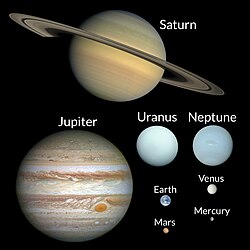
Jupiter and Saturn is about 2 times bigger than Uranus and Neptune, 10 times bigger than Venus and Earth, 20 times bigger than Mars and 25 times bigger than Mercury

外惑星の公転周期は非常に長く、最も遠い海王星が太陽を一周するのに約165年もの時間を要します。また、これらの惑星はそれぞれ多くの衛星を伴っており、複雑な衛星系を構築しています。
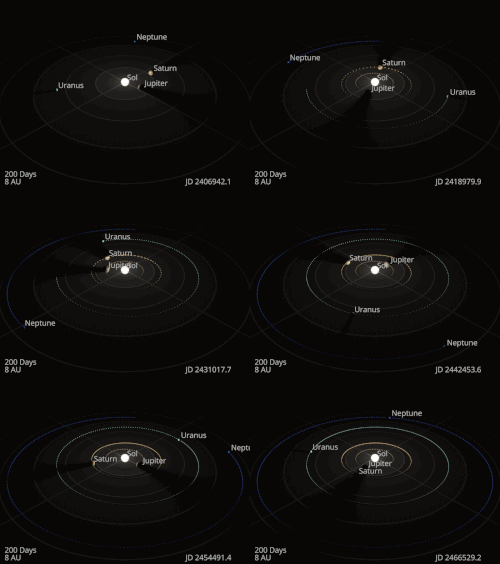
Animations of the Solar System's outer planets orbiting. This animation is 100 times faster than the inner planet animation.

太陽系の果てと未知の領域

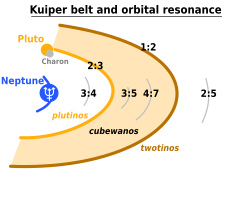
海王星の軌道よりもさらに外側には、氷の天体が集まるカイパーベルトが存在します。ここには冥王星などの準惑星が含まれており、一部の天体は特定の軌道共鳴状態にあります。
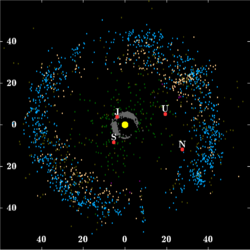
Plot of objects around the Kuiper belt and other asteroid populations. J, S, U and N denotes Jupiter, Saturn, Uranus and Neptune.
Orbit classification of Kuiper belt objects. Some clusters that are subject to orbital resonance are marked.

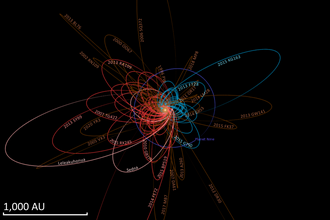
さらに遠方には、軌道が大きく乱れた天体が分布する散在円盤や、極めて遠い軌道を持つ極端太陽系外天体(ETNO)が存在します。一部の天文学者は、これらの軌道の乱れから、まだ発見されていない「第9惑星」の存在を想定しています。
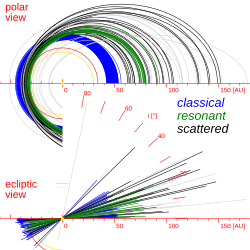
The orbital eccentricities and inclinations of the scattered disc population compared to the classical and resonant Kuiper belt objects
The current orbits of Sedna, 2012 VP113, Leleākūhonua (pink), and other very distant objects (red, brown and cyan) along with the predicted orbit of the hypothetical Planet Nine (dark blue)

太陽系の最外縁には、球殻状に氷の天体が分布しているとされるオールトの雲があると考えられています。ここは太陽の重力影響が及ぶ限界に近い領域であり、多くの長周期彗星の故郷であるとされています。
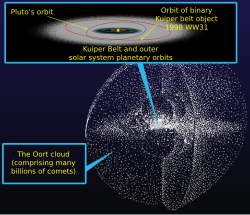
An artist's impression of the Oort cloud, a region still well within the sphere of influence of the Solar System, including a depiction of the much further inside Kuiper belt (inset); the sizes of objects are over-scaled for visibility.

宇宙における位置付けと環境

太陽系は孤立して存在するのではなく、星間物質に囲まれています。太陽圏の外には局所星間雲などのガス雲が広がっており、隣接する恒星系で最も近いのはプロキシマ・ケンタウリ(約4.25光年)です。
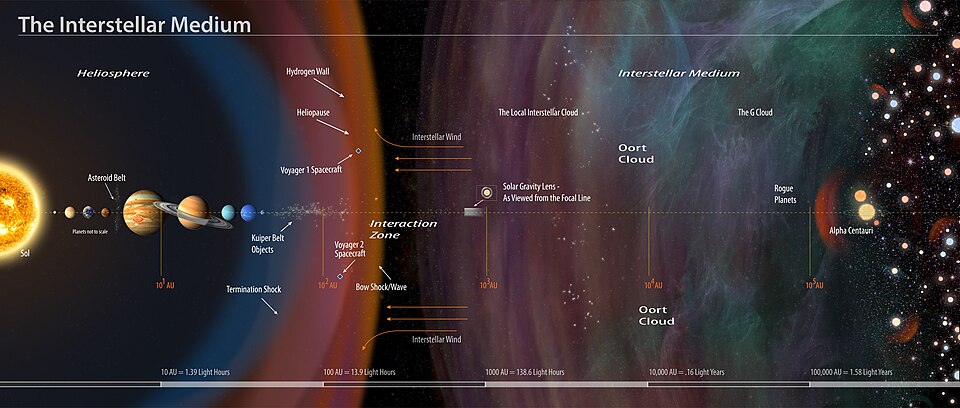
The Solar System (left) within the interstellar medium, with the different regions and their distances on a logarithmic scale
Diagram of the Local Interstellar Cloud, the G-Cloud and surrounding stars. As of 2022[update], the exact position of the Solar System within the interstellar clouds remains an unresolved question in astronomy.[277]

銀河系全体で見ると、太陽系は巨大な渦巻き構造の一部であり、銀河中心の周りを約2億3000万年かけて一周しています。
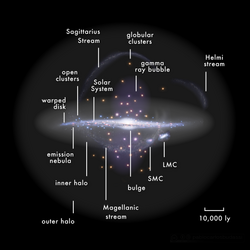
Diagram of the Milky Way, with galactic features and the relative position of the Solar System labeled.

また、太陽系内には惑星以外にも、太陽の光で尾を引く彗星や、宇宙空間を漂う流星体、塵などが存在し、ダイナミックな環境を作り出しています。
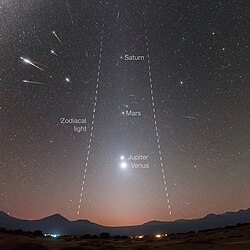
The planets, zodiacal light and meteor shower (top left of image)
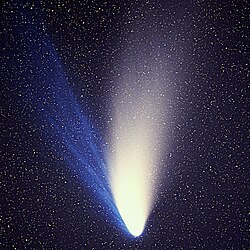
At lower left, a white coma stands out against a black background. Nebulous material streams away to the top and left, slowly fading with distance.

惑星の軌道特性まとめ

各惑星の公転周期と速度は、太陽からの距離に応じて大きく異なります。以下の表に主要なデータをまとめます。

主要惑星の軌道データ
惑星名 公転周期(地球日) 公転周期(地球年) 平均公転速度
水星 87.969 0.241 47.9 km/s
金星 224.701 0.615 35.0 km/s
地球 365.256 1.000 29.8 km/s
火星 686.980 1.881 24.1 km/s
木星 4,332.589 11.862 13.1 km/s
土星 10,759.22 29.457 9.7 km/s
天王星 30,688.5 84.020 6.8 km/s
海王星 60,182 164.8 5.4 km/s

このように、太陽から離れるほど公転速度は遅くなり、一周にかかる時間は飛躍的に増大します。
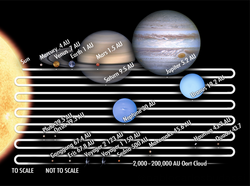
Relative orbital distances in the Solar System visualized as a condensed rectangle
Comparison of the distances between planets, with the white bar showing orbital variations. The size of the planets is not to scale.

人類による探査の歴史

古くは星の動きを観察することで惑星の存在が知られていましたが、近代天文学の発展により、望遠鏡や宇宙探査機による詳細な調査が可能となりました。かつては天王星や海王星、小惑星帯などは未知の領域でしたが、現在は多くの無人探査機が太陽系の隅々までデータを届けています。
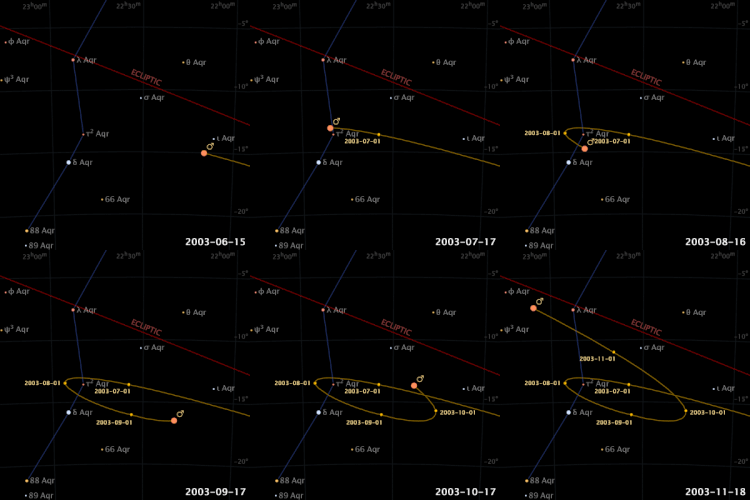
The motion of 'lights' moving across the sky is the basis of the classical definition of planets: wandering stars.
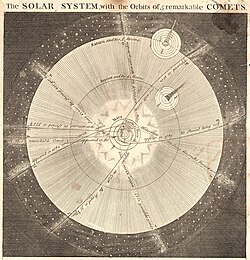
Solar system diagram by Emanuel Bowen in 1747, when neither Uranus, Neptune, nor the asteroid belts had yet been discovered. Orbits of planets are to scale, but the orbits of moons and the sizes of bodies are not.

現在も多くの探査機が活動しており、2026年に向けてもさらなるミッションが計画されています。これにより、太陽系の成り立ちや、生命が存在しうる環境についての理解が深まっています。
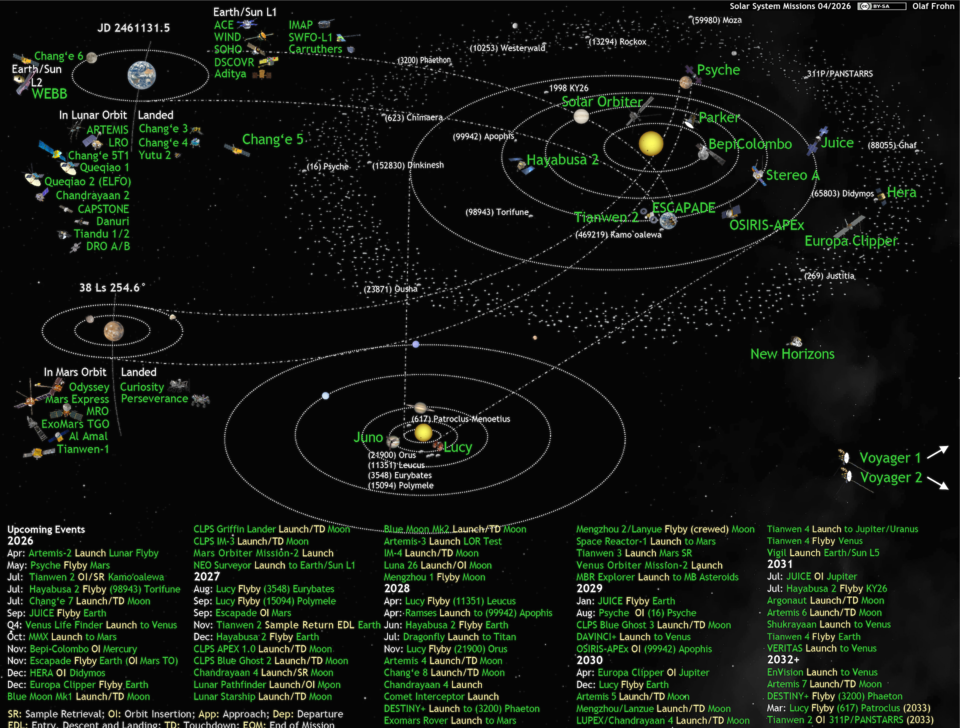
All active Solar System space probes in 2026 (and a list of upcoming ones)
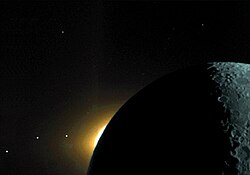
A color enhanced photograph from the Moon of a range of components of the Solar System. The three dots at the lower left are from left to right the planets Saturn, Mars, and Mercury, and in the middle of the picture rises the Sun's corona over the dark limb of the Moon, which is from the right lit by earthshine.
The Sun, the planets, their moons, and several trans-Neptunian objects

Frequently Asked Questions

太陽系で最も遠い領域はどこですか?

物理的な影響範囲としては、太陽の重力が及ぶヒル圏(ヒル球)が最大ですが、一般的に天体が存在する最外縁としては、球殻状に分布するオールトの雲が挙げられます。

準惑星とは何ですか?

惑星に近い性質を持ちながら、自身の軌道周辺から他の天体を排除できていない天体のことです。冥王星やケレス、エリスなどがこれに分類されます。

太陽系は銀河系の中でどのように動いていますか?

太陽系は天の川銀河の中心を軸に、時速約72万kmという猛烈な速度で公転しています。一周するのにかかる時間は約2億3000万年です。

小惑星帯とカイパーベルトの違いは何ですか?

小惑星帯は火星と木星の間に位置し、主に岩石質の天体で構成されています。一方、カイパーベルトは海王星の外側に位置し、氷や揮発性物質を多く含む天体が分布している点が異なります。

太陽の寿命が尽きるとどうなりますか?

太陽は将来的に赤色巨星へと進化し、大きく膨張します。その過程で内側の惑星を飲み込む可能性がありますが、その後は外層を放出して惑星状星雲となり、中心部は白色矮星として静かに冷えていくと考えられています。

References

  1. The , , and are not added because the individual asteroids are too small to be shown on the diagram.
  2. The date is based on the oldest found to date in , 4568.2+0.2
    −0.4 million years, and is thought to be the date of the formation of the first solid material in the collapsing nebula.
  3. If ψ {\displaystyle \psi } is the angle between the and the north then:
    cos ψ = cos ( β g ) cos ( β e ) cos ( α g α e ) + sin ( β g ) sin ( β e ) {\displaystyle \cos \psi =\cos(\beta _{g})\cos(\beta _{e})\cos(\alpha _{g}-\alpha _{e})+\sin(\beta _{g})\sin(\beta _{e})}
    where β g {\displaystyle \beta _{g}} = 27° 07′ 42.01″ and α g {\displaystyle \alpha _{g}} = 12h 51m 26.282s are the declination and right ascension of the north galactic pole, whereas β e {\displaystyle \beta _{e}} = 66° 33′ 38.6″ and α e {\displaystyle \alpha _{e}} = 18h 0m 00s are those for the north pole of the ecliptic. (Both pairs of coordinates are for epoch.) The result of the calculation is 60.19°.
  4. The scale of the Solar System is sufficiently large that astronomers use a custom unit to express distances. The , abbreviated AU, is equal to 150,000,000 km; 93,000,000 mi. This is what the distance from the Earth to the Sun would be if the planet's orbit were perfectly circular.
  5. For more classifications of Solar System objects, see and .
  6. The mass of the Solar System excluding the Sun, Jupiter and Saturn can be determined by adding together all the calculated masses for its largest objects and using rough calculations for the masses of the Oort cloud (estimated at roughly 3 Earth masses), the Kuiper belt (estimated at 0.1 Earth mass) and the asteroid belt (estimated to be 0.0005 Earth mass) for a total, rounded upwards, of ~37 Earth masses, or 8.1% of the mass in orbit around the Sun. With the combined masses of Uranus and Neptune (~31 Earth masses) subtracted, the remaining ~6 Earth masses of material comprise 1.3% of the total orbiting mass.

📸 フォトギャラリー

Diagram of the early Solar System's protoplanetary disk, out of which Earth and other Solar System bodies formed
The current Sun compared to its peak size in the red-giant phase
A color enhanced photograph from the Moon of a range of components of the Solar System. The three dots at the lower left are from left to right the planets Saturn, Mars, and Mercury, and in the middle of the picture rises the Sun's corona over the dark limb of the Moon, which is from the right lit by earthshine.
Animations of the Solar System's inner planets orbiting. Each frame represents 2 days of motion.
Animations of the Solar System's outer planets orbiting. This animation is 100 times faster than the inner planet animation.
Relative orbital distances in the Solar System visualized as a condensed rectangle
Comparison of the distances between planets, with the white bar showing orbital variations. The size of the planets is not to scale.
White ball of plasma
Venus and Earth about the same size, Mars is about 0.55 times as big and Mercury is about 0.4 times as big
Asteroid populations depicted: near-Earth asteroids, Earth trojans, Mars trojans, main asteroid belt, Jupiter trojans, Jupiter Greeks, Jupiter Hilda's triangle
The four largest asteroids: Ceres, Vesta, Pallas, Hygiea. Only Ceres and Vesta have been visited by a spacecraft and thus have a detailed picture.
Jupiter and Saturn is about 2 times bigger than Uranus and Neptune, 10 times bigger than Venus and Earth, 20 times bigger than Mars and 25 times bigger than Mercury
Plot of objects around the Kuiper belt and other asteroid populations. J, S, U and N denotes Jupiter, Saturn, Uranus and Neptune.
Orbit classification of Kuiper belt objects. Some clusters that are subject to orbital resonance are marked.
The orbital eccentricities and inclinations of the scattered disc population compared to the classical and resonant Kuiper belt objects
The current orbits of Sedna, 2012 VP113, Leleākūhonua (pink), and other very distant objects (red, brown and cyan) along with the predicted orbit of the hypothetical Planet Nine (dark blue)
An artist's impression of the Oort cloud, a region still well within the sphere of influence of the Solar System, including a depiction of the much further inside Kuiper belt (inset); the sizes of objects are over-scaled for visibility.
The planets, zodiacal light and meteor shower (top left of image)
At lower left, a white coma stands out against a black background. Nebulous material streams away to the top and left, slowly fading with distance.
The Solar System (left) within the interstellar medium, with the different regions and their distances on a logarithmic scale
Diagram of the Sun's magnetosphere and helioshealth
Diagram of the Local Interstellar Cloud, the G-Cloud and surrounding stars. As of 2022[update], the exact position of the Solar System within the interstellar clouds remains an unresolved question in astronomy.[277]
Diagram of the Milky Way, with galactic features and the relative position of the Solar System labeled.
The motion of 'lights' moving across the sky is the basis of the classical definition of planets: wandering stars.
Solar system diagram by Emanuel Bowen in 1747, when neither Uranus, Neptune, nor the asteroid belts had yet been discovered. Orbits of planets are to scale, but the orbits of moons and the sizes of bodies are not.
All active Solar System space probes in 2026 (and a list of upcoming ones)
The Sun, the planets, their moons, and several trans-Neptunian objects
太陽系構造から構成天体までを網羅する宇宙の旅