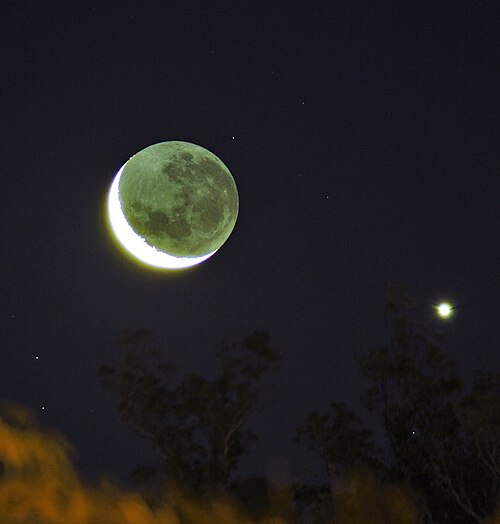
夜空を見上げているとき、2つの明るい惑星や月が驚くほど近くに寄り添っている光景を目にすることがあります。天文学では、このような現象を合(コンジャンクション)と呼びます。これは、地球から見たときに2つの天体が同じ赤経、あるいは同じ黄道経度(太陽の通り道である黄道上の位置)にある状態を指します。
重要なのは、これが「見かけ上の現象」であるということです。実際には、これらの天体は宇宙空間において互いに遠く離れた位置にありますが、観測者の視点から直線上に並ぶため、接近しているように見えます。特に黄道付近を移動する惑星同士や、月と惑星の組み合わせでは頻繁に発生します。また、天体同士が最も接近する瞬間をアプルスと呼び、区別して表現されます。
Key Facts
- 定義:2つの天体が同じ黄道経度または赤経に位置し、視覚的に接近して見える現象。
- 視覚的錯覚:実際の間隔ではなく、地球からの視点による見かけ上の接近である。
- 発生頻度:天体の公転周期(会合周期)によって異なり、水星のような速い惑星は頻繁に合を起こす。
- 多重合:3つ以上の惑星が同時に接近することもあり、極めて稀な天文イベントとなる。
合が発生する仕組みと周期性
惑星はそれぞれ異なる速度で太陽の周りを公転しているため、地球から見たときの位置関係は常に変化しています。ある惑星が別の惑星を追い越すタイミングで「合」が発生します。この合から次の合までの平均的な期間を会合周期と呼びます。
例えば、水星と金星の合は非常に複雑です。金星が太陽の東側から西側へ、そして再び東側へ戻る1サイクル(約1.599年)の間に、水星は公転速度が速いため、金星を何度も追い越します。通常は4回ですが、場合によっては2回や6回(五重合)になることもあります。2048年には、金星が太陽の背後を東進する間に水星と5回出会う現象が予想されています。
![A conjunction of Mars and Jupiter in the morning of 1 May 2011, when, about an hour before sunrise, five of the Solar System's eight planets and the Moon could be seen from Cerro Paranal, Chile.[5]](/images/cd/3d/cd3db1485ae0ba9063fd2d544281009b29a498de759079d61b551ef58fe8fd41.jpg)
天体別の平均合間隔
以下は、主要な天体同士が再び同じ相対位置に戻るまでの平均的な期間(ユリウス年)をまとめた表です。
| 天体 | 水星 | 金星 | 太陽 | 火星 | 木星 | 土星 |
|---|---|---|---|---|---|---|
| 水星 | - | 1.599 | 0.317 | 2.135 | 1.092 | 1.035 |
| 金星 | 1.599 | - | 2.135 | 1.092 | 1.035 | 1.012 |
| 太陽 | 0.317 | 2.135 | - | 1.599 | 2.135 | 1.092 |
| 火星 | 2.135 | 1.092 | 1.599 | - | 2.009 | 1.924 |
| 木星 | 1.092 | 1.035 | 2.135 | 19.859 | - | 13.812 |
| 土星 | 1.035 | 1.012 | 1.092 | 19.859 | 45.360 | - |
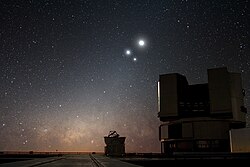
稀に見る大規模な惑星の集結
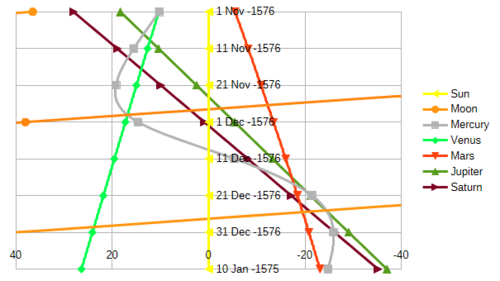
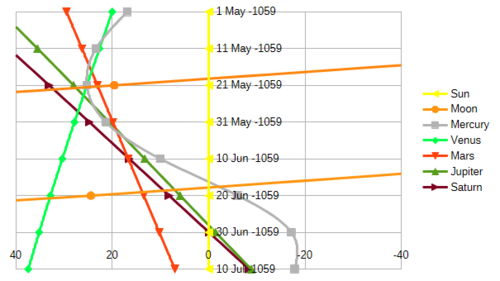
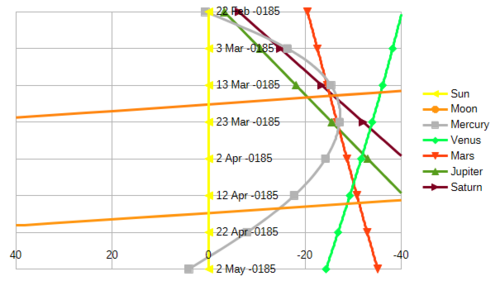
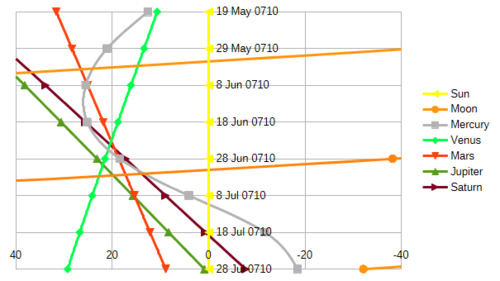
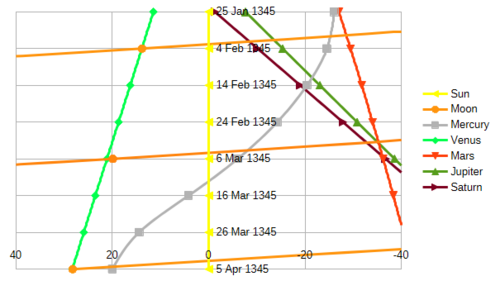
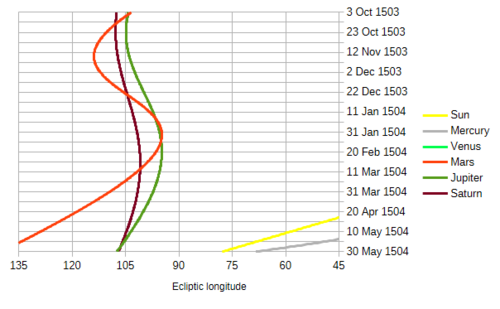
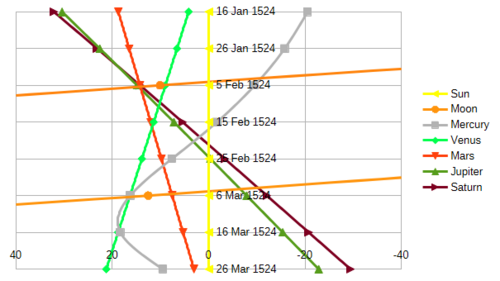
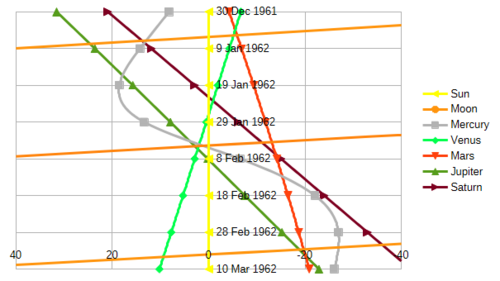
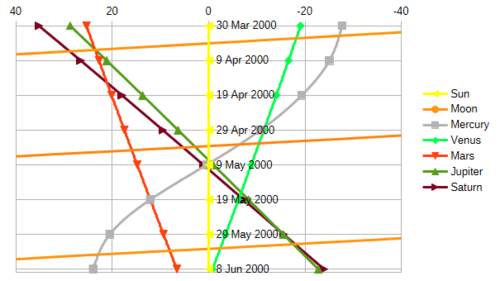
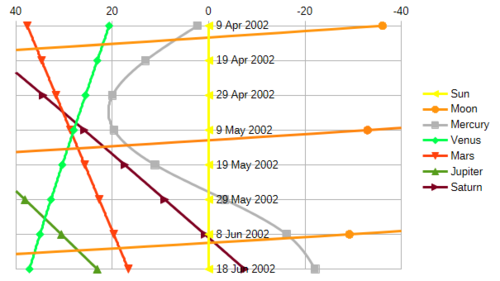
3つ以上の惑星が同時に同じ経度に並ぶことは数学的にほぼあり得ませんが、非常に狭い範囲に集まる「近似的な合」は起こり得ます。歴史的に見ても、肉眼で見える5つの惑星が狭い範囲に集まった例がいくつか記録されています。
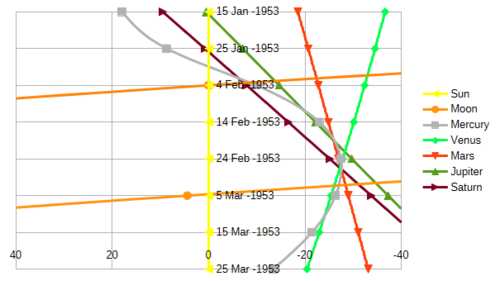
紀元前1953年2月27日には、水星、金星、火星、土星が非常に狭い範囲に集まり、木星を含めた5惑星がわずか4.33度の範囲内に収まっていました。この現象は中国の夏王朝の始まりに関連しているという説もあります。
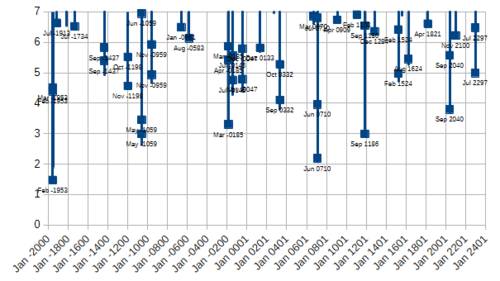
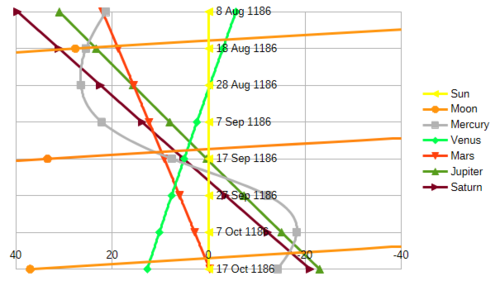
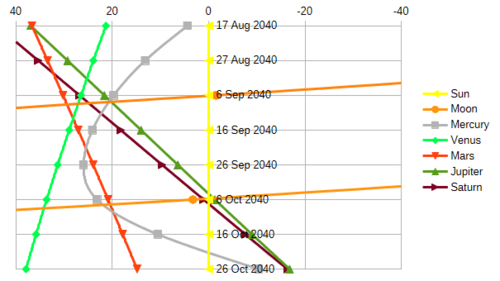
また、西暦710年6月25日には、5惑星が6度という非常に狭い範囲に集まり、マヤ文明によって記録されました。さらに、2040年9月9日には、再び5惑星と月が夜空に集結し、西暦1186年以来の極めて近いグループを形成すると予測されています。
歴史に残る特筆すべき合の事例
超新星と天体の合
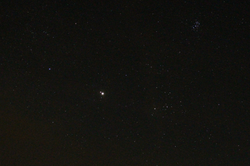
1054年7月5日には、金星よりも明るい超新星がおうし座に現れ、三日月状の月と接近しました。また、1604年10月9日には火星と木星の合が発生した際、そのわずか2度先にケプラーの超新星が出現しました。これは記録上、超新星が惑星の合の近くに現れた極めて稀な例です。
近年の注目イベント
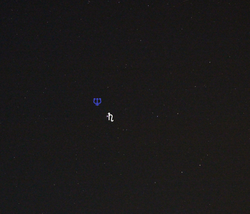
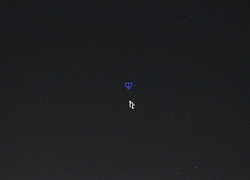
2020年12月21日には、木星と土星が1623年以来の最小接近を記録する「大合(グレート・コンジャンクション)」が起こりました。また、2025年には土星と海王星の三重合が発生します。6月29日に一度目の合(離角59.3分)があり、8月6日に二度目の合(離角1.14度)を迎えます。
Frequently Asked Questions
惑星の合が起きると、実際に惑星同士が衝突する危険はありますか?
いいえ、全くありません。合は地球から見たときの「見かけ上の位置」が重なる現象であり、実際の宇宙空間では惑星同士は数千万から数億キロメートルという膨大な距離を隔てて存在しています。
「三重合」とはどのような現象ですか?
惑星の公転速度の差や地球の公転による逆行現象により、短期間に3回合が発生することを指します。例えば、2025年から2026年にかけて起こる土星と海王星の接近がこれに当たります。
肉眼で合を観察するためのコツはありますか?
明るい惑星(金星や木星など)同士の合は、特別な道具がなくても夜空で簡単に見つけることができます。黄道(太陽や月が通る道)に沿って、特に明るい星が2つ寄り添っている場所を探してください。
惑星が一直線に並ぶ「惑星直列」と「合」は同じことですか?
厳密には異なります。「合」は2つの天体が同じ経度にあることを指しますが、「直列」は複数の惑星が太陽から見てほぼ同じ方向に並ぶ状態を指します。多くの惑星が合の状態になると、結果として直列に近い見た目になります。
References
- Her Majesty's Nautical Almanac Office and United States Naval Observatory (2012). "Conjunction". Glossary, The Astronomical Almanac Online. Archived from the original on 2013-06-15. Retrieved 2012-07-08.
- Jean Meeus (1991). Astronomical Algorithms. Willman-Bell Inc., Richmond, Virginia.
- Her Majesty's Nautical Almanac Office and United States Naval Observatory (2012). "Appulse". Glossary, The Astronomical Almanac Online. Archived from the original on 2013-06-15. Retrieved 2012-07-08.
- Ridpath, John Clark, ed. (1897). The Standard American Encyclopedia. Vol. 1. p. 198.
- "Planetary Conjunction over Paranal". ESO Picture of the Week. ESO. Retrieved 2011-05-02.
- Compare the longitudes of Mercury and the longitudes of Venus in the period January through September 2048, calculated by the .
- Compare the longitudes of Mercury and the longitudes of Venus in the period November 4, 2005, to June 9, 2007, calculated by the . There is a quasiconjunction on August 9, 2006.
- The periods are calculated from the "mean mean motions" given by Simon, J. L.; Bretagnon, P.; Chapront, J.; Chapront-Touze, M.; Francou, G.; Laskar, J. (February 1994). "Numerical expressions for precession formulae and mean elements for the Moon and the planets". Astronomy and Astrophysics. 282: 663. :1994A&A...282..663S.
- Jean Meeus (Dec 1961). "Compact Planetary Groupings". Sky & Telescope: 320.
- Jean Meeus (Aug 1997). "Planet Groupings and the Millennium". Sky & Telescope: 60.
📸 フォトギャラリー