2022年に行われた米国上院議員選挙は、今後の米国の政治方向性を決定づける重要な局面となりました。全100議席のうち35議席を争ったこの選挙では、民主党と共和党が激しく競り合い、最終的な議席配分が政権の運営能力に直結することとなりました。
米国上院では過半数の51議席を確保することが権力掌握の鍵となります。今回の選挙戦では、多くの州で接戦が繰り広げられ、一部の州では決選投票(ランオフ)が行われるなど、極めて緊迫した展開となりました。
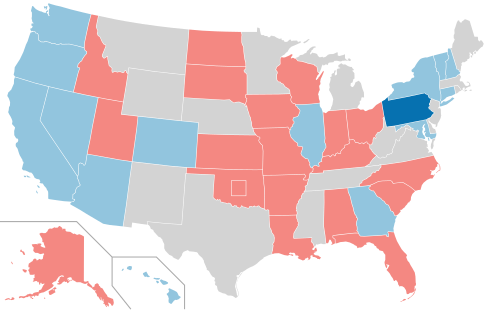
Key Facts
- 最終結果: 民主党が51議席、共和党が49議席となり、民主党が過半数を維持しました。
- 得票数: 民主党が約4,620万票(得票率50.0%)、共和党が約4,385万票(得票率47.4%)を獲得しました。
- 議席の変動: 共和党が保持していた1議席を民主党が奪取(フリップ)しました。
- 接戦の状況: 全体のうち9つの選挙区で、勝利圏の差が10%未満という僅差の戦いとなりました。
選挙結果の詳細と議席の動向
今回の選挙では、多くの現職議員が再選を果たしましたが、注目すべきはペンシルベニア州などの激戦区での変動です。特に、共和党から民主党への議席交代が発生したことで、上院の勢力図に影響を与えました。
得票率で見ると、民主党が全体の約半分を占め、共和党を上回る結果となりました。その他の小政党や独立系候補も一定の票を集めましたが、主要二党による支配的な構造は変わりませんでした。
![Map of retirements: Republican incumbent Democratic incumbent Republican retiring[k] Democratic retiring](/images/22/e8/22e89d89042275f84e92ef634d7b095ae0ced2888719312ae71756609c4c1ada.webp)
主要州の得票傾向
各州の結果を分析すると、地域によって支持傾向が明確に分かれています。例えば、ジョージア州ではラファエル・ウォーノック氏が激しい接戦の末に再選を果たし、民主党の地盤を維持しました。一方で、アラバマ州のケイティ・ブリット氏やアーカンソー州のジョン・ブーズマン氏のように、共和党が圧倒的な得票率で勝利した州も多く存在します。
また、ペンシルベニア州ではジョン・フェッターマン氏が勝利し、共和党から議席を奪い返したことが戦略的なポイントとなりました。このように、州ごとの政治的傾向が最終的な議席数に大きく寄与しています。
得票データまとめ
以下に、主要な政党別の得票数と得票率をまとめました。
| 政党 | 得票数 | 得票率 (%) |
|---|---|---|
| 民主党 | 46,208,845 | 50.0% |
| 共和党 | 43,850,241 | 47.4% |
| その他 | 2,213,856 | 2.6% |
Frequently Asked Questions
2022年上院選挙の最終的な議席数はどうなりましたか?
最終的に民主党が51議席、共和党が49議席となり、民主党が上院の過半数を保持する結果となりました。
得票率で最も差がついたのはどの政党ですか?
民主党が50.0%、共和党が47.4%となり、民主党が約2.6ポイントのリードで最も多くの票を獲得しました。
「フリップ(Flip)」とは何を指しますか?
選挙において、以前の任期で保持していた政党とは異なる政党がその議席を獲得することを指します。今回の選挙では、共和党から民主党へ1議席が移動しました。
接戦となった選挙区はどのくらいありましたか?
勝利した候補者と敗れた候補者の得票差が10%未満であった選挙区が9つ存在し、非常に激しい競争が行われたことがわかります。
ジョージア州の選挙で特徴的だった点は何ですか?
第1回投票で決着がつかず、その後決選投票(ランオフ)が行われ、最終的に民主党のラファエル・ウォーノック氏が勝利した点が特徴的です。
References
- 34 Class 3 seats including both the concurring special and regular elections in California, as well as 1 Class 2 seat in special election
- Majority control in an evenly divided Senate is determined by the , who can break tied votes in their constitutional capacity as President of the Senate. Accordingly, Senate control requires 51 seats without control of the vice presidency or 50 seats with control of the vice presidency.
- Independent senators and caucus with Democrats.
- Although the 2020 elections yielded a 50–50 tie between the Democratic and Republican caucuses, Democrats took the majority due to their concurrent victory in the presidential election, with Vice President empowered to act as tie-breaker.
- , whose seat was not up for election in 2022, left the Democratic Party and became an in December 2022, after the election but before the swearing in of the next Congress. As a result, 48 Democrats (rather than 49), plus King and Sanders, , served in the . Sinema has opted to caucus with neither party but to continue to align with the Democrats, bringing the Democratic Senate majority to 51 seats.
- For the Georgia race, only the runoff results are counted.
- In the 1914 U.S. Senate elections, no incumbent senator lost a general election, but two senators, one each from Kansas and South Dakota, lost renomination in their primary elections.
- Three previous elections have taken place in which both major-party nominees were Black: the , the , and the .
- Democratic incumbents were reelected in Michigan, Montana, Ohio, Pennsylvania, West Virginia, and Wisconsin, while Republicans flipped Florida, Indiana, Missouri, and North Dakota.
- Includes Alex Padilla, an interim appointee to a Class 3 seat who ran in concurrent special and general elections in .
📸 フォトギャラリー