Levels of ozone at various altitudes (DU/km) and blocking of different bands of ultraviolet radiation: In essence, all UVC is blocked by diatomic oxygen (100–200 nm) or by ozone (triatomic oxygen) (200–280 nm) in the atmosphere. The ozone layer then blocks most UVB. Meanwhile, UVA is hardly affected by ozone, and most of it reaches the ground. UVA makes up almost all UV light that penetrates the Earth's atmosphere.
← ホームへ戻る

紫外線(UV)の性質と影響科学的メカニズムから実用的な応用まで

私たちの生活に密接に関わる紫外線(Ultraviolet radiation)は、可視光線よりも波長が短く、X線よりも長い電磁波の一種です。太陽光の約10%を占めるこのエネルギーは、目に見えないながらも、生物学的プロセスや化学反応に強力な影響を及ぼします。単に「日焼けの原因」としてだけでなく、医療や工業、科学分析など、現代社会のあらゆる場面で活用されています。

Key Facts

  • 波長範囲は10〜400ナノメートル(nm)で、エネルギーレベルによってUVA、UVB、UVCに分類される。
  • 短波長の紫外線は電離放射線として機能し、DNAを破壊して殺菌作用を持つ。
  • 地球の大気(主にオゾン層と酸素分子)が、有害な短波長紫外線の大部分を遮断している。
  • 人間にとって、ビタミンDの生成という有益な側面と、皮膚がんや白内障のリスクという有害な側面の双方を持つ。
  • 特定の物質に照射すると、可視光として発光させる「蛍光」現象を引き起こす。

紫外線の分類と物理的特性

紫外線は、その波長によって特性が大きく異なります。一般的にISO 21348規格に基づき、いくつかのカテゴリーに分けられます。波長が短くなるほど光子のエネルギーが高まり、物質に与える影響も強くなります。

紫外線の主要分類と特性
名称 波長 (nm) 主な特徴・性質
UVA 315–400 大気を透過しやすく、皮膚の深層まで到達する。
UVB 280–315 日焼けの主因。ビタミンD生成に寄与する。
UVC 100–280 極めて高いエネルギーを持ち、強力な殺菌作用がある。
極端紫外線 (EUV) 10–121 X線に近い性質を持ち、高度なリソグラフィに使用される。

特に波長200nm以下の領域は、空気中の酸素に強く吸収されるため「真空紫外線(VUV)」と呼ばれます。このため、科学的な計測や半導体製造などの産業利用では、酸素を除去した環境や真空状態で取り扱われます。

太陽から放出される紫外線は、地球の大気圏でフィルタリングされています。酸素分子やオゾン層がUVCのすべてとUVBの大部分を吸収することで、地表に到達するのは主にUVAとなります。
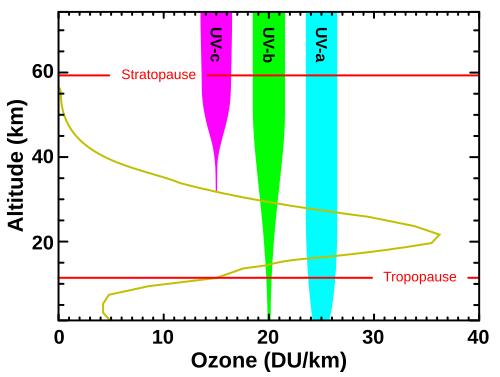
Levels of ozone at various altitudes (DU/km) and blocking of different bands of ultraviolet radiation: In essence, all UVC is blocked by diatomic oxygen (100–200 nm) or by ozone (triatomic oxygen) (200–280 nm) in the atmosphere. The ozone layer then blocks most UVB. Meanwhile, UVA is hardly affected by ozone, and most of it reaches the ground. UVA makes up almost all UV light that penetrates the Earth's atmosphere.

生物への影響:メリットとリスク

紫外線が生物に与える影響は、そのエネルギー量によって「化学的な刺激」から「構造的な破壊」まで多岐にわたります。長波長の紫外線は分子の振動や回転を促して温度を上昇させますが、短波長の紫外線は電子を弾き飛ばす電離作用を持ち、有機分子の化学結合を直接切断することが可能です。

皮膚と健康への影響

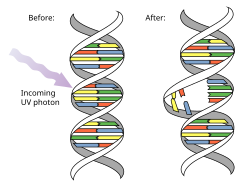
人間にとって最も身近な影響は皮膚への作用です。UVBは皮膚の炎症(サンバーン)を引き起こしますが、同時に体内でビタミンDを合成させる不可欠な役割も担っています。一方で、過剰な曝露はDNAの構造を歪ませ、隣接するチミン塩基同士を結合させる「チミンダイマー」を形成させます。これが適切に修復されない場合、細胞の機能不全や皮膚がんのリスクへとつながります。
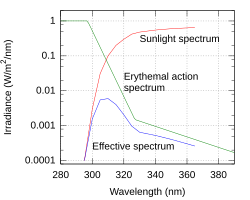
Sunburn effect (as measured by the UV index) is the product of the sunlight spectrum (radiation intensity) and the erythemal action spectrum (skin sensitivity) across the range of UV wavelengths. Sunburn production per milliwatt of radiation intensity is increased by nearly a factor of 100 between the near UVB wavelengths of 315–295 nm.
Ultraviolet photons harm the DNA molecules of living organisms in different ways. In one common damage event, adjacent thymine bases bond with each other, instead of across the "ladder". This "thymine dimer" makes a bulge, and the distorted DNA molecule does not function properly.

日焼け止めなどのUVカット製品は、これらの有害な光線を吸収または反射させることで皮膚を保護します。UVカメラで観察すると、日焼け止めを塗った部分は紫外線を吸収するため、黒く写ることが確認できます。
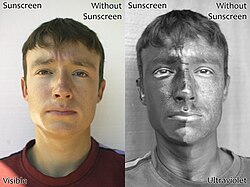
Demonstration of the effect of sunscreen. The left image is a regular photograph of his face; the right image is of reflected UV light. The man's face has sunscreen on his right side only. It appears darker because the sunscreen absorbs the UV light.

眼への影響

目は特にUVC(265〜275nm)に対して非常に敏感です。太陽光では地表に届きませんが、アーク溶接などの人工光源に不用意にさらされると、「電気性眼炎(ウェルダーズフラッシュ)」や白内障、翼状片などの深刻な損傷を招く恐れがあります。また、雪原などで反射したUVBによる「雪目」も同様のメカニズムによるものです。
Signs are often used to warn of the hazard of strong UV sources.

物質の劣化と化学的変化

紫外線は生物だけでなく、無機物や合成樹脂(ポリマー)にも影響を与えます。プラスチック製品が屋外で放置されると、紫外線による化学結合の切断が起こり、脆くなったり変色したりします。これはポリプロピレンなどの素材で顕著に見られ、赤外分光法などでカルボニル基の生成といった化学的劣化が証明されています。
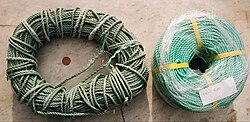

UV damaged polypropylene rope (left) and new rope (right)
IR spectrum showing carbonyl absorption due to UV degradation of polyethylene
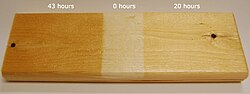
Effects of UV on finished surfaces in 0, 20 and 43 hours

実用的な応用例

紫外線の特性を巧みに利用した技術は、多方面で導入されています。

殺菌と衛生管理

UVC(特に253.7nm付近)は微生物のDNAを破壊するため、強力な殺菌剤として利用されます。水銀ランプを用いた殺菌装置は、研究室や食品工場での表面除菌に広く普及しています。
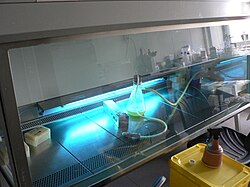
A low-pressure mercury vapor discharge tube floods the inside of a hood with shortwave UV light when not in use, sterilizing microbiological contaminants from irradiated surfaces.

分析と鑑定

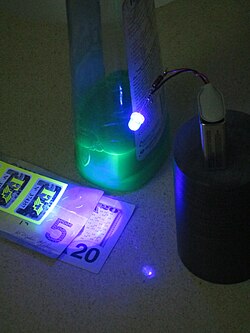
多くの物質は、特定の波長の紫外線を吸収して異なる波長の可視光を放出する「蛍光」という性質を持っています。これを利用して、以下のような用途に活用されています。

  • 法医学・衛生検査:血液や体液などの不可視の汚れを検出する。
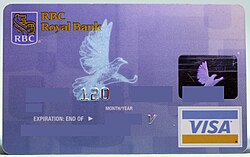
  • 真贋判定:クレジットカードや紙幣に組み込まれたUV蛍光インクの確認。
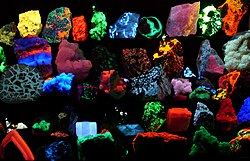
  • 鉱物学:鉱物固有の蛍光反応による同定。
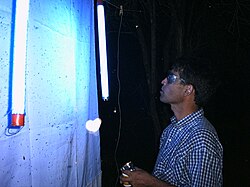
  • 昆虫採集:特定の波長に誘引される昆虫の捕獲。
A 380 nanometer UV LED makes some common household items fluoresce.
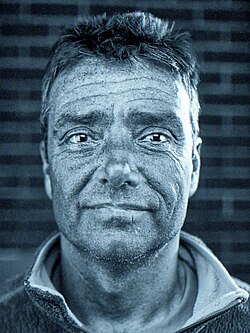
A portrait taken using only UV light between the wavelengths of 335 and 365 nanometers
A bird appears on many Visa credit cards when they are held under a UV light source.
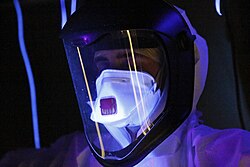
A person wearing full protective gear, glowing in ultraviolet light
A collection of mineral samples fluorescing brilliantly at various wavelengths as seen while being irradiated by UV
Entomologist using a UV lamp for collecting beetles in Chaco, Paraguay

産業・科学技術

極端紫外線(EUV)は、超微細な回路を形成する半導体リソグラフィに不可欠です。また、天文学の分野では、ハッブル宇宙望遠鏡などが紫外線を用いて木星のオーロラなどを観測し、宇宙の構造を解明しています。
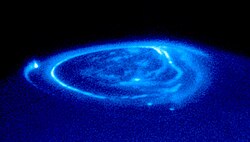

Aurora at Jupiter's north pole as seen in ultraviolet light by the Hubble Space Telescope
ภาพประกอบบทความ

Frequently Asked Questions

UVAとUVBの決定的な違いは何ですか?

主な違いは波長と浸透力です。UVA(315-400nm)は波長が長く、大気を通り抜けて皮膚の深層まで到達し、シワやたるみなどの光老化に関与します。一方、UVB(280-315nm)は波長が短く、皮膚の表面層で吸収され、炎症(日焼け)やビタミンD生成を引き起こします。

窓ガラスは紫外線を完全に遮断しますか?

いいえ、完全に遮断するわけではありません。一般的なソーダ石灰ガラスは、波長300nm以下の短波長(UVBやUVC)はほぼ遮断しますが、350nm以上のUVAは大部分を透過させます。そのため、室内であっても窓際ではUVAの影響を受ける可能性があります。

UV LEDと水銀ランプのどちらが効率的ですか?

用途によります。水銀ランプは特に253.7nmの強力な殺菌波長を効率よく出せるため、広範囲の除菌に適しています。一方、UV LEDは小型で寿命が長く、特定の波長(365nmなど)をピンポイントで照射できるため、硬化剤や鑑定用ライトとして非常に効率的です。

紫外線によるDNA損傷はどのように起こりますか?

紫外線(特にUVBやUVC)のエネルギーがDNA分子に吸収されると、本来は向かい側と結合すべきチミン塩基同士が、隣り合わせで結合してしまう「チミンダイマー」という構造的な歪みが生じます。これにより、DNAの正確な複製や転写が妨げられ、細胞の機能不全や突然変異が引き起こされます。

References

  1. Maqbool, Muhammad (2023). An Introduction to Non-Ionizing Radiation. Bentham Science Publishers.  .
  2. Ida, Nathan (2008). Engineering Electromagnetics, 2nd Ed. Springer Science and Business Media. p. 1122.  .
  3. "Reference Solar Spectral Irradiance: Air Mass 1.5". Archived from the original on 27 January 2011. Retrieved 12 November 2009.
  4. Haigh, Joanna D. (2007). "The Sun and the Earth's Climate: Absorption of solar spectral radiation by the atmosphere". Living Reviews in Solar Physics. 4 (2): 2. :2007LRSP....4....2H. :10.12942/lrsp-2007-2.
  5. Wacker, Matthias; Holick, Michael F. (1 January 2013). "Sunlight and Vitamin D". Dermato-endocrinology. 5 (1): 51–108. :10.4161/derm.24494.  1938-1972.  3897598.  24494042.
  6. David Hambling (29 May 2002). "Let the light shine in". The Guardian. Archived from the original on 23 November 2014. Retrieved 2 January 2015.
  7. Cronin, Thomas W.; Bok, Michael J. (15 September 2016). "Photoreception and vision in the ultraviolet". Journal of Experimental Biology. 219 (18): 2790–2801. :2016JExpB.219.2790C. :10.1242/jeb.128769. :11603/13303.  1477-9145.  27655820.  22365933.
  8. M A Mainster (2006). "Violet and blue light blocking intraocular lenses: photoprotection versus photoreception". British Journal of Ophthalmology. 90 (6): 784–792. :10.1136/bjo.2005.086553.  1860240.  16714268.
  9. Lynch, David K.; Livingston, William Charles (2001). Color and Light in Nature (2nd ed.). Cambridge: . p. 231.  . Archived from the original on 31 December 2013. Retrieved 12 October 2013. Limits of the eye's overall range of sensitivity extends from about 310 to 1050 nanometers
  10. Dash, Madhab Chandra; Dash, Satya Prakash (2009). Fundamentals of Ecology 3E. Tata McGraw-Hill Education. p. 213.  . Archived from the original on 31 December 2013. Retrieved 18 October 2013. Normally the human eye responds to light rays from 390 to 760 nm. This can be extended to a range of 310 to 1,050 nm under artificial conditions.

📸 フォトギャラリー

Levels of ozone at various altitudes (DU/km) and blocking of different bands of ultraviolet radiation: In essence, all UVC is blocked by diatomic oxygen (100–200 nm) or by ozone (triatomic oxygen) (200–280 nm) in the atmosphere. The ozone layer then blocks most UVB. Meanwhile, UVA is hardly affected by ozone, and most of it reaches the ground. UVA makes up almost all UV light that penetrates the Earth's atmosphere.
A 380 nanometer UV LED makes some common household items fluoresce.
Sunburn effect (as measured by the UV index) is the product of the sunlight spectrum (radiation intensity) and the erythemal action spectrum (skin sensitivity) across the range of UV wavelengths. Sunburn production per milliwatt of radiation intensity is increased by nearly a factor of 100 between the near UVB wavelengths of 315–295 nm.
Ultraviolet photons harm the DNA molecules of living organisms in different ways. In one common damage event, adjacent thymine bases bond with each other, instead of across the "ladder". This "thymine dimer" makes a bulge, and the distorted DNA molecule does not function properly.
Demonstration of the effect of sunscreen. The left image is a regular photograph of his face; the right image is of reflected UV light. The man's face has sunscreen on his right side only. It appears darker because the sunscreen absorbs the UV light.
Signs are often used to warn of the hazard of strong UV sources.
UV damaged polypropylene rope (left) and new rope (right)
IR spectrum showing carbonyl absorption due to UV degradation of polyethylene
A portrait taken using only UV light between the wavelengths of 335 and 365 nanometers
Aurora at Jupiter's north pole as seen in ultraviolet light by the Hubble Space Telescope
A bird appears on many Visa credit cards when they are held under a UV light source.
A person wearing full protective gear, glowing in ultraviolet light
A collection of mineral samples fluorescing brilliantly at various wavelengths as seen while being irradiated by UV
Effects of UV on finished surfaces in 0, 20 and 43 hours
A low-pressure mercury vapor discharge tube floods the inside of a hood with shortwave UV light when not in use, sterilizing microbiological contaminants from irradiated surfaces.
Entomologist using a UV lamp for collecting beetles in Chaco, Paraguay
ภาพประกอบบทความ