Collective name of 6 mathematical functions
数学 において 、 双曲線関数は 通常の 三角関数 に類似していますが、 円 ではなく 双曲線 を用いて定義されます。点 (cos t , sin t ) が単位半径の円 を形成するのと同様に 、点 (cosh t , sinh t )は 単位双曲線 の右半分を形成します。また、 sin( t ) と cos( t ) の導関数がそれぞれ cos( t ) と –sin( t ) であるのと同様に、 sinh( t ) と cosh( t ) の導関数はそれぞれ cosh( t ) と sinh( t ) です 。
双曲関数は、双曲幾何学 において 平行角を 表すために使用されます 。 特殊相対論 では、 ローレンツブーストを 双曲回転 として表すために使用されます。また、多くの線形 微分方程式( 懸垂線 を定義する方程式など )、 3次方程式 、および 直交座標 における ラプラス方程式 の解にも現れます 。 ラプラス方程式は、 電磁気学 、 伝熱 、 流体力学 など、 物理学 の多くの分野で重要です 。
基本的な双曲線関数は以下の通りである: [1]
双曲線正弦 " sinh " ( )、 [2] 余弦 「 cosh ( 、 [3] そこから派生したもの: [4]
双曲線正接 " Tanh " ( )、 [5] 余接 coth 」 / [ ] [7] 双曲正割 " sech " ( )、 [8] 双曲線余割 " csch " または " cosech " ( [3] ) 導出された三角関数に対応します。
逆 双曲線関数は次の とおりです。
逆双曲線正弦 「 arsinh 」(「 sinh −1 」、「 asinh 」、または「 arcsinh 」と表記されることもある) [9] [10] [11] 逆双曲線余弦 「 arcosh 」(「 cosh −1 」、「 acosh 」、または「 arccosh 」と表記されることもある) 逆双曲線正接 「 artanh 」(「 tanh −1 」、「 atanh 」、または「 arctanh 」と表記されることもある) 逆双曲余接 「 アークス」(「 アークス −1 」、「 アークス 」、あるいは「 アークス 」とも表記される ) 逆双曲正割 「 arsech 」(「 sech −1 」、「 asech 」、または「 arcsech 」と表記されることもある) 逆双曲余割 「 arcsch 」(「 arcosech 」、「 csch −1 」、「 cosech −1 」、「 acsch 」、「 acosech 」、または「 arccsch 」や「 arccosech 」と表記されることもある) 単位双曲線 x 2 − y 2 = 1 を通る直線 が 点 (cosh a , sinh a ) を通過する 。ここで a は 直線、双曲線、 x軸の間の面積の2倍である。x 軸より下の双曲線上の 点 については 、面積は負とみなされる(三角関数(円関数)との比較を含む アニメーション版を 参照)。 双曲関数は、 双曲角 と呼ばれる 実 引数 を取ります。双曲角の大きさは、 xy = 1 に対する 双曲扇形 の 面積です。双曲関数は、この扇形を覆う 直角三角形の辺 によって定義できます 。
複素解析 において 、通常の正弦関数と余弦関数を虚角に適用すると双曲関数が生じる。双曲正弦関数と双曲余弦関数は 整関数 である。その結果、他の双曲関数は 複素平面全体において 有理型となる。
リンデマン・ワイエルシュトラスの定理 によれば 、双曲関数は 引数の ゼロでない 代数的値すべてに対して 超越値を持つ。 [12]
歴史 双曲三角法の問題の計算は、 1566年頃に メルカトル図法を 発表した ゲラルドゥス・メルカトルが初めて行ったとされています。この計算では、双曲関数を含む 超越方程式 の解を表にまとめる必要がありました。 [13]
円の扇形と双曲線の扇形の類似性を最初に示唆したのは、 アイザック・ニュートンが 1687年に著した 『プリンキピア・マテマティカ』 である。 [14]
ロジャー・コーツは、 虚数単位 を使って三角関数を修正し、 長楕円体から扁平 楕円体 を得ることを提案した。 [14] i = − 1 {\displaystyle i={\sqrt {-1}}}
双曲関数は1757年に ヴィンチェンツォ・リカッティ によって正式に導入されました。 [14] [13] [15] リカッティは 円関数を表すために Sc. と Cc. ( 正弦/余弦円 )を使用し、双曲関数を表すために Sh. と Ch. ( 正弦/余弦双曲 )を使用しました。 [14] 1759年には早くも ダヴィエ・ド・フォンセネックスは 虚数単位を使用して三角関数と双曲関数の互換性を示し、 ド・モアブルの公式を 双曲関数に拡張しました。 [15] [14]
1760年代、 ヨハン・ハインリヒ・ランベルトは 関数の使用を体系化し、指数表現を様々な出版物で提供した。 [14] [15] ランベルトは関数の用語と名前をリカッチに帰したが、略語を今日使用されているものに変更した。 [15] [16]
表記
定義 sinhとcoshに比例する脚を持つ直角三角形 双曲線角 u では 、双曲線関数 sinh と cosh は 指数関数 e u で定義できます。 [1] [4] 図では 。 A = ( e − u , e u ) , B = ( e u , e − u ) , O A + O B = O C {\displaystyle A=(e^{-u},e^{u}),\ B=(e^{u},\ e^{-u}),\ OA+OB=OC}
指数関数の定義 sinh xは e x と e − x の 差 の半分である。 cosh xは e x と e − x の 平均 である。 双曲線正弦:指数関数の 奇数部 、つまり sinh x = e x − e − x 2 = e 2 x − 1 2 e x = 1 − e − 2 x 2 e − x . {\displaystyle \sinh x={\frac {e^{x}-e^{-x}}{2}}={\frac {e^{2x}-1}{2e^{x}}}={\frac {1-e^{-2x}}{2e^{-x}}}.} 双曲線余弦:指数関数の 偶数部 、つまり cosh x = e x + e − x 2 = e 2 x + 1 2 e x = 1 + e − 2 x 2 e − x . {\displaystyle \cosh x={\frac {e^{x}+e^{-x}}{2}}={\frac {e^{2x}+1}{2e^{x}}}={\frac {1+e^{-2x}}{2e^{-x}}}.} sinh 、 cosh 、 tanh csch 、 sech 、 coth 双曲線正接: tanh x = sinh x cosh x = e x − e − x e x + e − x = e 2 x − 1 e 2 x + 1 . {\displaystyle \tanh x={\frac {\sinh x}{\cosh x}}={\frac {e^{x}-e^{-x}}{e^{x}+e^{-x}}}={\frac {e^{2x}-1}{e^{2x}+1}}.} 双曲余接: x ≠0 の場合、 coth x = cosh x sinh x = e x + e − x e x − e − x = e 2 x + 1 e 2 x − 1 . {\displaystyle \coth x={\frac {\cosh x}{\sinh x}}={\frac {e^{x}+e^{-x}}{e^{x}-e^{-x}}}={\frac {e^{2x}+1}{e^{2x}-1}}.} 双曲正割: sech x = 1 cosh x = 2 e x + e − x = 2 e x e 2 x + 1 . {\displaystyle \operatorname {sech} x={\frac {1}{\cosh x}}={\frac {2}{e^{x}+e^{-x}}}={\frac {2e^{x}}{e^{2x}+1}}.} 双曲余割: x ≠ 0 の場合、 csch x = 1 sinh x = 2 e x − e − x = 2 e x e 2 x − 1 . {\displaystyle \operatorname {csch} x={\frac {1}{\sinh x}}={\frac {2}{e^{x}-e^{-x}}}={\frac {2e^{x}}{e^{2x}-1}}.}
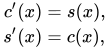
微分方程式の定義 双曲線関数は、微分方程式 の解として定義できます。双曲線正弦と双曲線余弦は、 初期条件を持つ システムの 解 ( s 、 c ) です。初期条件により、解は一意になります。初期条件がなければ、どの関数のペアも 解にはなりません。 c ′ ( x ) = s ( x ) , s ′ ( x ) = c ( x ) , {\displaystyle {\begin{aligned}c'(x)&=s(x),\\s'(x)&=c(x),\\\end{aligned}}} s ( 0 ) = 0 , c ( 0 ) = 1. {\displaystyle s(0)=0,c(0)=1.} ( a e x + b e − x , a e x − b e − x ) {\displaystyle (ae^{x}+be^{-x},ae^{x}-be^{-x})}
sinh( x ) と cosh( x ) は方程式 f ″( x ) = f ( x ) の唯一の解でもあり、 双曲線余弦の場合は f (0) = 1 、 f ′(0) = 0となり、双曲線正弦の場合は f (0) = 0 、 f ′(0) = 1 となります 。
複雑な三角関数の定義 双曲線関数は、 複素 引数を持つ 三角関数 から推定することもできます。
双曲線正弦: [1] sinh x = − i sin ( i x ) . {\displaystyle \sinh x=-i\sin(ix).} 双曲線余弦: [1] cosh x = cos ( i x ) . {\displaystyle \cosh x=\cos(ix).} 双曲線正接: tanh x = − i tan ( i x ) . {\displaystyle \tanh x=-i\tan(ix).} 双曲線余接: coth x = i cot ( i x ) . {\displaystyle \coth x=i\cot(ix).} 双曲正割: sech x = sec ( i x ) . {\displaystyle \operatorname {sech} x=\sec(ix).} 双曲線余割: csch x = i csc ( i x ) . {\displaystyle \operatorname {csch} x=i\csc(ix).} ここで、 i は 虚数単位 で、 i 2 = −1 です。
上記の定義は、オイラーの公式 を介して指数定義と関連しています (以下の§複素数の双曲線関数を参照)。
特性評価
双曲線余弦 双曲余弦曲線 の下の面積(有限区間)は常にその区間に対応する 弧の長さ に等しいことが示される : [17] area = ∫ a b cosh x d x = ∫ a b 1 + ( d d x cosh x ) 2 d x = arc length. {\displaystyle {\text{area}}=\int _{a}^{b}\cosh x\,dx=\int _{a}^{b}{\sqrt {1+\left({\frac {d}{dx}}\cosh x\right)^{2}}}\,dx={\text{arc length.}}}
双曲線正接 双曲正接は、微分方程式 f ′ = 1 − f 2 ( f (0) = 0 ) の(唯一の)解である 。 [18] [19]
有用な関係 双曲関数は多くの恒等式を満たし、それらはすべて 三角関数の恒等 式と形が似ています。実際、 オズボーンの定理 [20] ( ジョージ・オズボーン にちなんで名付けられました)によれば、、、 または に対する任意の三角関数の恒等式(4次正弦および暗黙の正弦を除く)は、次のよう に 双曲関数の恒等式に変換できます 。 θ {\displaystyle \theta } 2 θ {\displaystyle 2\theta } 3 θ {\displaystyle 3\theta } θ {\displaystyle \theta } φ {\displaystyle \varphi }
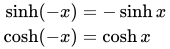
これを正弦と余弦の積分乗で完全に拡張すると、 正弦をsinhに、余弦をcoshに変更し、 2 つの sinh の積を含むすべての項の符号を切り替えます。 奇数関数と偶数関数: sinh ( − x ) = − sinh x cosh ( − x ) = cosh x {\displaystyle {\begin{aligned}\sinh(-x)&=-\sinh x\\\cosh(-x)&=\cosh x\end{aligned}}}
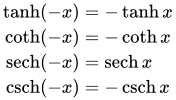
したがって: tanh ( − x ) = − tanh x coth ( − x ) = − coth x sech ( − x ) = sech x csch ( − x ) = − csch x {\displaystyle {\begin{aligned}\tanh(-x)&=-\tanh x\\\coth(-x)&=-\coth x\\\operatorname {sech} (-x)&=\operatorname {sech} x\\\operatorname {csch} (-x)&=-\operatorname {csch} x\end{aligned}}}
したがって、 cosh x と sech x は偶関数 であり 、その他は 奇関数 です。
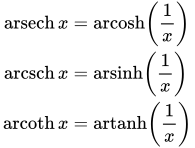
arsech x = arcosh ( 1 x ) arcsch x = arsinh ( 1 x ) arcoth x = artanh ( 1 x ) {\displaystyle {\begin{aligned}\operatorname {arsech} x&=\operatorname {arcosh} \left({\frac {1}{x}}\right)\\\operatorname {arcsch} x&=\operatorname {arsinh} \left({\frac {1}{x}}\right)\\\operatorname {arcoth} x&=\operatorname {artanh} \left({\frac {1}{x}}\right)\end{aligned}}}
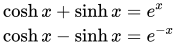
双曲線正弦と双曲線余弦は次を満たします。 cosh x + sinh x = e x cosh x − sinh x = e − x {\displaystyle {\begin{aligned}\cosh x+\sinh x&=e^{x}\\\cosh x-\sinh x&=e^{-x}\end{aligned}}}
これは オイラーの公式 に類似しており、
cosh 2 x − sinh 2 x = 1 {\displaystyle \cosh ^{2}x-\sinh ^{2}x=1}
これは ピタゴラスの三角関数の恒等式 に類似しています。
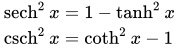
また、 sech 2 x = 1 − tanh 2 x csch 2 x = coth 2 x − 1 {\displaystyle {\begin{aligned}\operatorname {sech} ^{2}x&=1-\tanh ^{2}x\\\operatorname {csch} ^{2}x&=\coth ^{2}x-1\end{aligned}}}
その他の機能については。
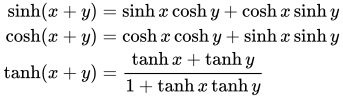
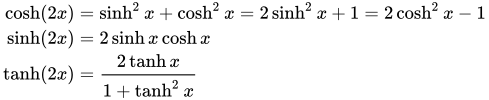
引数の合計 sinh ( x + y ) = sinh x cosh y + cosh x sinh y cosh ( x + y ) = cosh x cosh y + sinh x sinh y tanh ( x + y ) = tanh x + tanh y 1 + tanh x tanh y {\displaystyle {\begin{aligned}\sinh(x+y)&=\sinh x\cosh y+\cosh x\sinh y\\\cosh(x+y)&=\cosh x\cosh y+\sinh x\sinh y\\\tanh(x+y)&={\frac {\tanh x+\tanh y}{1+\tanh x\tanh y}}\\\end{aligned}}} 特に cosh ( 2 x ) = sinh 2 x + cosh 2 x = 2 sinh 2 x + 1 = 2 cosh 2 x − 1 sinh ( 2 x ) = 2 sinh x cosh x tanh ( 2 x ) = 2 tanh x 1 + tanh 2 x {\displaystyle {\begin{aligned}\cosh(2x)&=\sinh ^{2}{x}+\cosh ^{2}{x}=2\sinh ^{2}x+1=2\cosh ^{2}x-1\\\sinh(2x)&=2\sinh x\cosh x\\\tanh(2x)&={\frac {2\tanh x}{1+\tanh ^{2}x}}\\\end{aligned}}}
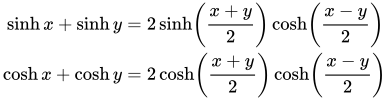
また: sinh x + sinh y = 2 sinh ( x + y 2 ) cosh ( x − y 2 ) cosh x + cosh y = 2 cosh ( x + y 2 ) cosh ( x − y 2 ) {\displaystyle {\begin{aligned}\sinh x+\sinh y&=2\sinh \left({\frac {x+y}{2}}\right)\cosh \left({\frac {x-y}{2}}\right)\\\cosh x+\cosh y&=2\cosh \left({\frac {x+y}{2}}\right)\cosh \left({\frac {x-y}{2}}\right)\\\end{aligned}}}
cosh x cosh y = 1 2 ( cosh ( x + y ) + cosh ( x − y ) ) sinh x sinh y = 1 2 ( cosh ( x + y ) − cosh ( x − y ) ) sinh x cosh y = 1 2 ( sinh ( x + y ) + sinh ( x − y ) ) cosh x sinh y = 1 2 ( sinh ( x + y ) − sinh ( x − y ) ) {\displaystyle {\begin{aligned}\cosh x\,\cosh y&={\tfrac {1}{2}}{\bigl (}\!\!~\cosh(x+y)+\cosh(x-y){\bigr )}\\[5mu]\sinh x\,\sinh y&={\tfrac {1}{2}}{\bigl (}\!\!~\cosh(x+y)-\cosh(x-y){\bigr )}\\[5mu]\sinh x\,\cosh y&={\tfrac {1}{2}}{\bigl (}\!\!~\sinh(x+y)+\sinh(x-y){\bigr )}\\[5mu]\cosh x\,\sinh y&={\tfrac {1}{2}}{\bigl (}\!\!~\sinh(x+y)-\sinh(x-y){\bigr )}\\[5mu]\end{aligned}}}
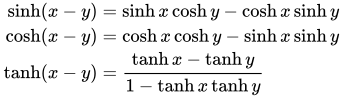
sinh ( x − y ) = sinh x cosh y − cosh x sinh y cosh ( x − y ) = cosh x cosh y − sinh x sinh y tanh ( x − y ) = tanh x − tanh y 1 − tanh x tanh y {\displaystyle {\begin{aligned}\sinh(x-y)&=\sinh x\cosh y-\cosh x\sinh y\\\cosh(x-y)&=\cosh x\cosh y-\sinh x\sinh y\\\tanh(x-y)&={\frac {\tanh x-\tanh y}{1-\tanh x\tanh y}}\\\end{aligned}}}
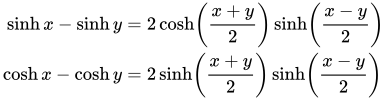
また: [21] sinh x − sinh y = 2 cosh ( x + y 2 ) sinh ( x − y 2 ) cosh x − cosh y = 2 sinh ( x + y 2 ) sinh ( x − y 2 ) {\displaystyle {\begin{aligned}\sinh x-\sinh y&=2\cosh \left({\frac {x+y}{2}}\right)\sinh \left({\frac {x-y}{2}}\right)\\\cosh x-\cosh y&=2\sinh \left({\frac {x+y}{2}}\right)\sinh \left({\frac {x-y}{2}}\right)\\\end{aligned}}}
sinh ( x 2 ) = sinh x 2 ( cosh x + 1 ) = sgn x cosh x − 1 2 cosh ( x 2 ) = cosh x + 1 2 tanh ( x 2 ) = sinh x cosh x + 1 = sgn x cosh x − 1 cosh x + 1 = e x − 1 e x + 1 {\displaystyle {\begin{aligned}\sinh \left({\frac {x}{2}}\right)&={\frac {\sinh x}{\sqrt {2(\cosh x+1)}}}&&=\operatorname {sgn} x\,{\sqrt {\frac {\cosh x-1}{2}}}\\[6px]\cosh \left({\frac {x}{2}}\right)&={\sqrt {\frac {\cosh x+1}{2}}}\\[6px]\tanh \left({\frac {x}{2}}\right)&={\frac {\sinh x}{\cosh x+1}}&&=\operatorname {sgn} x\,{\sqrt {\frac {\cosh x-1}{\cosh x+1}}}={\frac {e^{x}-1}{e^{x}+1}}\end{aligned}}}
ここで、 sgnは 符号関数 です 。
x ≠0の 場合 、 [22]
tanh ( x 2 ) = cosh x − 1 sinh x = coth x − csch x {\displaystyle \tanh \left({\frac {x}{2}}\right)={\frac {\cosh x-1}{\sinh x}}=\coth x-\operatorname {csch} x}
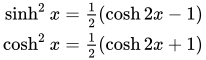
sinh 2 x = 1 2 ( cosh 2 x − 1 ) cosh 2 x = 1 2 ( cosh 2 x + 1 ) {\displaystyle {\begin{aligned}\sinh ^{2}x&={\tfrac {1}{2}}(\cosh 2x-1)\\\cosh ^{2}x&={\tfrac {1}{2}}(\cosh 2x+1)\end{aligned}}}
不平等 次の不等式は統計学で有用である: [23] cosh ( t ) ≤ e t 2 / 2 . {\displaystyle \operatorname {cosh} (t)\leq e^{t^{2}/2}.}
これは、2 つの関数のテイラー級数を各項ごとに比較することによって証明できます。
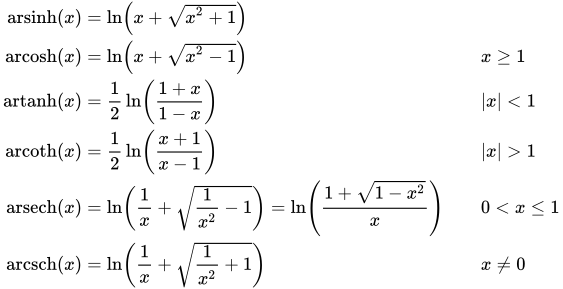
逆関数を対数として表す arsinh ( x ) = ln ( x + x 2 + 1 ) arcosh ( x ) = ln ( x + x 2 − 1 ) x ≥ 1 artanh ( x ) = 1 2 ln ( 1 + x 1 − x ) | x | < 1 arcoth ( x ) = 1 2 ln ( x + 1 x − 1 ) | x | > 1 arsech ( x ) = ln ( 1 x + 1 x 2 − 1 ) = ln ( 1 + 1 − x 2 x ) 0 < x ≤ 1 arcsch ( x ) = ln ( 1 x + 1 x 2 + 1 ) x ≠ 0 {\displaystyle {\begin{aligned}\operatorname {arsinh} (x)&=\ln \left(x+{\sqrt {x^{2}+1}}\right)\\\operatorname {arcosh} (x)&=\ln \left(x+{\sqrt {x^{2}-1}}\right)&&x\geq 1\\\operatorname {artanh} (x)&={\frac {1}{2}}\ln \left({\frac {1+x}{1-x}}\right)&&|x|<1\\\operatorname {arcoth} (x)&={\frac {1}{2}}\ln \left({\frac {x+1}{x-1}}\right)&&|x|>1\\\operatorname {arsech} (x)&=\ln \left({\frac {1}{x}}+{\sqrt {{\frac {1}{x^{2}}}-1}}\right)=\ln \left({\frac {1+{\sqrt {1-x^{2}}}}{x}}\right)&&0<x\leq 1\\\operatorname {arcsch} (x)&=\ln \left({\frac {1}{x}}+{\sqrt {{\frac {1}{x^{2}}}+1}}\right)&&x\neq 0\end{aligned}}}
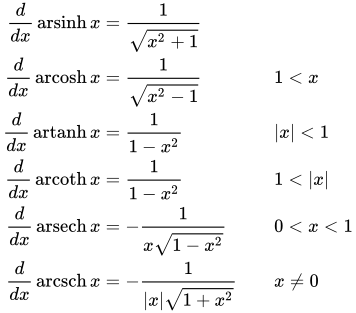
デリバティブ d d x sinh x = cosh x d d x cosh x = sinh x d d x tanh x = 1 − tanh 2 x = sech 2 x = 1 cosh 2 x d d x coth x = 1 − coth 2 x = − csch 2 x = − 1 sinh 2 x x ≠ 0 d d x sech x = − tanh x sech x d d x csch x = − coth x csch x x ≠ 0 {\displaystyle {\begin{aligned}{\frac {d}{dx}}\sinh x&=\cosh x\\{\frac {d}{dx}}\cosh x&=\sinh x\\{\frac {d}{dx}}\tanh x&=1-\tanh ^{2}x=\operatorname {sech} ^{2}x={\frac {1}{\cosh ^{2}x}}\\{\frac {d}{dx}}\coth x&=1-\coth ^{2}x=-\operatorname {csch} ^{2}x=-{\frac {1}{\sinh ^{2}x}}&&x\neq 0\\{\frac {d}{dx}}\operatorname {sech} x&=-\tanh x\operatorname {sech} x\\{\frac {d}{dx}}\operatorname {csch} x&=-\coth x\operatorname {csch} x&&x\neq 0\end{aligned}}} d d x arsinh x = 1 x 2 + 1 d d x arcosh x = 1 x 2 − 1 1 < x d d x artanh x = 1 1 − x 2 | x | < 1 d d x arcoth x = 1 1 − x 2 1 < | x | d d x arsech x = − 1 x 1 − x 2 0 < x < 1 d d x arcsch x = − 1 | x | 1 + x 2 x ≠ 0 {\displaystyle {\begin{aligned}{\frac {d}{dx}}\operatorname {arsinh} x&={\frac {1}{\sqrt {x^{2}+1}}}\\{\frac {d}{dx}}\operatorname {arcosh} x&={\frac {1}{\sqrt {x^{2}-1}}}&&1<x\\{\frac {d}{dx}}\operatorname {artanh} x&={\frac {1}{1-x^{2}}}&&|x|<1\\{\frac {d}{dx}}\operatorname {arcoth} x&={\frac {1}{1-x^{2}}}&&1<|x|\\{\frac {d}{dx}}\operatorname {arsech} x&=-{\frac {1}{x{\sqrt {1-x^{2}}}}}&&0<x<1\\{\frac {d}{dx}}\operatorname {arcsch} x&=-{\frac {1}{|x|{\sqrt {1+x^{2}}}}}&&x\neq 0\end{aligned}}}
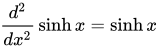
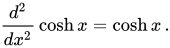
2次導関数 各関数 sinh と cosh はその 2 次導関数 に等しくなります 。つまり、次のようになります。 d 2 d x 2 sinh x = sinh x {\displaystyle {\frac {d^{2}}{dx^{2}}}\sinh x=\sinh x} d 2 d x 2 cosh x = cosh x . {\displaystyle {\frac {d^{2}}{dx^{2}}}\cosh x=\cosh x\,.}
この性質を持つすべての関数は sinh と cosh の 線形結合 であり、特に 指数関数 とがそれに該当します 。 [24] e x {\displaystyle e^{x}} e − x {\displaystyle e^{-x}}
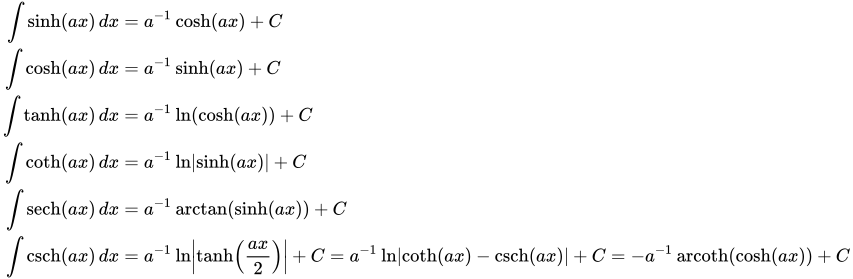
標準積分 ∫ sinh ( a x ) d x = a − 1 cosh ( a x ) + C ∫ cosh ( a x ) d x = a − 1 sinh ( a x ) + C ∫ tanh ( a x ) d x = a − 1 ln ( cosh ( a x ) ) + C ∫ coth ( a x ) d x = a − 1 ln | sinh ( a x ) | + C ∫ sech ( a x ) d x = a − 1 arctan ( sinh ( a x ) ) + C ∫ csch ( a x ) d x = a − 1 ln | tanh ( a x 2 ) | + C = a − 1 ln | coth ( a x ) − csch ( a x ) | + C = − a − 1 arcoth ( cosh ( a x ) ) + C {\displaystyle {\begin{aligned}\int \sinh(ax)\,dx&=a^{-1}\cosh(ax)+C\\\int \cosh(ax)\,dx&=a^{-1}\sinh(ax)+C\\\int \tanh(ax)\,dx&=a^{-1}\ln(\cosh(ax))+C\\\int \coth(ax)\,dx&=a^{-1}\ln \left|\sinh(ax)\right|+C\\\int \operatorname {sech} (ax)\,dx&=a^{-1}\arctan(\sinh(ax))+C\\\int \operatorname {csch} (ax)\,dx&=a^{-1}\ln \left|\tanh \left({\frac {ax}{2}}\right)\right|+C=a^{-1}\ln \left|\coth \left(ax\right)-\operatorname {csch} \left(ax\right)\right|+C=-a^{-1}\operatorname {arcoth} \left(\cosh \left(ax\right)\right)+C\end{aligned}}}
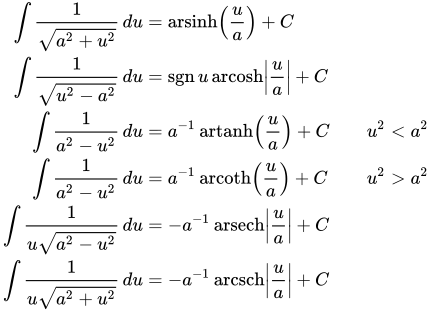
次の積分は 双曲置換法 を使って証明できます。 ∫ 1 a 2 + u 2 d u = arsinh ( u a ) + C ∫ 1 u 2 − a 2 d u = sgn u arcosh | u a | + C ∫ 1 a 2 − u 2 d u = a − 1 artanh ( u a ) + C u 2 < a 2 ∫ 1 a 2 − u 2 d u = a − 1 arcoth ( u a ) + C u 2 > a 2 ∫ 1 u a 2 − u 2 d u = − a − 1 arsech | u a | + C ∫ 1 u a 2 + u 2 d u = − a − 1 arcsch | u a | + C {\displaystyle {\begin{aligned}\int {{\frac {1}{\sqrt {a^{2}+u^{2}}}}\,du}&=\operatorname {arsinh} \left({\frac {u}{a}}\right)+C\\\int {{\frac {1}{\sqrt {u^{2}-a^{2}}}}\,du}&=\operatorname {sgn} {u}\operatorname {arcosh} \left|{\frac {u}{a}}\right|+C\\\int {\frac {1}{a^{2}-u^{2}}}\,du&=a^{-1}\operatorname {artanh} \left({\frac {u}{a}}\right)+C&&u^{2}<a^{2}\\\int {\frac {1}{a^{2}-u^{2}}}\,du&=a^{-1}\operatorname {arcoth} \left({\frac {u}{a}}\right)+C&&u^{2}>a^{2}\\\int {{\frac {1}{u{\sqrt {a^{2}-u^{2}}}}}\,du}&=-a^{-1}\operatorname {arsech} \left|{\frac {u}{a}}\right|+C\\\int {{\frac {1}{u{\sqrt {a^{2}+u^{2}}}}}\,du}&=-a^{-1}\operatorname {arcsch} \left|{\frac {u}{a}}\right|+C\end{aligned}}}
ここで、 Cは 積分定数 です 。
テイラー級数表現 上記の関数のゼロにおける テイラー級数 (関数がゼロで定義されていない場合は ローラン級数 )を明示的に表現することができます。
sinh x = x + x 3 3 ! + x 5 5 ! + x 7 7 ! + ⋯ = ∑ n = 0 ∞ x 2 n + 1 ( 2 n + 1 ) ! {\displaystyle \sinh x=x+{\frac {x^{3}}{3!}}+{\frac {x^{5}}{5!}}+{\frac {x^{7}}{7!}}+\cdots =\sum _{n=0}^{\infty }{\frac {x^{2n+1}}{(2n+1)!}}} この級数は xの任意の 複素数 値 に対して 収束します 。関数 sinh x は奇数 なので、 テイラー級数に
は x の奇指数のみが現れます。
cosh x = 1 + x 2 2 ! + x 4 4 ! + x 6 6 ! + ⋯ = ∑ n = 0 ∞ x 2 n ( 2 n ) ! {\displaystyle \cosh x=1+{\frac {x^{2}}{2!}}+{\frac {x^{4}}{4!}}+{\frac {x^{6}}{6!}}+\cdots =\sum _{n=0}^{\infty }{\frac {x^{2n}}{(2n)!}}} この級数は xの任意の 複素数 値 に対して 収束します 。関数 cosh x は 偶数 なので、 テイラー級数には x の偶数指数のみが含まれます。
sinh 級数と cosh 級数の和は、 指数関数 の 無限級数 表現です。
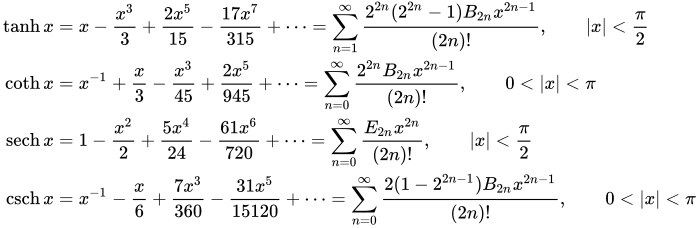
次の級数の後には、その収束領域 のサブセットの説明が続きます 。ここで、級数は収束し、その和は関数に等しくなります。 tanh x = x − x 3 3 + 2 x 5 15 − 17 x 7 315 + ⋯ = ∑ n = 1 ∞ 2 2 n ( 2 2 n − 1 ) B 2 n x 2 n − 1 ( 2 n ) ! , | x | < π 2 coth x = x − 1 + x 3 − x 3 45 + 2 x 5 945 + ⋯ = ∑ n = 0 ∞ 2 2 n B 2 n x 2 n − 1 ( 2 n ) ! , 0 < | x | < π sech x = 1 − x 2 2 + 5 x 4 24 − 61 x 6 720 + ⋯ = ∑ n = 0 ∞ E 2 n x 2 n ( 2 n ) ! , | x | < π 2 csch x = x − 1 − x 6 + 7 x 3 360 − 31 x 5 15120 + ⋯ = ∑ n = 0 ∞ 2 ( 1 − 2 2 n − 1 ) B 2 n x 2 n − 1 ( 2 n ) ! , 0 < | x | < π {\displaystyle {\begin{aligned}\tanh x&=x-{\frac {x^{3}}{3}}+{\frac {2x^{5}}{15}}-{\frac {17x^{7}}{315}}+\cdots =\sum _{n=1}^{\infty }{\frac {2^{2n}(2^{2n}-1)B_{2n}x^{2n-1}}{(2n)!}},\qquad \left|x\right|<{\frac {\pi }{2}}\\\coth x&=x^{-1}+{\frac {x}{3}}-{\frac {x^{3}}{45}}+{\frac {2x^{5}}{945}}+\cdots =\sum _{n=0}^{\infty }{\frac {2^{2n}B_{2n}x^{2n-1}}{(2n)!}},\qquad 0<\left|x\right|<\pi \\\operatorname {sech} x&=1-{\frac {x^{2}}{2}}+{\frac {5x^{4}}{24}}-{\frac {61x^{6}}{720}}+\cdots =\sum _{n=0}^{\infty }{\frac {E_{2n}x^{2n}}{(2n)!}},\qquad \left|x\right|<{\frac {\pi }{2}}\\\operatorname {csch} x&=x^{-1}-{\frac {x}{6}}+{\frac {7x^{3}}{360}}-{\frac {31x^{5}}{15120}}+\cdots =\sum _{n=0}^{\infty }{\frac {2(1-2^{2n-1})B_{2n}x^{2n-1}}{(2n)!}},\qquad 0<\left|x\right|<\pi \end{aligned}}}
どこ:
B n {\displaystyle B_{n}} n 番目の ベルヌーイ数 である E n {\displaystyle E_{n}} n 番目の オイラー数 である
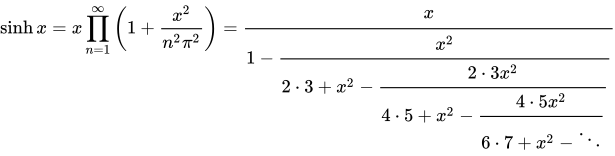
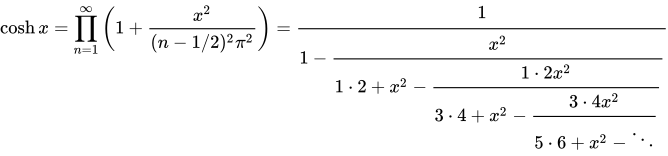
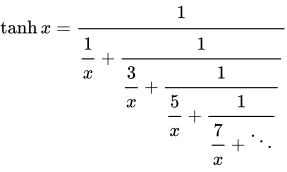
無限積と連分数 複素平面全体では次のような展開が有効です。
sinh x = x ∏ n = 1 ∞ ( 1 + x 2 n 2 π 2 ) = x 1 − x 2 2 ⋅ 3 + x 2 − 2 ⋅ 3 x 2 4 ⋅ 5 + x 2 − 4 ⋅ 5 x 2 6 ⋅ 7 + x 2 − ⋱ {\displaystyle \sinh x=x\prod _{n=1}^{\infty }\left(1+{\frac {x^{2}}{n^{2}\pi ^{2}}}\right)={\cfrac {x}{1-{\cfrac {x^{2}}{2\cdot 3+x^{2}-{\cfrac {2\cdot 3x^{2}}{4\cdot 5+x^{2}-{\cfrac {4\cdot 5x^{2}}{6\cdot 7+x^{2}-\ddots }}}}}}}}} cosh x = ∏ n = 1 ∞ ( 1 + x 2 ( n − 1 / 2 ) 2 π 2 ) = 1 1 − x 2 1 ⋅ 2 + x 2 − 1 ⋅ 2 x 2 3 ⋅ 4 + x 2 − 3 ⋅ 4 x 2 5 ⋅ 6 + x 2 − ⋱ {\displaystyle \cosh x=\prod _{n=1}^{\infty }\left(1+{\frac {x^{2}}{(n-1/2)^{2}\pi ^{2}}}\right)={\cfrac {1}{1-{\cfrac {x^{2}}{1\cdot 2+x^{2}-{\cfrac {1\cdot 2x^{2}}{3\cdot 4+x^{2}-{\cfrac {3\cdot 4x^{2}}{5\cdot 6+x^{2}-\ddots }}}}}}}}} tanh x = 1 1 x + 1 3 x + 1 5 x + 1 7 x + ⋱ {\displaystyle \tanh x={\cfrac {1}{{\cfrac {1}{x}}+{\cfrac {1}{{\cfrac {3}{x}}+{\cfrac {1}{{\cfrac {5}{x}}+{\cfrac {1}{{\cfrac {7}{x}}+\ddots }}}}}}}}}
円関数との比較 (1, 1) における円と双曲線の接線は、 円弧面積 u に 基づく円関数と、 双曲線 面積 u に依存する双曲線関数の幾何学を表示します 。 双曲線関数は、円関数を 超えた 三角法 の拡張を表します 。どちらの関数 も、 円角 または 双曲線角のいずれかの 引数 に依存します。
半径 r 、角度 u (ラジアン) の扇形の面積は r 2 u / 2なので、 r = √ 2 のとき、面積は u と等しくなります 。図では、このような円は (1, 1) において双曲線 xy = 1 に接しています。黄色の扇形は面積と角度の大きさを表しています。同様に、黄色と赤色の領域は、面積が双曲線の角度の大きさに対応する 双曲扇形 を表しています。
角度を定義する放射状の 斜辺 を持つ2 つの 直角三角形 の脚の長さは 、円関数と双曲線関数
の √ 2倍です。
双曲角は、円角が回転に対して不変であるのと同様に、 スクイーズ写像 に関して 不変の測度 である。 [25]
グーデルマン 関数は 、複素数を含まない円関数と双曲線関数の間の直接的な関係を与えます。
関数 のグラフは a cosh ( x / a ) {\displaystyle a\cosh(x/a)} 懸垂線 、つまり均一な重力下にある 2 つの固定点の間に自由に垂れ下がった均一で柔軟な鎖によって形成される曲線 です。
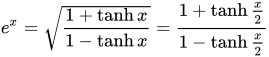
指数関数との関係 指数関数を 偶数部と奇数部 に分解すると、恒等式と が得られます。 これを オイラーの公式 と組み合わせると 、 一般的な複素指数関数 が得られ
ます 。 e x = cosh x + sinh x , {\displaystyle e^{x}=\cosh x+\sinh x,} e − x = cosh x − sinh x . {\displaystyle e^{-x}=\cosh x-\sinh x.} e i x = cos x + i sin x , {\displaystyle e^{ix}=\cos x+i\sin x,} e x + i y = ( cosh x + sinh x ) ( cos y + i sin y ) {\displaystyle e^{x+iy}=(\cosh x+\sinh x)(\cos y+i\sin y)}
さらに、 e x = 1 + tanh x 1 − tanh x = 1 + tanh x 2 1 − tanh x 2 {\displaystyle e^{x}={\sqrt {\frac {1+\tanh x}{1-\tanh x}}}={\frac {1+\tanh {\frac {x}{2}}}{1-\tanh {\frac {x}{2}}}}}
複素数の双曲線関数 複素平面上の双曲線関数 sinh ( z ) {\displaystyle \sinh(z)} cosh ( z ) {\displaystyle \cosh(z)} tanh ( z ) {\displaystyle \tanh(z)} coth ( z ) {\displaystyle \coth(z)} sech ( z ) {\displaystyle \operatorname {sech} (z)} csch ( z ) {\displaystyle \operatorname {csch} (z)}
指数関数は任意 の複素 引数に対して定義できる ため、双曲関数の定義を複素引数に拡張することもできます。 この場合、 関数 sinh z と cosh z は正則関数と なります。
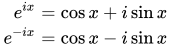
通常の三角関数との関係は、 複素数の オイラーの公式 によって与えられます。
つまり、 e i x = cos x + i sin x e − i x = cos x − i sin x {\displaystyle {\begin{aligned}e^{ix}&=\cos x+i\sin x\\e^{-ix}&=\cos x-i\sin x\end{aligned}}} cosh ( i x ) = 1 2 ( e i x + e − i x ) = cos x sinh ( i x ) = 1 2 ( e i x − e − i x ) = i sin x tanh ( i x ) = i tan x cosh ( x + i y ) = cosh ( x ) cos ( y ) + i sinh ( x ) sin ( y ) sinh ( x + i y ) = sinh ( x ) cos ( y ) + i cosh ( x ) sin ( y ) tanh ( x + i y ) = tanh ( x ) + i tan ( y ) 1 + i tanh ( x ) tan ( y ) cosh x = cos ( i x ) sinh x = − i sin ( i x ) tanh x = − i tan ( i x ) {\displaystyle {\begin{aligned}\cosh(ix)&={\frac {1}{2}}\left(e^{ix}+e^{-ix}\right)=\cos x\\\sinh(ix)&={\frac {1}{2}}\left(e^{ix}-e^{-ix}\right)=i\sin x\\\tanh(ix)&=i\tan x\\\cosh(x+iy)&=\cosh(x)\cos(y)+i\sinh(x)\sin(y)\\\sinh(x+iy)&=\sinh(x)\cos(y)+i\cosh(x)\sin(y)\\\tanh(x+iy)&={\frac {\tanh(x)+i\tan(y)}{1+i\tanh(x)\tan(y)}}\\\cosh x&=\cos(ix)\\\sinh x&=-i\sin(ix)\\\tanh x&=-i\tan(ix)\end{aligned}}}
したがって、双曲線関数は 虚数成分に関して 周期的で あり、周期は( 双曲線正接と双曲線余接の場合)です。 2 π i {\displaystyle 2\pi i} π i {\displaystyle \pi i}
参照
参考文献 ^ abcd Weisstein, Eric W. 「双曲関数」. mathworld.wolfram.com . 2020年8月29日 閲覧 。 ^ (1999) コリンズ・コンサイス辞典 、第4版、ハーパーコリンズ、グラスゴー、 ISBN 0 00 472257 4 、1386ページ ^ ab コリンズコンサイス辞典 、328ページ ^ ab 「双曲線関数」 www.mathsisfun.com . 2020年8月29日 閲覧 。 ^ コリンズ・コンサイス辞典 、1520ページ ^ コリンズ・コンサイス辞典 、329ページ ^ tanh ^ コリンズ・コンサイス辞典 、1340ページ ^ Woodhouse, NMJ (2003), Special Relativity , London: Springer, p. 71, ISBN 978-1-85233-426-0 ^ アブラモウィッツ、ミルトン 、 ステガン 、アイリーンA.編(1972年)、 数式、グラフ、数学表付き数学関数ハンドブック 、ニューヨーク: ドーバー出版 、 ISBN 978-0-486-61272-0 ^ arcsinh の使用例が Google ブックス で見つかりました。 ^ ニーヴン、イヴァン(1985年) 『無理数 』第11巻、アメリカ数学会 ISBN 9780883850381 . JSTOR 10.4169/j.ctt5hh8zn. ^ ab George F. Becker; CE Van Orstrand (1909). 双曲関数. ユニバーサルデジタルライブラリ. スミソニアン協会. ^ abcdef McMahon, James (1896). 双曲関数. オスマニア大学, インドデジタル図書館. John Wiley And Sons. ^ abcd ブラッドリー, ロバート・E.; ダントニオ, ローレンス・A.; サンディファー, チャールズ・エドワード. オイラー生誕300年:その評価. アメリカ数学協会, 2007年. 100ページ. ^ ベッカー、ゲオルグ・F. 双曲関数. リードブックス, 1931年. xlviiiページ. ^ NP, Bali (2005). Golden Integral Calculus. Firewall Media. p. 472. ISBN 81-7008-169-6 。 ^ Steeb, Willi-Hans (2005). 『非線形ワークブック:カオス、フラクタル、セルオートマトン、ニューラルネットワーク、遺伝的アルゴリズム、遺伝子発現プログラミング、サポートベクターマシン、ウェーブレット、隠れマルコフモデル、ファジーロジック(C++、Java、SymbolicC++プログラムによる)』(第3版). World Scientific Publishing Company. p. 281. ISBN 978-981-310-648-2 。 281ページの抜粋(lambda=1を使用) ^ オールドハム, キース・B.; マイランド, ヤン; スパニアー, ジェローム (2010). 『関数アトラス:アトラス関数計算機 Equator(第2版、イラスト入り)』 Springer Science & Business Media. p. 290. ISBN 978-0-387-48807-3 。 290ページの抜粋 ^ Osborn, G. (1902年7月). 「双曲型公式の記憶法」. The Mathematical Gazette . 2 (34): 189. doi :10.2307/3602492. JSTOR 3602492. S2CID 125866575. ^ マーティン、ジョージ・E. (1986). 『幾何学の基礎と非ユークリッド平面』 (初訂版). ニューヨーク: シュプリンガー・フェアラーク. p. 416. ISBN 3-540-90694-0 。 ^ 「tanh(x/2) = (cosh(x) - 1)/sinh(x)という恒等式を証明せよ」 StackExchange (数学) . 2016年 1月24日 閲覧 。 ^ Audibert, Jean-Yves (2009). 「集約による統計的推論における高速学習率」『統計年報』1627頁。 [1] ^ Olver, Frank WJ ; Lozier, Daniel M.; Boisvert, Ronald F.; Clark, Charles W. 編 (2010)「双曲関数」、 NIST Handbook of Mathematical Functions 、ケンブリッジ大学出版局、 ISBN 978-0-521-19225-5 、 MR 2723248 。 ^ Haskell, Mellen W. 、「双曲関数の概念の導入について」、 アメリカ数学会報 1 :6:155–9、全文
外部リンク ウィキメディア コモンズには、双曲関数 に関連するメディアがあります 。





















![{\displaystyle {\begin{aligned}\cosh x\,\cosh y&={\tfrac {1}{2}}{\bigl (}\!\!~\cosh(x+y)+\cosh(xy){\bigr )}\\[5mu]\sinh x\,\sinh y&={\tfrac {1}{2}}{\bigl (}\!\!~\cosh(x+y)-\cosh(xy){\bigr )}\\[5mu]\sinh x\,\cosh y&={\tfrac {1}{2}}{\bigl (}\!\!~\sinh(x+y)+\sinh(xy){\bigr )}\\[5mu]\cosh x\,\sinh y&={\tfrac {1}{2}}{\bigl (}\!\!~\sinh(x+y)-\sinh(xy){\bigr )}\\[5mu]\end{aligned}}}](https://wikimedia.org/api/rest_v1/media/math/render/svg/ebcc6e905df736163061cf56b304ab50d7853739)
![{\displaystyle {\begin{aligned}\sinh \left({\frac {x}{2}}\right)&={\frac {\sinh x}{\sqrt {2(\cosh x+1)}}}&&=\operatorname {sgn} x\,{\sqrt {\frac {\cosh x-1}{2}}}\\[6px]\cosh \left({\frac {x}{2}}\right)&={\sqrt {\frac {\cosh x+1}{2}}}\\[6px]\tanh \left({\frac {x}{2}}\right)&={\frac {\sinh x}{\cosh x+1}}&&=\operatorname {sgn} x\,{\sqrt {\frac {\cosh x-1}{\cosh x+1}}}={\frac {e^{x}-1}{e^{x}+1}}\end{aligned}}}](https://wikimedia.org/api/rest_v1/media/math/render/svg/412a4ffd109486f684e515634b33447b13444954)