Mathematical analysis of discontinuous points
連続関数は 数学 、関数、そしてその応用において極めて重要です 。しかし、すべての 関数 が連続であるわけではありません。関数がその 定義域の 極限点 (「集積点」または「クラスター点」とも呼ばれる)で連続でない場合、その関数はそこに 不連続性 を持つと言われています 。 関数の不連続点全体の 集合は、 離散集合 、 稠密集合 、あるいは関数の定義域全体となることもあります。
ある点における関数の振動は、これらの不連続性を次のように定量化し ます 。
除去可能な不連続性 では 、関数の値がずれる距離が振動です。 ジャンプ不連続 では 、ジャンプのサイズが振動です(その点 の 値が2つの側のこれらの限界値の間にあると仮定します)。 本質的な不連続性 (無限不連続性とも呼ばれる) において、振動は 限界 が存在しないことを測定します。 特別なケースとして、関数が 無限 大またはマイナス 無限大 に発散する場合があり、その場合には 振動は 定義されません ( 拡張実数 では、これは除去可能な不連続性です)。
分類 以下のそれぞれについて、 が不連続となる 点の近傍で定義された 実変数の 実数値関数 を考えます。 f {\displaystyle f} x , {\displaystyle x,} x 0 {\displaystyle x_{0}} f {\displaystyle f}
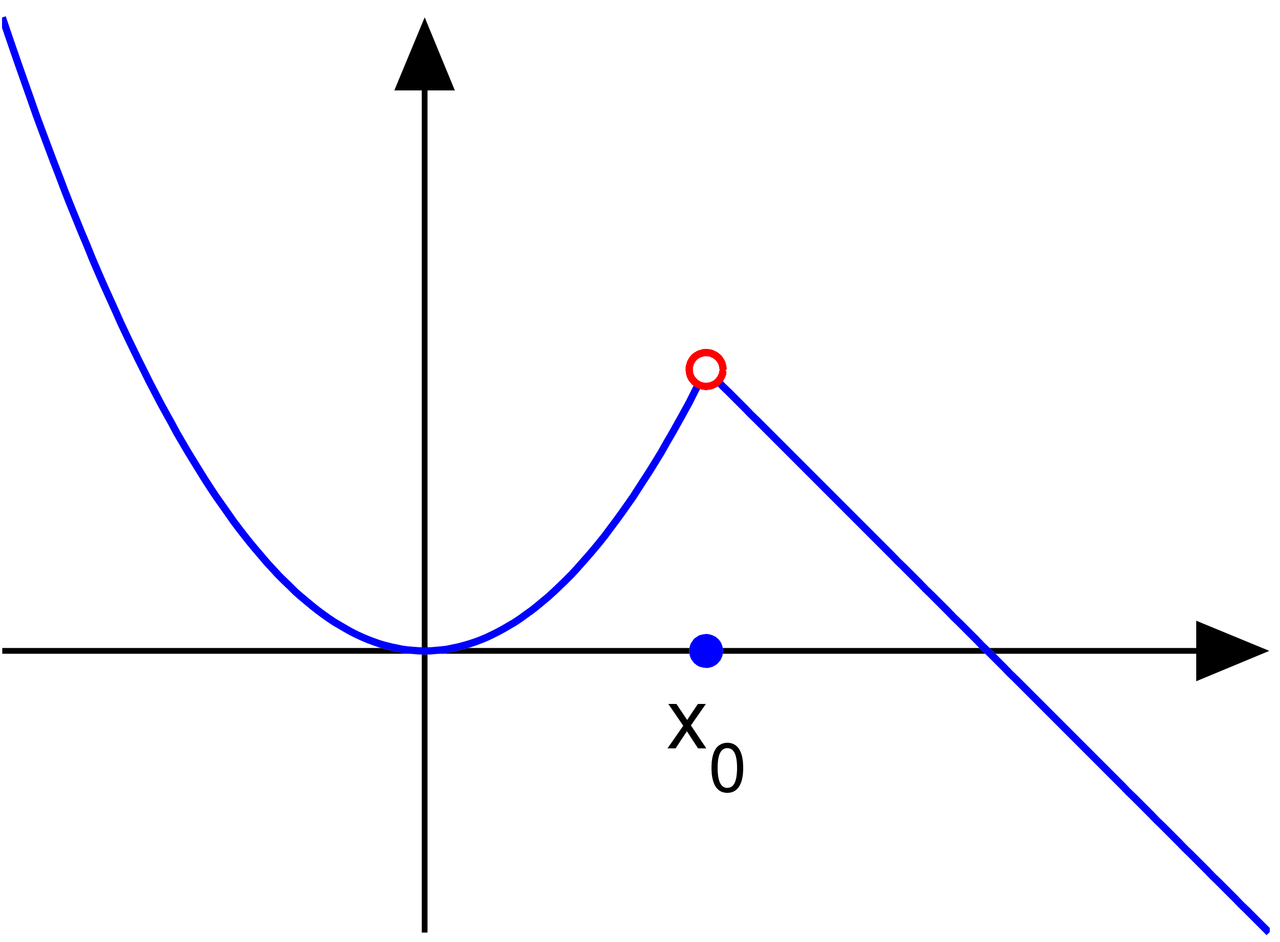
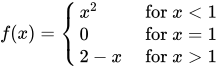
除去可能な不連続性 例1の関数、除去可能な不連続性 区分 関数 を考える f ( x ) = { x 2 for x < 1 0 for x = 1 2 − x for x > 1 {\displaystyle f(x)={\begin{cases}x^{2}&{\text{ for }}x<1\\0&{\text{ for }}x=1\\2-x&{\text{ for }}x>1\end{cases}}}
問題は、 除去可能な 不連続性 です 。この種の不連続性については、次のようになります。 x 0 = 1 {\displaystyle x_{0}=1}
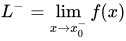
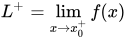
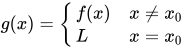
負方向からの片側極限: と 正 方向からの片側極限: は 両方とも に 存在し、有限であり、 に等しい。 言い換えれば、2つの片側極限が存在し、 が等しいので、が に 近づく とき の の極限 が存在し、 はこの同じ値に等しい。 の実際の値 が に等しく ない 場合、 は と呼ばれる。 L − = lim x → x 0 − f ( x ) {\displaystyle L^{-}=\lim _{x\to x_{0}^{-}}f(x)} L + = lim x → x 0 + f ( x ) {\displaystyle L^{+}=\lim _{x\to x_{0}^{+}}f(x)} x 0 {\displaystyle x_{0}} L = L − = L + . {\displaystyle L=L^{-}=L^{+}.} L {\displaystyle L} f ( x ) {\displaystyle f(x)} x {\displaystyle x} x 0 {\displaystyle x_{0}} f ( x 0 ) {\displaystyle f\left(x_{0}\right)} L , {\displaystyle L,} x 0 {\displaystyle x_{0}} 除去可能な不連続性 。この不連続性を除去すると、 連続に より正確には、関数は 連続である。 f {\displaystyle f} x 0 , {\displaystyle x_{0},} g ( x ) = { f ( x ) x ≠ x 0 L x = x 0 {\displaystyle g(x)={\begin{cases}f(x)&x\neq x_{0}\\L&x=x_{0}\end{cases}}} x = x 0 . {\displaystyle x=x_{0}.}
除去可能な不連続性 という用語は 、両方向の極限が存在して等しいが、 点 [a]では関数が 定義されていない、 除去可能な特異点 を含むように拡大解釈されることがあります。関数の 連続性 と不連続性は、関数の定義域内の点に対してのみ定義される概念である ため、 この用法は 用語の乱用です。 x 0 . {\displaystyle x_{0}.}
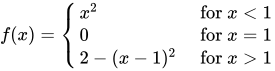
ジャンプの不連続性 例2の関数、ジャンプ不連続 機能について考える f ( x ) = { x 2 for x < 1 0 for x = 1 2 − ( x − 1 ) 2 for x > 1 {\displaystyle f(x)={\begin{cases}x^{2}&{\mbox{ for }}x<1\\0&{\mbox{ for }}x=1\\2-(x-1)^{2}&{\mbox{ for }}x>1\end{cases}}}
さて、ポイント は x 0 = 1 {\displaystyle x_{0}=1} ジャンプ不連続 。
この場合、片側極限、 および が存在し、有限であるものの 等しくない ため、単一の極限は存在しません。したがって、 極限 は存在しません。したがって、は ジャンプ不連続 、 ステップ不連続 、または 第一種不連続 と呼ばれます 。このタイプの不連続では、関数は 任意の値を取ることができます。 L − {\displaystyle L^{-}} L + {\displaystyle L^{+}} L − ≠ L + , {\displaystyle L^{-}\neq L^{+},} L {\displaystyle L} x 0 {\displaystyle x_{0}} f {\displaystyle f} x 0 . {\displaystyle x_{0}.}
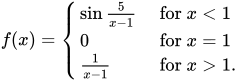
本質的な不連続性 例3の関数は、本質的な不連続性である 本質的な不連続性の場合、2 つの片側極限のうち少なくとも 1 つは に存在しません 。(片側極限の 1 つまたは両方が になる可能性があることに注意してください )。 R {\displaystyle \mathbb {R} } ± ∞ {\displaystyle \pm \infty }
機能について考える f ( x ) = { sin 5 x − 1 for x < 1 0 for x = 1 1 x − 1 for x > 1. {\displaystyle f(x)={\begin{cases}\sin {\frac {5}{x-1}}&{\text{ for }}x<1\\0&{\text{ for }}x=1\\{\frac {1}{x-1}}&{\text{ for }}x>1.\end{cases}}}
さて、ポイント は x 0 = 1 {\displaystyle x_{0}=1} 本質的な不連続性 。
この例では、 と はどちら も には 存在しない ため、本質的不連続性の条件を満たしています。 は 本質的不連続性、無限不連続性、または第二種不連続性です。(これは、 複素変数の関数 を研究する際によく使用される 本質的特異点 とは異なります)。 L − {\displaystyle L^{-}} L + {\displaystyle L^{+}} R {\displaystyle \mathbb {R} } x 0 {\displaystyle x_{0}}
関数の不連続点を数える が区間上で定義された関数であると 仮定すると、 における 不連続点すべての集合 を で表す。 によって、 で 除去可能な 不連続点 を 持つ すべての集合を意味する。 同様に、で ジャンプ 不連続点 を 持つ すべての集合を表す。で 本質 的な 不連続点 を持つ すべての集合は で表す。 もちろん、 f {\displaystyle f} I ⊆ R , {\displaystyle I\subseteq \mathbb {R} ,} D {\displaystyle D} f {\displaystyle f} I . {\displaystyle I.} R {\displaystyle R} x 0 ∈ I {\displaystyle x_{0}\in I} f {\displaystyle f} x 0 . {\displaystyle x_{0}.} J {\displaystyle J} x 0 ∈ I {\displaystyle x_{0}\in I} f {\displaystyle f} x 0 . {\displaystyle x_{0}.} x 0 ∈ I {\displaystyle x_{0}\in I} f {\displaystyle f} x 0 {\displaystyle x_{0}} E . {\displaystyle E.} D = R ∪ J ∪ E . {\displaystyle D=R\cup J\cup E.}
このセットの次の 2 つの特性 は文献で関連しています。 D {\displaystyle D}
トム・アポストル [3]は、 上記の分類に部分的に従い、除去可能不連続性とジャンプ不連続性のみを考察している。彼の目的は単調関数の不連続性を研究し、主にフロダの定理を証明することである。同じ目的で、ウォルター・ルーディン [4] とカール・R・ストロムバーグ [5] も、異なる用語を用いて除去可能不連続性とジャンプ不連続性を研究している。しかし、さらに両著者とも、 は 常に可算集合であると述べている( [6] [7] を参照)。 R ∪ J {\displaystyle R\cup J}
本質的不連続性という 用語は、 1889年には既に数学的な文脈で使用されていた証拠がある。 [8] しかし、この用語が数学的な定義と併せて使用された最も古い例は、ジョン・クリッパートの著作であると思われる。 [9] その著作の中で、クリッパートは本質的不連続性自体を、以下の3つの集合に 細分化して分類した。 E {\displaystyle E}
E 1 = { x 0 ∈ I : lim x → x 0 − f ( x ) and lim x → x 0 + f ( x ) do not exist in R } , {\displaystyle E_{1}=\left\{x_{0}\in I:\lim _{x\to x_{0}^{-}}f(x){\text{ and }}\lim _{x\to x_{0}^{+}}f(x){\text{ do not exist in }}\mathbb {R} \right\},} E 2 = { x 0 ∈ I : lim x → x 0 − f ( x ) exists in R and lim x → x 0 + f ( x ) does not exist in R } , {\displaystyle E_{2}=\left\{x_{0}\in I:\ \lim _{x\to x_{0}^{-}}f(x){\text{ exists in }}\mathbb {R} {\text{ and }}\lim _{x\to x_{0}^{+}}f(x){\text{ does not exist in }}\mathbb {R} \right\},} E 3 = { x 0 ∈ I : lim x → x 0 − f ( x ) does not exist in R and lim x → x 0 + f ( x ) exists in R } . {\displaystyle E_{3}=\left\{x_{0}\in I:\ \lim _{x\to x_{0}^{-}}f(x){\text{ does not exist in }}\mathbb {R} {\text{ and }}\lim _{x\to x_{0}^{+}}f(x){\text{ exists in }}\mathbb {R} \right\}.}
もちろん、 Wheneverは 第一種の本質的不連続性 と呼ばれます 。Any は第二種の本質的不連続性と呼ばれます 。 そこで彼は、次のように述べることで、可算であるという性質を失うことなく 集合を拡大します。 E = E 1 ∪ E 2 ∪ E 3 . {\displaystyle E=E_{1}\cup E_{2}\cup E_{3}.} x 0 ∈ E 1 , {\displaystyle x_{0}\in E_{1},} x 0 {\displaystyle x_{0}} x 0 ∈ E 2 ∪ E 3 {\displaystyle x_{0}\in E_{2}\cup E_{3}} R ∪ J {\displaystyle R\cup J}
この集合 は可算です。 R ∪ J ∪ E 2 ∪ E 3 {\displaystyle R\cup J\cup E_{2}\cup E_{3}}
ルベーグの定理の書き換え およびが 有界関数 の とき、 のリーマン 積分可能性 に関する 集合 の重要性はよく知られています。 実際、 ルベーグの定理 (ルベーグ-ヴィタリの 定理とも呼ばれる) によれば、 が 上でリーマン積分可能であるのは、 がルベーグ測度が 0 である集合である 場合のみです。 I = [ a , b ] {\displaystyle I=[a,b]} f {\displaystyle f} D {\displaystyle D} f . {\displaystyle f.} f {\displaystyle f} I = [ a , b ] {\displaystyle I=[a,b]} D {\displaystyle D}
この定理では、有界関数が リーマン積分可能であるという障害 に対して、あらゆる種類の不連続性が同等の重みを持つように思われる。可算集合はルベーグ測度零の集合であり、ルベーグ測度零を持つ集合の可算和もやはりルベーグ測度零の集合であるため、これは当てはまらないことが分かる。実際、集合内の不連続性は、 リーマン積分可能性に関して全く中立である。 この目的のための主要な不連続性は第一種の本質的不連続性であり、したがってルベーグ=ヴィタリの定理は次のように書き直すことができる。 f {\displaystyle f} [ a , b ] . {\displaystyle [a,b].} R ∪ J ∪ E 2 ∪ E 3 {\displaystyle R\cup J\cup E_{2}\cup E_{3}} f . {\displaystyle f.}
有界関数は、 第 1 種のすべての本質的不連続性の 対応集合が ルベーグ測度 0 を持つ 場合のみ、 上でリーマン積分可能です。 f , {\displaystyle f,} [ a , b ] {\displaystyle [a,b]} E 1 {\displaystyle E_{1}} f {\displaystyle f} の場合は、 有界関数のリーマン積分可能性に関する次のようなよく知られた古典的な補完状況に対応します 。 E 1 = ∅ {\displaystyle E_{1}=\varnothing } f : [ a , b ] → R {\displaystyle f:[a,b]\to \mathbb {R} }
の 各点で右極限を持つ 場合、 はリーマン積分可能である ( [10] を参照) f {\displaystyle f} [ a , b [ {\displaystyle [a,b[} f {\displaystyle f} [ a , b ] {\displaystyle [a,b]} の 各点で左極限を持つ 場合、 リーマン積分は f {\displaystyle f} ] a , b ] {\displaystyle ]a,b]} f {\displaystyle f} [ a , b ] . {\displaystyle [a,b].} が 上の 規制関数 である とき 、リーマン積分 は 上で f {\displaystyle f} [ a , b ] {\displaystyle [a,b]} f {\displaystyle f} [ a , b ] . {\displaystyle [a,b].}
例 トーマ関数は 、すべての非零 有理点 において不連続であるが、すべての 無理点において連続である。これらの不連続性はすべて除去可能であることは容易に理解できる。最初の段落で述べたように、すべての 有理 点において連続であるが、すべての無理点において不連続である関数は存在しない 。
有理数の指示関数(ディリクレ関数とも呼ばれる ) は 、 あらゆる点で不連続で ある 。これらの不連続性はすべて、第一種の性質を持つ。
ここで、三元 カントール集合 とその指示関数(特性関数)
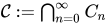
を考えてみましょう 。カントール集合 を構成する一つの方法は、 次のように与えられます。 ここで、集合は 再帰法によって次のように得られます。 C ⊂ [ 0 , 1 ] {\displaystyle {\mathcal {C}}\subset [0,1]} 1 C ( x ) = { 1 x ∈ C 0 x ∈ [ 0 , 1 ] ∖ C . {\displaystyle \mathbf {1} _{\mathcal {C}}(x)={\begin{cases}1&x\in {\mathcal {C}}\\0&x\in [0,1]\setminus {\mathcal {C}}.\end{cases}}} C {\displaystyle {\mathcal {C}}} C := ⋂ n = 0 ∞ C n {\textstyle {\mathcal {C}}:=\bigcap _{n=0}^{\infty }C_{n}} C n {\displaystyle C_{n}} C n = C n − 1 3 ∪ ( 2 3 + C n − 1 3 ) for n ≥ 1 , and C 0 = [ 0 , 1 ] . {\displaystyle C_{n}={\frac {C_{n-1}}{3}}\cup \left({\frac {2}{3}}+{\frac {C_{n-1}}{3}}\right){\text{ for }}n\geq 1,{\text{ and }}C_{0}=[0,1].}
関数の不連続性を考慮して、 点を仮定してみましょう。 1 C ( x ) , {\displaystyle \mathbf {1} _{\mathcal {C}}(x),} x 0 ∉ C . {\displaystyle x_{0}\not \in {\mathcal {C}}.}
したがって、の定式化 に用いられる 集合が存在し 、これは を含まない。つまり 、 は の構築で除去された開区間の1つに属する。 このように、 は の点を含まない近傍を持つ(言い換えれば、 は 閉集合 であり、 に対するその補集合は開集合であること を考慮すると、同じ結論が導かれる )。したがって、 は のある近傍においてのみ値0をとる。したがって 、 は で連続である。 C n , {\displaystyle C_{n},} C {\displaystyle {\mathcal {C}}} x 0 . {\displaystyle x_{0}.} x 0 {\displaystyle x_{0}} C n . {\displaystyle C_{n}.} x 0 {\displaystyle x_{0}} C . {\displaystyle {\mathcal {C}}.} C {\displaystyle {\mathcal {C}}} [ 0 , 1 ] {\displaystyle [0,1]} 1 C {\displaystyle \mathbf {1} _{\mathcal {C}}} x 0 . {\displaystyle x_{0}.} 1 C {\displaystyle \mathbf {1} _{\mathcal {C}}} x 0 . {\displaystyle x_{0}.}
これは、区間 上 の のすべての不連続性の 集合が のサブセットであることを意味します。 は ルベーグ測度がゼロの不可算集合で あるため 、 もルベーグ測度集合であり、したがって ルベーグ-ヴィタリ の定理に関して、 はリーマン積分関数です。 D {\displaystyle D} 1 C {\displaystyle \mathbf {1} _{\mathcal {C}}} [ 0 , 1 ] {\displaystyle [0,1]} C . {\displaystyle {\mathcal {C}}.} C {\displaystyle {\mathcal {C}}} D {\displaystyle D} 1 C {\displaystyle \mathbf {1} _{\mathcal {C}}}
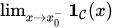
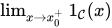
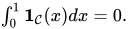
より正確には、 である。 実際、はどこにも稠密で ない 集合なので、 の 近傍 は には含まれない。 このように、 の任意の近傍は の点とに含ま れない点を含む 。関数 に関して言えば、 これは と がどちらも 存在しないことを意味する。つまり、 である。ここで、前と同様に、 によって 関数の第一種 のすべての本質的不連続の集合を表す。 明らかに D = C . {\displaystyle D={\mathcal {C}}.} C {\displaystyle {\mathcal {C}}} x 0 ∈ C {\displaystyle x_{0}\in {\mathcal {C}}} ( x 0 − ε , x 0 + ε ) {\displaystyle \left(x_{0}-\varepsilon ,x_{0}+\varepsilon \right)} x 0 , {\displaystyle x_{0},} C . {\displaystyle {\mathcal {C}}.} x 0 ∈ C {\displaystyle x_{0}\in {\mathcal {C}}} C {\displaystyle {\mathcal {C}}} C . {\displaystyle {\mathcal {C}}.} 1 C {\displaystyle \mathbf {1} _{\mathcal {C}}} lim x → x 0 − 1 C ( x ) {\textstyle \lim _{x\to x_{0}^{-}}\mathbf {1} _{\mathcal {C}}(x)} lim x → x 0 + 1 C ( x ) {\textstyle \lim _{x\to x_{0}^{+}}1_{\mathcal {C}}(x)} D = E 1 , {\displaystyle D=E_{1},} E 1 , {\displaystyle E_{1},} 1 C . {\displaystyle \mathbf {1} _{\mathcal {C}}.} ∫ 0 1 1 C ( x ) d x = 0. {\textstyle \int _{0}^{1}\mathbf {1} _{\mathcal {C}}(x)dx=0.}
微分の不連続性 開区間 を とし、 が 上で微分可能で が の導関数であるとする 。 つまり、 任意の に対して となる。 ダルブーの定理 によれば 、導関数は中間値の性質を満たす。 もちろん、 関数は区間 上で連続になることもあり、 その場合には ボルザノの定理 も適用される。ボルザノの定理は、すべての連続関数が中間値の性質を満たすことを主張していることを思い出してほしい。一方、逆は偽である。ダルブーの定理は が連続であると仮定しておらず、中間値の性質は が 上で連続であること を意味しない。 I ⊆ R {\displaystyle I\subseteq \mathbb {R} } F : I → R {\displaystyle F:I\to \mathbb {R} } I , {\displaystyle I,} f : I → R {\displaystyle f:I\to \mathbb {R} } F . {\displaystyle F.} F ′ ( x ) = f ( x ) {\displaystyle F'(x)=f(x)} x ∈ I {\displaystyle x\in I} f : I → R {\displaystyle f:I\to \mathbb {R} } f {\displaystyle f} I , {\displaystyle I,} f {\displaystyle f} f {\displaystyle f} I . {\displaystyle I.}
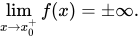
しかしながら、ダルブーの定理は、 がどのような不連続性を 持ち得るかという点に直接的な影響を及ぼします。実際、 が の不連続点である場合 、 は必然的に の本質的不連続点となります 。 [11] これは特に、以下の2つの状況は発生 しない ことを意味します。 f {\displaystyle f} x 0 ∈ I {\displaystyle x_{0}\in I} f {\displaystyle f} x 0 {\displaystyle x_{0}} f {\displaystyle f}
x 0 {\displaystyle x_{0}} は の除去可能な不連続点です 。 f {\displaystyle f} x 0 {\displaystyle x_{0}} は のジャンプ不連続です 。 f {\displaystyle f} さらに、他の2つの状況を除外する 必要があります (ジョン・クリッパート [12] を参照)。
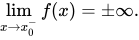
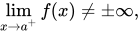
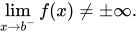
lim x → x 0 − f ( x ) = ± ∞ . {\displaystyle \lim _{x\to x_{0}^{-}}f(x)=\pm \infty .} lim x → x 0 + f ( x ) = ± ∞ . {\displaystyle \lim _{x\to x_{0}^{+}}f(x)=\pm \infty .} 条件 (i)、(ii)、(iii)、(iv) のいずれかが に対して満たされる場合は常に、 は 区間 上で 原始微分 、 を持たない と結論付けることができることに注意してください 。 x 0 ∈ I {\displaystyle x_{0}\in I} f {\displaystyle f} F {\displaystyle F} I {\displaystyle I}
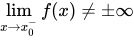
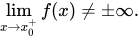
一方、任意の関数に関して新しいタイプの不連続性を導入することができる。 関数 の 本質的不連続性 は、 の 基本的な本質的不連続性 であると言われる 。 f : I → R {\displaystyle f:I\to \mathbb {R} } x 0 ∈ I {\displaystyle x_{0}\in I} f {\displaystyle f} f {\displaystyle f}
lim x → x 0 − f ( x ) ≠ ± ∞ {\displaystyle \lim _{x\to x_{0}^{-}}f(x)\neq \pm \infty } そして lim x → x 0 + f ( x ) ≠ ± ∞ . {\displaystyle \lim _{x\to x_{0}^{+}}f(x)\neq \pm \infty .}
したがって、 が微分関数 の不連続性である場合 、 は必然的に の基本的な本質的不連続性です 。 x 0 ∈ I {\displaystyle x_{0}\in I} f : I → R {\displaystyle f:I\to \mathbb {R} } x 0 {\displaystyle x_{0}} f {\displaystyle f}
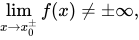
また、およびが有界関数である とき 、ルベーグの定理の仮定にあるように、すべての に対して が成り立つことにも注意してください 。
したがって 、 の任意の本質的不連続性 は基本的な不連続性です。 I = [ a , b ] {\displaystyle I=[a,b]} f : I → R {\displaystyle f:I\to \mathbb {R} } x 0 ∈ ( a , b ) {\displaystyle x_{0}\in (a,b)} lim x → x 0 ± f ( x ) ≠ ± ∞ , {\displaystyle \lim _{x\to x_{0}^{\pm }}f(x)\neq \pm \infty ,} lim x → a + f ( x ) ≠ ± ∞ , {\displaystyle \lim _{x\to a^{+}}f(x)\neq \pm \infty ,} lim x → b − f ( x ) ≠ ± ∞ . {\displaystyle \lim _{x\to b^{-}}f(x)\neq \pm \infty .} f {\displaystyle f}
参照 除去可能な特異点 – 正則関数上の未定義の点であり、正則化できる 数学的特異点 – 数学的対象が不規則に振る舞う点 Pages displaying short descriptions of redirect targets 連続性による拡張 – 位相空間の性質 滑らかさ – 関数の導関数の数(数学) 幾何学的連続性 - 関数の導関数の数(数学) Pages displaying short descriptions of redirect targets 媒介変数連続性 – 関数の導関数の数(数学) Pages displaying short descriptions of redirect targets
注記 ^ 例えば、Mathwordsの定義の最後の文を参照してください。 [1]
参考文献 ^ 「Mathwords: 除去可能な不連続性」. ^ ストロンバーグ、カール・R. (2015). 『古典実解析入門 』アメリカ数学会. p. 120. 例3 (c). ISBN 978-1-4704-2544-9 。 ^ アポストル、トム (1974). 『数学的解析』 (第2版). アディソン&ウェスレー. p. 92, sec. 4.22, sec. 4.23 and Ex. 4.63. ISBN 0-201-00288-4 。 ^ ウォルター・ルディン (1976). 『数学解析の原理』 (第3版). マグロウヒル. pp. 94, 定義4.26, 定義4.29, 定義4.30. ISBN 0-07-085613-3 。 ^ Stromberg, Karl R. 前掲書 . p. 128, 定義 3.87, 解釈 3.90. ^ ウォルター・ルディン。 前掲書 。100ページ、資料17。 ^ ストロンバーグ、カールR. 前掲書 . p. 131、Ex. 3。 ^ ホイットニー、ウィリアム・ドワイト (1889). 『センチュリー辞典:英語百科事典』第2巻. ロンドンおよびニューヨーク: T. フィッシャー・アンウィンおよびセンチュリー社. p. 1652. ISBN 9781334153952 2008年12月16日にオリジナルからアーカイブされました。 本質的不連続とは、関数の値が完全に不確定となる不連続のことです。 ^ クリッパート, ジョン (1989年2月). 「上級微積分学:区間領域における実数値関数の不連続点の計算」. 数学マガジン . 62 : 43–48 . doi :10.1080/0025570X.1989.11977410. ^ Metzler, RC (1971). 「リーマン積分可能性について」 . アメリカ数学月刊誌 . 78 (10): 1129– 1131. doi :10.1080/00029890.1971.11992961. ^ ルディン、ウォルター。 前掲書。pp . 109、系。 ^ Klippert, John (2000). 「導関数の不連続性について」 . 国際数学教育科学技術誌 . 31:S2: 282– 287. Bibcode :2000IJMES..31..282K. doi :10.1080/00207390050032252.
出典
外部リンク 






















![{\displaystyle I=[a,b]}](https://wikimedia.org/api/rest_v1/media/math/render/svg/6d6214bb3ce7f00e496c0706edd1464ac60b73b5)

![{\displaystyle [a,b].}](https://wikimedia.org/api/rest_v1/media/math/render/svg/3ba5cb29655f824ce80a0b6a32d9326d0e8742cd)

![{\displaystyle [a,b]}](https://wikimedia.org/api/rest_v1/media/math/render/svg/9c4b788fc5c637e26ee98b45f89a5c08c85f7935)


![{\displaystyle f:[a,b]\to \mathbb {R} }](https://wikimedia.org/api/rest_v1/media/math/render/svg/b592d102ccd1ba134d401c5b3ea177baaba3ffac)

![{\displaystyle ]a,b]}](https://wikimedia.org/api/rest_v1/media/math/render/svg/784ada3a213049f80d0909d4b95b4b8a7f871e83)
![{\displaystyle {\mathcal {C}}\subset [0,1]}](https://wikimedia.org/api/rest_v1/media/math/render/svg/8aaa630e6658df0560ae1e76d3ffa0830927d124)
![{\displaystyle \mathbf {1} _{\mathcal {C}}(x)={\begin{cases}1&x\in {\mathcal {C}}\\0&x\in [0,1]\setminus {\mathcal {C}}.\end{cases}}}](https://wikimedia.org/api/rest_v1/media/math/render/svg/6b86ffbd4ce1367a84f6dcb47be2f37bf2322b62)


![{\displaystyle C_{n}={\frac {C_{n-1}}{3}}\cup \left({\frac {2}{3}}+{\frac {C_{n-1}}{3}}\right){\text{ }}n\geq 1、{\text{ }}C_{0}=[0,1] の場合。}](https://wikimedia.org/api/rest_v1/media/math/render/svg/63ce55f16d75e2f4e4541e0f591116f23de19dc3)


![{\displaystyle [0,1]}](https://wikimedia.org/api/rest_v1/media/math/render/svg/738f7d23bb2d9642bab520020873cccbef49768d)