Rule in mathematics
選択原則の図解 S 1 ( A , B ) {\displaystyle {\text{S}}_{1}(\mathbf {A} ,\mathbf {B} )} 数学において、 選択原理とは、与えられた 集合 の 列 から要素を選択することで数学的に意味のある対象が得られる可能性を主張する規則である。 選択原理 の理論は 、これらの原理と他の数学的性質との関係を研究する。選択原理は主に、 位相空間 、特に 関数空間 における、カバー特性、 測度 論的 特性、圏論的特性、局所特性
を記述する 。選択原理を用いて数学的性質を特徴付けることは、しばしば容易ではない作業であり、特徴付けられた性質に関する新たな知見をもたらす。
主な選択原則 1924年、 カール・メンガー [1]は 計量空間
の基底性質として、次のような性質を導入した 。位相空間の 基底 には、その空間を覆う、直径が消失する集合の列が含まれる。その後まもなく、 ヴィトルド・ヒューレヴィッツ [2]は、メンガーの基底性質が、次のような選択性質と同値であることを指摘した。空間の 開被覆
の列ごとに 、その列の各被覆から有限個の開集合を選択し、選択されたすべての集合の族が空間を覆うようにすることができる。この被覆性質を持つ位相空間は、 メンガー空間 と呼ばれる。
ヒューレヴィッツによるメンガーの性質の再定式化は、選択原理によって記述された 最初の重要な 位相的性質 であった。と を 数学的対象の類とする。1996年、 マリオン・シェーパーズ [3] は
、多数の古典的な数学的性質を捉えた以下の選択仮説を提唱した。 A {\displaystyle \mathbf {A} } B {\displaystyle \mathbf {B} }
S 1 ( A , B ) {\displaystyle {\text{S}}_{1}(\mathbf {A} ,\mathbf {B} )} : クラス の要素の すべてのシーケンスに対して、 となる 要素が存在します 。 U 1 , U 2 , … {\displaystyle {\mathcal {U}}_{1},{\mathcal {U}}_{2},\ldots } A {\displaystyle \mathbf {A} } U 1 ∈ U 1 , U 2 ∈ U 2 , … {\displaystyle U_{1}\in {\mathcal {U}}_{1},U_{2}\in {\mathcal {U}}_{2},\dots } { U n : n ∈ N } ∈ B {\displaystyle \{U_{n}:n\in \mathbb {N} \}\in \mathbf {B} } S fin ( A , B ) {\displaystyle {\text{S}}_{\text{fin}}(\mathbf {A} ,\mathbf {B} )} : クラス の要素の すべてのシーケンスに対して、 となる 有限部分集合が存在します 。 U 1 , U 2 , … {\displaystyle {\mathcal {U}}_{1},{\mathcal {U}}_{2},\ldots } A {\displaystyle \mathbf {A} } F 1 ⊆ U 1 , F 2 ⊆ U 2 , … {\displaystyle {\mathcal {F}}_{1}\subseteq {\mathcal {U}}_{1},{\mathcal {F}}_{2}\subseteq {\mathcal {U}}_{2},\dots } ⋃ n = 1 ∞ F n ∈ B {\displaystyle \bigcup _{n=1}^{\infty }{\mathcal {F}}_{n}\in \mathbf {B} } クラスとが何らかの周囲空間の被覆から構成される 場合 、Scheepers は次の選択原理も導入しました。 A {\displaystyle \mathbf {A} } B {\displaystyle \mathbf {B} }
U fin ( A , B ) {\displaystyle {\text{U}}_{\text{fin}}(\mathbf {A} ,\mathbf {B} )} : クラス の要素の すべてのシーケンス (いずれも有限部分カバーを含まない) に対して、 となる有限部分集合が存在します 。 U 1 , U 2 , … {\displaystyle {\mathcal {U}}_{1},{\mathcal {U}}_{2},\ldots } A {\displaystyle \mathbf {A} } F 1 ⊆ U 1 , F 2 ⊆ U 2 , … {\displaystyle {\mathcal {F}}_{1}\subseteq {\mathcal {U}}_{1},{\mathcal {F}}_{2}\subseteq {\mathcal {U}}_{2},\dots } { ⋃ F 1 , ⋃ F 2 , … } ∈ B {\displaystyle \{\bigcup {\mathcal {F}}_{1},\bigcup {\mathcal {F}}_{2},\dotsc \}\in \mathbf {B} } その後、 ボアズ・ツァバンは 次のような関連原則が広く普及していることを確認しました。
( A B ) {\displaystyle {\binom {\mathbf {A} }{\mathbf {B} }}} : クラスのすべてのメンバー には、クラスのメンバーが含まれます 。 A {\displaystyle \mathbf {A} } B {\displaystyle \mathbf {B} } このように定義された概念は 選択原理 である。特定のクラスとを 考慮することによって選択原理を具体化すると、 選択(または選択的)特性 が得られる 。しかし、これらの用語は文献では互換的に使用されている。 A {\displaystyle \mathbf {A} } B {\displaystyle \mathbf {B} }
バリエーション 集合と の 部分集合の 族に対して 、 における のスター は集合 です 。 A ⊂ X {\displaystyle A\subset X} F {\displaystyle {\mathcal {F}}} X {\displaystyle X} A {\displaystyle A} F {\displaystyle {\mathcal {F}}} St ( A , F ) = ⋃ { F ∈ F : A ∩ F ≠ ∅ } {\displaystyle {\text{St}}(A,{\mathcal {F}})=\bigcup \{F\in {\mathcal {F}}:A\cap F\neq \emptyset \}}
1999年に リュビサ・DR・コシナツは 次のような スター選択原則 を導入した。 [4]
S 1 ∗ ( A , B ) {\displaystyle {\text{S}}_{1}^{*}(\mathbf {A} ,\mathbf {B} )} : クラス の要素の すべてのシーケンスに対して、 となる 要素が存在します 。 U 1 , U 2 , … {\displaystyle {\mathcal {U}}_{1},{\mathcal {U}}_{2},\ldots } A {\displaystyle \mathbf {A} } U 1 ∈ U 1 , U 2 ∈ U 2 , … {\displaystyle U_{1}\in {\mathcal {U}}_{1},U_{2}\in {\mathcal {U}}_{2},\dots } { St ( U n , U n ) : n ∈ N } ∈ B {\displaystyle \{{\text{St}}(U_{n},{\mathcal {U}}_{n}):n\in \mathbb {N} \}\in \mathbf {B} } S fin ∗ ( A , B ) {\displaystyle {\text{S}}_{\text{fin}}^{*}(\mathbf {A} ,\mathbf {B} )} : クラス の要素の すべてのシーケンスに対して、 となる 有限部分集合が存在します 。 U 1 , U 2 , … {\displaystyle {\mathcal {U}}_{1},{\mathcal {U}}_{2},\ldots } A {\displaystyle \mathbf {A} } F 1 ⊆ U 1 , F 2 ⊆ U 2 , … {\displaystyle {\mathcal {F}}_{1}\subseteq {\mathcal {U}}_{1},{\mathcal {F}}_{2}\subseteq {\mathcal {U}}_{2},\dots } { St ( ⋃ F n , U n ) : n ∈ N } ∈ B {\displaystyle \{{\text{St}}(\bigcup {\mathcal {F}}_{n},{\mathcal {U}}_{n}):n\in \mathbb {N} \}\in \mathbf {B} } スター選択原理は、一般的な選択原理の特殊なケースです。これは、ファミリーの定義を 適宜変更することで確認できます。 B {\displaystyle \mathbf {B} }
カバー特性 被覆特性は選択原理理論の中核を成す。被覆特性ではない選択特性は、関連する空間の選択被覆特性との含意を用いて研究されることが多い。
を位相空間 とします 。 の 開 被覆 は、その和が空間全体 となる開集合の族です。 技術的な理由から、空間全体 が被覆の要素ではないことも要求します。空間 の開被覆の類 は と表記されます 。(正式には ですが、通常、空間 は 背景に固定されています。) 上記の Menger の性質は、したがって、 です 。1942 年、Fritz Rothberger は Borel の強測度零集合を検討し、後に Rothberger 空間 ( C 空間 とも呼ばれる) と呼ばれる位相的変分を導入しました。選択の表記法では、Rothberger の性質は の性質です 。 X {\displaystyle X} X {\displaystyle X} X . {\displaystyle X.} X {\displaystyle X} X {\displaystyle X} O {\displaystyle \mathbf {O} } O ( X ) {\displaystyle \mathbf {O} (X)} X {\displaystyle X} S fin ( O , O ) {\displaystyle {\text{S}}_{\text{fin}}(\mathbf {O} ,\mathbf {O} )} ″ {\displaystyle ''} S 1 ( O , O ) {\displaystyle {\text{S}}_{1}(\mathbf {O} ,\mathbf {O} )}
の 開被覆は 、 それが無限個の元を持ち、かつすべての点が 有限個以外のすべての集合 に属するとき、 点-余有限 である。(このタイプの被覆は、ゲルリッツとナジが論文のあるリストの3番目の項目で考察した。リストはギリシャ文字で列挙されていたため、これらの被覆はしばしば -被覆 と呼ばれる。) の点-余有限開被覆のクラスは で表される 。位相空間が を満たすとき、それ は Hurewicz 空間 である。 U {\displaystyle {\mathcal {U}}} X {\displaystyle X} x ∈ X {\displaystyle x\in X} U ∈ U {\displaystyle U\in {\mathcal {U}}} γ {\displaystyle \gamma } X {\displaystyle X} Γ {\displaystyle \mathbf {\Gamma } } U fin ( O , Γ ) {\displaystyle {\text{U}}_{\text{fin}}(\mathbf {O} ,\mathbf {\Gamma } )}
の 開被覆が -被覆で ある とは、 のすべての有限部分集合が のいずれかの元に含まれることを意味する。 の -被覆 の類 は で表される 。位相空間が を満たすとき、それ は γ-空間 である。 U {\displaystyle {\mathcal {U}}} X {\displaystyle X} ω {\displaystyle \omega } X {\displaystyle X} U {\displaystyle {\mathcal {U}}} ω {\displaystyle \omega } X {\displaystyle X} Ω {\displaystyle \mathbf {\Omega } } ( Ω Γ ) {\displaystyle {\binom {\mathbf {\Omega } }{\mathbf {\Gamma } }}}
スター選択仮説を使用することで、スターメンガー ( )、 スターロスバーガー ( )、 スターヒューレヴィッツ ( ) などの特性が得られます 。 S fin ∗ ( O , O ) {\displaystyle {\text{S}}_{\text{fin}}^{*}(\mathbf {O} ,\mathbf {O} )} S 1 ∗ ( O , O ) {\displaystyle {\text{S}}_{1}^{*}(\mathbf {O} ,\mathbf {O} )} S fin ∗ ( O , Γ ) {\displaystyle {\text{S}}_{\text{fin}}^{*}(\mathbf {O} ,\mathbf {\Gamma } )}
シェーパーズ図 形式 には、 および に対して36 個の選択特性があります 。そのうちのいくつかは自明です(すべての空間で成立するか、すべての空間で成立しない)。 リンデレフ空間に着目すると、 シェーパーズ図 として知られる以下の図は、上記の形式の非自明な選択特性を示しており 、 [3] [5] 、すべての非自明な選択特性は図中のいずれか1つと等価です。矢印は含意を示します。 Π ( A , B ) {\displaystyle \Pi (\mathbf {A} ,\mathbf {B} )} Π ∈ { S 1 , S fin , U fin , ( ) } {\displaystyle \Pi \in \{{\text{S}}_{1},{\text{S}}_{\text{fin}},{\text{U}}_{\text{fin}},{\bigl (}~~{\bigr )}\}} A , B ∈ { O , Γ , Ω } {\displaystyle \mathbf {A} ,\mathbf {B} \in \{\mathbf {O} ,\mathbf {\Gamma } ,\mathbf {\Omega } \}}
ローカルプロパティ 選択原則では、重要なローカル プロパティも取得されます。
を位相空間とし、 とする 。 空間内の 集合のクラスで、 閉包に 点を含むものは で表される 。クラスは クラス の 可算な 元から構成される。 に収束する 内の数列のクラスは で表される 。 Y {\displaystyle Y} y ∈ Y {\displaystyle y\in Y} A {\displaystyle A} Y {\displaystyle Y} y {\displaystyle y} Ω y {\displaystyle \mathbf {\Omega _{y}} } Ω y ctbl {\displaystyle \mathbf {\Omega _{y}^{\text{ctbl}}} } Ω y {\displaystyle \mathbf {\Omega _{y}} } Y {\displaystyle Y} y {\displaystyle y} Γ y {\displaystyle \mathbf {\Gamma _{y}} }
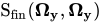
空間が フレシェ・ウリゾーン であるのは、 すべての点 に対して が満たされる 場合のみです 。 Y {\displaystyle Y} ( Ω y Γ y ) {\displaystyle {\binom {\mathbf {\Omega _{y}} }{\mathbf {\Gamma _{y}} }}} y ∈ Y {\displaystyle y\in Y} 空間が 強くフレシェ・ウリゾーン的 である ためには、 すべての点に対して が満たされる必要があります 。 Y {\displaystyle Y} S 1 ( Ω y , Γ y ) {\displaystyle {\text{S}}_{1}(\mathbf {\Omega _{y}} ,\mathbf {\Gamma _{y}} )} y ∈ Y {\displaystyle y\in Y} 空間が 可算な緊密性 を持つのは、 すべての点 に対して が満たされる場合のみです 。 Y {\displaystyle Y} ( Ω y Ω y ctbl ) {\displaystyle {\binom {\mathbf {\Omega _{y}} }{\mathbf {\Omega _{y}^{\text{ctbl}}} }}} y ∈ Y {\displaystyle y\in Y} 空間が 可算なファンタイトネス を持つのは、 すべての点に対して が満たされる場合のみです 。 Y {\displaystyle Y} S fin ( Ω y , Ω y ) {\displaystyle {\text{S}}_{\text{fin}}(\mathbf {\Omega _{y}} ,\mathbf {\Omega _{y}} )} y ∈ Y {\displaystyle y\in Y} 空間が 可算な強ファンタイトネス を持つのは、 すべての点に対して が満たされる場合のみです 。 Y {\displaystyle Y} S 1 ( Ω y , Ω y ) {\displaystyle {\text{S}}_{1}(\mathbf {\Omega _{y}} ,\mathbf {\Omega _{y}} )} y ∈ Y {\displaystyle y\in Y}
位相ゲーム 選択原理と位相ゲーム の間には密接な関係があります 。
メンガーゲーム を位相空間とする 。メンガーゲームは、アリスとボブという2人のプレイヤーが 行う ゲームである。このゲームは、自然数 ごとに1イニングずつ行われる 。イニングにおいて、アリスは の 開被覆を選択し、ボブは の 有限部分集合を選択する 。もし族が 空間 の被覆であれ ば、ボブがゲームに勝つ。そうでなければ、アリスが勝つ。 X {\displaystyle X} G fin ( O , O ) {\displaystyle {\text{G}}_{\text{fin}}(\mathbf {O} ,\mathbf {O} )} X {\displaystyle X} n {\displaystyle n} n t h {\displaystyle n^{th}} U n {\displaystyle {\mathcal {U}}_{n}} X {\displaystyle X} F n {\displaystyle {\mathcal {F}}_{n}} U {\displaystyle {\mathcal {U}}} ⋃ n = 1 ∞ F n {\displaystyle \bigcup _{n=1}^{\infty }{\mathcal {F}}_{n}} X {\displaystyle X}
プレイヤーにとっての戦略 と は、両プレイヤーの以前の動きに基づいて、自身の動きを決定する関数です。プレイヤーにとっての戦略 とは、そのプレイヤーがその戦略を貫くたびに 勝利する戦略です。
位相空間とは、アリスが この空間でプレイする ゲームで勝利戦略を持たない場合のみである。 [2] [3] S fin ( O , O ) {\displaystyle {\text{S}}_{\text{fin}}(\mathbf {O} ,\mathbf {O} )} G fin ( O , O ) {\displaystyle {\text{G}}_{\text{fin}}(\mathbf {O} ,\mathbf {O} )} を計量空間とする。ボブが この空間上で行う ゲームにおいて、その空間が-コンパクトで ある ことと同値である 。 [6] [7] X {\displaystyle X} G fin ( O , O ) {\displaystyle {\text{G}}_{\text{fin}}(\mathbf {O} ,\mathbf {O} )} X {\displaystyle X} X {\displaystyle X} σ {\displaystyle \sigma } リンデレフ空間のうち、計量化可能空間は正則空間および第2可算空間と同等であることに注意されたい。したがって、前述の結果は、 限定情報戦略を 考慮することによっても得られる可能性がある。 [ 8] マルコフ 戦略は、対戦相手の最新の動きと現在のラウンド番号のみを使用する戦略である。
を正則空間とする。ボブが 空間上で行われる ゲームにおいて、 空間が -コンパクトである場合にのみ、 勝利のマルコフ戦略を持つ 。 X {\displaystyle X} G fin ( O , O ) {\displaystyle {\text{G}}_{\text{fin}}(\mathbf {O} ,\mathbf {O} )} X {\displaystyle X} X {\displaystyle X} σ {\displaystyle \sigma } を第二可算空間 とする 。ボブが この空間でプレイする ゲームにおいて、 完全情報戦略で勝てる場合と同値である。 X {\displaystyle X} G fin ( O , O ) {\displaystyle {\text{G}}_{\text{fin}}(\mathbf {O} ,\mathbf {O} )} X {\displaystyle X} 同様に、与えられたシェーパーズ図から他の選択原理に対するゲームを定義する。これらのすべての場合において、位相空間がシェーパーズ図から得られる性質を持つのは、アリスが対応するゲームにおいて勝利戦略を持たない場合のみである [9] 。しかし、これは一般には成立しない。 空間のk被覆族をk被覆族とする。つまり、空間内のすべてのコンパクト集合が被覆の何らかの要素によって覆われるような空間である。フランシス・ジョーダンは、選択原理が 成立するが、アリスが ゲームにおいて勝利戦略を 持つ空間を示した [10]。 K {\displaystyle \mathbf {K} } S 1 ( K , O ) {\displaystyle {\text{S}}_{1}(\mathbf {K} ,\mathbf {O} )} G 1 ( K , O ) {\displaystyle {\text{G}}_{1}(\mathbf {K} ,\mathbf {O} )}
例と特性 すべての 空間は リンデレフ空間 です。 S fin ( O , O ) {\displaystyle {\text{S}}_{\text{fin}}(\mathbf {O} ,\mathbf {O} )} すべての σ-コンパクト空間 (コンパクト空間の可算な和)は です 。 U fin ( O , Γ ) {\displaystyle {\text{U}}_{\text{fin}}(\mathbf {O} ,\mathbf {\Gamma } )} ( Ω Γ ) ⇒ U fin ( O , Γ ) ⇒ S fin ( O , O ) {\displaystyle {\binom {\mathbf {\Omega } }{\mathbf {\Gamma } }}\Rightarrow {\text{U}}_{\text{fin}}(\mathbf {O} ,\mathbf {\Gamma } )\Rightarrow {\text{S}}_{\text{fin}}(\mathbf {O} ,\mathbf {O} )} 。 ( Ω Γ ) ⇒ S 1 ( O , O ) ⇒ S fin ( O , O ) {\displaystyle {\binom {\mathbf {\Omega } }{\mathbf {\Gamma } }}\Rightarrow {\text{S}}_{1}(\mathbf {O} ,\mathbf {O} )\Rightarrow {\text{S}}_{\text{fin}}(\mathbf {O} ,\mathbf {O} )} 。 連続体仮説 を仮定すると 、上記の意味が覆せないことを証明する実数の集合が存在します。 [5] あらゆる ルージン集合 は そうではない 。 [11] [12] S fin ( O , O ) {\displaystyle {\text{S}}_{\text{fin}}(\mathbf {O} ,\mathbf {O} )} U fin ( O , Γ ) {\displaystyle {\text{U}}_{\text{fin}}(\mathbf {O} ,\mathbf {\Gamma } )} シェルピンスキーのセット はすべて フレヴィチです。 [13] 選択原理の性質を持つ実数直線の部分集合 (誘導 部分空間位相 )は、特にメンガー空間とヒューレヴィツ空間において、 ベール空間 における連続像によって特徴付けられる。関数 について 、 有限個の自然数 を除くすべての自然数 に対して となる場合、と書く 。 を の部分集合とする 。 集合が 有界で あるとは、すべての関数 に対して となる 関数が存在することである 。集合 が 支配的 である とは、各関数 に対して と なる 関数が存在することである 。 R {\displaystyle \mathbb {R} } N N {\displaystyle \mathbb {N} ^{\mathbb {N} }} f , g ∈ N N {\displaystyle f,g\in \mathbb {N} ^{\mathbb {N} }} f ≤ ∗ g {\displaystyle f\leq ^{*}g} f ( n ) ≤ g ( n ) {\displaystyle f(n)\leq g(n)} n {\displaystyle n} A {\displaystyle A} N N {\displaystyle \mathbb {N} ^{\mathbb {N} }} A {\displaystyle A} g ∈ N N {\displaystyle g\in \mathbb {N} ^{\mathbb {N} }} f ≤ ∗ g {\displaystyle f\leq ^{*}g} f ∈ A {\displaystyle f\in A} A {\displaystyle A} f ∈ N N {\displaystyle f\in \mathbb {N} ^{\mathbb {N} }} g ∈ A {\displaystyle g\in A} f ≤ ∗ g {\displaystyle f\leq ^{*}g}
実数直線の部分集合とは、 その空間のベール空間への連続像がすべて支配的でない場合に限ります。 [14] S fin ( O , O ) {\displaystyle {\text{S}}_{\text{fin}}(\mathbf {O} ,\mathbf {O} )} 実数直線の部分集合とは、 その空間のベール空間への連続像がすべて有界である場合に限ります。 [14] U fin ( O , Γ ) {\displaystyle {\text{U}}_{\text{fin}}(\mathbf {O} ,\mathbf {\Gamma } )}
他の分野とのつながり
一般的な位相幾何学 あらゆる 空間は D空間 である。 [15] S fin ( O , O ) {\displaystyle {\text{S}}_{\text{fin}}(\mathbf {O} ,\mathbf {O} )} P を 空間の性質とする。ある空間 が 生成的に P であるとは、 性質 P を持つ各空間に対して 、その積空間が 性質 P を持つことを意味する。 X {\displaystyle X} Y {\displaystyle Y} X × Y {\displaystyle X\times Y}
すべての 可分な 生産的 パラコンパクト 空間は です 。 U fin ( O , Γ ) {\displaystyle {\text{U}}_{\text{fin}}(\mathbf {O} ,\mathbf {\Gamma } )} 連続体仮説 を仮定すると 、すべての生産的リンデレフ空間は生産的 [16] U fin ( O , Γ ) {\displaystyle {\text{U}}_{\text{fin}}(\mathbf {O} ,\mathbf {\Gamma } )} を実数直線の部分集合 とし 、を実数直線の 希薄 部分集合とする 。すると、集合 は希薄である。 [17] A {\displaystyle A} ( Ω Γ ) {\displaystyle {\binom {\mathbf {\Omega } }{\mathbf {\Gamma } }}} M {\displaystyle M} A + M = { a + x : a ∈ A , x ∈ M } {\displaystyle A+M=\{a+x:a\in A,x\in M\}}
測度論 実数直線上の任意の部分集合は強測度零集合である 。 [ 11 ] S 1 ( O , O ) {\displaystyle {\text{S}}_{1}(\mathbf {O} ,\mathbf {O} )}
機能スペース を ティコノフ空間 とし 、 を点収束 位相を持つ 連続関数の空間とします 。 X {\displaystyle X} C ( X ) {\displaystyle C(X)} f : X → R {\displaystyle f\colon X\to \mathbb {R} }
X {\displaystyle X} が強いフレシェ・ウリゾーン である 場合 、かつその場合に 限り、 強いフレシェ・ウリゾーンで ある 。 [18] ( Ω Γ ) {\displaystyle {\binom {\mathbf {\Omega } }{\mathbf {\Gamma } }}} C ( X ) {\displaystyle C(X)} C ( X ) {\displaystyle C(X)} X {\displaystyle X} が満たすべき条件 は、 可算な強いファンタイトネス を持つ場合である 。 [19] S 1 ( Ω , Ω ) {\displaystyle {\text{S}}_{1}(\mathbf {\Omega } ,\mathbf {\Omega } )} C ( X ) {\displaystyle C(X)} X {\displaystyle X} が満たされるとき、そしてそれ が可算なファンタイトネス を持つ ときのみ 。 [20] [5] S fin ( Ω , Ω ) {\displaystyle {\text{S}}_{\text{fin}}(\mathbf {\Omega } ,\mathbf {\Omega } )} C ( X ) {\displaystyle C(X)}
参照
参考文献 ^ カール、メンガー (1924)。 「Einige Überdeckungssätze der Punktmengenlehre」。 Sitzungsberichte der Wiener Academy 。 133 : 421–444。JFM 50.0129.01 。 Selecta Mathematica I (2002) に再録、 doi :10.1007/978-3-7091-6110-4_14、 ISBN 978-3-7091-7282-7 、pp.155-178。 ^ ab Hurewicz、Witold (1926)。 「ボレルシェンの定理の決定的な理論」。 数学的ツァイシュリフト 。 24 (1): 401–421 。 土井 :10.1007/bf01216792。 S2CID 119867793。 ^ abc Scheepers, Marion (1996). 「開被覆の組合せ論 I: ラムゼー理論」. 位相幾何学とその応用 . 69 : 31–62 . doi : 10.1016/0166-8641(95)00067-4 . ^ コシナツ、リュビサ DR (2015)。 「スター選考原則:アンケート」。 カイヤム数学ジャーナル 。 1 : 82~ 106。 ^ abc ^ Scheepers, Marion (1995-01-01). 「テルガルスキーの定理の直接証明」. Proceedings of the American Mathematical Society . 123 (11): 3483– 3485. doi : 10.1090/S0002-9939-1995-1273523-1 . ISSN 0002-9939. ^ テルガルスキー、ラスチスラフ (1984-06-01)。 「トプソーのゲームについて」。 マセマティカ スカンジナビカ 。 54 : 170–176 . 土井 : 10.7146/math.scand.a-12050 。 ISSN 1903-1807。 ^ スティーブン、クロンツ (2017-07-31). 「メンジャーゲームにおける限られた情報戦略の応用」。 コメント カロライナ大学数学 。 58 (2)。プラハのカレル大学、カロライヌム出版局: 225–239 . doi : 10.14712/1213-7243.2015.201 。 ISSN 0010-2628。 ^ パウリコウスキー、ヤヌシュ (1994)。 「ポイントオープンゲームのセットが未定」。 数学の基礎 。 144 (3): 279–285 。 土井 :10.4064/fm-144-3-279-285。 ISSN 0016-2736。 ^ Jordan, Francis (2020). 「協和音に関連する位相ゲームの不安定性について」. トポロジーとその応用 . 271 106990. Elsevier BV. doi : 10.1016/j.topol.2019.106990 . ISSN 0166-8641. S2CID 213386675. ^ ab ロスバーガー、フリッツ (1938)。 「Eine Verschärfung der Eigenschaft C」。 数学の基礎 。 30 : 50–55 . 土井 : 10.4064/fm-30-1-50-55 。 ^ フレヴィチ、ヴィトルド (1927)。 「ユーバー・フォルゲン・シュタイガー・ファンクティオネン」。 数学の基礎 。 9 : 193–210 . 土井 : 10.4064/fm-9-1-193-210 。 ^ Fremlin, David; Miller, Arnold (1988). 「Hurewicz, Menger and Rothbergerのいくつかの性質について」 (PDF) . Fundamenta Mathematicae . 129 : 17–33 . doi : 10.4064/fm-129-1-17-33 . ^ ab レツワフ、イレネウシュ (1994)。 「ポイントオープンゲームでは、すべてのルーシンのセットは未定です。」 数学の基礎 。 144 : 43–54 . 土井 : 10.4064/fm-144-1-43-54 。 ^ Aurichi, Leandro (2010). 「D空間、位相ゲーム、そして選択原理」 (PDF) . Topology Proceedings . 36 : 107–122 . ^ シェブチャク、ピョートル;ツァバン、ボアズ (2016)。 「メンジャー空間の積、II: 一般空間」。 arXiv : 1607.01687 [math.GN]。 ^ Galvin, Fred; Miller, Arnold (1984). 「γ {\displaystyle \gamma} -集合とその他の実数特異集合」. トポロジーとその応用 . 17 (2): 145– 155. doi : 10.1016/0166-8641(84)90038-5 . ^ Gerlits, J.; Nagy, Zs. (1982). 「C ( X ) {\displaystyle C(X)} , I のいくつかの性質」. トポロジーとその応用 . 14 (2): 151– 161. doi : 10.1016/0166-8641(82)90065-7 . ^ 酒井正美 (1988). 「性質C ″ {\displaystyle C''} と関数空間」 アメリカ数学会誌 . 104 (9): 917–919 . doi : 10.1090/S0002-9939-97-03897-5 . ^ アルハンゲルスキー, アレクサンダー (1986). 「ヒューレヴィツ空間、解析集合、および関数空間の扇形性」. ソビエト数学. Dokl. 2 : 396–399 .
フィールド 重要な概念 メトリックとプロパティ 主な結果