タグ

キュリー温度

2 件の記事

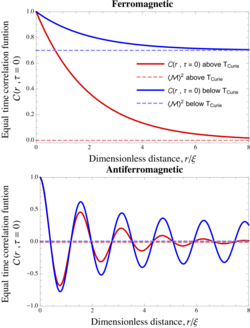
Schematic equal-time spin correlation functions for ferromagnetic and antiferromagnetic materials both above and below T Curie {\displaystyle T_{\text{Curie}}} versus the distance normalized by the correlation length, ξ {\displaystyle \xi } . In all cases, correlations are strongest nearest to the origin, indicating that a spin has the strongest influence on its nearest neighbors. All correlations gradually decay as the distance from the spin at the origin increases. Above the Curie temperature, the correlation between spins tends to zero as the distance between the spins gets very large. In contrast, below T Curie {\displaystyle T_{\text{Curie}}} , the correlation between the spins does not tend toward zero at large distances, but instead decays to a level consistent with the long-range order of the system. The difference in these decay behaviors, where correlations between microscopic random variables become zero versus non-zero at large distances, is one way of defining short- versus long-range order.

相関関数統計力学における秩序と変動の定量的解析

相関関数統計力学臨界温度相転移
Magnetic stripes are the result of reversals of the Earth's field and seafloor spreading. New oceanic crust is magnetized as it forms and then it moves away from the ridge in both directions. The models show a ridge (a) about 5 million years ago (b) about 2 million years ago and (c) in the present.[1]

古地磁気学が解き明かす地球の歴史とプレートテクトニクスの謎

古地磁気学地磁気逆転プレートテクトニクス海嶺