1760年代、 ヨハン・ハインリヒ・ランベルトは、 数 π が無理数で あること、つまりπは 分数 として表すことができない( ただし 、πとπは両方とも整数である ) こと を初めて証明しました 。19世紀には、 シャルル・エルミートが、基本的な 微積分 以上の前提知識を必要としない証明を発見しました 。エルミートの証明を簡略化した3つの証明は、 メアリー・カートライト 、 イヴァン・ニーヴン 、 ニコラ・ブルバキによるものです。ランベルトの証明を簡略化したもう1つの証明は、 ミクローシュ・ラチコビッチ によるものです 。これらの多くは 背理法による証明 です。 a / b , {\displaystyle a/b,} a {\displaystyle a} b {\displaystyle b}
1882年、 フェルディナント・フォン・リンデマンは 、それ が非合理的であるだけでなく、 超越的 でもあることを証明した。 [1] π {\displaystyle \pi }
ランバートの証明 ランバートの「Mémoires sur quelques propriétés remarquables des quantités transantantes, circulaires et logarithmiques」、Mémoires de l'Académie Royale des Sciences de Berlin (1768)、265–322 の 288 ページの式のスキャン。 1761年、 ヨハン・ハインリヒ・ランベルトは、まずこの 連分数 展開が成り立つことを示して、が無理数である ことを証明しました 。 π {\displaystyle \pi }
tan ( x ) = x 1 − x 2 3 − x 2 5 − x 2 7 − ⋱ . {\displaystyle \tan(x)={\cfrac {x}{1-{\cfrac {x^{2}}{3-{\cfrac {x^{2}}{5-{\cfrac {x^{2}}{7-{}\ddots }}}}}}}}.} 次にランバートは 、 が非ゼロかつ有理数であるならば、この式は無理数でなければならないことを証明した。 であるので 、 は 無理数であり、したがって も無理数である。 [2] ランバートの証明の簡略化を以下に示す。 x {\displaystyle x} tan π 4 = 1 {\displaystyle \tan {\tfrac {\pi }{4}}=1} π 4 {\displaystyle {\tfrac {\pi }{4}}} π {\displaystyle \pi }
エルミートの証明 1873年に書かれたこの証明は、 をコサイン 関数の半分が ゼロ である最小の正数として 特徴付け 、実際に が 無理数であることを証明しています。 [3] [4] 多くの無理数証明と同様に、これは 背理法による証明 です。 π {\displaystyle \pi } π 2 {\displaystyle \pi ^{2}}
次のように定義される 実関数 のシーケンスとを考え ます 。 A n {\displaystyle A_{n}} U n {\displaystyle U_{n}} n ∈ N 0 {\displaystyle n\in \mathbb {N} _{0}}
A 0 ( x ) = sin ( x ) , A n + 1 ( x ) = ∫ 0 x y A n ( y ) d y U 0 ( x ) = sin ( x ) x , U n + 1 ( x ) = − U n ′ ( x ) x {\displaystyle {\begin{aligned}A_{0}(x)&=\sin(x),&&A_{n+1}(x)=\int _{0}^{x}yA_{n}(y)\,dy\\[4pt]U_{0}(x)&={\frac {\sin(x)}{x}},&&U_{n+1}(x)=-{\frac {U_{n}'(x)}{x}}\end{aligned}}} 帰納法 を使って 証明できる
A n ( x ) = x 2 n + 1 ( 2 n + 1 ) ! ! − x 2 n + 3 2 × ( 2 n + 3 ) ! ! + x 2 n + 5 2 × 4 × ( 2 n + 5 ) ! ! ∓ ⋯ U n ( x ) = 1 ( 2 n + 1 ) ! ! − x 2 2 × ( 2 n + 3 ) ! ! + x 4 2 × 4 × ( 2 n + 5 ) ! ! ∓ ⋯ {\displaystyle {\begin{aligned}A_{n}(x)&={\frac {x^{2n+1}}{(2n+1)!!}}-{\frac {x^{2n+3}}{2\times (2n+3)!!}}+{\frac {x^{2n+5}}{2\times 4\times (2n+5)!!}}\mp \cdots \\[4pt]U_{n}(x)&={\frac {1}{(2n+1)!!}}-{\frac {x^{2}}{2\times (2n+3)!!}}+{\frac {x^{4}}{2\times 4\times (2n+5)!!}}\mp \cdots \end{aligned}}} したがって次の式が成り立ちます。
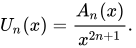
U n ( x ) = A n ( x ) x 2 n + 1 . {\displaystyle U_{n}(x)={\frac {A_{n}(x)}{x^{2n+1}}}.\,} それで
A n + 1 ( x ) x 2 n + 3 = U n + 1 ( x ) = − U n ′ ( x ) x = − 1 x d d x ( A n ( x ) x 2 n + 1 ) = − 1 x ( A n ′ ( x ) ⋅ x 2 n + 1 − ( 2 n + 1 ) x 2 n A n ( x ) x 2 ( 2 n + 1 ) ) = ( 2 n + 1 ) A n ( x ) − x A n ′ ( x ) x 2 n + 3 {\displaystyle {\begin{aligned}{\frac {A_{n+1}(x)}{x^{2n+3}}}&=U_{n+1}(x)=-{\frac {U_{n}'(x)}{x}}=-{\frac {1}{x}}{\frac {\mathrm {d} }{\mathrm {d} x}}\left({\frac {A_{n}(x)}{x^{2n+1}}}\right)\\[6pt]&=-{\frac {1}{x}}\left({\frac {A_{n}'(x)\cdot x^{2n+1}-(2n+1)x^{2n}A_{n}(x)}{x^{2(2n+1)}}}\right)\\[6pt]&={\frac {(2n+1)A_{n}(x)-xA_{n}'(x)}{x^{2n+3}}}\end{aligned}}} これは次の式と同等である。
A n + 1 ( x ) = ( 2 n + 1 ) A n ( x ) − x 2 A n − 1 ( x ) . {\displaystyle A_{n+1}(x)=(2n+1)A_{n}(x)-x^{2}A_{n-1}(x).\,} 数列の定義と帰納法を用いると、次のことが示せる。
A n ( x ) = P n ( x 2 ) sin ( x ) + x Q n ( x 2 ) cos ( x ) , {\displaystyle A_{n}(x)=P_{n}(x^{2})\sin(x)+xQ_{n}(x^{2})\cos(x),\,} ここで 、 およびは整数係数の多項式関数であり、の次数は 以下である 。特に、 P n {\displaystyle P_{n}} Q n {\displaystyle Q_{n}} P n {\displaystyle P_{n}} ⌊ 1 2 n ⌋ . {\displaystyle {\bigl \lfloor }{\tfrac {1}{2}}n{\bigr \rfloor }.} A n ( 1 2 π ) = P n ( 1 4 π 2 ) . {\displaystyle A_{n}{\bigl (}{\tfrac {1}{2}}\pi {\bigr )}=P_{n}{\bigl (}{\tfrac {1}{4}}\pi ^{2}{\bigr )}.}
エルミートはまた、この関数の閉じた表現を与えた 。 A n , {\displaystyle A_{n},}
A n ( x ) = x 2 n + 1 2 n n ! ∫ 0 1 ( 1 − z 2 ) n cos ( x z ) d z . {\displaystyle A_{n}(x)={\frac {x^{2n+1}}{2^{n}n!}}\int _{0}^{1}(1-z^{2})^{n}\cos(xz)\,\mathrm {d} z.\,} 彼はこの主張を正当化しなかったが、簡単に証明できる。まず、この主張は次のことと同義である。
1 2 n n ! ∫ 0 1 ( 1 − z 2 ) n cos ( x z ) d z = A n ( x ) x 2 n + 1 = U n ( x ) . {\displaystyle {\frac {1}{2^{n}n!}}\int _{0}^{1}(1-z^{2})^{n}\cos(xz)\,\mathrm {d} z={\frac {A_{n}(x)}{x^{2n+1}}}=U_{n}(x).} 帰納的に進めて、 n = 0. {\displaystyle n=0.}
∫ 0 1 cos ( x z ) d z = sin ( x ) x = U 0 ( x ) {\displaystyle \int _{0}^{1}\cos(xz)\,\mathrm {d} z={\frac {\sin(x)}{x}}=U_{0}(x)} そして、帰納的ステップとして、任意の 自然数 を考えます。もし n . {\displaystyle n.}
1 2 n n ! ∫ 0 1 ( 1 − z 2 ) n cos ( x z ) d z = U n ( x ) , {\displaystyle {\frac {1}{2^{n}n!}}\int _{0}^{1}(1-z^{2})^{n}\cos(xz)\,\mathrm {d} z=U_{n}(x),} 次に、 部分積分 と ライプニッツの定理 を用いると、
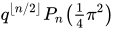
1 2 n + 1 ( n + 1 ) ! ∫ 0 1 ( 1 − z 2 ) n + 1 cos ( x z ) d z = 1 2 n + 1 ( n + 1 ) ! ( ( 1 − z 2 ) n + 1 sin ( x z ) x | z = 0 z = 1 ⏞ = 0 + ∫ 0 1 2 ( n + 1 ) ( 1 − z 2 ) n z sin ( x z ) x d z ) = 1 x ⋅ 1 2 n n ! ∫ 0 1 ( 1 − z 2 ) n z sin ( x z ) d z = − 1 x ⋅ d d x ( 1 2 n n ! ∫ 0 1 ( 1 − z 2 ) n cos ( x z ) d z ) = − U n ′ ( x ) x = U n + 1 ( x ) . {\displaystyle {\begin{aligned}&{\frac {1}{2^{n+1}(n+1)!}}\int _{0}^{1}\left(1-z^{2}\right)^{n+1}\cos(xz)\,\mathrm {d} z\\&\qquad ={\frac {1}{2^{n+1}(n+1)!}}{\Biggl (}\,\overbrace {\left.(1-z^{2})^{n+1}{\frac {\sin(xz)}{x}}\right|_{z=0}^{z=1}} ^{=\,0}\ +\,\int _{0}^{1}2(n+1)\left(1-z^{2}\right)^{n}z{\frac {\sin(xz)}{x}}\,\mathrm {d} z{\Biggr )}\\[8pt]&\qquad ={\frac {1}{x}}\cdot {\frac {1}{2^{n}n!}}\int _{0}^{1}\left(1-z^{2}\right)^{n}z\sin(xz)\,\mathrm {d} z\\[8pt]&\qquad =-{\frac {1}{x}}\cdot {\frac {\mathrm {d} }{\mathrm {d} x}}\left({\frac {1}{2^{n}n!}}\int _{0}^{1}(1-z^{2})^{n}\cos(xz)\,\mathrm {d} z\right)\\[8pt]&\qquad =-{\frac {U_{n}'(x)}{x}}\\[4pt]&\qquad =U_{n+1}(x).\end{aligned}}} と の 場合 、 の係数は 整数であり、 の次数は より小さいか等しいので、 は 整数 である 。言い換えれば、 1 4 π 2 = p / q , {\displaystyle {\tfrac {1}{4}}\pi ^{2}=p/q,} p {\displaystyle p} q {\displaystyle q} N {\displaystyle \mathbb {N} } P n {\displaystyle P_{n}} ⌊ 1 2 n ⌋ , {\displaystyle {\bigl \lfloor }{\tfrac {1}{2}}n{\bigr \rfloor },} q ⌊ n / 2 ⌋ P n ( 1 4 π 2 ) {\displaystyle q^{\lfloor n/2\rfloor }P_{n}{\bigl (}{\tfrac {1}{4}}\pi ^{2}{\bigr )}} N . {\displaystyle N.}
N = q ⌊ n / 2 ⌋ A n ( 1 2 π ) = q ⌊ n / 2 ⌋ 1 2 n n ! ( p q ) n + 1 2 ∫ 0 1 ( 1 − z 2 ) n cos ( 1 2 π z ) d z . {\displaystyle N=q^{\lfloor n/2\rfloor }{A_{n}}{\bigl (}{\tfrac {1}{2}}\pi {\bigr )}=q^{\lfloor n/2\rfloor }{\frac {1}{2^{n}n!}}\left({\dfrac {p}{q}}\right)^{n+{\frac {1}{2}}}\int _{0}^{1}(1-z^{2})^{n}\cos \left({\tfrac {1}{2}}\pi z\right)\,\mathrm {d} z.} しかし、この数は よりも明らかに大きいです。 一方、 が 無限大に近づくにつれて、この量の極限はゼロになります。したがって、 が十分に大きい場合、 によって矛盾が生じます。 0. {\displaystyle 0.} n {\displaystyle n} n {\displaystyle n} N < 1. {\displaystyle N<1.}
エルミートは、証明をそれ自体の目的として提示したのではなく、 超越性 の証明を探求する過程で、事後的に付け加えたものとして 提示した。彼は、便利な積分表現を得るための動機付けとそれを得るために、再帰関係を論じた。この積分表現が得られれば、積分から出発して簡潔かつ自己完結的な証明を提示する様々な方法が存在する(カートライト、ブルバキ、あるいはニーヴンの提示のように)。そして、エルミートはそれを容易に理解できた( [5] の超越性の証明においてそうであったように)。 π . {\displaystyle \pi .} e {\displaystyle e}
さらに、エルミートの証明はランバートの証明に見た目よりも近い。実際、 ランバートの連分数の「剰余」(あるいは「余り」)は [6]である。 A n ( x ) {\displaystyle A_{n}(x)} tan x . {\displaystyle \tan x.}
カートライトの証明 ハロルド・ジェフリーズは 、この証明は1945年に メアリー・カートライトによって ケンブリッジ大学 の試験で例として出された が、カートライトはその出所を突き止めていなかったと書いている。 [7] この証明は、ケンブリッジ大学の解析学IAコースの4番目の問題用紙に今でも掲載されている。 [8]
積分を考える
I n ( x ) = ∫ − 1 1 ( 1 − z 2 ) n cos ( x z ) d z , {\displaystyle I_{n}(x)=\int _{-1}^{1}(1-z^{2})^{n}\cos(xz)\,dz,} ここで、 は負でない整数です。 n {\displaystyle n}
2つ の部分積分は 再帰関係 を与える
x 2 I n ( x ) = 2 n ( 2 n − 1 ) I n − 1 ( x ) − 4 n ( n − 1 ) I n − 2 ( x ) . ( n ≥ 2 ) {\displaystyle x^{2}I_{n}(x)=2n(2n-1)I_{n-1}(x)-4n(n-1)I_{n-2}(x).\qquad (n\geq 2)} もし
J n ( x ) = x 2 n + 1 I n ( x ) , {\displaystyle J_{n}(x)=x^{2n+1}I_{n}(x),} すると、
J n ( x ) = 2 n ( 2 n − 1 ) J n − 1 ( x ) − 4 n ( n − 1 ) x 2 J n − 2 ( x ) . {\displaystyle J_{n}(x)=2n(2n-1)J_{n-1}(x)-4n(n-1)x^{2}J_{n-2}(x).} さらに、 したがって すべての J 0 ( x ) = 2 sin x {\displaystyle J_{0}(x)=2\sin x} J 1 ( x ) = − 4 x cos x + 4 sin x . {\displaystyle J_{1}(x)=-4x\cos x+4\sin x.} n ∈ Z + , {\displaystyle n\in \mathbb {Z} _{+},}
J n ( x ) = x 2 n + 1 I n ( x ) = n ! ( P n ( x ) sin ( x ) + Q n ( x ) cos ( x ) ) , {\displaystyle J_{n}(x)=x^{2n+1}I_{n}(x)=n!{\bigl (}P_{n}(x)\sin(x)+Q_{n}(x)\cos(x){\bigr )},} ここで 、 およびは次数 および の 多項式で、係数は 整数 です( に依存 )。 P n ( x ) {\displaystyle P_{n}(x)} Q n ( x ) {\displaystyle Q_{n}(x)} ≤ n , {\displaystyle \leq n,} n {\displaystyle n}
をとり 、可能であれば、とが自然数(つまり、が有理数)であると 仮定する 。 すると 、 x = 1 2 π , {\displaystyle x={\tfrac {1}{2}}\pi ,} 1 2 π = a / b {\displaystyle {\tfrac {1}{2}}\pi =a/b} a {\displaystyle a} b {\displaystyle b} π {\displaystyle \pi }
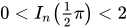
a 2 n + 1 n ! I n ( 1 2 π ) = P n ( 1 2 π ) b 2 n + 1 . {\displaystyle {\frac {a^{2n+1}}{n!}}I_{n}{\bigl (}{\tfrac {1}{2}}\pi {\bigr )}=P_{n}{\bigl (}{\tfrac {1}{2}}\pi {\bigr )}b^{2n+1}.} 右辺は整数です。しかし、 区間の 長さは であり 、積分される関数は と の間の値しか取らない ため 、 0 < I n ( 1 2 π ) < 2 {\displaystyle 0<I_{n}{\bigl (}{\tfrac {1}{2}}\pi {\bigr )}<2} [ − 1 , 1 ] {\displaystyle [-1,1]} 2 {\displaystyle 2} 0 {\displaystyle 0} 1. {\displaystyle 1.}
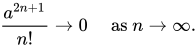
a 2 n + 1 n ! → 0 as n → ∞ . {\displaystyle {\frac {a^{2n+1}}{n!}}\to 0\quad {\text{ as }}n\to \infty .} したがって、十分に大きい n {\displaystyle n}
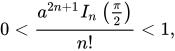
0 < a 2 n + 1 I n ( π 2 ) n ! < 1 , {\displaystyle 0<{\frac {a^{2n+1}I_{n}\left({\frac {\pi }{2}}\right)}{n!}}<1,} つまり、と の間に整数が見つかるということです。 これは、 が有理数であるという仮定から生じる矛盾です 。 0 {\displaystyle 0} 1. {\displaystyle 1.} π {\displaystyle \pi }
この証明はエルミートの証明に似ている。実際、
J n ( x ) = x 2 n + 1 ∫ − 1 1 ( 1 − z 2 ) n cos ( x z ) d z = 2 x 2 n + 1 ∫ 0 1 ( 1 − z 2 ) n cos ( x z ) d z = 2 n + 1 n ! A n ( x ) . {\displaystyle {\begin{aligned}J_{n}(x)&=x^{2n+1}\int _{-1}^{1}(1-z^{2})^{n}\cos(xz)\,dz\\[5pt]&=2x^{2n+1}\int _{0}^{1}(1-z^{2})^{n}\cos(xz)\,dz\\[5pt]&=2^{n+1}n!A_{n}(x).\end{aligned}}} しかし、明らかにより単純です。これは、関数の帰納的定義を省略し 、積分として表現することを出発点とすることで実現されます。 A n {\displaystyle A_{n}}
ニーヴンの証明 この証明では、正弦 関数の 最小の正の 零点 としての特徴付けを用いている 。 [9] π {\displaystyle \pi }
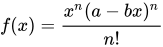
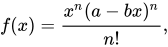
が有理数、 すなわちある整数に対して 、 一般性を失うことなく 両方とも正である と仮定する 。任意の正の整数が与えられたとき、 多項式関数を定義する。 π {\displaystyle \pi } π = a / b {\displaystyle \pi =a/b} a {\displaystyle a} b {\displaystyle b} n , {\displaystyle n,}
f ( x ) = x n ( a − b x ) n n ! {\displaystyle f(x)={\frac {x^{n}(a-bx)^{n}}{n!}}} そして、それぞれの let x ∈ R {\displaystyle x\in \mathbb {R} }
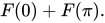
F ( x ) = f ( x ) − f ″ ( x ) + f ( 4 ) ( x ) + ⋯ + ( − 1 ) n f ( 2 n ) ( x ) . {\displaystyle F(x)=f(x)-f''(x)+f^{(4)}(x)+\cdots +(-1)^{n}f^{(2n)}(x).} 主張1: は整数である。 F ( 0 ) + F ( π ) {\displaystyle F(0)+F(\pi )}
証明: 単項式の和として 展開すると、 の係数は の形式の数になります。 ここで は整数であり、 の 場合 、 となります。したがって、 のときは となり、 の場合は と等しくなります 。 いずれ の 場合 も、 は整数であり、したがって は整数です。 f {\displaystyle f} x k {\displaystyle x^{k}} c k / n ! {\displaystyle c_{k}/n!} c k {\displaystyle c_{k}} 0 {\displaystyle 0} k < n . {\displaystyle k<n.} f ( k ) ( 0 ) {\displaystyle f^{(k)}(0)} 0 {\displaystyle 0} k < n {\displaystyle k<n} ( k ! / n ! ) c k {\displaystyle (k!/n!)c_{k}} n ≤ k ≤ 2 n {\displaystyle n\leq k\leq 2n} f ( k ) ( 0 ) {\displaystyle f^{(k)}(0)} F ( 0 ) {\displaystyle F(0)}
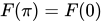
一方、 であり、したがって、 各非負整数 に対して となる。 特に、となる。 したがって、 も整数であり、 も 整数である(実際、 であることは容易に分かる )。 と は整数なので 、 それらの和も整数である。 f ( π − x ) = f ( x ) {\displaystyle f(\pi -x)=f(x)} ( − 1 ) k f ( k ) ( π − x ) = f ( k ) ( x ) {\displaystyle (-1)^{k}f^{(k)}(\pi -x)=f^{(k)}(x)} k . {\displaystyle k.} ( − 1 ) k f ( k ) ( π ) = f ( k ) ( 0 ) . {\displaystyle (-1)^{k}f^{(k)}(\pi )=f^{(k)}(0).} f ( k ) ( π ) {\displaystyle f^{(k)}(\pi )} F ( π ) {\displaystyle F(\pi )} F ( π ) = F ( 0 ) {\displaystyle F(\pi )=F(0)} F ( 0 ) {\displaystyle F(0)} F ( π ) {\displaystyle F(\pi )}
主張2:
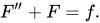
∫ 0 π f ( x ) sin ( x ) d x = F ( 0 ) + F ( π ) {\displaystyle \int _{0}^{\pi }f(x)\sin(x)\,dx=F(0)+F(\pi )} 証明: は零多項式な ので、 f ( 2 n + 2 ) {\displaystyle f^{(2n+2)}}
F ″ + F = f . {\displaystyle F''+F=f.} 正弦関数 と 余弦 関数の 微分 は 、sin' = cosとcos' = −sinで与えられる。したがって、 積の法則は次式 を意味する。
( F ′ ⋅ sin − F ⋅ cos ) ′ = f ⋅ sin {\displaystyle (F'\cdot \sin {}-F\cdot \cos {})'=f\cdot \sin } 微積分学の基本定理 により
∫ 0 π f ( x ) sin ( x ) d x = ( F ′ ( x ) sin x − F ( x ) cos x ) | 0 π . {\displaystyle \left.\int _{0}^{\pi }f(x)\sin(x)\,dx={\bigl (}F'(x)\sin x-F(x)\cos x{\bigr )}\right|_{0}^{\pi }.} および(ここでは 、正弦関数のゼロとしての の 前述の特徴付けを使用) であるため、請求項 2 が成り立ちます。 sin 0 = sin π = 0 {\displaystyle \sin 0=\sin \pi =0} cos 0 = − cos π = 1 {\displaystyle \cos 0=-\cos \pi =1} π {\displaystyle \pi }
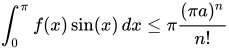
結論: および ( は正弦関数の最小の正の零点であるため ) であるので、主張1と2は が正の整数であることを示しています 。 および ( は正弦 関数 の最小の正の零点であるため )である ので 、 の元の定義により、 f ( x ) > 0 {\displaystyle f(x)>0} sin x > 0 {\displaystyle \sin x>0} 0 < x < π {\displaystyle 0<x<\pi } π {\displaystyle \pi } F ( 0 ) + F ( π ) {\displaystyle F(0)+F(\pi )} 0 ≤ x ( a − b x ) ≤ π a {\displaystyle 0\leq x(a-bx)\leq \pi a} 0 ≤ sin x ≤ 1 {\displaystyle 0\leq \sin x\leq 1} 0 ≤ x ≤ π , {\displaystyle 0\leq x\leq \pi ,} f , {\displaystyle f,}
∫ 0 π f ( x ) sin ( x ) d x ≤ π ( π a ) n n ! {\displaystyle \int _{0}^{\pi }f(x)\sin(x)\,dx\leq \pi {\frac {(\pi a)^{n}}{n!}}} これは、大きい場合 よりも小さいため、クレーム 2 により 、 これらに対しては 成り立ちます。これは、正の整数の場合不可能です。 これは、有理数であるという当初の仮定が 矛盾を導き、証明を結論づけることを示しています。 1 {\displaystyle 1} n , {\displaystyle n,} F ( 0 ) + F ( π ) < 1 {\displaystyle F(0)+F(\pi )<1} n , {\displaystyle n,} F ( 0 ) + F ( π ) . {\displaystyle F(0)+F(\pi ).} π {\displaystyle \pi }
上記の証明は、式を解析し、前提条件に関して可能な限り単純化した洗練されたバージョンである。
∫ 0 π f ( x ) sin ( x ) d x = ∑ j = 0 n ( − 1 ) j ( f ( 2 j ) ( π ) + f ( 2 j ) ( 0 ) ) + ( − 1 ) n + 1 ∫ 0 π f ( 2 n + 2 ) ( x ) sin ( x ) d x , {\displaystyle \int _{0}^{\pi }f(x)\sin(x)\,dx=\sum _{j=0}^{n}(-1)^{j}\left(f^{(2j)}(\pi )+f^{(2j)}(0)\right)+(-1)^{n+1}\int _{0}^{\pi }f^{(2n+2)}(x)\sin(x)\,dx,} これは 部分積分 によって得られる。請求項2は本質的にこの式を確立しており、 の使用 によって部分積分の反復が隠蔽されている。最後の積分は が零多項式であるため消える。請求項1は、残りの和が整数であることを示す。 2 n + 2 {\displaystyle 2n+2} F {\displaystyle F} f ( 2 n + 2 ) {\displaystyle f^{(2n+2)}}
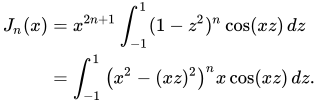
ニーヴンの証明は一見したよりもカートライトの(そしてエルミートの)証明に近い。 [6] 実際、
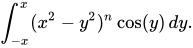
J n ( x ) = x 2 n + 1 ∫ − 1 1 ( 1 − z 2 ) n cos ( x z ) d z = ∫ − 1 1 ( x 2 − ( x z ) 2 ) n x cos ( x z ) d z . {\displaystyle {\begin{aligned}J_{n}(x)&=x^{2n+1}\int _{-1}^{1}(1-z^{2})^{n}\cos(xz)\,dz\\&=\int _{-1}^{1}\left(x^{2}-(xz)^{2}\right)^{n}x\cos(xz)\,dz.\end{aligned}}} したがって、この 置換 により、この積分は x z = y {\displaystyle xz=y}
∫ − x x ( x 2 − y 2 ) n cos ( y ) d y . {\displaystyle \int _{-x}^{x}(x^{2}-y^{2})^{n}\cos(y)\,dy.} 特に、
J n ( π 2 ) = ∫ − π / 2 π / 2 ( π 2 4 − y 2 ) n cos ( y ) d y = ∫ 0 π ( π 2 4 − ( y − π 2 ) 2 ) n cos ( y − π 2 ) d y = ∫ 0 π y n ( π − y ) n sin ( y ) d y = n ! b n ∫ 0 π f ( x ) sin ( x ) d x . {\displaystyle {\begin{aligned}J_{n}\left({\frac {\pi }{2}}\right)&=\int _{-\pi /2}^{\pi /2}\left({\frac {\pi ^{2}}{4}}-y^{2}\right)^{n}\cos(y)\,dy\\[5pt]&=\int _{0}^{\pi }\left({\frac {\pi ^{2}}{4}}-\left(y-{\frac {\pi }{2}}\right)^{2}\right)^{n}\cos \left(y-{\frac {\pi }{2}}\right)\,dy\\[5pt]&=\int _{0}^{\pi }y^{n}(\pi -y)^{n}\sin(y)\,dy\\[5pt]&={\frac {n!}{b^{n}}}\int _{0}^{\pi }f(x)\sin(x)\,dx.\end{aligned}}} 証明間のもう一つの関連性は、エルミートが既に [3] で多項式関数の 場合、 f {\displaystyle f}
F = f − f ( 2 ) + f ( 4 ) ∓ ⋯ , {\displaystyle F=f-f^{(2)}+f^{(4)}\mp \cdots ,} それから
∫ f ( x ) sin ( x ) d x = F ′ ( x ) sin ( x ) − F ( x ) cos ( x ) + C , {\displaystyle \int f(x)\sin(x)\,dx=F'(x)\sin(x)-F(x)\cos(x)+C,} そこから、
∫ 0 π f ( x ) sin ( x ) d x = F ( π ) + F ( 0 ) . {\displaystyle \int _{0}^{\pi }f(x)\sin(x)\,dx=F(\pi )+F(0).}
ブルバキの証明 ブルバキ の証明は彼の 微積分学の 論文の中で演習問題として概説されている。 [10] 任意の自然数 b と任意の非負整数に対して 定義する。 n , {\displaystyle n,}
A n ( b ) = b n ∫ 0 π x n ( π − x ) n n ! sin ( x ) d x . {\displaystyle A_{n}(b)=b^{n}\int _{0}^{\pi }{\frac {x^{n}(\pi -x)^{n}}{n!}}\sin(x)\,dx.} は、 で 値を取り 、 それ以外の場合はより大きい、 上で定義された関数の積分であるので 、 さらに、各自然数に対して、 が十分に大きい 場合、 A n ( b ) {\displaystyle A_{n}(b)} [ 0 , π ] {\displaystyle [0,\pi ]} 0 {\displaystyle 0} 0 {\displaystyle 0} π {\displaystyle \pi } 0 {\displaystyle 0} A n ( b ) > 0. {\displaystyle A_{n}(b)>0.} b , {\displaystyle b,} A n ( b ) < 1 {\displaystyle A_{n}(b)<1} n {\displaystyle n}
x ( π − x ) ≤ ( π 2 ) 2 {\displaystyle x(\pi -x)\leq \left({\frac {\pi }{2}}\right)^{2}} そしてそれゆえ
A n ( b ) ≤ π b n 1 n ! ( π 2 ) 2 n = π ( b π 2 / 4 ) n n ! . {\displaystyle A_{n}(b)\leq \pi b^{n}{\frac {1}{n!}}\left({\frac {\pi }{2}}\right)^{2n}=\pi {\frac {(b\pi ^{2}/4)^{n}}{n!}}.} 一方、 部分積分を繰り返すと 、 と が 自然数で と がから へ の多項式関数で 、 で定義されること
がわかる。 a {\displaystyle a} b {\displaystyle b} π = a / b {\displaystyle \pi =a/b} f {\displaystyle f} [ 0 , π ] {\displaystyle [0,\pi ]} R {\displaystyle \mathbb {R} }
f ( x ) = x n ( a − b x ) n n ! , {\displaystyle f(x)={\frac {x^{n}(a-bx)^{n}}{n!}},} それから:
A n ( b ) = ∫ 0 π f ( x ) sin ( x ) d x = [ − f ( x ) cos ( x ) ] x = 0 x = π − [ − f ′ ( x ) sin ( x ) ] x = 0 x = π + ⋯ ± [ f ( 2 n ) ( x ) cos ( x ) ] x = 0 x = π ± ∫ 0 π f ( 2 n + 1 ) ( x ) cos ( x ) d x . {\displaystyle {\begin{aligned}A_{n}(b)&=\int _{0}^{\pi }f(x)\sin(x)\,dx\\[5pt]&={\Big [}{-f(x)\cos(x)}{\Big ]}_{x=0}^{x=\pi }\,-{\Big [}{-f'(x)\sin(x)}{\Big ]}_{x=0}^{x=\pi }+\cdots \\[5pt]&\ \qquad \pm {\Big [}f^{(2n)}(x)\cos(x){\Big ]}_{x=0}^{x=\pi }\,\pm \int _{0}^{\pi }f^{(2n+1)}(x)\cos(x)\,dx.\end{aligned}}} この最後の積分は、 が零関数である ため( は次数 の多項式関数であるため )、 となります。 の各関数 ( ) は、 と において整数値を取り、 正弦関数と余弦関数でも同じことが起こるため、 が 整数であることが証明されます。 は よりも大きいため、自然数でなければなりません。しかし、 が十分に大きい 場合、 となる ことも証明されており、 矛盾が 生じます 。 0 , {\displaystyle 0,} f ( 2 n + 1 ) {\displaystyle f^{(2n+1)}} f {\displaystyle f} 2 n {\displaystyle 2n} f ( k ) {\displaystyle f^{(k)}} 0 ≤ k ≤ 2 n {\displaystyle 0\leq k\leq 2n} 0 {\displaystyle 0} π {\displaystyle \pi } A n ( b ) {\displaystyle A_{n}(b)} 0 , {\displaystyle 0,} A n ( b ) < 1 {\displaystyle A_{n}(b)<1} n {\displaystyle n}
この証明は Niven の証明に非常に近いですが、両者の主な違いは、数が整数であることを証明する方法です 。 A n ( b ) {\displaystyle A_{n}(b)}
ラツコビッチの証明 ミクローシュ・ラツコビッチ の証明はランバートの元の証明を簡略化したものである。 [11] 彼は関数
f k ( x ) = 1 − x 2 k + x 4 2 ! k ( k + 1 ) − x 6 3 ! k ( k + 1 ) ( k + 2 ) + ⋯ ( k ∉ { 0 , − 1 , − 2 , … } ) . {\displaystyle f_{k}(x)=1-{\frac {x^{2}}{k}}+{\frac {x^{4}}{2!k(k+1)}}-{\frac {x^{6}}{3!k(k+1)(k+2)}}+\cdots \quad (k\notin \{0,-1,-2,\ldots \}).} これらの関数は任意の実数に対して明確に定義されており 、さらに、 x . {\displaystyle x.}
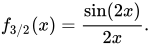
f 1 / 2 ( x ) = cos ( 2 x ) , {\displaystyle f_{1/2}(x)=\cos(2x),} f 3 / 2 ( x ) = sin ( 2 x ) 2 x . {\displaystyle f_{3/2}(x)={\frac {\sin(2x)}{2x}}.} 主張1: 任意の実数に対して 次の 再帰関係が成り立つ 。 x {\displaystyle x}
x 2 k ( k + 1 ) f k + 2 ( x ) = f k + 1 ( x ) − f k ( x ) . {\displaystyle {\frac {x^{2}}{k(k+1)}}f_{k+2}(x)=f_{k+1}(x)-f_{k}(x).} 証明: これは、 x . {\displaystyle x.}
主張2: 各実数について x , {\displaystyle x,}
lim k → + ∞ f k ( x ) = 1. {\displaystyle \lim _{k\to +\infty }f_{k}(x)=1.} 証明: 列 は有界である( に収束するため ) そして が 上限であり、 ならば x 2 n / n ! {\displaystyle x^{2n}/n!} 0 {\displaystyle 0} C {\displaystyle C} k > 1 , {\displaystyle k>1,}
| f k ( x ) − 1 | ⩽ ∑ n = 1 ∞ C k n = C 1 / k 1 − 1 / k = C k − 1 . {\displaystyle \left|f_{k}(x)-1\right|\leqslant \sum _{n=1}^{\infty }{\frac {C}{k^{n}}}=C{\frac {1/k}{1-1/k}}={\frac {C}{k-1}}.} 主張3: が有理数 なら ば
、 x ≠ 0 , {\displaystyle x\neq 0,} x 2 {\displaystyle x^{2}} k ∈ Q ∖ { 0 , − 1 , − 2 , … } {\displaystyle k\in \mathbb {Q} \smallsetminus \{0,-1,-2,\ldots \}}
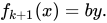
f k ( x ) ≠ 0 and f k + 1 ( x ) f k ( x ) ∉ Q . {\displaystyle f_{k}(x)\neq 0\quad {\text{ and }}\quad {\frac {f_{k+1}(x)}{f_{k}(x)}}\notin \mathbb {Q} .} 証明: そうでなければ、と なるような整数 と数 が存在する。 理由を見るために、 の場合は と を取り 、 そう で ない 場合は となる整数 と 数を選び 、 と を定義する 。いずれの場合も は 成り立たない。なぜなら、そうでなければ、主張1から各 ( ) が となることが導かれ、 これは主張2と矛盾するからである。次に、 3つの数 とが すべて整数となるような自然数を 1 つ取り 、数列を考える。 y ≠ 0 {\displaystyle y\neq 0} a {\displaystyle a} b {\displaystyle b} f k ( x ) = a y {\displaystyle f_{k}(x)=ay} f k + 1 ( x ) = b y . {\displaystyle f_{k+1}(x)=by.} y = f k + 1 ( x ) , {\displaystyle y=f_{k+1}(x),} a = 0 , {\displaystyle a=0,} b = 1 {\displaystyle b=1} f k ( x ) = 0 {\displaystyle f_{k}(x)=0} a {\displaystyle a} b {\displaystyle b} f k + 1 ( x ) / f k ( x ) = b / a {\displaystyle f_{k+1}(x)/f_{k}(x)=b/a} y = f k ( x ) / a = f k + 1 ( x ) / b . {\displaystyle y=f_{k}(x)/a=f_{k+1}(x)/b.} y {\displaystyle y} 0 , {\displaystyle 0,} f k + n ( x ) {\displaystyle f_{k+n}(x)} n ∈ N {\displaystyle n\in \mathbb {N} } 0 , {\displaystyle 0,} c {\displaystyle c} b c / k , {\displaystyle bc/k,} c k / x 2 , {\displaystyle ck/x^{2},} c / x 2 {\displaystyle c/x^{2}}
g n = { f k ( x ) n = 0 c n k ( k + 1 ) ⋯ ( k + n − 1 ) f k + n ( x ) n ≠ 0 {\displaystyle g_{n}={\begin{cases}f_{k}(x)&n=0\\{\dfrac {c^{n}}{k(k+1)\cdots (k+n-1)}}f_{k+n}(x)&n\neq 0\end{cases}}} それから
g 0 = f k ( x ) = a y ∈ Z y and g 1 = c k f k + 1 ( x ) = b c k y ∈ Z y . {\displaystyle g_{0}=f_{k}(x)=ay\in \mathbb {Z} y\quad {\text{ and }}\quad g_{1}={\frac {c}{k}}f_{k+1}(x)={\frac {bc}{k}}y\in \mathbb {Z} y.} 一方、請求項1から次のことが分かる。
g n + 2 = c n + 2 x 2 k ( k + 1 ) ⋯ ( k + n − 1 ) ⋅ x 2 ( k + n ) ( k + n + 1 ) f k + n + 2 ( x ) = c n + 2 x 2 k ( k + 1 ) ⋯ ( k + n − 1 ) f k + n + 1 ( x ) − c n + 2 x 2 k ( k + 1 ) ⋯ ( k + n − 1 ) f k + n ( x ) = c ( k + n ) x 2 g n + 1 − c 2 x 2 g n = ( c k x 2 + c x 2 n ) g n + 1 − c 2 x 2 g n , {\displaystyle {\begin{aligned}g_{n+2}&={\frac {c^{n+2}}{x^{2}k(k+1)\cdots (k+n-1)}}\cdot {\frac {x^{2}}{(k+n)(k+n+1)}}f_{k+n+2}(x)\\[5pt]&={\frac {c^{n+2}}{x^{2}k(k+1)\cdots (k+n-1)}}f_{k+n+1}(x)-{\frac {c^{n+2}}{x^{2}k(k+1)\cdots (k+n-1)}}f_{k+n}(x)\\[5pt]&={\frac {c(k+n)}{x^{2}}}g_{n+1}-{\frac {c^{2}}{x^{2}}}g_{n}\\[5pt]&=\left({\frac {ck}{x^{2}}}+{\frac {c}{x^{2}}}n\right)g_{n+1}-{\frac {c^{2}}{x^{2}}}g_{n},\end{aligned}}} これは整数係数を持つと の線形結合である。したがって、それぞれは の 整数 倍である。 さらに、主張2から、が十分に大きい 場合、それぞれは よりも大きい (したがって ) ことが示され、すべての の列は に収束する。 しかし 以上の数の列は に収束しない。 g n + 1 {\displaystyle g_{n+1}} g n {\displaystyle g_{n}} g n {\displaystyle g_{n}} y . {\displaystyle y.} g n {\displaystyle g_{n}} 0 {\displaystyle 0} g n ≥ | y | {\displaystyle g_{n}\geq |y|} n {\displaystyle n} g n {\displaystyle g_{n}} 0. {\displaystyle 0.} | y | {\displaystyle |y|} 0. {\displaystyle 0.}
主張 3から 、それ は無理数であることがわかり、したがってそれ は無理数である。 f 1 / 2 ( 1 4 π ) = cos 1 2 π = 0 , {\displaystyle f_{1/2}({\tfrac {1}{4}}\pi )=\cos {\tfrac {1}{2}}\pi =0,} 1 16 π 2 {\displaystyle {\tfrac {1}{16}}\pi ^{2}} π {\displaystyle \pi }
一方、
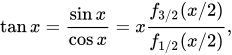
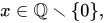
tan x = sin x cos x = x f 3 / 2 ( x / 2 ) f 1 / 2 ( x / 2 ) , {\displaystyle \tan x={\frac {\sin x}{\cos x}}=x{\frac {f_{3/2}(x/2)}{f_{1/2}(x/2)}},} 請求項 3 の別の結果は、 の場合、 は無理数であるということです。 x ∈ Q ∖ { 0 } , {\displaystyle x\in \mathbb {Q} \smallsetminus \{0\},} tan x {\displaystyle \tan x}
ラツコビッチの証明は 超幾何関数 に関するものである。実際、 ガウス は 関数方程式 を用いて超幾何関数の連分数展開を見出した 。 [12] これによりラツコビッチは、正接関数がランバートが発見した連分数展開を持つことの新たな、より簡単な証明を見出すことができた。 f k ( x ) = 0 F 1 ( k − x 2 ) {\displaystyle f_{k}(x)={}_{0}F_{1}(k-x^{2})}
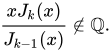
ラツコビッチの結果は、第一種ベッセル関数 J ν ( x ) {\displaystyle J_{\nu }(x)} で表すこともできます 。実際、 (ここでは ガンマ関数 です)。したがって、ラツコビッチの結果は 次の式 と等価です。 が有理数である場合、 Γ ( k ) J k − 1 ( 2 x ) = x k − 1 f k ( x ) {\displaystyle \Gamma (k)J_{k-1}(2x)=x^{k-1}f_{k}(x)} Γ {\displaystyle \Gamma } x ≠ 0 , {\displaystyle x\neq 0,} x 2 {\displaystyle x^{2}} k ∈ Q ∖ { 0 , − 1 , − 2 , … } {\displaystyle k\in \mathbb {Q} \smallsetminus \{0,-1,-2,\ldots \}}
x J k ( x ) J k − 1 ( x ) ∉ Q . {\displaystyle {\frac {xJ_{k}(x)}{J_{k-1}(x)}}\notin \mathbb {Q} .}
参照
参考文献 


![{\displaystyle {\begin{aligned}A_{0}(x)&=\sin(x),&&A_{n+1}(x)=\int _{0}^{x}yA_{n}(y)\,dy\\[4pt]U_{0}(x)&={\frac {\sin(x)}{x}},&&U_{n+1}(x)=-{\frac {U_{n}'(x)}{x}}\end{aligned}}}](https://wikimedia.org/api/rest_v1/media/math/render/svg/383a2c124e9fb0483d8cff6fe43ec2cb11123f1e)
![{\displaystyle {\begin{aligned}A_{n}(x)&={\frac {x^{2n+1}}{(2n+1)!!}}-{\frac {x^{2n+3}}{2\times (2n+3)!!}}+{\frac {x^{2n+5}}{2\times 4\times (2n+5)!!}}\mp \cdots \\[4pt]U_{n}(x)&={\frac {1}{(2n+1)!!}}-{\frac {x^{2}}{2\times (2n+3)!!}}+{\frac {x^{4}}{2\times 4\times (2n+5)!!}}\mp \cdots \end{aligned}}}](https://wikimedia.org/api/rest_v1/media/math/render/svg/71ef34699d572cced2bc23573fe5c44333a8f69a)
![{\displaystyle {\begin{aligned}{\frac {A_{n+1}(x)}{x^{2n+3}}}&=U_{n+1}(x)=-{\frac {U_{n}'(x)}{x}}=-{\frac {1}{x}}{\frac {\mathrm {d} }{\mathrm {d} x}}\left({\frac {A_{n}(x)}{x^{2n+1}}}\right)\\[6pt]&=-{\frac {1}{x}}\left({\frac {A_{n}'(x)\cdot x^{2n+1}-(2n+1)x^{2n}A_{n}(x)}{x^{2(2n+1)}}}\right)\\[6pt]&={\frac {(2n+1)A_{n}(x)-xA_{n}'(x)}{x^{2n+3}}}\end{aligned}}}](https://wikimedia.org/api/rest_v1/media/math/render/svg/0c6c2b5d9763dbd3e23a56ecc17adabfe3350fb6)












![{\displaystyle {\begin{aligned}&{\frac {1}{2^{n+1}(n+1)!}}\int _{0}^{1}\left(1-z^{2}\right)^{n+1}\cos(xz)\,\mathrm {d} z\\&\qquad ={\frac {1}{2^{n+1}(n+1)!}}{\Biggl (}\,\overbrace {\left.(1-z^{2})^{n+1}{\frac {\sin(xz)}{x}}\right|_{z=0}^{z=1}} ^{=\,0}\ +\,\int _{0}^{1}2(n+1)\left(1-z^{2}\right)^{n}z{\frac {\sin(xz)}{x}}\,\mathrm {d} z{\Biggr )}\\[8pt]&\qquad ={\frac {1}{x}}\cdot {\frac {1}{2^{n}n!}}\int _{0}^{1}\left(1-z^{2}\right)^{n}z\sin(xz)\,\mathrm {d} z\\[8pt]&\qquad =-{\frac {1}{x}}\cdot {\frac {\mathrm {d} }{\mathrm {d} x}}\left({\frac {1}{2^{n}n!}}\int _{0}^{1}(1-z^{2})^{n}\cos(xz)\,\mathrm {d} z\right)\\[8pt]&\qquad =-{\frac {U_{n}'(x)}{x}}\\[4pt]&\qquad =U_{n+1}(x).\end{aligned}}}](https://wikimedia.org/api/rest_v1/media/math/render/svg/b17a80baac92f2f9acdd016e5b3c6cb82d072775)















![{\displaystyle [-1,1]}](https://wikimedia.org/api/rest_v1/media/math/render/svg/51e3b7f14a6f70e614728c583409a0b9a8b9de01)


![{\displaystyle {\begin{aligned}J_{n}(x)&=x^{2n+1}\int _{-1}^{1}(1-z^{2})^{n}\cos(xz)\,dz\\[5pt]&=2x^{2n+1}\int _{0}^{1}(1-z^{2})^{n}\cos(xz)\,dz\\[5pt]&=2^{n+1}n!A_{n}(x).\end{aligned}}}](https://wikimedia.org/api/rest_v1/media/math/render/svg/a2b59eeb1f470090f6b6b8fe33df2b451cde970e)






























![{\displaystyle {\begin{aligned}J_{n}\left({\frac {\pi }{2}}\right)&=\int _{-\pi /2}^{\pi /2}\left({\frac {\pi ^{2}}{4}}-y^{2}\right)^{n}\cos(y)\,dy\\[5pt]&=\int _{0}^{\pi }\left({\frac {\pi ^{2}}{4}}-\left(y-{\frac {\pi }{2}}\right)^{2}\right)^{n}\cos \left(y-{\frac {\pi }{2}}\right)\,dy\\[5pt]&=\int _{0}^{\pi }y^{n}(\pi -y)^{n}\sin(y)\,dy\\[5pt]&={\frac {n!}{b^{n}}}\int _{0}^{\pi }f(x)\sin(x)\,dx.\end{aligned}}}](https://wikimedia.org/api/rest_v1/media/math/render/svg/410fc7da3ac44721eeb5582178544cf1d7021306)





![{\displaystyle [0,\pi ]}](https://wikimedia.org/api/rest_v1/media/math/render/svg/3e2a912eda6ef1afe46a81b518fe9da64a832751)




![{\displaystyle {\begin{aligned}A_{n}(b)&=\int _{0}^{\pi }f(x)\sin(x)\,dx\\[5pt]&={\Big [}{-f(x)\cos(x)}{\Big ]}_{x=0}^{x=\pi }\,-{\Big [}{-f'(x)\sin(x)}{\Big ]}_{x=0}^{x=\pi }+\cdots \\[5pt]&\ \qquad \pm {\Big [}f^{(2n)}(x)\cos(x){\Big ]}_{x=0}^{x=\pi }\,\pm \int _{0}^{\pi }f^{(2n+1)}(x)\cos(x)\,dx.\end{aligned}}}](https://wikimedia.org/api/rest_v1/media/math/render/svg/50e2387c01eb198c28734cd09322b53b073475c6)



















![{\displaystyle {\begin{aligned}g_{n+2}&={\frac {c^{n+2}}{x^{2}k(k+1)\cdots (k+n-1)}}\cdot {\frac {x^{2}}{(k+n)(k+n+1)}}f_{k+n+2}(x)\\[5pt]&={\frac {c^{n+2}}{x^{2}k(k+1)\cdots (k+n-1)}}f_{k+n+1}(x)-{\frac {c^{n+2}}{x^{2}k(k+1)\cdots (k+n-1)}}f_{k+n}(x)\\[5pt]&={\frac {c(k+n)}{x^{2}}}g_{n+1}-{\frac {c^{2}}{x^{2}}}g_{n}\\[5pt]&=\left({\frac {ck}{x^{2}}}+{\frac {c}{x^{2}}}n\right)g_{n+1}-{\frac {c^{2}}{x^{2}}}g_{n},\end{aligned}}}](https://wikimedia.org/api/rest_v1/media/math/render/svg/c762d4cefc09f9ffbb2077a4e94f9db8b4246056)