Subset of all points that is bounded by some given point of a dual (in a dual pairing)
関数 解析 、凸解析、および 数学 の関連分野 において 、 極集合は、 双対空間 にある ベクトル空間 の任意の 部分集合に関連付けられた特別な凸集合です。 部分集合の双極集合は の極集合です
が 、 にあります ( ではありません )。 A ∘ {\displaystyle A^{\circ }} A {\displaystyle A} X , {\displaystyle X,} X ′ . {\displaystyle X^{\prime }.} A ∘ , {\displaystyle A^{\circ },} X {\displaystyle X} X ′ ′ {\displaystyle X^{\prime \prime }}
定義 集合の極の定義には、射影幾何学と凸解析に由来する少なくとも3つの競合する定義があります。 [1] [ 要出典 ] それぞれの場合において、定義は、実数または複素数上の ベクトル空間のペア
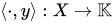
の特定の部分集合間の双対性を記述します( そして、多くの場合 、位相ベクトル空間 (TVS)です )。 ⟨ X , Y ⟩ {\displaystyle \langle X,Y\rangle } X {\displaystyle X} Y {\displaystyle Y}
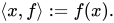
が体上のベクトル空間である 場合 、特に明記されていない限り、 は通常は 上の 線型関数 のベクトル空間になり、双対関係は によって定義される 双線型 評価 ( 点 における ) 写像 になります。 が 位相ベクトル空間 である 場合 、 は通常は の 連続双対空間 になりますが、常にそうであるとは限りません。 その場合、双対関係は再び評価写像になります。 X {\displaystyle X} K {\displaystyle \mathbb {K} } Y {\displaystyle Y} X {\displaystyle X} ⟨ ⋅ , ⋅ ⟩ : X × Y → K {\displaystyle \langle \cdot ,\cdot \rangle :X\times Y\to \mathbb {K} } ⟨ x , f ⟩ := f ( x ) . {\displaystyle \langle x,f\rangle :=f(x).} X {\displaystyle X} Y {\displaystyle Y} X , {\displaystyle X,}
の 基底 スカラー場における原点を中心とする 半径の閉球を r ≥ 0 {\displaystyle r\geq 0} K {\displaystyle \mathbb {K} } X {\displaystyle X} B r := B r K := { s ∈ K : | s | ≤ r } . {\displaystyle B_{r}:=B_{r}^{\mathbb {K} }:=\{s\in \mathbb {K} :|s|\leq r\}.}
関数解析の定義
絶対極性 がペアリング である と仮定します 。 の 部分集合の 極座標 または 絶対極座標は 、次の集合です。 ⟨ X , Y ⟩ {\displaystyle \langle X,Y\rangle } A {\displaystyle A} X {\displaystyle X} A ∘ := { y ∈ Y : sup a ∈ A | ⟨ a , y ⟩ | ≤ 1 } = { y ∈ Y : sup | ⟨ A , y ⟩ | ≤ 1 } where | ⟨ A , y ⟩ | := { | ⟨ a , y ⟩ | : a ∈ A } = { y ∈ Y : ⟨ A , y ⟩ ⊆ B 1 } where B 1 := { s ∈ K : | s | ≤ 1 } . {\displaystyle {\begin{alignedat}{4}A^{\circ }:=&\left\{y\in Y~:~\sup _{a\in A}|\langle a,y\rangle |\leq 1\right\}~~~~&&\\[0.7ex]=&\left\{y\in Y~:~\sup |\langle A,y\rangle |\leq 1\right\}~~~~&&{\text{ where }}|\langle A,y\rangle |:=\{|\langle a,y\rangle |:a\in A\}\\[0.7ex]=&\left\{y\in Y~:~\langle A,y\rangle \subseteq B_{1}\right\}~~~~&&{\text{ where }}B_{1}:=\{s\in \mathbb {K} :|s|\leq 1\}.\\[0.7ex]\end{alignedat}}}
ここで、 は定義される 写像の下の 集合の 像 を表す。 は定義により を含む最小の 凸 均衡 部分 集合 である 凸均衡包 を 表す
場合 、 ⟨ A , y ⟩ := { ⟨ a , y ⟩ : a ∈ A } {\displaystyle \langle A,y\rangle :=\{\langle a,y\rangle :a\in A\}} A {\displaystyle A} ⟨ ⋅ , y ⟩ : X → K {\displaystyle \langle \cdot ,y\rangle :X\to \mathbb {K} } x ↦ ⟨ x , y ⟩ . {\displaystyle x\mapsto \langle x,y\rangle .} cobal A {\displaystyle \operatorname {cobal} A} A , {\displaystyle A,} X {\displaystyle X} A , {\displaystyle A,} A ∘ = [ cobal A ] ∘ . {\displaystyle A^{\circ }=[\operatorname {cobal} A]^{\circ }.}
これは幾何学的定義の アフィンシフト であり、単位球体( )の関数解析的極が まさに単位球体( )であるという便利な特徴があります。 X {\displaystyle X} Y {\displaystyle Y}
の サブセットの 前 極 または 絶対前極は 次のセットです。 B {\displaystyle B} Y {\displaystyle Y} ∘ B := { x ∈ X : sup b ∈ B | ⟨ x , b ⟩ | ≤ 1 } = { x ∈ X : sup | ⟨ x , B ⟩ | ≤ 1 } {\displaystyle {}^{\circ }B:=\left\{x\in X~:~\sup _{b\in B}|\langle x,b\rangle |\leq 1\right\}=\{x\in X~:~\sup |\langle x,B\rangle |\leq 1\}}
多くの場合、の サブセットの前極は の 極 または 絶対極 とも呼ばれ 、 と表記されます 。実際には、この表記法と「極」という単語の再利用によって問題(あいまいさなど)が発生することはほとんどなく、多くの著者は「前極」という単語さえ使用していません。 B {\displaystyle B} Y {\displaystyle Y} B {\displaystyle B} B ∘ {\displaystyle B^{\circ }}
の 部分集合の 双極子 は 集合 と表記されることが多い 。つまり、 A {\displaystyle A} X , {\displaystyle X,} A ∘ ∘ , {\displaystyle A^{\circ \circ },} ∘ ( A ∘ ) {\displaystyle {}^{\circ }\left(A^{\circ }\right)} A ∘ ∘ := ∘ ( A ∘ ) = { x ∈ X : sup y ∈ A ∘ | ⟨ x , y ⟩ | ≤ 1 } . {\displaystyle A^{\circ \circ }:={}^{\circ }\left(A^{\circ }\right)=\left\{x\in X~:~\sup _{y\in A^{\circ }}|\langle x,y\rangle |\leq 1\right\}.}
リアルポーラー の 部分集合の 実 極は 次の集合である。 また、 の 部分集合の 実前極は 次の集合である。 A {\displaystyle A} X {\displaystyle X} A r := { y ∈ Y : sup a ∈ A Re ⟨ a , y ⟩ ≤ 1 } {\displaystyle A^{r}:=\left\{y\in Y~:~\sup _{a\in A}\operatorname {Re} \langle a,y\rangle \leq 1\right\}} B {\displaystyle B} Y {\displaystyle Y} r B := { x ∈ X : sup b ∈ B Re ⟨ x , b ⟩ ≤ 1 } . {\displaystyle {}^{r}B:=\left\{x\in X~:~\sup _{b\in B}\operatorname {Re} \langle x,b\rangle \leq 1\right\}.}
絶対前極子と同様に、実前極子は通常、 実極子と呼ばれ、 とも表記されます
。一部の著者 (例: [Schaefer 1999]) は、「極子」を (この記事のように「絶対極子」ではなく)「実極子」と定義し、 その表記法 (この記事や [Narici 2011] で使用されている表記法ではなく ) を使用していることに注意することが重要です。 B r . {\displaystyle B^{r}.} A ∘ {\displaystyle A^{\circ }} A r {\displaystyle A^{r}}
の 部分集合の 実 双極子は 集合 であり、これは の 凸包 の -閉包 に等しい。 A {\displaystyle A} X , {\displaystyle X,} A r r , {\displaystyle A^{rr},} r ( A r ) {\displaystyle {}^{r}\left(A^{r}\right)} σ ( X , Y ) {\displaystyle \sigma (X,Y)} A ∪ { 0 } . {\displaystyle A\cup \{0\}.}
の 部分集合は 凸閉 集合であり、 を含む
。一般に、 となる可能性はあるが、 が バランスして いる場合には等式が成立する 。さらに、 は の バランス包 を表す。 A {\displaystyle A} X , {\displaystyle X,} A r {\displaystyle A^{r}} σ ( Y , X ) {\displaystyle \sigma (Y,X)} A ∘ . {\displaystyle A^{\circ }.} A ∘ ≠ A r {\displaystyle A^{\circ }\neq A^{r}} A {\displaystyle A} A ∘ = ( bal ( A r ) ) {\displaystyle A^{\circ }=\left(\operatorname {bal} \left(A^{r}\right)\right)} bal ( A r ) {\displaystyle \operatorname {bal} \left(A^{r}\right)} A r . {\displaystyle A^{r}.}
競合する定義 集合の「極」の定義は、普遍的に合意されているわけではありません。この記事では「極」を「絶対極」と定義しましたが、一部の著者は「極」を「実極」と定義し、また他の著者は異なる定義を用いています。著者が「極」をどのように定義したとしても、表記は ほとんどの場合、著者の選択による定義を反映しています ( そのため、表記の意味は 情報源によって異なる場合があります)。特に、 の極は 次のように定義されることがあります。 この表記は標準的な表記では あり ません 。 A ∘ {\displaystyle A^{\circ }} A ∘ {\displaystyle A^{\circ }} A {\displaystyle A} A | r | := { y ∈ Y : sup a ∈ A | Re ⟨ a , y ⟩ | ≤ 1 } {\displaystyle A^{|r|}:=\left\{y\in Y~:~\sup _{a\in A}|\operatorname {Re} \langle a,y\rangle |\leq 1\right\}} A | r | {\displaystyle A^{|r|}}
ここで、これらのさまざまな定義が互いにどのように関連し、どのような場合に同等となるかについて簡単に説明します。
が実数値の 場合(または、 と が 上のベクトル空間の場合 ) は常に となり、 A ∘ ⊆ A | r | ⊆ A r {\displaystyle A^{\circ }~\subseteq ~A^{|r|}~\subseteq ~A^{r}} ⟨ ⋅ , ⋅ ⟩ {\displaystyle \langle \cdot ,\cdot \rangle } X {\displaystyle X} Y {\displaystyle Y} R {\displaystyle \mathbb {R} } A ∘ = A | r | . {\displaystyle A^{\circ }=A^{|r|}.}
が対称集合 (つまり 、 または同値 ) である 場合、 ここで が実数値である場合、 A {\displaystyle A} − A = A {\displaystyle -A=A} − A ⊆ A {\displaystyle -A\subseteq A} A | r | = A r {\displaystyle A^{|r|}=A^{r}} ⟨ ⋅ , ⋅ ⟩ {\displaystyle \langle \cdot ,\cdot \rangle } A ∘ = A | r | = A r . {\displaystyle A^{\circ }=A^{|r|}=A^{r}.}
と が (したがって は 複素数値) 上のベクトル空間であり、 (ただしこれは と を意味することに注意 )ならば、 ここでさらに すべて の実数 に対してならば、 X {\displaystyle X} Y {\displaystyle Y} C {\displaystyle \mathbb {C} } ⟨ ⋅ , ⋅ ⟩ {\displaystyle \langle \cdot ,\cdot \rangle } i A ⊆ A {\displaystyle iA\subseteq A} − A = A {\displaystyle -A=A} i A = A {\displaystyle iA=A} A ∘ ⊆ A | r | = A r ⊆ ( 1 2 A ) ∘ {\displaystyle A^{\circ }\subseteq A^{|r|}=A^{r}\subseteq \left({\tfrac {1}{\sqrt {2}}}A\right)^{\circ }} e i r A ⊆ A {\displaystyle e^{ir}A\subseteq A} r {\displaystyle r} A ∘ = A r . {\displaystyle A^{\circ }=A^{r}.}
したがって、 の極集合のこれらの定義がすべて 一致するためには、 単位長さ の すべてのスカラー に対してが成立すれば十分です [注 1] (ただし、これは 単位長さのすべてのスカラー に対して と等価です )。特に、が 均衡集合 である 場合 (多くの場合そうであるが、常にそうとは限らない)、 の極集合のすべての定義は一致するため、これらの競合する定義のどちらを使用するかは重要ではない場合がよくあります。しかし、集合の「極」の定義におけるこれらの違いは、が必ずしも均衡していない 場合に、微妙な、あるいは重要な技術的な違いをもたらすことがあります 。 A {\displaystyle A} s A ⊆ A {\displaystyle sA\subseteq A} s {\displaystyle s} s A = A {\displaystyle sA=A} s {\displaystyle s} A {\displaystyle A} A {\displaystyle A} A {\displaystyle A} A {\displaystyle A}
標準的双対性の特殊化 代数的双対空間
が任意のベクトル空間である とき、 は 上のすべての 線型関数 の成す集合である 代数的双対空間 を表すものとする。 ベクトル空間は常に 、 上のすべての -値関数 の 成す空間の閉部分集合であり、 点収束の位相の下で閉部分集合となる。したがって、 が部分空間位相を持つとき、 は ハウスドルフ 完備な 局所 凸位相ベクトル空間 (TVS)となる 。任意の部分集合 に対して、 は X {\displaystyle X} X # {\displaystyle X^{\#}} X , {\displaystyle X,} X . {\displaystyle X.} X # {\displaystyle X^{\#}} K X {\displaystyle \mathbb {K} ^{X}} K {\displaystyle \mathbb {K} } X {\displaystyle X} X # {\displaystyle X^{\#}} X # {\displaystyle X^{\#}} A ⊆ X , {\displaystyle A\subseteq X,} A # := A ∘ , # := { f ∈ X # : sup a ∈ A | f ( a ) | ≤ 1 } = { f ∈ X # : sup | f ( A ) | ≤ 1 } where | f ( A ) | := { | f ( a ) | : a ∈ A } = { f ∈ X # : f ( A ) ⊆ B 1 } where B 1 := { s ∈ K : | s | ≤ 1 } . {\displaystyle {\begin{alignedat}{4}A^{\#}:=A^{\circ ,\#}:=&\left\{f\in X^{\#}~:~\sup _{a\in A}|f(a)|\leq 1\right\}&&\\[0.7ex]=&\left\{f\in X^{\#}~:~\sup |f(A)|\leq 1\right\}~~~~&&{\text{ where }}|f(A)|:=\{|f(a)|:a\in A\}\\[0.7ex]=&\left\{f\in X^{\#}~:~f(A)\subseteq B_{1}\right\}~~~&&{\text{ where }}B_{1}:=\{s\in \mathbb {K} :|s|\leq 1\}.\\[0.7ex]\end{alignedat}}}
が任意の部分集合であるとき 、 で あり、は の 凸均衡包 を表す。 の 任意の
有限次元ベクトル部分空間について、が ハウス ドルフ位相ベクトル空間(TVS)を形成する唯一の位相であるユークリッド位相を表すものとする。 は、 が の すべて の 有限 次元 ベクトル部分空間上で変化する ときの 閉包 の和集合を表すものとする(
説明については この脚注 [注2] を参照)。 がの吸収部分集合であるとき、 バナッハ・アラオグルの定理 より 、は の 弱*コンパクト 部分集合 となる。 A ⊆ B ⊆ X {\displaystyle A\subseteq B\subseteq X} B # ⊆ A # {\displaystyle B^{\#}\subseteq A^{\#}} A # = [ cobal A ] # , {\displaystyle A^{\#}=[\operatorname {cobal} A]^{\#},} cobal A {\displaystyle \operatorname {cobal} A} A . {\displaystyle A.} Y {\displaystyle Y} X , {\displaystyle X,} τ Y {\displaystyle \tau _{Y}} Y , {\displaystyle Y,} Y {\displaystyle Y} A ∪ cl Finite {\displaystyle A_{\cup \operatorname {cl} \operatorname {Finite} }} cl ( Y , τ Y ) ( Y ∩ A ) {\displaystyle \operatorname {cl} _{\left(Y,\tau _{Y}\right)}(Y\cap A)} Y {\displaystyle Y} X , {\displaystyle X,} A # = [ A ∪ cl Finite ] # {\displaystyle A^{\#}=\left[A_{\cup \operatorname {cl} \operatorname {Finite} }\right]^{\#}} A {\displaystyle A} X {\displaystyle X} A # {\displaystyle A^{\#}} X # . {\displaystyle X^{\#}.}
が ベクトル空間の任意の空でない部分集合であり 、が (つまり、 の 代数的双対空間 のベクトル部分空間)上の任意の線型汎関数のベクトル空間である場合 、実数値写像 A ⊆ X {\displaystyle A\subseteq X} X {\displaystyle X} Y {\displaystyle Y} X {\displaystyle X} X {\displaystyle X}
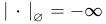
| ⋅ | A : Y → R {\displaystyle |\,\cdot \,|_{A}\;:\,Y\,\to \,\mathbb {R} } 定義 | x ′ | A := sup | x ′ ( A ) | := sup a ∈ A | x ′ ( a ) | {\displaystyle \left|x^{\prime }\right|_{A}~:=~\sup \left|x^{\prime }(A)\right|~:=~\sup _{a\in A}\left|x^{\prime }(a)\right|} は上の 半ノルム です。その 場合、 上限 の定義により となるため 、上で定義された 写像は 実数値ではなく、結果として半ノルムではありません。 Y . {\displaystyle Y.} A = ∅ {\displaystyle A=\varnothing } sup | x ′ ( A ) | = − ∞ {\displaystyle \,\sup \left|x^{\prime }(A)\right|=-\infty \,} | ⋅ | ∅ = − ∞ {\displaystyle \,|\,\cdot \,|_{\varnothing }=-\infty \,}
連続二重空間
が連続双対空間を持つ 位相ベクトル空間 (TVS) である とする。
ここで重要な特別な場合として 、括弧は標準写像を表す: を考える。この三つ組は、 に関連付けられた 標準 ペアリング と呼ばれる。 X {\displaystyle X} X ′ . {\displaystyle X^{\prime }.} Y := X ′ {\displaystyle Y:=X^{\prime }} ⟨ x , x ′ ⟩ := x ′ ( x ) {\displaystyle \left\langle x,x^{\prime }\right\rangle :=x^{\prime }(x)} ⟨ X , X ′ ⟩ {\displaystyle \left\langle X,X^{\prime }\right\rangle } X . {\displaystyle X.}
この標準的なペアリングに関する サブセットの極は次のとおりです。 A ⊆ X {\displaystyle A\subseteq X} A ∘ := { x ′ ∈ X ′ : sup a ∈ A | x ′ ( a ) | ≤ 1 } because ⟨ a , x ′ ⟩ := x ′ ( a ) = { x ′ ∈ X ′ : sup | x ′ ( A ) | ≤ 1 } where | x ′ ( A ) | := { | x ′ ( a ) | : a ∈ A } = { x ′ ∈ X ′ : x ′ ( A ) ⊆ B 1 } where B 1 := { s ∈ K : | s | ≤ 1 } . {\displaystyle {\begin{alignedat}{4}A^{\circ }:=&\left\{x^{\prime }\in X^{\prime }~:~\sup _{a\in A}\left|x^{\prime }(a)\right|\leq 1\right\}~~~~&&{\text{ because }}\left\langle a,x^{\prime }\right\rangle :=x^{\prime }(a)\\[0.7ex]=&\left\{x^{\prime }\in X^{\prime }~:~\sup \left|x^{\prime }(A)\right|\leq 1\right\}~~~~&&{\text{ where }}\left|x^{\prime }(A)\right|:=\left\{\left|x^{\prime }(a)\right|:a\in A\right\}\\[0.7ex]=&\left\{x^{\prime }\in X^{\prime }~:~x^{\prime }(A)\subseteq B_{1}\right\}~~~~&&{\text{ where }}B_{1}:=\{s\in \mathbb {K} :|s|\leq 1\}.\\[0.7ex]\end{alignedat}}}
が 閉包 を 表す 任意 の部分集合に対して A ⊆ X , {\displaystyle A\subseteq X,} A ∘ = [ cl X A ] ∘ {\displaystyle A^{\circ }=\left[\operatorname {cl} _{X}A\right]^{\circ }} cl X A {\displaystyle \operatorname {cl} _{X}A} A {\displaystyle A} X . {\displaystyle X.}
バナッハ ・アラオグルの定理は 、が の 原点の近傍である 場合 、この極集合は、 が 弱 * 位相 (点ごとの収束の位相とも呼ばれる)を備えている とき、 連続双対空間の コンパクト部分集合である ことを述べています。 A ⊆ X {\displaystyle A\subseteq X} X {\displaystyle X} A ∘ = A # {\displaystyle A^{\circ }=A^{\#}} X ′ {\displaystyle X^{\prime }} X ′ {\displaystyle X^{\prime }}
単位長さのすべてのスカラーに対してが 満たされる 場合 、絶対値符号を (実部演算子)に置き換えることができます。 A {\displaystyle A} s A ⊆ A {\displaystyle sA\subseteq A} s {\displaystyle s} Re {\displaystyle \operatorname {Re} } A ∘ = A r := { x ′ ∈ X ′ : sup a ∈ A Re x ′ ( a ) ≤ 1 } = { x ′ ∈ X ′ : sup Re x ′ ( A ) ≤ 1 } . {\displaystyle {\begin{alignedat}{4}A^{\circ }=A^{r}:=&\left\{x^{\prime }\in X^{\prime }~:~\sup _{a\in A}\operatorname {Re} x^{\prime }(a)\leq 1\right\}\\[0.7ex]=&\left\{x^{\prime }\in X^{\prime }~:~\sup \operatorname {Re} x^{\prime }(A)\leq 1\right\}.\\[0.7ex]\end{alignedat}}}
の サブセットの前極は次の とおりです。 B {\displaystyle B} Y = X ′ {\displaystyle Y=X^{\prime }} ∘ B := { x ∈ X : sup b ′ ∈ B | b ′ ( x ) | ≤ 1 } = { x ∈ X : sup | B ( x ) | ≤ 1 } {\displaystyle {}^{\circ }B:=\left\{x\in X~:~\sup _{b^{\prime }\in B}\left|b^{\prime }(x)\right|\leq 1\right\}=\{x\in X:\sup |B(x)|\leq 1\}}
単位長さのすべてのスカラーに対してが 成り立つ 場合 、絶対値の符号を 次のように置き換えることができる。 ここで B {\displaystyle B} s B ⊆ B {\displaystyle sB\subseteq B} s {\displaystyle s} Re {\displaystyle \operatorname {Re} } ∘ B = { x ∈ X : sup b ′ ∈ B Re b ′ ( x ) ≤ 1 } = { x ∈ X : sup Re B ( x ) ≤ 1 } {\displaystyle {}^{\circ }B=\left\{x\in X~:~\sup _{b^{\prime }\in B}\operatorname {Re} b^{\prime }(x)\leq 1\right\}=\{x\in X~:~\sup \operatorname {Re} B(x)\leq 1\}} B ( x ) := { b ′ ( x ) : b ′ ∈ B } . {\displaystyle B(x):=\left\{b^{\prime }(x)~:~b^{\prime }\in B\right\}.}
双極 定理は、 位相ベクトル空間のサブセットの双極を特徴付けます。
が ノルム空間であり、が (または、開単位球を含む閉単位球の任意の部分集合) における開単位球または閉単位球である場合、 が標準的な 双対ノルム を備えている とき、 は連続双対空間における閉単位球です 。 X {\displaystyle X} S {\displaystyle S} X {\displaystyle X} S ∘ {\displaystyle S^{\circ }} X ′ {\displaystyle X^{\prime }} X ′ {\displaystyle X^{\prime }}
円錐の幾何学的定義 凸錐の 極錐 は 、 A ⊆ X {\displaystyle A\subseteq X} A ∘ := { y ∈ Y : sup x ∈ A ⟨ x , y ⟩ ≤ 0 } {\displaystyle A^{\circ }:=\left\{y\in Y~:~\sup _{x\in A}\langle x,y\rangle \leq 0\right\}}
この定義は点と超平面の双対性を与え、超平面は2つの反対向きの半空間の交わりとして表される。点の極超平面は 軌跡であり 、超平面の 双対 関係はその超平面の極点を与える。 [3] [ 要出典 ] x ∈ X {\displaystyle x\in X} { y : ⟨ y , x ⟩ = 0 } {\displaystyle \{y~:~\langle y,x\rangle =0\}}
一部の著者は(紛らわしいことに)双対円錐を極円錐と呼んでいますが、この記事ではその慣例には従いません。 [4]
プロパティ 特に断りのない限り、は ペアリング になります 。位相は 上の 弱*位相 であり 、は 上の 弱位相 です。
任意の集合 に対して、 は の実極を表し 、 は の絶対極を表します。
「極」という用語は 絶対 極を指します。 ⟨ X , Y ⟩ {\displaystyle \langle X,Y\rangle } σ ( Y , X ) {\displaystyle \sigma (Y,X)} Y {\displaystyle Y} σ ( X , Y ) {\displaystyle \sigma (X,Y)} X . {\displaystyle X.} A , {\displaystyle A,} A r {\displaystyle A^{r}} A {\displaystyle A} A ∘ {\displaystyle A^{\circ }} A . {\displaystyle A.}
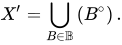
集合の(絶対)極は 凸 で バランス が取れている。 の 部分集合の 実極は 凸であるが、必ずしも平衡している必要は ない 。平衡して いれば平衡する 。 A r {\displaystyle A^{r}} A {\displaystyle A} X {\displaystyle X} A r {\displaystyle A^{r}} A {\displaystyle A} 単位長さの すべてのスカラーに対して 、 s A ⊆ A {\displaystyle sA\subseteq A} s {\displaystyle s} A ∘ = A r . {\displaystyle A^{\circ }=A^{r}.} A ∘ {\displaystyle A^{\circ }} は 上 の 弱*位相 で 閉じて いる。 [3] Y {\displaystyle Y} Y {\displaystyle Y} の 部分集合 が弱有界(つまり - 有界)であるためには、 が に 吸収される 必要がある 。 S {\displaystyle S} X {\displaystyle X} σ ( X , Y ) {\displaystyle \sigma (X,Y)} S ∘ {\displaystyle S^{\circ }} Y {\displaystyle Y} がTVSで その連続双対空間である双対対に対して、が有界ならば、 は [ 5 で 吸収される 。 が局所凸で、 が吸収する なら ば、 は有界である。さらに、 の 部分 集合が弱有界となるのは、 が 吸収する 場合に限る。 ⟨ X , X ′ ⟩ , {\displaystyle \langle X,X^{\prime }\rangle ,} X {\displaystyle X} X ′ {\displaystyle X^{\prime }} B ⊆ X {\displaystyle B\subseteq X} B ∘ {\displaystyle B^{\circ }} X ′ . {\displaystyle X^{\prime }.} X {\displaystyle X} B ∘ {\displaystyle B^{\circ }} X ′ {\displaystyle X^{\prime }} B {\displaystyle B} X . {\displaystyle X.} S {\displaystyle S} X {\displaystyle X} S ∘ {\displaystyle S^{\circ }} X ′ . {\displaystyle X^{\prime }.} 集合の 双極子は、 最小の - 閉凸包であり 、 - と - の 両方を含む - 閉凸集合で ある。 A ∘ ∘ {\displaystyle A^{\circ \circ }} A {\displaystyle A} σ ( X , Y ) {\displaystyle \sigma (X,Y)} A ∪ { 0 } , {\displaystyle A\cup \{0\},} σ ( X , Y ) {\displaystyle \sigma (X,Y)} A {\displaystyle A} 0. {\displaystyle 0.} 同様に、円錐の双対円錐は [7] の 閉 円錐包 である。 A {\displaystyle A} σ ( X , Y ) {\displaystyle \sigma (X,Y)} A . {\displaystyle A.} が TVSの原点の基底である 場合、 B {\displaystyle {\mathcal {B}}} X {\displaystyle X} X ′ = ⋃ B ∈ B ( B ∘ ) . {\displaystyle X^{\prime }=\bigcup _{B\in \mathbb {B} }\left(B^{\circ }\right).} が局所凸TVSである場合 、任意の0近傍基数の 極座標( に関して取られた)は の等連続部分集合の基本族を形成する(すなわち、 の任意の 有界部分集合が与えられたとき、 となるような における原点の 近傍が存在する )。 X {\displaystyle X} ⟨ X , X ′ ⟩ {\displaystyle \left\langle X,X^{\prime }\right\rangle } X ′ {\displaystyle X^{\prime }} H {\displaystyle H} X σ ′ , {\displaystyle X_{\sigma }^{\prime },} S {\displaystyle S} X {\displaystyle X} H ⊆ S ∘ {\displaystyle H\subseteq S^{\circ }} 逆に、 が局所凸TVSである場合、 の等連続部分集合の基本族の 極座標( に関して取られた)は、 の原点の近傍基を形成する。 X {\displaystyle X} ⟨ X , X # ⟩ {\displaystyle \langle X,X^{\#}\rangle } X ′ {\displaystyle X^{\prime }} X . {\displaystyle X.} 位相を持つTVSとすると、 局所 凸TVS位相とは、 [ の等連続部分集合上で一様収束する位相であることと同値である。 X {\displaystyle X} τ . {\displaystyle \tau .} τ {\displaystyle \tau } τ {\displaystyle \tau } X ′ . {\displaystyle X^{\prime }.} 最後の 2 つの結果は、連続双対空間の等連続部分集合が関数解析の現代理論で重要な役割を果たす理由を説明しています。等連続部分集合は、局所凸空間 の元の位相に関するすべての情報をカプセル化するためです。 X {\displaystyle X}
関係を設定する
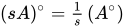
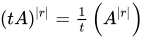
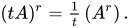
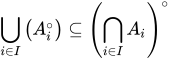
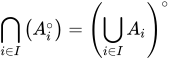
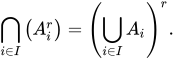
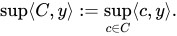
X ∘ = X | r | = X r = { 0 } {\displaystyle X^{\circ }=X^{|r|}=X^{r}=\{0\}} と ∅ ∘ = ∅ | r | = ∅ r = Y . {\displaystyle \varnothing ^{\circ }=\varnothing ^{|r|}=\varnothing ^{r}=Y.} すべてのスカラー とすべての実数 と s ≠ 0 , {\displaystyle s\neq 0,} ( s A ) ∘ = 1 s ( A ∘ ) {\displaystyle (sA)^{\circ }={\tfrac {1}{s}}\left(A^{\circ }\right)} t ≠ 0 , {\displaystyle t\neq 0,} ( t A ) | r | = 1 t ( A | r | ) {\displaystyle (tA)^{|r|}={\tfrac {1}{t}}\left(A^{|r|}\right)} ( t A ) r = 1 t ( A r ) . {\displaystyle (tA)^{r}={\tfrac {1}{t}}\left(A^{r}\right).} A ∘ ∘ ∘ = A ∘ . {\displaystyle A^{\circ \circ \circ }=A^{\circ }.} しかし、実数極の場合、 A r r r ⊆ A r . {\displaystyle A^{rrr}\subseteq A^{r}.} 任意の有限集合に対して A 1 , … , A n , {\displaystyle A_{1},\ldots ,A_{n},} ( A 1 ∩ ⋯ ∩ A n ) ∘ = ( A 1 ∘ ) ∪ ⋯ ∪ ( A n ∘ ) . {\displaystyle \left(A_{1}\cap \cdots \cap A_{n}\right)^{\circ }=\left(A_{1}^{\circ }\right)\cup \cdots \cup \left(A_{n}^{\circ }\right).} もし そうなら そして A ⊆ B {\displaystyle A\subseteq B} B ∘ ⊆ A ∘ , {\displaystyle B^{\circ }\subseteq A^{\circ },} B r ⊆ A r , {\displaystyle B^{r}\subseteq A^{r},} B | r | ⊆ A | r | . {\displaystyle B^{|r|}\subseteq A^{|r|}.} 直ちに導かれる帰結は 、 が有限の場合には等式が必然的に成り立ち 、 が無限の場合には等式が成り立たない可能性がある、ということです 。 ⋃ i ∈ I ( A i ∘ ) ⊆ ( ⋂ i ∈ I A i ) ∘ {\displaystyle \bigcup _{i\in I}\left(A_{i}^{\circ }\right)\subseteq \left(\bigcap _{i\in I}A_{i}\right)^{\circ }} I {\displaystyle I} I {\displaystyle I} ⋂ i ∈ I ( A i ∘ ) = ( ⋃ i ∈ I A i ) ∘ {\displaystyle \bigcap _{i\in I}\left(A_{i}^{\circ }\right)=\left(\bigcup _{i\in I}A_{i}\right)^{\circ }} そして ⋂ i ∈ I ( A i r ) = ( ⋃ i ∈ I A i ) r . {\displaystyle \bigcap _{i\in I}\left(A_{i}^{r}\right)=\left(\bigcup _{i\in I}A_{i}\right)^{r}.} が円錐である 場合、 [ C {\displaystyle C} X {\displaystyle X} C ∘ = { y ∈ Y : ⟨ c , y ⟩ = 0 for all c ∈ C } . {\displaystyle C^{\circ }=\left\{y\in Y:\langle c,y\rangle =0{\text{ for all }}c\in C\right\}.} が を含む の閉部分集合 族である 場合 、 の実極は の 閉凸包である ( S i ) i ∈ I {\displaystyle \left(S_{i}\right)_{i\in I}} σ ( X , Y ) {\displaystyle \sigma (X,Y)} X {\displaystyle X} 0 ∈ X , {\displaystyle 0\in X,} ∩ i ∈ I S i {\displaystyle \cap _{i\in I}S_{i}} ∪ i ∈ I ( S i r ) . {\displaystyle \cup _{i\in I}\left(S_{i}^{r}\right).} もし そうなら 0 ∈ A ∩ B {\displaystyle 0\in A\cap B} A ∘ ∩ B ∘ ⊆ 2 [ ( A + B ) ∘ ] ⊆ 2 ( A ∘ ∩ B ∘ ) . {\displaystyle A^{\circ }\cap B^{\circ }\subseteq 2\left[(A+B)^{\circ }\right]\subseteq 2\left(A^{\circ }\cap B^{\circ }\right).} 実ベクトル空間の閉凸 錐 に対して、 極錐 は の 極である 。つまり、 [1] C {\displaystyle C} X , {\displaystyle X,} C {\displaystyle C} C ∘ = { y ∈ Y : sup ⟨ C , y ⟩ ≤ 0 } , {\displaystyle C^{\circ }=\{y\in Y:\sup _{}\langle C,y\rangle \leq 0\},} sup ⟨ C , y ⟩ := sup c ∈ C ⟨ c , y ⟩ . {\displaystyle \sup _{}\langle C,y\rangle :=\sup _{c\in C}\langle c,y\rangle .}
参照
注記 ^ 極集合のこれらの完全な定義がすべて 一致するためには、 が実数値の場合、 が 対称であることで十分であり、 が複素数値の場合、 すべての実数値に対してが A ∘ {\displaystyle A^{\circ }} ⟨ ⋅ , ⋅ ⟩ {\displaystyle \langle \cdot ,\cdot \rangle } A {\displaystyle A} ⟨ ⋅ , ⋅ ⟩ {\displaystyle \langle \cdot ,\cdot \rangle } e i r A ⊆ A {\displaystyle e^{ir}A\subseteq A} s . {\displaystyle s.} ^ が の有限次元ベクトル部分空間である ことを証明するために は、 が 連続である(有限次元ハウスドルフTVS上のすべての線形関数がそうであるように)ので、 と が 閉 集合であることから次のことが分かる 。したがって、そのようなすべての集合の和集合は の部分集合でもあり、 が である ことを証明する。 したがって、 が 上の任意のTVS位相である とき、 A # ⊆ [ A ∪ cl Finite ] # , {\displaystyle A^{\#}\subseteq \left[A_{\cup \operatorname {cl} \operatorname {Finite} }\right]^{\#},} f ∈ A # . {\displaystyle f\in A^{\#}.} Y {\displaystyle Y} X {\displaystyle X} f | Y : ( Y , τ Y ) → K {\displaystyle f{\big \vert }_{Y}:\left(Y,\tau _{Y}\right)\to \mathbb {K} } f ( A ) ⊆ B 1 {\displaystyle f(A)\subseteq B_{1}} B 1 {\displaystyle B_{1}} f ( cl ( Y , τ Y ) ( Y ∩ A ) ) = f | Y ( cl ( Y , τ Y ) ( Y ∩ A ) ) ⊆ cl K ( f ( Y ∩ A ) ) ⊆ cl K f ( A ) ⊆ cl K B 1 = B 1 . {\displaystyle f\left(\operatorname {cl} _{\left(Y,\tau _{Y}\right)}(Y\cap A)\right)=f{\big \vert }_{Y}\left(\operatorname {cl} _{\left(Y,\tau _{Y}\right)}(Y\cap A)\right)\subseteq \operatorname {cl} _{\mathbb {K} }(f(Y\cap A))\subseteq \operatorname {cl} _{\mathbb {K} }f(A)\subseteq \operatorname {cl} _{\mathbb {K} }B_{1}=B_{1}.} B 1 , {\displaystyle B_{1},} f ( A ∪ cl Finite ) ⊆ B 1 {\displaystyle f\left(A_{\cup \operatorname {cl} \operatorname {Finite} }\right)\subseteq B_{1}} f ∈ [ A ∪ cl Finite ] # . {\displaystyle f\in \left[A_{\cup \operatorname {cl} \operatorname {Finite} }\right]^{\#}.} ◼ {\displaystyle \blacksquare } τ {\displaystyle \tau } X {\displaystyle X} A ∪ cl Finite ⊆ cl ( X , τ ) A . {\displaystyle A_{\cup \operatorname {cl} \operatorname {Finite} }\subseteq \operatorname {cl} _{(X,\tau )}A.}
参考文献 ^ ab Aliprantis, CD; Border, KC (2007). 『無限次元解析:ヒッチハイク・ガイド』 (第3版). Springer. p. 215. doi :10.1007/3-540-29587-9. ISBN 978-3-540-32696-0 。 ^ ab Zălinescu, C. (2002). 一般ベクトル空間における凸解析 . リバーエッジ, ニュージャージー: World Scientific. pp. 7–8. ISBN 978-9812380678 。 ^ Rockafellar, TR (1970). 凸解析 . プリンストン大学. pp. 121-8. ISBN 978-0-691-01586-6 。 ^
参考文献
基本概念 トポロジー 主な結果 地図 サブセット その他の概念
基本概念 主な結果 地図 セットの種類 集合演算 TVSの種類
スペース
定理 オペレーター 代数 未解決の問題 アプリケーション 高度なトピック





![{\displaystyle {\begin{alignedat}{4}A^{\circ }:=&\left\{y\in Y~:~\sup _{a\in A}|\langle a,y\rangle |\leq 1\right\}~~~~&&\\[0.7ex]=&\left\{y\in Y~:~\sup |\langle A,y\rangle |\leq 1\right\}~~~~&&{\text{ ただし }}|\langle A,y\rangle |:=\{|\langle a,y\rangle |:a\in A\}\\[0.7ex]=&\left\{y\in Y~:~\langle A,y\rangle \subseteq B_{1}\right\}~~~~&&{\text{ ただし }}B_{1}:=\{s\in \mathbb {K} :|s|\leq 1\}.\\[0.7ex]\end{alignedat}}}](https://wikimedia.org/api/rest_v1/media/math/render/svg/af73bd385336a18f8700ce68511d1f84cb7f2c5a)



![{\displaystyle A^{\circ }=[\operatorname {cobal} A]^{\circ }.}](https://wikimedia.org/api/rest_v1/media/math/render/svg/cebcfe82d7a295d41910884c62b6984e140a6b19)























![{\displaystyle {\begin{alignedat}{4}A^{\#}:=A^{\circ ,\#}:=&\left\{f\in X^{\#}~:~\sup _{a\in A}|f(a)|\leq 1\right\}&&\\[0.7ex]=&\left\{f\in X^{\#}~:~\sup |f(A)|\leq 1\right\}~~~~&&{\text{ ただし }}|f(A)|:=\{|f(a)|:a\in A\}\\[0.7ex]=&\left\{f\in X^{\#}~:~f(A)\subseteq B_{1}\right\}~~~&&{\text{ ただし }}B_{1}:=\{s\in \mathbb {K} :|s|\leq 1\}.\\[0.7ex]\end{alignedat}}}](https://wikimedia.org/api/rest_v1/media/math/render/svg/7801a13fe2c2dfcaa5615b237e7b228f0eed0af6)


![{\displaystyle A^{\#}=[\operatorname {cobal} A]^{\#},}](https://wikimedia.org/api/rest_v1/media/math/render/svg/85cf1011160fdbe0d2c8af67320ae00941a65e25)


![{\displaystyle A^{\#}=\left[A_{\cup \operatorname {cl} \operatorname {有限} }\right]^{\#}}](https://wikimedia.org/api/rest_v1/media/math/render/svg/0ddeb6649e9500ca8506c8b0c1d8abbfb79e5664)










![{\displaystyle {\begin{alignedat}{4}A^{\circ }:=&\left\{x^{\prime }\in X^{\prime }~:~\sup _{a\in A}\left|x^{\prime }(a)\right|\leq 1\right\}~~~~&&{\text{ なぜなら }}\left\langle a,x^{\prime }\right\rangle :=x^{\prime }(a)\\[0.7ex]=&\left\{x^{\prime }\in X^{\prime }~:~\sup \left|x^{\prime }(A)\right|\leq 1\right\}~~~~&&{\text{ ここで }}\left|x^{\prime }(A)\right|:=\left\{\left|x^{\prime }(a)\right|:a\in A\right\}\\[0.7ex]=&\left\{x^{\prime }\in X^{\prime }~:~x^{\prime }(A)\subseteq B_{1}\right\}~~~~&&{\text{ ただし }}B_{1}:=\{s\in \mathbb {K} :|s|\leq 1\}.\\[0.7ex]\end{alignedat}}}](https://wikimedia.org/api/rest_v1/media/math/render/svg/c1e9e1cb9806bffc9f4d5b0fa4a9124e2e6f044c)
![{\displaystyle A^{\circ }=\left[\operatorname {cl} _{X}A\right]^{\circ }}](https://wikimedia.org/api/rest_v1/media/math/render/svg/48d54d2ac5ee3ac1bfb58f025e4dfdb66b3214ac)


![{\displaystyle {\begin{alignedat}{4}A^{\circ }=A^{r}:=&\left\{x^{\prime }\in X^{\prime }~:~\sup _{a\in A}\operatorname {Re} x^{\prime }(a)\leq 1\right\}\\[0.7ex]=&\left\{x^{\prime }\in X^{\prime }~:~\sup \operatorname {Re} x^{\prime }(A)\leq 1\right\}.\\[0.7ex]\end{alignedat}}}](https://wikimedia.org/api/rest_v1/media/math/render/svg/e81b61e74d09c27d6084ea8b67d99412c0ead268)




























![{\displaystyle A^{\circ}\cap B^{\circ}\subseteq 2\left[(A+B)^{\circ}\right]\subseteq 2\left(A^{\circ}\cap B^{\circ}\right).}](https://wikimedia.org/api/rest_v1/media/math/render/svg/554041b7ff8eb544b226e26edd510c07de846c3d)


![{\displaystyle A^{\#}\subseteq \left[A_{\cup \operatorname {cl} \operatorname {有限} }\right]^{\#},}](https://wikimedia.org/api/rest_v1/media/math/render/svg/1541029a4ef45bbb041524dc2847f56657c1d1e9)







![{\displaystyle f\in \left[A_{\cup \operatorname {cl} \operatorname {有限} }\right]^{\#}.}](https://wikimedia.org/api/rest_v1/media/math/render/svg/9fde4b6279d7647b04d7ada781a40edaeab77442)



