アメリカ合衆国の人口統計
| アメリカ合衆国の人口統計 | |
|---|---|
 | |
| 人口 |  342,034,432人(2025年予測) 342,034,432人(2025年予測)340,110,998人(2024年公式推定)[1] 331,449,281人(2020年国勢調査)[2] |
| 密度 | 86.16/平方マイル (33.27/km 2 ) |
| 成長率 | 1% (2024) [3] |
| 出生率 |  出生数10.7人/人口1,000人(2023年) 出生数10.7人/人口1,000人(2023年) |
| 死亡率 |  人口1,000人あたり9.2人(2023年) 人口1,000人あたり9.2人(2023年) |
| 平均寿命 | 78.4歳(2023年)[4] |
| • 男 | 75.8歳(2023年)[4] |
| • 女性 | 81.1歳(2023年)[4] |
| 出生率 | 1.6人/女性(2024年)[5] |
| 乳児死亡率 | 死亡数5.4人/出生数1,000人(2020年)[6] |
| 純移住率 | 人口1,000人あたり移民3人(2024年)[7] |
| 年齢構成 | |
| 18歳未満 | 21.5%(2024年推定)[8] |
| 18~44歳 | 36.0%(2023年推定)[8] |
| 45~64歳 | 24.6%(2023年推定)[8] |
| 65歳以上 | 18%(2023年推定)[8] |
| 性比 | |
| 合計 | 0.98 男性/女性 (2023 年推定) [8] |
| 出生時 | 1.045人(男性/女性)(2022年)[9] |
| 15歳未満 | 1.05 男性/女性 (2023 年推定) [8] |
| 15~64歳 | 1.01 男性/女性 (2023 年推定) [8] |
| 65歳以上 | 0.82 男性/女性 (2023 年推定) [8] |
| 国籍 | |
| 国籍 | アメリカ人 |
| 主要民族 |
|
| 少数民族 |
|
| 言語 | |
| 正式 | 英語 |
| 話し言葉 |
|
| 出典:米国国勢調査局のアメリカ人コミュニティ調査[24] | |


アメリカ合衆国は南北アメリカ大陸と西半球で最も人口の多い国であり、米国国勢調査局によると、2025年7月1日の予想人口は3億4,203万4,432人である。[1]世界人口の約4%を占め、世界で3番目に人口の多い国である。 アメリカの人口は、2020年の国勢調査の3億3,144万9,281人から2024年の公式年間推計3億4,011万998人の間で2.6%増加した。[2]これらの数字には50州と連邦首都のワシントンD.C.が含まれるが、5つの非編入アメリカ領土(プエルトリコ、グアム、米領バージン諸島、アメリカ領サモア、北マリアナ諸島)といくつかの小さな無人島領土の360万人の住民は含まれない。国勢調査局は、2024年7月までの12か月間の人口増加率が0.98%であると示しており、[3]これは世界推定の年間増加率1.03%をわずかに下回っています。[25]人種や民族的背景、宗教的所属、都市部と農村部の人口比など、いくつかの指標から判断すると、イリノイ州はアメリカ合衆国の人口統計を最も代表していると言えます。[26]
米国の人口は20世紀にほぼ4倍になり、年間約1.3%の成長率で、1900年の約7,600万人から2000年の2億8,100万人になった。[27] 1967年には2億人の大台に達し、2006年10月17日には3億人の大台に達したと推定されている。 [27] [28]外国生まれの移民によって米国の人口は急速な増加を続け、1990年の約2,000万人から2015年には4,500万人を超え、[29]人口増加の3分の1を占めている。[30]米国国勢調査局は2024年末、近年の米国への移民が、低い出生率と特殊出生率を相殺して余りあるほどの増加を見せていると報告した。「国際純移民の人口動向への影響はここ数年で増大している。2021年以降、純移民は国の成長の大部分を占めており、自然増加が主な要因であった過去20年間とは大きく異なる」。この結果、2022年、2023年、2024年の米国の人口はそれぞれ0.58%、0.83%、0.98%増加した。[31]
人口増加は全体として少数民族の間で最も速く、2020年の米国国勢調査局の分析によると、18歳未満の米国の子供の50%は少数民族グループに属しています。[32] 2020年時点で、白人アメリカ人は2億3,541万1,507人で、人口の71%を占めており、これには白人と他の人種の両方を自認する人々が含まれています。白人のみを自認する人(ヒスパニック系白人を含む)は2億4,277,273人で、人口の61.6%を占め、非ラテン系白人は国の人口の57.8%を占めています。[33]
2010年から2020年までの米国全体の人口増加の51.1%はラテン系アメリカ人によるものでした。[34]ヒスパニック系またはラテン系の人口は、2010年の5050万人から2020年には6210万人に増加し、23%の増加、1160万人以上の増加となりました。[34]今後数十年間の米国の人口増加の大部分は、移民とその米国生まれの子孫によってもたらされると予想されています。[35]
アジア系アメリカ人は、米国で最も急速に増加している人種グループであり、その成長率は35%です。しかし、最も急速に増加しているサブグループである多民族アジア系アメリカ人は、米国における異人種間結婚の増加を反映して、55%の成長率を記録しています。[36] [37]
2022年現在[update]、白人アメリカ人の母親による出生は米国全体の約50%を占めており、2021年と比較して3%減少しています。 [38]同じ期間に、アジア系アメリカ人とヒスパニック系女性の出生はそれぞれ2%と6%増加しました。[39]

人口
| 国勢調査 | ポップ。 | 注記 | %± |
|---|---|---|---|
| 1790 | 3,929,326 | — | |
| 1800 | 5,308,483 | 35.1% | |
| 1810 | 7,239,881 | 36.4% | |
| 1820 | 9,638,453 | 33.1% | |
| 1830 | 12,866,020 | 33.5% | |
| 1840 | 17,069,453 | 32.7% | |
| 1850 | 23,191,876 | 35.9% | |
| 1860 | 31,443,321 | 35.6% | |
| 1870 | 38,925,598 | 23.8% | |
| 1880 | 50,189,209 | 28.9% | |
| 1890 | 62,979,766 | 25.5% | |
| 1900 | 76,212,168 | 21.0% | |
| 1910 | 92,228,496 | 21.0% | |
| 1920 | 106,021,537 | 15.0% | |
| 1930 | 1億2277万5046 | 15.8% | |
| 1940 | 1億3216万4569 | 7.6% | |
| 1950 | 1億5069万7361 | 14.0% | |
| 1960 | 1億7932万3175 | 19.0% | |
| 1970 | 2億339万2031 | 13.4% | |
| 1980 | 2億2654万5805 | 11.4% | |
| 1990 | 2億4,870万9,873 | 9.8% | |
| 2000 | 2億8142万1906 | 13.2% | |
| 2010 | 3億874万5538 | 9.7% | |
| 2020 | 3億3,144万9,281 | 7.4% | |
| 2024年(推定) | 3億4011万988 | [1] | 2.6% |
| 米国10年ごとの国勢調査 | |||
1900年、米国の人口が7600万人だった当時、米国には6680万人の白人アメリカ人がおり、全人口の88%を占めていた。[40]黒人アメリカ人は880万人で、その約90%がまだ南部諸州に住んでいた。[41]そして、ヒスパニック系は50万人強であった。[42]
連邦法である1965年の移民国籍法の下では、[43]米国に住む第一世代の移民の数は増加しており、[44] 1970年の960万人から2007年には約3800万人に増加しています。[45] 1990年代には年間約100万人が合法的に米国に移民しており、1950年代の年間25万人から増加しています。[46]
1900年には、米国の10大都市の人口の約97%を非ヒスパニック系白人が占めていた。[47]国勢調査局は、2010年7月から2011年7月の間に米国で生まれた子供の50.4%を少数民族(ヒスパニック系白人を含む)が占めていると報告した。[ 48]これは1990年の37%と比較して増加している。 [49]
2014年、出生率が最も低かったのはロードアイランド州で1.56、最も高かったのはユタ州で2.33でした。[50]これは各州の人口の年齢と相関しており、ロードアイランド州の平均年齢は全米で9番目に高く39.2歳、ユタ州は最も低く29.0歳となっています。[51]
2017年の米国の出生率は、人口減少を経験しないために女性一人当たり少なくとも2.1人の子供が必要な置換レベルを大きく下回ったままであり、全50州とコロンビア特別区で白人の出生数が減少した。非ヒスパニック系白人女性では、出生率が置換レベルを超えた州はなかった。非ヒスパニック系黒人女性では、12州が必要な置換レベルを超えた。ヒスパニック系女性では、29州が上回った。[52]非ヒスパニック系白人女性の場合、合計特殊出生率が最も高かったのはユタ州で2.099、最も低かったのはコロンビア特別区で1.012であった。非ヒスパニック系黒人女性の場合、合計特殊出生率が最も高かったのはメイン州で4.003、最も低かったのはワイオミング州で1.146であった。ヒスパニック系女性の合計特殊出生率は、アラバマ州が3.085で最も高く、バーモント州が1.200、メイン州が1.281で最も低かった。[52] [53] 2016年時点では、高齢化、出生率の低下、薬物の過剰摂取などによる死亡率の上昇により、国内の半数以上の州で非ヒスパニック系白人の死亡数が出生数を上回っている。 [54]
成長率


-2.00%以下
-0.01%から-1.99%
0%から0.99%
1%から2.49%
2.5%から4.99%
5%から8.99%
9%から11.99%
12%以上
- 米国の人口増加率:0.98%(2024年)、0.83%(2023年)、0.58%(2022年)、0.16%(2021年)、0.41%(2020年)[3]
年齢と性別の分布


性別分布
2020年の米国国勢調査によると、女性が男性を上回り、人口の50.9%(1億6,876万3,470人)、男性が49.1%(1億6,268万5,811人)を占めています。前回の2010年の国勢調査でも女性が男性を上回っていましたが、女性の割合は50.8%とわずかに低く、男性が49.2%とわずかに高くなっています。[56]
アメリカ合衆国で初めて女性数が男性数を上回った国勢調査は1950年の国勢調査であった。[57]
年齢と性別の分布(2021年)
| 年齢 (歳) | 合計 (千) | 米国人口の割合。 | 男性 (千人) | 女性 (千人) | % 男 | % 女性 | 性比 (男性/ 女性) |
|---|---|---|---|---|---|---|---|
| 0 | 3,564 | 1.1% | 1,822 | 1,743 | 51.1% | 48.9% | 1.05 |
| 5歳未満 | 18,827 | 5.7% | 9,624 | 9,203 | 51.1% | 48.9% | 1.05 |
| 15歳未満 | 60,467 | 18.2% | 30,989 | 29,578 | 51.2% | 48.8% | 1.05 |
| 15~24歳 | 43,089 | 13.0% | 21,996 | 21,092 | 51.0% | 49.0% | 1.04 |
| 25~34歳 | 45,495 | 13.7% | 23,053 | 22,442 | 50.7% | 49.3% | 1.03 |
| 35~44歳 | 43,404 | 13.1% | 21,858 | 21,546 | 50.4% | 49.6% | 1.01 |
| 45~54 | 40,688 | 12.3% | 20,312 | 20,376 | 49.9% | 50.1% | 0.99 |
| 55~64歳 | 42,803 | 12.9% | 20,963 | 21,840 | 49.0% | 51.0% | 0.96 |
| 65歳以上 | 55,848 | 16.8% | 25,214 | 30,634 | 45.1% | 54.9% | 0.82 |
| 75歳以上 | 22,182 | 6.7% | 9,344 | 12,837 | 42.1% | 57.9% | 0.73 |
| 85歳以上 | 5,976 | 1.8% | 2,176 | 3,800 | 36.4% | 63.6% | 0.57 |
| 100以上 | 98 | 0.03% | 25 | 73 | 25.5% | 74.5% | 0.34 |
| 合計 | 331,894 | 100% | 164,385 | 167,509 | 49.5% | 50.5% | 0.98 |
この表では、複数のグループに属する人物が示されていることに注意してください。たとえば、90 歳の人物は、「65 歳以上」、「75 歳以上」、「85 歳以上」の 3 つのグループに含まれています。
| 年齢層 | パーセンテージ |
|---|---|
| 0~14歳 | 18.2% |
| 15~24歳 | 13.0% |
| 25~54歳 | 39.0% |
| 55~64歳 | 12.9% |
| 65歳以上 | 16.8% |
年齢別の総人口の割合:1900年から2015年
出典:米国国勢調査局、米国商務省、国連中位推計[59]
年齢層別の総人口の割合(1900年から2015年)
| 年齢 | 1900 | 1910 | 1920 | 1930 | 1940 | 1950 | 1960 | 1970 | 1980 | 1990 | 2000 | 2010 | 2015 |
|---|---|---|---|---|---|---|---|---|---|---|---|---|---|
| 0~14歳 | 34.5 | 32.1 | 31.8 | 29.4 | 25.0 | 26.9 | 31.1 | 28.5 | 22.6 | 21.5 | 21.4 | 20.2 | 19.8 |
| 15~24歳 | 19.6 | 19.7 | 17.7 | 18.3 | 18.2 | 14.7 | 13.4 | 17.4 | 18.8 | 14.8 | 13.9 | ||
| 25~44歳 | 28.1 | 29.2 | 29.6 | 29.5 | 30.1 | 30.0 | 26.2 | 23.6 | 27.7 | 32.5 | 30.2 | ||
| 45~64歳 | 13.7 | 14.6 | 16.1 | 17.5 | 19.8 | 20.3 | 20.1 | 20.6 | 19.6 | 18.6 | 22.0 | ||
| 65歳以上 | 4.1 | 4.3 | 4.7 | 5.4 | 6.8 | 8.1 | 9.2 | 9.9 | 11.3 | 12.6 | 12.4 | 13.0 | 14.3 |
| 合計 (%) | 100 | 100 | 100 | 100 | 100 | 100 | 100 | 100 | 100 | 100 | 100 | 33.2 | 34.1 |
依存度比率

従属人口指数とは、通常労働力人口に属さない人々(0~14歳および65歳以上の従属人口)と、労働力人口(15~64歳の生産年齢人口)の年齢人口比です。これは、生産年齢人口への負担を測る指標として用いられます。扶養人口指数とは、生産年齢人口と高齢者人口の比率であり、高齢者従属人口指数の逆数です。
| カテゴリ | 世界ランキング | 参考文献 |
|---|---|---|
| 総依存度比率 | 110番目 | [58] [60] |
| 児童扶養比率 | 138番目 | [58] |
| 高齢者従属比率 | 42位 | [58] |
| 潜在的支持率 | 160番目 | [58] |

密度
最も人口密度が高い州はニュージャージー州(1,263人/mi 2または488人/km 2)です。
人口は高度に都市化しており、人口の83.3%が都市部および郊外に居住している。[7]大きな都市クラスターは米国東部(特に五大湖周辺、北東部、東部、南東部)および西部諸州に広がっている。山岳地帯(主にロッキー山脈とアパラチア山脈)、南西部の砂漠、最北部の深い北方林、中央草原諸州は人口密度が低い。アラスカの人口は南海岸沿いに集中しており(特にアンカレッジ市)、ハワイの人口はオアフ島に集中している。[7] カリフォルニア州とテキサス州は米国の人口の中心が一貫して西と南に移動しているため、最も人口の多い州はカリフォルニア州とテキサス州である。 [62] [63] ニューヨーク市は米国で最も人口の多い都市であり[64] 、少なくとも1790年以来その状態が続いている。
米国の領土における人口の中心地としては、プエルトリコのサンファン都市圏、[65] 、北マリアナ諸島のサイパン島、[66] 、アメリカ領サモアのツツイラ島などがあります。[67]
人口の中央年齢

2022年の郡別平均年齢
46以上
43から45.9
39から42.9
35から39.9
34.9以下
2021年現在の総人口の平均年齢は38.8歳で、男性の平均年齢は37.7歳、女性の平均年齢は39.8歳である。[58]
歴史を通じた米国人口の中央年齢。出典:米国商務省、国勢調査局、米国国勢調査局、ワールドファクトブック。[68] [69]
| 年 | 男性の平均年齢 | 女性の平均年齢 | 総人口の中央年齢 |
|---|---|---|---|
| 1820 | 16.6 | 16.8 | 16.7 |
| 1830 | 17.2 | 17.3 | 17.2 |
| 1840 | 17.9 | 17.8 | 17.8 |
| 1850 | 19.2 | 18.6 | 18.9 |
| 1860 | 19.8 | 19.1 | 19.4 |
| 1870 | 20.2 | 20.1 | 20.2 |
| 1880 | 21.2 | 20.7 | 20.9 |
| 1890 | 22.3 | 21.6 | 22.0 |
| 1900 | 23.3 | 22.4 | 22.9 |
| 1910 | 24.6 | 23.5 | 24.1 |
| 1920 | 25.8 | 24.7 | 25.3 |
| 1930 | 26.7 | 25.2 | 26.5 |
| 1940 | 29.1 | 29.0 | 29.0 |
| 1950 | 29.9 | 30.5 | 30.2 |
| 1960 | 28.7 | 30.4 | 29.6 |
| 1970 | 26.8 | 29.8 | 28.1 |
| 1980 | 28.8 | 31.2 | 30.0 |
| 1990 | 31.7 | 34.1 | 32.9 |
| 2000 | 34.0 | 36.5 | 35.3 |
| 2010 | 35.8 | 38.5 | 37.2 |
| 2018 | 36.9 | 37.7 | 38.2 |
| 2021 | 39.5 | 39.8 | 38.8 |
人口密集地
アメリカ合衆国には数十の主要都市があり、その中にはあらゆる種類の「グローバル都市」[70]が31あり、そのうち10都市はグローバル都市の「アルファ」グループに属し、ニューヨーク、ロサンゼルス、シカゴ、ワシントンD.C.、ボストン、サンフランシスコ、マイアミ、フィラデルフィア、ダラス、アトランタとなっている[71]。2021年現在[update]、アメリカ合衆国には100万人以上の住民を抱える大都市圏が56ある。(米国国勢調査局は、ホノルル都市圏を人口100万人強で56番目に人口の多い地域にランク付けしている。アメリカ合衆国大都市統計地域表を参照。)
2011年現在[update]、約2億5000万人のアメリカ人が都市部またはその周辺に居住しています。つまり、米国人口の4分の3以上が、米国の国土面積のわずか3%を占めていることになります。[72]
次の表は、上位 20 の都市圏の人口を示しています。
| ランク | 名前 | 地域 | ポップ。 | ランク | 名前 | 地域 | ポップ。 | ||
|---|---|---|---|---|---|---|---|---|---|
| 1 | ニューヨーク | 北東 | 19,940,274 | 11 | ボストン | 北東 | 5,025,517 | ||
| 2 | ロサンゼルス | 西 | 12,927,614 | 12 | リバーサイド・サンバーナーディーノ | 西 | 4,744,214 | ||
| 3 | シカゴ | 中西部 | 9,408,576 | 13 | サンフランシスコ | 西 | 4,648,486 | ||
| 4 | ダラス・フォートワース | 南 | 8,344,032 | 14 | デトロイト | 中西部 | 4,400,578 | ||
| 5 | ヒューストン | 南 | 7,796,182 | 15 | シアトル | 西 | 4,145,494 | ||
| 6 | マイアミ | 南 | 6,457,988 | 16 | ミネアポリス・セントポール | 中西部 | 3,757,952 | ||
| 7 | ワシントンD.C. | 南 | 6,436,489 | 17 | タンパ・セントピーターズバーグ | 南 | 3,424,560 | ||
| 8 | アトランタ | 南 | 6,411,149 | 18 | サンディエゴ | 西 | 3,298,799 | ||
| 9 | フィラデルフィア | 北東 | 6,330,422 | 19 | デンバー | 西 | 3,052,498 | ||
| 10 | フェニックス | 西 | 5,186,958 | 20 | オーランド | 南 | 2,940,513 | ||
年別人口(推定値を含む)
この表には、米国国勢調査局による米国公式人口(年別)と、国勢調査中間年推計値が含まれています。これらの推計値は毎年7月1日に算出されますが、10年ごとの国勢調査(2000年、2010年、2020年など)の年には含まれていません。数値が10年ごとの国勢調査値か国勢調査中間年推計値かは明記されています。
国民人口
| 年 | 全国の総人口 |
|---|---|
| 2024年(国勢調査中間推計)[74] | 3億4011万988 |
| 2023年(国勢調査中間推計)[74] | 3億3,680万6,231 |
| 2022年(国勢調査中間推計)[74] | 3億3,401万7,321 |
| 2021年(国勢調査中間推計)[74] | 3億3,209万9,760 |
| 2020年(国勢調査)[75] | 3億3,144万9,390 |
| 2019年(中間推定)[75] | 330,226,227 |
| 2018年(中間推定)[75] | 3億2852万9577円 |
| 2017年(中間推定)[75] | 3億2635万3340円 |
| 2016年(中間推定)[75] | 3億2435万3340円 |
| 2015年(中間推定)[75] | 3億2181万5121 |
| 2014年(中間推定)[75] | 3億1925万7560 |
| 2013年(中間推定)[75] | 3億1672万6282円 |
| 2012年(中間推定)[75] | 3億1433万9099円 |
| 2011年(中間推定)[75] | 3億1183万9461 |
| 2010年(国勢調査)[75] | 3億874万5538 |
| 2009 年 (暫定推定値) [76] | 3億677万1529 |
| 2008年(暫定推定値)[76] | 3億409万3966 |
| 2007 年 (暫定推定値) [76] | 301,231,207 |
| 2006 年 (暫定推定値) [76] | 2億9837万9912円 |
| 2005 年 (暫定推定値) [76] | 2億9551万6599円 |
| 2004 年 (暫定推定値) [76] | 2億9280万5298円 |
| 2003 年 (暫定推定値) [76] | 2億9010万7933 |
| 2002 年 (暫定推定値) [76] | 2億8762万5193 |
| 2001 年 (暫定推定値) [76] | 2億8496万8955 |
| 2000年(国勢調査)[76] | 2億8142万4600 |
| 1999 年 (暫定推定) [77] | 2億7269万813 |
| 1998年(暫定推定)[77] | 2億7024万8003 |
| 1997 年 (暫定推定) [77] | 2億6778万3607 |
| 1996 年 (暫定推定) [77] | 2億6522万8572 |
| 1995年(暫定推定)[77] | 2億6280万3276 |
| 1994 年 (インターセンサー推定値) [77] | 2億6032万7021 |
| 1993 年 (暫定推定) [77] | 2億5,778万2,608 |
| 1992 年 (暫定推定) [77] | 2億5502万9699円 |
| 1991年(暫定推定)[77] | 2億5215万3092 |
| 1990年(国勢調査)[78] | 2億4,870万9,873 |
| 1989年(暫定推定)[79] | 2億4,681万9,230 |
| 1988年(暫定推定)[79] | 2億4449万8982円 |
| 1987年(暫定推定)[79] | 2億4,228万8,918 |
| 1986年(暫定推定)[79] | 2億4013万2887円 |
| 1985年(暫定推定)[79] | 2億3,792万3,795 |
| 1984年(暫定推定)[79] | 2億3582万4902 |
| 1983年(暫定推定)[79] | 2億3,379万1,994 |
| 1982年(暫定推定)[79] | 2億3,166万4,458 |
| 1981年(暫定推定)[79] | 2億2946万5714 |
| 1980年(国勢調査)[79] | 2億2654万5805 |
重要な統計
米国の人口統計表
出典: [80] [81] [82] [ 83 ] [84] [85] [1]
アメリカの人口統計における注目すべき出来事:
- 1917年~1918年:第一次世界大戦とスペイン風邪の大流行
- 1929年~1939年:大恐慌
- 1941年~1945年:第二次世界大戦
- 1946年~1964年: 20世紀半ばのベビーブーム
- 2008年:2008年の金融危機
- 2020~2021年:COVID-19パンデミック
| 年 | 平均人口 | 出生数 | 死亡者(数 | 自然な変化 | 粗出生率(1,000人あたり) | 粗死亡率(1,000人あたり)[86] | 自然増減(1,000あたり) | 粗移民数の変化(1,000人あたり) | 合計特殊出生率 [脚注 1] [87] [88] | 乳児死亡率 [89] [90] [91] [92] |
|---|---|---|---|---|---|---|---|---|---|---|
| 1870 | 38,600,000 | 150万 | 75万 | 75万 | 38.9 | 19.4 | 19.5 | 5.02 | ||
| 1871 | 39,800,000 | 1,540,000 | 76万 | 78万 | 38.7 | 19.1 | 19.6 | -9.4 | 4.99 | |
| 1872 | 41,000,000 | 1,585,000 | 77万 | 81万5000 | 38.7 | 18.8 | 19.9 | -9.2 | 4.96 | |
| 1873 | 42,200,000 | 1,630,000 | 785,000 | 84万5000 | 38.6 | 18.6 | 20.0 | -8.9 | 4.94 | |
| 1874 | 43,400,000 | 1,670,000 | 80万 | 87万 | 38.5 | 18.4 | 20.1 | -8.6 | 4.91 | |
| 1875 | 44,600,000 | 1,710,000 | 81万5000 | 895,000 | 38.4 | 18.3 | 20.1 | -8.4 | 4.88 | |
| 1876 | 45,800,000 | 1,745,000 | 82万5000 | 92万 | 38.1 | 18.0 | 20.1 | -8.2 | 4.86 | |
| 1877 | 47,000,000 | 1,780,000 | 835,000 | 94万5000 | 37.9 | 17.8 | 20.1 | -7.9 | 4.83 | |
| 1878 | 48,200,000 | 1,805,000 | 84万5000 | 96万 | 37.5 | 17.5 | 20.0 | -7.6 | 4.80 | |
| 1879 | 49,000,000 | 1,840,000 | 86万 | 98万 | 37.6 | 17.6 | 20.0 | -4.1 | 4.77 | |
| 1880 | 49,400,000 | 1,720,000 | 80万 | 92万 | 34.9 | 16.3 | 18.6 | 0.0 | 4.75 | |
| 1881 | 50,800,000 | 1,755,000 | 82万 | 93万5000 | 34.6 | 16.1 | 18.5 | -11.7 | 4.70 | |
| 1882 | 52,300,000 | 1,790,000 | 835,000 | 95万5000 | 34.2 | 16.0 | 18.2 | -11.2 | 4.66 | |
| 1883 | 53,800,000 | 1,820,000 | 85万 | 97万 | 33.8 | 15.8 | 18.0 | -10.6 | 4.61 | |
| 1884 | 55,300,000 | 1,855,000 | 865,000 | 99万 | 33.5 | 15.6 | 17.9 | -10.1 | 4.57 | |
| 1885 | 56,800,000 | 1,890,000 | 88万 | 1,010,000 | 33.3 | 15.5 | 17.8 | -9.6 | 4.52 | |
| 1886 | 58,300,000 | 1,925,000 | 895,000 | 1,030,000 | 33.0 | 15.3 | 17.7 | -9.2 | 4.48 | |
| 1887 | 59,800,000 | 1,960,000 | 91万 | 1,050,000 | 32.8 | 15.2 | 17.6 | -8.8 | 4.43 | |
| 1888 | 61,300,000 | 1,985,000 | 92万 | 1,065,000 | 32.4 | 15.0 | 17.4 | -8.3 | 4.39 | |
| 1889 | 62,100,000 | 2,000,000 | 93万 | 1,070,000 | 32.2 | 15.0 | 17.2 | -17.3 | 4.35 | |
| 1890 | 62,900,000 | 2,020,000 | 88万 | 1,140,000 | 32.1 | 14.0 | 18.1 | -2.1 | 4.30 | |
| 1891 | 64,400,000 | 2,045,000 | 89万 | 1,155,000 | 31.7 | 13.8 | 17.9 | -2.0 | 4.26 | |
| 1892 | 65,900,000 | 2,070,000 | 90万 | 1,170,000 | 31.4 | 13.6 | 17.8 | -1.9 | 4.21 | |
| 1893 | 67,400,000 | 2,095,000 | 91万 | 1,185,000 | 31.1 | 13.5 | 17.6 | -1.8 | 4.17 | |
| 1894 | 68,900,000 | 2,120,000 | 92万 | 1,200,000 | 30.8 | 13.4 | 17.4 | -1.8 | 4.12 | |
| 1895 | 70,400,000 | 2,150,000 | 93万 | 1,220,000 | 30.5 | 13.2 | 17.3 | -1.7 | 4.08 | |
| 1896 | 71,900,000 | 2,180,000 | 94万 | 1,240,000 | 30.3 | 13.1 | 17.2 | -1.6 | 4.03 | |
| 1897 | 73,400,000 | 220万 | 95万 | 1,250,000 | 30.0 | 12.9 | 17.1 | -1.5 | 3.99 | |
| 1898 | 74,900,000 | 2,235,000 | 96万 | 1,275,000 | 29.8 | 12.8 | 17.0 | -1.4 | 3.94 | |
| 1899 | 76,100,000 | 2,250,000 | 97万 | 1,280,000 | 29.6 | 12.7 | 16.9 | -15.0 | 3.90 | |
| 1900 | 76,100,000 | 2,565,000 | 1,050,000 | 1,515,000 | 30.1 | 12.3 | 17.8 | 0.0 | 3.85 | 162.4 |
| 1901 | 77,700,000 | 2,610,000 | 1,085,000 | 1,525,000 | 29.8 | 12.4 | 17.4 | -2.6 | 3.85 | 141.4 |
| 1902 | 79,200,000 | 2,650,000 | 1,120,000 | 1,530,000 | 29.5 | 12.5 | 17.0 | -2.4 | 3.84 | 138.9 |
| 1903 | 80,700,000 | 2,690,000 | 1,145,000 | 1,545,000 | 29.3 | 12.5 | 16.8 | -2.1 | 3.83 | 132.6 |
| 1904 | 82,300,000 | 2,720,000 | 1,165,000 | 1,555,000 | 29.0 | 12.4 | 16.6 | -1.9 | 3.79 | 139.2 |
| 1905 | 83,900,000 | 2,735,000 | 1,180,000 | 1,555,000 | 28.8 | 12.4 | 16.4 | -1.8 | 3.75 | 141.2 |
| 1906 | 85,500,000 | 2,745,000 | 1,195,000 | 1,550,000 | 28.6 | 12.4 | 16.2 | -1.7 | 3.71 | 144.8 |
| 1907 | 87,100,000 | 2,760,000 | 1,210,000 | 1,550,000 | 28.4 | 12.4 | 16.0 | -1.6 | 3.67 | 138.6 |
| 1908 | 88,800,000 | 2,765,000 | 1,220,000 | 1,545,000 | 28.2 | 12.4 | 15.8 | -1.5 | 3.63 | 133.2 |
| 1909 | 90,600,000 | 2,773,000 | 1,230,000 | 1,543,000 | 28.0 | 12.4 | 15.6 | -1.5 | 3.58 | 126.7 |
| 1910 | 92,407,000 | 2,777,000 | 1,357,000 | 1,420,000 | 30.1 | 14.7 | 15.4 | 5.4 | 3.59 | 131.8 |
| 1911 | 93,863,000 | 2,809,000 | 1,305,000 | 1,504,000 | 29.9 | 13.9 | 16.0 | -0.5 | 3.57 | 114.0 |
| 1912 | 95,335,000 | 2,840,000 | 1,297,000 | 1,543,000 | 29.8 | 13.6 | 16.2 | -0.7 | 3.56 | 111.1 |
| 1913 | 97,225,000 | 2,869,000 | 1,343,000 | 1,526,000 | 29.5 | 13.8 | 15.7 | 3.7 | 3.45 | 114.8 |
| 1914 | 99,111,000 | 2,966,000 | 1,318,000 | 1,648,000 | 29.9 | 13.3 | 16.6 | 2.4 | 3.57 | 107.2 |
| 1915 | 1億54万6000 | 2,965,000 | 1,325,000 | 1,640,000 | 29.5 | 13.2 | 16.3 | -2.0 | 3.52 | 99.9 |
| 1916 | 1億196万1000 | 2,964,000 | 1,408,000 | 1,556,000 | 29.1 | 13.8 | 15.3 | -1.4 | 3.47 | 101.0 |
| 1917 | 1億341万4000 | 2,944,000 | 1,445,000 | 1,499,000 | 28.5 | 14.0 | 14.5 | -0.4 | 3.333 | 93.8 |
| 1918 | 1億455万 | 2,948,000 | 1,892,000 | 1,056,000 | 28.2 | 18.1 | 10.1 | 0.8 | 3.312 | 100.9 |
| 1919 | 1億506万3000 | 2,740,000 | 1,354,000 | 1,386,000 | 26.1 | 12.9 | 13.2 | -8.3 | 3.068 | 86.6 |
| 1920 | 1億646万1000 | 2,950,000 | 1,383,000 | 1,567,000 | 27.7 | 13.0 | 14.7 | -1.6 | 3.263 | 85.8 |
| 1921 | 1億853万8000 | 3,055,000 | 1,248,000 | 1,807,000 | 28.1 | 11.5 | 16.6 | 2.5 | 3.326 | 75.6 |
| 1922 | 1億1004万9000 | 2,882,000 | 1,286,000 | 1,596,000 | 26.2 | 11.7 | 14.5 | -0.8 | 3.109 | 76.2 |
| 1923 | 1億1194万7000 | 2,910,000 | 1,358,000 | 1,552,000 | 26.0 | 12.1 | 13.9 | 3.1 | 3.101 | 77.1 |
| 1924 | 1億1410万9000 | 2,979,000 | 1,323,000 | 1,656,000 | 26.1 | 11.6 | 14.5 | 4.4 | 3.121 | 70.8 |
| 1925 | 1億1582万8000 | 2,909,000 | 1,353,000 | 1,556,000 | 25.1 | 11.7 | 13.4 | 1.4 | 3.012 | 71.7 |
| 1926 | 1億1739万7000 | 2,839,000 | 1,422,000 | 1,417,000 | 24.2 | 12.1 | 12.1 | 1.3 | 2.901 | 73.3 |
| 1927 | 1億1908万5000 | 2,802,000 | 1,347,000 | 1,455,000 | 23.5 | 11.3 | 12.2 | 1.5 | 2.824 | 64.6 |
| 1928 | 1億2050万9000 | 2,674,000 | 1,445,000 | 1,229,000 | 22.2 | 12.0 | 10.2 | 2.0 | 2.660 | 68.7 |
| 1929 | 1億2176万7000 | 2,582,000 | 1,447,000 | 1,135,000 | 21.2 | 11.9 | 9.3 | 1.0 | 2.532 | 67.6 |
| 1930 | 1億2307万6741 | 2,618,000 | 1,393,000 | 1,225,000 | 21.3 | 11.3 | 10.0 | 0.7 | 2.533 | 64.6 |
| 1931 | 1億2403万9648円 | 2,506,000 | 1,372,000 | 1,134,000 | 20.2 | 11.1 | 9.1 | -1.4 | 2.402 | 61.6 |
| 1932 | 1億2484万471 | 2,440,000 | 1,358,000 | 1,082,000 | 19.5 | 10.9 | 8.6 | -2.3 | 2.319 | 57.6 |
| 1933 | 1億2557万8763 | 2,307,000 | 1,342,106 | 964,894 | 18.4 | 10.7 | 7.7 | -1.8 | 2.172 | 58.1 |
| 1934 | 1億2637万3773 | 2,396,000 | 1,396,903 | 999,097 | 19.0 | 11.1 | 7.9 | -1.6 | 2.232 | 60.1 |
| 1935 | 1億2725万2320円 | 2,377,000 | 1,392,752 | 984,248 | 18.7 | 10.9 | 7.8 | -0.8 | 2.189 | 55.7 |
| 1936 | 1億2805万3180円 | 2,355,000 | 1,479,228 | 875,772 | 18.4 | 11.6 | 6.8 | -0.6 | 2.146 | 57.1 |
| 1937 | 1億2882万4829円 | 2,413,000 | 1,450,427 | 962,573 | 18.7 | 11.3 | 7.4 | -1.5 | 2.173 | 54.4 |
| 1938 | 1億2982万4939円 | 2,496,000 | 1,381,391 | 1,114,609 | 19.2 | 10.6 | 8.6 | -0.9 | 2.222 | 51.0 |
| 1939 | 1億3087万9718 | 2,466,000 | 1,387,897 | 1,078,103 | 18.8 | 10.6 | 8.2 | -0.2 | 2.172 | 48.0 |
| 1940 | 1億3212万2446 | 2,559,000 | 1,417,269 | 1,142,000 | 19.4 | 10.7 | 8.7 | 0.8 | 2.301 | 47.0 |
| 1941 | 1億3340万2471 | 2,703,000 | 1,397,642 | 1,305,358 | 20.3 | 10.5 | 9.8 | -0.2 | 2.399 | 45.3 |
| 1942 | 1億3485万9553 | 2,989,000 | 1,385,187 | 1,603,813 | 22.2 | 10.3 | 11.9 | -1.1 | 2.628 | 40.4 |
| 1943 | 1億3673万9353 | 3,104,000 | 1,459,544 | 1,644,306 | 22.7 | 10.7 | 12.0 | 1.7 | 2.718 | 40.4 |
| 1944 | 1億3,839万7,345 | 2,939,000 | 1,411,338 | 1,644,456 | 21.2 | 10.2 | 11.0 | 0.9 | 2.568 | 39.8 |
| 1945 | 1億3992万8165 | 2,858,000 | 1,401,719 | 1,456,281 | 20.4 | 10.0 | 10.4 | 0.5 | 2.491 | 38.3 |
| 1946 | 1億4138万8566 | 3,411,000 | 1,395,617 | 2,015,383 | 24.1 | 9.9 | 14.2 | -3.9 | 2.943 | 33.8 |
| 1947 | 1億4412万6071 | 3,817,000 | 1,445,370 | 2,371,630 | 26.5 | 10.0 | 16.5 | 2.5 | 3.274 | 32.2 |
| 1948 | 1億4663万1302 | 3,637,000 | 1,444,337 | 2,192,663 | 24.8 | 9.9 | 14.9 | 2.1 | 3.109 | 32.0 |
| 1949 | 1億4918万8130 | 3,649,000 | 1,443,607 | 2,205,393 | 24.5 | 9.7 | 14.8 | 2.4 | 3.110 | 31.3 |
| 1950 | 1億5227万1417 | 3,632,000 | 1,452,454 | 2,180,000 | 23.9 | 9.5 | 14.4 | 5.9 | 3.091 | 29.2 |
| 1951 | 1億5487万7889 | 3,823,000 | 1,482,099 | 2,340,901 | 24.7 | 9.6 | 15.1 | 1.7 | 3.269 | 28.4 |
| 1952 | 1億5,755万2,740円 | 3,913,000 | 1,496,838 | 2,416,162 | 24.8 | 9.5 | 15.3 | 1.6 | 3.358 | 28.4 |
| 1953 | 1億6018万4192円 | 3,965,000 | 1,518,459 | 2,517,541 | 24.8 | 9.5 | 15.3 | 1.2 | 3.424 | 27.8 |
| 1954 | 1億6302万5854 | 4,078,000 | 1,481,091 | 2,596,909 | 25.0 | 9.1 | 15.9 | 1.5 | 3.543 | 26.6 |
| 1955 | 1億6593万1202 | 4,104,000 | 1,528,717 | 2,568,283 | 24.7 | 9.2 | 15.5 | 2.0 | 3.580 | 26.4 |
| 1956 | 1億6890万3031 | 4,218,000 | 1,564,476 | 2,653,524 | 25.0 | 9.3 | 15.7 | 1.9 | 3.689 | 26.0 |
| 1957 | 1億7198万4130 | 4,308,000 | 1,633,128 | 2,666,872 | 25.0 | 9.5 | 15.5 | 2.4 | 3.767 | 26.3 |
| 1958 | 1億7488万1904 | 4,255,000 | 1,647,886 | 2,607,114 | 24.3 | 9.4 | 14.9 | 1.7 | 3.701 | 27.1 |
| 1959 | 1億7782万9628 | 4,244,796 | 1,656,814 | 2,587,982 | 23.9 | 9.3 | 14.6 | 2.0 | 3.670 | 26.4 |
| 1960 | 1億8067万1158 | 4,257,850 | 1,711,982 | 2,545,868 | 23.6 | 9.5 | 14.1 | 1.6 | 3.654 | 26.0 |
| 1961 | 1億8369万1481 | 4,268,326 | 1,701,522 | 2,566,804 | 23.2 | 9.3 | 13.9 | 2.5 | 3.629 | 25.3 |
| 1962 | 1億8653万7737 | 4,167,362 | 1,756,720 | 2,410,642 | 22.3 | 9.4 | 12.9 | 2.3 | 3.474 | 25.3 |
| 1963 | 1億8924万1798 | 4,098,020 | 1,813,549 | 2,284,471 | 21.7 | 9.6 | 12.1 | 2.2 | 3.333 | 25.2 |
| 1964 | 1億9188万8791 | 4,027,490 | 1,798,051 | 2,229,439 | 21.0 | 9.4 | 11.6 | 2.2 | 3.208 | 24.8 |
| 1965 | 1億9430万2963円 | 3,760,358 | 1,828,136 | 1,932,222 | 19.4 | 9.4 | 10.0 | 2.5 | 2.928 | 24.7 |
| 1966 | 1億9656万3380円 | 3,606,274 | 1,863,149 | 1,743,125 | 18.3 | 9.5 | 8.8 | 2.6 | 2.736 | 23.7 |
| 1967 | 1億9871万2056 | 3,520,959 | 1,851,323 | 1,669,636 | 17.7 | 9.3 | 8.4 | 2.4 | 2.578 | 22.4 |
| 1968 | 2億706万5200円 | 3,501,564 | 1,930,082 | 1,571,482 | 17.4 | 9.6 | 7.8 | 2.1 | 2.477 | 21.8 |
| 1969 | 2億267万6946 | 3,600,206 | 1,921,990 | 1,678,216 | 17.8 | 9.5 | 8.3 | 1.4 | 2.465 | 20.9 |
| 1970 | 2億505万2174円 | 3,731,386 | 1,921,031 | 1,810,355 | 18.2 | 9.4 | 8.8 | 2.8 | 2.480 | 20.0 |
| 1971 | 2億766万677 | 3,555,970 | 1,927,542 | 1,628,428 | 17.1 | 9.3 | 7.8 | 4.7 | 2.266 | 19.1 |
| 1972 | 2億989万6021 | 3,258,411 | 1,963,944 | 1,294,467 | 15.5 | 9.4 | 6.1 | 4.5 | 2.010 | 18.5 |
| 1973 | 2億1190万8788 | 3,136,965 | 1,973,003 | 1,163,962 | 14.8 | 9.3 | 5.5 | 4.0 | 1.879 | 17.7 |
| 1974 | 2億1385万3928円 | 3,159,958 | 1,934,388 | 1,225,570 | 14.8 | 9.0 | 5.8 | 3.4 | 1.835 | 16.7 |
| 1975 | 2億1597万3199円 | 3,144,198 | 1,892,879 | 1,251,319 | 14.6 | 8.8 | 5.8 | 4.0 | 1.774 | 16.1 |
| 1976 | 2億1803万5164 | 3,167,788 | 1,909,440 | 1,258,348 | 14.5 | 8.8 | 5.7 | 3.7 | 1.738 | 15.2 |
| 1977 | 2億2023万9425円 | 3,326,632 | 1,899,597 | 1,427,035 | 15.1 | 8.6 | 6.5 | 3.5 | 1.789 | 14.1 |
| 1978 | 2億2258万4545 | 3,333,279 | 1,927,788 | 1,405,491 | 15.0 | 8.7 | 6.3 | 4.2 | 1.760 | 13.8 |
| 1979 | 2億2505万5487円 | 3,494,398 | 1,913,841 | 1,580,557 | 15.5 | 8.5 | 7.0 | 4.0 | 1.808 | 13.1 |
| 1980 | 2億2,722万4,681 | 3,612,258 | 1,989,841 | 1,622,417 | 15.9 | 8.8 | 7.1 | 2.4 | 1.839 | 12.6 |
| 1981 | 2億2946万5714 | 3,629,238 | 1,977,981 | 1,651,257 | 15.8 | 8.6 | 7.2 | 2.6 | 1.812 | 11.9 |
| 1982 | 2億3,166万4,458 | 3,680,537 | 1,974,797 | 1,705,740 | 15.9 | 8.5 | 7.4 | 2.1 | 1.827 | 11.5 |
| 1983 | 2億3,379万1,994 | 3,638,933 | 2,019,201 | 1,619,732 | 15.6 | 8.6 | 7.0 | 2.2 | 1.799 | 11.2 |
| 1984 | 2億3582万4902 | 3,669,141 | 2,039,369 | 1,629,772 | 15.6 | 8.6 | 7.0 | 1.7 | 1.806 | 10.8 |
| 1985 | 2億3,792万3,795 | 3,760,561 | 2,086,440 | 1,674,121 | 15.8 | 8.8 | 7.0 | 1.8 | 1.844 | 10.6 |
| 1986 | 2億4013万2887円 | 3,756,547 | 2,105,361 | 1,651,186 | 15.6 | 8.8 | 6.8 | 2.3 | 1.837 | 10.4 |
| 1987 | 2億4,228万8,918 | 3,809,394 | 2,123,323 | 1,686,071 | 15.7 | 8.8 | 6.9 | 1.9 | 1.872 | 10.1 |
| 1988 | 2億4449万8982円 | 3,909,510 | 2,167,999 | 1,741,511 | 16.0 | 8.9 | 7.1 | 1.9 | 1.934 | 10.0 |
| 1989 | 2億4,681万9,230 | 4,040,958 | 2,150,466 | 1,890,492 | 16.4 | 8.7 | 7.7 | 1.7 | 2.014 | 9.8 |
| 1990 | 2億4,962万2,814 | 4,158,212 | 2,148,463 | 2,009,749 | 16.7 | 8.6 | 8.1 | 3.2 | 2.081 | 9.2 |
| 1991 | 2億5298万0021 | 4,110,907 | 2,169,518 | 1,941,389 | 16.2 | 8.6 | 7.6 | 5.6 | 2.062 | 8.9 |
| 1992 | 2億5651万2810 | 4,065,014 | 2,175,613 | 1,889,401 | 15.8 | 8.5 | 7.3 | 6.4 | 2.046 | 8.4 |
| 1993 | 2億5992万1907 | 4,000,240 | 2,268,553 | 1,731,687 | 15.4 | 8.7 | 6.7 | 6.5 | 2.019 | 8.4 |
| 1994 | 2億6312万6536 | 3,952,767 | 2,278,994 | 1,673,773 | 15.0 | 8.7 | 6.3 | 5.8 | 2.001 | 8.0 |
| 1995 | 2億6,627万8,403 | 3,899,589 | 2,312,132 | 1,587,457 | 14.6 | 8.7 | 5.9 | 5.9 | 1.978 | 7.6 |
| 1996 | 2億6,939万4,284 | 3,891,494 | 2,314,690 | 1,576,804 | 14.4 | 8.6 | 5.8 | 5.7 | 1.976 | 7.3 |
| 1997 | 2億7,264万6,074 | 3,880,894 | 2,314,245 | 1,566,649 | 14.2 | 8.5 | 5.7 | 6.2 | 1.971 | 7.2 |
| 1998 | 2億7585万4104 | 3,941,553 | 2,337,256 | 1,604,297 | 14.3 | 8.5 | 5.8 | 5.8 | 1.999 | 7.2 |
| 1999 | 2億7,904万1680円 | 3,959,417 | 2,391,399 | 1,568,018 | 14.2 | 8.6 | 5.6 | 5.8 | 2.007 | 7.0 |
| 2000 | 2億8216万2411 | 4,058,814 | 2,403,351 | 1,655,463 | 14.4 | 8.5 | 5.9 | 5.2 | 2.056 | 6.9 |
| 2001 | 2億8496万8955 | 4,025,933 | 2,416,425 | 1,609,508 | 14.1 | 8.5 | 5.6 | 4.2 | 2.030 | 6.8 |
| 2002 | 2億8762万5193 | 4,021,726 | 2,443,387 | 1,578,339 | 14.0 | 8.5 | 5.5 | 3.7 | 2.020 | 7.0 |
| 2003 | 2億9010万7933 | 4,089,950 | 2,448,288 | 1,641,662 | 14.1 | 8.4 | 5.7 | 2.9 | 2.047 | 6.8 |
| 2004 | 2億9280万5298円 | 4,112,052 | 2,397,615 | 1,714,437 | 14.0 | 8.2 | 5.8 | 3.4 | 2.051 | 6.8 |
| 2005 | 2億9551万6599円 | 4,138,349 | 2,448,017 | 1,690,332 | 14.0 | 8.3 | 5.7 | 3.5 | 2.057 | 6.9 |
| 2006 | 2億9837万9912円 | 4,265,555 | 2,426,264 | 1,839,291 | 14.3 | 8.1 | 6.2 | 3.4 | 2.108 | 6.7 |
| 2007 | 301,231,207 | 4,316,234 | 2,423,712 | 1,892,522 | 14.3 | 8.0 | 6.3 | 3.2 | 2.120 | 6.8 |
| 2008 | 3億409万3966 | 4,247,694 | 2,471,984 | 1,775,710 | 14.0 | 8.1 | 5.9 | 3.6 | 2.072 | 6.6 |
| 2009 | 3億677万1529 | 4,130,665 | 2,437,163 | 1,693,502 | 13.5 | 7.9 | 5.6 | 3.2 | 2.002 | 6.4 |
| 2010 | 309,378,227 | 3,999,386 | 2,468,435 | 1,530,951 | 12.9 | 8.0 | 4.9 | 3.5 | 1.931 | 6.1 |
| 2011 | 3億1183万9461 | 3,953,590 | 2,515,458 | 1,438,412 | 12.7 | 8.1 | 4.6 | 3.3 | 1.894 | 6.1 |
| 2012 | 3億1433万9099円 | 3,952,841 | 2,543,279 | 1,409,562 | 12.6 | 8.1 | 4.5 | 3.5 | 1.880 | 6.0 |
| 2013 | 3億1672万6282円 | 3,932,181 | 2,596,993 | 1,336,183 | 12.4 | 8.2 | 4.2 | 3.3 | 1.857 | 6.0 |
| 2014 | 3億1925万7560 | 3,988,076 | 2,626,418 | 1,361,658 | 12.5 | 8.2 | 4.3 | 3.7 | 1.862 | 5.8 |
| 2015 | 3億2181万5121 | 3,978,497 | 2,712,630 | 1,265,867 | 12.4 | 8.4 | 4.0 | 4.0 | 1.843 | 5.9 |
| 2016 | 3億2435万3340円 | 3,945,875 | 2,744,248 | 1,201,627 | 12.2 | 8.5 | 3.7 | 4.1 | 1.820 | 5.9 |
| 2017 | 3億2660万8609円 | 3,855,500 | 2,813,503 | 1,041,997 | 11.8 | 8.6 | 3.2 | 3.7 | 1.765 | 5.8 |
| 2018 | 3億2852万9577円 | 3,791,712 | 2,839,205 | 952,507 | 11.5 | 8.6 | 2.9 | 2.9 | 1.729 | 5.7 |
| 2019 | 330,226,227 | 3,747,540 | 2,854,858 | 892,682 | 11.3 | 8.6 | 2.7 | 2.4 | 1.706 | 5.6 |
| 2020年[93] [94] [95] | 331,577,720 [a] | 3,613,647 | 3,383,729 | 229,918 | 10.9 | 10.2 | 0.7 | 3.4 | 1.641 | 5.4 |
| 2021年[97] [98] [99] | 332,099,760 [a] | 3,664,292 | 3,464,231 | 200,061 | 11.0 | 10.4 | 0.6 | 1.0 | 1.664 [99] | 5.4 |
| 2022年[100] [101] [99] | 334,017,321 [a] | 3,667,758 | 3,279,857 | 387,901 | 11.0 | 9.8 | 1.2 | 4.6 | 1.656 [99] | 5.6 |
| 2023年[102] | 336,806,231 [a] | 3,596,017 | 3,090,964 | 505,053 | 10.7 | 9.2 | 1.5 | 6.8 | 1.621 | 5.6 |
| 2024ページ[b] [102] [103] | 3億4011万988 | 3,628,934 | 3,072,551 | 556,383 | 10.7 | 9.0 | 1.7 | 8.1 | 1.599 | 5.5 |
- ^ abcd 2024年に改訂された人口[96] [1]
- ^ 暫定データ
現在の人口動態統計
| 期間 | 出生数 | 死亡者(数 | 自然増加 |
|---|---|---|---|
| 2024年1月〜8月 | 2,408,756 | 2,052,900 | +355,856 |
| 2025年1月〜8月 | 2,398,713 | 2,066,282 | +332,431 |
| 違い | -10,043 (-0.42%) |  +13,382 (+0.65%) +13,382 (+0.65%) | -23,425 |
| 出典: [104] | |||
このセクションに記載されている現在の数値はすべて暫定的なものであり、今後のアップデートにより変更される可能性があります。詳細については、参照リンクをご覧ください。
ソースデータを表示します。
ソースデータを表示します。
ソースデータを表示します。
ソースデータを表示します。
ソースデータを表示します。


米国国勢調査局によると、2021年の米国の人口増加率は、建国以来どの年よりも低かった。[105]米国の人口は前年からわずか0.1%しか増加しなかった。[105]米国の人口増加数が1937年以来初めて100万人を下回った。これは、国勢調査局が毎年の人口推計を始めた1900年以降で、少なくとも最も低い数値の増加数となった。[105]人口増加率が歴史的に低い水準にまで急落した過去数年間を除けば、20世紀で増加率が最も低かったのは、インフルエンザの流行と第一次世界大戦がともに本格化した1918年から1919年の間である。[105]米国では、出生率の低下と国際純移民、高齢化による死亡率の上昇により、ここ数年間、人口増加率の鈍化が常態化している。 [105]
言い換えれば、2010年代半ば以降、出生数と国際純移民数は減少し、死亡数は増加している。これらの傾向は、人口増加率の減少という累積的な影響を及ぼしている。[105]
COVID -19パンデミックによりこの傾向が加速し、2021年の人口増加は歴史的に緩やかなものとなりました。
2021年の成長率は0.1%と推定されている。[105]
The birth rate is 11.0 births/1,000 population, as of 2020.[106] This was the lowest birth rate since records began. There were 3,613,647 births in 2020, this was the lowest number of births since 1980.[106]
- 11.0 births/1,000 population per year (final data for 2020).
- 11.4 births/1,000 population per year (final data for 2019).[106]
In 2020, the CDC reported that there were 1,676,911 marriages in 2020, compared to 2019, there were 2,015,603 marriages.[107] Marriage rates varied significantly by state, ranging from 3.2 marriages/1,000 population in California to 21.0 marriages/1,000 population in Nevada.*[108]
- 5.1 marriages/1,000 population per year (provisional data for 2020).[107]
- 6.1 marriages/1,000 population per year (provisional data for 2019).[107]
*Rates are based on provisional counts of marriages by state of occurrence
In 2009, Time magazine reported that 40% of births were to unmarried women.[109] The following is a breakdown by race for unwed births: 17% Asian, 29% White, 53% Hispanics (of any race), 66% Native Americans, and 72% Black American.[110]
According to the CDC, in 2020, there were at least, 1,461,121 births to unmarried women. In 2020, 40.5% of births were to unmarried women. The following is a breakdown by race for unwed births: 28.4% Non-Hispanic White, 70.4% Non-Hispanic Black, and 52.8% Hispanic (of any race).[111]
The drop in the birth rate from 2007 to 2009 is believed to be associated with the Great Recession.[112]
A study by the Agency for Healthcare Research and Quality (AHRQ) found that more than half (51 percent) of live hospital births in 2008 and 2011 were male.[113]
Per U.S. federal government data released in March 2011, births fell 4% from 2007 to 2009, the largest drop in the U.S. for any two-year period since the 1970s.[114]Births have declined for three consecutive years, and are now 7% below the peak in 2007.[115] This drop has continued through 2010, according to data released by the U.S. National Center for Health Statistics in June 2011.[115] Numerous experts have suggested that this decline is largely a reflection of unfavorable economic conditions.[116] This connection between birth rates and economic downturns partly stems from the fact that American birth rates have now fallen to levels that are comparable to the Great Depression of the 1930s.[117] Teen birth rates in the U.S. are at the lowest level in U.S. history.[118] In fact, teen birth rates in the U.S. have consistently decreased since 1991 through 2011, except for a brief increase between 2005 and 2007.[118] The other aberration from this otherwise steady decline in teen birth rates is the 6% decrease in birth rates for 15- to 19-year-olds between 2008 and 2009.[118] Despite these years of decrease, U.S. teen birth rates are still higher than in other developed nations.[118] Racial differences prevail with teen birth and pregnancy rates as well. The American Indian/Alaska Native, Hispanic, and non-Hispanic Black teen pregnancy rates are more than double the non-Hispanic white teen birth rate.[119]
| Age group (2010) | Total (of population) | White alone (of race/age group) | Black alone (of race/age group) | Mixed and/or Some Other Race (of race/age group) | Asian alone (of race/age group) | Either American Indian or Alaska Native (of race/age group) | Either Native Hawaiian or Other Pacific Islander (of race/age group) |
|---|---|---|---|---|---|---|---|
| Total | 308745538 (100%) | 223553265 (72.4%) | 38929319 (12.6%) | 28116441 (9.1%) | 14674252 (4.9%) | 2932248 (1.0%) | 540013 (0.2%) |
| 0–4 | 20201362 (6.5%) | 12795675 (5.7%/63.3%) | 2902590 (7.5%/14.4%) | 3315480 (11.8%/16.4%) | 898011 (6.1%/4.5%) | 244615 (8.3%/1.2%) | 44991 (8.3%/0.2%) |
| 5–9 | 20348657 (6.6%) | 13293799 (5.9%/65.3%) | 2882597 (7.4%/14.2%) | 2957487 (10.5%/14.5%) | 928248 (6.3%/4.6%) | 243259 (8.3%/1.2%) | 43267 (8.0%/0.0%) |
| 10–14 | 20677194 (6.7%) | 13737332 (6.1%/66.4%) | 3034266 (7.8%/14.7%) | 2736570 (9.7%/13.2%) | 881590 (6.0%/4.3%) | 245049 (8.4%/1.19%) | 42387 (7.8%/0.2%) |
| 15–19 | 22040343 (7.1%) | 14620638 (6.5%/66.4%) | 3448051 (8.9%/15.6%) | 2704571 (9.6%/12.3%) | 956028 (6.5%/4.3%) | 263805 (9.0%/1.2%) | 47250 (8.7%/0.2%) |
| 20–24 | 21585999 (7.0%) | 14535947 (6.5%/67.3%) | 3111397 (8.0%/14.4%) | 2538967 (9.0%/11.8%) | 1106222 (7.5%/5.1%) | 240716 (8.2%/1.1%) | 52750 (9.8%/0.2%) |
| 25–29 | 21101849 (6.8%) | 14345364 (6.4%/68.0%) | 2786254 (7.2%/13.2%) | 2464343 (8.8%/11.7%) | 1234322 (8.4%/5.9%) | 221654 (7.6%/1.1%) | 49912 (9.2%/0.2%) |
| 30–34 | 19962099 (6.5%) | 13573270 (6.1%/68.0%) | 2627925 (6.8%/13.2%) | 2273322 (8.1%/11.4%) | 1240906 (8.5%/6.2%) | 202928 (6.9%/1.0%) | 43748 (8.1%/0.2%) |
| 35–39 | 20179642 (6.5%) | 13996797 (6.3%/69.36%) | 2613389 (6.7%/13.0%) | 2038408 (7.2%/10.1%) | 1296301 (8.8%/6.4%) | 196017 (6.7%/1.0%) | 38730 (7.2%/0.2%) |
| 40–44 | 20890964 (6.8%) | 15052798 (6.7%/72.1%) | 2669034 (6.9%/12.8%) | 1782463 (6.3%/8.5%) | 1155565 (7.9%/5.5%) | 194713 (6.6%/0.9%) | 36391 (6.7%/0.2%) |
| 45–49 | 22708591 (7.4%) | 17028255 (7.6%/75.0%) | 2828657 (7.3%/12.5%) | 1532117 (5.4%/6.8%) | 1076060 (7.3%/4.7%) | 207857 (7.1%/0.9%) | 35645 (6.6%/0.2%) |
| 50–54 | 22298125 (7.2%) | 17178632 (7.7%/77.0%) | 2694247 (6.9%/12.1%) | 1222175 (4.3%/5.5%) | 980282 (6.7%/4.4%) | 191893 (6.5%/0.9%) | 30896 (5.7%/0.1%) |
| 55–59 | 19664805 (6.4%) | 15562187 (7.0%/79.1%) | 2205820 (5.7%/11.2%) | 873943 (3.1%/4.4%) | 844490 (5.8%/4.3%) | 154320 (5.3%/0.8%) | 24045 (4.5%/0.1%) |
| 60–64 | 16817924 (5.4%) | 13693334 (6.1%/81.4%) | 1686695 (4.3%/10.0%) | 611144 (2.2%/3.6%) | 689601 (4.7%/4.1%) | 118362 (4.0%/0.7%) | 18788 (3.5%/0.1%) |
| 65–69 | 12435263 (4.0%) | 10313002 (4.6%/82.9%) | 1162577 (3.0%/9.4%) | 394208 (1.4%/3.2%) | 474327 (3.2%/3.8%) | 79079 (2.7%/0.6%) | 12070 (2.2%/0.1%) |
| 70–74 | 9278166 (3.0%) | 7740932 (3.5%/83.4%) | 852317 (2.2%/9.2%) | 268574 (1.0%/2.9%) | 354268 (2.4%/3.8%) | 53926 (1.8%/0.6%) | 8149 (1.5%/0.1%) |
| 75–79 | 7317795 (2.4%) | 6224569 (2.8%/85.1%) | 616789 (1.6%/8.4%) | 184596 (0.7%/2.5%) | 251210 (1.7%/3.4%) | 35268 (1.2%/0.5%) | 5363 (1.0%/0.1%) |
| 80–84 | 5743327 (1.9%) | 5002427 (2.2%/87.1%) | 424592 (1.1%/7.4%) | 122249 (0.4%/2.1%) | 168879 (1.2%/2.9%) | 21963 (0.7%/0.4%) | 3217 (0.6%/0.1%) |
| 85+ | 5493433 (1.8%) | 4858307 (2.2%/88.4%) | 382122 (1.0%/7.0%) | 95824 (0.3%/1.7%) | 137942 (0.9%/2.5%) | 16824 (0.6%/0.3%) | 2414 (0.4%/0.0%) |
Total fertility rate (TFR)

In 1800 the average U.S. woman had 7.04 children;[120] by the first decade of the 1900s, this number had already decreased to 3.56.[121] Since 1971, the birth rate has generally been below the replacement rate of 2.1.[122][123]: 3 Since the Great Recession of 2007, the rate has consistently been below replacement.[122][123]: 3 The drop in the TFR from 2.08 per woman in 2007 to 1.76 in 2017 was mostly due to the declining birth rate of ethnic minorities, teenagers and women in their 30s.[124] During that period, the birthrate for women ages 35 to 44 has risen.[122][124] The 12 month ending general fertility rate increased from 56.6 to 57.0 in 2022 Q1 compared to 2021 Q4.[125]
Total fertility rates from 1800 to 2020
The total fertility rate is the number of children born per woman. Sources: Ansley J. Coale, Zelnik and National Center for Health Statistics.[126]
| Years | 1800 | 1810 | 1820 | 1830 | 1840 | 1850 | 1860 | 1870 | 1880 | 1890 | 1900[126] |
|---|---|---|---|---|---|---|---|---|---|---|---|
| Total Fertility Rate in the United States | 7.0 | 6.9 | 6.7 | 6.6 | 6.1 | 5.4 | 5.2 | 4.6 | 4.2 | 3.9 | 3.6 |
| Years | 1910 | 1920 | 1930 | 1940 | 1950 | 1960 | 1970 | 1980 | 1990 | 2000 | 2010[126] | 2020 |
|---|---|---|---|---|---|---|---|---|---|---|---|---|
| Total Fertility Rate in the United States | 3.4 | 3.2 | 2.5 | 2.2 | 3.0 | 3.5 | 2.5 | 1.8 | 2.08 | 2.06 | 1.93 | 1.64 |
The U.S. total fertility rate as of 2020 is 1.641[106]
- 1.55 for non-Hispanic whites[106]
- 1.71 for non-Hispanic Blacks[106]
- 1.65 for Native Americans (including Hispanics)
- 1.53 for Asian Americans (including Hispanics)
Other:[50]
- 1.88 for Hispanics (of all racial groups)[106]
(Note that ≈95% of Hispanics are included as "white Hispanics" by CDC, which does not recognize the Census's "Some other race" category and counts people in that category as white.)
Source: National Vital statistics report based on 2010 US Census data[127]
Total fertility rates by state, federal district or territory
| State federal district or territory | TFR |
|---|---|
 Northern Mariana Islands Northern Mariana Islands | 2.13 |
 Guam Guam | 2.11 |
 South Dakota South Dakota | 2.00 |
 Nebraska Nebraska | 1.91 |
 North Dakota North Dakota | 1.85 |
 Alaska Alaska | 1.83 |
 Louisiana Louisiana | 1.83 |
 Iowa Iowa | 1.81 |
 Texas Texas | 1.81 |
 Kansas Kansas | 1.81 |
 Utah Utah | 1.80 |
 Kentucky Kentucky | 1.80 |
 Idaho Idaho | 1.79 |
 Mississippi Mississippi | 1.79 |
 Oklahoma Oklahoma | 1.77 |
 Arkansas Arkansas | 1.77 |
 Indiana Indiana | 1.76 |
 Alabama Alabama | 1.73 |
 Tennessee Tennessee | 1.73 |
 New Jersey New Jersey | 1.70 |
 Minnesota Minnesota | 1.69 |
 Hawaii Hawaii | 1.68 |
 Ohio Ohio | 1.68 |
 Wyoming Wyoming | 1.68 |
 Missouri Missouri | 1.67 |
 South Carolina South Carolina | 1.67 |
 North Carolina North Carolina | 1.66 |
 Georgia Georgia | 1.64 |
 Delaware Delaware | 1.63 |
 Wisconsin Wisconsin | 1.63 |
 Maryland Maryland | 1.61 |
 Virginia Virginia | 1.60 |
 Florida Florida | 1.60 |
 Arizona Arizona | 1.60 |
 West Virginia West Virginia | 1.60 |
 Michigan Michigan | 1.56 |
 New Mexico New Mexico | 1.55 |
 Montana Montana | 1.55 |
 Pennsylvania Pennsylvania | 1.55 |
 New York New York | 1.53 |
 Connecticut Connecticut | 1.52 |
 Nevada Nevada | 1.50 |
 Illinois Illinois | 1.50 |
 California California | 1.48 |
 Washington Washington | 1.47 |
 Colorado Colorado | 1.45 |
 Maine Maine | 1.40 |
 Massachusetts Massachusetts | 1.40 |
 U.S. Virgin Islands U.S. Virgin Islands | 1.40 |
 New Hampshire New Hampshire | 1.38 |
 Rhode Island Rhode Island | 1.37 |
 Oregon Oregon | 1.35 |
 Vermont Vermont | 1.30 |
 District of Columbia District of Columbia | 1.20 |
 Puerto Rico Puerto Rico | 0.90 |
 US US | 1.62 |
Births and fertility by race
A total of 3,659,289 babies were born in 2021, a 1% increase from 2020. Additionally, researchers also looked at births by race and found that White and Hispanic women each saw the number of births increase by about 2% from 2020 to 2021. Meanwhile, Black and Asian women saw the number of births decline by 2.4% and 2.5%, respectively, over the same period, while American Indian/Alaskan Native women saw their numbers fall by 3.2%.[128] It also marks the first rise in births since 2014. Prior to this report, the total number of births had been decreasing by an average of 2% per year.[128] However, the total fertility rate (the number of births that the average women have over their lifetimes) was 1.6635 births per every woman. This is still below the replacement level, the level a population needs to replace itself, which is, at least, 2.1 births per woman.[128]
Number of births by state
[129]
| States | |
|---|---|
| Alabama | 57,858 |
| Alaska | 9,015 |
| Arizona | 78,096 |
| Arkansas | 35,264 |
| California | 400,108 |
| Colorado | 61,494 |
| Connecticut | 34,559 |
| Delaware | 10,427 |
| District of Columbia | 7,896 |
| Florida | 221,410 |
| Georgia | 125,120 |
| Hawaii | 14,808 |
| Idaho | 22,397 |
| Illinois | 124,820 |
| Indiana | 79,000 |
| Iowa | 36,052 |
| Kansas | 34,065 |
| Kentucky | 51,984 |
| Louisiana | 54,927 |
| Maine | 11,627 |
| Maryland | 65,594 |
| Massachusetts | 67,093 |
| Michigan | 99,124 |
| Minnesota | 61,715 |
| Mississippi | 34,459 |
| Missouri | 67,123 |
| Montana | 11,078 |
| Nebraska | 24,111 |
| Nevada | 31,794 |
| New Hampshire | 11,936 |
| New Jersey | 101,001 |
| New Mexico | 20,951 |
| New York | 203,612 |
| North Carolina | 120,082 |
| North Dakota | 9,647 |
| Ohio | 126,896 |
| Oklahoma | 47,909 |
| Oregon | 38,298 |
| Pennsylvania | 126,951 |
| Rhode Island | 9,805 |
| South Carolina | 57,729 |
| South Dakota | 11,201 |
| Tennessee | 83,021 |
| Texas | 387,945 |
| Utah | 45,019 |
| Vermont | 5,065 |
| Virginia | 92,649 |
| Washington | 80,932 |
| West Virginia | 16,606 |
| Wisconsin | 59,754 |
| Wyoming | 5,990 |
| US | 3,596,017 |
Number of births by race and origin
| General Fertility Rate: 15–44 years | 2020 Q1 | 2020 Q2 | 2020 Q3 | 2020 Q4 | 2021 Q1 | 2021 Q2 | 2021 Q3 | 2021 Q4 | 2022 Q1 | 2022 Q2 | 2022 Q3 |
|---|---|---|---|---|---|---|---|---|---|---|---|
| All races and origins | 58.1 | 57.6 | 56.8 | 56.0 | 55.0 | 55.2 | 55.6 | 56.3 | 56.6 | 56.4 | 56.2 |
| Hispanic | 65.2 | 64.7 | 63.9 | 63.1 | 61.5 | 61.7 | 62.2 | 63.4 | 64.8 | 65.1 | 65.7 |
| Non-Hispanic Black | 61.3 | 61.0 | 60.1 | 59.2 | 57.7 | 57.3 | 57.3 | 57.4 | 57.5 | 57.2 | 56.6 |
| Non-Hispanic White | 55.2 | 54.7 | 54.0 | 53.2 | 52.7 | 53.1 | 53.6 | 54.4 | 54.3 | 53.7 | 53.2 |
| Year | Total | Non-Hispanic White | Non-Hispanic Black | Hispanic | Non-Hispanic Asian | Non-Hispanic American Indian/Alaskan Native | Non-Hispanic Native Hawaiian | Multiracial |
|---|---|---|---|---|---|---|---|---|
| 2021 | 3,664,292 (TFR: 1.664) | 1,887,656 (TFR: 1.598) | 517,889 (TFR: 1.675) | 885,916 (TFR: 1.899) | 213,813 (TFR: 1.351) | 26,124 (TFR: 1.477) | 9,531 (TFR: 2.131) | 86,982 (TFR: 1.52) |
| 2020 | 3,613,647 (TFR: 1.641) | 1,843,432 (TFR: 1.551) | 529,811 (TFR: 1.713) | 866,713 (TFR: 1.879) | 219,068 (TFR: 1.379) | 26,813 (TFR: 1.520) | 9,626 (TFR: 2.134) | |
| 2019 | 3,747,540(TFR: 1.706 | 1,915,912 (TFR: 1.610) | 548,075 (TFR: 1.775) | 886,467 (TFR: 1.940) | 238,769 (TFR: 1.511) | 28,450 (TFR: 1.611) | 9.770 (TFR: 2,178) |
| Race and Hispanic origin of mother and year | January–June | January | February | March | April | May | June | Total pop.'s percent (January–June) |
|---|---|---|---|---|---|---|---|---|
| Non-Hispanic White (2019) | 937,741 | 156,819 | 142,992 | 157,502 | 156,516 | 165,587 | 158,325 | 51.67% |
| Non-Hispanic White (2020) | 916,986 | 152,519 | 138,756 | 155,981 | 150,953 | 156,888 | 156,933 | 51.43% |
| Non-Hispanic White (2021) | 914,813 | 142,083 | 138,803 | 159,055 | 153,980 | 156,969 | 163,923 | 52.32% |
| Non-Hispanic Black (2019) | 262,114 | 47,486 | 41,497 | 43,583 | 42,151 | 44,584 | 42,813 | 14.45% |
| Non-Hispanic Black (2020) | 259,759 | 46,356 | 40,587 | 43,591 | 41,395 | 42,999 | 43,381 | 14.57% |
| Non-Hispanic Black (2021) | 245,753 | 41,310 | 38,628 | 41,952 | 39,810 | 40,936 | 43,117 | 14.05% |
| Non-Hispanic American Indian or Alaska native (2019) | 14,013 | 2,525 | 2,182 | 2,332 | 2,293 | 2,382 | 2,299 | 0.77% |
| Non-Hispanic American Indian or Alaska native (2020) | 13,234 | 2,292 | 1,977 | 2,213 | 2,195 | 2,240 | 2,246 | 0.74% |
| Non-Hispanic American Indian or Alaska native (2021) | 12,498 | 2,135 | 1,932 | 2,181 | 2,098 | 1,961 | 2,191 | 0.69% |
| Non-Hispanic Asian (2019) | 116,289 | 19,628 | 17,975 | 19,910 | 19,261 | 20,168 | 19,347 | 6.41% |
| Non-Hispanic Asian (2020) | 110,811 | 19,303 | 17,068 | 19,268 | 17,986 | 18,696 | 17,880 | 6.21% |
| Non-Hispanic Asian (2021) | 102,279 | 15,658 | 15,410 | 18,019 | 17,482 | 17,552 | 18,158 | 5.85% |
| Non-Hispanic Hawaiian or other Pacific Islander (2019) | 4,695 | 790 | 762 | 814 | 738 | 847 | 744 | 0.26% |
| Non-Hispanic Hawaiian or other Pacific Islander (2020) | 4,665 | 803 | 759 | 794 | 705 | 820 | 757 | 0.26% |
| Non-Hispanic Hawaiian or other Pacific Islander (2021) | 4,413 | 799 | 616 | 753 | 731 | 806 | 708 | 0.25% |
| Hispanic (of any race) (2019) | 421,991 | 73,742 | 65,667 | 70,442 | 68,517 | 72,747 | 70,876 | 23.26% |
| Hispanic (of any race) (2020) | 420,563 | 73,601 | 65,140 | 70,361 | 68,000 | 70,085 | 71,050 | 23.59% |
| Hispanic (of any race) (2021) | 409,941 | 65,687 | 61,961 | 70,060 | 68,202 | 70,722 | 73,309 | 23.44% |
| All races and origins (2019) | 1,814,497 | 310,872 | 279,963 | 304,237 | 298,947 | 316,386 | 304,092 | |
| All races and origins (2020) | 1,783,124 | 304,722 | 272,907 | 301,625 | 290,478 | 301,481 | 302,164 | |
| All races and origins (2021) | 1,748,768 | 276,980 | 266,107 | 302,137 | 292,454 | 299,308 | 311,782 |
| Race and Hispanic origin of mother and year | January–June | January | February | March | April | May | June |
|---|---|---|---|---|---|---|---|
| Non-Hispanic White (2019-2020) | -2 | -3 | -3 | -1 | -4 | -5 | -1 |
| Non-Hispanic White (2020-2021) | †0 | -7 | †0 | 2 | 2 | †0 | 4 |
| Non-Hispanic Black (2019-2020) | -1 | -2 | -2 | †0 | -2 | -4 | †1 |
| Non-Hispanic Black (2020-2021) | -5 | -11 | -5 | -4 | -4 | -5 | †-1 |
| Non-Hispanic American Indian or Alaska native (2019-2020) | -6 | -9 | -9 | †-5 | †-4 | -6 | †-2 |
| Non-Hispanic American Indian or Alaska native (2020-2021) | -6 | -7 | †-2 | †-1 | †-4 | -12 | †-2 |
| Non-Hispanic Asian (2019-2020) | -5 | †-2 | -5 | -3 | -7 | -7 | -8 |
| Non-Hispanic Asian (2020-2021) | -8 | -19 | -10 | -6 | -3 | -6 | †2 |
| Non-Hispanic Hawaiian or other Pacific Islander (2019-2020) | †-1 | †2 | †0 | †-2 | †-4 | †-3 | †2 |
| Non-Hispanic Hawaiian or other Pacific Islander (2020-2021) | 5 | †0 | -19 | †-5 | †4 | †-2 | †-6 |
| Hispanic (of any race) (2019-2020) | †0 | †0 | †-1 | †0 | †-1 | -4 | †0 |
| Hispanic (of any race) (2020-2021) | -3 | -11 | -5 | †0 | †0 | †1 | 3 |
| All races and origins (2019-2020) | -2 | -2 | -3 | -1 | -3 | -5 | -1 |
| All races and origins (2020-2021) | -2 | -9 | -2 | †0 | 1 | -1 | 3 |
U.S.-born residents
Note: Hispanics are counted both by their ethnicity and by their race, giving a higher overall number. Also note that growth arrows indicate an increase or decrease in the number of births, not in the fertility rate.[50][135][136][137]
| Race of mother | Number of births in 2016 | % of all born | TFR (2016) | Number of births in 2017 | % of all born | TFR (2017) | Number of births in 2018 | % of all born | TFR (2018) | Number of births in 2019 | % of all born | TFR (2019) | Number of births in 2020 | % of all born | TFR (2020) | 2020-2016
|
|---|---|---|---|---|---|---|---|---|---|---|---|---|---|---|---|---|
| White | 2,900,933 | 73.5% | 1.77 | 2,812,267 | 72.9% | 1.76 | 2,788,439 | 73.5% | 1.75 | |||||||
| > NH White | 2,056,332 | 52.1% | 1.719 | 1,992,461 | 51.7% | 1.666 | 1,956,413 | 51.6% | 1.640 | 1,915,912 | 51.1% | 1.611 | 1,843,432 | 51.0% | 1.552 | 10.35% |
| Black | 623,886 | 15.8% | 1.90 | 626,027 | 16.2% | 1.92 | 600,933 | 15.8% | 1.87 | |||||||
| > NH Black | 558,622 | 14.2% | 1.832 | 560,715 | 14.5% | 1.824 | 552,029 | 14.6% | 1.792 | 548,075 | 14.6% | 1.776 | 529,811 | 14.7% | 1.714 | 5.16% |
| NH Asian | 254,471 | 6.5% | 1.690 | 249,250 | 6.5% | 1.597 | 240,798 | 6.4% | 1.525 | 238,769 | 6.4% | 1.511 | 219,068 | 6.1% | 1.385 | 13.9% |
| NH American Indian or Alaska native | 31,452 | 0.8% | 1.794 | 29,957 | 0.8% | 1.702 | 29,092 | 0.8% | 1.651 | 28,450 | 0.76% | 1.612 | 26,813 | 0.74% | 1.517 | 14.75% |
| NH Hawaiian (incl. other Pacific Islander) | 9,342 | 0.2% | 2.076 | 9,426 | 0.2% | 2.085 | 9,476 | 0.3% | 2.106 | 9,770 | 0.26% | 2.178 | 9,626 | 0.26% | 2.142 | 3.04% |
| Total | 3,945,875 | 100% | 1.820 | 3,855,500 | 100% | 1.765 | 3,791,712 | 100% | 1.729 | 3,747,540 | 100% | 1.706 | 3,613,647 | 100% | 1.641 | 9.84% |
Key:
- NH = Non-Hispanic.
- TFR = Total fertility rate (number of children born per woman).
- Growth arrows (
 /) indicate an increase or decrease in the number of births, not in the fertility rate, comparing to the previous year.
| Ethnicity of mother | Number of births in 2016 | % of all born | TFR (2016) | Number of births in 2017 | % of all born | TFR (2017) | Number of births in 2018 | % of all born | TFR (2018) | Number of births in 2019 | % of all born | TFR (2019) | Number of births in 2020 | % of all born | TFR (2020) | 2020-2016
|
|---|---|---|---|---|---|---|---|---|---|---|---|---|---|---|---|---|
| Non-Hispanic (of any race) | 3,027,428 | 2,956,736 | 2,905,502 | 2,861,073 | 2,746,933 | | ||||||||||
| Hispanic (of any race) | 918,447 | 23.3% | 2.093 | 898,764 | 23.3% | 2.007 | 886,210 | 23.4% | 1.959 | 886,467 | 23.7% | 1.940 | 866,714 | 24.0% | 1.876 | 5.63% |
| Race | 2008 | 2011 | 2013 |
|---|---|---|---|
| White | 2.29 | 2.01 | 1.94 |
| Black | 2.51 | 2.57 | 2.35 |
| Asian | 2.25 | 2.02 | 1.93 |
| Other | 1.80 | 2.04 | 2.06 |
| Hispanic (of any race) | 3.15 | 2.77 | 2.46 |
| Total | 2.75 | 2.45 | 2.22 |
Percent of births to White Non-Hispanic women that were their 8th+ child, by U.S. state, in 2021
| State | Percent |
|---|---|
| New York | 2.21% |
| New Jersey | 1.7% |
| Wisconsin | 1.04% |
| Arkansas | 1.02% |
| Montana | 0.86% |
| Ohio | 0.85% |
| Iowa | 0.84% |
| Pennsylvania | 0.82% |
| Kansas | 0.76% |
| Kentucky | 0.76% |
| Utah | 0.75% |
| Minnesota | 0.75% |
| Indiana | 0.72% |
| Wyoming | 0.72% |
| Mississippi | 0.7% |
| Michigan | 0.7% |
| Idaho | 0.65% |
| West Virginia | 0.64% |
| Arizona | 0.62% |
| North Dakota | 0.59% |
| South Dakota | 0.54% |
| Arkansas | 0.51% |
| New Mexico | 0.50% |
| Maryland | 0.49% |
| Oregon | 0.46% |
| Michigan | 0.44% |
| Oklahoma | 0.44% |
| Florida | 0.43% |
| Tennessee | 0.42% |
| Virginia | 0.41% |
| Illinois | 0.40% |
| Nevada | 0.40% |
| West Virginia | 0.39% |
| Delaware | 0.38% |
| Georgia | 0.36% |
| Nebraska | 0.36% |
| Texas | 0.33% |
| Alabama | 0.33% |
| Missouri | 0.32% |
| Vermont | 0.31% |
| South Carolina | 0.30% |
| California | 0.29% |
| Colorado | 0.29% |
| North Carolina | 0.25% |
| Alaska | 0.25% |
| Connecticut | 0.20% |
| New Hampshire | 0.19% |
| Massachusetts | 0.17% |
Mother's mean age at first birth

- 27.1 years (2020 est.)[106]
Life expectancy


According to the Centers for Disease Control and Prevention (CDC), average American life expectancy at birth was 78.4 years in 2023. This was a gain of 0.9 year from 77.5 years in 2022.[139] It was 76.4 years in 2021.[140]: 1
- Male: 75.8 years (2023), 74.8 years (2022), 73.5 years (2021)[140]: 1
- Female: 81.1 years (2023), 80.2 years (2022), 79.3 years (2021)[140]: 1
Starting in 1998, life expectancy in the U.S. fell behind that of other wealthy industrialized countries, and Americans' "health disadvantage" gap has been increasing ever since.[141] Average U.S. life expectancy in the United States has actually declined in four of the years following 2014 (the year when average U.S. life expectancy reached 78.9 years, its historical peak).[142] These declines were mostly reversed in both 2022 (+1.1 years) and 2023 (+0.9 year).[143] As of 2024, death rates among the youngest remain well higher than in peer nations.[143] In 2023, there lower death rates in each of the ten U.S. leading causes of death but gains in life expectancy were largely driven by "decreases in mortality due to COVID-19, heart disease, unintentional injuries, cancer and diabetes".[143][139]
From 2019 to 2020, the COVID-19 pandemic had contributed to approximately 61% of the decrease in life expectancy in the United States.[144] While increases in mortality from unintentional injuries, heart disease, homicide, and diabetes contributed to 11.7%, 5.8%, 2.9%, and 2.8% of the decrease in life expectancy from 2019 to 2020, respectively.[144] Life expectancy has also varied by racial and ethnic group, with Non-Hispanic Asians having the highest life expectancy and Non-Hispanic American Indians having the lowest.[144] In 2021, life expectancy at birth in the United States fell for the second year in a row, the first two-year drop since 1961–1963.[145]
| Race | Males 2021 | Females 2021 | Total 2021* | Total 2020 | Total 2019 | 2019 to 2021/ |
|---|---|---|---|---|---|---|
| NH White | 73.7 | 79.2 | 76.4 | 77.4 | 78.8 | 2.4 |
| NH Black | 66.7 | 74.8 | 70.8 | 71.5 | 74.8 | 4.0 |
| NH Asian | 81.2 | 85.6 | 83.5 | 83.6 | 85.6 | 2.1 |
| NH American Indian or Alaska Native | 61.5 | 69.2 | 65.2 | 67.1 | 71.8 | 6.6 |
| Hispanic | 74.4 | 81.0 | 77.7 | 77.9 | 81.9 | 4.2 |
| All origins and races | 73.2 | 79.1 | 76.1 | 77.0 | 78.8 | 2.7 |
NOTE: Life expectancy at birth data for 2021 are provisional.*
- NH = Non-Hispanic.
- LEB = Life expectancy at birth
- Growth arrows (/) indicate an increase or decrease in total life expectancy compared to years before.
Life expectancy at birth from 1901 to 2015
Life expectancy in the United States from 1901 to 2015. Source: Our World In Data and the United Nations.
1901–1950
| Years | 1901 | 1902 | 1903 | 1904 | 1905 | 1906 | 1907 | 1908 | 1909 | 1910[147] |
|---|---|---|---|---|---|---|---|---|---|---|
| Life expectancy in the United States | 49.3 | 50.5 | 50.6 | 49.6 | 50.3 | 50.2 | 50.1 | 51.9 | 52.8 | 51.8 |
| Years | 1911 | 1912 | 1913 | 1914 | 1915 | 1916 | 1917 | 1918 | 1919 | 1920[147] |
|---|---|---|---|---|---|---|---|---|---|---|
| Life expectancy in the United States | 53.4 | 54.1 | 53.5 | 54.6 | 55.1 | 54.2 | 54.0 | 47.0 | 55.3 | 55.4 |
| Years | 1921 | 1922 | 1923 | 1924 | 1925 | 1926 | 1927 | 1928 | 1929 | 1930[147] |
|---|---|---|---|---|---|---|---|---|---|---|
| Life expectancy in the United States | 58.2 | 58.1 | 57.5 | 58.5 | 58.5 | 57.9 | 59.4 | 58.3 | 58.5 | 59.6 |
| Years | 1931 | 1932 | 1933 | 1934 | 1935 | 1936 | 1937 | 1938 | 1939 | 1940[147] |
|---|---|---|---|---|---|---|---|---|---|---|
| Life expectancy in the United States | 60.3 | 61.0 | 60.9 | 60.2 | 60.9 | 60.4 | 61.1 | 62.4 | 63.1 | 63.2 |
| Years | 1941 | 1942 | 1943 | 1944 | 1945 | 1946 | 1947 | 1948 | 1949 | 1950[147] |
|---|---|---|---|---|---|---|---|---|---|---|
| Life expectancy in the United States | 63.8 | 64.6 | 64.3 | 65.1 | 65.6 | 66.3 | 66.7 | 67.3 | 67.6 | 68.1 |
1901–2015
| Period | Life expectancy in Years |
|---|---|
| 1901–1909 | 49.3 – 52.8 |
| 1910–1919 | 53.5 – 55.3[148] |
| 1920–1929 | 55.4 – 59.4 |
| 1930–1939 | 60.2 – 63.1 |
| 1940–1949 | 63.8 – 67.6 |
| 1950–1955 | 68.7 |
| 1955–1960 | 69.7 |
| 1960–1965 | 70.1 |
| 1965–1970 | 70.4 |
| 1970–1975 | 71.4 |
| 1975–1980 | 73.3 |
| 1980–1985 | 74.4 |
| 1985–1990 | 74.9 |
| 1990–1995 | 75.7 |
| 1995–2000 | 76.5 |
| 2000–2005 | 77.2 |
| 2005–2010 | 78.2 |
| 2010–2015 | 78.9 |
| 2015–2020 | 78.8 |
| 2022[149] | 77.5 |
| 2023[149] | 78.4 |
Source: UN World Population Prospects[150]
Life tables
| Females | Males | Total | ||||
|---|---|---|---|---|---|---|
| Age | Cohort | Life expectancy | Cohort | Life expectancy | Cohort | Life expectancy |
| 0 | 100,000 | 79.9 | 100,000 | 74.2 | 100,000 | 77.0 |
| 1 | 99,508 | 79.3 | 99,415 | 73.6 | 99,461 | 76.4 |
| 5 | 99,429 | 75.3 | 99,313 | 69.7 | 99,377 | 72.5 |
| 10 | 99,381 | 70.4 | 99,254 | 64.7 | 99,323 | 67.5 |
| 15 | 99,317 | 65.4 | 99,155 | 59.8 | 99,242 | 62.6 |
| 20 | 99,157 | 60.5 | 98,741 | 55.0 | 98,952 | 57.7 |
| 25 | 98,876 | 55.7 | 97,961 | 50.5 | 98,415 | 53.0 |
| 30 | 98,479 | 50.9 | 96,994 | 45.9 | 97,725 | 48.4 |
| 35 | 97,933 | 46.2 | 95,815 | 41.5 | 96,856 | 43.8 |
| 40 | 97,215 | 41.5 | 94,420 | 37.0 | 95,794 | 39.3 |
| 45 | 96,266 | 36.9 | 92,731 | 32.7 | 94,471 | 34.8 |
| 50 | 94,928 | 32.4 | 90,497 | 28.4 | 92,680 | 30.4 |
| 55 | 92,979 | 28.0 | 87,332 | 24.3 | 90,115 | 26.2 |
| 60 | 90,111 | 23.8 | 82,736 | 20.5 | 86,376 | 22.2 |
| 65 | 86,039 | 19.8 | 76,439 | 17.0 | 81,181 | 18.5 |
| 70 | 80,547 | 15.9 | 68,491 | 13.7 | 74,466 | 14.9 |
| 75 | 72,737 | 12.4 | 58,588 | 10.6 | 65,565 | 11.6 |
| 80 | 61,298 | 9.2 | 45,661 | 7.8 | 53,346 | 8.6 |
| 85 | 45,424 | 6.5 | 30,276 | 5.5 | 37,700 | 6.1 |
| 90 | 26,271 | 4.4 | 14,824 | 3.7 | 20,477 | 4.2 |
| 95 | 9,599 | 2.9 | 4,216 | 2.5 | 6,889 | 2.8 |
| 100 | 1,727 | 2.0 | 549 | 1.8 | 1,142 | 2.0 |
Future projections
The United States Census Bureau's 2017 projections were produced using the cohort-component method. In the cohort-component method, the components of population change (fertility, mortality, and net migration) are projected separately for each birth cohort (persons born in a given year). The base population is advanced each year by using projected survival rates and net international migration. Each year, a new birth cohort is added to the population by applying the projected fertility rates to the female population.
| Year | Population |
|---|---|
| 2017 | 325,511 |
| 2018 | 327,892 |
| 2019 | 330,269 |
| 2020 | 332,639 |
| 2021 | 334,998 |
| 2022 | 337,342 |
| 2023 | 339,665 |
| 2024 | 341,963 |
| 2025 | 344,234 |
| 2026 | 346,481 |
| 2027 | 348,695 |
| 2028 | 350,872 |
| 2029 | 353,008 |
| 2030 | 355,101 |
| 2031 | 357,147 |
| 2032 | 359,147 |
| 2033 | 361,099 |
| 2034 | 363,003 |
| 2035 | 364,862 |
| 2036 | 366,676 |
| 2037 | 368,448 |
| 2038 | 370,179 |
| 2039 | 371,871 |
| 2040 | 373,528 |
| 2041 | 375,152 |
| 2042 | 376,746 |
| 2043 | 378,314 |
| 2044 | 379,861 |
| 2045 | 381,390 |
| 2046 | 382,907 |
| 2047 | 384,415 |
| 2048 | 385,918 |
| 2049 | 387,419 |
| 2050 | 388,922 |
| 2051 | 390,431 |
| 2052 | 391,947 |
| 2053 | 393,473 |
| 2054 | 395,009 |
| 2055 | 396,557 |
| 2056 | 398,118 |
| 2057 | 399,691 |
| 2058 | 401,277 |
| 2059 | 402,874 |
| 2060 | 404,483 |
| states | 2030 | 2040 |
|---|---|---|
| Alabama | 5,029,833 | 5,056,796 |
| Alaska | 792,188 | 819,954 |
| Arizona | 8,238,407 | 9,166,279 |
| Arkansas | 3,155,798 | 3,217,535 |
| California | 43,751,116 | 46,467,001 |
| Colorado | 6,766,983 | 7,692,907 |
| Connecticut | 3,601,202 | 3,542,707 |
| Delaware | 1,082,192 | 1,164,344 |
| District of Columbia | 888,891 | 1,058,820 |
| Florida | 25,372,664 | 28,886,983 |
| Georgia (U.S. state) | 11,835,126 | 12,820,271 |
| Hawaii | 1,548,831 | 1,619,703 |
| Idaho | 2,008,329 | 2,227,842 |
| Illinois | 12,709,901 | 12,397,564 |
| Indiana | 6,978,254 | 7,095,000 |
| Iowa | 3,317,412 | 3,392,783 |
| Kansas | 3,011,782 | 3,032,653 |
| Kentucky | 4,648,190 | 4,714,761 |
| Louisiana | 4,945,783 | 5,062,780 |
| Maine | 1,344,841 | 1,326,159 |
| Maryland | 6,553,548 | 6,842,902 |
| Massachusetts | 7,420,882 | 7,742,628 |
| Michigan | 10,068,941 | 9,960,115 |
| Minnesota | 6,070,551 | 6,364,886 |
| Mississippi | 3,003,963 | 2,962,160 |
| Missouri | 6,318,126 | 6,359,970 |
| Montana | 1,163,353 | 1,236,304 |
| Nebraska | 2,089,841 | 2,190,918 |
| Nevada | 3,591,043 | 4,058,371 |
| New Hampshire | 1,385,799 | 1,393,451 |
| New Jersey | 9,363,317 | 9,470,012 |
| New Mexico | 2,132,823 | 2,127,318 |
| New York | 20,638,066 | 20,873,488 |
| North Carolina | 11,673,849 | 12,658,927 |
| North Dakota | 923,452 | 1,060,457 |
| Ohio | 11,837,405 | 11,751,540 |
| Oklahoma | 4,253,604 | 4,439,038 |
| Oregon | 4,738,074 | 5,164,041 |
| Pennsylvania | 12,946,245 | 12,809,150 |
| Rhode Island | 1,068,663 | 1,055,318 |
| South Carolina | 5,792,247 | 6,352,502 |
| South Dakota | 973,361 | 1,043,032 |
| Tennessee | 7,395,106 | 7,823,662 |
| Texas | 34,738,482 | 40,015,913 |
| Utah | 3,786,963 | 4,344,339 |
| Vermont | 617,969 | 601,865 |
| Virginia | 9,331,666 | 9,876,728 |
| Washington | 8,746,493 | 9,776,126 |
| West Virginia | 1,746,577 | 1,661,849 |
| Wisconsin | 5,971,617 | 5,997,137 |
| Wyoming | 605,972 | 615,787 |
Race and ethnicity

Hispanics and Non-Hispanics in the United States (2020 United States census)[10]
- Non-Hispanic Americans (81.3%)
- Hispanic Americans (18.7%)
The following table shows the race and ethnicity of the United States per the 1930, 1970, 2000, and 2020 censuses. Data only covers states and the federal district, thus only covering the first 48 states and Washington, D.C. in 1930 and including Alaska and Hawaii as well in 1970, 2000, and 2020. The figures thus do not include various other territories that have been under the United States during this time period.[a] Over this time period, the U.S. has evolved from being 89% White, 10% Black and 1% Hispanic in 1930 to 58% White, 12% Black, and 19% Hispanic ninety years later, reflecting a significant demographic shift.
| Race and ethnicity | 1930[153] | 1970[154][155] | 2000[156] | 2020[157] | ||||
|---|---|---|---|---|---|---|---|---|
| Pop. | % | Pop. | % | Pop. | % | Pop. | % | |
| White | 108,864,207 | 88.67% | 169,282,849 | 83.3% | 194,552,774 | 69.13% | 191,697,647 | 57.84% |
| Hispanic or Latino[b] | 1,422,533[c] | 1.16% | 9,072,602 | 4.46% | 35,305,818 | 12.55% | 62,080,044 | 18.73% |
| Black or African American[d] | 11,891,143 | 9.69% | 22,125,355 | 10.89% | 33,947,837 | 12.06% | 39,940,338 | 12.05% |
| Asian[e] | 264,100[f] | 0.22% | 1,965,249[g] | 0.97% | 10,123,169 | 3.6% | 19,618,719 | 5.92% |
| American Indian and Alaska Native[h] | 332,397 | 0.27% | 765,871 | 0.38% | 2,068,883 | 0.74% | 2,251,699 | 0.68% |
| Native Hawaiian and Other Pacific Islander[i] | 666[j] | 0% | n/a | n/a | 353,509 | 0.13% | 622,018 | 0.19% |
| Some Other Race[k] | n/a | n/a | n/a | n/a | 467,770 | 0.17% | 1,689,833 | 0.51% |
| Two or more races[l] | n/a | n/a | n/a | n/a | 4,602,146 | 1.64% | 13,548,983 | 4.09% |
| Total responses | 122,775,046 | 100% | 203,211,926 | 100% | 281,421,906 | 100% | 331,449,281 | 100% |
| Non-Hispanic Americans in 2020 | |||||||
|---|---|---|---|---|---|---|---|
| Year | Population | % of Non-Hispanics | % of the US | Percent Change | |||
| White (alone) | 191,697,647 | 71.16% | 57.83% | -2.6% | |||
| African (alone) | 39,940,338 | 14.83% | 12.05% | 6.0% | |||
| Asian (alone) | 19,618,719 | 7.28% | 5.92% | 35.6% | |||
| Multiracial | 13,548,983 | 5.03% | 4.09% | 127.1% | |||
| Native (alone) | 2,251,699 | 0.84% | 0.67% | 0.2% | |||
| Pacific Islander (alone) | 622,018 | 0.23% | 0.19% | 29.2% | |||
| Some Other Race (alone) | 1,689,833 | 0.63% | 0.51% | 179.7% | |||
| Total | 269,369,237 | 100% | 81.27% | ||||
| Source: 2020 United States census[10] | |||||||
Racial Hispanic groups in the United States (2020 United States census)[10]
| Hispanic Americans in 2020 | |||||||
|---|---|---|---|---|---|---|---|
| Year | Population | % of Hispanics | % of the US | Percent Change | |||
| Multiracial | 20,299,960 | 32.70% | 6.12% | 567.2% | |||
| White (alone) | 12,579,626 | 20.26% | 3.80% | -52.9% | |||
| Native (alone) | 1,475,436 | 2.38% | 0.45% | 115.3% | |||
| African (alone) | 1,163,862 | 1.87% | 0.35% | -6.2% | |||
| Asian (alone) | 267,330 | 0.43% | 0.08% | 27.8% | |||
| Pacific Islander (alone) | 67,948 | 0.11% | 0.02% | 16.3% | |||
| Some Other Race (alone) | 26,225,882 | 42.25% | 7.91% | 41.7% | |||
| Total | 62,080,044 | 100% | 18.73% | ||||
| Source: 2020 United States census[10] | |||||||
Racial groups in the United States (2020 census) including racial identification of Hispanic[158]
- White Americans (61.6%)
- Black Americans (12.4%)
- Two or more races (10.2%)
- Some other race (8.40%)
- Asian Americans (6.00%)
- Native Americans (1.10%)
- Pacific Islander Americans (0.20%)
Racial and ethnic groups in the United States (2020 census)[159]
- White Americans* (57.8%)
- Hispanic Americans** (18.7%)
- Black Americans* (12.1%)
- Asian Americans* (5.90%)
- Two or more races* (4.10%)
- Native Americans* (0.70%)
- Some other race* (0.50%)
- Pacific Islander Americans* (0.20%)


Race
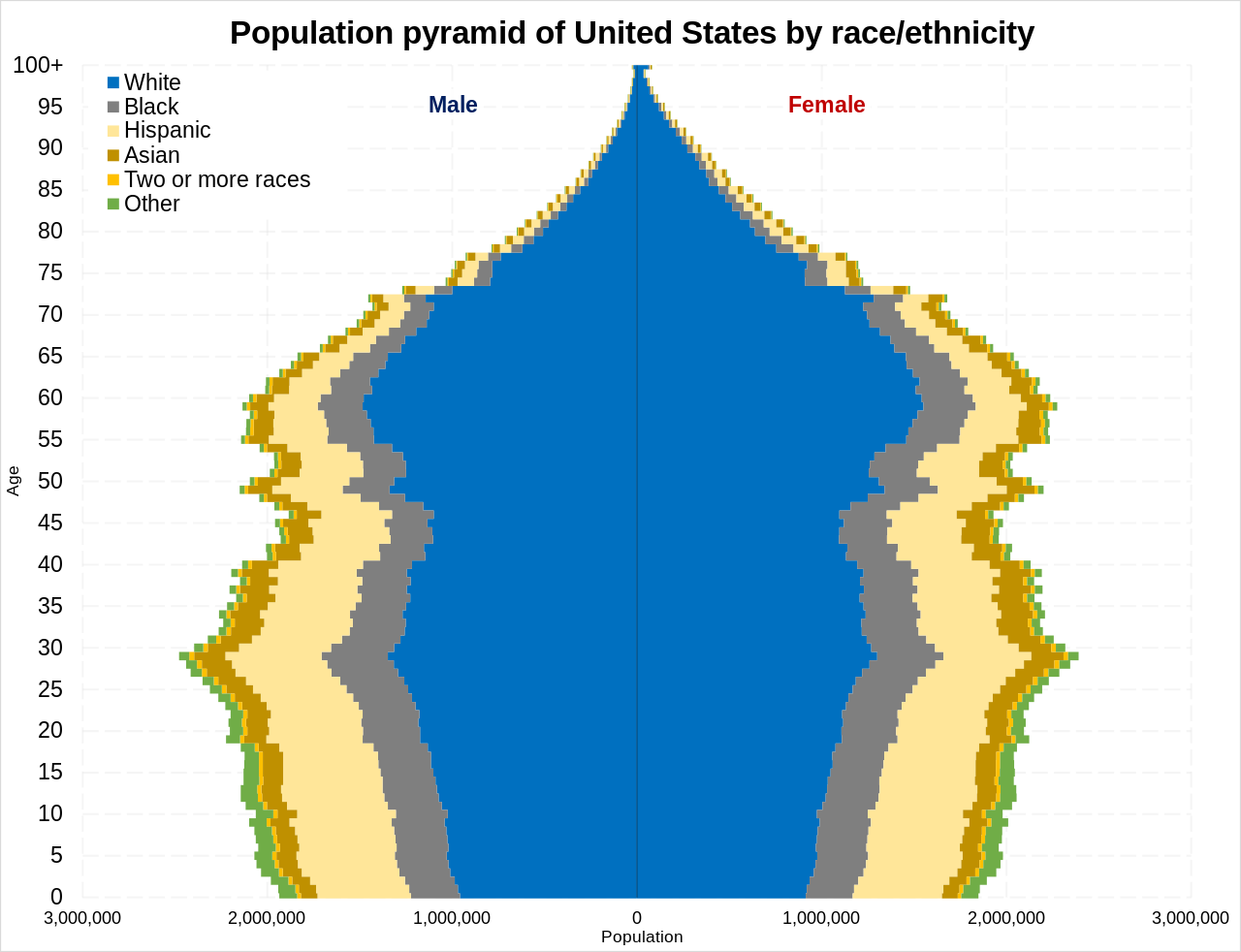
The United States Census Bureau collects racial data in accordance with guidelines provided by the U.S. Office of Management and Budget (OMB), and these data are based on self-identification. Many other countries count multiple races based on origin while America compiles multiple dozens of ethnicity groups into skin color grouping them together.[161] The racial classifications and definitions used by the U.S. Census Bureau are:[162]
- White: a person having origins in any of the original peoples of Europe, the Middle East, or North Africa.[163] It includes people who indicate their race as "White" or report entries such as English, Azerbaijani, Iranian (Kurd and Lur), Irish, German, Italian, Spanish, Portuguese, Greek, Turkish, Lebanese, Moroccan (Arab and Berber), or Caucasian.
- Black or African American: a person having origins in any of the Black racial groups of Africa.[163] It includes people who indicate their race as "Black, African Am." or report entries such as African American, Kenyan, Nigerian, or Haitian.
- American Indian or Alaska Native: a person having origins in any of the original peoples of North and South America (including Central America) and who maintains tribal affiliation or community attachment.[163] This category includes people who indicate their race as "American Indian or Alaska Native" or report entries such as Navajo, Blackfeet, Inupiat, Yup'ik, Central American Indian groups, or South American Indian groups.
- Asian: a person having origins in any of the original peoples of East Asia, Southeast Asia, or South Asia, such as Cambodia, China, India, Japan, Korea, Malaysia, Pakistan, the Philippine Islands, Thailand, and Vietnam.[163]
- Native Hawaiian or Other Pacific Islander: a person having origins in any of the original peoples of Hawaii, Guam, Samoa, or other Pacific Islands.[163]
- Some other race: includes all other responses not included in the "White", "Black or African American", "American Indian or Alaska Native", "Asian", and "Native Hawaiian or other Pacific Islander" racial categories described above includes Asians from West Asia or Russia (non-European Russia) and White Africans.
- Two or more races: people may choose to provide two or more races either by checking two or more race response check boxes, providing multiple responses, or some combination of check boxes and other responses.
Data about race and ethnicity are self-reported to the Census Bureau. Since the 2000 census, Congress has authorized people to identify themselves according to more than one racial classification by selecting more than one category. Only one ethnicity may be selected, however, because the Census Bureau recognizes only two ethnicities – "Hispanic or Latino" and "Not Hispanic or Latino" – which are mutually exclusive since you can be one or the other, but not both. The singular term Hispanic has been supplanted as a federally-recognized ethnicity by the combined "Hispanic or Latino," defined by the Census Bureau as a person of Cuban, Mexican, Puerto Rican, Cuban, South or Central American, or other Spanish culture or origin, regardless of race.[164]
.jpg/1280px-Largest_Race_and_Ethnicity_in_United_States_(2020).jpg)
According to the Census Bureau website, the racial composition of the United States in 2021 was:[165]
| Race (2021) | Population | Share of population |
|---|---|---|
| Total | 323,175,700 | 100.0% |
| (Non-Hispanic) White, percent | 187,925,100 | 58.2% |
| (Non-Hispanic) Black or African American, percent | 37,520,800 | 11.6% |
| Hispanic or Latino, percent | 61,241,900 | 19.0% |
| (Non-Hispanic) Asian, percent | 18,558,600 | 5.7% |
| (Non-Hispanic) American Indian and Alaska Native, percent | 1,667,100 | 0.5% |
| (Non-Hispanic) Native Hawaiian and Other Pacific Islander | 541,200 | 0.2% |
| Two or more Races, percent | 15,711,100 | 4.9% |
According to the 2022 American Community Survey, the racial composition of the United States in 2022 was:[166][167]
| Race | Population (2022 est.) | Share of total population |
|---|---|---|
| Total | 333,287,550 | 100% |
| One race | 291,505,262 | 87.5% |
| White | 202,889,020 | 60.2% |
| Black or African American | 40,603,656 | 12.2% |
| American Indian and Alaska Native | 3,205,331 | 1% |
| Asian | 19,696,980 | 5.9% |
| Native Hawaiian and Other Pacific Islander | 665,807 | 0.2% |
| Other races | 24,444,482 | 7.3% |
| Two or more races | 41,782,288 | 12.5% |
| White and Black or African American | 3,831,683 | 1.1% |
| White and American Indian and Alaska Native | 3,012,849 | 0.9% |
| White and Asian | 2,865,504 | 0.9% |
| Black or African American and American Indian and Alaska Native | 464,679 | 0.1% |
| White and Some Other Race | 26,317,236 | 7.9% |
| Hispanic or Latino (of any race) | 63,553,640 | 19.1% |
| Mexican | 37,414,772 | 11.2% |
| Central American | 6,531,267 | 2% |
| Puerto Rican | 5,905,178 | 1.8% |
| South American | 4,666,970 | 1.4% |
| Cuban | 2,435,573 | 0.7% |
| Dominican | 2,396,784 | 0.7% |
| Other Hispanic or Latino | 4,203,095 | 1.3% |
| Not Hispanic or Latino | 269,733,920 | 80.9% |
| White (non-Hispanic) | 192,153,070 | 57.7% |
| Black or African American (non-Hispanic) | 39,582,960 | 11.9% |
| American Indian and Alaska Native (non-Hispanic) | 1,750,489 | 0.5% |
| Asian (non-Hispanic) | 19,415,252 | 5.8% |
| Native Hawaiian and Other Pacific Islander (non-Hispanic) | 590,339 | 0.2% |
| Some other race (non-Hispanic) | 1,912,680 | 0.6% |
| Two or more races | 14,329,127 | 4.3% |
- United States in racial groups (of one race)


- United States in ethnic groups


- Distribution of Total Population by Race, 1900 to 2020 (in %)
Hispanic are shown like part of the races. Source: U.S. Census Bureau.[168][69]
| Years | 1900 | 1910 | 1920 | 1930 | 1940 | 1950 | 1960 | 1970 | 1980 | 1990 | 2000* | 2010* | 2020* |
|---|---|---|---|---|---|---|---|---|---|---|---|---|---|
| White | 87.9 | 88.9 | 89.7 | 89.8 | 89.8 | 89.5 | 88.6 | 87.5 | 83.0 | 80.3 | 75.1 | 72.4 | 61.6 |
| Black or African American | 11.6 | 10.7 | 9.9 | 9.7 | 9.8 | 10.0 | 10.5 | 11.1 | 11.7 | 12.1 | 12.3 | 12.6 | 12.4 |
| American Indian and Alaska Native | 0.8 | 0.8 | 0.9 | 0.9 | 1.1 | ||||||||
| Asian and Native Hawaiian and other Pacific Islander | 1.5 | 2.9 | 3.8 | 5.0 | 6.2 | ||||||||
| Some other race | 3.0 | 3.9 | 5.5 | 6.2 | 8.4 | ||||||||
| Two or more races | 2.4 | 2.9 | 10.2 | ||||||||||
| Sum (%) | 99.5 | 99.6 | 99.6 | 99.5 | 99.6 | 99.5 | 99.1 | 98.6 | 100 | 100 | 100 | 100 | 100 |
*Data are shown for the White, Black or African American, American Indian and Alaska Native, Asian and Native Hawaiian and Other Pacific Islander, and Some other race alone populations.
- Median age by each race alone and ethnicity, 2021
Source: United States Census Bureau.[169]
| Race | Median age (both sexes) (years) | Median age (male) (years) | Median age (female) (years) |
|---|---|---|---|
| Total Population | 38.8 | 37.7 | 39.8 |
| White (Non-Hispanic) | 43.8 | 42.6 | 45.0 |
| Black or African American (Non-Hispanic) | 34.5 | 32.9 | 36.1 |
| American Indian and Alaska Native (Non-Hispanic) | 32.1 | 31.8 | 32.5 |
| Asian (Non-Hispanic) | 37.7 | 36.5 | 38.9 |
| Native Hawaiian and Other Pacific Islander (Non-Hispanic) | 32.7 | 32.5 | 32.9 |
| Two or More Races | 29.5 (2020)[170] | 20.4 | 21.8 |
| Hispanic alone | 30.5 | 30.2 | 30.8 |
| Not Hispanic | 41.0 | 39.8 | 42.1 |
- Median age by race alone or in combination and ethnicity, 2021
Source: United States Census Bureau.[169]
| Race | Median age (both sexes) (years) | Median age (male) (years) | Median age (female) (years) |
|---|---|---|---|
| White (include White Hispanics) | 39.8 | 38.9 | 40.8 |
| Black or African American | 32.7 | 31.2 | 34.2 |
| American Indian and Alaska Native | 31.6 | 30.9 | 32.2 |
| Asian | 35.4 | 34.1 | 36.6 |
| Native Hawaiian and Other Pacific Islander | 29.8 | 29.3 | 30.3 |
| White (excludes White Hispanics) | 42.8 | 41.7 | 44.0 |
| Race/ethnicity | White | Black or African American | Hispanic | Asian | American Indian and Alaska Native | Native Hawaiian and Pacific Islander | Multiracial |
|---|---|---|---|---|---|---|---|
| Most common age | 58 yo | 27 yo | 11 yo | 29 yo | 26 yo | 28 yo | 3 yo |
| State or territory | Population (2015 est.) | White | Black or African American | American Indian and Alaska Native | Asian | Native Hawaiian and Other Pacific Islander | Some other race | Two or more races |
|---|---|---|---|---|---|---|---|---|
| Alabama | 4,830,620 | 68.8% | 26.4% | 0.5% | 1.2% | 0.1% | 1.3% | 1.7% |
| Alaska | 733,375 | 66.0% | 3.4% | 13.8% | 5.9% | 1.2% | 1.3% | 8.4% |
| Arizona | 6,641,928 | 78.4% | 4.2% | 4.4% | 3.0% | 0.2% | 6.5% | 3.2% |
| Arkansas | 2,958,208 | 78.0% | 15.5% | 0.6% | 1.4% | 0.2% | 2.1% | 2.1% |
| California | 38,421,464 | 61.8% | 5.9% | 0.7% | 13.7% | 0.4% | 12.9% | 4.5% |
| Colorado | 5,278,906 | 84.2% | 4.0% | 0.9% | 2.9% | 0.1% | 4.3% | 3.5% |
| Connecticut | 3,593,222 | 77.3% | 10.3% | 0.2% | 4.2% | 0.0% | 5.1% | 2.8% |
| Delaware | 926,454 | 69.4% | 21.6% | 0.3% | 3.6% | 0.0% | 2.3% | 2.7% |
| District of Columbia | 647,484 | 40.2% | 48.9% | 0.3% | 3.7% | 0.0% | 4.2% | 2.7% |
| Florida | 19,645,772 | 76.0% | 16.1% | 0.3% | 2.6% | 0.1% | 2.5% | 2.4% |
| Georgia | 10,006,693 | 60.2% | 30.9% | 0.3% | 3.6% | 0.0% | 2.8% | 2.1% |
| Hawaii | 1,406,299 | 25.4% | 2.0% | 0.2% | 37.7% | 9.9% | 1.1% | 23.7% |
| Idaho | 1,616,547 | 91.7% | 0.6% | 1.3% | 1.3% | 0.1% | 2.4% | 2.6% |
| Illinois | 12,873,761 | 72.3% | 14.3% | 0.2% | 5.0% | 0.0% | 5.8% | 2.2% |
| Indiana | 6,568,645 | 84.2% | 9.2% | 0.2% | 1.9% | 0.0% | 2.3% | 2.2% |
| Iowa | 3,093,526 | 91.2% | 3.2% | 0.3% | 2.0% | 0.1% | 1.3% | 2.0% |
| Kansas | 2,892,987 | 85.2% | 5.8% | 0.8% | 2.6% | 0.1% | 2.2% | 3.3% |
| Kentucky | 4,397,353 | 87.6% | 7.9% | 0.2% | 1.3% | 0.0% | 0.9% | 2.1% |
| Louisiana | 4,625,253 | 62.8% | 32.1% | 0.6% | 1.7% | 0.0% | 1.0% | 1.8% |
| Maine | 1,329,100 | 95.0% | 1.1% | 0.6% | 1.1% | 0.0% | 0.2% | 2.0% |
| Maryland | 5,930,538 | 57.6% | 29.5% | 0.3% | 6.0% | 0.0% | 3.6% | 3.0% |
| Massachusetts | 6,705,586 | 79.6% | 7.1% | 0.2% | 6.0% | 0.0% | 4.2% | 2.9% |
| Michigan | 9,900,571 | 79.0% | 14.0% | 0.5% | 2.7% | 0.0% | 1.1% | 2.6% |
| Minnesota | 5,419,171 | 84.8% | 5.5% | 1.0% | 4.4% | 0.0% | 1.5% | 2.7% |
| Mississippi | 2,988,081 | 59.2% | 37.4% | 0.4% | 1.0% | 0.0% | 0.9% | 1.2% |
| Missouri | 6,045,448 | 82.6% | 11.5% | 0.4% | 1.8% | 0.1% | 1.1% | 2.4% |
| Montana | 1,014,699 | 89.2% | 0.5% | 6.5% | 0.7% | 0.1% | 0.5% | 2.5% |
| Nebraska | 1,869,365 | 88.1% | 4.7% | 0.9% | 2.0% | 0.1% | 1.9% | 2.2% |
| Nevada | 2,798,636 | 69.0% | 8.4% | 1.1% | 7.7% | 0.6% | 8.8% | 4.4% |
| New Hampshire | 1,324,201 | 93.7% | 1.3% | 0.2% | 2.4% | 0.0% | 0.5% | 1.8% |
| New Jersey | 8,904,413 | 68.3% | 13.5% | 0.2% | 9.0% | 0.0% | 6.4% | 2.5% |
| New Mexico | 2,084,117 | 73.2% | 2.1% | 9.1% | 1.4% | 0.1% | 10.9% | 3.3% |
| New York | 19,673,174 | 64.6% | 15.6% | 0.4% | 8.0% | 0.0% | 8.6% | 2.9% |
| North Carolina | 9,845,333 | 69.5% | 21.5% | 1.2% | 2.5% | 0.1% | 3.0% | 2.4% |
| North Dakota | 721,640 | 88.7% | 1.6% | 5.3% | 1.2% | 0.0% | 0.8% | 2.2% |
| Ohio | 11,575,977 | 82.4% | 12.2% | 0.2% | 1.9% | 0.0% | 0.8% | 2.5% |
| Oklahoma | 3,849,733 | 73.1% | 7.2% | 7.3% | 1.9% | 0.1% | 2.6% | 7.8% |
| Oregon | 3,939,233 | 85.1% | 1.8% | 1.2% | 4.0% | 0.4% | 3.4% | 4.1% |
| Pennsylvania | 12,779,559 | 81.6% | 11.0% | 0.2% | 3.1% | 0.0% | 2.0% | 2.1% |
| Puerto Rico | 3,583,073 | 69.7% | 8.4% | 0.3% | 0.3% | 0.0% | 12.0% | 9.3% |
| Rhode Island | 1,053,661 | 81.1% | 6.5% | 0.5% | 3.2% | 0.0% | 5.8% | 2.8% |
| South Carolina | 4,777,576 | 67.2% | 27.5% | 0.3% | 1.4% | 0.1% | 1.5% | 2.0% |
| South Dakota | 843,190 | 85.0% | 1.6% | 8.6% | 1.2% | 0.0% | 0.9% | 2.6% |
| Tennessee | 6,499,615 | 77.8% | 16.8% | 0.3% | 1.6% | 0.1% | 1.5% | 2.0% |
| Texas | 26,538,614 | 74.9% | 11.9% | 0.5% | 4.2% | 0.1% | 6.0% | 2.5% |
| Utah | 2,903,379 | 87.6% | 1.1% | 1.1% | 2.2% | 0.9% | 4.5% | 2.6% |
| Vermont | 626,604 | 94.9% | 1.1% | 0.3% | 1.4% | 0.0% | 0.3% | 1.9% |
| Virginia | 8,256,630 | 69.0% | 19.2% | 0.3% | 6.0% | 0.1% | 2.2% | 3.2% |
| Washington | 6,985,464 | 77.8% | 3.6% | 1.3% | 7.7% | 0.6% | 3.8% | 5.2% |
| West Virginia | 1,851,420 | 93.6% | 3.3% | 0.2% | 0.7% | 0.0% | 0.2% | 2.0% |
| Wisconsin | 5,742,117 | 86.5% | 6.3% | 0.9% | 2.5% | 0.0% | 1.7% | 2.1% |
| Wyoming | 579,679 | 91.0% | 1.1% | 2.2% | 0.9% | 0.1% | 2.1% | 2.7% |
| State or territory | Population (2022 est.) | White (Non Hispanic) | Black or African American (Non Hispanic) | American Indian and Alaska Native (Non Hispanic) | Asian (Non Hispanic) | Native Hawaiian and Other Pacific Islander (Non Hispanic) | Some other race (Non Hispanic) | Two or more races (Non Hispanic) | Hispanic or Latino |
|---|---|---|---|---|---|---|---|---|---|
| Alabama | 5,074,296 | 64.1% | 25.6% | 0.3% | 1.5% | 0.0% | 0.4% | 3.3% | 4.9% |
| Alaska | 733,583 | 57.4% | 2.8% | 12.7% | 6.1% | 2.0% | 0.5% | 10.7% | 7.7% |
| Arizona | 7,359,197 | 51.8% | 4.4% | 3.3% | 3.5% | 0.2% | 0.5% | 3.9% | 32.5% |
| Arkansas | 3,045,637 | 67.5% | 14.3% | 0.4% | 1.6% | 0.5% | 0.4% | 7.0% | 8.4% |
| California | 39,029,344 | 33.7% | 5.2% | 0.3% | 15.3% | 0.3% | 0.6% | 4.3% | 40.3% |
| Colorado | 5,839,926 | 65.0% | 3.8% | 0.4% | 3.1% | 0.1% | 0.5% | 4.6% | 22.5% |
| Connecticut | 3,626,205 | 62.0% | 9.8% | 0.1% | 4.8% | 0.0% | 0.8% | 4.4% | 18.2% |
| Delaware | 1,018,396 | 58.9% | 21.6% | 0.1% | 4.1% | 0.0% | 0.5% | 4.5% | 10.3% |
| District of Columbia | 671,803 | 36.7% | 41.7% | 0.2% | 4.1% | 0.1% | 0.6% | 5.0% | 11.7% |
| Florida | 22,244,824 | 50.8% | 14.6% | 0.1% | 2.8% | 0.0% | 0.7% | 3.9% | 27.1% |
| Georgia | 10,912,876 | 49.6% | 30.7% | 0.1% | 4.4% | 0.1% | 0.5% | 4.2% | 10.4% |
| Hawaii | 1,440,196 | 20.7% | 1.6% | 0.1% | 34.6% | 9.3% | 0.4% | 22.1% | 11.1% |
| Idaho | 1,939,033 | 79.0% | 0.6% | 0.8% | 1.3% | 0.2% | 0.5% | 4.2% | 13.5% |
| Illinois | 12,582,032 | 58.5% | 13.2% | 0.1% | 5.9% | 0.0% | 0.4% | 3.6% | 18.3% |
| Indiana | 6,833,037 | 76.0% | 9.2% | 0.1% | 2.5% | 0.0% | 0.5% | 3.9% | 7.8% |
| Iowa | 3,200,517 | 82.8% | 3.7% | 0.2% | 2.3% | 0.3% | 0.3% | 3.6% | 6.8% |
| Kansas | 2,937,150 | 73.1% | 5.0% | 0.4% | 2.9% | 0.1% | 0.5% | 4.9% | 13.0% |
| Kentucky | 4,512,310 | 82.2% | 7.6% | 0.1% | 1.4% | 0.1% | 0.3% | 4.2% | 4.2% |
| Louisiana | 4,590,241 | 56.7% | 30.9% | 0.4% | 1.8% | 0.0% | 0.4% | 4.0% | 5.7% |
| Maine | 1,385,340 | 90.2% | 1.6% | 0.4% | 1.2% | 0.0% | 0.4% | 4.2% | 2.1% |
| Maryland | 6,164,660 | 47.1% | 29.2% | 0.1% | 6.5% | 0.0% | 0.8% | 4.7% | 11.4% |
| Massachusetts | 6,981,974 | 67.0% | 6.6% | 0.1% | 7.2% | 0.0% | 1.2% | 4.9% | 13.0% |
| Michigan | 10,034,118 | 72.6% | 13.1% | 0.3% | 3.3% | 0.0% | 0.5% | 4.5% | 5.7% |
| Minnesota | 5,717,184 | 76.2% | 6.9% | 0.7% | 5.2% | 0.0% | 0.6% | 4.5% | 5.8% |
| Mississippi | 2,940,057 | 55.3% | 36.5% | 0.4% | 0.9% | 0.0% | 0.3% | 3.3% | 3.3% |
| Missouri | 6,177,957 | 76.6% | 10.6% | 0.2% | 2.1% | 0.1% | 0.4% | 5.1% | 4.7% |
| Montana | 1,122,867 | 83.5% | 0.3% | 5.2% | 0.7% | 0.1% | 0.8% | 4.9% | 4.4% |
| Nebraska | 1,967,923 | 75.8% | 4.5% | 0.5% | 2.5% | 0.1% | 0.4% | 3.9% | 12.3% |
| Nevada | 3,177,772 | 44.4% | 9.0% | 0.6% | 8.8% | 0.6% | 0.6% | 5.7% | 30.3% |
| New Hampshire | 1,395,231 | 86.6% | 1.3% | 0.1% | 2.6% | 0.1% | 0.5% | 4.4% | 4.5% |
| New Jersey | 9,261,699 | 51.5% | 12.0% | 0.1% | 10.0% | 0.0% | 1.0% | 3.6% | 21.9% |
| New Mexico | 2,113,344 | 34.8% | 1.7% | 8.1% | 1.7% | 0.0% | 0.4% | 3.1% | 50.2% |
| New York | 19,677,152 | 52.9% | 13.4% | 0.2% | 9.0% | 0.0% | 1.1% | 3.7% | 19.7% |
| North Carolina | 10,698,973 | 60.7% | 20.1% | 0.9% | 3.2% | 0.1% | 0.5% | 4.1% | 10.4% |
| North Dakota | 779,261 | 82.0% | 3.3% | 4.3% | 1.6% | 0.4% | 0.4% | 3.7% | 4.4% |
| Ohio | 11,756,058 | 76.1% | 11.9% | 0.1% | 2.5% | 0.0% | 0.4% | 4.5% | 4.4% |
| Oklahoma | 4,019,800 | 62.6% | 6.7% | 6.8% | 2.3% | 0.1% | 0.3% | 9.1% | 12.1% |
| Oregon | 4,240,137 | 71.6% | 1.8% | 0.7% | 4.5% | 0.4% | 0.6% | 6.0% | 14.4% |
| Pennsylvania | 12,972,008 | 73.1% | 10.1% | 0.1% | 3.8% | 0.0% | 0.5% | 3.8% | 8.6% |
| Puerto Rico | 3,221,789 | 0.6% | 0.1% | 0.0% | 0.1% | 0% | 0.1% | 0.1% | 99.0% |
| Rhode Island | 1,093,734 | 68.2% | 4.7% | 0.1% | 3.4% | 0.0% | 0.9% | 5.2% | 17.6% |
| South Carolina | 5,282,634 | 62.5% | 24.9% | 0.2% | 1.7% | 0.0% | 0.6% | 3.6% | 6.5% |
| South Dakota | 909,824 | 79.9% | 2.0% | 7.1% | 1.4% | 0.1% | 0.3% | 4.5% | 4.7% |
| Tennessee | 7,051,339 | 71.9% | 15.5% | 0.1% | 1.9% | 0.1% | 0.4% | 4.0% | 6.3% |
| Texas | 30,029,572 | 38.9% | 11.7% | 0.2% | 5.4% | 0.1% | 0.4% | 3.2% | 40.2% |
| Utah | 3,380,800 | 75.6% | 1.0% | 0.7% | 2.4% | 1.1% | 0.4% | 3.5% | 15.1% |
| Vermont | 647,064 | 90.2% | 1.0% | 0.2% | 1.8% | 0.0% | 0.4% | 4.2% | 2.3% |
| Virginia | 8,683,619 | 58.7% | 18.4% | 0.1% | 6.9% | 0.1% | 0.7% | 4.7% | 10.4% |
| Washington | 7,785,786 | 63.5% | 3.8% | 0.9% | 9.7% | 0.7% | 0.7% | 6.7% | 14.0% |
| West Virginia | 1,775,156 | 89.8% | 3.3% | 0.1% | 0.7% | 0.0% | 0.3% | 3.8% | 1.9% |
| Wisconsin | 5,892,539 | 79.0% | 5.9% | 0.6% | 2.9% | 0.0% | 0.3% | 3.7% | 7.6% |
| Wyoming | 581,381 | 81.4% | 0.7% | 1.6% | 0.6% | 0.1% | 0.9% | 3.9% | 10.8% |
| Territory | Population (2010 est.) | White | Black or African American | American Indian and Alaska Native | Asian | Native Hawaiian and Other Pacific Islander | Some other race | Two or more races |
|---|---|---|---|---|---|---|---|---|
| American Samoa | 55,519 | 0.9% | 0.0% | — | 3.6% | 92.6% | 0.1% | 2.7% |
| Guam | 159,358 | 7.1% | 1.0% | — | 32.2% | 49.3% | 0.3% | 9.4% |
| Northern Mariana Islands | 53,883 | 2.1% | 0.1% | — | 49.9% | 34.9% | 0.2% | 12.7% |
| U.S. Virgin Islands | 106,405 | 15.6% | 76.0% | — | 1.4% | 0.0% | 4.9% | 2.1% |
| Year | White Alone | Black Alone | Hispanic | Native American Alone | Asian Alone | Pacific Islander Alone |
|---|---|---|---|---|---|---|
| 2018 | 51.6% | 14.6% | 23.4% | 0.8% | 6.4% | 0.3% |
| Year | White | Black or African American | Hispanic | Asian | Pacific Islander | American Indian Alaska Native | Two or more races |
|---|---|---|---|---|---|---|---|
| 2000 | 60% | 15% | 16% | 3% | — | 1% | 2% |
| 2017 | 51% | 14% | 25% | 5% | — | 1% | 4% |
| Year | White | Black or African American | Hispanic | Asian | Pacific Islander | American Indian Alaska Native | Two or more races |
|---|---|---|---|---|---|---|---|
| 2000 | 62% | 14% | 18% | 4% | — | 1% | 1% |
| 2017 | 54% | 14% | 22% | 6% | — | 1% | 3% |
| Age group | 85+ | 80–84 | 75–79 | 70–74 | 65–69 | 60–64 | 55–59 | 50–54 | 45–49 | 40–44 | 35–39 | 30–34 | 25–29 | 20–24 | 15–19 | 10–14 | 5–9 | <5 |
|---|---|---|---|---|---|---|---|---|---|---|---|---|---|---|---|---|---|---|
| non-Hispanic white | 83% | 81% | 79% | 78% | 77% | 74% | 72% | 69% | 65% | 61% | 58% | 57% | 57% | 56% | 55% | 54% | 52% | 50% |
| Minority | 17% | 19% | 21% | 22% | 23% | 26% | 28% | 31% | 35% | 39% | 42% | 43% | 43% | 44% | 45% | 46% | 48% | 50% |
Hispanic or Latino origin

The U.S. Office of Management and Budget (OMB) defines "Hispanic or Latino" as a person of Cuban, Mexican, Puerto Rican, Dominican, South or Central American, or other Spanish culture or origin regardless of race. People who identify with the terms "Hispanic" or "Latino" are those who classify themselves in one of the specific Hispanic or Latino categories listed on the decennial census questionnaire and various Census Bureau survey questionnaires – "Mexican, Mexican Am., Chicano" or "Puerto Rican" or "Cuban" – as well as those who indicate that they are "another Hispanic, Latino, or Spanish origin."[181] People who identify their origin as Hispanic or Latino may be of any race.[162]
| Hispanic or Latino and Race | Population (2022 est.) | Percentage of total population |
|---|---|---|
| United States population | 333,287,550 | 100% |
| Hispanic or Latino (of any race) | 63,553,640 | 19.1% |
| White | 10,735,941 | 3.2% |
| Black or African American | 1,020,695 | 0.3% |
| American Indian and Alaska Native | 1,454,842 | 0.4% |
| Asian | 181,231 | 0.1% |
| Native Hawaiian and Other Pacific Islander | 75,468 | 0.0% |
| Some other race | 22,531,802 | 6.8% |
| Two or more races | 27,453,162 | 8.2% |
| Not Hispanic or Latino | 269,733,920 | 80.9% |
- Population distribution by Hispanic origin 1970–2020 (in %)
Source: U.S. Census Bureau, decennial census of population, 1970 (5-percent sample), 1980 to 2020.[69]
| Years | 1970 | 1980 | 1990 | 2000 | 2010 | 2020 |
|---|---|---|---|---|---|---|
| Not Hispanic or Latino | 95.5 | 93.6 | 91.0 | 87.5 | 83.7 | 81.3 |
| Hispanic or Latino | 4.5 | 6.4 | 9.0 | 12.5 | 16.3 | 18.7 |
| Total (%) | 100 | 100 | 100 | 100 | 100 | 100 |
- Median age of each race alone, 2021 (Hispanic)
Source: United States Census Bureau.[169]
| Race | Median age (both sex) (years) | Median age (male) (years) | Median age (female) (years) |
|---|---|---|---|
| Total (Hispanic) | 30.5 | 30.2 | 30.8 |
| White | 31.2 | 30.9 | 31.5 |
| Black or African American | 27.1 | 26.1 | 28.2 |
| American Indian and Alaska Native | 28.4 | 29.0 | 27.8 |
| Asian | 26.9 | 26.2 | 27.7 |
| Native Hawaiian and Other Pacific Islander | 27.8 | 28.3 | 27.2 |
| Two or More Races | 21.5 | 21.1 | 22.0 |
- Median age of each race alone or in combination, 2021 (Hispanic)
Source: United States Census Bureau.[169]
| Race | Median age (both sex) (years) | Median age (male) (years) | Median age (female) (years) |
|---|---|---|---|
| White | 30.9 | 30.6 | 31.1 |
| Black or African American | 25.3 | 24.3 | 26.3 |
| American Indian and Alaska Native | 27.6 | 27.8 | 27.3 |
| Asian | 23.0 | 22.3 | 23.7 |
| Native Hawaiian and Other Pacific Islander | 24.8 | 24.9 | 24.7 |
Note: Hispanic origin is considered an ethnicity, not a race. Hispanics may be of any race.
Indigenous peoples
As of 2020, there are 9,666,058 people identifying as American Indian and Alaska Native people in the United States, including those identifying with more than one race,[182] representing around 3% of the U.S. population. This number includes not only groups indigenous to the United States, but any Indigenous people of the Americas,[183] including Mesoamerican peoples such as the Maya, as well as Canadian and South American natives. In 2022, 634,503 Indigenous people in the United States identified with Central American Indigenous groups, 875,183 identified with the Indigenous people of Mexico, and 47,518 identified with Canadian First Nations.[184] Of the 3.2 million Americans who identified as American Indian or Alaska Native alone in 2022, around 45% were of Hispanic or Latino ethnicity,[185][186] with this number growing as increasing numbers of Indigenous people from Latin American countries immigrate to the US and more Latinos self-identify with indigenous heritage. Of groups Indigenous to the contiguous United States, the largest self-reported tribes are Cherokee (1,449,888), Navajo (434,910), Choctaw (295,373), Blackfeet (288,255), and Sioux (220,739). Additionally, 205,954 identify with an Alaska Native tribe. There are 573 federally recognized tribal governments[187] in the United States.[188]
The US Census Bureau classifies Native Hawaiians separately from American Indians and Alaska Natives, grouping them with Pacific Islanders instead. According to 2022 estimates, 714,847 Americans identified with Native Hawaiian ancestry.[189]
Other groups
Veterans
There were 15.8 million veterans in 2023,[190] with only 6.2% of Americans having served in the Armed Forces.[191] In 2023 the war with the highest number of veterans was the Korean War. Most veterans were male at 14 million and 1.7 million veterans were female.[190]
Illegal/undocumented immigrants
In 2010, The Washington Post estimated that there were 11 million undocumented immigrants in the country.[192] As of 2017, Pew Research reported that there an estimated 10.5 million undocumented immigrants in the U.S.[193]
Prisoners
In 2023, an estimated 1,850,595 adults were imprisoned in the US.[194]
In 2016 it was reported that 92.7% of all prisoners were male, 6.9% female, 0.3% being transgender and 0.1% being nonbinary.[195] In 2022 there were 180,684 women in prison. Most women that were involved in the correctional system were under probation with 717,811 being so and parolees numbered at 76,870. 87,874 women were in prison and 92,900 in jail in 2022.[196]
Racially speaking at the federal level; 37% were Hispanic, 32% Black/African American, 21% white, 2% Native American or Alaska Native while Asians, Native Hawaiians and other pacific islanders made up 2% of the population while "Nearly 7% of federal prisoners identified as two or more races". At the state level 34% identified as Black/African American, 32% white, 21% Hispanic, 1% Native American or Alaskan Native, 1% as being either Asian/Native Hawaiian/Other Pacific Islander and 11% "identified with two or more races".[195]
Projections
| 2023 | 2060 | |
|---|---|---|
| White Americans1 | 75.5% | 72.3% |
| > Non-Hispanic Whites | 58.9% | 44.9% |
| Black Americans1 | 13.6% | 14.8% |
| Asian Americans1 | 6.3% | 9.4% |
| Multiracial Americans1 | 3.0% | 6.1% |
| Native Americans1 | 1.3% | 1.4% |
| Pacific Islanders1 | 0.3% | 0.4% |
| Hispanics/Latinos (of any race) | 19.1% | 26.9% |
| 1 Including Hispanics | ||
A report by the U.S. Census Bureau projects a decrease in the ratio of non-Hispanic Whites between 2023 and 2060, a decline from 58.9% of the population to 44.9%. Non-Hispanic Whites are projected to no longer make up a majority of the population by 2050, but will remain the largest single ethnic group. Non-Hispanic whites made up 85% of the population in 1960.[198]
While non-Hispanic whites are projected to become a minority, the total White population (including Hispanics), will remain a majority from 2023 to 2060, falling from 75.5% to 72.3% of the population who are white alone according to the projections.[199] However, these projections are not directly comparable to other Census Bureau data, as they are based on a modified race dataset,[200] which does not include the "some other race" category used in census surveys.[201] Individuals identifying as “some other race” alone or in combination made up 16.2% of the population in 2022,[202] and they are reclassified into recognized race categories in the dataset used for the projections.[203] As a result, there is a significant discrepancy between the share of the white alone population in 2023 according to the projections (75.5%), and the estimated share of white alone (60.9%), as reported by the American Community Survey in 2022.[204]
The report foresees the Hispanic or Latino population rising from 19.1% today to 26.9% by 2060, the Black percentage barely rising from 13.6% to 14.8%, and Asian Americans upping their 6.3% share to 9.4%. The United States had a population of 333 million people in July 2023, and is projected to reach 355 million by 2040 and 364 million in 2060.[205][206][207][208][209] It is further projected that all of the increase in population from 2023 to 2060 will be due to immigrants.
Of the nation's children in 2060, 64% are expected to be of a minority ethnicity, up from 51% today. Approximately 32% are projected to be Hispanic or Latino (up from 26% in 2023), and 36% are projected to be single-race, non-Hispanic Whites (down from 49% in 2023). Racial and ethnic minorities surpassed non-Hispanic whites as the largest group of U.S. children under 5 years old in 2015.[210]
The fastest growing racial group in America is Asian Americans with a growth rate of 35%, however the multiracial mixed Asian group is growing even faster, with a growth rate of 55%. Multiracial Asians are therefore the fastest growing demographic group in America.[37][36]
In 2020, it was reported that 51.0% of births were to non-Hispanic white mothers.[127] In 2021, the percentage increased to 51.5%.[127][211] However, by 2022 the rate of births to white mothers had declined by 3%, dropping to 50% of all total births. In the same period, the rate of births to Asian and Hispanic women increased by 2% and 6%, respectively.[39][38]
- Population pyramids of racial groups (of one race)


- Population pyramids of ethnic groups
- Non-Hispanic African Americans


- Pew Research Center projections
The United Nations projects a population of just over 400 million in 2060.[citation needed]
| 1960 | 2005 | 2050 | |
|---|---|---|---|
| White Americans | 85% | 67% | 47% |
| Hispanic Americans | 3.5% | 14% | 29% |
| Black Americans | 11% | 13% | 14% |
| Asian Americans | 0.6% | 5% | 9% |
| Note: All races modified and not Hispanic; American Indian/Alaska Native not shown. | |||
The country's racial profile will be vastly different, and although whites will remain the single largest ethnic group in the U.S., they will no longer be a majority excluding White Hispanics by 2055 according to Pew Research Center. Growth in the Hispanic and Asian populations is predicted to almost triple over the next 40 years. By 2055, the breakdown is estimated to be 48% non-Hispanic white, 24% Hispanic, 16% Black, and 14% Asian.[213]
As of 2015[update], 14% of the United States' population is foreign born, compared to just 5% in 1965. Nearly 39 million immigrants have come to the U.S. since 1965, with most coming from Asia and Latin America. The 2015 Census Report predicts that the percentage of the U.S. population that is foreign-born will continue to increase, reaching 19% by 2060. This increase in the foreign-born population will account for a large share of the overall population growth.[213]
The average person in the U.S. of 2060 is likely to be older than the average person of 2018 today, and it is projected that almost one in four people will be 65 or older.[213]
U.S. Census Census Bureau projections
- Percent minority 1970–2042 (2008 projections)
- [69]
| Years | 1970 | 1980 | 1990 | 2000 | 2010 | 2020 | 2030 | 2040 | 2042 |
|---|---|---|---|---|---|---|---|---|---|
| Percent minority (%) | 16.5 | 20.4 | 24.4 | 30.9 | 36.3 | 39.9 | 44.5 | 49.2 | 50.1 |
Note: "Minority" refers to people who reported their ethnicity and race as something other than non-Hispanic White alone in the decennial census.
- Total US population
| Year | Projection (Census Bureau)[206] (thousands) | Projection (UN)[214] (thousands) | Actual result |
|---|---|---|---|
| 2010 | 310,233 | 309,011 | 308,745,538 |
| 2020 | 332,639 | 331,003 | 331,449,281 |
| 2030 | 373,504 | 349,642 | |
| 2040 | 405,655 | 366,572 | |
| 2050 | 439,010 | 379,419 |
Self-reported ancestry

This table displays all self-reported ancestries with over 50,000 members, alone or in combination, according to estimates from the 2022 American Community Survey. The total population of the US according to the survey was 333,287,550, and 251,732,240 people reported an ancestry. Of these, 175,054,020 reported a single ancestry, and 76,678,224 reported two or more ancestries.[215] Hispanic groups are not distinguished between total and partial ancestry:
| Ancestry[216][217][218][219] | Number in 2022 (Alone)[220] | Number as of 2022 (Alone or in any combination) | % Total |
|---|---|---|---|
| Black or African American (Including Afro-Caribbean and sub-Saharan African) | 40,603,656 | 47,859,760 | 14.4% |
| German | 13,241,923 | 41,137,168 | 12.3% |
| Mexican | — | 37,414,772 | 11.2% |
| English | 12,331,696 | 31,380,620 | 9.4% |
| Irish | 8,649,243 | 30,655,612 | 9.2% |
| American (Mostly old-stock white Americans of British descent) | 14,929,899 | 17,786,214 | 5.3% |
| Italian | 5,766,634 | 16,009,774 | 4.8% |
| Polish | 2,658,632 | 8,249,491 | 2.5% |
| French (Not including French Canadian) | 1,360,631 | 6,310,548 | 1.9% |
| Puerto Rican | — | 5,905,178 | 1.8% |
| Chinese (Not including Taiwanese) | 4,258,198 | 5,465,428 | 1.6% |
| Scottish | 1,555,579 | 5,352,344 | 1.6% |
| Indian | 4,534,339 | 4,946,306 | 1.5% |
| Broadly "European" (No country specified) | 3,718,055 | 4,819,541 | 1.4% |
| Filipino | 2,969,978 | 4,466,918 | 1.3% |
| Swedish | 740,478 | 3,936,772 | 1.2% |
| Norwegian | 1,224,373 | 3,317,462 | 1.0% |
| Dutch | 858,809 | 3,019,465 | 0.9% |
| Indigenous American (No tribe specified) | 493,837 | 2,550,528 | 0.8% |
| Scotch-Irish | 940,337 | 2,524,746 | 0.8% |
| Salvadoran | — | 2,480,509 | 0.7% |
| Cuban | — | 2,435,573 | 0.7% |
| Dominican | — | 2,396,784 | 0.7% |
| Vietnamese | 1,887,550 | 2,301,868 | 0.7% |
| Other Hispanic or Latino (Including Hispano, Californio, Tejano, Isleño, and unspecifiedHispanic origins) | — | 2,276,867 | 0.7% |
| Arab (Including Lebanese (583,719), Egyptian (334,574), Syrian (203,282), Palestinian (171,969), Iraqi (164,851), Moroccan (140,196), Jordanian (86,926), and all other Arab ancestries) | 1,502,360 | 2,237,982 | 0.7% |
| Russian | 747,866 | 2,099,079 | 0.6% |
| Korean | 1,501,587 | 2,051,572 | 0.6% |
| Spanish (Including responses of "Spaniard," "Spanish," and "Spanish American." Many Hispanos of New Mexico identify as Spanish/Spaniard) | — | 1,926,228 | 0.6% |
| Guatemalan | — | 1,878,599 | 0.6% |
| Broadly “African” (Not further specified) | 1,297,668 | 1,721,108 | 0.5% |
| French Canadian | 694,089 | 1,626,456 | 0.5% |
| Japanese | 717,413 | 1,587,040 | 0.5% |
| Welsh | 293,551 | 1,521,565 | 0.5% |
| Colombian | — | 1,451,271 | 0.4% |
| Cherokee | 239,224 | 1,449,888 | 0.4% |
| Portuguese | 543,531 | 1,350,442 | 0.4% |
| Hungarian | 390,561 | 1,247,165 | 0.4% |
| Jamaican | 903,516 | 1,234,336 | 0.4% |
| Honduran | — | 1,219,212 | 0.4% |
| Greek | 486,878 | 1,200,706 | 0.4% |
| Broadly “British” (Not further specified) | 503,077 | 1,196,265 | 0.4% |
| Czech | 340,768 | 1,188,711 | 0.4% |
| Ukrainian | 565,431 | 1,164,728 | 0.3% |
| Haitian | 937,373 | 1,138,855 | 0.3% |
| Danish | 268,019 | 1,127,518 | 0.3% |
| Broadly "Eastern European" (Not further specified) | 566,715 | 951,384 | 0.3% |
| Broadly "Scandinavian" (Not further specified) | 372,673 | 935,153 | 0.3% |
| Indigenous Mexican | 548,717 | 875,183 | 0.3% |
| Ecuadorian | — | 870,965 | 0.3% |
| Swiss | 196,120 | 847,247 | 0.3% |
| Venezuelan | — | 814,080 | 0.2% |
| Peruvian | — | 751,519 | 0.2% |
| Native Hawaiian | 185,466 | 714,847 | 0.2% |
| Nigerian | 532,438 | 712,294 | 0.2% |
| Indigenous Central American (Mayan, etc) | 315,313 | 634,503 | 0.2% |
| Pakistani | 560,494 | 625,570 | 0.2% |
| Finnish | 189,603 | 606,028 | 0.2% |
| Slovak | 186,902 | 602,949 | 0.2% |
| Lithuanian | 167,355 | 598,508 | 0.2% |
| Broadly "Asian" (Not further specified) | 218,730 | 591,806 | 0.2% |
| Austrian | 123,987 | 584,517 | 0.2% |
| Brazilian | 389,082 | 546,757 | 0.2% |
| Canadian | 249,309 | 542,459 | 0.2% |
| Iranian | 392,051 | 519,658 | 0.2% |
| Nicaraguan | — | 488,080 | 0.1% |
| Armenian | 282,012 | 458,841 | 0.1% |
| Other sub-Saharan African All sub-Saharan African origins other those already listed + Ugandan (35,849), Senegalese (31,462), and Zimbabwean (17,991) | 325,963 | 452,003 | 0.1% |
| Romanian | 251,069 | 450,751 | 0.1% |
| Navajo | 328,434 | 434,910 | 0.1% |
| Broadly "Northern European" (No country specified) | 273,675 | 434,292 | 0.1% |
| Croatian | 128,623 | 389,272 | 0.1% |
| Ethiopian | 348,332 | 387,880 | 0.1% |
| Cambodian | 280,862 | 376,096 | 0.1% |
| Hmong | 335,612 | 362,244 | 0.1% |
| Thai | 197,158 | 328,176 | 0.1% |
| Taiwanese | 263,772 | 324,389 | 0.1% |
| Belgian | 96,361 | 316,493 | 0.1% |
| Argentine | — | 304,541 | 0.09% |
| Choctaw | 90,321 | 295,373 | 0.09% |
| Bangladeshi | 256,681 | 272,338 | 0.08% |
| Central Asian | 186,393 | 269,255 | 0.08% |
| Samoan | 123,150 | 264,392 | 0.08% |
| Nepali | 247,639 | 260,323 | 0.08% |
| Other Pacific Islander (Pacific Islander origin without a specified Melanesian, Polynesian, or Micronesian group) | 43,135 | 251,806 | 0.08% |
| Guyanese | 182,088 | 250,467 | 0.08% |
| Broadly "West Indian" (No country specified) | 130,229 | 245,867 | 0.07% |
| Laotian | 173,524 | 245,220 | 0.07% |
| Burmese | 225,591 | 244,086 | 0.07% |
| Trinidadian | 167,746 | 243,541 | 0.07% |
| Panamanian | — | 242,035 | 0.07% |
| Turkish | 168,354 | 239,667 | 0.07% |
| Pennsylvania German | 155,563 | 228,634 | 0.07% |
| "Czechoslovakian" (Not further specified) | 79,992 | 227,217 | 0.07% |
| Albanian | 182,625 | 223,984 | 0.07% |
| Sioux | 100,575 | 220,739 | 0.07% |
| Ghanian | 179,527 | 217,322 | 0.07% |
| Chippewa/Ojibwe | 87,888 | 206,224 | 0.06% |
| Alaska Native (Including all tribes) | 107,877 | 205,954 | 0.06% |
| Chilean | — | 199,948 | 0.06% |
| "Yugoslavian" (Not further specified) | 129,759 | 198,687 | 0.06% |
| Apache | 73,085 | 191,823 | 0.06% |
| Serbian | 96,388 | 191,538 | 0.06% |
| Afghan | 169,255 | 189,493 | 0.06% |
| Costa Rican | — | 186,159 | 0.06% |
| Somali | 151,206 | 164,723 | 0.05% |
| Indonesian | 84,074 | 155,173 | 0.05% |
| Slovene | 48,809 | 153,589 | 0.05% |
| Chamorro (10,194 additionally reported their ancestry as "Guamanian" alone, and 25,888 reported "Guamanian" alone or in combination) | 74,138 | 152,006 | 0.05% |
| Israeli | 80,336 | 144,202 | 0.04% |
| Bolivian | — | 142,108 | 0.04% |
| Broadly "Slavic" (No country specified) | 57,491 | 140,956 | 0.04% |
| Kenyan | 98,938 | 122,131 | 0.04% |
| Creek/Muscogee | 36,446 | 119,850 | 0.04% |
| "British West Indian" (No country/territory specified) | 74,833 | 109,344 | 0.03% |
| Iroqouis | 30,095 | 107,839 | 0.03% |
| Bulgarian | 75,386 | 106,896 | 0.03% |
| Cape Verdean | 71,306 | 104,710 | 0.03% |
| South African | 64,890 | 98,309 | 0.03% |
| Assyrian | 64,349 | 93,542 | 0.03% |
| Liberian | 76,087 | 92,651 | 0.03% |
| Latvian | 33,742 | 91,859 | 0.03% |
| Cajun | 59,046 | 91,706 | 0.03% |
| Indigenous South American | 28,813 | 91,508 | 0.03% |
| Australian | 37,180 | 88,999 | 0.03% |
| Lumbee | 58,226 | 81,645 | 0.02% |
| Pueblo | 49,201 | 81,419 | 0.02% |
| Other Micronesian (All Micronesian groups otherthan Chamorro/Guamanian, Chuukese (12,567), or Marshallese) | 62,829 | 79,879 | 0.02% |
| Tongan | 41,530 | 79,826 | 0.02% |
| Uruguayan | — | 77,180 | 0.02% |
| Sri Lankan | 58,210 | 75,808 | 0.02% |
| Chickasaw | 23,670 | 72,601 | 0.02% |
| Sudanese | 64,586 | 71,788 | 0.02% |
| Yaqui | 35,442 | 71,063 | 0.02% |
| Belizean | 42,028 | 67,329 | 0.02% |
| Macedonian | 39,586 | 65,107 | 0.02% |
| Basque | 24,219 | 62,731 | 0.02% |
| Barbadian | 37,974 | 62,356 | 0.02% |
| Bahamian | 31,777 | 56,928 | 0.02% |
| Icelandic | 18,978 | 53,415 | 0.02% |
| Fijian | 35,788 | 53,250 | 0.02% |
| Uzbek | 25,849 | 52,304 | 0.02% |
| Mongolian | — | 51,954 | 0.02% |
| Marshallese | 43,548 | 51,119 | 0.02% |
Religion
Religious affiliations
Religion in the United States (2023)[221]
- Protestantism (39.0%)
- Catholicism (19.0%)
- Mormon (2.00%)
- Other Christian (2.00%)
- Jewish (2.00%)
- Muslim (1.00%)
- Buddhist (1.00%)
- Hindu (1.00%)
- Other religion (3.00%)
- Unaffiliated (29.0%)
- Refused (1.00%)
The table below is based mainly on selected data as reported to the United States Census Bureau. It only includes the voluntary self-reported membership of religious bodies with 750,000 or more. The definition of a member is determined by each religious body.[222] In 2004[update], the US census bureau reported that about 13% of the population did not identify themselves as a member of any religion.[223][clarification needed]
According to data from Pew Research, Americans are significantly more religious on average than populations in other developed Western nations, with 55% of Americans reporting praying daily, compared to only 25% of Canadians, 18% of Australians, 6% of British people, and 22% of Europeans as a whole.[224] The country has a smaller share of unaffiliated or atheist population than most other Western nations. However, this population has been growing significantly in recent decades. Surveys conducted in 2014 and 2019 by Pew indicated that the percentage of Americans unaffiliated with a religion increased from 16% in 2007 to 23% in 2014 and 26% of the population in 2019.[225][226] A Pew Research Survey performed in 2012 found that the number of Americans without a religion was approaching the number of Evangelical Protestants, and estimated that if the current growth rate in irreligion continued, around 51% of Americans will not have a religion by 2050.[227]
According to statistical data made by the Pew Research Center in 2023 about 62% of the US population is Christian, 29% is Unaffiliated, 2% is Jewish, 1% follows Buddhism, 1% follows Hinduism, 1% follows Islam and 3% follow traditional religions and others.[228] Currently, the United States has the largest Christian population in the world (approximately 210 million) and the largest Protestant Christian population (approximately 130 million). The country also has the second largest Jewish community in the world (after Israel) and the largest Buddhist and Hindu communities in the West, as well as the largest number of followers of Islam in North America. The country has about 99 million non-affiliates (only China and Japan have more).
Chart:
- Religious affiliation within each state that has the largest deviation compared to the national average, 2001
- Percentage of state populations that identify with a religion rather than "no religion", 2014
- Plurality religion by state, 2001. Data is unavailable for Alaska and Hawaii.


According to Pew Research Center study released in 2018, by 2040, Islam will surpass Judaism to become the second largest religion in the US due to higher immigration and birth rates.[254]
Religions of U.S. adults
The United States government does not collect religious data in its census. The survey below, the American Religious Identification Survey (ARIS) 2008, was a random digit-dialed telephone survey of 54,461 American residential households in the contiguous United States. The 1990 sample size was 113,723; 2001 sample size was 50,281.
Adult respondents were asked the open-ended question, "What is your religion, if any?". Interviewers did not prompt or offer a suggested list of potential answers. The religion of the spouse or partner was also asked. If the initial answer was "Protestant" or "Christian" further questions were asked to probe which particular denomination. About one-third of the sample was asked more detailed demographic questions.
Religious Self-Identification of the U.S. Adult Population: 1990, 2001, 2008[255]
Figures are not adjusted for refusals to reply; investigators suspect refusals are possibly more representative of "no religion" than any other group.
| Group | 1990 adults × 1,000 | 2001 adults × 1,000 | 2008 adults × 1,000 | Numerical Change 1990– 2008 as % of 1990 | 1990 % of adults | 2001 % of adults | 2008 % of adults | change in % of total adults 1990– 2008 |
|---|---|---|---|---|---|---|---|---|
| Adult population, total | 175,440 | 207,983 | 228,182 | 30.1% | ||||
| Adult population, Responded | 171,409 | 196,683 | 216,367 | 26.2% | 97.7% | 94.6% | 94.8% | −2.9% |
| Total Christian | 151,225 | 159,514 | 173,402 | 14.7% | 86.2% | 76.7% | 76.0% | −10.2% |
| Catholic | 46,004 | 50,873 | 57,199 | 24.3% | 26.2% | 24.5% | 25.1% | −1.2% |
| Non-Catholic Christian | 105,221 | 108,641 | 116,203 | 10.4% | 60.0% | 52.2% | 50.9% | −9.0% |
| Baptist | 33,964 | 33,820 | 36,148 | 6.4% | 19.4% | 16.3% | 15.8% | −3.5% |
| Mainline Protestant | 32,784 | 35,788 | 29,375 | −10.4% | 18.7% | 17.2% | 12.9% | −5.8% |
| Methodist | 14,174 | 14,039 | 11,366 | −19.8% | 8.1% | 6.8% | 5.0% | −3.1% |
| Lutheran | 9,110 | 9,580 | 8,674 | −4.8% | 5.2% | 4.6% | 3.8% | −1.4% |
| Presbyterian | 4,985 | 5,596 | 4,723 | −5.3% | 2.8% | 2.7% | 2.1% | −0.8% |
| Episcopalian/Anglican | 3,043 | 3,451 | 2,405 | −21.0% | 1.7% | 1.7% | 1.1% | −0.7% |
| United Church of Christ | 438 | 1,378 | 736 | 68.0% | 0.2% | 0.7% | 0.3% | 0.1% |
| Christian Generic | 25,980 | 22,546 | 32,441 | 24.9% | 14.8% | 10.8% | 14.2% | −0.6% |
| Jehovah's Witness | 1,381 | 1,331 | 1,914 | 38.6% | 0.8% | 0.6% | 0.8% | 0.1% |
| Christian Unspecified | 8,073 | 14,190 | 16,384 | 102.9% | 4.6% | 6.8% | 7.2% | 2.6% |
| Non-denominational Christian | 194 | 2,489 | 8,032 | 4040.2% | 0.1% | 1.2% | 3.5% | 3.4% |
| Protestant – Unspecified | 17,214 | 4,647 | 5,187 | −69.9% | 9.8% | 2.2% | 2.3% | −7.5% |
| Evangelical/Born Again | 546 | 1,088 | 2,154 | 294.5% | 0.3% | 0.5% | 0.9% | 0.6% |
| Pentecostal/Charismatic | 5,647 | 7,831 | 7,948 | 40.7% | 3.2% | 3.8% | 3.5% | 0.3% |
| Pentecostal – Unspecified | 3,116 | 4,407 | 5,416 | 73.8% | 1.8% | 2.1% | 2.4% | 0.6% |
| Assemblies of God | 617 | 1,105 | 810 | 31.3% | 0.4% | 0.5% | 0.4% | 0.0% |
| Church of God | 590 | 943 | 663 | 12.4% | 0.3% | 0.5% | 0.3% | 0.0% |
| Other Protestant Denomination | 4,630 | 5,949 | 7,131 | 54.0% | 2.6% | 2.9% | 3.1% | 0.5% |
| Seventh-day Adventist | 668 | 724 | 938 | 40.4% | 0.4% | 0.3% | 0.4% | 0.0% |
| Churches of Christ | 1,769 | 2,593 | 1,921 | 8.6% | 1.0% | 1.2% | 0.8% | −0.2% |
| Mormon/Latter-Day Saints | 2,487 | 2,697 | 3,158 | 27.0% | 1.4% | 1.3% | 1.4% | 0.0% |
| Total non-Christian religions | 5,853 | 7,740 | 8,796 | 50.3% | 3.3% | 3.7% | 3.9% | 0.5% |
| Jewish | 3,137 | 2,837 | 2,680 | −14.6% | 1.8% | 1.4% | 1.2% | −0.6% |
| Eastern Religions | 687 | 2,020 | 1,961 | 185.4% | 0.4% | 1.0% | 0.9% | 0.5% |
| Buddhist | 404 | 1,082 | 1,189 | 194.3% | 0.2% | 0.5% | 0.5% | 0.3% |
| Muslim | 527 | 1,104 | 1,349 | 156.0% | 0.3% | 0.5% | 0.6% | 0.3% |
| New Religious Movements & Others | 1,296 | 1,770 | 2,804 | 116.4% | 0.7% | 0.9% | 1.2% | 0.5% |
| None/ No religion, total | 14,331 | 29,481 | 34,169 | 138.4% | 8.2% | 14.2% | 15.0% | 6.8% |
| Agnostic+Atheist | 1,186 | 1,893 | 3,606 | 204.0% | 0.7% | 0.9% | 1.6% | 0.9% |
| Did Not Know/ Refused to reply | 4,031 | 11,300 | 11,815 | 193.1% | 2.3% | 5.4% | 5.2% | 2.9% |
- States in the United States by Catholic population according to the Pew Research Center 2014 Religious Landscape Survey.[256] States with Catholic population greater than the United States as a whole are in full red.
- States in the United States by Evangelical Protestant population according to the Pew Research Center 2014 Religious Landscape Survey.[256] States with Evangelical Protestant populations greater than the United States as a whole are in full orange.
![States in the United States by Catholic population according to the Pew Research Center 2014 Religious Landscape Survey.[256] States with Catholic population greater than the United States as a whole are in full red.](http://upload.wikimedia.org/wikipedia/commons/thumb/c/ca/US_states_by_Catholic_population.png/1280px-US_states_by_Catholic_population.png)
![States in the United States by Evangelical Protestant population according to the Pew Research Center 2014 Religious Landscape Survey.[256] States with Evangelical Protestant populations greater than the United States as a whole are in full orange.](http://upload.wikimedia.org/wikipedia/commons/thumb/7/7d/US_states_by_Evangelical_Protestant_population.png/1280px-US_states_by_Evangelical_Protestant_population.png)
- States in the United States by Mainline or Black Protestant population according to the Pew Research Center 2014 Religious Landscape Survey.[256] States with Mainline or Black Protestant population greater than the United States as a whole are in full purple.
- States in the United States by non-Christian (e.g. Non-religious, Jewish, Muslim, Hindu, Buddhist) population according to the Pew Research Center 2014 Religious Landscape Survey.[256] States with non-Christian populations greater than the United States as a whole are in full blue.
![States in the United States by Mainline or Black Protestant population according to the Pew Research Center 2014 Religious Landscape Survey.[256] States with Mainline or Black Protestant population greater than the United States as a whole are in full purple.](http://upload.wikimedia.org/wikipedia/commons/thumb/f/f6/US_states_by_Mainline_or_Black_Protestant_population.png/1280px-US_states_by_Mainline_or_Black_Protestant_population.png)
![States in the United States by non-Christian (e.g. Non-religious, Jewish, Muslim, Hindu, Buddhist) population according to the Pew Research Center 2014 Religious Landscape Survey.[256] States with non-Christian populations greater than the United States as a whole are in full blue.](http://upload.wikimedia.org/wikipedia/commons/thumb/5/53/US_states_by_non-Christian_population.png/1280px-US_states_by_non-Christian_population.png)
- States in the United States by non-Protestant and non-Catholic Christian (e.g. Mormon, Jehovah's Witness, Eastern Orthodox) population according to the Pew Research Center 2014 Religious Landscape Survey.[256] States with non-Catholic/non-Protestant Christian population greater than the United States as a whole are in full green.
![States in the United States by non-Protestant and non-Catholic Christian (e.g. Mormon, Jehovah's Witness, Eastern Orthodox) population according to the Pew Research Center 2014 Religious Landscape Survey.[256] States with non-Catholic/non-Protestant Christian population greater than the United States as a whole are in full green.](http://upload.wikimedia.org/wikipedia/commons/thumb/5/55/US_states_by_other_Christian_population.png/1280px-US_states_by_other_Christian_population.png)
LGBTQ population
The United States Census Bureau does not measure sexual orientation but plans are in place to start measuring it starting in 2027 with the American Community Survey.[257] In 2024, Gallup reported that 9.3% of adults were LGBTQ. The percentage of people who have reported being LGBTQ has risen during the 2010s and 2020s. Of LGBTQ adults in the United States the most common identification was Bisexual with 56.3% of LGBTQ adults identifying as Bisexual and Bisexual people made up 5.2% of the adult population. The survey reported that 13.9% of LGBTQ adults were transgender and made up 1.3% of the US adult population.[258]
In June 2023 the UCLA Williams Institute reported there were approximately 823,000 same-sex couples in the United States. According to the UCLA Williams Institute most same-sex couples were female at 53% and males were 47% of same-sex couples.[259]
Migration
Immigration
Foreign-born population


As of 2017, an estimated 44,525,458 residents of the United States were foreign-born,[261] 13.5% of the country's total population. This demographic includes recent as well as longstanding immigrants; statistically Europeans have resided in the US longer than those from other regions with approximately 66% having arrived prior to 2000.[262]
| Place of birth | Estimate | Percentage of total foreign-born people |
|---|---|---|
| Americas | 23,241,959 | 52.2% |
| Caribbean | 4,414,943 | 9.9% |
| > Cuba | 1,311,803 | 3.0% |
| > Dominican Republic | 1,162,568 | 2.6% |
| Central America (including Mexico) | 14,796,926 | 33.2% |
| > Mexico | 11,269,913 | 25.3% |
| > El Salvador | 1,401,832 | 3.2% |
| South America | 3,213,187 | 7.2% |
| Canada | 809,267 | 1.8% |
| Europe | 4,818,662 | 10.8% |
| Northern Europe | 941,796 | 2.1% |
| Western Europe | 949,591 | 2.1% |
| Southern Europe | 761,390 | 1.7% |
| Eastern Europe | 2,153,855 | 4.8% |
| Asia | 13,907,844 | 31.2% |
| Eastern Asia | 4,267,303 | 9.6% |
| > China | 2,639,365 | 5.9% |
| > Korea | 1,064,960 | 2.4% |
| South Central Asia | 4,113,013 | 9.2% |
| > India | 2,348,687 | 5.3% |
| South Eastern Asia | 4,318,647 | 9.8% |
| > Philippines | 1,945,345 | 4.4% |
| > Vietnam | 1,314,927 | 3.0% |
| Western Asia | 1,159,835 | 2.6% |
| Africa | 2,293,028 | 5.2% |
| Eastern Africa | 693,784 | 1.6% |
| Middle Africa | 163,364 | 0.4% |
| Northern Africa | 359,559 | 0.8% |
| Southern Africa | 116,297 | 0.2% |
| Western Africa | 837,290 | 1.9% |
| Oceania | 263,965 | 0.6% |
| Australia and New Zealand Subregion | 123,080 | 0.3% |
Immigration (2023)
| Immigrants in the United States[263] | ||||
| Country | Immigrants | |||
|---|---|---|---|---|
 Mexico Mexico | 10,918,205 | |||
 India India | 2,910,042 | |||
 China China | 2,193,250 | |||
 Philippines Philippines | 2,051,900 | |||
 El Salvador El Salvador | 1,494,869 | |||
 Cuba Cuba | 1,450,808 | |||
 Vietnam Vietnam | 1,365,841 | |||
 Dominican Republic Dominican Republic | 1,265,231 | |||
 Guatemala Guatemala | 1,250,053 | |||
 Colombia Colombia | 1,049,821 | |||
In 2017, out of the U.S. foreign-born population, some 45% (20.7 million) were naturalized citizens, 27% (12.3 million) were lawful permanent residents (including many eligible to become citizens), 6% (2.2 million) were temporary lawful residents, and 23% (10.5 million) were unauthorized immigrants.[264] The Pew Research Center estimated that "the number of unauthorized immigrants in the United States reached an all-time high of 14 million in 2023 after two consecutive years of growth".[265]
Among current living immigrants to the U.S., the top five countries of birth are Mexico (25% of immigrants), China (6%), India (6%), the Philippines (5%) and El Salvador (3%). Some 13% of current living immigrants come from Europe and Canada, and 10% from the Caribbean.[264] Among new arrivals, Asian immigrants have been more numerous than Hispanic immigrants since 2010; in 2017, 37.4% of immigrant arrivals were Asian, and 26.6% were Hispanic.[264] Until 2017 and 2018, the United States led the world in refugee resettlement for decades, admitting more refugees than the rest of the world combined.[266] From fiscal year 1980 until 2017, 55% of refugees came from Asia, 27% from Europe, 13% from Africa, and 4% from Latin America, fleeing war and persecution.[266]
- Net migration rate (2024): 3 migrants/1,000 population.[7] Country comparison to the world: 38th[7]
- Net migration rate* (2020-2021): 0.73 migrants/1,000 population.[267]
*(mid-year estimates)
As of 2017, 13.6% (44.4 million) of the population was foreign-born – an increase from 4.7% in 1970 but less than the 1890 record of 14.8%. Some 45% of the foreign-born population were naturalized US citizens. Around 23% (10.3 million) of the foreign-born community is undocumented, accounting for 3.2% of the total population.[264] According to the 2010 census, Latin America and the Caribbean is the largest region-of-birth group, accounting for 53% of the foreign-born population. As of 2018, this region is still the largest source of immigrants to the United States.[268][269][270] In 2018, there were almost 90 million immigrants and U.S. born children of immigrants (second-generation Americans) in the United States, accounting for 28% of the overall U.S. population.[271] In 2018, 1,096,611 immigrants were granted either permanent or temporary legal residence in the United States[272]






.svg/1280px-Flag_of_Honduras_(2022%E2%80%93present).svg.png)


.svg/1280px-Flag_of_Canada_(Pantone).svg.png)































.svg/1280px-Flag_of_Syria_(2025-).svg.png)







.svg/1280px-Flag_of_Australia_(converted).svg.png)









.svg/1280px-Flag_of_Togo_(3-2).svg.png)




























.svg/1280px-Flag_of_Portugal_(official).svg.png)













.svg/1280px-Flag_of_Belgium_(civil).svg.png)


.svg/1280px-Flag_of_Switzerland_(Pantone).svg.png)



.svg/1280px-Flag_of_Serbia_and_Montenegro_(1992%E2%80%932006).svg.png)































































.svg/1280px-Flag_of_the_Netherlands_Antilles_(1986%E2%80%932010).svg.png)



| Region | 2021 |
|---|---|
| Americas | 311,806 |
| Asia | 295,306 |
| Africa | 66,211 |
| Europe | 61,521 |
| Oceania | 4,147 |
| Not Specified | 1,011 |
| Total | 707,362 |
| Class of Admission (Adjustments of Status and New Arrivals) | 2021 |
|---|---|
| Immediate relatives of U.S. citizens | 385,396 |
| Family-sponsored preferences | 65,690 |
| Employment-based preferences | 193,338 |
| Diversity | 15,145 |
| Refugees | 35,847 |
| Asylees | 20,550 |
| Parolees | 13 |
| Children born abroad to alien residents | 75 |
| Certain Iraqis and Afghans employed by U.S. Government and their spouses and children | 8,303 |
| Cancellation of removal | 5,017 |
| Victims of human trafficking | 942 |
| Victims of crimes and their spouses and children | 9,257 |
| Other | 429 |
Emigration and Expatriation
As of April 2015, the U.S. State Department estimated that 8.7 million American citizens live overseas. Americans living abroad are not counted in the U.S. Census unless they are federal government employees or dependents of a federal employee.[275] A 2010 paper estimated the number of civilian Americans living abroad to be around 4 million.[276] So-called "accidental Americans" are citizens of a country other than the United States who may also be considered U.S. citizens or be eligible for U.S. citizenship under specific laws but are not aware of having such status (or became aware of it only recently).[277]
As of 2022, 1.6 million Americans live in Mexico, according to the State Department.[278]
Economics
Income
In 2020, the median household income in the United States was around $67,521, 2.9 percent less than the 2019 median of $69,560.[279] Household and personal income depends on variables such as race, number of income earners, educational attainment and marital status.
| Type of household | Race and Hispanic origin | Region | ||||||||
|---|---|---|---|---|---|---|---|---|---|---|
| All households | Family households | Nonfamily households | Asian | Non-Hispanic White | Hispanic (of any race) | Black | Northeast | Midwest | South | West |
| $70,784 | $91,162 | $41,797 | $101,418 | $77,999 | $57,981 | $48,297 | $77,422 | $71,129 | $63,368 | $79,430 |
| Age of Householder | Nativity of Householder | Metropolitan Statistical Area (MSA) Status | Educational Attainment of Householder* | ||||||
|---|---|---|---|---|---|---|---|---|---|
| Under 65 years | 65 years and older | Native-born | Foreign-born | Inside MSA | Outside MSA | No high school diploma | High school, no college | Some college | Bachelor's degree or higher |
| $80,734 | $47,620 | $71,522 | $66,043 | $73,823 | $53,750 | $30,378 | $50,401 | $64,378 | $115,456 |
| *Householders aged 25 and older. In 2021, the median household income for this group was $72,046. | |||||||||
| Total workers | Full-Time, year-round workers | ||||
|---|---|---|---|---|---|
| Both sexes | Male | Female | Both sexes | Male | Female |
| $45,470 | $50,983 | $39,201 | $56,473 | $61,180 | $51,226 |
| Measure | Overall | Less than 9th grade | Some High School | High school graduate | Some college | Associate's degree | Bachelor's degree or higher | Bachelor's degree | Master's degree | Professional degree | Doctorate degree |
|---|---|---|---|---|---|---|---|---|---|---|---|
| Persons, age 25+ w/ earnings* | $46,985 | $25,162 | $26,092 | $34,540 | $39,362 | $42,391 | $66,423 | $60,705 | $71,851 | $102,741 | $101,526 |
| Male, age 25+ w/ earnings* | $52,298 | $30,089 | $31,097 | $40,852 | $47,706 | $52,450 | $80,192 | $71,666 | $91,141 | $126,584 | $121,956 |
| Female, age 25+ w/ earnings* | $40,392 | $18,588 | $19,504 | $27,320 | $31,837 | $36,298 | $57,355 | $51,154 | $62,522 | $92,780 | $85,551 |
| Persons, age 25+, employed full-time | $59,371 | $33,945 | $34,897 | $42,417 | $50,640 | $52,285 | $77,105 | $71,283 | $82,183 | $130,466 | $119,552 |
| Household | $69,228 | $29,609 | $29,520 | $47,405 | $60,392 | $68,769 | $106,936 | $100,128 | $114,900 | $151,560 | $142,493 |
| *Total work experience | |||||||||||
| 10th percentile | 20th percentile | 30th percentile | 40th percentile | 50th percentile | 60th percentile | 70th percentile | 80th percentile | 90th percentile | 95th percentile |
|---|---|---|---|---|---|---|---|---|---|
| ≤ $15,700 | ≤ $28,000 | ≤ $40,500 | ≤ $55,000 | $70,800 | ≤ $89,700 | ≤ $113,200 | ≤ $149,100 | ≤ $212,100 | ≤ $286,300 |
| Source: US Census Bureau, 2021; income statistics for the year 2021 | |||||||||
- Counties in the United States by the percentage of the over 25-year-old population with bachelor's degrees according to the U.S. Census Bureau American Community Survey 2013–2017 5-Year Estimates.[283] Counties with higher percentages of bachelor's degrees than the United States as a whole are in full orange.
- States in the United States by the percentage of the over 25-year-old population with bachelor's degrees according to the U.S. Census Bureau American Community Survey 2013–2017 5-Year Estimates.[283] States with higher percentages of bachelor's degrees than the United States as a whole are in full orange.
![Counties in the United States by the percentage of the over 25-year-old population with bachelor's degrees according to the U.S. Census Bureau American Community Survey 2013–2017 5-Year Estimates.[283] Counties with higher percentages of bachelor's degrees than the United States as a whole are in full orange.](http://upload.wikimedia.org/wikipedia/commons/thumb/1/18/US_counties_by_percentage_BAs.png/1280px-US_counties_by_percentage_BAs.png)
![States in the United States by the percentage of the over 25-year-old population with bachelor's degrees according to the U.S. Census Bureau American Community Survey 2013–2017 5-Year Estimates.[283] States with higher percentages of bachelor's degrees than the United States as a whole are in full orange.](http://upload.wikimedia.org/wikipedia/commons/thumb/5/5b/US_states_by_percentage_BAs.png/1280px-US_states_by_percentage_BAs.png)
- Counties in the United States by per capita income according to the U.S. Census Bureau American Community Survey 2013–2017 5-Year Estimates.[284] Counties with per capita incomes higher than the United States as a whole are in full green.
- States in the United States by per capita income according to the U.S. Census Bureau American Community Survey 2013–2017 5-Year Estimates.[284] States with per capita incomes higher than the United States as a whole are in full green.
![Counties in the United States by per capita income according to the U.S. Census Bureau American Community Survey 2013–2017 5-Year Estimates.[284] Counties with per capita incomes higher than the United States as a whole are in full green.](http://upload.wikimedia.org/wikipedia/commons/thumb/7/7e/US_counties_by_per_capita_income.png/1280px-US_counties_by_per_capita_income.png)
![States in the United States by per capita income according to the U.S. Census Bureau American Community Survey 2013–2017 5-Year Estimates.[284] States with per capita incomes higher than the United States as a whole are in full green.](http://upload.wikimedia.org/wikipedia/commons/thumb/1/18/US_states_by_per_capita_income.png/1280px-US_states_by_per_capita_income.png)
- Counties in the United States by median nonfamily household income according to the U.S. Census Bureau American Community Survey 2013–2017 5-Year Estimates.[284] Counties with median nonfamily household incomes higher than the United States as a whole are in full green.
- States in the United States by median nonfamily household income according to the U.S. Census Bureau American Community Survey 2013–2017 5-Year Estimates.[284] States with median nonfamily household incomes higher than the United States as a whole are in full green.
![Counties in the United States by median nonfamily household income according to the U.S. Census Bureau American Community Survey 2013–2017 5-Year Estimates.[284] Counties with median nonfamily household incomes higher than the United States as a whole are in full green.](http://upload.wikimedia.org/wikipedia/commons/thumb/5/50/US_counties_by_median_nonfamily_income.png/1280px-US_counties_by_median_nonfamily_income.png)
![States in the United States by median nonfamily household income according to the U.S. Census Bureau American Community Survey 2013–2017 5-Year Estimates.[284] States with median nonfamily household incomes higher than the United States as a whole are in full green.](http://upload.wikimedia.org/wikipedia/commons/thumb/b/b3/US_states_by_median_nonfamily_income.png/1280px-US_states_by_median_nonfamily_income.png)
- Counties in the United States by median family household income according to the U.S. Census Bureau American Community Survey 2013–2017 5-Year Estimates.[284] Counties with median family household incomes higher than the United States as a whole are in full green.
- States in the United States by median family household income according to the U.S. Census Bureau American Community Survey 2013–2017 5-Year Estimates.[284] States with median family household incomes higher than the United States as a whole are in full green.
![Counties in the United States by median family household income according to the U.S. Census Bureau American Community Survey 2013–2017 5-Year Estimates.[284] Counties with median family household incomes higher than the United States as a whole are in full green.](http://upload.wikimedia.org/wikipedia/commons/thumb/4/4c/US_counties_by_median_family_income.png/1280px-US_counties_by_median_family_income.png)
![States in the United States by median family household income according to the U.S. Census Bureau American Community Survey 2013–2017 5-Year Estimates.[284] States with median family household incomes higher than the United States as a whole are in full green.](http://upload.wikimedia.org/wikipedia/commons/thumb/f/fb/US_states_by_median_family_income.png/1280px-US_states_by_median_family_income.png)
Economic class
Social classes in the United States lack distinct boundaries and may overlap. Even their existence (when distinguished from economic strata) is controversial. The following table provides a summary of some prominent academic theories on the stratification of American society:
| Dennis Gilbert, 2002 | William Thompson & Joseph Hickey, 2005 | Leonard Beeghley, 2004 | |||
|---|---|---|---|---|---|
| Class | Typical characteristics | Class | Typical characteristics | Class | Typical characteristics |
| Capitalist class (1%) | Top-level executives, high-rung politicians, heirs. Ivy League education common. | Upper class (1%) | Top-level executives, celebrities, heirs; income of $500,000+ common. Ivy League education common. | The super-rich (0.9%) | Multi-millionaires whose incomes commonly exceed $3.5 million or more; includes celebrities and powerful executives/politicians. Ivy League education common. |
| Upper middle class[1] (15%) | Highly-educated (often with graduate degrees), most commonly salaried, professionals and middle management with large work autonomy. | Upper middle class[1] (15%) | Highly-educated (often with graduate degrees) professionals & managers with household incomes varying from the high 5-figure range to commonly above $100,000. | The rich (5%) | Households with net worth of $1 million or more; largely in the form of home equity. Generally have college degrees. |
| Middle class (plurality/ majority?; ca. 46%) | College-educated workers with considerably higher-than-average incomes and compensation; a man making $57,000 and a woman making $40,000 may be typical. | ||||
| Lower middle class (30%) | Semi-professionals and craftsmen with a roughly average standard of living. Most have some college education and are white-collar. | Lower middle class (32%) | Semi-professionals and craftsmen with some work autonomy; household incomes commonly range from $35,000 to $75,000. Typically, some college education. | ||
| Working class (30%) | Clerical and most blue-collar workers whose work is highly routinized. Standard of living varies depending on number of income earners, but is commonly just adequate. High school education. | ||||
| Working class (32%) | Clerical, pink- and blue-collar workers with often low job security; common household incomes range from $16,000 to $30,000. High school education. | Working class (ca. 40–45%) | Blue-collar workers and those whose jobs are highly routinized with low economic security; a man making $40,000 and a woman making $26,000 may be typical. High school education. | ||
| Working poor (13%) | Service, low-rung clerical and some blue-collar workers. High economic insecurity and risk of poverty. Some high school education. | ||||
| Lower class (ca. 14–20%) | Those who occupy poorly-paid positions or rely on government transfers. Some high school education. | ||||
| Underclass (12%) | Those with limited or no participation in the labor force. Reliant on government transfers. Some high school education. | The poor (ca. 12%) | Those living below the poverty line with limited to no participation in the labor force; a household income of $18,000 may be typical. Some high school education. | ||
| |||||
Unemployment rate (seasonally adjusted)

<3.0%
<3.5%
<4.0%
<4.5%
<5.0%
<5.5%
<6.0%
<6.5%
≥6.5%
| Year | Unemployment Rate |
|---|---|
| As of May 2025[update] | 4.2% [286] |
| As of July 2024[update] | 4.2%[287] |
| As of July 2023[update] | 3.5%[287] |
| As of July 2022[update] | 3.5%[287] |
| As of July 2021[update] | 5.4%[287] |
| As of July 2020[update] | 10.2%[287] |
| As of July 2019[update] | 3.7%[287] |
| As of July 2018[update] | 3.7%[287] |
| As of July 2017[update] | 4.3%[288] |
| As of July 2016[update] | 4.9% [288] |
| As of July 2015[update] | 5.3% [289] |
| As of July 2014[update] | 6.2% [288] |
The U6 unemployment rate as of April 2017[update] was 8.6 percent.[290] The U6 unemployment rate counts not only people without work seeking full-time employment (the more familiar U3 rate), but also counts "marginally attached workers and those working part-time for economic reasons." Some of these part-time workers counted as employed by U6 could be working as little as an hour a week. And the "marginally attached workers" include those who have become discouraged and stopped looking, but still want to work. The age considered for this calculation is 16 years and over.
Urban Americans have more job opportunities than those in more rural areas. From 2008 to 2018, 72% of the nation's employment growth occurred in cities with more than one million residents, which account for 56% of the overall population.[291]
Generational cohorts
A definitive recent study of US generational cohorts was done by Schuman and Scott (2012) in which a broad sample of adults of all ages was asked, "What world events are especially important to you?"[292] They found that 33 events were mentioned with great frequency. When the ages of the respondents were correlated with the expressed importance rankings, seven (some put 8 or 9) distinct cohorts became evident.
Today the following descriptors are frequently used for these cohorts:
| Generation | Birth years | Notes | Citation |
|---|---|---|---|
| Lost Generation | 1883 – 1900 | Came of age during World War I; known for disillusionment and questioning of traditional values. | [293] |
| Greatest Generation | 1901 – 1927 | Also called the "G.I. Generation"; fought in World War II. | [294] |
| Silent Generation | 1928 – 1945 | Grew up during the Great Depression and World War II; includes most who fought in the Korean War. | [295] |
| Baby boomers | 1946 – 1964 | The large generation of children born after World War II to the Greatest and Silent Generations; also called "boomers". | [296] |
| Generation X | 1965 – 1980 | Sometimes called the "baby bust" generation due to declining birth rates after the baby boom. | [297] |
| Millennials | 1981 – 1996 | Also known as "Generation Y". | [298] |
| Generation Z | c. 1997 – 2012 | Also known as "zoomers". | [299] |
| Generation Alpha | Early 2010s – mid-2020s | First generation fully raised in a digital world; children of millennials. | [300] |
U.S. demographic birth cohorts
View source data.
Birth rate, death rate and natural increase rate in the United States 1935–2021
Subdivided groups are present when peak boom years or inverted peak bust years are present, and may be represented by a normal or inverted bell-shaped curve (rather than a straight curve). The boom subdivided cohorts may be considered as "pre-peak" (including peak year) and "post-peak". The year 1957 was the baby boom peak with 4.3 million births and 122.7 fertility rate. Although post-peak births (such as trailing edge boomers) are in decline, and sometimes referred to as a "bust", there are still a relatively large number of births. The dearth-in-birth bust cohorts include those up to the valley birth year, and those including and beyond, leading up to the subsequent normal birth rate. The baby boom began around 1943 to 1946.[301]
From the decline in U.S. birth rates starting in 1958 and the introduction of the birth control pill in 1960, the Baby Boomer normal distribution curve is negatively skewed. The trend in birth rates from 1958 to 1961 show a tendency to end late in the decade at approximately 1969, thus returning to pre-WWII levels, with 12 years of rising and 12 years of declining birth rates. Pre-war birth rates were defined as anywhere between 1939 and 1941 by demographers such as the Taeuber's, Philip M. Hauser and William Fielding Ogburn.[302]
Mobility
In 2021, 27.1 million Americans said they were living in a different place than a year before, compared to 29.8 million in 2020. This reflects an 8.4% mover rate, the lowest recorded in more than 70 years.[303]
Education
In 2022 the most common level of highest educational attainment among those 25 years old and up (who were civilian and not institutionalized) was completing high school.[304]
See also


| This article is part of a series on |
| Income in the United States |
|---|
 |
| United States portal |
- Aging of the United States
- Demographic history of the United States
- History of public health in the United States
- Historical Statistics of the United States, the book
- Languages of the United States
- Maps of American ancestries
- Places in the United States with notable demographic characteristics
Lists
- List of metropolitan areas in the Americas
- List of U.S. states and territories by fertility rate
- List of U.S. states and territories by population
- List of U.S. states and territories by race/ethnicity
- List of U.S. states by socioeconomic factors
- Lists of U.S. cities with non-white majority populations
Income
- Affluence in the United States
- Household income in the United States
- List of highest-income counties in the United States
- List of lowest-income counties in the United States
- Personal income in the United States
Population
- List of metropolitan statistical areas
- List of United States counties and county equivalents
- Office of Management and Budget
- United States urban area (list)
Notes
- ^ including Alaska (1930), American Samoa (1930, 1970, 2000, 2020), Guam (1930, 1970, 2000, 2020), Hawaii (1930), Northern Mariana Islands (2000, 2020), Panama Canal Zone (1930, 1970), Philippines (1930), Puerto Rico (1930, 1970, 2000, 2020), Trust Territory of the Pacific Islands (1970), Virgin Islands (1930, 1970, 2000, 2020), and various largely uninhabited Minor Outlying Islands
- ^ Not enumerated in 1930. "Persons of Spanish origin" in 1970.
- ^ Includes 1,422,533 "Mexican" responses.
- ^ "Negro" in 1930 and 1970.
- ^ Not enumerated in 1930 or 1970.
- ^ Includes 74,954 "Chinese", 138,834 "Japanese", 45,208 "Filipino", 3,130 "Hindu", 1,860 "Korean", 96 "Malay", and 18 "Siamese" responses.
- ^ All Americans not of the "White", "Black", or "Indian" races who did not identify as "of Spanish origin".
- ^ "Indian" in 1930 and 1970.
- ^ Not enumerated in 1930 or 1970.
- ^ Includes 660 "Hawaiian" and 6 "Samoan" responses.
- ^ Not enumerated in 1930 or 1970.
- ^ Not enumerated in 1930 or 1970.
- ^ In fertility rates, 2.1 and above is a stable population and has been marked blue, 2 and below leads to an aging population and the result is that the population decreases.
References
- ^ a b c d e "National Population Totals and Components of Change: 2020-2024".
- ^ a b "U.S. Census Bureau Today Delivers State Population Totals for Congressional Apportionment". United States Census. Retrieved April 26, 2021. The 2020 census is as of April 1, 2020.
- ^ a b c "U.S. Population Grows at Fastest Pace in More than Two Decades". U.S. Census Bureau. December 19, 2024. Retrieved January 14, 2025.
- ^ a b c "American life expectancy rose slightly in 2023, CDC says". LL. December 2024. Retrieved 2024-12-24.
- ^ "Births in the United States, 2024". US Centers for Disease Control and Prevention. Retrieved 24 July 2025.
- ^ "Infant Mortality". cdc.gov. 22 June 2022. Retrieved 6 July 2022.
- ^ a b c d e "Net migration rate". cia.gov. CIA. Retrieved 1 October 2025.
- ^ a b c d e f g h "Annual Estimates of the Resident Population for Selected Age Groups by Sex for the United States: April 1, 2020 to July 1, 2023 (NC-EST2023-AGESEX)". Census.gov. U.S. Census Bureau, Population Division. June 2024. Retrieved 2025-01-21.
- ^ Osterman, Michelle; Hamilton, Brady; et al. (4 April 2024). Births: Final Data for 2022 (PDF). National Vital Statistics Reports (Technical report). U.S. Department of Health and Human Services, Centers for Disease Control and Prevention, National Center for Health Statistics. p. 31. Retrieved 21 January 2025.
- ^ a b c d e f g h i j "Race and Ethnicity in the United States: 2010 Census and 2020 Census". U.S. Census Bureau. August 12, 2021. Archived from the original on October 7, 2021. Retrieved September 18, 2021.
- ^ "Detailed Races and Ethnicities in the United States and Puerto Rico: 2020 Census". United States census. September 21, 2023. Retrieved October 21, 2023.
- ^ "Detailed Races and Ethnicities in the United States and Puerto Rico: 2020 Census". United States census. September 21, 2023. Retrieved October 21, 2023.
- ^ "Detailed Races and Ethnicities in the United States and Puerto Rico: 2020 Census". United States census. September 21, 2023. Retrieved October 21, 2023.
- ^ "Detailed Races and Ethnicities in the United States and Puerto Rico: 2020 Census". United States census. September 21, 2023. Retrieved October 21, 2023.
- ^ "Detailed Races and Ethnicities in the United States and Puerto Rico: 2020 Census". United States census. September 21, 2023. Retrieved October 21, 2023.
- ^ "Detailed Races and Ethnicities in the United States and Puerto Rico: 2020 Census". United States census. September 21, 2023. Retrieved October 21, 2023.
- ^ Vivian Ho; Rachel Pannett (March 1, 2025). "A Trump order made English the official language of the U.S. What does that mean?". The Washington Post.
- ^ Luke Broadwater (March 1, 2025). "Trump Signs Order to Designate English as Official Language of the U.S." The New York Times.
- ^ Kaczke, Lisa (25 March 2019). "South Dakota recognizes official indigenous language". Argus Leader.
- ^ "Samoa now an official language of instruction in American Samoa". Radio New Zealand International. 2008-10-03.
- ^ "Guam". Encyclopædia Britannica. 2018-10-24.
- ^ "Northern Mariana Islands". Encyclopædia Britannica. 2018-10-19.
- ^ Crawford, James. "Puerto Rico and Official English". Language Policy.net. Retrieved April 27, 2011.
- ^ "Explore Census Data". Retrieved April 18, 2025.
- ^ "Population growth rate". The World Factbook. Central Intelligence Agency. Retrieved 25 November 2024.
- ^ "Illinois ranks as 'most normal state' in U.S. according to Washington Post data analysis". Illinois. WMAQ-TV. 2024-05-14. Retrieved 2024-05-15.
- ^ a b "Statistical Abstract of the United States" (PDF). U.S. Census Bureau. 2005. Retrieved October 25, 2015.
- ^ "U.S. population hits 300 million mark". MSNBC. Associated Press. October 17, 2006. Archived from the original on October 17, 2006. Retrieved October 17, 2006.
- ^ "Modern Immigration Wave Brings 59 Million to U.S." Pew Research Center's Hispanic Trends Project. September 28, 2015.
- ^ "Changing Patterns in U.S. Immigration and Population". The Pew Charitable Trusts. 18 December 2014.
- ^ "New 2024 population estimates show nation's population grew by about 1% to 340.1 million since 2023". U.S. Census Bureau. December 19, 2024. Retrieved December 24, 2024.
- ^ "Children of color projected to be majority of U.S. youth this year". PBS NewsHour. January 9, 2020.
- ^ "Racial and Ethnic Diversity in the United States: 2010 Census and 2020 Census". U.S. Census Bureau. Retrieved 2022-03-03.
- ^ a b "2020 Census Illuminates Racial and Ethnic Composition of the Country". Census.gov. Retrieved 2022-06-27.
- ^ "U.S. Population Projections: 2005–2050". Pew Hispanic Center. February 11, 2008. Retrieved September 19, 2011.
- ^ a b Lemi, Danielle Casarez (2021-09-23). "Analysis - U.S. census racial categories have shifted over centuries. How will the jump in multiracials affect politics?". Washington Post. Retrieved 2023-06-19. "Asian Americans — the fastest-growing racial group in America — grew 35.5 percent, while Asian plus another race grew 55.5 percent."
- ^ a b Foster-Frau, Silvia (2021-10-08). "'We're talking about a big, powerful phenomenon': Multiracial Americans drive change". Washington Post. Retrieved 2023-06-19.
- ^ a b "U.S. births in 2022 didn't return to pre-pandemic levels". STAT. Associated Press. 2023-06-01. Retrieved 2023-06-19. "Births to Hispanic moms rose 6% last year and surpassed 25% of the U.S. total. Births to white moms fell 3%, but still accounted for 50% of births. Births to Black moms fell 1%, and were 14% of the total."
- ^ a b America, Good Morning (2023-06-01). "Teenage birth rates in the US hit record lows in 2022: CDC report". Good Morning America. Retrieved 2023-06-19. "Among race/ethnicity between 2021 and 2022, the provisional number of births declined 3% for American Indian/Alaska Native and white women and by 1% for Black women from 2021 to 2022. However, birth rates rose 2% for Asian women and 6% for Native Hawaiian/Pacific Islander and Hispanic women."
- ^ Hobbs, Frank; Stoops, Nicole (November 2002). "Census 2000 Special Reports: Demographics Trends in the 20th Century" (PDF). U.S. Census Bureau. Archived from the original (PDF) on January 20, 2012.
- ^ Bennett, Claudette E. (September 1993). "We the Americans: Blacks" (PDF). U.S. Census Bureau. Archived from the original (PDF) on 2010-03-26.
- ^ Saenz, Rogelio (August 2004). "Latinos and the Changing Face of America". Population Reference Bureau. Archived from the original on May 19, 2012.
- ^ Fredrickson, George M. (2005). Foner, Nancy; Fredrickson, George M. (eds.). Not Just Black and White: Historical and Contemporary Perspectives on Immigration, Race, and Ethnicity in the United States. Russell Sage Foundation. p. 120. ISBN 0-87154-270-6.
- ^ Papademetriou, Demetrios G.; Terrazas, Aaron (April 2009). "Immigrants in the United States and the Current Economic Crisis". Migration Policy Institute. Archived from the original on 2010-03-04.
- ^ Segal, Uma A.; Elliott, Doreen; Mayadas, Nazneen S. (2010). Immigration Worldwide: Policies, Practices, and Trends. Oxford University Press US. p. 32. ISBN 978-0-19-538813-8.
- ^ Borjas, George J. (2003). "Welfare reform, labor supply, and health insurance in the immigrant population". Journal of Health Economics. 22 (6): 933–958. CiteSeerX 10.1.1.517.7531. doi:10.1016/j.jhealeco.2003.05.002. ISSN 0167-6296. PMID 14604554. S2CID 488620.
- ^ "The First Measured Century: An Illustrated Guide to Trends in America, 1900–2000". Public Broadcasting Service.
- ^ Exner, Rich (July 3, 2012). "Americans under age 1 now mostly minorities, but not in Ohio: Statistical Snapshot". The Plain Dealer. Retrieved July 29, 2012.
- ^ "Non-white births outnumber white births for the first time in US". The Daily Telegraph. May 17, 2012. Archived from the original on 2012-05-18.
- ^ a b c "Births: Final Data for 2014" (PDF). Centers for Disease Control and Prevention. Retrieved October 3, 2017.
- ^ "Median Age Of The Total Population". American FactFinder. Archived from the original on February 12, 2020. Retrieved October 3, 2017.
- ^ a b Howard, Jacqueline (January 10, 2019). "US fertility rate is below level needed to replace population, study says". CNN.
- ^ Mathews, T.J.; Hamilton, Brady E. (January 10, 2019). "Total Fertility Rates by State and Race and Hispanic Origin: United States, 2017" (PDF). Centers for Disease Control and Prevention.
- ^ Tavernise, Sabrina (June 20, 2018). "Fewer Births Than Deaths Among Whites in Majority of U.S. States". The New York Times. Retrieved 28 December 2024.
- ^ "Table A. Apportionment Population, Resident Population, and Overseas Population: 2020 Census and 2010 Census" (PDF).
- ^ Blakeslee, Laura; Caplan, Zoe; Meyer, Julie A.; Rabe, Megan A.; Roberts, Andrew W. (2023). Age and Sex Composition: 2020 - 2020 Census Briefs (PDF). United States Census Bureau. Retrieved July 28, 2025.
- ^ "Numerical Predominance of Women over Men in the United States". Journal of the American Medical Association. 150 (12): 1222–1223. 1952-11-22. doi:10.1001/jama.1952.03680120058013. ISSN 0002-9955. PMID 12990393.
- ^ a b c d e f g "National Population by Characteristics: 2020-2021". Census.gov. Retrieved 2022-07-06.
- ^ name= "2002pub""Feature Article 1: Population by Age and Sex, Australian States and Territories". Australian Bureau of Statistics. 16 December 2011.
- ^ "Dependency ratios - The World Factbook". www.cia.gov. Retrieved 2022-07-06.
- ^ a b "PEPANNRES – Annual Estimates of the Resident Population: April 1, 2010 to July 1, 2018". U.S. Census Bureau. Archived from the original on February 14, 2020. Retrieved October 17, 2019.
- ^ "Table 13. State Population – Rank, Percent Change, and Population Density". U.S. Census Bureau. 2008. Archived from the original (Excel) on September 23, 2015. Retrieved October 24, 2010.
- ^ "Mean Center of Population for the United States: 1790 to 2000" (PDF). U.S. Census Bureau. Archived from the original (PDF) on November 3, 2001. Retrieved October 24, 2010.
- ^ "Annual Estimates of the Resident Population for Incorporated Places over 110,000, Ranked by July 1, 2009 Population: April 1, 2000 to July 1, 2009 (SUB-EST2009-01)". U.S. Census Bureau. Archived from the original on October 18, 2010. Retrieved May 19, 2011.
- ^ "The World Factbook: Puerto Rico". CIA. Retrieved July 1, 2020.
- ^ "The World Factbook: Northern Mariana Islands". CIA. Retrieved July 1, 2020.
- ^ "The World Factbook: American Samoa". CIA. Retrieved July 1, 2020.
- ^ Historical Statistics of the United States – Colonial Times To 1970 – Part 1 (PDF) (Report) (Bicentennial ed.). U.S. Department of Commerce. Bureau of Census. 1975. pp. 19, 50.
- ^ a b c d "A Look at the 1940 Census" (PDF). United States Census Bureau. pp. 9, 10, 11, 12, 13.
- ^ "The 2012 Global Cities Index". A.T. Kearney. Archived from the original on February 15, 2013. Retrieved January 5, 2013.
- ^ "The World According to GaWC – Classification of cities 2010". 2010. Archived from the original on October 10, 2013. Retrieved January 5, 2013.
- ^ "American cities on the rebound". CBS News. August 5, 2011. Retrieved May 8, 2013.
- ^ "Metropolitan and Micropolitan Statistical Areas Population Totals: 2020–2024". United States Census Bureau. March 13, 2025. Retrieved March 13, 2025.
- ^ a b c d "Annual Estimates of the Resident Population for the United States, Regions, States, District of Columbia and Puerto Rico: April 1, 2020 to July 1, 2024 (NST-EST2024-POP)". United States Census Bureau. December 2024. Retrieved November 4, 2025.
- ^ a b c d e f g h i j k "National Intercensal Population Totals: 2010-2020 | Intercensal Population Estimates of the Resident Population for the United States, Regions, States, District of Columbia and Puerto Rico: April 1, 2010 to April 1, 2020 (NST-EST2020INT-POP)". United States Census Bureau. Retrieved July 24, 2025.
- ^ a b c d e f g h i j "State Intercensal Tables: 2000-2010 | Annual Population Estimates | Intercensal Estimates of the Resident Population for the United States, Regions, States, and Puerto Rico: April 1, 2000 to July 1, 2010".
- ^ a b c d e f g h i "Historical National Population Estimates: July 1, 1900 to July 1, 1999 (revised June 28, 2000)". United States Census Bureau. April 11, 2000. Retrieved July 24, 2025.
- ^ 1990 Census of Population - General Population Characteristics - United States (PDF). United States Census Bureau. p. 34.
- ^ a b c d e f g h i j "Intercensal Estimates of the Total Resident Population of States: 1980 to 1990". United States Census Bureau. August 1996. Retrieved November 4, 2025.
- ^ Mitchell, Brian R. (2003). International historical statistics : the Americas, 1750-2000. Palgrave Macmillan.
- ^ "VITAL STATISTICS OF THE UNITED STATES 1990 VOLUME I - NATALITY" (PDF).
- ^ "Products - Vital Statistics of the US 1890-1938". www.cdc.gov. 2019-06-06. Retrieved 2025-03-18.
- ^ Lahmeyer, Jan (January 22, 2000). "United States of America: historical demographical data of the whole country". Population Statistics. Archived from the original on July 23, 2019. Retrieved October 16, 2013.
- ^ "Statistical abstract of the United States, 1951, p8, Est. population of continental US excluding overseas armed forces" (PDF). U.S. Census Bureau.
- ^ "Current population reports, 1962, p2" (PDF). U.S. Census Bureau.
- ^ 1960 to 2011"United States – Death rate: Death rate, crude (per 1,000 people)". Index Mundi. Retrieved October 24, 2013.
- ^ Historical Statistics of the United States – Colonial Times To 1970 – Part 1 (PDF) (Report) (Bicentennial ed.). U.S. Department of Commerce. Bureau of Census. 1975. pp. 19, 50.
- ^ "Fertility rate: children per woman - Our World in Data". 2022-11-27. Archived from the original on 2022-11-27. Retrieved 2025-05-16.
- ^ "Historical Statistics of the United States, Colonial Times to 1970" (PDF). Bureau of the Census. 1975. p. 57/60.
- ^ "United Nations Demographic Yearbook - Historical Supplement" (PDF). United Nations Department of Economic and Social Affairs. 1997. p. 82-83.
- ^ "National Vital Statistics Report: Infant Mortality in the United States, 2023" (PDF). CDC. 12 June 2025. p. 8.
- ^ "Population and Vital Statistics Report" (PDF). United Nations Department of Economic and Social Affairs. 16 September 2025. p. 14.
- ^ "COVID-19 Coding and Reporting Guidance – Monthly Birth Counts for Maternal Coronavirus Disease (COVID-19)". Centers for Disease Control and Prevention. 2021-03-08. Retrieved 2021-03-13.
- ^ "Mortality in the United States, 2020" (PDF). NCHS Data Brief (427). CDC. Archived (PDF) from the original on December 22, 2021. Retrieved 2021-12-21.
- ^ Births: Final Data for 2020 (PDF) (Report). Centers for Disease Control and Prevention. 7 February 2022. p. 50. Archived (PDF) from the original on 2022-02-07. Retrieved 25 November 2024.
- ^ "New 2024 Population Estimates Show Nation's Population Grew by About 1% to 340.1 Million Since 2023". December 19, 2024. Retrieved February 7, 2025.
- ^ "Births: Provisional Data for 2021" (PDF). Retrieved 24 May 2022.
- ^ Ahmad, Farida B. (2022). "Provisional Mortality Data — United States, 2021". MMWR. Morbidity and Mortality Weekly Report. 71 (17): 597–600. doi:10.15585/mmwr.mm7117e1. ISSN 0149-2195. PMC 9098238. PMID 35482572.
- ^ a b c d "Births: Final Data for 2022" (PDF). CDC>NCHS>National Vital Statistics System. US CDC. Retrieved 8 April 2024.
- ^ Ahmad, Farida B. (2023). "Provisional Mortality Data — United States, 2022". MMWR. Morbidity and Mortality Weekly Report. 72 (18): 488–492. doi:10.15585/mmwr.mm7218a3. ISSN 0149-2195. PMC 10168603. PMID 37141156.
- ^ Fitzpatrick, Alex; Beheraj, Kavya (October 4, 2023). "The birth rate ticked up in 2022. Can the reversal last?". Axios. Retrieved October 7, 2023.
- ^ a b "CDC WONDER". CDC WONDER. US CDC. Retrieved 3 January 2025.
- ^ "Births: Provisional Data for 2024" (PDF). Vital Statistics Rapid Release. NVSS. Retrieved 19 July 2025.
- ^ "CDC WONDER". CDC WONDER. US CDC. Retrieved 31 July 2025.
- ^ a b c d e f g "COVID-19, Declining Birth Rates and International Migration Resulted in Historically Small Population Gains". US Census B.gov. Retrieved 2022-02-16.
- ^ a b c d e f g h Births: Final Data for 2020 (PDF) (Report). Centers for Disease Control and Prevention. 7 February 2022. p. 50. Archived (PDF) from the original on 2022-02-07. Retrieved 25 November 2024.
- ^ a b c "Provisional number of marriages and marriage rate, divorces and annulments and rate, 2000–2020" (PDF). Centers for Disease Control and Prevention/NCHS National Vital Statistics System. Archived (PDF) from the original on February 16, 2022. Retrieved February 16, 2022.
- ^ "Marriage rates by State: 1990, 1995, and 1999–2019" (PDF). Centers for Disease Control and Prevention/NCHS, National Vital Statistics System. Archived (PDF) from the original on February 14, 2022. Retrieved February 16, 2022.
- ^ Sullivan, Amy (March 20, 2009). "Behind the Boom in Adult Single Motherhood". Time. Archived from the original on March 22, 2009.
- ^ "Blacks rank highest in unwed births". Florida Today. Melbourne, Florida. November 7, 2010. p. 9A. Archived from the original on June 14, 2011. Retrieved November 9, 2010.
- ^ "Births to unmarried women, by race and Hispanic origin of mother: United States, each state and territory, 2020" (PDF). National Vital Statistics Reports. 17 (70). CDC. March 7, 2022. Retrieved February 16, 2022.
- ^ "Birthrate Is Lowest in a Century". The New York Times. Associated Press. August 27, 2010. Retrieved August 28, 2010.
- ^ Kowlessar, N.M.; Jiang, H.J.; Steiner, C. (October 2013). "Hospital Stays for Newborns, 2011". HCUP Statistical Brief (163). Rockville, MD: Agency for Healthcare Research and Quality. PMID 24308074.
- ^ Roan, Shari (March 31, 2011). "Drop in U.S. birth rate is the biggest in 30 years". Los Angeles Times.
- ^ a b "America's Birth Rate Declined For The Third Year Running". Business Insider. August 12, 2011.
- ^ "Health and Wellness". USA Today.
- ^ "Lower birth rate blamed on the economy". WZZM. February 9, 2013. Archived from the original on February 9, 2013. Retrieved October 3, 2017.
- ^ a b c d "Teen Birth Rates Declined Again in 2009". Centers for Disease Control and Prevention. June 27, 2019. Archived from the original on July 4, 2011.
- ^ "Teen Birth Rates Drop, But Disparities Persist". Centers for Disease Control and Prevention. March 6, 2020.
- ^ Weinstein, Jay; Pillai, Vijayan K. (29 October 2015). Demography: The Science of Population (2nd ed.). Rowman & Littlefield. p. 208. ISBN 978-1-44223521-2.
- ^ Doan, Alesha E. (2007). Opposition and Intimidation:The abortion wars and strategies of political harassment. University of Michigan Press. p. 40. ISBN 978-0-472-06975-0.
- ^ a b c Belluz, Julia (13 January 2020). "The historically low birthrate, explained in 3 charts". Vox. Retrieved 25 November 2024.
- ^ a b "Births: Provisional Data for 2022" (PDF). cdc.gov. 1 June 2023. Retrieved 3 June 2023.
- ^ a b Stone, Lyman (May 16, 2018). "Baby Bust: Fertility is Declining the Most Among Minority Women". Institute for Family Studies. Retrieved 25 November 2024.
- ^ "Vital Statistics Rapid Release Quarterly Provisional Estimates". June 29, 2022. Retrieved 10 July 2022.
- ^ a b c Weinstein, Jay; Pillai, Vijayan K. (2016). Demography: The Science of Population (2nd ed.). Rowman & Littlefield. p. 208. ISBN 978-1-442235212.
- ^ a b c Martin, Joyce A.; Hamilton, Brady E.; Driscoll, Anne K.; Osterman, Michelle J. K.; Valenzuela, Claudia P. (February 7, 2022). "Births: Final Data for 2020" (PDF). National Vital Statistics Reports. 70 (1). CDC: 12. PMID 35157571.
- ^ a b c Kekatos, Mary (May 24, 2022). "1st increase in births reported in 7 years, CDC finds". ABC News.
- ^ "Births: Final Data for 2023" (PDF).
- ^ "Quarterly Provisional Estimates". Centers for Disease Control and Prevention. February 16, 2023.
- ^ "Number of Births by Race". Kaiser Family Foundation. April 20, 2022.
- ^ Cox, Wendell (July 28, 2022). "US total fertility rates: toward Europe?". Newgeography.com.
- ^ Osterman, Michelle J.K.; Hamilton, Brady E.; Martin, Joyce A.; Driscoll, Anne K.; Valenzuela, Claudia P. (January 31, 2023). "Births: Final Data for 2021" (PDF). National Vital Statistics Reports. 72 (1): 1–53. PMID 36723449.
- ^ a b Hamilton, Brady E.; Osterman, Michelle J. K.; Martin, Joyce A. (March 2022). "Changes in Births by Month: United States, January 2019–June 2021" (PDF). Centers for Disease Control and Prevention.
- ^ "National Vital Statistics Reports. Births: Final Data for 2015" (PDF). Centers for Disease Control and Prevention. Retrieved October 3, 2017.
- ^ Perry, Susan (January 11, 2019). "U.S. fertility rate continues to decline, reaching lowest level in 40 years". MinnPost.
- ^ "NVSS - Birth Data". Centers for Disease Control and Prevention. June 14, 2021.
- ^ Camarota, Steven A.; Zeigler, Karen. "The Declining Fertility of Immigrants and Natives" (PDF). Center for Immigration Studies. Retrieved October 3, 2017.
- ^ a b Murphy, Sherry, BS; Kochanek, Kenneth D., MA; Xu, Jiaquan, MD; Arias, Elizabeth, PhD (December 19, 2024). "Mortality in the United States, 2023". NCHS Data Brief (521). CDC National Center for Health Statistics. PMC 11770397. PMID 39819663. Retrieved January 7, 2025.
{{cite journal}}: CS1 maint: multiple names: authors list (link) - ^ a b c Arias, Elizabeth; Xu, Jiaquan; Kochanek, Kenneth D. (November 7, 2023). "United States Life Tables, 2021". National Vital Statistics Reports. 72 (12). U.S. Centers for Disease Control and Prevention: 1–64. PMID 38048433. Retrieved January 8, 2025.
- ^ Achenbach, Joel (November 26, 2019). "'There's something terribly wrong': Americans are dying young at alarming rates". The Washington Post. Retrieved December 19, 2019.
- ^ "National Vital Statistics System: Life Expectancy". CDC National Center for Health Statistics. November 29, 2024. Retrieved January 8, 2024.
- ^ a b c McPhillips, Deidre (19 December 2024). "US life expectancy has rebounded closer to pre-pandemic levels". CNN. Retrieved 8 January 2025.
- ^ a b c d Arias, Elizabeth; Xu, Jiaquan (August 8, 2022). "United States Life Tables, 2020" (PDF). National Vital Statistics Reports: From the Centers for Disease Control and Prevention, National Center for Health Statistics, National Vital Statistics System. 71 (1): 1–64. PMID 35947823. Retrieved August 9, 2022.
- ^ "CDC - NCHS - National Center for Health Statistics". www.cdc.gov. 2022-08-30. Retrieved 2022-08-31.
- ^ Arias, Elizabeth; Tejada-Vera, Betzaida; Kochanek, Kenneth D; Ahmad, Farida B (August 2022). "Provisional Life Expectancy Estimates for 2021" (PDF). Center for Disease Control. Retrieved August 31, 2022.
- ^ a b c d e "Life expectancy". Our World in Data. Retrieved August 28, 2018.
- ^ except 1918 with only 47 years
- ^ a b "Mortality in the United States, 2023". www.cdc.gov. 2025-02-11. Retrieved 2025-05-20.
- ^ "World Population Prospects – Population Division". United Nations Department of Economic and Social Affairs. Archived from the original on September 19, 2016. Retrieved August 25, 2018.
- ^ "Population Projections". U.S. Census Bureau.
- ^ "Observed and Total Population for the U.S. and the States, 2010–2040".
- ^ "Chapter 2 Color or Race, Nativity, and Parentage" (PDF). www2.census.gov. 10 December 1932. Retrieved 15 June 2025.
- ^ "Race of the Population of the United States, by States: 1970" (PDF). www2.census.gov. February 1972. Retrieved 15 June 2025.
- ^ "Table 2 Persons of Spanish Origin by Race" (PDF). www2.census.gov. June 1973. Retrieved 15 June 2025.
- ^ "P004HISPANIC OR LATINO, AND NOT HISPANIC OR LATINO BY RACE". data.census.gov. Retrieved 15 June 2025.
- ^ "P2HISPANIC OR LATINO, AND NOT HISPANIC OR LATINO BY RACE". data.census.gov. Retrieved 15 June 2025.
- ^ "Race and Ethnicity in the United States: 2010 Census and 2020 Census". U.S. Census Bureau. Retrieved December 2, 2021.
- ^ Jin, Connie Hanzhang; Talbot, Ruth; Lo Wang, Hansi (August 13, 2021). "What The New Census Data Shows About Race Depends On How You Look At It". NPR.
- ^ a b "DP05 – ACS Demographic and Housing Estimates". U.S. Census Bureau. Archived from the original on February 14, 2020. Retrieved October 17, 2019.
- ^ "2020 Census Frequently Asked Questions About Race and Ethnicity".
- ^ a b "2010 Census Demographic Profile Summary File" (PDF). U.S. Census Bureau. Retrieved August 25, 2017.
- ^ a b c d e "About Race". United States Census Bureau.
- ^ "Revisions to the Standards for the Classification of Federal Data on Race and Ethnicity". The White House. Retrieved 14 July 2024.
- ^ "Population Distribution by Race/Ethnicity". Kaiser Family Foundation. October 28, 2022.
- ^ "Grid View: Table B02001 - Census Reporter". censusreporter.org. Retrieved 2024-06-28.
- ^ "Grid View: Table B03002 - Census Reporter". censusreporter.org. Retrieved 2024-06-28.
- ^ Hobbs, Frank; Stoops, Nicole (November 2002). "Demographic Trends in the 20th Century. Census 2000 Special Reports" (PDF). U.S. Census Bureau, U.S. Department of Commerce. pp. 56, 77.
- ^ a b c d "National Population by Characteristics: 2020-2021". Census.gov. Retrieved 2022-06-30.
- ^ Rico, Brittany; Jacobs, Paul; Coritz, Alli (1 June 2023). "2020 Census Shows Increase in Multiracial Population in All Age Categories". United States Census Bureau. Retrieved 28 December 2024.
- ^ Schaeffer, Katherine (July 30, 2019). "The most common age among whites in U.S. is 58 – more than double that of racial and ethnic minorities". Pew Research Center.
- ^ "ACS Demographic and Housing Estimates – 2011–2015". U.S. Census Bureau. Archived from the original on February 13, 2020. Retrieved August 26, 2017.
- ^ "Grid View: Table B03002 - Census Reporter". censusreporter.org. Retrieved 2024-06-29.
- ^ "American Samoa 2010 Demographic Profile". American FactFinder. Archived from the original on May 3, 2017. Retrieved July 1, 2020.
- ^ "Guam 2010 Demographic Profile". American FactFinder. Archived from the original on April 13, 2016. Retrieved July 1, 2020.
- ^ "Northern Mariana Islands 2010 Demographic Profile". American FactFinder. Archived from the original on November 6, 2018. Retrieved July 1, 2020.
- ^ "The World Factbook: U.S. Virgin Islands". CIA. Retrieved July 1, 2020.
- ^ Patino, Marie (May 15, 2019). "U.S. Births Fell to Lowest Level in 32 Years in 2018". Bloomberg News.
- ^ a b National Center for Education Statistics (February 2019). "Indicator 1: Population Distribution".
- ^ Cohn, D'Vera (June 26, 2014). "Falloff in births slows shift to a majority-minority youth population". Pew Research Center.
- ^ "About Hispanic Origin". U.S. Census Bureau. Retrieved August 26, 2017.
- ^ "Overview of 2020 AIAN Redistricting Data: 2020" (PDF). Archived from the original (PDF) on January 26, 2022. Retrieved January 16, 2022.
- ^ "A Look at the Largest American Indian and Alaska Native Tribes and Villages in the Nation, Tribal Areas and States". Census.gov. United States Census Bureau. Retrieved 2024-06-29.
- ^ "Grid View: Table B02017 - Census Reporter". censusreporter.org. Retrieved 2024-06-29.
- ^ "Grid View: Table B03002 - Census Reporter". censusreporter.org. Retrieved 2024-06-29.
- ^ "Grid View: Table B02001 - Census Reporter". censusreporter.org. Retrieved 2024-06-29.
- ^ "Federal Register" (PDF). Retrieved September 14, 2016.
- ^ "Grid View: Table B02017 - Census Reporter". censusreporter.org. Retrieved 2024-06-29.
- ^ "Grid View: Table B02019 - Census Reporter". censusreporter.org. Retrieved 2024-06-29.
- ^ a b "Census profile: United States". Census Reporter. Retrieved September 23, 2025.
- ^ Davenport, Christian (April 20, 2010). "A disconnect at Magruder". The Washington Post. Washington, DC. p. B1.
- ^ Hsu, Spencer S. (May 2, 2010). "Senate Democrats' plan highlights nation's shift to the right on immigration". The Washington Post. Washington, DC. p. A3.
- ^ "How European and U.S. unauthorized immigrant populations compare". Pew Research Center. November 13, 2019. Retrieved 2020-01-07.
- ^ "Grid View: Table B26103 - Census Reporter". censusreporter.org. Retrieved September 23, 2025.
- ^ a b Beatty, Lauren G.; Snell, Tracy L. (December 2021). "SPECIAL REPORT - Prison Inmates: Profile of Prison Inmates, 2016" (PDF). US Department of Justice - Bureau of Justice Statistics. Retrieved September 23, 2025.
- ^ Beatty, Lauren G.; Snell, Tracy L. (December 2021). "SPECIAL REPORT - Survey of Prison Inmates: Profile of Prison Inmates" (PDF). Ballotpedia. Retrieved September 23, 2025.
- ^ "2023 National Population Projections Tables: Main Series". Census.gov. United States Census Bureau. Retrieved 2024-06-29.
- ^ "U.S. Hispanic population to triple by 2050". USA Today. February 11, 2008.
- ^ "2023 National Population Projections Tables: Main Series". Census.gov. United States Census Bureau. Retrieved 2024-06-29.
- ^ "Methodology, Assumptions, and Inputs for the 2023 National Population Projections" (PDF). US Census Bureau. July 3, 2024.
- ^ "The Population Estimates "Blended Base:" What it is and Why it Matters". CTData. 2024-05-08. Retrieved 2024-07-03.
- ^ "Grid View: Table B02013 - Census Reporter". censusreporter.org. Retrieved 2024-07-04.
- ^ "Census Bureau discusses new "blended base" methodology for annual Population Estimates - EconSpark". www.aeaweb.org. Retrieved 2024-07-04.
- ^ "Grid View: Table B02001 - Census Reporter". censusreporter.org. Retrieved 2024-07-04.
- ^ "2023 National Population Projections Tables: Main Series". Census.gov. United States Census Bureau. Retrieved 2024-06-29.
- ^ a b "International Database (IDB)". U.S. Census Bureau. Retrieved June 27, 2022.
- ^ Ohlemacher, Stephen (August 13, 2008). "White Americans no longer a majority by 2042". Associated Press. Archived from the original on August 24, 2008.
- ^ Aizenman, N.C. (August 13, 2008). "U.S. to Grow Grayer, More Diverse". The Washington Post. Retrieved May 8, 2013.
- ^ Passel, Jeffrey (February 11, 2008). "Immigration to Play Lead Role In Future U.S. Growth". Pew Research Center. Archived from the original on January 3, 2010. Retrieved May 8, 2013.
- ^ "The Majority of American Babies Are Now Minorities". Bloomberg. July 25, 2015.
- ^ "Births: Provisional Data for 2021" (PDF). Retrieved 10 July 2022.
- ^ Passel, Jeffrey S.; Conh, D'Vera (February 11, 2008). "U.S. Population Projections: 2005–2050". Pew Research Center.
- ^ a b c Cite error: The named reference
WPR 2018was invoked but never defined (see the help page). - ^ "United Nations, Department of Economic and Social Affairs, Population Division (2019). World Population Prospects 2019". 2019. Retrieved August 21, 2019.
- ^ "Grid View: Table B04007 - Census Reporter". censusreporter.org. Retrieved 2024-07-01.
- ^ "Grid View: Table B04006 - Census Reporter". censusreporter.org. Retrieved 2024-06-29.
- ^ "Grid View: Table B03001 - Census Reporter". censusreporter.org. Retrieved 2024-06-29.
- ^ "Grid View: Table B02018 - Census Reporter". censusreporter.org. Retrieved 2024-06-29.
- ^ "Grid View: Table B02019 - Census Reporter". censusreporter.org. Retrieved 2024-06-30.
- ^ "Grid View: Table B04004 - Census Reporter". censusreporter.org. Retrieved 2024-06-30.
- ^ "Measuring Religion in Pew Research Center's American Trends Panel". Pew Research Center. 14 January 2021. Archived from the original on 8 February 2021. Retrieved 10 April 2025.
- ^ Table No. 68. Religious Bodies – Selected Data (p. 59), "Statistical Abstract of the United States: 2004–2005 (tables 67–69)" (PDF). U.S. Census Bureau.
- ^ "Statistical Abstract of the United States: 2004–2005 (tables 67–69)" (PDF). U.S. Census Bureau.
- ^ Fahmy, Dalia (2018-07-31). "Americans are far more religious than adults in other wealthy nations". Pew Research Center. Retrieved 2025-04-10.
- ^ "America's Changing Religious Landscape". Pew Forum on Religion & Public Life. Pew Research Center's Religion & Public Life Project. May 12, 2015. Retrieved October 9, 2016.
- ^ "In U.S., Decline of Christianity Continues at Rapid Pace". Pew Forum on Religion & Public Life. October 17, 2019. Retrieved October 19, 2019.
- ^ "Statistics on Religion in America Report". Pew Forum on Religion & Public Life.
- ^ "Religious Landscape Study". Pew Research Center. Retrieved 2025-04-10.
- ^ a b "American Baptist Association – Membership Data". Association of Religion Data Archives. Archived from the original on November 27, 2020. Retrieved August 1, 2019.
- ^ "Summary of Denominational Statistics" (PDF). American Baptist Churches U.S.A. 2017.
- ^ a b c "AG Churches, Membership, Adherents and Ministers 1960–2018" (PDF). Assemblies of God USA.
- ^ a b c "Baptist Bible Fellowship International – Membership Data". Association of Religion Data Archives. Archived from the original on September 21, 2020. Retrieved October 28, 2019.
- ^ a b "Baptist Missionary Association of America – Membership Data". Association of Religion Data Archives. Archived from the original on November 11, 2020. Retrieved August 23, 2019.
- ^ Walton, Jeffrey (August 20, 2019). "Disciples of Christ Claim Distinction of Fastest Declining Church". Juicy Ecumenism. Retrieved 2019-11-14.
- ^ a b "Church of the Brethren denominational membership falls below 100,000". Church of the Brethren Newsline. January 27, 2021. Retrieved March 9, 2021.
- ^ a b "Churches Of Christ In The United States – Statistical Summary" (PDF). 21st Century Christian. Archived from the original (PDF) on July 29, 2020. Retrieved October 9, 2019.
- ^ a b "Table of Statistics of the Episcopal Church From 2018 Parochial Reports" (PDF). Episcopal Church. 2018. Archived from the original (PDF) on September 5, 2019. Retrieved September 9, 2019.
- ^ a b "ELCA Facts". Evangelical Lutheran Church in America. Archived from the original on September 25, 2016. Retrieved August 16, 2019.
- ^ "About the EPC". Evangelical Presbyterian Church.
- ^ a b c "Greek Orthodox Archdiocese of America – Membership Data". Association of Religion Data Archives. Archived from the original on April 25, 2021. Retrieved September 17, 2019.
- ^ a b c "Rosters and Statistics". The Lutheran Church-Missouri Synod. November 2018. Retrieved 9 June 2019.
- ^ a b c "National Association of Free Will Baptists – Membership Data". Association of Religion Data Archives. Archived from the original on May 5, 2011. Retrieved September 21, 2019.
- ^ a b c d "Statistics". Baptist World Alliance. Archived from the original on September 27, 2019.
- ^ a b c "Orthodox Church in America – Membership Data". Association of Religion Data Archives. Archived from the original on November 11, 2020. Retrieved October 17, 2019.
- ^ "PCA Statistics Five Year Summary". PCA Administrative Committee.
- ^ a b "Comparative Summaries of Statistics 2018" (PDF). Presbyterian Church USA. Retrieved 2019-06-03.
- ^ "Comparative Summaries of Statistics 2020" (PDF). Presbyterian Church USA.
- ^ "Church Statistical Data". Reformed Church in America.
- ^ "Catholics". Adherents.com. Archived from the original on October 3, 2003. Retrieved September 19, 2011.
- ^ "Section 1. Population" (PDF). Statistical Abstract of the United States: 2004–2005. U.S. Census Bureau. p. 55. Retrieved June 29, 2008. (Table No. 67. Self-described religious identification of adult population: 1990 and 2001; data for 2001).
- ^ a b "Southern Baptist Convention continues statistical decline, Floyd calls for rethinking ACP process". Baptist Press. June 4, 2020. Retrieved 8 June 2020.
- ^ "UMData". umdata.org.
- ^ a b "2019 WELS Annual Report". Wisconsin Evangelical Lutheran Synod. Retrieved July 23, 2019.
- ^ "By 2040, Islam will be second largest religion in US: Study". Hindustan Times. January 12, 2018.
- ^ a b Kosmin, Barry A.; Keysar, Ariela (2009). "American Religious Identification Survey (ARIS) 2008" (PDF). Trinity College. Hartford, Connecticut, USA. Archived from the original (PDF) on April 7, 2009. Retrieved April 1, 2009.
- ^ a b c d e "Religion in America: U.S. Religious Data, Demographics and Statistics". Pew Research Center. Retrieved October 19, 2019.
- ^ Schneider, Mike (2024-11-07). "Questions about sexual orientation and gender ID on track to be on US Census Bureau survey by 2027". AP News. Retrieved 2025-09-18.
- ^ Jones, Jeffrey M. (2025-02-20). "LGBTQ+ Identification in U.S. Rises to 9.3%". Gallup.com. Retrieved 2025-09-18.
- ^ "Over 820,000 married same-sex couples live in the U.S., double the number before Obergefell". Williams Institute. Retrieved 2025-09-18.
- ^ Leonhardt, David (12 June 2024). "The Force Shaping Western Politics". The New York Times. Archived from the original on 12 June 2024.
- ^ a b "Place Of Birth For The Foreign-Born Population In The United States. Universe: Foreign-born population excluding population born at sea more information. 2017 American Community Survey 1-Year Estimates". United States Census Bureau. Archived from the original on February 14, 2020. Retrieved August 6, 2019.
- ^ Alperin, Elijah; Batalova, Jeanne (1 August 2018). "European Immigrants in the United States – Immigration Pathways and Naturalization". Migration Policy Institute.
- ^ "Immigrant and Emigrant Populations". Migration Policy Institute. 10 February 2014. Retrieved 24 July 2023.
- ^ a b c d Radford, Jynnah (June 17, 2019). "Key findings about U.S. immigrants". Pew Research Center.
- ^ "U.S. Unauthorized Immigrant Population Reached a Record 14 Million in 2023". Pew Research Center. August 21, 2025.
- ^ a b Krogstad, Jens Manuel (October 7, 2019). "Key facts about refugees to the U.S." Pew Research Center.
- ^ "New Population Estimates Show COVID-19 Pandemic Significantly Disrupted Migration Across Borders". Census.gov. Retrieved 2022-07-20.
- ^ "Largest region-of-birth group of immigrants in US" (PDF). U.S. Census Bureau. Archived from the original (PDF) on February 9, 2015. Retrieved October 3, 2017.
- ^ "Introduction: Immigration from Latin America and Caribbean". Harvard University. Archived from the original on 2019-02-28.
- ^ "Table 3. Persons Obtaining Lawful Permanent Resident Status by Region and Country of Birth: Fiscal Years 2018 to 2020". Yearbook of Immigration Statistics. Department of Homeland Security. January 6, 2022. Retrieved 7 February 2021.
- ^ "Frequently Requested Statistics on Immigrants and Immigration in the United States". Migration Policy Institute. March 14, 2019.
- ^ "Table 1. Persons Obtaining Lawful Permanent Resident Status: Fiscal Years 1820 to 2018". Yearbook of Immigration Statistics. Department of Homeland Security. December 19, 2019. Retrieved 12 January 2020.
- ^ Cite error: The named reference
:0was invoked but never defined (see the help page). - ^ "Table 6. Persons Obtaining Lawful Permanent Resident Status by Type and Major Class of Admission: Fiscal Years 2018 to 2020". Yearbook of Immigration Statistics. Department of Homeland Security. December 19, 2019. Retrieved 7 February 2022.
- ^ "How Are We Counted?". American Citizens Abroad. April 2017. Retrieved 22 September 2019.
The Federal Voting Assistance Program (FVAP) estimates that there are 4.5 million to 6.5 million overseas Americans while the State Department's most recent calculation (April 2015) of US citizens living overseas is 8.7 million{...}US citizens living outside the US who are not employed by the US Government, including dependents living with them – Not counted in the census.
- ^ Smith, Claire M. "These are our Numbers: Civilian Americans Overseas and Voter Turnout" (PDF). Overseas Vote Foundation. Archived from the original (PDF) on October 24, 2013. (Originally published in OVF Research Newsletter, vol. 2, issue 4, August 2010).
- ^ Trow, Steve; Bruce, Charles (2007-03-26). "U.S. Citizens Who Don't Know It" (PDF). Legal Times. 30 (13). Archived from the original (PDF) on February 25, 2021. Retrieved 2014-11-03.
- ^ Jaylinn Herrera (November 12, 2022). "More Americans are living and working in Mexico. Where does that leave the locals?". NBC News website.
- ^ "Income and Poverty in the United States: 2020". Census.gov. Retrieved 2022-06-29.
- ^ Semega, Jessica; Chen, Frances; Kollar, Melissa; Shrider, Emily A. "Income and Poverty in the United States: 2021" (PDF). US CENSUS BUREAU. Retrieved 19 September 2022.
- ^ "Personal Income: PINC-03". US CENSUS BUREAU. Retrieved 29 June 2022.
- ^ "Historical Income Tables: Households". US CENSUS BUREAU. Retrieved 29 June 2022.
- ^ a b "S1501 – Educational Attainment". U.S. Census Bureau. Archived from the original on January 22, 2019. Retrieved October 17, 2019.
- ^ a b c d e f "DP03 – Selected Economic Characteristics". U.S. Census Bureau. Archived from the original on February 14, 2020. Retrieved October 17, 2019.
- ^ "Current Unemployment Rates for States and Historical Highs/Lows". U.S. Bureau of Labor Statistics.
- ^ "Employment Situation Summary - 2025 M05 Results". Bureau of Labor Statistics. 2025-06-06. Retrieved 2025-06-26.
- ^ a b c d e f g "U.S. Bureau of Labor Statistics". Bureau of Labor Statistics. 2025-06-26. Retrieved 2025-06-26.
- ^ a b c "Seasonally Adjusted Unemployment Rate". U.S. Dept. of Labor. Retrieved September 19, 2016.
- ^ "Employment Situation Summary". U.S. Dept. of Labor. July 2, 2015. Retrieved December 26, 2015.
- ^ "Table A-15. Alternative measures of labor underutilization". U.S. Bureau of Labor. Retrieved November 13, 2011.
- ^ Rickard, Stephanie J. (2020). "Economic Geography, Politics, and Policy". Annual Review of Political Science. 23: 187–202. doi:10.1146/annurev-polisci-050718-033649.
- ^ Schuman, H. and Scott, J. (1989), Generations and collective memories, American Sociological Review, vol. 54, 1989, pp. 359–81.
- ^ Britannica, T. Editors of Encyclopaedia. "Lost Generation." Encyclopedia Britannica, December 9, 2024. https://www.britannica.com/topic/Lost-Generation.
- ^ Frommer, Fred (May 30, 2024). "Greatest Generation". Encyclopaedia Britannica. Retrieved February 4, 2025.
- ^ Wallenfeldt, Jeff (October 9, 2024). "Silent Generation". Encyclopaedia Britannica. Retrieved February 4, 2025.
- ^ Bump, P. (January 18, 2025). "baby boomer". Encyclopaedia Britannica. Retrieved February 4, 2025.
- ^ Jackson, Ronald L. II, ed. (2010). Encyclopedia of Identity, Volume 1. Sage Publications. p. 307. ISBN 978-1-4129-5153-1.
- ^ Alicja Zelazko (February 2, 2025). "Millennial". Encyclopaedia Britannica. Retrieved February 4, 2025.
- ^ "Generation Z". Encyclopedia Britannica. Retrieved February 4, 2025.
- ^ "Understanding Generation Alpha". McCrindle Research. 6 July 2022. Retrieved February 4, 2025.
- ^ "Baby Boomers - Year Range, Definition & Facts". June 7, 2019.
- ^ タトル、ウィリアム・M. (1993). 「パパは戦争に行った」:アメリカの子供たちの生活における第二次世界大戦. オックスフォード大学出版局. p. 25. ISBN 978-0-195096491. 2014年3月17日閲覧。
- ^ 「国勢調査局、2021年CPS ASEC地理移動データを公開」米国国勢調査局. 2022年3月3日閲覧。
- ^ 「アメリカ合衆国の教育水準:2022年|表2.25歳以上の人口の教育水準(特定特性別):2022年 - 男女とも」アメリカ合衆国国勢調査局. 2025年7月23日閲覧。
外部リンク


.jpg)


- アメリカ合衆国国勢調査局
- ニューヨーク・タイムズ:「2010年米国国勢調査の地図」
- 2000年国勢調査(米国人口・住宅統計)、米国国勢調査局
- アジア系アメリカ人人口統計 /2006-07-04-us-population_x.htm?csp=34 3億人へのカウントダウン
- 国勢調査祖先地図
- USA Today 2004年選挙郡別地図
- Google – 公開データ「米国の人口」