Measurement on a normed vector space
関数解析 において 、 双対ノルムは、 ノルム付きベクトル空間 上で定義された 連続 線形関数 のサイズの尺度です 。
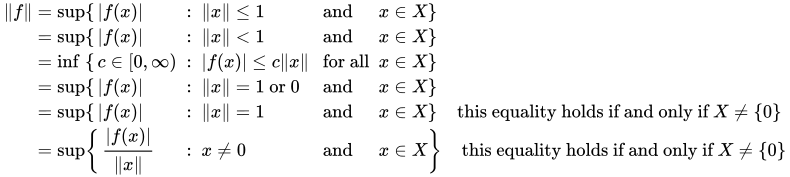
意味 をノルムを持つノルム 付きベクトル空間 とし 、 を その 連続双対空間 とする。 に属する連続 線型関数 の 双対ノルムは、 [1] で定義される以下の同値な式のいずれかによって 定義される非負の実数である。 ここで 、 と はそれぞれ 上限 と下限 を 表す 。定数 写像はベクトル空間の原点であり 、常にノルムを持つ。とする
と、 上の唯一の線型関数 は定数 写像であり、さらに、最後の2行の集合は両方とも空となり、その結果、それらの 上限は の正しい値ではなく に 等しくなる。 X {\displaystyle X} ‖ ⋅ ‖ {\displaystyle \|\cdot \|} X ∗ {\displaystyle X^{*}} f {\displaystyle f} X ∗ {\displaystyle X^{*}} ‖ f ‖ = sup { | f ( x ) | : ‖ x ‖ ≤ 1 and x ∈ X } = sup { | f ( x ) | : ‖ x ‖ < 1 and x ∈ X } = inf { c ∈ [ 0 , ∞ ) : | f ( x ) | ≤ c ‖ x ‖ for all x ∈ X } = sup { | f ( x ) | : ‖ x ‖ = 1 or 0 and x ∈ X } = sup { | f ( x ) | : ‖ x ‖ = 1 and x ∈ X } this equality holds if and only if X ≠ { 0 } = sup { | f ( x ) | ‖ x ‖ : x ≠ 0 and x ∈ X } this equality holds if and only if X ≠ { 0 } {\displaystyle {\begin{alignedat}{5}\|f\|&=\sup &&\{\,|f(x)|&&~:~\|x\|\leq 1~&&~{\text{ and }}~&&x\in X\}\\&=\sup &&\{\,|f(x)|&&~:~\|x\|<1~&&~{\text{ and }}~&&x\in X\}\\&=\inf &&\{\,c\in [0,\infty )&&~:~|f(x)|\leq c\|x\|~&&~{\text{ for all }}~&&x\in X\}\\&=\sup &&\{\,|f(x)|&&~:~\|x\|=1{\text{ or }}0~&&~{\text{ and }}~&&x\in X\}\\&=\sup &&\{\,|f(x)|&&~:~\|x\|=1~&&~{\text{ and }}~&&x\in X\}\;\;\;{\text{ this equality holds if and only if }}X\neq \{0\}\\&=\sup &&{\bigg \{}\,{\frac {|f(x)|}{\|x\|}}~&&~:~x\neq 0&&~{\text{ and }}~&&x\in X{\bigg \}}\;\;\;{\text{ this equality holds if and only if }}X\neq \{0\}\\\end{alignedat}}} sup {\displaystyle \sup } inf {\displaystyle \inf } 0 {\displaystyle 0} X ∗ {\displaystyle X^{*}} ‖ 0 ‖ = 0. {\displaystyle \|0\|=0.} X = { 0 } {\displaystyle X=\{0\}} X {\displaystyle X} 0 {\displaystyle 0} sup ∅ = − ∞ {\displaystyle \sup \varnothing =-\infty } 0. {\displaystyle 0.}
重要なのは、線型関数は一般には 閉単位球上で ノルムを達成することが保証されていないということ、 つまり、 となるような ノルムの ベクトルは存在しない可能性があるということ である(もしそのようなベクトルが存在し、 で あれば は必然的に単位ノルムを持つ )。 RC ジェームズは 1964 年に ジェームズの定理を証明した。この定理によれば、 バナッハ空間 が 反射的 であるためには、すべての有界線型関数が 閉単位球上でノルムを達成する必要がある。
特に、すべての非反射的バナッハ空間には、閉単位球上でノルムを達成しない何らかの有界線型関数が存在することになる。しかし、 ビショップ・フェルプスの定理は、 バナッハ空間 の単位球面でノルムを達成する有界線型関数の集合が、 連続双対空間 の ノルム 稠密な部分集合 であることを保証する。 [3] [4] f {\displaystyle f} ‖ f ‖ = sup { | f ( x ) | : ‖ x ‖ ≤ 1 , x ∈ X } {\displaystyle \|f\|=\sup\{|f(x)|:\|x\|\leq 1,x\in X\}} { x ∈ X : ‖ x ‖ ≤ 1 } , {\displaystyle \{x\in X:\|x\|\leq 1\},} u ∈ X {\displaystyle u\in X} ‖ u ‖ ≤ 1 {\displaystyle \|u\|\leq 1} ‖ f ‖ = | f u | {\displaystyle \|f\|=|fu|} f ≠ 0 , {\displaystyle f\neq 0,} u {\displaystyle u} ‖ u ‖ = 1 {\displaystyle \|u\|=1} X {\displaystyle X} f ∈ X ∗ {\displaystyle f\in X^{*}}
写像は 上の ノルム を定義する (以下の定理1と2を参照)。双対ノルムは、 ノルム付きベクトル空間間の各(有界)線型写像に対して定義される 作用素ノルム の特別な場合である。 ( または ) の 基底体は 完備 なので、 は バナッハ空間である。 によって誘導される 上の位相は、 上の 弱*位相 よりも強いことがわかる。 f ↦ ‖ f ‖ {\displaystyle f\mapsto \|f\|} X ∗ . {\displaystyle X^{*}.} X {\displaystyle X} R {\displaystyle \mathbb {R} } C {\displaystyle \mathbb {C} } X ∗ {\displaystyle X^{*}} X ∗ {\displaystyle X^{*}} ‖ ⋅ ‖ {\displaystyle \|\cdot \|} X ∗ . {\displaystyle X^{*}.}
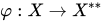
ノルム線型空間の二重双対 の 二 重双対 (または第二双対)は 、ノルムベクトル空間の双対である 。自然な写像が存在する 。実際、 の各 に対して、 を 定義する。 X ∗ ∗ {\displaystyle X^{**}} X {\displaystyle X} X ∗ {\displaystyle X^{*}} φ : X → X ∗ ∗ {\displaystyle \varphi :X\to X^{**}} w ∗ {\displaystyle w^{*}} X ∗ {\displaystyle X^{*}} φ ( v ) ( w ∗ ) := w ∗ ( v ) . {\displaystyle \varphi (v)(w^{*}):=w^{*}(v).}
写像は 線型 、 単射 、 距離保存で ある 。 [5] 特に、 が完備(すなわちバナッハ空間)であれば、 はの閉部分空間への等長写像となる 。 [6] φ {\displaystyle \varphi } X {\displaystyle X} φ {\displaystyle \varphi } X ∗ ∗ {\displaystyle X^{**}}
一般に、写像は 射影的ではありません。例えば、 が 実数直線上の有界関数からなる バナッハ空間で、上限ノルムを持つ場合、写像は 射影的ではありません( 空間 を参照)。 が 射影的である場合、 は 反射的バナッハ空間 と呼ばれます。 が射影 的である 場合、 は 反射的バナッハ空間 と呼ばれます。 φ {\displaystyle \varphi } X {\displaystyle X} L ∞ {\displaystyle L^{\infty }} φ {\displaystyle \varphi } L p {\displaystyle L^{p}} φ {\displaystyle \varphi } X {\displaystyle X} 1 < p < ∞ , {\displaystyle 1<p<\infty ,} L p {\displaystyle L^{p}}
例
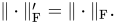
行列の双対ノルム その によって定義される フロベニウスノルムは 自己双対である。すなわち、その双対ノルムは ‖ A ‖ F = ∑ i = 1 m ∑ j = 1 n | a i j | 2 = trace ( A ∗ A ) = ∑ i = 1 min { m , n } σ i 2 {\displaystyle \|A\|_{\text{F}}={\sqrt {\sum _{i=1}^{m}\sum _{j=1}^{n}\left|a_{ij}\right|^{2}}}={\sqrt {\operatorname {trace} (A^{*}A)}}={\sqrt {\sum _{i=1}^{\min\{m,n\}}\sigma _{i}^{2}}}} ‖ ⋅ ‖ F ′ = ‖ ⋅ ‖ F . {\displaystyle \|\cdot \|'_{\text{F}}=\|\cdot \|_{\text{F}}.}
その スペクトルノルム は 、のときの 誘導ノルム の特殊なケース 行列の 最大 特異値 特異値を表す
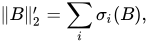
任意の行列に対して によって 定義される核ノルムをその双対ノルムとして持ちます [ 引用が必要 ] 。 p = 2 {\displaystyle p=2} ‖ A ‖ 2 = σ max ( A ) , {\displaystyle \|A\|_{2}=\sigma _{\max }(A),} ‖ B ‖ 2 ′ = ∑ i σ i ( B ) , {\displaystyle \|B\|'_{2}=\sum _{i}\sigma _{i}(B),} B {\displaystyle B} σ i ( B ) {\displaystyle \sigma _{i}(B)}
行列のSchatten ノルム が Schatten ノルムと双対である 場合 。 p , q ∈ [ 1 , ∞ ] {\displaystyle p,q\in [1,\infty ]} ℓ p {\displaystyle \ell ^{p}} ℓ q {\displaystyle \ell ^{q}}
有限次元空間 を のノルムとすると 、 関連 する 双対ノルム は次のように定義される。 ‖ ⋅ ‖ {\displaystyle \|\cdot \|} R n . {\displaystyle \mathbb {R} ^{n}.} ‖ ⋅ ‖ ∗ , {\displaystyle \|\cdot \|_{*},} ‖ z ‖ ∗ = sup { z ⊺ x : ‖ x ‖ ≤ 1 } . {\displaystyle \|z\|_{*}=\sup\{z^{\intercal }x:\|x\|\leq 1\}.}
(これはノルムであることが示せます。) 双対ノルムは、 の演算子 ノルム をのノルム 、 の絶対値を持つ 行列 として解釈すると解釈できます 。 z ⊺ , {\displaystyle z^{\intercal },} 1 × n {\displaystyle 1\times n} ‖ ⋅ ‖ {\displaystyle \|\cdot \|} R n {\displaystyle \mathbb {R} ^{n}} R {\displaystyle \mathbb {R} } ‖ z ‖ ∗ = sup { | z ⊺ x | : ‖ x ‖ ≤ 1 } . {\displaystyle \|z\|_{*}=\sup\{|z^{\intercal }x|:\|x\|\leq 1\}.}
双対ノルムの定義から、すべてに対して成り立つ不等式が得られます。 [ 7 ] [8] 双対ノルムの双対は元のノルムです。 すべてに対して成り立ちます (これは無限次元ベクトル空間では成立するとは限りません。) z ⊺ x = ‖ x ‖ ( z ⊺ x ‖ x ‖ ) ≤ ‖ x ‖ ‖ z ‖ ∗ {\displaystyle z^{\intercal }x=\|x\|\left(z^{\intercal }{\frac {x}{\|x\|}}\right)\leq \|x\|\|z\|_{*}} x {\displaystyle x} z . {\displaystyle z.} ‖ x ‖ ∗ ∗ = ‖ x ‖ {\displaystyle \|x\|_{**}=\|x\|} x . {\displaystyle x.}
ユークリッドノルム の双対は ユークリッドノルムである。 sup { z ⊺ x : ‖ x ‖ 2 ≤ 1 } = ‖ z ‖ 2 . {\displaystyle \sup\{z^{\intercal }x:\|x\|_{2}\leq 1\}=\|z\|_{2}.}
(これは コーシー・シュワルツの不等式 から導かれる。非ゼロの場合、 が最大となる の 値は である 。) z , {\displaystyle z,} x {\displaystyle x} z ⊺ x {\displaystyle z^{\intercal }x} ‖ x ‖ 2 ≤ 1 {\displaystyle \|x\|_{2}\leq 1} z ‖ z ‖ 2 . {\displaystyle {\tfrac {z}{\|z\|_{2}}}.}
-ノルムの双対は-ノルム です 。 また、-ノルムの双対は-ノルム です 。 ℓ ∞ {\displaystyle \ell ^{\infty }} ℓ 1 {\displaystyle \ell ^{1}} sup { z ⊺ x : ‖ x ‖ ∞ ≤ 1 } = ∑ i = 1 n | z i | = ‖ z ‖ 1 , {\displaystyle \sup\{z^{\intercal }x:\|x\|_{\infty }\leq 1\}=\sum _{i=1}^{n}|z_{i}|=\|z\|_{1},} ℓ 1 {\displaystyle \ell ^{1}} ℓ ∞ {\displaystyle \ell ^{\infty }}
より一般的には、 ヘルダーの不等式は、 -ノルム の双対が-ノルム であることを示しており 、ここで、は 次を満たす 。 ℓ p {\displaystyle \ell ^{p}} ℓ q {\displaystyle \ell ^{q}} q {\displaystyle q} 1 p + 1 q = 1 , {\displaystyle {\tfrac {1}{p}}+{\tfrac {1}{q}}=1,} q = p p − 1 . {\displaystyle q={\tfrac {p}{p-1}}.}
別の例として、 の - またはスペクトルノルムを考えてみましょう 。関連する双対ノルムは となり 、これは特異値の和となります。 ここで、 このノルムは ℓ 2 {\displaystyle \ell ^{2}} R m × n {\displaystyle \mathbb {R} ^{m\times n}} ‖ Z ‖ 2 ∗ = sup { t r ( Z ⊺ X ) : ‖ X ‖ 2 ≤ 1 } , {\displaystyle \|Z\|_{2*}=\sup\{\mathbf {tr} (Z^{\intercal }X):\|X\|_{2}\leq 1\},} ‖ Z ‖ 2 ∗ = σ 1 ( Z ) + ⋯ + σ r ( Z ) = t r ( Z ⊺ Z ) , {\displaystyle \|Z\|_{2*}=\sigma _{1}(Z)+\cdots +\sigma _{r}(Z)=\mathbf {tr} ({\sqrt {Z^{\intercal }Z}}),} r = r a n k Z . {\displaystyle r=\mathbf {rank} Z.} 核規範 [ 9]
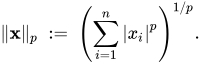
L p とℓ p スペース p の場合、 ベクトルの -ノルム( -ノルムとも呼ばれる) は p ∈ [ 1 , ∞ ] , {\displaystyle p\in [1,\infty ],} ℓ p {\displaystyle \ell _{p}} x = ( x n ) n {\displaystyle \mathbf {x} =(x_{n})_{n}} ‖ x ‖ p := ( ∑ i = 1 n | x i | p ) 1 / p . {\displaystyle \|\mathbf {x} \|_{p}~:=~\left(\sum _{i=1}^{n}\left|x_{i}\right|^{p}\right)^{1/p}.}
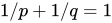
を満たす 場合 、ノルム と ノルムは互いに双対であり、ノルム と ノルムについても同様である。ただし、 は何らかの 測度空間 である。特に、 ユークリッドノルム は自己双対である。
なぜなら、 の場合 、双対ノルムは 正定値 であるからである。 p , q ∈ [ 1 , ∞ ] {\displaystyle p,q\in [1,\infty ]} 1 / p + 1 / q = 1 {\displaystyle 1/p+1/q=1} ℓ p {\displaystyle \ell ^{p}} ℓ q {\displaystyle \ell ^{q}} L p {\displaystyle L^{p}} L q {\displaystyle L^{q}} ( X , Σ , μ ) , {\displaystyle (X,\Sigma ,\mu ),} p = q = 2. {\displaystyle p=q=2.} x T Q x {\displaystyle {\sqrt {x^{\mathrm {T} }Qx}}} y T Q − 1 y {\displaystyle {\sqrt {y^{\mathrm {T} }Q^{-1}y}}} Q {\displaystyle Q}
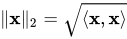
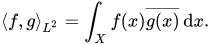
ノルム は 、すべてのベクトルに対して 、正準 内積 によって誘導される。この内積は 、分極恒等式 を用いてノルムで表現できる 。 これに基づいて、 p = 2 , {\displaystyle p=2,} ‖ ⋅ ‖ 2 {\displaystyle \|\,\cdot \,\|_{2}} ⟨ ⋅ , ⋅ ⟩ , {\displaystyle \langle \,\cdot ,\,\cdot \rangle ,} ‖ x ‖ 2 = ⟨ x , x ⟩ {\displaystyle \|\mathbf {x} \|_{2}={\sqrt {\langle \mathbf {x} ,\mathbf {x} \rangle }}} x . {\displaystyle \mathbf {x} .} ℓ 2 , {\displaystyle \ell ^{2},} ユークリッド内積は で定義されますが 二乗可積分関数 からなる 測度空間 に関連付けられた 空間 について 、この内積は となります。 と の連続双対空間のノルムは 分極恒等式 を満たすため 、 ヒルベルト空間 でもあります 。 ⟨ ( x n ) n , ( y n ) n ⟩ ℓ 2 = ∑ n x n y n ¯ {\displaystyle \langle \left(x_{n}\right)_{n},\left(y_{n}\right)_{n}\rangle _{\ell ^{2}}~=~\sum _{n}x_{n}{\overline {y_{n}}}} L 2 ( X , μ ) {\displaystyle L^{2}(X,\mu )} ( X , Σ , μ ) , {\displaystyle (X,\Sigma ,\mu ),} ⟨ f , g ⟩ L 2 = ∫ X f ( x ) g ( x ) ¯ d x . {\displaystyle \langle f,g\rangle _{L^{2}}=\int _{X}f(x){\overline {g(x)}}\,\mathrm {d} x.} ℓ 2 {\displaystyle \ell ^{2}} ℓ 2 {\displaystyle \ell ^{2}}
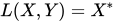
プロパティ ノルムベクトル空間が与えられ 、 [10] をから へのすべての 有界線型写像 (または 演算子 ) の集合とすると 、 に 標準ノルムを与えることができます。 X {\displaystyle X} Y , {\displaystyle Y,} L ( X , Y ) {\displaystyle L(X,Y)} X {\displaystyle X} Y . {\displaystyle Y.} L ( X , Y ) {\displaystyle L(X,Y)}
定理1 — と を ノルム空間とする。各連続線型作用素に スカラーを代入すると 、ノルム空間が定義され 、ノルム空間が定義される。さらに、がバナッハ空間であるならば、 バナッハ 空間も [11] である。 X {\displaystyle X} Y {\displaystyle Y} f ∈ L ( X , Y ) {\displaystyle f\in L(X,Y)} ‖ f ‖ = sup { ‖ f ( x ) ‖ : x ∈ X , ‖ x ‖ ≤ 1 } {\displaystyle \|f\|=\sup\{\|f(x)\|:x\in X,\|x\|\leq 1\}} ‖ ⋅ ‖ : L ( X , Y ) → R {\displaystyle \|\cdot \|~:~L(X,Y)\to \mathbb {R} } L ( X , Y ) {\displaystyle L(X,Y)} L ( X , Y ) {\displaystyle L(X,Y)} Y {\displaystyle Y} L ( X , Y ) . {\displaystyle L(X,Y).}
証拠
ノルム空間の部分集合が有界となるのは、それが 単位球面 の倍数に含まれる 場合のみである 。したがって、 任意の がスカラーである とき 、 ‖ f ‖ < ∞ {\displaystyle \|f\|<\infty } f ∈ L ( X , Y ) {\displaystyle f\in L(X,Y)} α {\displaystyle \alpha } ( α f ) ( x ) = α ⋅ f x {\displaystyle (\alpha f)(x)=\alpha \cdot fx} ‖ α f ‖ = | α | ‖ f ‖ . {\displaystyle \|\alpha f\|=|\alpha |\|f\|.}
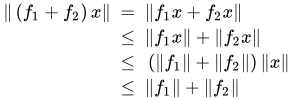
の三角 不等式 は 、 Y {\displaystyle Y} ‖ ( f 1 + f 2 ) x ‖ = ‖ f 1 x + f 2 x ‖ ≤ ‖ f 1 x ‖ + ‖ f 2 x ‖ ≤ ( ‖ f 1 ‖ + ‖ f 2 ‖ ) ‖ x ‖ ≤ ‖ f 1 ‖ + ‖ f 2 ‖ {\displaystyle {\begin{aligned}\|\left(f_{1}+f_{2}\right)x\|~&=~\|f_{1}x+f_{2}x\|\\&\leq ~\|f_{1}x\|+\|f_{2}x\|\\&\leq ~\left(\|f_{1}\|+\|f_{2}\|\right)\|x\|\\&\leq ~\|f_{1}\|+\|f_{2}\|\end{aligned}}}
を満たす任意の 値に対して、 この事実と定義を 合わせると三角不等式が成り立ちます。 x ∈ X {\displaystyle x\in X} ‖ x ‖ ≤ 1. {\displaystyle \|x\|\leq 1.} ‖ ⋅ ‖ : L ( X , Y ) → R {\displaystyle \|\cdot \|~:~L(X,Y)\to \mathbb {R} } ‖ f + g ‖ ≤ ‖ f ‖ + ‖ g ‖ . {\displaystyle \|f+g\|\leq \|f\|+\|g\|.}
は非負実数の非空集合な ので、 は非負実数である。ならば、 ある に対してとなり 、したがって と なる。 これは が ノルム空間であることを示す。 [12] { | f ( x ) | : x ∈ X , ‖ x ‖ ≤ 1 } {\displaystyle \{|f(x)|:x\in X,\|x\|\leq 1\}} ‖ f ‖ = sup { | f ( x ) | : x ∈ X , ‖ x ‖ ≤ 1 } {\displaystyle \|f\|=\sup \left\{|f(x)|:x\in X,\|x\|\leq 1\right\}} f ≠ 0 {\displaystyle f\neq 0} f x 0 ≠ 0 {\displaystyle fx_{0}\neq 0} x 0 ∈ X , {\displaystyle x_{0}\in X,} ‖ f x 0 ‖ > 0 {\displaystyle \left\|fx_{0}\right\|>0} ‖ f ‖ > 0. {\displaystyle \|f\|>0.} ( L ( X , Y ) , ‖ ⋅ ‖ ) {\displaystyle \left(L(X,Y),\|\cdot \|\right)}
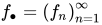
が完全であると仮定し、が完全である ことを示します 。 がコーシー列 で あるとすると、 定義 により、 この事実と関係 Y {\displaystyle Y} ( L ( X , Y ) , ‖ ⋅ ‖ ) {\displaystyle (L(X,Y),\|\cdot \|)} f ∙ = ( f n ) n = 1 ∞ {\displaystyle f_{\bullet }=\left(f_{n}\right)_{n=1}^{\infty }} L ( X , Y ) , {\displaystyle L(X,Y),} ‖ f n − f m ‖ → 0 {\displaystyle \left\|f_{n}-f_{m}\right\|\to 0} n , m → ∞ . {\displaystyle n,m\to \infty .} ‖ f n x − f m x ‖ = ‖ ( f n − f m ) x ‖ ≤ ‖ f n − f m ‖ ‖ x ‖ {\displaystyle \left\|f_{n}x-f_{m}x\right\|=\left\|\left(f_{n}-f_{m}\right)x\right\|\leq \left\|f_{n}-f_{m}\right\|\|x\|}
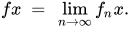
は、任意の に対して が の Cauchy 列である ことを意味します。したがって 、任意の に対して 極限 は に存在する ので、この (必然的に一意の) 極限を で表すことにします 。 ( f n x ) n = 1 ∞ {\displaystyle \left(f_{n}x\right)_{n=1}^{\infty }} Y {\displaystyle Y} x ∈ X . {\displaystyle x\in X.} x ∈ X , {\displaystyle x\in X,} lim n → ∞ f n x {\displaystyle \lim _{n\to \infty }f_{n}x} Y {\displaystyle Y} f x , {\displaystyle fx,} f x = lim n → ∞ f n x . {\displaystyle fx~=~\lim _{n\to \infty }f_{n}x.}
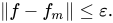
が線形であることが示せる 。 ならば 、 十分に大きい整数 n と m に対して となる。したがって、 十分 に大きい整数 n と m に対して となる。 これは 、 のノルム位相においてとなる ことを示している。これは 、[13] の完全性を確立する。 f : X → Y {\displaystyle f:X\to Y} ε > 0 {\displaystyle \varepsilon >0} ‖ f n − f m ‖ ‖ x ‖ ≤ ε ‖ x ‖ {\displaystyle \left\|f_{n}-f_{m}\right\|\|x\|~\leq ~\varepsilon \|x\|} ‖ f x − f m x ‖ ≤ ε ‖ x ‖ {\displaystyle \left\|fx-f_{m}x\right\|~\leq ~\varepsilon \|x\|} m . {\displaystyle m.} ‖ f x ‖ ≤ ( ‖ f m ‖ + ε ) ‖ x ‖ , {\displaystyle \|fx\|\leq \left(\left\|f_{m}\right\|+\varepsilon \right)\|x\|,} f ∈ L ( X , Y ) {\displaystyle f\in L(X,Y)} ‖ f − f m ‖ ≤ ε . {\displaystyle \left\|f-f_{m}\right\|\leq \varepsilon .} f m → f {\displaystyle f_{m}\to f} L ( X , Y ) . {\displaystyle L(X,Y).} L ( X , Y ) . {\displaystyle L(X,Y).}
がスカラー場 (つまり または ) の とき、 は の 双対空間 である。 Y {\displaystyle Y} Y = C {\displaystyle Y=\mathbb {C} } Y = R {\displaystyle Y=\mathbb {R} } L ( X , Y ) {\displaystyle L(X,Y)} X ∗ {\displaystyle X^{*}} X . {\displaystyle X.}
定理2 — をノルム空間とし、 定義 により が スカラーである 任意
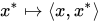
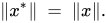
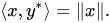
の に対して、 X {\displaystyle X} x ∗ ∈ X ∗ {\displaystyle x^{*}\in X^{*}} ‖ x ∗ ‖ := sup { | ⟨ x , x ∗ ⟩ | : x ∈ X with ‖ x ‖ ≤ 1 } {\displaystyle \left\|x^{*}\right\|~:=~\sup \left\{|\langle x,x^{*}\rangle |~:~x\in X{\text{ with }}\|x\|\leq 1\right\}} ⟨ x , x ∗ ⟩ := x ∗ ( x ) {\displaystyle \langle x,x^{*}\rangle ~:=~x^{*}(x)}
‖ ⋅ ‖ : X ∗ → R {\displaystyle \|\,\cdot \,\|:X^{*}\to \mathbb {R} } バナッハ空間 を作る 規範 である。 [14] X ∗ {\displaystyle X^{*}} が閉単位球体である とき 、任意 のに対して、したがって、は ノルムを 持つ 有界 線形関数である。 B ∗ {\displaystyle B^{*}} X ∗ {\displaystyle X^{*}} x ∈ X , {\displaystyle x\in X,} ‖ x ‖ = sup { | ⟨ x , x ∗ ⟩ | : x ∗ ∈ B ∗ } = sup { | x ∗ ( x ) | : ‖ x ∗ ‖ ≤ 1 with x ∗ ∈ X ∗ } . {\displaystyle {\begin{alignedat}{4}\|x\|~&=~\sup \left\{|\langle x,x^{*}\rangle |~:~x^{*}\in B^{*}\right\}\\&=~\sup \left\{\left|x^{*}(x)\right|~:~\left\|x^{*}\right\|\leq 1{\text{ with }}x^{*}\in X^{*}\right\}.\\\end{alignedat}}} x ∗ ↦ ⟨ x , x ∗ ⟩ {\displaystyle x^{*}\mapsto \langle x,x^{*}\rangle } X ∗ {\displaystyle X^{*}} ‖ x ∗ ‖ = ‖ x ‖ . {\displaystyle \|x^{*}\|~=~\|x\|.} B ∗ {\displaystyle B^{*}} は弱*コンパクトです。 いつものように、 は のノルムによって誘導される 標準 計量 を表し、点から部分集合までの 距離を で表す 。 がノルム空間上の有界線形関数である 場合、任意 のベクトル に対して、 は の 核を 表す。 d ( x , y ) := ‖ x − y ‖ {\displaystyle d(x,y):=\|x-y\|} X , {\displaystyle X,} x {\displaystyle x} S ⊆ X {\displaystyle S\subseteq X} d ( x , S ) := inf s ∈ S d ( x , s ) = inf s ∈ S ‖ x − s ‖ . {\displaystyle d(x,S)~:=~\inf _{s\in S}d(x,s)~=~\inf _{s\in S}\|x-s\|.} f {\displaystyle f} X , {\displaystyle X,} x ∈ X , {\displaystyle x\in X,} | f ( x ) | = ‖ f ‖ d ( x , ker f ) , {\displaystyle |f(x)|=\|f\|\,d(x,\ker f),} ker f = { k ∈ X : f ( k ) = 0 } {\displaystyle \ker f=\{k\in X:f(k)=0\}} f . {\displaystyle f.}
参照
注記 ^ ルディン 1991, p. 87 ^ ビショップ, エレット ; フェルプス, RR (1961). 「すべてのバナッハ空間が部分反射的であることの証明」 アメリカ数学会報 . 67 : 97–98 . doi : 10.1090/s0002-9904-1961-10514-4 . MR 0123174. ^ ロモノソフ、ビクター (2000). 「複素空間におけるビショップ・フェルプス定理の反例」. イスラエル数学ジャーナル . 115 : 25–28 . doi :10.1007/bf02810578. MR 1749671. S2CID 53646715. ^ Rudin 1991、セクション4.5、p.95 ^ ルディン 1991, p. 95 ^ ボイド & ヴァンデンバーグ 2004、p. 637 ^ この不等式は、次の意味で厳密です。任意の に対して、 不等式が等式とともに成立する が 存在します。(同様に、任意の に対して、等式を与える が 存在します 。) x {\displaystyle x} z {\displaystyle z} z {\displaystyle z} x {\displaystyle x} ^ ボイド & ヴァンデンバーグ 2004、p. 637 ^ それぞれは ベクトル空間 であり 、関数の加算とスカラー乗算の通常の定義に従います。これは のベクトル空間構造にのみ依存し 、 には依存しません 。 L ( X , Y ) {\displaystyle L(X,Y)} Y {\displaystyle Y} X {\displaystyle X} ^ ルディン 1991, 92ページ ^ ルディン 1991, 93ページ ^ ルディン 1991, 93ページ ^ アリプランティスとボーダー 2006、p. 230 ^ Rudin 1991, 定理3.3 系、p. 59 ^ Rudin 1991, 定理3.15 バナッハ–アラオグル定理 アルゴリズム、p. 68 ^ ルディン 1991, 94ページ
参考文献 アリプランティス, チャラランボス D.; ボーダー, キム C. (2006). 『無限次元解析:ヒッチハイク・ガイド』 (第3版). シュプリンガー. ISBN 9783540326960 。 ボイド、スティーブン 、ヴァンデンベルゲ、リーヴェン (2004). 凸最適化 . ケンブリッジ大学出版局 . ISBN 9780521833783 。 ディーステル、ジョー (1984). バナッハ空間における数列と級数 . ニューヨーク: シュプリンガー・フェアラーク. ISBN 0-387-90859-5 . OCLC 9556781. 橋本和夫;中村元;おはる、しんのすけ(1986-01-01)。 「リースの補題と正規空間における直交性」 (PDF) 。 広島数学雑誌 。 16 (2)。広島大学 - 数学科。 土井 :10.32917/hmj/1206130429。 ISSN 0018-2079。 コルモゴロフ, AN ; フォミン, SV (1957). 『関数理論と関数解析の要素』第1巻:距離空間とノルム空間 . ロチェスター: グレイロック・プレス. ナリシ, ローレンス; ベッケンシュタイン, エドワード (2011). 『位相ベクトル空間 』 純粋数学と応用数学(第2版) ボカラトン, フロリダ州: CRC Press. ISBN 978-1584888666 . OCLC 144216834. ルディン、ウォルター (1991). 関数解析. 国際純粋・応用数学叢書. 第8巻(第2版). ニューヨーク: McGraw-Hill Science/Engineering/Math . ISBN 978-0-07-054236-5 . OCLC 21163277。 Schaefer, Helmut H. ; Wolff, Manfred P. (1999). Topological Vector Spaces . GTM . Vol. 8 (Second ed.). New York, NY: Springer New York Imprint Springer. ISBN 978-1-4612-7155-0 . OCLC 840278135。 トレヴ、フランソワ (2006) [1967]。 トポロジカル ベクトル空間、ディストリビューション、およびカーネル 。ニューヨーク州ミネオラ:ドーバー出版。 ISBN 978-0-486-45352-1 . OCLC 853623322。
外部リンク Lieven Vandenbergeによる近位マッピングに関する注釈
バナッハ空間の種類 バナッハ空間は以下のとおりです。 関数空間トポロジー 線形演算子 作用素理論 定理 分析 セットの種類 部分集合 / 集合演算 例 アプリケーション
基本概念 トポロジー 主な結果 地図 サブセット その他の概念
スペース
定理 オペレーター 代数 未解決の問題 アプリケーション 高度なトピック



















![{\displaystyle p,q\in [1,\infty ]}](https://wikimedia.org/api/rest_v1/media/math/render/svg/68ee142bd759e6d2fa264a449ed5d40d60edede7)


















![{\displaystyle p\in [1,\infty ],}](https://wikimedia.org/api/rest_v1/media/math/render/svg/baad7248219218c8509ef36f99da556e804fa631)