Mean of a function
In calculus, and especially multivariable calculus, the mean of a function is loosely defined as the ”average" value of the function over its domain.
One-dimensional
In a one-dimensional domain, the mean of a function f(x) over the interval (a,b) is defined by:[1]
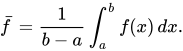
Recall that a defining property of the average value of finitely many numbers is that . In other words, is the constant value which whenadded times equals the result of adding the terms . By analogy, a defining property of the average value of a function over the interval is that





![{\displaystyle [a,b]}](https://wikimedia.org/api/rest_v1/media/math/render/svg/9c4b788fc5c637e26ee98b45f89a5c08c85f7935)
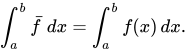
In other words, is the constant value which when integrated over equals the result of integrating over . But the integral of a constant is just


See also the first mean value theorem for integration, which guarantees that if is continuous then there exists a point such that


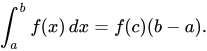
The point is called the mean value of on . So we write and rearrange the preceding equation to get the above definition.


Multi-dimensional
In several variables, the mean over a relatively compact domain U in a Euclidean space is defined by

where and are, respectively, the domain volume and volume element (or generalizations thereof, e.g., volume form).


Non-arithmetic
The above generalizes the arithmetic mean to functions. On the other hand, it is also possible to generalize the geometric mean to functions by:
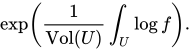
More generally, in measure theory and probability theory, either sort of mean plays an important role. In this context, Jensen's inequality places sharp estimates on the relationship between these two different notions of the mean of a function.
There is also a harmonic average of functions and a quadratic average (or root mean square) of functions.
See also
References
