Cardamine maxima
Jump to content


| Cardamine maxima | |
|---|---|
 | |
Scientific classification  | |
| Kingdom: | Plantae |
| Clade: | Tracheophytes |
| Clade: | Angiosperms |
| Clade: | Eudicots |
| Clade: | Rosids |
| Order: | Brassicales |
| Family: | Brassicaceae |
| Genus: | Cardamine |
| Species: | C. maxima |
| Binomial name | |
| Cardamine maxima | |
| Synonyms[3] | |
Homotypic Synonyms
Heterotypic Synonyms
| |

Cardamine maxima is a species of flowering plant in the mustard family Brassicaceae.[3]
Taxonomy
[edit]Cardamine maxima was first described as Dentaria maxima by the English botanist Thomas Nuttall in 1818.[4][5] The American botanist Alphonso Wood placed Dentaria maxima Nutt. in genus Cardamine in 1870.[2][6] The name Cardamine maxima (Nutt.) Alph.Wood is widely used today.[1][3][7][8][9][10]
Cardamine maxima is a member of the Cardamine concatenata alliance, a monophyletic group of eastern North American species that includes Cardamine angustata, Cardamine concatenata, Cardamine diphylla, Cardamine dissecta, Cardamine incisa, and Cardamine maxima.[11] All members of the alliance were previously placed in genus Dentaria Tourn. ex L., which is now considered to be a synonym for Cardamine L.[12]
Distribution and habitat
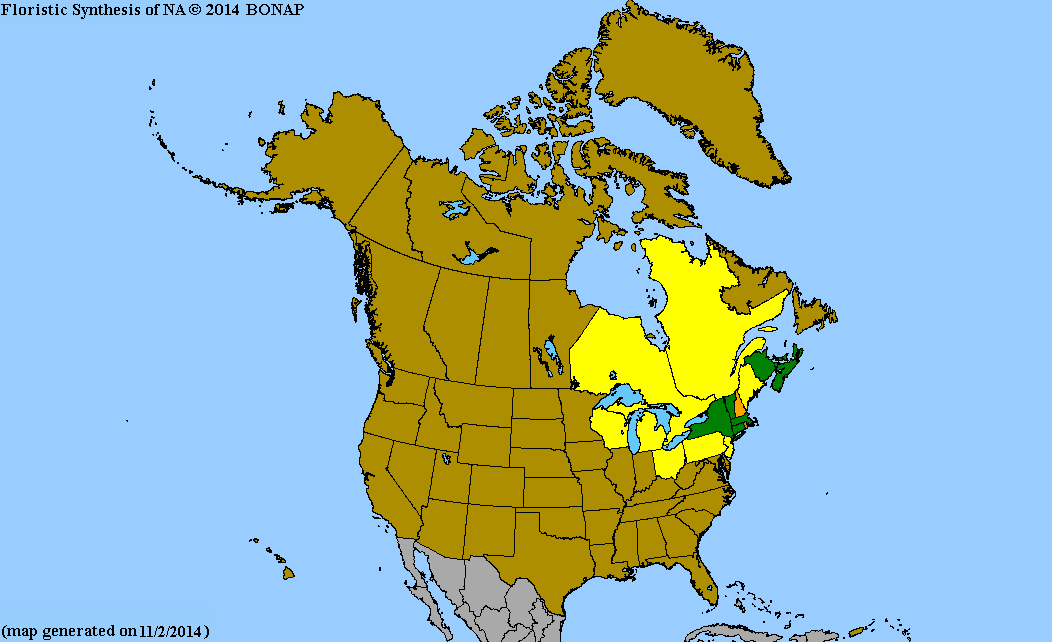
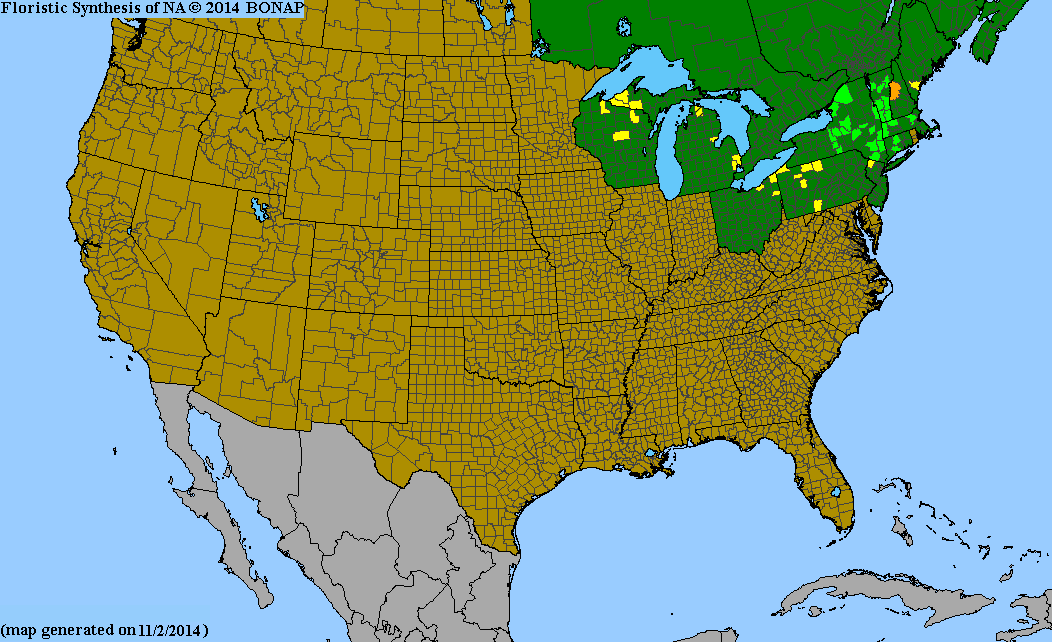
[edit]Cardamine maxima is native to eastern North America. Its range extends north to New Brunswick and Québec, south to Pennsylvania and New Jersey, and west to Ontario and Wisconsin.[11] It is known to occur in the following provinces and states:[3][13]
- Canada: New Brunswick, Ontario, Québec
- United States: Connecticut, Maine, Massachusetts, Michigan, New Jersey, New York, Ohio, Pennsylvania, Vermont, Wisconsin
In the United States, its distribution is centered in New York and western New England (Connecticut, Massachusetts, Vermont).[14]
Conservation
[edit]The global conservation status of Cardamine maxima is secure (G5).[1] However, outside of New York (its center of distribution) it is uncommon (S3) at best.
References
[edit]- ^ a b c "Cardamine maxima". NatureServe Explorer. NatureServe. Retrieved 10 June 2023.
- ^ a b "Cardamine maxima (Nutt.) Alph.Wood". International Plant Names Index (IPNI). Royal Botanic Gardens, Kew; Harvard University Herbaria & Libraries; Australian National Botanic Gardens. Retrieved 7 June 2023.
- ^ a b c d "Cardamine maxima (Nutt.) Alph.Wood". Plants of the World Online. Royal Botanic Gardens, Kew. Retrieved 7 June 2023.
- ^ "Dentaria maxima Nutt.". International Plant Names Index (IPNI). Royal Botanic Gardens, Kew; Harvard University Herbaria & Libraries; Australian National Botanic Gardens. Retrieved 7 June 2023.
- ^ Nuttall, Thomas (1818). The genera of North American plants, and a catalogue of the species, to the year 1817: Volume II. Philadelphia. p. 66. Retrieved 12 June 2023.
- ^ Wood (1889), Part IV, pp. 37–38.
- ^ Al-Shehbaz, Ihsan A.; Marhold, Karol; Lihová, Judita (2010). "Cardamine maxima". In Flora of North America Editorial Committee (ed.). Flora of North America North of Mexico (FNA). Vol. 7. New York and Oxford: Oxford University Press. Retrieved 7 June 2023 – via eFloras.org, Missouri Botanical Garden, St. Louis, MO & Harvard University Herbaria, Cambridge, MA.
- ^ Weakley & Southeastern Flora Team (2022).
- ^ Haines (2011).
- ^ Gilman (2015).
- ^ a b Sweeney, Patrick W.; Price, Robert A. (2001). "A multivariate morphological analysis of the Cardamine concatenata alliance (Brassicaceae)". Brittonia. 53 (1): 82–95. Bibcode:2001Britt..53...82S. doi:10.1007/BF02805400. Retrieved 8 June 2023.
- ^ "Dentaria Tourn. ex L.". Plants of the World Online. Royal Botanic Gardens, Kew. Retrieved 8 June 2023.
- ^ Kartesz, John T. (2014). "Cardamine maxima". State-level distribution map from the North American Plant Atlas (NAPA). Biota of North America Program (BONAP). Retrieved 10 June 2023.
- ^ Kartesz, John T. (2014). "Cardamine maxima". County-level distribution map from the North American Plant Atlas (NAPA). Biota of North America Program (BONAP). Retrieved 10 June 2023.
Bibliography
[edit]- Gilman, Arthur V. (2015). New Flora of Vermont. Memoirs of The New York Botanical Garden, Volume 110. Bronx, New York, USA: The New York Botanical Garden Press. ISBN 978-0-89327-516-7.
- Haines, Arthur (2011). New England Wild Flower Society's Flora Novae Angliae: A Manual for the Identification of Native and Naturalized Higher Vascular Plants of New England. Illustrated by Elizabeth Farnsworth and Gordon Morrison. Yale University Press. ISBN 978-0-300-17154-9.
- Weakley, Alan S.; Southeastern Flora Team (2022). "Flora of the southeastern United States". University of North Carolina Herbarium, North Carolina Botanical Garden.
- Wood, Alphonso (1889) [First edition 1870]. Willis, Oliver R. (ed.). The New American Botanist and Florist (Revised 8th ed.). New York and Chicago: A. S. Barnes & Company. Retrieved 9 June 2023.
External links
[edit]- "Cardamine maxima — large toothwort". Go Botany. Native Plant Trust. Retrieved 10 June 2023.
- "Cardamine maxima (Nuttall) Alph.Wood". Flora of the Southeastern United States (2023 Edition). Retrieved 10 June 2023.
 | This Brassicaceae article is a stub. You can help Wikipedia by expanding it. |

| Cardamine maxima | |
|---|---|
 | |
Scientific classification  | |
| Kingdom: | Plantae |
| Clade: | Tracheophytes |
| Clade: | Angiosperms |
| Clade: | Eudicots |
| Clade: | Rosids |
| Order: | Brassicales |
| Family: | Brassicaceae |
| Genus: | Cardamine |
| Species: | C. maxima |
| Binomial name | |
| Cardamine maxima | |
| Synonyms[3] | |
Homotypic Synonyms
Heterotypic Synonyms
| |


Cardamine maxima is a species of flowering plant in the mustard family Brassicaceae.[3]
Taxonomy
Cardamine maxima was first described as Dentaria maxima by the English botanist Thomas Nuttall in 1818.[4][5] The American botanist Alphonso Wood placed Dentaria maxima Nutt. in genus Cardamine in 1870.[2][6] The name Cardamine maxima (Nutt.) Alph.Wood is widely used today.[1][3][7][8][9][10]
Cardamine maxima is a member of the Cardamine concatenata alliance, a monophyletic group of eastern North American species that includes Cardamine angustata, Cardamine concatenata, Cardamine diphylla, Cardamine dissecta, Cardamine incisa, and Cardamine maxima.[11] All members of the alliance were previously placed in genus Dentaria Tourn. ex L., which is now considered to be a synonym for Cardamine L.[12]
Distribution and habitat
Cardamine maxima is native to eastern North America. Its range extends north to New Brunswick and Québec, south to Pennsylvania and New Jersey, and west to Ontario and Wisconsin.[11] It is known to occur in the following provinces and states:[3][13]
- Canada: New Brunswick, Ontario, Québec
- United States: Connecticut, Maine, Massachusetts, Michigan, New Jersey, New York, Ohio, Pennsylvania, Vermont, Wisconsin
In the United States, its distribution is centered in New York and western New England (Connecticut, Massachusetts, Vermont).[14]
Conservation
The global conservation status of Cardamine maxima is secure (G5).[1] However, outside of New York (its center of distribution) it is uncommon (S3) at best.
References
- ^ a b c "Cardamine maxima". NatureServe Explorer. NatureServe. Retrieved 10 June 2023.
- ^ a b "Cardamine maxima (Nutt.) Alph.Wood". International Plant Names Index (IPNI). Royal Botanic Gardens, Kew; Harvard University Herbaria & Libraries; Australian National Botanic Gardens. Retrieved 7 June 2023.
- ^ a b c d "Cardamine maxima (Nutt.) Alph.Wood". Plants of the World Online. Royal Botanic Gardens, Kew. Retrieved 7 June 2023.
- ^ "Dentaria maxima Nutt.". International Plant Names Index (IPNI). Royal Botanic Gardens, Kew; Harvard University Herbaria & Libraries; Australian National Botanic Gardens. Retrieved 7 June 2023.
- ^ Nuttall, Thomas (1818). The genera of North American plants, and a catalogue of the species, to the year 1817: Volume II. Philadelphia. p. 66. Retrieved 12 June 2023.
- ^ Wood (1889), Part IV, pp. 37–38.
- ^ Al-Shehbaz, Ihsan A.; Marhold, Karol; Lihová, Judita (2010). "Cardamine maxima". In Flora of North America Editorial Committee (ed.). Flora of North America North of Mexico (FNA). Vol. 7. New York and Oxford: Oxford University Press. Retrieved 7 June 2023 – via eFloras.org, Missouri Botanical Garden, St. Louis, MO & Harvard University Herbaria, Cambridge, MA.
- ^ Weakley & Southeastern Flora Team (2022).
- ^ Haines (2011).
- ^ Gilman (2015).
- ^ a b Sweeney, Patrick W.; Price, Robert A. (2001). "A multivariate morphological analysis of the Cardamine concatenata alliance (Brassicaceae)". Brittonia. 53 (1): 82–95. Bibcode:2001Britt..53...82S. doi:10.1007/BF02805400. Retrieved 8 June 2023.
- ^ "Dentaria Tourn. ex L.". Plants of the World Online. Royal Botanic Gardens, Kew. Retrieved 8 June 2023.
- ^ Kartesz, John T. (2014). "Cardamine maxima". State-level distribution map from the North American Plant Atlas (NAPA). Biota of North America Program (BONAP). Retrieved 10 June 2023.
- ^ Kartesz, John T. (2014). "Cardamine maxima". County-level distribution map from the North American Plant Atlas (NAPA). Biota of North America Program (BONAP). Retrieved 10 June 2023.
Bibliography
- Gilman, Arthur V. (2015). New Flora of Vermont. Memoirs of The New York Botanical Garden, Volume 110. Bronx, New York, USA: The New York Botanical Garden Press. ISBN 978-0-89327-516-7.
- Haines, Arthur (2011). New England Wild Flower Society's Flora Novae Angliae: A Manual for the Identification of Native and Naturalized Higher Vascular Plants of New England. Illustrated by Elizabeth Farnsworth and Gordon Morrison. Yale University Press. ISBN 978-0-300-17154-9.
- Weakley, Alan S.; Southeastern Flora Team (2022). "Flora of the southeastern United States". University of North Carolina Herbarium, North Carolina Botanical Garden.
- Wood, Alphonso (1889) [First edition 1870]. Willis, Oliver R. (ed.). The New American Botanist and Florist (Revised 8th ed.). New York and Chicago: A. S. Barnes & Company. Retrieved 9 June 2023.
External links
- "Cardamine maxima — large toothwort". Go Botany. Native Plant Trust. Retrieved 10 June 2023.
- "Cardamine maxima (Nuttall) Alph.Wood". Flora of the Southeastern United States (2023 Edition). Retrieved 10 June 2023.
| This Brassicaceae article is a stub. You can help Wikipedia by expanding it. |