Covering code
Jump to content


In coding theory, a covering code is a set of elements (called codewords) in a space, with the property that every element of the space is within a fixed distance of some codeword.
Definition
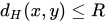
[edit]Let , , be integers. A code over an alphabet Q of size |Q| = q is calledq-ary R-covering code of length nif for every word there is a codeword such that the Hamming distance . In other words, the spheres (or balls or rook-domains) of radius Rwith respect to the Hamming metric around the codewords of C have to exhaust the finite metric space . The covering radius of a code C is the smallest R such that C is R-covering. Every perfect code is a covering code of minimal size.



Example
[edit]C = {0134,0223,1402,1431,1444,2123,2234,3002,3310,4010,4341} is a 5-ary 2-covering code of length 4.[1]
Covering problem
[edit]The determination of the minimal size of a q-ary R-covering code of length n is a very hard problem. In many cases, only upper and lower bounds are known with a large gap between them. Every construction of a covering code gives an upper bound on Kq(n, R). Lower bounds include the sphere covering bound and Rodemich's bounds and .[2]The covering problem is closely related to the packing problem in , i.e. the determination of the maximal size of a q-ary e-error correcting code of length n.



Football pools problem
[edit]A particular case is the football pools problem, based on football pool betting, where the aim is to come up with a betting system over n football matches that, regardless of the outcome, has at most R 'misses'. Thus, for n matches with at most one 'miss', a ternary covering, K3(n,1), is sought.
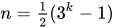
If then 3n-k are needed, so for n = 4, k = 2, 9 are needed; for n = 13, k = 3, 59049 are needed.[3] The best bounds known as of 2011[4] are
| n | 1 | 2 | 3 | 4 | 5 | 6 | 7 | 8 | 9 | 10 | 11 | 12 | 13 | 14 |
|---|---|---|---|---|---|---|---|---|---|---|---|---|---|---|
| K3(n,1) | 1 | 3 | 5 | 9 | 27 | 71-73 | 156-186 | 402-486 | 1060-1269 | 2854-3645 | 7832-9477 | 21531-27702 | 59049 | 166610-177147 |
| K3(n,2) | 1 | 3 | 3 | 8 | 15-17 | 26-34 | 54-81 | 130-219 | 323-555 | 729 | 1919-2187 | 5062-6561 | 12204-19683 | |
| K3(n,3) | 1 | 3 | 3 | 6 | 11-12 | 14-27 | 27-54 | 57-105 | 117-243 | 282-657 | 612-1215 | 1553-2187 |
Applications
[edit]The standard work[5] on covering codes lists the following applications.
- Compression with distortion
- Data compression
- Decoding errors and erasures
- Broadcasting in interconnection networks
- Football pools[6]
- Write-once memories
- Berlekamp-Gale game
- Speech coding
- Cellular telecommunications
- Subset sums and Cayley graphs
References
[edit]- ^ P.R.J. Östergård (1991). "Upper bounds for q-ary covering codes". IEEE Transactions on Information Theory. 37: 660–664.
- ^ E.R. Rodemich (1970). "Covering by rook-domains". Journal of Combinatorial Theory. 9: 117–128.
- ^ Kamps, H.J.L.; van Lint, J.H. (December 1967). "The football pool problem for 5 matches" (PDF). Journal of Combinatorial Theory. 3 (4): 315–325. doi:10.1016/S0021-9800(67)80102-9. Retrieved 9 November 2022.
- ^ "Bounds on K3(n, R) (lower and upper bounds on the size of ternary optimal covering codes)" (PDF). SZÁMÍTÁSTECHNIKAI ÉS AUTOMATIZÁLÁSI KUTATÓINTÉZET. Archived (PDF) from the original on 27 October 2022. Retrieved 9 November 2022.
- ^ G. Cohen, I. Honkala, S. Litsyn, A. Lobstein (1997). Covering Codes. Elsevier. ISBN 0-444-82511-8.
{{cite book}}: CS1 maint: multiple names: authors list (link) - ^ H. Hämäläinen, I. Honkala, S. Litsyn, P.R.J. Östergård (1995). "Football pools — a game for mathematicians". American Mathematical Monthly. 102: 579–588.
{{cite journal}}: CS1 maint: multiple names: authors list (link)
External links
[edit]
In coding theory, a covering code is a set of elements (called codewords) in a space, with the property that every element of the space is within a fixed distance of some codeword.
Definition
Let , , be integers. A code over an alphabet Q of size |Q| = q is calledq-ary R-covering code of length nif for every word there is a codeword such that the Hamming distance . In other words, the spheres (or balls or rook-domains) of radius Rwith respect to the Hamming metric around the codewords of C have to exhaust the finite metric space . The covering radius of a code C is the smallest R such that C is R-covering. Every perfect code is a covering code of minimal size.
Example
C = {0134,0223,1402,1431,1444,2123,2234,3002,3310,4010,4341} is a 5-ary 2-covering code of length 4.[1]
Covering problem
The determination of the minimal size of a q-ary R-covering code of length n is a very hard problem. In many cases, only upper and lower bounds are known with a large gap between them. Every construction of a covering code gives an upper bound on Kq(n, R). Lower bounds include the sphere covering bound and Rodemich's bounds and .[2]The covering problem is closely related to the packing problem in , i.e. the determination of the maximal size of a q-ary e-error correcting code of length n.
Football pools problem
A particular case is the football pools problem, based on football pool betting, where the aim is to come up with a betting system over n football matches that, regardless of the outcome, has at most R 'misses'. Thus, for n matches with at most one 'miss', a ternary covering, K3(n,1), is sought.
If then 3n-k are needed, so for n = 4, k = 2, 9 are needed; for n = 13, k = 3, 59049 are needed.[3] The best bounds known as of 2011[4] are
| n | 1 | 2 | 3 | 4 | 5 | 6 | 7 | 8 | 9 | 10 | 11 | 12 | 13 | 14 |
|---|---|---|---|---|---|---|---|---|---|---|---|---|---|---|
| K3(n,1) | 1 | 3 | 5 | 9 | 27 | 71-73 | 156-186 | 402-486 | 1060-1269 | 2854-3645 | 7832-9477 | 21531-27702 | 59049 | 166610-177147 |
| K3(n,2) | 1 | 3 | 3 | 8 | 15-17 | 26-34 | 54-81 | 130-219 | 323-555 | 729 | 1919-2187 | 5062-6561 | 12204-19683 | |
| K3(n,3) | 1 | 3 | 3 | 6 | 11-12 | 14-27 | 27-54 | 57-105 | 117-243 | 282-657 | 612-1215 | 1553-2187 |
Applications
The standard work[5] on covering codes lists the following applications.
- Compression with distortion
- Data compression
- Decoding errors and erasures
- Broadcasting in interconnection networks
- Football pools[6]
- Write-once memories
- Berlekamp-Gale game
- Speech coding
- Cellular telecommunications
- Subset sums and Cayley graphs
References
- ^ P.R.J. Östergård (1991). "Upper bounds for q-ary covering codes". IEEE Transactions on Information Theory. 37: 660–664.
- ^ E.R. Rodemich (1970). "Covering by rook-domains". Journal of Combinatorial Theory. 9: 117–128.
- ^ Kamps, H.J.L.; van Lint, J.H. (December 1967). "The football pool problem for 5 matches" (PDF). Journal of Combinatorial Theory. 3 (4): 315–325. doi:10.1016/S0021-9800(67)80102-9. Retrieved 9 November 2022.
- ^ "Bounds on K3(n, R) (lower and upper bounds on the size of ternary optimal covering codes)" (PDF). SZÁMÍTÁSTECHNIKAI ÉS AUTOMATIZÁLÁSI KUTATÓINTÉZET. Archived (PDF) from the original on 27 October 2022. Retrieved 9 November 2022.
- ^ G. Cohen, I. Honkala, S. Litsyn, A. Lobstein (1997). Covering Codes. Elsevier. ISBN 0-444-82511-8.
{{cite book}}: CS1 maint: multiple names: authors list (link) - ^ H. Hämäläinen, I. Honkala, S. Litsyn, P.R.J. Östergård (1995). "Football pools — a game for mathematicians". American Mathematical Monthly. 102: 579–588.
{{cite journal}}: CS1 maint: multiple names: authors list (link)
External links
- Literature on covering codes
- Bounds on K q ( n , R ) {\displaystyle K_{q}(n,R)}