Microsoft Surface
Jump to content


 | |
 Microsoft Surface Pro 9, Platinum tablet, sapphire keyboard | |
| Developer | Microsoft |
|---|---|
| Manufacturer | Pegatron[1] |
| Type | Personal computers, mobile devices, whiteboards |
| Lifespan | 2012–present |
| Operating system | Windows Android (Surface Duo only) |
| Website | www |
| This article is part of a series on |
| Microsoft Surface |
|---|
Microsoft Surface is a family of touchscreen-based personal computer, tablet, and interactive whiteboard hardware products designed and developed by Microsoft. The majority of them run the Windows operating system and use Intel processors;[2][3][4] the earliest models (Surface RT and Surface 2) ran on ARM32, and a select handful of models starting with the Surface Pro X in 2019 run on ARM64.
The Surface line has served as Microsoft's umbrella brand for PCs since it was first introduced in 2012, marking the company's first entry in building its own branded computers.[5] It has since expanded to comprise several generations of hybrid tablets, 2-in-1 detachable notebooks, a convertible desktop all-in-one, an interactive whiteboard, and various accessories, many with unique form factors.[6][7] Microsoft is also consolidating all other Microsoft hardware products such as PC accessories under the Surface brand as of 2023.[8]
Devices
[edit]The Surface family currently features seven main lines of devices:
- The Surface Go line of compact-sized hybrid tablets, with optional detachable keyboard accessories and optional digital pen.
- The Surface Pro line of hybrid tablets, slightly larger and more powerful than Go, with similar, optional detachable keyboard accessories and optional digital pen.
- The Surface Laptop, a classic notebook with a 13-inch, 13.8-inch or 15-inch touchscreen aimed at students.[9] Variants include:
- The Surface Laptop Go, marketed as a more affordable alternative to the brand's premium laptops.
- The Surface Laptop Studio, a notebook with dual-pivoting screen to change into tablet mode.
- The Surface Studio, a 28-inch all-in-one desktop that adjusts into a digital drafting table with stylus and on-screen Surface Dial support.[10]
- The Surface Hub, a touch screen interactive whiteboard designed for collaboration.
| Legend: | Unsupported | Discontinued | Supported | Current | Upcoming |
|---|
| Model | Release | Support | ||||
|---|---|---|---|---|---|---|
| Line | Surface | OS | Date | Final OS | Ended | Lifespan |
| Surface | Surface RT | Windows RT | October 26, 2012 | Windows RT 8.1 Update 3 | January 10, 2023 | 10 years, 2 months |
| Surface 2 | Windows RT 8.1 | October 22, 2013 | Windows RT 8.1 Update 3 | January 10, 2023 | 9 years, 2 months | |
| Surface 3 | Windows 8.1 Update | May 5, 2015 | Windows 10 version 22H2 | October 14, 2025 | 10 years, 5 months | |
| Surface Go | Surface Go | Windows 10 version 1709 | August 2, 2018 | Windows 10 version 22H2 | October 14, 2025 | 7 years, 2 months |
| Surface Go 2 | Windows 10 version 1809 | May 12, 2020 | Latest Windows[a] | Active | 5 years, 7 months | |
| Surface Go 3 | Windows 11 version 21H2 | October 5, 2021 | Latest Windows[a] | Active | 4 years, 2 months | |
| Surface Go 4 | Windows 11 version 22H2 | October 3, 2023 | Latest Windows[a] | Active | 2 years, 2 months | |
| Surface Pro | Surface Pro | Windows 8 | February 9, 2013 | Windows 10 version 22H2 | October 14, 2025 | 12 years, 8 months |
| Surface Pro 2 | Windows 8.1 | October 22, 2013 | Windows 10 version 22H2 | October 14, 2025 | 11 years, 11 months | |
| Surface Pro 3 | Windows 8.1 Update | June 20, 2014 | Windows 10 version 22H2 | October 14, 2025 | 11 years, 3 months | |
| Surface Pro 4 | Windows 10 version 1507 | October 26, 2015 | Windows 10 version 22H2 | October 14, 2025 | 9 years, 11 months | |
| Surface Pro (2017) | Windows 10 version 1703 | June 15, 2017 | Windows 10 version 22H2 | October 14, 2025 | 8 years, 3 months | |
| Surface Pro 6 | Windows 10 version 1709 | October 16, 2018 | Latest Windows[a] | Active | 7 years, 2 months | |
| Surface Pro 7 | Windows 10 version 1809 | October 22, 2019 | Latest Windows[a] | Active | 6 years, 2 months | |
| Surface Pro X (1st) | Windows 10 version 1903 | November 5, 2019 | Latest Windows[a] | Active | 6 years, 2 months | |
| Surface Pro X (2nd) | Windows 10 version 2004 | October 13, 2020 | Latest Windows[a] | Active | 5 years, 2 months | |
| Surface Pro 7+ | Windows 10 version 2004 | January 11, 2021 | Latest Windows[a] | Active | 4 years, 11 months | |
| Surface Pro 8 | Windows 11 version 21H2 | October 5, 2021 | Latest Windows[a] | Active | 4 years, 2 months | |
| Surface Pro 9 | Windows 11 version 22H2 | October 25, 2022 | Latest Windows[a] | Active | 3 years, 2 months | |
| Surface Pro 10 | Windows 11 version 23H2 | April 9, 2024 | Latest Windows[a] | Active | 1 year, 8 months | |
| Surface Pro (11th generation) | Windows 11 version 24H2 | June 18, 2024 | Latest Windows[a] | Active | 1 year, 6 months | |
| Surface Laptop SE | Surface Laptop SE | Windows 11 SE version 21H2 | February 4, 2022 | Windows 11 SE version 24H2 | October 13, 2026 | 4 years, 8 months |
| Surface Laptop Go | Surface Laptop Go | Windows 10 version 1909 | October 27, 2020 | Latest Windows[a] | Active | 5 years, 2 months |
| Surface Laptop Go 2 | Windows 11 version 21H2 | June 1, 2022 | Latest Windows[a] | Active | 3 years, 7 months | |
| Surface Laptop Go 3 | Windows 11 version 22H2 | October 3, 2023 | Latest Windows[a] | Active | 2 years, 2 months | |
| Surface Laptop | Surface Laptop | Windows 10 version 1703 | June 15, 2017 | Windows 10 version 22H2 | October 14, 2025 | 8 years, 3 months |
| Surface Laptop 2 | Windows 10 version 1709 | October 16, 2018 | Latest Windows[a] | Active | 7 years, 2 months | |
| Surface Laptop 3 | Windows 10 version 1809 | October 22, 2019 | Latest Windows[a] | Active | 6 years, 2 months | |
| Surface Laptop 4 | Windows 10 version 20H2 | April 20, 2021 | Latest Windows[a] | Active | 4 years, 8 months | |
| Surface Laptop 5 | Windows 11 version 22H2 | October 25, 2022 | Latest Windows[a] | Active | 3 years, 2 months | |
| Surface Laptop 6 | Windows 11 version 23H2 | April 9, 2024 | Latest Windows[a] | Active | 1 year, 8 months | |
| Surface Laptop (7th generation) | Windows 11 version 24H2 | June 18, 2024 | Latest Windows[a] | Active | 1 year, 7 months | |
| Surface Book | Surface Book | Windows 10 version 1507 | October 26, 2015 | Windows 10 version 22H2 | October 14, 2025 | 9 years, 11 months |
| Surface Book with Performance Base | Windows 10 version 1607 | November 10, 2016 | Windows 10 version 22H2 | October 14, 2025 | 8 years, 11 months | |
| Surface Book 2[b] | Windows 10 version 1703 | November 16, 2017 | Windows 10 version 22H2[11] | October 14, 2025 | 7 years, 11 months | |
| Latest Windows[a] | Active | 8 years, 2 months | ||||
| Surface Book 3 | Windows 10 version 1903 | May 21, 2020 | Latest Windows[a] | Active | 5 years, 7 months | |
| Surface Laptop Studio | Surface Laptop Studio | Windows 11 version 21H2 | October 5, 2021 | Latest Windows[a] | Active | 4 years, 2 months |
| Surface Laptop Studio 2 | Windows 11 version 22H2 | October 3, 2023 | Latest Windows[a] | Active | 2 years, 2 months | |
| Surface Studio | Surface Studio | Windows 10 version 1607 | December 15, 2016 | Windows 10 version 22H2 | October 14, 2025 | 8 years, 9 months |
| Surface Studio 2 | Windows 10 version 1803 | October 2, 2018 | Latest Windows[a] | Active | 7 years, 3 months | |
| Surface Studio 2+ | Windows 11 version 22H2 | October 25, 2022 | Latest Windows[a] | Active | 3 years, 2 months | |
| Surface Hub | Surface Hub | Windows 10 Team version 1507 | June 1, 2015 | Latest Windows[a] | Active | 10 years, 7 months |
| Surface Hub 2S | Windows 10 Team version 1703 | April 17, 2019 | Latest Windows[a] | Active | 6 years, 8 months | |
| Surface Hub 3 | Windows 11 version 22H2 | October 3, 2023 | Latest Windows[a] | Active | 2 years, 2 months | |
| Surface Duo | Surface Duo | Android 10 | September 10, 2020 | Android 12.1 | September 10, 2023[12] | 3 years |
| Surface Duo 2 | Android 11 | October 5, 2021 | Android 12.1[13] | October 21, 2024[12] | 3 years | |
History
[edit]Microsoft first announced Surface at an event on June 18, 2012, presented by former CEO Steve Ballmer in Milk Studios Los Angeles. Surface was the first major initiative by Microsoft to integrate its Windows operating system with its own hardware, and is the first PC designed and distributed solely by Microsoft.[14] Panos Panay was the general manager of the team that developed the Surface.[15]
Sinofsky initially stated that pricing for the first Surface would be comparable to other ARM devices and pricing for Surface Pro would be comparable to current ultrabooks. Later, Ballmer noted the "sweet spot" for the bulk of the PC market was $300 to $800.[16] Microsoft revealed the pricing and began accepting preorders for the 2012 Surface tablet, on October 16, 2012 "for delivery by 10/26".[17][18][19] The device was launched alongside the general availability of Windows 8 on October 26, 2012.[20] Surface Pro became available the following year on February 9, 2013.[21] The devices were initially available only at Microsoft Stores retail and online, but availability was later expanded into other vendors.[22]
In November 2012, Ballmer described the distribution approach to Surface as "modest"[23] and on November 29 of that year, Microsoft revealed the pricing for the 64 GB and 128 GB versions of Surface with Windows 8 Pro.[24] The tablet would go on sale on February 9, 2013, in the United States and Canada.[25] A launch event was set to be held on February 8, 2013, but was cancelled at the last minute due to the February 2013 nor'easter.[26] The 128GB version of the tablet sold out on the same day as its release. Though there was less demand for the 64GB version because of the much smaller available storage capacity, supplies of the lower cost unit were almost as tight.[27]
The following year, on March 30, 2015, it announced the Surface 3, a more compact version of the Surface Pro 3. On September 8, 2015, Microsoft announced the "Surface Enterprise Initiative", a partnership between Accenture, Avanade, Dell Inc., and HP, to "enable more customers to enjoy the benefits of Windows 10." As part of the partnership, Dell will resell Surface Pro products through its business and enterprise channels, and offer its existing enterprise services (including Pro Support, warranty, and Configuration and Deployment) for Surface Pro devices it sells.[28][29]
Microsoft announced the next generation Surface Pro 4 and the all new Surface Book, a hybrid laptop, at Microsoft October 2015 Event in New York on October 10, 2015.[30] Microsoft began shipping Surface Hub devices on March 25, 2016.[31] In June 2016, Microsoft confirmed production of the Surface 3 would stop in December of that year.[32] No replacement product has been announced. Reports suggest this may be a consequence of Intel discontinuing the Broxton iteration of the Atom processor.[33] On October 26, 2016, at Microsoft's event, a Surface Studio and Surface Book with Performance Base was announced.[34] A wheel accessory, the Surface Dial, was announced as well, and became available on November 10, 2016.[35]
Immediately following the announcement of the Surface Laptop at the #MicrosoftEDU event on May 2, 2017, and the Microsoft Build 2017 developer conference, Microsoft announced the fifth-generation Surface Pro at a special event in Shanghai on May 23, 2017.[36]
On May 15, 2018, Microsoft announced the Surface Hub 2, featuring a new rotating hinge and the ability to link multiple Hubs together.[37][38]
In June 2018, Microsoft announced the Surface Go, a $400 Surface tablet with a 10-inch screen and 64 or 128 GB of storage.[39]
On October 2, 2019, Microsoft announced the Surface Pro 7, the Surface Laptop 3, and the Surface Pro X. Both the Surface Pro 7 and the Surface Laptop 3 come with a USB-C port.[40][41] The Surface Pro X comes with the Microsoft SQ1 ARM processor. Microsoft also teased upcoming products: the Surface Neo, a dual screen tablet originally planned to run Windows 10X; and the Surface Duo, a dual screen mobile phone that runs Android. Both products were initially announced to be released in 2020, though reports suggest the release of the Surface Neo will be delayed until 2021.[42] The Surface Duo was released on September 10, 2020.[43][44]
On September 22, 2021, Microsoft announced the Surface Pro 8, the Surface Duo 2 and the Surface Laptop Studio.[45]
Processor
[edit]The first-generation Surface uses a quad-core Nvidia Tegra 3 of the ARM architecture, as opposed to the Intel x64 architecture and therefore shipped with Windows RT, which was written for the ARM architecture. The second-generation Surface 2 added an Nvidia Tegra 4. The architecture limited Surface and Surface 2 to only apps from the Windows Store recompiled for ARM. With the release of the Surface 3, Microsoft switched the Surface line to the Intel x64 architecture, the same architecture found in the Surface Pro line. Surface 3 uses the Braswell Atom X7 processor.[46]
The 2019 Surface Pro X uses a custom ARM64 SOC, the Microsoft SQ1. The latest model uses an updated version of the SOC, known as Microsoft SQ2.[47]
Storage
[edit]The Surface devices are released in six internal storage capacities: 32, 64, 128, 256, 512 GB and 1 TB. With the release of the third generation, the 32 GB model was discontinued. All models except the Surface Pro X also feature a microSDXC card slot, located behind the kickstand, which allow for the use of memory cards up to 200 GB.
Microsoft's Surface/Storage site revealed that the 32 GB Surface RT has approximately 16 GB of user-available storage and the 64 GB Surface RT has roughly 45 GB.[48]
External color and kickstand
[edit]The exterior of the earlier generations of Surface (2012 tablet, Pro, and Pro 2) is made of VaporMg magnesium alloy giving a semi-glossy black durable finish that Microsoft calls "dark titanium".[49] Originally, the design of Surface was to feature a full "VaporMg" design, but the production models ditched this and went with a "VaporMg" coating.[50] Later devices moved towards a matte gray finish showing the actual magnesium color through the semi-transparent top coating.[49] The Surface Laptop is available in four colors: platinum, graphite gold, burgundy, and cobalt blue.[51]
The Surface and Surface Pro lines feature a kickstand which flips out from the back of the device to prop it up, allowing the device to be stood up at an angle hands-free. According to Microsoft, this is great for watching movies, video chatting, and typing documents. According to some reviewers, this kickstand is uncomfortable to use in one's lap and means the device won't fit on shallow desks.[52] The first generation has a kickstand that can be set to a 22 degrees angle position. The second generation added a 55 degrees angle position which according to Microsoft makes the device more comfortable to type on the lap. The Surface 3 features three angle positions: 22, 44, and 60 degrees. The Surface Pro 3 is the first device to have a continuous kickstand that can be set at any angles between 22 and 150 degrees. With the fifth-generation Surface Pro, Microsoft added an additional 15 degrees of rotation to the hinge bringing the widest possible angle to 165 degrees, or what Microsoft calls "Studio Mode".[53]
Surface Book
[edit]On October 6, 2015, Microsoft unveiled the Surface Book, a 2-in-1 detachable with a mechanically attached, durable hardware keyboard. It became the first Surface device to be marketed as a laptop instead of a tablet. The device has a teardrop design.
The Surface Book has what Microsoft calls a "dynamic fulcrum hinge" which allows the device to support the heavier notebook/screen portion.[54]
On October 26, 2016, Microsoft unveiled an additional configuration, called the Surface Book with Performance Base, which has an upgraded processor and a longer battery life.[55]
The second generation Surface Book 2 was announced on October 17, 2017, introducing an upgraded ceramic hinge for stability, and lighter overall weight distribution. A 15-inch model was added to the line.[56] On May 6, 2020, the third generation Surface Book 3 was announced, featuring 10th-generation Intel processors, improved battery life, and faster SSD storage.[57]
Surface Laptop
[edit]On May 3, 2017, Microsoft unveiled the Surface Laptop, a non-detachable version of the Surface Book claiming to have the thinnest touch-enabled LCD panel of its kind.[58] Its permanently attached hardware keyboard comes in four colors and uses the same kind of fabric as the Type Cover accessories for the tablets. The device comes with the newly announced Windows 10 S operating system, which enables faster boot times at the expense of the ability to download and install programs from the web instead of the Microsoft Store. Users can switch to a fully enabled version of Windows 10 for free.[58]
Surface Studio
[edit]
On October 26, 2016, Microsoft announced a 28-inch all-in-one desktop PC, the Surface Studio.[59] The device claims to have the thinnest LCD ever made in an all-in-one PC. All its components, including the processor and a surround-sound system, are located in a compact base on which the screen is mounted upon via a flexible, four-point hinge. The design allows the screen to fold down to a 20-degree angle for physical interaction with the user.[60] It comes with the Windows 10 Anniversary Update preinstalled, but is optimized for the Windows 10 Creators Update released in April 2017.
Surface Hub
[edit]On January 21, 2015, Microsoft introduced a new device category under the Surface family: the Surface Hub. It is an 84-inch 120 Hz 4K or 55-inch 1080p multi-touch, multi-pen, wall-mounted all-in-one device, aimed for collaboration and videoconferencing use of businesses. The device runs a variant of the Windows 10 operating system.[61]
Surface Neo
[edit]On October 2, 2019, Microsoft unveiled the Surface Neo, an upcoming dual-screen tablet. The device is a folio with two 9-inch displays that can be used in various configurations ("postures"), including a laptop-like form where a Bluetooth keyboard is attached to the bottom screen. Depending on its position, the remainder of the touchscreen can be used for different features; the keyboard can be attached at the top to use the bottom as a touchpad, or at the bottom to display a special area above the keyboard (the "wonderbar"), which can house tools such as emojis. The device was originally planned to run a new Windows 10 edition known as Windows 10X, which was designed specifically for this class of devices. However, Microsoft eventually discontinued Windows 10X. At this time, it is unknown which version of Windows it will run.[62][63]
Surface Duo
[edit]Alongside the Surface Neo, Microsoft also unveiled the Surface Duo, a dual-screen Android mobile device with a similar design.[64] Unlike the Surface Neo, the Surface Duo did release in September 2020 with 6GB of RAM and 128/256GB of storage. It initially shipped with Android 10 and uses Microsoft Launcher as the default launcher. Both Surface Duo models hold two screens, one screen per side. The Surface Duo can be folded in many ways, such as tabletop, tent, or single-screen. The first Duo has a selfie camera on the right side with a flashlight. A second model, the Surface Duo 2, got released in 2021 with 8GB of RAM and a back camera on one side.
Software
[edit]The original Surface and Surface 2 models use Windows RT, a special version of Windows 8 designed for devices with ARM processors and cannot be upgraded to Windows 10. However, there were several major updates made available after its initial release that include Windows RT 8.1, RT 8.1 Update 1, RT 8.1 August update, and RT 8.1 Update 3. These older, ARM-based models of Surface are not compatible with Windows 10, but received several new features including a new Start menu similar to that found in early preview builds of Windows 10.[65]
From Surface Pro 4 and onward, all Surface devices support Windows Hello facial biometric authentication out of the box through its cameras and IR-sensors.[66] The Surface Pro 3 can utilize the Surface Pro 4 Type Cover with Fingerprint ID to gain Windows Hello support.[67]
Specialized software
[edit]Prior to the release of Windows 10, on Surface Pro 3 Microsoft made the Surface Hub app available, which allowed the adjustment of Pen pressure sensitivity and button functions.[68] The Surface Hub app was renamed "Surface" following the launch of the Surface Hub device. Additionally, toggles to control sound quality and to disable the capacitive Windows button on the Surface 3 and Pro 3 devices were included.[69]
With Surface Pro 3 and the Surface Pen based on N-Trig technology, Microsoft added the capability to launch OneNote from the lock screen without logging in by pressing the purple button at the top of the pen.[70] Microsoft added sections to Windows 10 settings that have the ability to control the functions of the buttons on the Surface Pen. One such function is to launch OneNote with the press of the top button of the Surface Pro 4 pen.[71] With the introduction of the Surface Dial, Microsoft added a Wheel settings section to the Settings app in Windows 10 under Devices.[72] The Windows 10 Anniversary Update added the ability to adjust the shortcuts of each of the Pen's buttons performed.[73]
Accessories
[edit]There are two main versions of the keyboard covers that connect via the Accessory Spine on the Surface tablets. The now discontinued Touch Cover, and the ever-evolving Type Cover. They feature a multi-touch touchpad, and a full QWERTY keyboard (with pre-defined action keys in place of the function row, though the function row is still accessible via the function button). The covers are made of various soft-touch materials and connect to the Surface with a polycarbonate spine with pogo pins.[74][75]

Microsoft sells the Surface Pen, an active-digitizer pen, separate of Surface, but included it in all Surface tablets until the fifth-generation Surface Pro where it was removed. The Surface Pen is designed to integrate with inking capabilities on Windows including OneNote.[76]
Remix project
[edit]In 2013, Microsoft announced that they were going to design other covers for the Surface accessory spine (code named "blades"[77]) based on the Touch Cover 2's sensors. The only product that was shipped was the Surface Music Cover and the Surface Music Kit app.[78][79][80][81]
Model comparison
[edit]Surface and Surface Go line
[edit]| Model | Surface[82] | Surface 2[83] | Surface 3[84] | Surface Go[85] | Surface Go 2[86] | Surface Go 3[87] | Surface Go 4[88][89] | |
|---|---|---|---|---|---|---|---|---|
| Date released | October 26, 2012 | October 22, 2013 | May 5, 2015 | August 2, 2018 | May 12, 2020 | October 5, 2021 | October 3, 2023 | |
| Operating system | Initial | Windows RT | Windows RT 8.1 | Windows 8.1 Update | Windows 10 version 1803 | Windows 10 version 1909 | Windows 11 version 21H2 | Windows 11 version 22H2 |
| Latest supported | Windows RT 8.1 Update 3[90] | Windows 10 version 22H2 | Windows 11 version 24H2 | |||||
| Edition | Core | Home/Pro | Pro | |||||
| Driver support until | April 11, 2017 | April 10, 2018 | November 13, 2021 | August 2, 2022 | December 30, 2024 | October 5, 2027 | September 21, 2029 | |
| Dimensions mm (in) | Height | 171.9 (6.77) | 172.4 (6.79) | 186.9 (7.36) | 175 (6.9) | |||
| Width | 274.5 (10.81) | 274.5 (10.81) | 266.9 (10.51) | 245 (9.6) | ||||
| Depth | 9.3 (0.37) | 8.8 (0.35) | 8.6 (0.34) | 8.3 (0.33) | ||||
| Weight g (lb) | 680 (1.50) | 622 (1.371) | 522 (1.151) | 544 (1.199) 553 (1.219) (LTE) | 544 (1.199) | 521 (1.149) | ||
| RAM (GB) | 2 | 2/4 | 4/8 | 8 | ||||
| Internal storage (GB) | 32/64 | 64/128 | 64/128/256 | |||||
| Expandable storage (GB) | MicroSDXC, up to 200 GB | |||||||
| Display | Size | 26.9 cm (10.6 in) | 27.4 cm (10.8 in) | 25.4 cm (10.0 in) | 26.67 cm (10.50 in) | |||
| Aspect ratio | 16:9 | 3:2 | ||||||
| Resolution | 1366 × 768 | 1920 × 1080 | 1920 × 1280 | 1800 × 1200 | 1920 × 1280 | |||
| PPI | 148 | 208 | 214 | 217 | 220 | |||
| Refresh Rate | 60 Hz | |||||||
| Technology | LCD | |||||||
| CPU | Generation | Nvidia Tegra 3 | Nvidia Tegra 4 | Intel Silvermont Cherry Trail | Intel 7th gen Kaby Lake-Y | Intel 8th gen Amber Lake-Y | Intel 10th gen Amber Lake-Y | Intel 12th gen Alder Lake-N |
| Model(s) | Atom x7-Z8700 | Pentium Gold 4415Y | Pentium Gold 4425Y Core m3-8100Y | Pentium Gold 6500Y Core i3-10100Y | Processor N200 | |||
| iGPU | Geforce ULP | Intel HD Graphics | Intel HD Graphics 615 | Intel UHD Graphics 615 | ||||
| Battery | Capacity (Wh) | 31.5 Wh | 28 Wh | 26.12 Wh | 24 Wh | 28 Wh | 29 Wh | |
| Type | Li-Ion | |||||||
| Cameras | Front camera | 3.5 MP | 5.0 MP | |||||
| HD (1280 × 720) video | FHD (1920 × 1080) video | |||||||
| Rear camera | 5.0 MP | 8.0 MP | ||||||
| HD (1280 × 720) video | FHD (1920 × 1080) video | |||||||
| Sensors | Ambient light | Yes | ||||||
| Accelerometer | Yes | |||||||
| Gyroscope | Yes | |||||||
| GPS | No | Cellular version | No | |||||
| Magnetometer | Yes | |||||||
| Proximity | No | Yes | ||||||
| Microphones | 2 | 1 | ||||||
| Connectors | A/V | 3.5 mm audio socket | ||||||
| Micro HDMI | Mini DisplayPort | via USB-C | ||||||
| USB | 1 × USB-A 2.0 | 1 × USB-A 3.0 | 1 × USB-C 3.1 Gen 1 | |||||
| Radios | Wi-Fi | Wi-Fi 4 | Wi-Fi 5 | Wi-Fi 6 | ||||
| Bluetooth | 4.0 | 4.1 | 5.0 | 5.1 | ||||
| Cellular | No | Optional | No | |||||
| Surface Pen support | Wacom active pen | Microsoft Pen Protocol | ||||||
| TPM | Yes | No | Yes | Yes (2.0) | ||||
| Surface Dial support | No | Partial (no on-screen support, Windows 10 upgrade) | Partial (no on-screen support) | |||||
| Integrated Windows Hello support | No | Yes (via backlit IR camera) | ||||||
Surface Pro line
[edit]| Model | Pro[91] | Pro 2[92] | Pro 3[93] | Pro 4[94] | Pro (2017)[95] | Pro 6[96] | Pro 7[97] | Pro X[98] | Pro X 2nd gen | Pro 7+[99] | Pro 8[100] | Pro 9[101] | Pro 10[102] | Pro (11th)[103] | |
|---|---|---|---|---|---|---|---|---|---|---|---|---|---|---|---|
| Date released | February 9, 2013 | October 22, 2013 | June 20, 2014 | October 26, 2015 | June 15, 2017 | October 16, 2018 | October 22, 2019 | October 22, 2019 | October 13, 2020 | January 11, 2021 | October 5, 2021 | October 19, 2022 | April 9, 2024 | June 18, 2024 | |
| Operating system | Initial | Windows 8 | Windows 8.1 | Windows 8.1 Update | Windows 10 version 1507 | Windows 10 version 1607 | Windows 10 version 1803 | Windows 10 version 1903 | Windows 10 version 2004 | Windows 11 version 21H2 | Windows 11 version 22H2 | Windows 11 version 23H2 | Windows 11 version 24H2 | ||
| Latest supported | Windows 10 version 22H2 | Windows 11 version 24H2 | |||||||||||||
| Edition | Pro | Home/Pro | Pro | Home/Pro | Pro | Home (Snapdragon) Pro (Intel Core) | |||||||||
| Driver support until | April 11, 2017 | April 10, 2018 | November 13, 2021 | January 15, 2024 | June 30, 2023 | February 28, 2024 | August 10, 2025 | January 15, 2027 | October 5, 2027 | October 25, 2028 | |||||
| Dimensions mm (in) | Height | 172.9 (6.81) | 201.3 (7.93) | 201.4 (7.93) | 208 (8.2) | 201.4 (7.93) | 208 (8.2) | ||||||||
| Width | 274.5 (10.81) | 292 (11.5) | 292.1 (11.50) | 287 (11.3) | 292.1 (11.50) | 287 (11.3) | |||||||||
| Depth | 13.46 (0.530) | 9.1 (0.36) | 8.4 (0.33) | 8.5 (0.33) | 7.3 (0.29) | 8.5 (0.33) | 9.3 (0.37) | 9.4 (0.37) | 9.3 (0.37) | ||||||
| Weight g (lb) | 910 (2.01) | 900 (2.0) | 800 (1.8) | 766 (1.689) (m3) 786 (1.733) (i5) 786 (1.733) (i7) | 768 (1.693) (m3) 770 (1.70) (i5) 784 (1.728) (i7) | 775 (1.709) (i5) 792 (1.746) (i7) | 775 (1.709) (i3) 776 (1.711) (i5) 790 (1.74) (i7) | 774 (1.706) | 770 (1.70) (i3, i5) 796 (1.755) (i5 LTE) 784 (1.728) (i7) | 889 (1.960) | 891 (1.964) | 879 (1.938) | 895 (1.973) | ||
| RAM | Capacity (GB) | 4 | 4/8 | 4/8/16 | 8/16 | 4/8/16 | 8/16 | 8/16/32 | 8/16/32/64 | 16/32 | |||||
| Speed (MHz) | 1600 | 1866 | 3733 | 4266 | 3733 | 4266 | |||||||||
| Type | DDR3 | LPDDR3 | LPDDR4X | LPDDR5X | |||||||||||
| Internal storage | Size (GB) | 64/128/256 | 64/128/256/512 | 128/256/512/1024 | 128/256/512 | 128/256/512/1024 | 256/512/1024 | ||||||||
| Type | mSATA SSD | PCIe NVME SSD | |||||||||||||
| Removable | No | Yes | 128/256 only | Yes | |||||||||||
| Expandable storage (GB) | MicroSDXC, up to 200 GB | N/a | MicroSDXC, up to 200 GB | N/a | |||||||||||
| Display | Size | 27.0 cm (10.6 in) | 30.0 cm (11.8 in) | 31.2 cm (12.3 in) | 33.0 cm (13.0 in) | 31.2 cm (12.3 in) | 33.0 cm (13.0 in) | ||||||||
| Aspect ratio | 16:9 | 3:2 | |||||||||||||
| Resolution | 1920 × 1080 pixels | 2160 × 1440 pixels | 2736 × 1824 pixels | 2880 × 1920 pixels | 2736 × 1824 pixels | 2880 × 1920 pixels | |||||||||
| PPI | 208 | 214 | 267 | ||||||||||||
| Refresh Rate | 60 Hz | 120 Hz | |||||||||||||
| Technology | LCD | LCD OLED | |||||||||||||
| Processor | Generation | Intel 3rd gen Ivy Bridge | Intel 4th gen Haswell | Intel 6th gen Skylake | Intel 7th gen Kaby Lake | Intel 8th gen Kaby Lake R | Intel 10th gen Ice Lake | Kryo 495 | Intel 11th gen Tiger Lake | Intel 12th gen Alder Lake Kryo | Intel 1st gen Meteor Lake | Qualcomm Snapdragon X Intel 2nd gen Lunar Lake | |||
| Model(s) | i5-3317U | i5-4200U i5-4300U | i3-4020Y i5-4300U i7-4650U | m3-6Y30 i5-6300U i7-6650U | m3-7Y30 i5-7300U i7-7660U | i5-8250U i5-8350U i7-8650U | i3-1005G1 i5-1035G4 i7-1065G7 | Microsoft SQ1 | Microsoft SQ2 | i3-1115G4 i5-1135G7 i7-1165G7 | i3-1115G4 i5-1135G7 i5-1145G7 i7-1185G7 | i5-1235U i5-1245U i7-1255U i7-1265U Microsoft SQ3 | 5-135U 7-165U | X Plus X Elite 5-236V 5-238V 7-266V 7-268V | |
| iGPU | Gen7 | Gen7.5 | Gen9 | Gen9.5 | Gen11 | Adreno 685 | Adreno 690 | Xe | Xe Adreno 730 | Arc 1st gen | Adreno 750 Arc 2nd gen | ||||
| NPU | N/a | Yes | |||||||||||||
| Battery | Capacity (Wh)[104] | 42.0 Wh | 42.2 Wh | 38.2 Wh | 45.0 Wh | 43.2 Wh | 38.2 Wh | 50.4 Wh | 51.5 Wh | 50.2 Wh | 48 Wh | 48 Wh 53 Wh | |||
| Type | Li-Ion | ||||||||||||||
| Cameras | Front camera | 1.2 MP | 5 MP | ||||||||||||
| HD video | FHD video | QHD video | |||||||||||||
| Rear camera | 1.2 MP | 5 MP | 8 MP | 10 MP | 8 MP | 10 MP | 10.5 MP | ||||||||
| HD video | FHD video | 4K video | FHD video | 4K video | |||||||||||
| Rear autofocus | No | Yes | |||||||||||||
| Sensors | Ambient light | Yes | |||||||||||||
| Accelerometer | Yes | ||||||||||||||
| Gyroscope | Yes | ||||||||||||||
| GPS | No | Yes | No | Partial | No | ||||||||||
| Magnetometer | Yes | No | Yes | No | Yes | ||||||||||
| NFC | No | Yes | No | ||||||||||||
| Microphones | 2 | ||||||||||||||
| Connectors | A/V | 3.5 mm audio socket | 2 × USB-C 3.1 | 3.5 mm audio socket | 2 x USB-C 4 with Thunderbolt 4 | ||||||||||
| Mini DisplayPort | USB-C | USB-C | 2 × USB-C 4.0 with Thunderbolt 4 | ||||||||||||
| USB | USB-A 3.0 | USB-A 3.0, USB-C 3.1 | USB-A 3.0, USB-C 3.1 | ||||||||||||
| Surface Connect | Surface Connect (5-pin) | Surface Connect (40-pin) | |||||||||||||
| Cover port | Cover port with power pins | Cover port | Surface Keyboard port | Cover port | Surface Keyboard port | ||||||||||
| Radios | Wi-Fi | WiFi 4 | 2x2 MIMO WiFi 5 | 2x2 MIMO WiFi 6 | 2x2 MIMO WiFi 5 | 2x2 MIMO WiFi 6 | 2x2 MIMO WiFi 6e | 2x2 MIMO Wi-Fi 7 | |||||||
| Bluetooth | 4.0 | 4.1 | 5.0 | 5.1 | 5.3 | 5.4 | |||||||||
| Cellular | No | Optional | No | Optional | No | Yes | |||||||||
| Surface Pen support | Technology | Wacom passive pen | Microsoft Pen Protocol | ||||||||||||
| Pressure levels | 256 | 1024 | 256 | 1024 | 4096 | ||||||||||
| Tilt levels | No | 1024 | |||||||||||||
| TPM | Yes | Yes (1.2) | Yes (2.0) | ||||||||||||
| Surface Dial support | Partial (no on-screen support, Windows 10 upgrade) | Yes firmware update | Yes | ||||||||||||
| Integrated Windows Hello support | No | Yes (via backlit IR camera) | |||||||||||||
Surface Book line
[edit]| Model | Surface Book[105] | Surface Book with Performance Base | Surface Book 2[106] | Surface Book 3[107] | |
|---|---|---|---|---|---|
| Date released | October 26, 2015 | November 10, 2016 | November 16, 2017 | May 21, 2020 | |
| Operating system | Initial | Windows 10 version 1507 | Windows 10 version 1607 | Windows 10 version 1703 | Windows 10 version 1909 |
| Latest supported | Windows 10 version 22H2 | Windows 11 version 24H2 | |||
| Edition | Pro | ||||
| Driver support until | November 13, 2021 | June 30, 2023 | April 1, 2025 | ||
| Dimensions mm (in) | Height | 232 (9.1) | |||
| Width | 312 (12.3) | ||||
| Depth | 23 (0.91) | ||||
| Weight g (lb) | 1,516 (3.342) 1,576 (3.474) (with dGPU) | 1,647 (3.631) | 1,534 (3.382) (13.5" i5) 1,642 (3.620) (13.5" i7) 1,905 (4.200) (15") | ||
| RAM | Capacity (GB) | 8/16 | 8/16 (13.5") 16 (15") | 8/16/32 (13.5") 16/32 (15") | |
| Speed (MHz) | 1600 | 1866 | 3733 | ||
| Type | LPDDR3 | LPDDR4x | |||
| Internal storage | Size (GB) | 128/256/512/1024 | 256/512/1024 | 256/512/1024 | 256/512/1024 (13.5") 256/512/1024/2048 (15") |
| Type | PCIe SSD | ||||
| Expandable storage | MicroSDXC, up to 200 GB | ||||
| Display | Size (cm (in)) | 34.3 (13.5) | 34.3 (13.5) 38.1 (15.0) | 34.3 (13.5) 38.1 (15.0) | |
| Aspect ratio | 3:2 | ||||
| Resolution | 3000 × 2000 | 3000 × 2000 (13.5") 3240 × 2160 (15") | |||
| PPI | 267 | 267 (13.5") 260 (15") | |||
| Refresh Rate (Hz) | 60 | ||||
| Processor | Generation | Intel 6th gen Skylake | Intel 7/8th gen Kaby Lake | Intel 10th gen Ice Lake | |
| Model | i5-6300U | i7-6600U | i5-7300U i7-8650U | i5-1035G7 i7-1065G7 | |
| iGPU | Intel HD Graphics 520 | Intel HD Graphics 620 | Intel Iris Plus | ||
| Graphics card | Custom GeForce 940M | GeForce GTX 965M | GeForce GTX 1050 (13.5") GeForce GTX 1060 (15") | GeForce GTX 1650 (13.5") GeForce GTX 1660 Ti (15") GeForce RTX 3000 (15") | |
| Battery | Capacity (Wh) | Display: 18 Keyboard base: 51[108] | Display: 18 Keyboard base: 63.4 | 13.5" Display: 18 13.5" Keyboard base: 51[109] | |
| 15" Display: 23 15" Keyboard base: 67[110] | |||||
| Type | Li-ion | ||||
| Cameras | Front camera | 5 MP | |||
| FHD (1920 × 1080) video | |||||
| Rear camera | 8 MP | ||||
| FHD (1920 × 1080) video | |||||
| Sensors | Ambient light sensor | Yes | |||
| Accelerometer | Yes | ||||
| Gyroscope | Yes | ||||
| GPS | No | ||||
| Magnetometer | No | Yes | |||
| Microphones | 2 | ||||
| Connectors | A/V | 3.5 mm audio socket | |||
| Mini DisplayPort | USB-C | ||||
| USB | 2 × USB-A 3.0 | 2 × USB-A 3.0, 1 × USB-C 3.1 | |||
| Surface Connect | Surface Connect (40-pin) | ||||
| Radios | Wi-Fi | Wi-Fi 5 | Wi-Fi 6 | ||
| Bluetooth | 4.0 LE | 4.1 | 5.0 | ||
| Cellular | No | ||||
| Surface Pen support | Technology | Microsoft Pen Protocol | |||
| Pressure levels | 1024 | 4096 | |||
| Tilt levels | 1024 | ||||
| TPM | Yes | Yes (2.0) | |||
| Surface Dial support | Yes (with firmware update) | Yes | |||
| Integrated Windows Hello support | Yes (via backlit IR camera) | ||||
Surface Laptop line
[edit]| Model | Laptop[111] | Laptop 2[112] | Laptop 3[113] | Laptop 4[114] | Laptop 5[115] | Laptop 6[116] | Laptop (7th)[117] | |||
|---|---|---|---|---|---|---|---|---|---|---|
| Date released | June 15, 2017 | October 16, 2018 | October 22, 2019 | April 20, 2021 | October 25, 2022 | April 9, 2024 | June 18, 2024 | |||
| Operating system | Initial | Windows 10 version 1607 | Windows 10 version 1803 | Windows 10 version 1903 | Windows 10 version 20H2 | Windows 11 version 22H2 | Windows 11 version 23H2 | Windows 11 version 24H2 | ||
| Latest supported | Windows 10 version 22H2 | Windows 11 version 24H2 | ||||||||
| Edition | S | Home/Pro | Pro | Home/Pro | ||||||
| Driver support until | November 13, 2021 | December 27, 2022 | July 30, 2024 | April 15, 2027 | October 25, 2028 | |||||
| Dimensions mm (in) | Height | 223.2 (8.79) | 224 (8.8) 244 (9.6) | 223 (8.8) 244 (9.6) | 220 (8.7) 239 (9.4) | |||||
| Width | 308 (12.1) | 308 (12.1) 339.5 (13.37) | 301 (11.9) 329 (13.0) | |||||||
| Depth | 14.5 (0.57) | 14.5 (0.57) 14.69 (0.578) | 16.7 (0.66) 16.9 (0.67) | 17.5 (0.69) 18.3 (0.72) | ||||||
| Weight (g (lb)) | 1,250 (2.76) | 1,260 (2.78) | 1,265 (2.789) 1,542 (3.400) | 1,272 (2.804) 1,545 (3.406) | 1,380 (3.04) 1,680 (3.70) | 1,340 (2.95) 1,660 (3.66) | ||||
| RAM | Capacity (GB) | 4/8/16 | 8/16 | 8/16/32 | 8/16/32/64 | 16/32/64 | ||||
| Speed (MHz) | 1866 | 3733 2400 | 5200 | |||||||
| Type | LPDDR3 | LPDDR4X DDR4 | LPDDR5X | LPDDR5 LPDDR5X | LPDDR5X | |||||
| Internal storage | Size (GB) | 128/256/512/1024 | 128/256/512/1024 | 256/512/1024 | ||||||
| Type | PCIe SSD | |||||||||
| Removable | No | Yes | ||||||||
| Expandable storage (GB) | No | |||||||||
| Display | Size | 34.29 cm (13.50 in) | 34.29 cm (13.50 in) 38.1 cm (15.0 in) | 35.05 cm (13.80 in) 38.1 cm (15.0 in) | ||||||
| Aspect ratio | 3:2 | |||||||||
| Resolution | 1536 x 1024 pixels | 2256 x 1504 pixels 2496 x 1664 pixels | 2304 x 1536 pixels 2496 x 1664 pixels | |||||||
| PPI | 201 | |||||||||
| Refresh rate | 60 Hz | 120 Hz | ||||||||
| Technology | LCD | |||||||||
| Processor | Generation | Intel 7th generation Kaby Lake | Intel 8th generation Kaby Lake R | Intel 10th generation Ice Lake AMD Zen+ | Intel 11th generation Tiger Lake AMD Zen 2 | Intel 12th generation Alder Lake | Intel 1st gen Meteor Lake | Qualcomm Snapdragon X | ||
| Model | m3-7Y30 i5-7200U i7-7660U | i5-8250U i5-8350U i7-8650U | i5-1035G7 i7-1065G7 5 3580U 7 3780U | i5-1135G7 i5-1145G7 i7-1185G7 5 4680U 7 4980U | i5-1235U i7-1255U | 5-135H 7-165H | X Plus X Elite | |||
| iGPU | HD Graphics 615 HD Graphics 620 HD Graphics 640 | HD Graphics 620 | Iris Plus Radeon Vega 9 Radeon RX Vega 11 | Iris Xe Radeon Graphics | Iris Xe | Arc | Adreno | |||
| NPU | N/a | Yes | ||||||||
| Battery | Capacity (Wh) | 45.2 Wh | 45.8 Wh | 46 Wh | 47 Wh | 54 Wh 66 Wh | ||||
| Type | Li-Ion | |||||||||
| Front camera | 5 MP | |||||||||
| HD video | FHD video | |||||||||
| Sensors | Ambient light | Yes | ||||||||
| Accelerometer | No | |||||||||
| Gyroscope | No | |||||||||
| GPS | No | |||||||||
| Magnetometer | No | |||||||||
| Microphones | 2 | |||||||||
| Connectors | A/V | 3.5 mm audio socket | ||||||||
| Mini DisplayPort | USB-C | |||||||||
| USB | USB-A 3.0 | USB-A 3.0, USB-C 3.1 | USB-A 3.1, USB-C 4.0 | USB-A 3.1, USB-C 4.0 USB-A 3.1, 2x USB-C 4.0 | USB-A 3.1, 2x USB-C 4.0 | |||||
| Surface Connect | Surface Connect (40-pin) | |||||||||
| Radios | Wi-Fi | Wi-Fi 5 | Wi-Fi 6 Wi-Fi 5 | Wi-Fi 6 | Wi-Fi 6E | Wi-Fi 7 | ||||
| Bluetooth | 4.0 LE | 4.1 | 5.0 | 5.1 | 5.3 | 5.4 | ||||
| Cellular | No | |||||||||
| Surface Pen support | Technology | Microsoft Pen Protocol | N/a | |||||||
| Pressure levels | 4096 | |||||||||
| Tilt levels | 1024 | |||||||||
| TPM | Yes (2.0) | |||||||||
| Surface Dial support | Yes | No | ||||||||
| Integrated Windows Hello support | Yes (via backlit IR camera) | |||||||||
Surface Studio line
[edit]| Models | Surface Studio[118] | Surface Studio 2[119] | Surface Studio 2+[120] | |
|---|---|---|---|---|
| Date released | December 15, 2016 | October 2, 2018 | October 12, 2022 | |
| Operating System | Initial | Windows 10 version 1607 | Windows 10 version 1803 | Windows 11 version 22H2 |
| Latest supported | Windows 10 version 22H2 | Windows 11 version 24H2 | ||
| Edition | Pro | |||
| Driver support until | November 13, 2021 | October 2, 2024 | October 2, 2028 | |
| Base dimensions mm (in) | Height | 220 (8.7) | ||
| Width | 250 (9.8) | |||
| Depth | 31.4 (1.24) | |||
| Display dimensions mm (in) | Height | 438.9 (17.28) | ||
| Width | 637.3 (25.09) | |||
| Depth | 12.5 (0.49) | |||
| Weight kg (lb) | 9.56 (21.1) max | |||
| RAM | Capacity (GB) | 8/16/32 | 16/32 | 32 |
| Speed (MHz) | 2133 | 2400 | ||
| Type | DDR4 | |||
| Internal storage | Capacity (TB) | 1/2 | 1 | |
| Type | Hybrid drive | PCIe SSD | ||
| Expandable storage | SDXC, up to 200 GB | N/A | ||
| Display | Size (cm (in)) | 71.1 (28.0) | ||
| Aspect ratio | 3:2 | |||
| Resolution | 4500 × 3000 | |||
| Pixel density (PPI) | 192 | |||
| Refresh rate (Hz) | 60 | |||
| Technology | LCD | |||
| Processor | Generation | Intel 6th generation Skylake | Intel 7th generation Kaby Lake | Intel 11th generation Tiger Lake |
| Model | i5-6440HQ i7-6820HQ | i7-7820HQ | i7-11370H | |
| Graphics card | GeForce GTX 965M GeForce GTX 980M | GeForce GTX 1060 GeForce GTX 1070 | GeForce RTX 3060 | |
| Front camera | 5 MP | |||
| FHD (1920 × 1080) video | ||||
| Sensors | Ambient light sensor | Yes | ||
| Microphones | 2 | |||
| Connectors | A/V | 3.5 mm audio socket | ||
| Mini DisplayPort | 1x USB-C | 3x USB-C 4.0 with Thunderbolt 4 | ||
| USB | N/A | |||
| 4x USB-A 3.0 | 2x USB-A 3.1 | |||
| Ethernet | 1x Gigabit Ethernet | |||
| Radios | Wi-Fi | Wi-Fi 5 | Wi-Fi 6 | |
| Bluetooth | 4.0 LE | 5.1 | ||
| Surface Pen support | Technology | Microsoft Pen Protocol | ||
| Pressure levels | 1024 | 4096 | ||
| Tilt levels | 1024 | |||
| TPM | Yes (2.0) | |||
| Surface Dial support | Yes | |||
| Integrated Windows Hello support | Yes (via backlit IR camera) | |||
Promotion
[edit]
Television commercial
[edit]In October 2012, Microsoft aired its first commercial, directed by Jon Chu, for the Surface product line. The first 30-second commercial is the Surface Movement which focus on Windows RT version of the first generation of Surface with detachable keyboard and kickstand.[121] It first aired during Dancing with the Stars commercial break.[122]
Partnership with NFL
[edit]In 2014, Microsoft announced a five-year, $400 million deal with the National Football League, in which Surface became the official tablet computer brand of the NFL. As part of the partnership, special, ruggedized Surface Pro 2 devices were issued to teams for use on the sidelines, allowing coaches and players view and annotate footage of previous plays. The partnership was initially hampered by television commentators, who erroneously referred to the devices as being an "iPad" on several occasions. Microsoft has since stated that it "coached" commentators on properly referring to the devices on-air.[123][124][125][126]
Designed on Surface
[edit]On January 11, 2016, Microsoft announced a collaboration with POW! WOW!. It includes a group of artists from around the world that utilizes various Surface devices, such as the Surface Pro 4 and the Surface Book, to create a total of 17 murals. The artists are filmed using their Surface devices and explain how they integrate Surface into their workflow. The final products are then posted to YouTube that accompanies a post on the Microsoft Devices blog.[127]
United States Department of Defense
[edit]On February 17, 2016, Microsoft announced that alongside the US Department of Defense's plans to upgrade to Windows 10, it has approved Surface devices and certified them for use through the Defense Information Systems Agency Unified Capabilities Approved Products List. Surface Book, Surface Pro 4, Surface Pro 3, and Surface 3 have all been approved as Multifunction Mobile Devices, thus meeting the necessary requirements for security and compatibility with other systems.[128]
Reception
[edit]Industry response
[edit]When Surface was first announced, critics noted that the device represented a significant departure for Microsoft, as the company had previously relied exclusively on third-party OEMs to produce devices running Windows, and began shifting towards a first-party hardware model with similarities to that of Apple.[129][130] Steve Ballmer said that like Xbox, Surface was an example of the sort of hardware products Microsoft will release in the future.[131]
Original equipment manufacturers (OEMs), whose products have traditionally run Microsoft operating systems, have had positive responses to the release of Surface.[132] HP, Lenovo, Samsung, and Dell[133] applauded Microsoft's decision to create its own Tablet PC and said that relationships with Microsoft have not changed. John Solomon, senior vice president of HP, said that "Microsoft was basically making a leadership statement and showing what's possible in the tablet space".[134][135] Acer founder Stan Shih said that he believed Microsoft only introduced its own hardware in order to establish the market and would then withdraw in favor of its OEMs.[136]
However, others believe that OEMs were left sidelined by the perception that Microsoft's new tablet would replace their products.[137][138] Acer chairman JT Wang advised Microsoft to "please think twice".[139] Microsoft has acknowledged that Surface may "affect their commitment" of partners to the Windows platform.[140]
The need for the Surface to market an ARM-compatible version of Windows was questioned by analysts because of recent developments in the PC industry; both Intel and AMD introduced x86-based system-on-chip designs for Windows 8, Atom "Clover Trail" and "Temash" respectively, in response to the growing competition from ARM licensees. In particular, Intel claimed that Clover Trail-based tablets could provide battery life rivaling that of ARM devices; in a test by PC World, Samsung's Clover Trail-based Ativ Smart PC was shown to have battery life exceeding that of the first gen ARM-based Surface. Peter Bright of Ars Technica argued that Windows RT had no clear purpose, since the power advantage of ARM-based devices was "nowhere near as clear-cut as it was two years ago", and that users would be better off purchasing Office 2013 themselves because of the removed features and licensing restrictions of Office RT.[141][142][143]
Sales
[edit]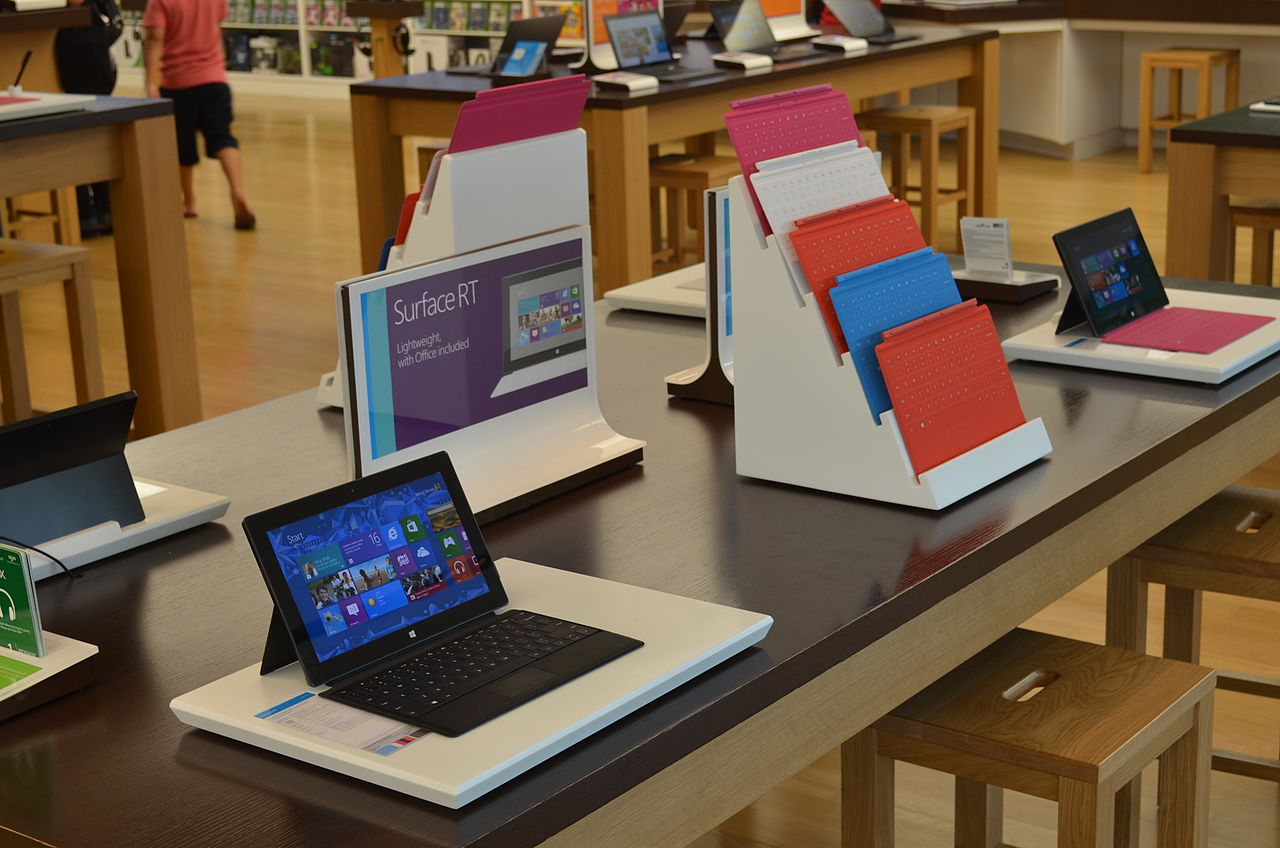
Sales of the first generation Surface did not meet Microsoft's expectations, which led to price reductions and other sales incentives.[144][145]
In July 2013, Steve Ballmer revealed that the Surface hasn't sold as well as he hoped.[146] He reported that Microsoft had made a loss of US$900,000,000 due to the lackluster Surface sales. Concurrently, Microsoft cut the price of first-gen Surface RT worldwide by 30%, with its U.S. price falling to US$350.[147][148][149][150] This was followed by a further price cut in August after it was revealed that even the marketing costs had exceed the sales.[151] On August 4, 2013, the cost of Surface Pro was cut by $100 giving it an entry price of $799. Several law firms sued Microsoft, accusing the company of misleading shareholders about sales of the first-gen ARM based Surface tablet, calling it an "unmitigated disaster".[152] In the first two years of sales, Microsoft lost almost two billion dollars.[153]

The poor sales of the ARM-based Surface tablet had been credited to the continuing market dominance of Microsoft's competitors in the tablet market. Particularly, Apple's iPad retained its dominance due its App store offering the most tablet-optimized applications. Most OEMs opted to produce tablets running Google Android, which came in a wide variety of sizes and prices (albeit with mixed success among most OEMs), and Google Play had the second-largest selection of tablet applications. By contrast there was a limited amount of software designed specifically for Surface's operating system, Windows RT, the selection which was even weaker than Windows Phone.[154] Indeed, OEMs reported that most customers felt Intel-based tablets were more appropriate for use in business environments, as they were compatible with the much more widely available x86 programs while Windows RT was not. Microsoft's subsequent efforts have been focused upon refining the Surface Pro and making it a viable competitor in the premium ultra-mobile PC category, against other Ultrabooks and the MacBook Air, while discontinuing development of ARM-powered Surface devices as the Surface 3 (non-Pro) had an Intel x86 CPU (albeit with lower performance than the Surface Pro 3).[154][155]
The resultant Surface Pro 3 succeeded in garnering a great interest in the Surface line, making Surface business profitable for the first time in fiscal year Q1 2015.[156] Later in Q2, the Surface division's sales topped $1 billion.[157] Surface division scored $888 million for Q4 2015 despite an overall loss of $2.1 billion for Microsoft, a 117% year-over-year growth thanks to the steady commercial performance of Surface Pro 3 and the launch of mainstream model Surface 3.[158] In the first quarter of fiscal year 2018 the Surface division posted its best earnings performance to date.[159]
Timeline
[edit]| Timeline of Surface devices |
|---|
 |
See also
[edit]- Microsoft PixelSense, a product line launched in 2007 and formerly called Microsoft Surface
- Comparison of tablet computers
- Microsoft Lumia
References
[edit]- ^ Thomson, Iain (June 20, 2012). "Pegatron named as Microsoft Surface fondleslab foundry". The Register. Archived from the original on September 25, 2016.
- ^ Bott, Ed. "What OEMs desperately need to learn from Microsoft's Surface". ZDNet. Archived from the original on November 22, 2016. Retrieved November 21, 2016.
- ^ "Why Lenovo's MIIX 700 is a good thing for Windows 10 and the Surface brand". Windows Central. Archived from the original on November 22, 2016. Retrieved November 21, 2016.
- ^ "Microsoft wants other PC makers to copy the Surface Dial controller". Digital Trends. October 27, 2016. Archived from the original on November 22, 2016. Retrieved November 21, 2016.
- ^ "Microsoft's Surface: Technology experts' reactions". BBC News. June 19, 2012. Retrieved November 20, 2024.
- ^ Orf, Darren. "The World Finally Admits Microsoft Surface Is the Shit". Gizmodo. Archived from the original on November 22, 2016. Retrieved November 21, 2016.
- ^ "Microsoft becomes a form factor trend setter". winsupersite.com. Archived from the original on November 22, 2016. Retrieved November 21, 2016.
- ^ Thurrott, Paul (April 27, 2023). "Microsoft Moves All Hardware Peripherals Under Surface". Thurrott.com. Retrieved November 20, 2024.
- ^ Hardawar, Devindra (May 2, 2017). "Microsoft's Surface Laptop is built to beat Apple's MacBooks". Engadget. Archived from the original on May 2, 2017. Retrieved May 2, 2017.
- ^ "Microsoft announces "Surface Studio", an all-in-one touch PC for creators". Windows Central. Archived from the original on November 22, 2016. Retrieved November 21, 2016.
- ^ "Which Surface devices can be upgraded to Windows 11? - Microsoft Support". support.microsoft.com. Retrieved September 22, 2023.
- ^ a b "Surface Lifecycle for Android-based devices". January 3, 2023.
- ^ "Surface Duo 2 update history - Microsoft Support". support.microsoft.com. Retrieved September 22, 2023.
- ^ Sullivan, Mark. "Microsoft Announces New 'Surface' Tablet PC". PC World. IDG. Archived from the original on February 8, 2013. Retrieved June 19, 2012.
- ^ Warren, Tom (March 12, 2013). "A look at Microsoft's top-secret Surface prototypes". The Verge. Vox Media.
- ^ Tu, Janet I. "Ballmer trumpets Microsoft's 'epic year'". The Seattle Times. Archived from the original on September 18, 2012. Retrieved September 19, 2012.
- ^ "Microsoft Surface: Pricing and Availability". Paul Thurrott at winsupersite.com. Archived from the original on October 18, 2012. Retrieved October 16, 2012.
- ^ "Microsoft Surface Windows RT device Now available to pre order". Microsoft UK Faculty Connection. Archived from the original on October 21, 2017. Retrieved May 24, 2017.
- ^ "Microsoft Surface Preorders Open". slashgear.com. October 16, 2012. Archived from the original on October 18, 2012. Retrieved October 16, 2012.
- ^ "Microsoft to launch Surface at midnight on October 26th". NotebookBee.com. October 5, 2012. Archived from the original on June 6, 2013.
- ^ Panay, Panos (January 22, 2013). Meisner, Jeffrey (ed.). "Growing the Surface Family: Surface Windows 8 Pro Availability Confirmed". The Official Microsoft Blog. Microsoft. Archived from the original on January 28, 2013.
- ^ "Microsoft Announces Surface: New Family of PCs for Windows". News Center (Press release). Microsoft. June 18, 2012. Archived from the original on January 8, 2015. Retrieved June 20, 2012.
- ^ Clarke, Gavin. "Surface sales 'modest' so far, Ballmer modestly admits". Theregister.co.uk. Archived from the original on September 5, 2017. Retrieved October 27, 2017.
- ^ "Next Up for the Surface Family: Surface with Windows 8 Pro – Pricing". The Official Microsoft Blog. Archived from the original on February 17, 2013. Retrieved February 17, 2013.
- ^ "Microsoft Surface Pro Tablet to Launch Feb. 9 for $899". ABC News. January 22, 2013. Retrieved January 23, 2013.
- ^ Clarke, Gavin. "Nemo cancels Microsoft's Surface Pro launch". Theregister.co.uk. Archived from the original on October 21, 2017. Retrieved October 27, 2017.
- ^ Foley, Mary Jo. "Microsoft's Surface Pro launch marred by supply shortages". Zdnet.com. Archived from the original on September 28, 2014. Retrieved October 27, 2017.
- ^ "Dell to start selling Microsoft's Surface Pro in new enterprise push". Ars Technica. September 8, 2015. Archived from the original on September 9, 2015. Retrieved September 8, 2015.
- ^ "Dell, HP to resell Microsoft's Surface Pro tablets". ZDNet. Archived from the original on September 8, 2015. Retrieved September 8, 2015.
- ^ "Microsoft Introduces its First Laptop". Archived from the original on October 26, 2015. Retrieved October 7, 2015.
- ^ "After a number of delays, Microsoft begins shipping Surface Hubs". Neowin. Archived from the original on April 13, 2016. Retrieved April 18, 2016.
- ^ Howse, Brett (June 24, 2016). "Microsoft Confirms Surface 3 Production to End in December". Anandtech.com. Archived from the original on June 27, 2016. Retrieved June 28, 2016.
- ^ Ian Cutress (April 29, 2016). "Intel's Changing Future: Smartphone SoCs Broxton & SoFIA Officially Cancelled". AnandTech. Archived from the original on June 30, 2016.
- ^ "Microsoft unveils pricey but powerful Surface Book update, Surface Studio at NY event". Digital Trends. October 26, 2016. Archived from the original on November 22, 2016. Retrieved November 21, 2016.
- ^ "Microsoft spins the innovation wheel, wins big with Surface Dial". CNET. Archived from the original on February 27, 2017. Retrieved February 26, 2017.
- ^ "Microsoft launches new Surface Pro". BBC News. May 23, 2017. Archived from the original on May 24, 2017. Retrieved May 23, 2017.
- ^ Panay, Panos (May 15, 2018). "Meet Surface Hub 2". Windows Blogs. Microsoft. Retrieved May 18, 2018.
- ^ Rubino, Daniel (May 15, 2018). "Microsoft's Surface Hub 2 sports a 4K+ display and gravity-defying hinge". Windows Central. Mobile Nations. Retrieved May 18, 2018.
- ^ Chacos, Brad (May 16, 2018). "Microsoft may release a tiny $400 Surface tablet to challenge the iPad". PCWorld. Retrieved May 18, 2018.
- ^ Welch, Chris (October 2, 2019). "Microsoft announces Surface Pro 7 with long-awaited USB-C port". The Verge. Retrieved September 21, 2020.
- ^ Hollister, Sean (October 2, 2019). "Microsoft announces Surface Laptop 3 with a new 15-inch model and USB-C". The Verge. Retrieved September 21, 2020.
- ^ Jones, Luke (April 9, 2020). "Microsoft Postpones the Surface Neo to Focus on Windows 10X". WinBuzzer. Retrieved August 26, 2020.
- ^ Lumb, David; Uy, Michelle Ray; Hanson, Matt (August 12, 2020). "Microsoft Surface Duo price, release date and phone specs". TechRadar. Retrieved August 26, 2020.
- ^ Bowden, Zac (August 12, 2020). "Microsoft Surface Duo launches September 10 for $1,399 with preorders starting today". Windows Central. Retrieved August 26, 2020.
- ^ Peters, Jay (September 22, 2021). "Microsoft's fall Surface event: the 7 biggest announcements". The Verge. Retrieved October 5, 2021.
- ^ Surface, Microsoft. "Surface 3". Microsoft Surface. Archived from the original on June 27, 2015. Retrieved June 28, 2015.
- ^ Warren, Tom (October 23, 2020). "Microsoft Surface Pro X (2020) review: ARM gets more muscle". The Verge. Retrieved October 5, 2021.
- ^ Foley, Mary Jo. "Microsoft's Surface Pro: How much usable storage will it really have?". ZDNet. Retrieved December 24, 2019.
- ^ a b "Panos Panay and the Surface team just finished their Reddit AMA, here are the highlights". Windows Central. May 27, 2014. Archived from the original on October 21, 2017. Retrieved October 27, 2017.
- ^ "Microsoft reportedly dumps 'VaporMg' chassis, will use 'VaporMg' only as 'surface treatment' – MacDailyNews - Welcome Home". Macdailynews.com. July 9, 2012. Archived from the original on October 21, 2017. Retrieved October 27, 2017.
- ^ Thorp-Lancaster, Dan (May 2, 2017). "Surface Laptop's four colors only available on single model in U.S. | Windows Central". Windows Central. Archived from the original on May 3, 2017. Retrieved May 2, 2017.
- ^ Westover, Brian. "Microsoft Surface 3 Review & Rating". PCWorld. Archived from the original on August 19, 2015. Retrieved July 12, 2015.
- ^ "Should you buy the Surface Pro 4 instead of the new Surface Pro?". Windows Central. Archived from the original on June 16, 2017. Retrieved June 12, 2017.
- ^ Webster, Andrew (October 6, 2015). "This is how Surface Book's crazy hinge works". The Verge. Archived from the original on October 21, 2017. Retrieved October 27, 2017.
- ^ "Surface Book - The Ultimate i5 or i7 powered Laptop Computer". www.microsoft.com. Archived from the original on January 27, 2017. Retrieved January 26, 2017.
- ^ "The Surface Book 2's secret weapon is ceramic, says Panos Panay". Engadget. Archived from the original on October 21, 2017. Retrieved October 21, 2017.
- ^ Riley, Sean (May 6, 2020). "Microsoft launches Surface Book 3: Price, release date, specs and battery life". LaptopMag. Archived from the original on April 11, 2021. Retrieved March 26, 2021.
- ^ a b "Microsoft".
- ^ "Surface Studio". Microsoft. Archived from the original on October 27, 2016. Retrieved October 27, 2016.
- ^ Moynihan, Tim (October 26, 2016). "Look at Microsoft's Fancy Surface Studio All-in-One PC". Wired. Condé Nast. Archived from the original on June 7, 2017. Retrieved May 5, 2017.
- ^ "Surface Hub". Microsoft.com. Archived from the original on January 22, 2015. Retrieved January 22, 2015.
- ^ Warren, Tom (October 2, 2019). "Microsoft Surface Neo first look: the future of Windows 10X is dual-screen". The Verge. Retrieved February 26, 2020.
- ^ Warren, Tom (May 18, 2021). "Microsoft confirms Windows 10X is dead". The Verge. Retrieved July 28, 2021.
- ^ Warren, Tom (October 3, 2019). "A first look at Surface Duo, Microsoft's foldable Android phone". The Verge. Retrieved February 26, 2020.
- ^ "Microsoft's Windows 8.1 RT Update 3 said to include smaller Start menu - but not much else". Neowin.net. Archived from the original on October 15, 2016. Retrieved October 26, 2016.
- ^ "How to set up Windows Hello on your Surface device". Microsoft Devices Blog. December 17, 2015. Archived from the original on February 20, 2016. Retrieved February 18, 2016.
- ^ "Should you upgrade your Surface Pro 2 or Surface Pro 3 to the Surface Pro 4?". Windows Central. October 21, 2015. Archived from the original on February 25, 2016. Retrieved February 18, 2016.
- ^ "The brand new Surface Hub application is now available in the Windows Store - Microsoft Devices BlogMicrosoft Devices Blog". blogs.windows.com. October 13, 2014. Archived from the original on February 27, 2017. Retrieved February 26, 2017.
- ^ Microsoft. "Surface". www.microsoft.com. Archived from the original on February 27, 2017. Retrieved February 26, 2017.
- ^ Microsoft. "Microsoft Surface Pen with two side buttons". www.microsoft.com. Archived from the original on February 27, 2017. Retrieved February 26, 2017.
- ^ Microsoft. "Using Surface Pen with single button on flat edge". www.microsoft.com. Archived from the original on February 27, 2017. Retrieved February 26, 2017.
- ^ "What's your frequency? Tuning into the Surface Dial". Surface Pro Artist. Archived from the original on February 27, 2017. Retrieved February 26, 2017.
- ^ "What's new in digital pen settings for the Windows 10 Anniversary Update". Windows Central. Archived from the original on February 27, 2017. Retrieved February 26, 2017.
- ^ "Microsoft Type Cover with Fingerprint ID Review". TabletPCReview.com. Archived from the original on June 7, 2017. Retrieved June 12, 2017.
- ^ "[Q] MS Surface Cover Connector Pinout". XDA Developers. May 9, 2013. Archived from the original on May 11, 2018. Retrieved June 12, 2017.
- ^ Microsoft. "Using OneNote on Microsoft Surface". www.microsoft.com. Archived from the original on July 4, 2017. Retrieved June 12, 2017.
- ^ Warren, Tom (September 24, 2013). "Surface blades: Microsoft bets on accessories as the future of tablets". The Verge. Archived from the original on November 22, 2016. Retrieved November 21, 2016.
- ^ Pierce, David (September 23, 2013). "Surface Remix Project: hands-on with Microsoft's crazy new DJ tool". The Verge. Archived from the original on December 6, 2016. Retrieved November 21, 2016.
- ^ "More limited edition Surface Music Covers available through new remixing contest". Neowin. Archived from the original on November 22, 2016. Retrieved November 21, 2016.
- ^ "Microsoft reveals Surface Music Cover, gives DJs and producers more musical tools (updated)". Engadget. September 23, 2013. Archived from the original on November 22, 2016. Retrieved November 21, 2016.
- ^ Surface (September 23, 2013), Surface Workshop at Art Center College of Design, archived from the original on January 29, 2016, retrieved November 21, 2016
- ^ "Surface Specifications". microsoft.com. Microsoft. Archived from the original on October 24, 2013. Retrieved February 13, 2015.
- ^ "Surface 2 Specifications". microsoft.com. Microsoft. Archived from the original on October 24, 2013. Retrieved February 13, 2015.
- ^ "Surface 3 Specifications". microsoft.com. Microsoft. Archived from the original on March 31, 2015. Retrieved March 31, 2015.
- ^ "Surface Go Specifications". microsoft.com. Microsoft. Retrieved July 19, 2018.
- ^ "Surface Go 2 Specifications". microsoft.com. Microsoft. Retrieved May 6, 2020.
- ^ "Surface Go 3 Specifications". microsoft.com. Microsoft. Retrieved September 22, 2021.
- ^ "Surface Go 4
for Business Specifications". microsoft.com. Microsoft. Retrieved March 19, 2024. - ^ "Your request has been blocked. This could be due to several reasons". www.microsoft.com. Retrieved July 6, 2025.
- ^ "Update Microsoft Surface from Windows 8 to Windows 8.1". www.microsoft.com. Archived from the original on March 5, 2016. Retrieved October 29, 2015.
- ^ "Surface Pro Specifications". microsoft.com. Microsoft. Archived from the original on July 17, 2015. Retrieved February 13, 2015.
- ^ "Surface Pro 2 Specifications". microsoft.com. Microsoft. Archived from the original on January 20, 2015. Retrieved February 13, 2015.
- ^ "Surface Pro 3 Specifications". microsoft.com. Microsoft. Archived from the original on March 14, 2015. Retrieved February 13, 2015.
- ^ "Surface Pro 4 Specifications". microsoft.com. Microsoft. Archived from the original on October 29, 2016. Retrieved October 6, 2015.
- ^ "Surface Pro Technical Specs". microsoft.com. Microsoft. Archived from the original on July 19, 2017. Retrieved May 23, 2017.
- ^ "Surface Pro 6 Technical Specs". Microsoft. Retrieved October 2, 2018.
- ^ "Surface Pro 7 Technical Specs" (PDF). Microsoft. Archived from the original (PDF) on October 2, 2019. Retrieved October 2, 2018.
- ^ "Surface Pro X Technical Specs" (PDF). Microsoft. Archived from the original (PDF) on October 2, 2019. Retrieved October 2, 2018.
- ^ "Surface Pro 7+". Microsoft. Retrieved January 11, 2021.
- ^ "Surface Pro 8". Microsoft. Retrieved September 22, 2021.
- ^ "Surface Pro 9". Microsoft. Retrieved October 12, 2022.
- ^ "Surface Pro 10" (PDF). Microsoft. Retrieved March 21, 2024.
- ^ "Surface Pro (11th generation)". Microsoft. Retrieved May 21, 2024.
- ^ "Microsoft Surface battery capacity - a complete list". Surfacetip. November 16, 2017. Retrieved February 4, 2020.
- ^ "Surface Book | Everything you need to know about the full power of Surface Book". Microsoft. Archived from the original on October 29, 2016. Retrieved November 2, 2016.
- ^ "Microsoft Surface Book 2 Specs | Powerhouse Performance | Surface". Microsoft. Archived from the original on October 25, 2017. Retrieved October 25, 2017.
- ^ "Microsoft Surface Book 3 Specs | Powerhouse Performance | Surface". Microsoft. Archived from the original on October 25, 2017. Retrieved May 6, 2020.
- ^ "Microsoft Surface Book Teardown - iFixit". iFixit. November 3, 2015. Archived from the original on September 26, 2017. Retrieved October 28, 2017.
- ^ "Microsoft Surface Book 2 Teardown". iFixit. November 17, 2017. Retrieved October 8, 2019.
- ^ "Microsoft Surface Book 2 Detailed Specs - Everything you need to know!". Surface Tip. October 18, 2017. Retrieved October 8, 2019.
- ^ "Surface Laptop Specifications" (PDF). microsoft.com. Microsoft. Retrieved February 13, 2015.
- ^ "Surface Laptop 2 Specifications" (PDF). microsoft.com. Microsoft. Retrieved February 13, 2015.
- ^ "Surface Laptop 3 Specifications". microsoft.com. Microsoft. Retrieved February 13, 2015.
- ^ "Surface Laptop 4 Specifications". microsoft.com. Microsoft. Retrieved April 13, 2021.
- ^ "Surface Laptop 5 Specifications". microsoft.com. Microsoft. Retrieved March 6, 2024.
- ^ "Surface Laptop 6 Specifications" (PDF). microsoft.com. Microsoft. Retrieved March 21, 2024.
- ^ "Surface Laptop 7th Edition Specifications". microsoft.com. Microsoft. Retrieved May 22, 2024.
- ^ "Microsoft Surface Studio | Tech Specs". Microsoft. Archived from the original on October 29, 2016. Retrieved November 4, 2016.
- ^ "Microsoft Surface Studio 2 Tech Specs". Microsoft. Retrieved October 2, 2018.
- ^ "Microsoft Surface Studio 2+ Tech Specs". Microsoft. Retrieved March 6, 2024.
- ^ "Microsoft's first Surface commercial shows off click-in keyboard [video]". BGR. Archived from the original on October 8, 2015. Retrieved October 7, 2015.
- ^ "Microsoft 'Surface' Has Top Tablet Ad". MediaPost. Archived from the original on December 8, 2015. Retrieved October 7, 2015.
- ^ "How Microsoft redesigned the Surface Pro for the NFL". Engadget. Archived from the original on June 30, 2015. Retrieved June 4, 2015.
- ^ "The NFL Says Goodbye to the Polaroid, Hello to Microsoft's Surface Tablet". Bloomberg. Archived from the original on January 28, 2016. Retrieved June 4, 2015.
- ^ "On the sidelines: how the NFL is making use of the Surface Pro 2". Engadget. Archived from the original on June 30, 2015. Retrieved June 4, 2015.
- ^ "After Coaching From Microsoft, NFL Announcers Have Gotten Very Good At Identifying Surface Tablets". Business Insider. Archived from the original on April 13, 2015. Retrieved June 4, 2015.
- ^ "Jasper Wong creates the first in a series of 17 murals for Designed on Surface". Microsoft Devices Blog. January 14, 2016. Archived from the original on February 25, 2016. Retrieved February 18, 2016.
- ^ "Surface now approved for U.S. Department of Defense". Microsoft Devices Blog. February 17, 2016. Archived from the original on February 25, 2016. Retrieved February 18, 2016.
- ^ "With the Surface, Microsoft just started writing its next chapter". The Verge. June 19, 2012. Archived from the original on May 1, 2013. Retrieved June 16, 2013.
- ^ "Microsoft breaks tradition with Microsoft Surface tablets". CNET. Archived from the original on May 28, 2013. Retrieved June 16, 2013.
- ^ Clarke, Gavin. "Ballmer aims chair at Apple after Windows package miss." Archived August 19, 2016, at the Wayback Machine The Register, October 10, 2012.
- ^ Kan, Michael (August 17, 2012). "Lenovo Not Worried About Microsoft's Surface Tablet, Expects to Beat It". Archived from the original on August 19, 2012.
- ^ Robinson, Seth (August 21, 2012). "Windows 8 Launch, Microsoft Surface: Michael Dell's Spin". The VAR Guy. Archived from the original on August 25, 2012. Retrieved October 27, 2017.
- ^ Kristin Bent (August 30, 2012). "HP Targets Microsoft Surface With New Windows 8 Convertible PC". Crn.com. Archived from the original on October 28, 2017. Retrieved October 27, 2017.
- ^ Williams, Martyn (August 30, 2012). "Lenovo exec welcomes Microsoft tablet competition". Computerworld. Archived from the original on July 2, 2014. Retrieved October 27, 2017.
- ^ Epstein, Zach (June 20, 2012). "Microsoft's tablet efforts are fleeting, says Acer founder". Boy Genius Report. Archived from the original on November 2, 2012.
- ^ Crothers, Brooke (June 27, 2012). "Microsoft to feel Surface heat from PC makers". CNET. Archived from the original on July 31, 2012.
- ^ Fingas, Jon (June 21, 2012). "Acer is skeptical of Surface tablets, thinks Microsoft isn't playing nice". Archived from the original on October 15, 2016.
- ^ "Acer chief takes aim at Microsoft Surface." Archived February 2, 2013, at the Wayback Machine FT, August 6, 2012.
- ^ Kunert, Paul. "Microsoft Surface slate: Acer, resellers predict a riot." Archived September 13, 2017, at the Wayback Machine The Register, August 7, 2012.
- ^ Chacos, Brad. "Why Windows RT is hurtling toward disaster". InfoWorld. Archived from the original on October 2, 2013. Retrieved January 27, 2013.
- ^ "Can Intel Challenge ARM's Mobile Dominance?". Great Speculations. Forbes. Archived from the original on November 27, 2012. Retrieved November 22, 2012.
- ^ Bright, Peter (October 24, 2012). "Now that it's here, is there a place for Windows RT?". Ars Technica. Archived from the original on November 12, 2012. Retrieved November 22, 2012.
- ^ "Desperate Microsoft wants to pay you at least $200 to trade in your iPad for a Surface tablet – MacDailyNews - Welcome Home". Macdailynews.com. September 13, 2013. Archived from the original on October 28, 2017. Retrieved October 27, 2017.
- ^ "Microsoft offering $200 for your iPad in desperate attempt to sell Surface tablets". Archived from the original on September 15, 2013. Retrieved October 27, 2017.
- ^ "Steve Ballmer Admits Microsoft's iPad-Killer Is A Flop". Cult of Mac. July 26, 2013. Archived from the original on August 23, 2013. Retrieved September 4, 2013.
- ^ "Microsoft's Surface Tablet Is Said to Fall Short of Predictions". Bloomberg L.P. Archived from the original on May 1, 2013. Retrieved May 21, 2013.
- ^ "Microsoft Misses, Takes a $900 Million Charge on Surface RT Stock". All Things Digital. Archived from the original on July 26, 2013. Retrieved July 25, 2013.
- ^ "Microsoft cuts Surface RT prices by 30 percent worldwide, hopes to boost slow sales". The Verge. July 15, 2013. Archived from the original on July 29, 2013. Retrieved July 25, 2013.
- ^ Lowe, Scott (July 18, 2013). "Microsoft Lost $900 Million on Surface RT in Q1". IGN.com. Archived from the original on July 21, 2013. Retrieved July 20, 2013.
- ^ Steven Musil (August 4, 2013). "Microsoft cuts Surface Pro tablet prices by $100". News.cnet.com. Archived from the original on October 21, 2013. Retrieved October 27, 2017.
- ^ Keizer, Gregg (August 13, 2013). "Lawyers sue Microsoft over Surface RT 'unmitigated disaster'". Computerworld. Archived from the original on July 3, 2014. Retrieved October 27, 2017.
- ^ Hruska, Joel (August 6, 2014). "Microsoft's Surface Losses Approach $2B, How Much More Will Redmond Take?". hothardware.com. ComputerWorld. Archived from the original on August 8, 2014. Retrieved August 6, 2014.
- ^ a b Brad Reed (July 9, 2014). "Microsoft Surface Pro 3 sales: Better than expected?". BGR. Archived from the original on October 27, 2016. Retrieved October 26, 2016.
- ^ Bott, Ed (June 19, 2014). "How Microsoft's Surface Pro 3 marketing push backfired". ZDNet. Archived from the original on December 5, 2014. Retrieved October 26, 2016.
- ^ Keizer, Gregg (October 25, 2015). "Microsoft's Surface turns first profit in 2 years". ComputerWorld.com. Archived from the original on August 28, 2015. Retrieved July 24, 2015.
- ^ Fiegerman, Seth (January 27, 2015). "Microsoft Surface sales topped $1 billion in December quarter". Mashable.com. Archived from the original on July 23, 2015. Retrieved July 24, 2015.
- ^ "Microsoft reports big losses in the fourth quarter". The Verge. July 21, 2015. Archived from the original on July 22, 2015. Retrieved July 23, 2015.
- ^ "Microsoft Surface sales increase as firm prepares to launch Surface Pro LTE - TheINQUIRER". theinquirer.net. Archived from the original on November 7, 2017.
External links
[edit]

| National | |
|---|---|
| Other | |

 | |
Microsoft Surface Pro 9, Platinum tablet, sapphire keyboard | |
| Developer | Microsoft |
|---|---|
| Manufacturer | Pegatron[1] |
| Type | Personal computers, mobile devices, whiteboards |
| Lifespan | 2012–present |
| Operating system | Windows Android (Surface Duo only) |
| Website | www.microsoft.com/surface/ |
| This article is part of a series on |
| Microsoft Surface |
|---|
Microsoft Surface is a family of touchscreen-based personal computer, tablet, and interactive whiteboard hardware products designed and developed by Microsoft. The majority of them run the Windows operating system and use Intel processors;[2][3][4] the earliest models (Surface RT and Surface 2) ran on ARM32, and a select handful of models starting with the Surface Pro X in 2019 run on ARM64.
The Surface line has served as Microsoft's umbrella brand for PCs since it was first introduced in 2012, marking the company's first entry in building its own branded computers.[5] It has since expanded to comprise several generations of hybrid tablets, 2-in-1 detachable notebooks, a convertible desktop all-in-one, an interactive whiteboard, and various accessories, many with unique form factors.[6][7] Microsoft is also consolidating all other Microsoft hardware products such as PC accessories under the Surface brand as of 2023.[8]
Devices
The Surface family currently features seven main lines of devices:
- The Surface Go line of compact-sized hybrid tablets, with optional detachable keyboard accessories and optional digital pen.
- The Surface Pro line of hybrid tablets, slightly larger and more powerful than Go, with similar, optional detachable keyboard accessories and optional digital pen.
- The Surface Laptop, a classic notebook with a 13-inch, 13.8-inch or 15-inch touchscreen aimed at students.[9] Variants include:
- The Surface Laptop Go, marketed as a more affordable alternative to the brand's premium laptops.
- The Surface Laptop Studio, a notebook with dual-pivoting screen to change into tablet mode.
- The Surface Studio, a 28-inch all-in-one desktop that adjusts into a digital drafting table with stylus and on-screen Surface Dial support.[10]
- The Surface Hub, a touch screen interactive whiteboard designed for collaboration.
| Legend: | Unsupported | Discontinued | Supported | Current | Upcoming |
|---|
| Model | Release | Support | ||||
|---|---|---|---|---|---|---|
| Line | Surface | OS | Date | Final OS | Ended | Lifespan |
| Surface | Surface RT | Windows RT | October 26, 2012 | Windows RT 8.1 Update 3 | January 10, 2023 | 10 years, 2 months |
| Surface 2 | Windows RT 8.1 | October 22, 2013 | Windows RT 8.1 Update 3 | January 10, 2023 | 9 years, 2 months | |
| Surface 3 | Windows 8.1 Update | May 5, 2015 | Windows 10 version 22H2 | October 14, 2025 | 10 years, 5 months | |
| Surface Go | Surface Go | Windows 10 version 1709 | August 2, 2018 | Windows 10 version 22H2 | October 14, 2025 | 7 years, 2 months |
| Surface Go 2 | Windows 10 version 1809 | May 12, 2020 | Latest Windows[a] | Active | 5 years, 7 months | |
| Surface Go 3 | Windows 11 version 21H2 | October 5, 2021 | Latest Windows[a] | Active | 4 years, 2 months | |
| Surface Go 4 | Windows 11 version 22H2 | October 3, 2023 | Latest Windows[a] | Active | 2 years, 2 months | |
| Surface Pro | Surface Pro | Windows 8 | February 9, 2013 | Windows 10 version 22H2 | October 14, 2025 | 12 years, 8 months |
| Surface Pro 2 | Windows 8.1 | October 22, 2013 | Windows 10 version 22H2 | October 14, 2025 | 11 years, 11 months | |
| Surface Pro 3 | Windows 8.1 Update | June 20, 2014 | Windows 10 version 22H2 | October 14, 2025 | 11 years, 3 months | |
| Surface Pro 4 | Windows 10 version 1507 | October 26, 2015 | Windows 10 version 22H2 | October 14, 2025 | 9 years, 11 months | |
| Surface Pro (2017) | Windows 10 version 1703 | June 15, 2017 | Windows 10 version 22H2 | October 14, 2025 | 8 years, 3 months | |
| Surface Pro 6 | Windows 10 version 1709 | October 16, 2018 | Latest Windows[a] | Active | 7 years, 2 months | |
| Surface Pro 7 | Windows 10 version 1809 | October 22, 2019 | Latest Windows[a] | Active | 6 years, 2 months | |
| Surface Pro X (1st) | Windows 10 version 1903 | November 5, 2019 | Latest Windows[a] | Active | 6 years, 2 months | |
| Surface Pro X (2nd) | Windows 10 version 2004 | October 13, 2020 | Latest Windows[a] | Active | 5 years, 2 months | |
| Surface Pro 7+ | Windows 10 version 2004 | January 11, 2021 | Latest Windows[a] | Active | 4 years, 11 months | |
| Surface Pro 8 | Windows 11 version 21H2 | October 5, 2021 | Latest Windows[a] | Active | 4 years, 2 months | |
| Surface Pro 9 | Windows 11 version 22H2 | October 25, 2022 | Latest Windows[a] | Active | 3 years, 2 months | |
| Surface Pro 10 | Windows 11 version 23H2 | April 9, 2024 | Latest Windows[a] | Active | 1 year, 8 months | |
| Surface Pro (11th generation) | Windows 11 version 24H2 | June 18, 2024 | Latest Windows[a] | Active | 1 year, 6 months | |
| Surface Laptop SE | Surface Laptop SE | Windows 11 SE version 21H2 | February 4, 2022 | Windows 11 SE version 24H2 | October 13, 2026 | 4 years, 8 months |
| Surface Laptop Go | Surface Laptop Go | Windows 10 version 1909 | October 27, 2020 | Latest Windows[a] | Active | 5 years, 2 months |
| Surface Laptop Go 2 | Windows 11 version 21H2 | June 1, 2022 | Latest Windows[a] | Active | 3 years, 7 months | |
| Surface Laptop Go 3 | Windows 11 version 22H2 | October 3, 2023 | Latest Windows[a] | Active | 2 years, 2 months | |
| Surface Laptop | Surface Laptop | Windows 10 version 1703 | June 15, 2017 | Windows 10 version 22H2 | October 14, 2025 | 8 years, 3 months |
| Surface Laptop 2 | Windows 10 version 1709 | October 16, 2018 | Latest Windows[a] | Active | 7 years, 2 months | |
| Surface Laptop 3 | Windows 10 version 1809 | October 22, 2019 | Latest Windows[a] | Active | 6 years, 2 months | |
| Surface Laptop 4 | Windows 10 version 20H2 | April 20, 2021 | Latest Windows[a] | Active | 4 years, 8 months | |
| Surface Laptop 5 | Windows 11 version 22H2 | October 25, 2022 | Latest Windows[a] | Active | 3 years, 2 months | |
| Surface Laptop 6 | Windows 11 version 23H2 | April 9, 2024 | Latest Windows[a] | Active | 1 year, 8 months | |
| Surface Laptop (7th generation) | Windows 11 version 24H2 | June 18, 2024 | Latest Windows[a] | Active | 1 year, 7 months | |
| Surface Book | Surface Book | Windows 10 version 1507 | October 26, 2015 | Windows 10 version 22H2 | October 14, 2025 | 9 years, 11 months |
| Surface Book with Performance Base | Windows 10 version 1607 | November 10, 2016 | Windows 10 version 22H2 | October 14, 2025 | 8 years, 11 months | |
| Surface Book 2[b] | Windows 10 version 1703 | November 16, 2017 | Windows 10 version 22H2[11] | October 14, 2025 | 7 years, 11 months | |
| Latest Windows[a] | Active | 8 years, 2 months | ||||
| Surface Book 3 | Windows 10 version 1903 | May 21, 2020 | Latest Windows[a] | Active | 5 years, 7 months | |
| Surface Laptop Studio | Surface Laptop Studio | Windows 11 version 21H2 | October 5, 2021 | Latest Windows[a] | Active | 4 years, 2 months |
| Surface Laptop Studio 2 | Windows 11 version 22H2 | October 3, 2023 | Latest Windows[a] | Active | 2 years, 2 months | |
| Surface Studio | Surface Studio | Windows 10 version 1607 | December 15, 2016 | Windows 10 version 22H2 | October 14, 2025 | 8 years, 9 months |
| Surface Studio 2 | Windows 10 version 1803 | October 2, 2018 | Latest Windows[a] | Active | 7 years, 3 months | |
| Surface Studio 2+ | Windows 11 version 22H2 | October 25, 2022 | Latest Windows[a] | Active | 3 years, 2 months | |
| Surface Hub | Surface Hub | Windows 10 Team version 1507 | June 1, 2015 | Latest Windows[a] | Active | 10 years, 7 months |
| Surface Hub 2S | Windows 10 Team version 1703 | April 17, 2019 | Latest Windows[a] | Active | 6 years, 8 months | |
| Surface Hub 3 | Windows 11 version 22H2 | October 3, 2023 | Latest Windows[a] | Active | 2 years, 2 months | |
| Surface Duo | Surface Duo | Android 10 | September 10, 2020 | Android 12.1 | September 10, 2023[12] | 3 years |
| Surface Duo 2 | Android 11 | October 5, 2021 | Android 12.1[13] | October 21, 2024[12] | 3 years | |
- ^ a b c d e f g h i j k l m n o p q r s t u v w x y z aa ab ac ad Windows 11 version 24H2.
- ^ The Surface Book 2 variants with Intel Core 8th generation processors support Windows 11 and later.
History
Microsoft first announced Surface at an event on June 18, 2012, presented by former CEO Steve Ballmer in Milk Studios Los Angeles. Surface was the first major initiative by Microsoft to integrate its Windows operating system with its own hardware, and is the first PC designed and distributed solely by Microsoft.[14] Panos Panay was the general manager of the team that developed the Surface.[15]
Sinofsky initially stated that pricing for the first Surface would be comparable to other ARM devices and pricing for Surface Pro would be comparable to current ultrabooks. Later, Ballmer noted the "sweet spot" for the bulk of the PC market was $300 to $800.[16] Microsoft revealed the pricing and began accepting preorders for the 2012 Surface tablet, on October 16, 2012 "for delivery by 10/26".[17][18][19] The device was launched alongside the general availability of Windows 8 on October 26, 2012.[20] Surface Pro became available the following year on February 9, 2013.[21] The devices were initially available only at Microsoft Stores retail and online, but availability was later expanded into other vendors.[22]
In November 2012, Ballmer described the distribution approach to Surface as "modest"[23] and on November 29 of that year, Microsoft revealed the pricing for the 64 GB and 128 GB versions of Surface with Windows 8 Pro.[24] The tablet would go on sale on February 9, 2013, in the United States and Canada.[25] A launch event was set to be held on February 8, 2013, but was cancelled at the last minute due to the February 2013 nor'easter.[26] The 128GB version of the tablet sold out on the same day as its release. Though there was less demand for the 64GB version because of the much smaller available storage capacity, supplies of the lower cost unit were almost as tight.[27]
The following year, on March 30, 2015, it announced the Surface 3, a more compact version of the Surface Pro 3. On September 8, 2015, Microsoft announced the "Surface Enterprise Initiative", a partnership between Accenture, Avanade, Dell Inc., and HP, to "enable more customers to enjoy the benefits of Windows 10." As part of the partnership, Dell will resell Surface Pro products through its business and enterprise channels, and offer its existing enterprise services (including Pro Support, warranty, and Configuration and Deployment) for Surface Pro devices it sells.[28][29]
Microsoft announced the next generation Surface Pro 4 and the all new Surface Book, a hybrid laptop, at Microsoft October 2015 Event in New York on October 10, 2015.[30] Microsoft began shipping Surface Hub devices on March 25, 2016.[31] In June 2016, Microsoft confirmed production of the Surface 3 would stop in December of that year.[32] No replacement product has been announced. Reports suggest this may be a consequence of Intel discontinuing the Broxton iteration of the Atom processor.[33] On October 26, 2016, at Microsoft's event, a Surface Studio and Surface Book with Performance Base was announced.[34] A wheel accessory, the Surface Dial, was announced as well, and became available on November 10, 2016.[35]
Immediately following the announcement of the Surface Laptop at the #MicrosoftEDU event on May 2, 2017, and the Microsoft Build 2017 developer conference, Microsoft announced the fifth-generation Surface Pro at a special event in Shanghai on May 23, 2017.[36]
On May 15, 2018, Microsoft announced the Surface Hub 2, featuring a new rotating hinge and the ability to link multiple Hubs together.[37][38]
In June 2018, Microsoft announced the Surface Go, a $400 Surface tablet with a 10-inch screen and 64 or 128 GB of storage.[39]
On October 2, 2019, Microsoft announced the Surface Pro 7, the Surface Laptop 3, and the Surface Pro X. Both the Surface Pro 7 and the Surface Laptop 3 come with a USB-C port.[40][41] The Surface Pro X comes with the Microsoft SQ1 ARM processor. Microsoft also teased upcoming products: the Surface Neo, a dual screen tablet originally planned to run Windows 10X; and the Surface Duo, a dual screen mobile phone that runs Android. Both products were initially announced to be released in 2020, though reports suggest the release of the Surface Neo will be delayed until 2021.[42] The Surface Duo was released on September 10, 2020.[43][44]
On September 22, 2021, Microsoft announced the Surface Pro 8, the Surface Duo 2 and the Surface Laptop Studio.[45]
Processor
The first-generation Surface uses a quad-core Nvidia Tegra 3 of the ARM architecture, as opposed to the Intel x64 architecture and therefore shipped with Windows RT, which was written for the ARM architecture. The second-generation Surface 2 added an Nvidia Tegra 4. The architecture limited Surface and Surface 2 to only apps from the Windows Store recompiled for ARM. With the release of the Surface 3, Microsoft switched the Surface line to the Intel x64 architecture, the same architecture found in the Surface Pro line. Surface 3 uses the Braswell Atom X7 processor.[46]
The 2019 Surface Pro X uses a custom ARM64 SOC, the Microsoft SQ1. The latest model uses an updated version of the SOC, known as Microsoft SQ2.[47]
Storage
The Surface devices are released in six internal storage capacities: 32, 64, 128, 256, 512 GB and 1 TB. With the release of the third generation, the 32 GB model was discontinued. All models except the Surface Pro X also feature a microSDXC card slot, located behind the kickstand, which allow for the use of memory cards up to 200 GB.
Microsoft's Surface/Storage site revealed that the 32 GB Surface RT has approximately 16 GB of user-available storage and the 64 GB Surface RT has roughly 45 GB.[48]
External color and kickstand
The exterior of the earlier generations of Surface (2012 tablet, Pro, and Pro 2) is made of VaporMg magnesium alloy giving a semi-glossy black durable finish that Microsoft calls "dark titanium".[49] Originally, the design of Surface was to feature a full "VaporMg" design, but the production models ditched this and went with a "VaporMg" coating.[50] Later devices moved towards a matte gray finish showing the actual magnesium color through the semi-transparent top coating.[49] The Surface Laptop is available in four colors: platinum, graphite gold, burgundy, and cobalt blue.[51]
The Surface and Surface Pro lines feature a kickstand which flips out from the back of the device to prop it up, allowing the device to be stood up at an angle hands-free. According to Microsoft, this is great for watching movies, video chatting, and typing documents. According to some reviewers, this kickstand is uncomfortable to use in one's lap and means the device won't fit on shallow desks.[52] The first generation has a kickstand that can be set to a 22 degrees angle position. The second generation added a 55 degrees angle position which according to Microsoft makes the device more comfortable to type on the lap. The Surface 3 features three angle positions: 22, 44, and 60 degrees. The Surface Pro 3 is the first device to have a continuous kickstand that can be set at any angles between 22 and 150 degrees. With the fifth-generation Surface Pro, Microsoft added an additional 15 degrees of rotation to the hinge bringing the widest possible angle to 165 degrees, or what Microsoft calls "Studio Mode".[53]
Surface Book
On October 6, 2015, Microsoft unveiled the Surface Book, a 2-in-1 detachable with a mechanically attached, durable hardware keyboard. It became the first Surface device to be marketed as a laptop instead of a tablet. The device has a teardrop design.
The Surface Book has what Microsoft calls a "dynamic fulcrum hinge" which allows the device to support the heavier notebook/screen portion.[54]
On October 26, 2016, Microsoft unveiled an additional configuration, called the Surface Book with Performance Base, which has an upgraded processor and a longer battery life.[55]
The second generation Surface Book 2 was announced on October 17, 2017, introducing an upgraded ceramic hinge for stability, and lighter overall weight distribution. A 15-inch model was added to the line.[56] On May 6, 2020, the third generation Surface Book 3 was announced, featuring 10th-generation Intel processors, improved battery life, and faster SSD storage.[57]
Surface Laptop
On May 3, 2017, Microsoft unveiled the Surface Laptop, a non-detachable version of the Surface Book claiming to have the thinnest touch-enabled LCD panel of its kind.[58] Its permanently attached hardware keyboard comes in four colors and uses the same kind of fabric as the Type Cover accessories for the tablets. The device comes with the newly announced Windows 10 S operating system, which enables faster boot times at the expense of the ability to download and install programs from the web instead of the Microsoft Store. Users can switch to a fully enabled version of Windows 10 for free.[58]
Surface Studio

On October 26, 2016, Microsoft announced a 28-inch all-in-one desktop PC, the Surface Studio.[59] The device claims to have the thinnest LCD ever made in an all-in-one PC. All its components, including the processor and a surround-sound system, are located in a compact base on which the screen is mounted upon via a flexible, four-point hinge. The design allows the screen to fold down to a 20-degree angle for physical interaction with the user.[60] It comes with the Windows 10 Anniversary Update preinstalled, but is optimized for the Windows 10 Creators Update released in April 2017.
Surface Hub
On January 21, 2015, Microsoft introduced a new device category under the Surface family: the Surface Hub. It is an 84-inch 120 Hz 4K or 55-inch 1080p multi-touch, multi-pen, wall-mounted all-in-one device, aimed for collaboration and videoconferencing use of businesses. The device runs a variant of the Windows 10 operating system.[61]
Surface Neo
On October 2, 2019, Microsoft unveiled the Surface Neo, an upcoming dual-screen tablet. The device is a folio with two 9-inch displays that can be used in various configurations ("postures"), including a laptop-like form where a Bluetooth keyboard is attached to the bottom screen. Depending on its position, the remainder of the touchscreen can be used for different features; the keyboard can be attached at the top to use the bottom as a touchpad, or at the bottom to display a special area above the keyboard (the "wonderbar"), which can house tools such as emojis. The device was originally planned to run a new Windows 10 edition known as Windows 10X, which was designed specifically for this class of devices. However, Microsoft eventually discontinued Windows 10X. At this time, it is unknown which version of Windows it will run.[62][63]
Surface Duo
Alongside the Surface Neo, Microsoft also unveiled the Surface Duo, a dual-screen Android mobile device with a similar design.[64] Unlike the Surface Neo, the Surface Duo did release in September 2020 with 6GB of RAM and 128/256GB of storage. It initially shipped with Android 10 and uses Microsoft Launcher as the default launcher. Both Surface Duo models hold two screens, one screen per side. The Surface Duo can be folded in many ways, such as tabletop, tent, or single-screen. The first Duo has a selfie camera on the right side with a flashlight. A second model, the Surface Duo 2, got released in 2021 with 8GB of RAM and a back camera on one side.
Software
The original Surface and Surface 2 models use Windows RT, a special version of Windows 8 designed for devices with ARM processors and cannot be upgraded to Windows 10. However, there were several major updates made available after its initial release that include Windows RT 8.1, RT 8.1 Update 1, RT 8.1 August update, and RT 8.1 Update 3. These older, ARM-based models of Surface are not compatible with Windows 10, but received several new features including a new Start menu similar to that found in early preview builds of Windows 10.[65]
From Surface Pro 4 and onward, all Surface devices support Windows Hello facial biometric authentication out of the box through its cameras and IR-sensors.[66] The Surface Pro 3 can utilize the Surface Pro 4 Type Cover with Fingerprint ID to gain Windows Hello support.[67]
Specialized software
Prior to the release of Windows 10, on Surface Pro 3 Microsoft made the Surface Hub app available, which allowed the adjustment of Pen pressure sensitivity and button functions.[68] The Surface Hub app was renamed "Surface" following the launch of the Surface Hub device. Additionally, toggles to control sound quality and to disable the capacitive Windows button on the Surface 3 and Pro 3 devices were included.[69]
With Surface Pro 3 and the Surface Pen based on N-Trig technology, Microsoft added the capability to launch OneNote from the lock screen without logging in by pressing the purple button at the top of the pen.[70] Microsoft added sections to Windows 10 settings that have the ability to control the functions of the buttons on the Surface Pen. One such function is to launch OneNote with the press of the top button of the Surface Pro 4 pen.[71] With the introduction of the Surface Dial, Microsoft added a Wheel settings section to the Settings app in Windows 10 under Devices.[72] The Windows 10 Anniversary Update added the ability to adjust the shortcuts of each of the Pen's buttons performed.[73]
Accessories
There are two main versions of the keyboard covers that connect via the Accessory Spine on the Surface tablets. The now discontinued Touch Cover, and the ever-evolving Type Cover. They feature a multi-touch touchpad, and a full QWERTY keyboard (with pre-defined action keys in place of the function row, though the function row is still accessible via the function button). The covers are made of various soft-touch materials and connect to the Surface with a polycarbonate spine with pogo pins.[74][75]
Microsoft sells the Surface Pen, an active-digitizer pen, separate of Surface, but included it in all Surface tablets until the fifth-generation Surface Pro where it was removed. The Surface Pen is designed to integrate with inking capabilities on Windows including OneNote.[76]
Remix project
In 2013, Microsoft announced that they were going to design other covers for the Surface accessory spine (code named "blades"[77]) based on the Touch Cover 2's sensors. The only product that was shipped was the Surface Music Cover and the Surface Music Kit app.[78][79][80][81]
Model comparison
Surface and Surface Go line
| Model | Surface[82] | Surface 2[83] | Surface 3[84] | Surface Go[85] | Surface Go 2[86] | Surface Go 3[87] | Surface Go 4[88][89] | |
|---|---|---|---|---|---|---|---|---|
| Date released | October 26, 2012 | October 22, 2013 | May 5, 2015 | August 2, 2018 | May 12, 2020 | October 5, 2021 | October 3, 2023 | |
| Operating system | Initial | Windows RT | Windows RT 8.1 | Windows 8.1 Update | Windows 10 version 1803 | Windows 10 version 1909 | Windows 11 version 21H2 | Windows 11 version 22H2 |
| Latest supported | Windows RT 8.1 Update 3[90] | Windows 10 version 22H2 | Windows 11 version 24H2 | |||||
| Edition | Core | Home/Pro | Pro | |||||
| Driver support until | April 11, 2017 | April 10, 2018 | November 13, 2021 | August 2, 2022 | December 30, 2024 | October 5, 2027 | September 21, 2029 | |
| Dimensions mm (in) | Height | 171.9 (6.77) | 172.4 (6.79) | 186.9 (7.36) | 175 (6.9) | |||
| Width | 274.5 (10.81) | 274.5 (10.81) | 266.9 (10.51) | 245 (9.6) | ||||
| Depth | 9.3 (0.37) | 8.8 (0.35) | 8.6 (0.34) | 8.3 (0.33) | ||||
| Weight g (lb) | 680 (1.50) | 622 (1.371) | 522 (1.151) | 544 (1.199) 553 (1.219) (LTE) | 544 (1.199) | 521 (1.149) | ||
| RAM (GB) | 2 | 2/4 | 4/8 | 8 | ||||
| Internal storage (GB) | 32/64 | 64/128 | 64/128/256 | |||||
| Expandable storage (GB) | MicroSDXC, up to 200 GB | |||||||
| Display | Size | 26.9 cm (10.6 in) | 27.4 cm (10.8 in) | 25.4 cm (10.0 in) | 26.67 cm (10.50 in) | |||
| Aspect ratio | 16:9 | 3:2 | ||||||
| Resolution | 1366 × 768 | 1920 × 1080 | 1920 × 1280 | 1800 × 1200 | 1920 × 1280 | |||
| PPI | 148 | 208 | 214 | 217 | 220 | |||
| Refresh Rate | 60 Hz | |||||||
| Technology | LCD | |||||||
| CPU | Generation | Nvidia Tegra 3 | Nvidia Tegra 4 | Intel Silvermont Cherry Trail | Intel 7th gen Kaby Lake-Y | Intel 8th gen Amber Lake-Y | Intel 10th gen Amber Lake-Y | Intel 12th gen Alder Lake-N |
| Model(s) | Atom x7-Z8700 | Pentium Gold 4415Y | Pentium Gold 4425Y Core m3-8100Y | Pentium Gold 6500Y Core i3-10100Y | Processor N200 | |||
| iGPU | Geforce ULP | Intel HD Graphics | Intel HD Graphics 615 | Intel UHD Graphics 615 | ||||
| Battery | Capacity (Wh) | 31.5 Wh | 28 Wh | 26.12 Wh | 24 Wh | 28 Wh | 29 Wh | |
| Type | Li-Ion | |||||||
| Cameras | Front camera | 3.5 MP | 5.0 MP | |||||
| HD (1280 × 720) video | FHD (1920 × 1080) video | |||||||
| Rear camera | 5.0 MP | 8.0 MP | ||||||
| HD (1280 × 720) video | FHD (1920 × 1080) video | |||||||
| Sensors | Ambient light | Yes | ||||||
| Accelerometer | Yes | |||||||
| Gyroscope | Yes | |||||||
| GPS | No | Cellular version | No | |||||
| Magnetometer | Yes | |||||||
| Proximity | No | Yes | ||||||
| Microphones | 2 | 1 | ||||||
| Connectors | A/V | 3.5 mm audio socket | ||||||
| Micro HDMI | Mini DisplayPort | via USB-C | ||||||
| USB | 1 × USB-A 2.0 | 1 × USB-A 3.0 | 1 × USB-C 3.1 Gen 1 | |||||
| Radios | Wi-Fi | Wi-Fi 4 | Wi-Fi 5 | Wi-Fi 6 | ||||
| Bluetooth | 4.0 | 4.1 | 5.0 | 5.1 | ||||
| Cellular | No | Optional | No | |||||
| Surface Pen support | Wacom active pen | Microsoft Pen Protocol | ||||||
| TPM | Yes | No | Yes | Yes (2.0) | ||||
| Surface Dial support | No | Partial (no on-screen support, Windows 10 upgrade) | Partial (no on-screen support) | |||||
| Integrated Windows Hello support | No | Yes (via backlit IR camera) | ||||||
Surface Pro line
| Model | Pro[91] | Pro 2[92] | Pro 3[93] | Pro 4[94] | Pro (2017)[95] | Pro 6[96] | Pro 7[97] | Pro X[98] | Pro X 2nd gen | Pro 7+[99] | Pro 8[100] | Pro 9[101] | Pro 10[102] | Pro (11th)[103] | |
|---|---|---|---|---|---|---|---|---|---|---|---|---|---|---|---|
| Date released | February 9, 2013 | October 22, 2013 | June 20, 2014 | October 26, 2015 | June 15, 2017 | October 16, 2018 | October 22, 2019 | October 22, 2019 | October 13, 2020 | January 11, 2021 | October 5, 2021 | October 19, 2022 | April 9, 2024 | June 18, 2024 | |
| Operating system | Initial | Windows 8 | Windows 8.1 | Windows 8.1 Update | Windows 10 version 1507 | Windows 10 version 1607 | Windows 10 version 1803 | Windows 10 version 1903 | Windows 10 version 2004 | Windows 11 version 21H2 | Windows 11 version 22H2 | Windows 11 version 23H2 | Windows 11 version 24H2 | ||
| Latest supported | Windows 10 version 22H2 | Windows 11 version 24H2 | |||||||||||||
| Edition | Pro | Home/Pro | Pro | Home/Pro | Pro | Home (Snapdragon) Pro (Intel Core) | |||||||||
| Driver support until | April 11, 2017 | April 10, 2018 | November 13, 2021 | January 15, 2024 | June 30, 2023 | February 28, 2024 | August 10, 2025 | January 15, 2027 | October 5, 2027 | October 25, 2028 | |||||
| Dimensions mm (in) | Height | 172.9 (6.81) | 201.3 (7.93) | 201.4 (7.93) | 208 (8.2) | 201.4 (7.93) | 208 (8.2) | ||||||||
| Width | 274.5 (10.81) | 292 (11.5) | 292.1 (11.50) | 287 (11.3) | 292.1 (11.50) | 287 (11.3) | |||||||||
| Depth | 13.46 (0.530) | 9.1 (0.36) | 8.4 (0.33) | 8.5 (0.33) | 7.3 (0.29) | 8.5 (0.33) | 9.3 (0.37) | 9.4 (0.37) | 9.3 (0.37) | ||||||
| Weight g (lb) | 910 (2.01) | 900 (2.0) | 800 (1.8) | 766 (1.689) (m3) 786 (1.733) (i5) 786 (1.733) (i7) | 768 (1.693) (m3) 770 (1.70) (i5) 784 (1.728) (i7) | 775 (1.709) (i5) 792 (1.746) (i7) | 775 (1.709) (i3) 776 (1.711) (i5) 790 (1.74) (i7) | 774 (1.706) | 770 (1.70) (i3, i5) 796 (1.755) (i5 LTE) 784 (1.728) (i7) | 889 (1.960) | 891 (1.964) | 879 (1.938) | 895 (1.973) | ||
| RAM | Capacity (GB) | 4 | 4/8 | 4/8/16 | 8/16 | 4/8/16 | 8/16 | 8/16/32 | 8/16/32/64 | 16/32 | |||||
| Speed (MHz) | 1600 | 1866 | 3733 | 4266 | 3733 | 4266 | |||||||||
| Type | DDR3 | LPDDR3 | LPDDR4X | LPDDR5X | |||||||||||
| Internal storage | Size (GB) | 64/128/256 | 64/128/256/512 | 128/256/512/1024 | 128/256/512 | 128/256/512/1024 | 256/512/1024 | ||||||||
| Type | mSATA SSD | PCIe NVME SSD | |||||||||||||
| Removable | No | Yes | 128/256 only | Yes | |||||||||||
| Expandable storage (GB) | MicroSDXC, up to 200 GB | N/a | MicroSDXC, up to 200 GB | N/a | |||||||||||
| Display | Size | 27.0 cm (10.6 in) | 30.0 cm (11.8 in) | 31.2 cm (12.3 in) | 33.0 cm (13.0 in) | 31.2 cm (12.3 in) | 33.0 cm (13.0 in) | ||||||||
| Aspect ratio | 16:9 | 3:2 | |||||||||||||
| Resolution | 1920 × 1080 pixels | 2160 × 1440 pixels | 2736 × 1824 pixels | 2880 × 1920 pixels | 2736 × 1824 pixels | 2880 × 1920 pixels | |||||||||
| PPI | 208 | 214 | 267 | ||||||||||||
| Refresh Rate | 60 Hz | 120 Hz | |||||||||||||
| Technology | LCD | LCD OLED | |||||||||||||
| Processor | Generation | Intel 3rd gen Ivy Bridge | Intel 4th gen Haswell | Intel 6th gen Skylake | Intel 7th gen Kaby Lake | Intel 8th gen Kaby Lake R | Intel 10th gen Ice Lake | Kryo 495 | Intel 11th gen Tiger Lake | Intel 12th gen Alder Lake Kryo | Intel 1st gen Meteor Lake | Qualcomm Snapdragon X Intel 2nd gen Lunar Lake | |||
| Model(s) | i5-3317U | i5-4200U i5-4300U | i3-4020Y i5-4300U i7-4650U | m3-6Y30 i5-6300U i7-6650U | m3-7Y30 i5-7300U i7-7660U | i5-8250U i5-8350U i7-8650U | i3-1005G1 i5-1035G4 i7-1065G7 | Microsoft SQ1 | Microsoft SQ2 | i3-1115G4 i5-1135G7 i7-1165G7 | i3-1115G4 i5-1135G7 i5-1145G7 i7-1185G7 | i5-1235U i5-1245U i7-1255U i7-1265U Microsoft SQ3 | 5-135U 7-165U | X Plus X Elite 5-236V 5-238V 7-266V 7-268V | |
| iGPU | Gen7 | Gen7.5 | Gen9 | Gen9.5 | Gen11 | Adreno 685 | Adreno 690 | Xe | Xe Adreno 730 | Arc 1st gen | Adreno 750 Arc 2nd gen | ||||
| NPU | N/a | Yes | |||||||||||||
| Battery | Capacity (Wh)[104] | 42.0 Wh | 42.2 Wh | 38.2 Wh | 45.0 Wh | 43.2 Wh | 38.2 Wh | 50.4 Wh | 51.5 Wh | 50.2 Wh | 48 Wh | 48 Wh 53 Wh | |||
| Type | Li-Ion | ||||||||||||||
| Cameras | Front camera | 1.2 MP | 5 MP | ||||||||||||
| HD video | FHD video | QHD video | |||||||||||||
| Rear camera | 1.2 MP | 5 MP | 8 MP | 10 MP | 8 MP | 10 MP | 10.5 MP | ||||||||
| HD video | FHD video | 4K video | FHD video | 4K video | |||||||||||
| Rear autofocus | No | Yes | |||||||||||||
| Sensors | Ambient light | Yes | |||||||||||||
| Accelerometer | Yes | ||||||||||||||
| Gyroscope | Yes | ||||||||||||||
| GPS | No | Yes | No | Partial | No | ||||||||||
| Magnetometer | Yes | No | Yes | No | Yes | ||||||||||
| NFC | No | Yes | No | ||||||||||||
| Microphones | 2 | ||||||||||||||
| Connectors | A/V | 3.5 mm audio socket | 2 × USB-C 3.1 | 3.5 mm audio socket | 2 x USB-C 4 with Thunderbolt 4 | ||||||||||
| Mini DisplayPort | USB-C | USB-C | 2 × USB-C 4.0 with Thunderbolt 4 | ||||||||||||
| USB | USB-A 3.0 | USB-A 3.0, USB-C 3.1 | USB-A 3.0, USB-C 3.1 | ||||||||||||
| Surface Connect | Surface Connect (5-pin) | Surface Connect (40-pin) | |||||||||||||
| Cover port | Cover port with power pins | Cover port | Surface Keyboard port | Cover port | Surface Keyboard port | ||||||||||
| Radios | Wi-Fi | WiFi 4 | 2x2 MIMO WiFi 5 | 2x2 MIMO WiFi 6 | 2x2 MIMO WiFi 5 | 2x2 MIMO WiFi 6 | 2x2 MIMO WiFi 6e | 2x2 MIMO Wi-Fi 7 | |||||||
| Bluetooth | 4.0 | 4.1 | 5.0 | 5.1 | 5.3 | 5.4 | |||||||||
| Cellular | No | Optional | No | Optional | No | Yes | |||||||||
| Surface Pen support | Technology | Wacom passive pen | Microsoft Pen Protocol | ||||||||||||
| Pressure levels | 256 | 1024 | 256 | 1024 | 4096 | ||||||||||
| Tilt levels | No | 1024 | |||||||||||||
| TPM | Yes | Yes (1.2) | Yes (2.0) | ||||||||||||
| Surface Dial support | Partial (no on-screen support, Windows 10 upgrade) | Yes firmware update | Yes | ||||||||||||
| Integrated Windows Hello support | No | Yes (via backlit IR camera) | |||||||||||||
Surface Book line
| Model | Surface Book[105] | Surface Book with Performance Base | Surface Book 2[106] | Surface Book 3[107] | |
|---|---|---|---|---|---|
| Date released | October 26, 2015 | November 10, 2016 | November 16, 2017 | May 21, 2020 | |
| Operating system | Initial | Windows 10 version 1507 | Windows 10 version 1607 | Windows 10 version 1703 | Windows 10 version 1909 |
| Latest supported | Windows 10 version 22H2 | Windows 11 version 24H2 | |||
| Edition | Pro | ||||
| Driver support until | November 13, 2021 | June 30, 2023 | April 1, 2025 | ||
| Dimensions mm (in) | Height | 232 (9.1) | |||
| Width | 312 (12.3) | ||||
| Depth | 23 (0.91) | ||||
| Weight g (lb) | 1,516 (3.342) 1,576 (3.474) (with dGPU) | 1,647 (3.631) | 1,534 (3.382) (13.5" i5) 1,642 (3.620) (13.5" i7) 1,905 (4.200) (15") | ||
| RAM | Capacity (GB) | 8/16 | 8/16 (13.5") 16 (15") | 8/16/32 (13.5") 16/32 (15") | |
| Speed (MHz) | 1600 | 1866 | 3733 | ||
| Type | LPDDR3 | LPDDR4x | |||
| Internal storage | Size (GB) | 128/256/512/1024 | 256/512/1024 | 256/512/1024 | 256/512/1024 (13.5") 256/512/1024/2048 (15") |
| Type | PCIe SSD | ||||
| Expandable storage | MicroSDXC, up to 200 GB | ||||
| Display | Size (cm (in)) | 34.3 (13.5) | 34.3 (13.5) 38.1 (15.0) | 34.3 (13.5) 38.1 (15.0) | |
| Aspect ratio | 3:2 | ||||
| Resolution | 3000 × 2000 | 3000 × 2000 (13.5") 3240 × 2160 (15") | |||
| PPI | 267 | 267 (13.5") 260 (15") | |||
| Refresh Rate (Hz) | 60 | ||||
| Processor | Generation | Intel 6th gen Skylake | Intel 7/8th gen Kaby Lake | Intel 10th gen Ice Lake | |
| Model | i5-6300U | i7-6600U | i5-7300U i7-8650U | i5-1035G7 i7-1065G7 | |
| iGPU | Intel HD Graphics 520 | Intel HD Graphics 620 | Intel Iris Plus | ||
| Graphics card | Custom GeForce 940M | GeForce GTX 965M | GeForce GTX 1050 (13.5") GeForce GTX 1060 (15") | GeForce GTX 1650 (13.5") GeForce GTX 1660 Ti (15") GeForce RTX 3000 (15") | |
| Battery | Capacity (Wh) | Display: 18 Keyboard base: 51[108] | Display: 18 Keyboard base: 63.4 | 13.5" Display: 18 13.5" Keyboard base: 51[109] | |
| 15" Display: 23 15" Keyboard base: 67[110] | |||||
| Type | Li-ion | ||||
| Cameras | Front camera | 5 MP | |||
| FHD (1920 × 1080) video | |||||
| Rear camera | 8 MP | ||||
| FHD (1920 × 1080) video | |||||
| Sensors | Ambient light sensor | Yes | |||
| Accelerometer | Yes | ||||
| Gyroscope | Yes | ||||
| GPS | No | ||||
| Magnetometer | No | Yes | |||
| Microphones | 2 | ||||
| Connectors | A/V | 3.5 mm audio socket | |||
| Mini DisplayPort | USB-C | ||||
| USB | 2 × USB-A 3.0 | 2 × USB-A 3.0, 1 × USB-C 3.1 | |||
| Surface Connect | Surface Connect (40-pin) | ||||
| Radios | Wi-Fi | Wi-Fi 5 | Wi-Fi 6 | ||
| Bluetooth | 4.0 LE | 4.1 | 5.0 | ||
| Cellular | No | ||||
| Surface Pen support | Technology | Microsoft Pen Protocol | |||
| Pressure levels | 1024 | 4096 | |||
| Tilt levels | 1024 | ||||
| TPM | Yes | Yes (2.0) | |||
| Surface Dial support | Yes (with firmware update) | Yes | |||
| Integrated Windows Hello support | Yes (via backlit IR camera) | ||||
Surface Laptop line
| Model | Laptop[111] | Laptop 2[112] | Laptop 3[113] | Laptop 4[114] | Laptop 5[115] | Laptop 6[116] | Laptop (7th)[117] | |||
|---|---|---|---|---|---|---|---|---|---|---|
| Date released | June 15, 2017 | October 16, 2018 | October 22, 2019 | April 20, 2021 | October 25, 2022 | April 9, 2024 | June 18, 2024 | |||
| Operating system | Initial | Windows 10 version 1607 | Windows 10 version 1803 | Windows 10 version 1903 | Windows 10 version 20H2 | Windows 11 version 22H2 | Windows 11 version 23H2 | Windows 11 version 24H2 | ||
| Latest supported | Windows 10 version 22H2 | Windows 11 version 24H2 | ||||||||
| Edition | S | Home/Pro | Pro | Home/Pro | ||||||
| Driver support until | November 13, 2021 | December 27, 2022 | July 30, 2024 | April 15, 2027 | October 25, 2028 | |||||
| Dimensions mm (in) | Height | 223.2 (8.79) | 224 (8.8) 244 (9.6) | 223 (8.8) 244 (9.6) | 220 (8.7) 239 (9.4) | |||||
| Width | 308 (12.1) | 308 (12.1) 339.5 (13.37) | 301 (11.9) 329 (13.0) | |||||||
| Depth | 14.5 (0.57) | 14.5 (0.57) 14.69 (0.578) | 16.7 (0.66) 16.9 (0.67) | 17.5 (0.69) 18.3 (0.72) | ||||||
| Weight (g (lb)) | 1,250 (2.76) | 1,260 (2.78) | 1,265 (2.789) 1,542 (3.400) | 1,272 (2.804) 1,545 (3.406) | 1,380 (3.04) 1,680 (3.70) | 1,340 (2.95) 1,660 (3.66) | ||||
| RAM | Capacity (GB) | 4/8/16 | 8/16 | 8/16/32 | 8/16/32/64 | 16/32/64 | ||||
| Speed (MHz) | 1866 | 3733 2400 | 5200 | |||||||
| Type | LPDDR3 | LPDDR4X DDR4 | LPDDR5X | LPDDR5 LPDDR5X | LPDDR5X | |||||
| Internal storage | Size (GB) | 128/256/512/1024 | 128/256/512/1024 | 256/512/1024 | ||||||
| Type | PCIe SSD | |||||||||
| Removable | No | Yes | ||||||||
| Expandable storage (GB) | No | |||||||||
| Display | Size | 34.29 cm (13.50 in) | 34.29 cm (13.50 in) 38.1 cm (15.0 in) | 35.05 cm (13.80 in) 38.1 cm (15.0 in) | ||||||
| Aspect ratio | 3:2 | |||||||||
| Resolution | 1536 x 1024 pixels | 2256 x 1504 pixels 2496 x 1664 pixels | 2304 x 1536 pixels 2496 x 1664 pixels | |||||||
| PPI | 201 | |||||||||
| Refresh rate | 60 Hz | 120 Hz | ||||||||
| Technology | LCD | |||||||||
| Processor | Generation | Intel 7th generation Kaby Lake | Intel 8th generation Kaby Lake R | Intel 10th generation Ice Lake AMD Zen+ | Intel 11th generation Tiger Lake AMD Zen 2 | Intel 12th generation Alder Lake | Intel 1st gen Meteor Lake | Qualcomm Snapdragon X | ||
| Model | m3-7Y30 i5-7200U i7-7660U | i5-8250U i5-8350U i7-8650U | i5-1035G7 i7-1065G7 5 3580U 7 3780U | i5-1135G7 i5-1145G7 i7-1185G7 5 4680U 7 4980U | i5-1235U i7-1255U | 5-135H 7-165H | X Plus X Elite | |||
| iGPU | HD Graphics 615 HD Graphics 620 HD Graphics 640 | HD Graphics 620 | Iris Plus Radeon Vega 9 Radeon RX Vega 11 | Iris Xe Radeon Graphics | Iris Xe | Arc | Adreno | |||
| NPU | N/a | Yes | ||||||||
| Battery | Capacity (Wh) | 45.2 Wh | 45.8 Wh | 46 Wh | 47 Wh | 54 Wh 66 Wh | ||||
| Type | Li-Ion | |||||||||
| Front camera | 5 MP | |||||||||
| HD video | FHD video | |||||||||
| Sensors | Ambient light | Yes | ||||||||
| Accelerometer | No | |||||||||
| Gyroscope | No | |||||||||
| GPS | No | |||||||||
| Magnetometer | No | |||||||||
| Microphones | 2 | |||||||||
| Connectors | A/V | 3.5 mm audio socket | ||||||||
| Mini DisplayPort | USB-C | |||||||||
| USB | USB-A 3.0 | USB-A 3.0, USB-C 3.1 | USB-A 3.1, USB-C 4.0 | USB-A 3.1, USB-C 4.0 USB-A 3.1, 2x USB-C 4.0 | USB-A 3.1, 2x USB-C 4.0 | |||||
| Surface Connect | Surface Connect (40-pin) | |||||||||
| Radios | Wi-Fi | Wi-Fi 5 | Wi-Fi 6 Wi-Fi 5 | Wi-Fi 6 | Wi-Fi 6E | Wi-Fi 7 | ||||
| Bluetooth | 4.0 LE | 4.1 | 5.0 | 5.1 | 5.3 | 5.4 | ||||
| Cellular | No | |||||||||
| Surface Pen support | Technology | Microsoft Pen Protocol | N/a | |||||||
| Pressure levels | 4096 | |||||||||
| Tilt levels | 1024 | |||||||||
| TPM | Yes (2.0) | |||||||||
| Surface Dial support | Yes | No | ||||||||
| Integrated Windows Hello support | Yes (via backlit IR camera) | |||||||||
Surface Studio line
| Models | Surface Studio[118] | Surface Studio 2[119] | Surface Studio 2+[120] | |
|---|---|---|---|---|
| Date released | December 15, 2016 | October 2, 2018 | October 12, 2022 | |
| Operating System | Initial | Windows 10 version 1607 | Windows 10 version 1803 | Windows 11 version 22H2 |
| Latest supported | Windows 10 version 22H2 | Windows 11 version 24H2 | ||
| Edition | Pro | |||
| Driver support until | November 13, 2021 | October 2, 2024 | October 2, 2028 | |
| Base dimensions mm (in) | Height | 220 (8.7) | ||
| Width | 250 (9.8) | |||
| Depth | 31.4 (1.24) | |||
| Display dimensions mm (in) | Height | 438.9 (17.28) | ||
| Width | 637.3 (25.09) | |||
| Depth | 12.5 (0.49) | |||
| Weight kg (lb) | 9.56 (21.1) max | |||
| RAM | Capacity (GB) | 8/16/32 | 16/32 | 32 |
| Speed (MHz) | 2133 | 2400 | ||
| Type | DDR4 | |||
| Internal storage | Capacity (TB) | 1/2 | 1 | |
| Type | Hybrid drive | PCIe SSD | ||
| Expandable storage | SDXC, up to 200 GB | N/A | ||
| Display | Size (cm (in)) | 71.1 (28.0) | ||
| Aspect ratio | 3:2 | |||
| Resolution | 4500 × 3000 | |||
| Pixel density (PPI) | 192 | |||
| Refresh rate (Hz) | 60 | |||
| Technology | LCD | |||
| Processor | Generation | Intel 6th generation Skylake | Intel 7th generation Kaby Lake | Intel 11th generation Tiger Lake |
| Model | i5-6440HQ i7-6820HQ | i7-7820HQ | i7-11370H | |
| Graphics card | GeForce GTX 965M GeForce GTX 980M | GeForce GTX 1060 GeForce GTX 1070 | GeForce RTX 3060 | |
| Front camera | 5 MP | |||
| FHD (1920 × 1080) video | ||||
| Sensors | Ambient light sensor | Yes | ||
| Microphones | 2 | |||
| Connectors | A/V | 3.5 mm audio socket | ||
| Mini DisplayPort | 1x USB-C | 3x USB-C 4.0 with Thunderbolt 4 | ||
| USB | N/A | |||
| 4x USB-A 3.0 | 2x USB-A 3.1 | |||
| Ethernet | 1x Gigabit Ethernet | |||
| Radios | Wi-Fi | Wi-Fi 5 | Wi-Fi 6 | |
| Bluetooth | 4.0 LE | 5.1 | ||
| Surface Pen support | Technology | Microsoft Pen Protocol | ||
| Pressure levels | 1024 | 4096 | ||
| Tilt levels | 1024 | |||
| TPM | Yes (2.0) | |||
| Surface Dial support | Yes | |||
| Integrated Windows Hello support | Yes (via backlit IR camera) | |||
Promotion
Television commercial
In October 2012, Microsoft aired its first commercial, directed by Jon Chu, for the Surface product line. The first 30-second commercial is the Surface Movement which focus on Windows RT version of the first generation of Surface with detachable keyboard and kickstand.[121] It first aired during Dancing with the Stars commercial break.[122]
Partnership with NFL
In 2014, Microsoft announced a five-year, $400 million deal with the National Football League, in which Surface became the official tablet computer brand of the NFL. As part of the partnership, special, ruggedized Surface Pro 2 devices were issued to teams for use on the sidelines, allowing coaches and players view and annotate footage of previous plays. The partnership was initially hampered by television commentators, who erroneously referred to the devices as being an "iPad" on several occasions. Microsoft has since stated that it "coached" commentators on properly referring to the devices on-air.[123][124][125][126]
Designed on Surface
On January 11, 2016, Microsoft announced a collaboration with POW! WOW!. It includes a group of artists from around the world that utilizes various Surface devices, such as the Surface Pro 4 and the Surface Book, to create a total of 17 murals. The artists are filmed using their Surface devices and explain how they integrate Surface into their workflow. The final products are then posted to YouTube that accompanies a post on the Microsoft Devices blog.[127]
United States Department of Defense
On February 17, 2016, Microsoft announced that alongside the US Department of Defense's plans to upgrade to Windows 10, it has approved Surface devices and certified them for use through the Defense Information Systems Agency Unified Capabilities Approved Products List. Surface Book, Surface Pro 4, Surface Pro 3, and Surface 3 have all been approved as Multifunction Mobile Devices, thus meeting the necessary requirements for security and compatibility with other systems.[128]
Reception
Industry response
When Surface was first announced, critics noted that the device represented a significant departure for Microsoft, as the company had previously relied exclusively on third-party OEMs to produce devices running Windows, and began shifting towards a first-party hardware model with similarities to that of Apple.[129][130] Steve Ballmer said that like Xbox, Surface was an example of the sort of hardware products Microsoft will release in the future.[131]
Original equipment manufacturers (OEMs), whose products have traditionally run Microsoft operating systems, have had positive responses to the release of Surface.[132] HP, Lenovo, Samsung, and Dell[133] applauded Microsoft's decision to create its own Tablet PC and said that relationships with Microsoft have not changed. John Solomon, senior vice president of HP, said that "Microsoft was basically making a leadership statement and showing what's possible in the tablet space".[134][135] Acer founder Stan Shih said that he believed Microsoft only introduced its own hardware in order to establish the market and would then withdraw in favor of its OEMs.[136]
However, others believe that OEMs were left sidelined by the perception that Microsoft's new tablet would replace their products.[137][138] Acer chairman JT Wang advised Microsoft to "please think twice".[139] Microsoft has acknowledged that Surface may "affect their commitment" of partners to the Windows platform.[140]
The need for the Surface to market an ARM-compatible version of Windows was questioned by analysts because of recent developments in the PC industry; both Intel and AMD introduced x86-based system-on-chip designs for Windows 8, Atom "Clover Trail" and "Temash" respectively, in response to the growing competition from ARM licensees. In particular, Intel claimed that Clover Trail-based tablets could provide battery life rivaling that of ARM devices; in a test by PC World, Samsung's Clover Trail-based Ativ Smart PC was shown to have battery life exceeding that of the first gen ARM-based Surface. Peter Bright of Ars Technica argued that Windows RT had no clear purpose, since the power advantage of ARM-based devices was "nowhere near as clear-cut as it was two years ago", and that users would be better off purchasing Office 2013 themselves because of the removed features and licensing restrictions of Office RT.[141][142][143]
Sales
Sales of the first generation Surface did not meet Microsoft's expectations, which led to price reductions and other sales incentives.[144][145]
In July 2013, Steve Ballmer revealed that the Surface hasn't sold as well as he hoped.[146] He reported that Microsoft had made a loss of US$900,000,000 due to the lackluster Surface sales. Concurrently, Microsoft cut the price of first-gen Surface RT worldwide by 30%, with its U.S. price falling to US$350.[147][148][149][150] This was followed by a further price cut in August after it was revealed that even the marketing costs had exceed the sales.[151] On August 4, 2013, the cost of Surface Pro was cut by $100 giving it an entry price of $799. Several law firms sued Microsoft, accusing the company of misleading shareholders about sales of the first-gen ARM based Surface tablet, calling it an "unmitigated disaster".[152] In the first two years of sales, Microsoft lost almost two billion dollars.[153]
The poor sales of the ARM-based Surface tablet had been credited to the continuing market dominance of Microsoft's competitors in the tablet market. Particularly, Apple's iPad retained its dominance due its App store offering the most tablet-optimized applications. Most OEMs opted to produce tablets running Google Android, which came in a wide variety of sizes and prices (albeit with mixed success among most OEMs), and Google Play had the second-largest selection of tablet applications. By contrast there was a limited amount of software designed specifically for Surface's operating system, Windows RT, the selection which was even weaker than Windows Phone.[154] Indeed, OEMs reported that most customers felt Intel-based tablets were more appropriate for use in business environments, as they were compatible with the much more widely available x86 programs while Windows RT was not. Microsoft's subsequent efforts have been focused upon refining the Surface Pro and making it a viable competitor in the premium ultra-mobile PC category, against other Ultrabooks and the MacBook Air, while discontinuing development of ARM-powered Surface devices as the Surface 3 (non-Pro) had an Intel x86 CPU (albeit with lower performance than the Surface Pro 3).[154][155]
The resultant Surface Pro 3 succeeded in garnering a great interest in the Surface line, making Surface business profitable for the first time in fiscal year Q1 2015.[156] Later in Q2, the Surface division's sales topped $1 billion.[157] Surface division scored $888 million for Q4 2015 despite an overall loss of $2.1 billion for Microsoft, a 117% year-over-year growth thanks to the steady commercial performance of Surface Pro 3 and the launch of mainstream model Surface 3.[158] In the first quarter of fiscal year 2018 the Surface division posted its best earnings performance to date.[159]
Timeline
| Timeline of Surface devices |
|---|
Sources: Microsoft Devices Blog Microsoft Surface Store Microsoft Surface for Business store |
See also
- Microsoft PixelSense, a product line launched in 2007 and formerly called Microsoft Surface
- Comparison of tablet computers
- Microsoft Lumia
References
- ^ Thomson, Iain (June 20, 2012). "Pegatron named as Microsoft Surface fondleslab foundry". The Register. Archived from the original on September 25, 2016.
- ^ Bott, Ed. "What OEMs desperately need to learn from Microsoft's Surface". ZDNet. Archived from the original on November 22, 2016. Retrieved November 21, 2016.
- ^ "Why Lenovo's MIIX 700 is a good thing for Windows 10 and the Surface brand". Windows Central. Archived from the original on November 22, 2016. Retrieved November 21, 2016.
- ^ "Microsoft wants other PC makers to copy the Surface Dial controller". Digital Trends. October 27, 2016. Archived from the original on November 22, 2016. Retrieved November 21, 2016.
- ^ "Microsoft's Surface: Technology experts' reactions". BBC News. June 19, 2012. Retrieved November 20, 2024.
- ^ Orf, Darren. "The World Finally Admits Microsoft Surface Is the Shit". Gizmodo. Archived from the original on November 22, 2016. Retrieved November 21, 2016.
- ^ "Microsoft becomes a form factor trend setter". winsupersite.com. Archived from the original on November 22, 2016. Retrieved November 21, 2016.
- ^ Thurrott, Paul (April 27, 2023). "Microsoft Moves All Hardware Peripherals Under Surface". Thurrott.com. Retrieved November 20, 2024.
- ^ Hardawar, Devindra (May 2, 2017). "Microsoft's Surface Laptop is built to beat Apple's MacBooks". Engadget. Archived from the original on May 2, 2017. Retrieved May 2, 2017.
- ^ "Microsoft announces "Surface Studio", an all-in-one touch PC for creators". Windows Central. Archived from the original on November 22, 2016. Retrieved November 21, 2016.
- ^ "Which Surface devices can be upgraded to Windows 11? - Microsoft Support". support.microsoft.com. Retrieved September 22, 2023.
- ^ a b "Surface Lifecycle for Android-based devices". January 3, 2023.
- ^ "Surface Duo 2 update history - Microsoft Support". support.microsoft.com. Retrieved September 22, 2023.
- ^ Sullivan, Mark. "Microsoft Announces New 'Surface' Tablet PC". PC World. IDG. Archived from the original on February 8, 2013. Retrieved June 19, 2012.
- ^ Warren, Tom (March 12, 2013). "A look at Microsoft's top-secret Surface prototypes". The Verge. Vox Media.
- ^ Tu, Janet I. "Ballmer trumpets Microsoft's 'epic year'". The Seattle Times. Archived from the original on September 18, 2012. Retrieved September 19, 2012.
- ^ "Microsoft Surface: Pricing and Availability". Paul Thurrott at winsupersite.com. Archived from the original on October 18, 2012. Retrieved October 16, 2012.
- ^ "Microsoft Surface Windows RT device Now available to pre order". Microsoft UK Faculty Connection. Archived from the original on October 21, 2017. Retrieved May 24, 2017.
- ^ "Microsoft Surface Preorders Open". slashgear.com. October 16, 2012. Archived from the original on October 18, 2012. Retrieved October 16, 2012.
- ^ "Microsoft to launch Surface at midnight on October 26th". NotebookBee.com. October 5, 2012. Archived from the original on June 6, 2013.
- ^ Panay, Panos (January 22, 2013). Meisner, Jeffrey (ed.). "Growing the Surface Family: Surface Windows 8 Pro Availability Confirmed". The Official Microsoft Blog. Microsoft. Archived from the original on January 28, 2013.
- ^ "Microsoft Announces Surface: New Family of PCs for Windows". News Center (Press release). Microsoft. June 18, 2012. Archived from the original on January 8, 2015. Retrieved June 20, 2012.
- ^ Clarke, Gavin. "Surface sales 'modest' so far, Ballmer modestly admits". Theregister.co.uk. Archived from the original on September 5, 2017. Retrieved October 27, 2017.
- ^ "Next Up for the Surface Family: Surface with Windows 8 Pro – Pricing". The Official Microsoft Blog. Archived from the original on February 17, 2013. Retrieved February 17, 2013.
- ^ "Microsoft Surface Pro Tablet to Launch Feb. 9 for $899". ABC News. January 22, 2013. Retrieved January 23, 2013.
- ^ Clarke, Gavin. "Nemo cancels Microsoft's Surface Pro launch". Theregister.co.uk. Archived from the original on October 21, 2017. Retrieved October 27, 2017.
- ^ Foley, Mary Jo. "Microsoft's Surface Pro launch marred by supply shortages". Zdnet.com. Archived from the original on September 28, 2014. Retrieved October 27, 2017.
- ^ "Dell to start selling Microsoft's Surface Pro in new enterprise push". Ars Technica. September 8, 2015. Archived from the original on September 9, 2015. Retrieved September 8, 2015.
- ^ "Dell, HP to resell Microsoft's Surface Pro tablets". ZDNet. Archived from the original on September 8, 2015. Retrieved September 8, 2015.
- ^ "Microsoft Introduces its First Laptop". Archived from the original on October 26, 2015. Retrieved October 7, 2015.
- ^ "After a number of delays, Microsoft begins shipping Surface Hubs". Neowin. Archived from the original on April 13, 2016. Retrieved April 18, 2016.
- ^ Howse, Brett (June 24, 2016). "Microsoft Confirms Surface 3 Production to End in December". Anandtech.com. Archived from the original on June 27, 2016. Retrieved June 28, 2016.
- ^ Ian Cutress (April 29, 2016). "Intel's Changing Future: Smartphone SoCs Broxton & SoFIA Officially Cancelled". AnandTech. Archived from the original on June 30, 2016.
- ^ "Microsoft unveils pricey but powerful Surface Book update, Surface Studio at NY event". Digital Trends. October 26, 2016. Archived from the original on November 22, 2016. Retrieved November 21, 2016.
- ^ "Microsoft spins the innovation wheel, wins big with Surface Dial". CNET. Archived from the original on February 27, 2017. Retrieved February 26, 2017.
- ^ "Microsoft launches new Surface Pro". BBC News. May 23, 2017. Archived from the original on May 24, 2017. Retrieved May 23, 2017.
- ^ Panay, Panos (May 15, 2018). "Meet Surface Hub 2". Windows Blogs. Microsoft. Retrieved May 18, 2018.
- ^ Rubino, Daniel (May 15, 2018). "Microsoft's Surface Hub 2 sports a 4K+ display and gravity-defying hinge". Windows Central. Mobile Nations. Retrieved May 18, 2018.
- ^ Chacos, Brad (May 16, 2018). "Microsoft may release a tiny $400 Surface tablet to challenge the iPad". PCWorld. Retrieved May 18, 2018.
- ^ Welch, Chris (October 2, 2019). "Microsoft announces Surface Pro 7 with long-awaited USB-C port". The Verge. Retrieved September 21, 2020.
- ^ Hollister, Sean (October 2, 2019). "Microsoft announces Surface Laptop 3 with a new 15-inch model and USB-C". The Verge. Retrieved September 21, 2020.
- ^ Jones, Luke (April 9, 2020). "Microsoft Postpones the Surface Neo to Focus on Windows 10X". WinBuzzer. Retrieved August 26, 2020.
- ^ Lumb, David; Uy, Michelle Ray; Hanson, Matt (August 12, 2020). "Microsoft Surface Duo price, release date and phone specs". TechRadar. Retrieved August 26, 2020.
- ^ Bowden, Zac (August 12, 2020). "Microsoft Surface Duo launches September 10 for $1,399 with preorders starting today". Windows Central. Retrieved August 26, 2020.
- ^ Peters, Jay (September 22, 2021). "Microsoft's fall Surface event: the 7 biggest announcements". The Verge. Retrieved October 5, 2021.
- ^ Surface, Microsoft. "Surface 3". Microsoft Surface. Archived from the original on June 27, 2015. Retrieved June 28, 2015.
- ^ Warren, Tom (October 23, 2020). "Microsoft Surface Pro X (2020) review: ARM gets more muscle". The Verge. Retrieved October 5, 2021.
- ^ Foley, Mary Jo. "Microsoft's Surface Pro: How much usable storage will it really have?". ZDNet. Retrieved December 24, 2019.
- ^ a b "Panos Panay and the Surface team just finished their Reddit AMA, here are the highlights". Windows Central. May 27, 2014. Archived from the original on October 21, 2017. Retrieved October 27, 2017.
- ^ "Microsoft reportedly dumps 'VaporMg' chassis, will use 'VaporMg' only as 'surface treatment' – MacDailyNews - Welcome Home". Macdailynews.com. July 9, 2012. Archived from the original on October 21, 2017. Retrieved October 27, 2017.
- ^ Thorp-Lancaster, Dan (May 2, 2017). "Surface Laptop's four colors only available on single model in U.S. | Windows Central". Windows Central. Archived from the original on May 3, 2017. Retrieved May 2, 2017.
- ^ Westover, Brian. "Microsoft Surface 3 Review & Rating". PCWorld. Archived from the original on August 19, 2015. Retrieved July 12, 2015.
- ^ "Should you buy the Surface Pro 4 instead of the new Surface Pro?". Windows Central. Archived from the original on June 16, 2017. Retrieved June 12, 2017.
- ^ Webster, Andrew (October 6, 2015). "This is how Surface Book's crazy hinge works". The Verge. Archived from the original on October 21, 2017. Retrieved October 27, 2017.
- ^ "Surface Book - The Ultimate i5 or i7 powered Laptop Computer". www.microsoft.com. Archived from the original on January 27, 2017. Retrieved January 26, 2017.
- ^ "The Surface Book 2's secret weapon is ceramic, says Panos Panay". Engadget. Archived from the original on October 21, 2017. Retrieved October 21, 2017.
- ^ Riley, Sean (May 6, 2020). "Microsoft launches Surface Book 3: Price, release date, specs and battery life". LaptopMag. Archived from the original on April 11, 2021. Retrieved March 26, 2021.
- ^ a b "Microsoft".
- ^ "Surface Studio". Microsoft. Archived from the original on October 27, 2016. Retrieved October 27, 2016.
- ^ Moynihan, Tim (October 26, 2016). "Look at Microsoft's Fancy Surface Studio All-in-One PC". Wired. Condé Nast. Archived from the original on June 7, 2017. Retrieved May 5, 2017.
- ^ "Surface Hub". Microsoft.com. Archived from the original on January 22, 2015. Retrieved January 22, 2015.
- ^ Warren, Tom (October 2, 2019). "Microsoft Surface Neo first look: the future of Windows 10X is dual-screen". The Verge. Retrieved February 26, 2020.
- ^ Warren, Tom (May 18, 2021). "Microsoft confirms Windows 10X is dead". The Verge. Retrieved July 28, 2021.
- ^ Warren, Tom (October 3, 2019). "A first look at Surface Duo, Microsoft's foldable Android phone". The Verge. Retrieved February 26, 2020.
- ^ "Microsoft's Windows 8.1 RT Update 3 said to include smaller Start menu - but not much else". Neowin.net. Archived from the original on October 15, 2016. Retrieved October 26, 2016.
- ^ "How to set up Windows Hello on your Surface device". Microsoft Devices Blog. December 17, 2015. Archived from the original on February 20, 2016. Retrieved February 18, 2016.
- ^ "Should you upgrade your Surface Pro 2 or Surface Pro 3 to the Surface Pro 4?". Windows Central. October 21, 2015. Archived from the original on February 25, 2016. Retrieved February 18, 2016.
- ^ "The brand new Surface Hub application is now available in the Windows Store - Microsoft Devices BlogMicrosoft Devices Blog". blogs.windows.com. October 13, 2014. Archived from the original on February 27, 2017. Retrieved February 26, 2017.
- ^ Microsoft. "Surface". www.microsoft.com. Archived from the original on February 27, 2017. Retrieved February 26, 2017.
- ^ Microsoft. "Microsoft Surface Pen with two side buttons". www.microsoft.com. Archived from the original on February 27, 2017. Retrieved February 26, 2017.
- ^ Microsoft. "Using Surface Pen with single button on flat edge". www.microsoft.com. Archived from the original on February 27, 2017. Retrieved February 26, 2017.
- ^ "What's your frequency? Tuning into the Surface Dial". Surface Pro Artist. Archived from the original on February 27, 2017. Retrieved February 26, 2017.
- ^ "What's new in digital pen settings for the Windows 10 Anniversary Update". Windows Central. Archived from the original on February 27, 2017. Retrieved February 26, 2017.
- ^ "Microsoft Type Cover with Fingerprint ID Review". TabletPCReview.com. Archived from the original on June 7, 2017. Retrieved June 12, 2017.
- ^ "[Q] MS Surface Cover Connector Pinout". XDA Developers. May 9, 2013. Archived from the original on May 11, 2018. Retrieved June 12, 2017.
- ^ Microsoft. "Using OneNote on Microsoft Surface". www.microsoft.com. Archived from the original on July 4, 2017. Retrieved June 12, 2017.
- ^ Warren, Tom (September 24, 2013). "Surface blades: Microsoft bets on accessories as the future of tablets". The Verge. Archived from the original on November 22, 2016. Retrieved November 21, 2016.
- ^ Pierce, David (September 23, 2013). "Surface Remix Project: hands-on with Microsoft's crazy new DJ tool". The Verge. Archived from the original on December 6, 2016. Retrieved November 21, 2016.
- ^ "More limited edition Surface Music Covers available through new remixing contest". Neowin. Archived from the original on November 22, 2016. Retrieved November 21, 2016.
- ^ "Microsoft reveals Surface Music Cover, gives DJs and producers more musical tools (updated)". Engadget. September 23, 2013. Archived from the original on November 22, 2016. Retrieved November 21, 2016.
- ^ Surface (September 23, 2013), Surface Workshop at Art Center College of Design, archived from the original on January 29, 2016, retrieved November 21, 2016
- ^ "Surface Specifications". microsoft.com. Microsoft. Archived from the original on October 24, 2013. Retrieved February 13, 2015.
- ^ "Surface 2 Specifications". microsoft.com. Microsoft. Archived from the original on October 24, 2013. Retrieved February 13, 2015.
- ^ "Surface 3 Specifications". microsoft.com. Microsoft. Archived from the original on March 31, 2015. Retrieved March 31, 2015.
- ^ "Surface Go Specifications". microsoft.com. Microsoft. Retrieved July 19, 2018.
- ^ "Surface Go 2 Specifications". microsoft.com. Microsoft. Retrieved May 6, 2020.
- ^ "Surface Go 3 Specifications". microsoft.com. Microsoft. Retrieved September 22, 2021.
- ^ "Surface Go 4for Business Specifications". microsoft.com. Microsoft. Retrieved March 19, 2024.
- ^ "Your request has been blocked. This could be due to several reasons". www.microsoft.com. Retrieved July 6, 2025.
- ^ "Update Microsoft Surface from Windows 8 to Windows 8.1". www.microsoft.com. Archived from the original on March 5, 2016. Retrieved October 29, 2015.
- ^ "Surface Pro Specifications". microsoft.com. Microsoft. Archived from the original on July 17, 2015. Retrieved February 13, 2015.
- ^ "Surface Pro 2 Specifications". microsoft.com. Microsoft. Archived from the original on January 20, 2015. Retrieved February 13, 2015.
- ^ "Surface Pro 3 Specifications". microsoft.com. Microsoft. Archived from the original on March 14, 2015. Retrieved February 13, 2015.
- ^ "Surface Pro 4 Specifications". microsoft.com. Microsoft. Archived from the original on October 29, 2016. Retrieved October 6, 2015.
- ^ "Surface Pro Technical Specs". microsoft.com. Microsoft. Archived from the original on July 19, 2017. Retrieved May 23, 2017.
- ^ "Surface Pro 6 Technical Specs". Microsoft. Retrieved October 2, 2018.
- ^ "Surface Pro 7 Technical Specs" (PDF). Microsoft. Archived from the original (PDF) on October 2, 2019. Retrieved October 2, 2018.
- ^ "Surface Pro X Technical Specs" (PDF). Microsoft. Archived from the original (PDF) on October 2, 2019. Retrieved October 2, 2018.
- ^ "Surface Pro 7+". Microsoft. Retrieved January 11, 2021.
- ^ "Surface Pro 8". Microsoft. Retrieved September 22, 2021.
- ^ "Surface Pro 9". Microsoft. Retrieved October 12, 2022.
- ^ "Surface Pro 10" (PDF). Microsoft. Retrieved March 21, 2024.
- ^ "Surface Pro (11th generation)". Microsoft. Retrieved May 21, 2024.
- ^ "Microsoft Surface battery capacity - a complete list". Surfacetip. November 16, 2017. Retrieved February 4, 2020.
- ^ "Surface Book | Everything you need to know about the full power of Surface Book". Microsoft. Archived from the original on October 29, 2016. Retrieved November 2, 2016.
- ^ "Microsoft Surface Book 2 Specs | Powerhouse Performance | Surface". Microsoft. Archived from the original on October 25, 2017. Retrieved October 25, 2017.
- ^ "Microsoft Surface Book 3 Specs | Powerhouse Performance | Surface". Microsoft. Archived from the original on October 25, 2017. Retrieved May 6, 2020.
- ^ "Microsoft Surface Book Teardown - iFixit". iFixit. November 3, 2015. Archived from the original on September 26, 2017. Retrieved October 28, 2017.
- ^ "Microsoft Surface Book 2 Teardown". iFixit. November 17, 2017. Retrieved October 8, 2019.
- ^ "Microsoft Surface Book 2 Detailed Specs - Everything you need to know!". Surface Tip. October 18, 2017. Retrieved October 8, 2019.
- ^ "Surface Laptop Specifications" (PDF). microsoft.com. Microsoft. Retrieved February 13, 2015.
- ^ "Surface Laptop 2 Specifications" (PDF). microsoft.com. Microsoft. Retrieved February 13, 2015.
- ^ "Surface Laptop 3 Specifications". microsoft.com. Microsoft. Retrieved February 13, 2015.
- ^ "Surface Laptop 4 Specifications". microsoft.com. Microsoft. Retrieved April 13, 2021.
- ^ "Surface Laptop 5 Specifications". microsoft.com. Microsoft. Retrieved March 6, 2024.
- ^ "Surface Laptop 6 Specifications" (PDF). microsoft.com. Microsoft. Retrieved March 21, 2024.
- ^ "Surface Laptop 7th Edition Specifications". microsoft.com. Microsoft. Retrieved May 22, 2024.
- ^ "Microsoft Surface Studio | Tech Specs". Microsoft. Archived from the original on October 29, 2016. Retrieved November 4, 2016.
- ^ "Microsoft Surface Studio 2 Tech Specs". Microsoft. Retrieved October 2, 2018.
- ^ "Microsoft Surface Studio 2+ Tech Specs". Microsoft. Retrieved March 6, 2024.
- ^ "Microsoft's first Surface commercial shows off click-in keyboard [video]". BGR. Archived from the original on October 8, 2015. Retrieved October 7, 2015.
- ^ "Microsoft 'Surface' Has Top Tablet Ad". MediaPost. Archived from the original on December 8, 2015. Retrieved October 7, 2015.
- ^ "How Microsoft redesigned the Surface Pro for the NFL". Engadget. Archived from the original on June 30, 2015. Retrieved June 4, 2015.
- ^ "The NFL Says Goodbye to the Polaroid, Hello to Microsoft's Surface Tablet". Bloomberg. Archived from the original on January 28, 2016. Retrieved June 4, 2015.
- ^ "On the sidelines: how the NFL is making use of the Surface Pro 2". Engadget. Archived from the original on June 30, 2015. Retrieved June 4, 2015.
- ^ "After Coaching From Microsoft, NFL Announcers Have Gotten Very Good At Identifying Surface Tablets". Business Insider. Archived from the original on April 13, 2015. Retrieved June 4, 2015.
- ^ "Jasper Wong creates the first in a series of 17 murals for Designed on Surface". Microsoft Devices Blog. January 14, 2016. Archived from the original on February 25, 2016. Retrieved February 18, 2016.
- ^ "Surface now approved for U.S. Department of Defense". Microsoft Devices Blog. February 17, 2016. Archived from the original on February 25, 2016. Retrieved February 18, 2016.
- ^ "With the Surface, Microsoft just started writing its next chapter". The Verge. June 19, 2012. Archived from the original on May 1, 2013. Retrieved June 16, 2013.
- ^ "Microsoft breaks tradition with Microsoft Surface tablets". CNET. Archived from the original on May 28, 2013. Retrieved June 16, 2013.
- ^ Clarke, Gavin. "Ballmer aims chair at Apple after Windows package miss." Archived August 19, 2016, at the Wayback Machine The Register, October 10, 2012.
- ^ Kan, Michael (August 17, 2012). "Lenovo Not Worried About Microsoft's Surface Tablet, Expects to Beat It". Archived from the original on August 19, 2012.
- ^ Robinson, Seth (August 21, 2012). "Windows 8 Launch, Microsoft Surface: Michael Dell's Spin". The VAR Guy. Archived from the original on August 25, 2012. Retrieved October 27, 2017.
- ^ Kristin Bent (August 30, 2012). "HP Targets Microsoft Surface With New Windows 8 Convertible PC". Crn.com. Archived from the original on October 28, 2017. Retrieved October 27, 2017.
- ^ Williams, Martyn (August 30, 2012). "Lenovo exec welcomes Microsoft tablet competition". Computerworld. Archived from the original on July 2, 2014. Retrieved October 27, 2017.
- ^ Epstein, Zach (June 20, 2012). "Microsoft's tablet efforts are fleeting, says Acer founder". Boy Genius Report. Archived from the original on November 2, 2012.
- ^ Crothers, Brooke (June 27, 2012). "Microsoft to feel Surface heat from PC makers". CNET. Archived from the original on July 31, 2012.
- ^ Fingas, Jon (June 21, 2012). "Acer is skeptical of Surface tablets, thinks Microsoft isn't playing nice". Archived from the original on October 15, 2016.
- ^ "Acer chief takes aim at Microsoft Surface." Archived February 2, 2013, at the Wayback Machine FT, August 6, 2012.
- ^ Kunert, Paul. "Microsoft Surface slate: Acer, resellers predict a riot." Archived September 13, 2017, at the Wayback Machine The Register, August 7, 2012.
- ^ Chacos, Brad. "Why Windows RT is hurtling toward disaster". InfoWorld. Archived from the original on October 2, 2013. Retrieved January 27, 2013.
- ^ "Can Intel Challenge ARM's Mobile Dominance?". Great Speculations. Forbes. Archived from the original on November 27, 2012. Retrieved November 22, 2012.
- ^ Bright, Peter (October 24, 2012). "Now that it's here, is there a place for Windows RT?". Ars Technica. Archived from the original on November 12, 2012. Retrieved November 22, 2012.
- ^ "Desperate Microsoft wants to pay you at least $200 to trade in your iPad for a Surface tablet – MacDailyNews - Welcome Home". Macdailynews.com. September 13, 2013. Archived from the original on October 28, 2017. Retrieved October 27, 2017.
- ^ "Microsoft offering $200 for your iPad in desperate attempt to sell Surface tablets". Archived from the original on September 15, 2013. Retrieved October 27, 2017.
- ^ "Steve Ballmer Admits Microsoft's iPad-Killer Is A Flop". Cult of Mac. July 26, 2013. Archived from the original on August 23, 2013. Retrieved September 4, 2013.
- ^ "Microsoft's Surface Tablet Is Said to Fall Short of Predictions". Bloomberg L.P. Archived from the original on May 1, 2013. Retrieved May 21, 2013.
- ^ "Microsoft Misses, Takes a $900 Million Charge on Surface RT Stock". All Things Digital. Archived from the original on July 26, 2013. Retrieved July 25, 2013.
- ^ "Microsoft cuts Surface RT prices by 30 percent worldwide, hopes to boost slow sales". The Verge. July 15, 2013. Archived from the original on July 29, 2013. Retrieved July 25, 2013.
- ^ Lowe, Scott (July 18, 2013). "Microsoft Lost $900 Million on Surface RT in Q1". IGN.com. Archived from the original on July 21, 2013. Retrieved July 20, 2013.
- ^ Steven Musil (August 4, 2013). "Microsoft cuts Surface Pro tablet prices by $100". News.cnet.com. Archived from the original on October 21, 2013. Retrieved October 27, 2017.
- ^ Keizer, Gregg (August 13, 2013). "Lawyers sue Microsoft over Surface RT 'unmitigated disaster'". Computerworld. Archived from the original on July 3, 2014. Retrieved October 27, 2017.
- ^ Hruska, Joel (August 6, 2014). "Microsoft's Surface Losses Approach $2B, How Much More Will Redmond Take?". hothardware.com. ComputerWorld. Archived from the original on August 8, 2014. Retrieved August 6, 2014.
- ^ a b Brad Reed (July 9, 2014). "Microsoft Surface Pro 3 sales: Better than expected?". BGR. Archived from the original on October 27, 2016. Retrieved October 26, 2016.
- ^ Bott, Ed (June 19, 2014). "How Microsoft's Surface Pro 3 marketing push backfired". ZDNet. Archived from the original on December 5, 2014. Retrieved October 26, 2016.
- ^ Keizer, Gregg (October 25, 2015). "Microsoft's Surface turns first profit in 2 years". ComputerWorld.com. Archived from the original on August 28, 2015. Retrieved July 24, 2015.
- ^ Fiegerman, Seth (January 27, 2015). "Microsoft Surface sales topped $1 billion in December quarter". Mashable.com. Archived from the original on July 23, 2015. Retrieved July 24, 2015.
- ^ "Microsoft reports big losses in the fourth quarter". The Verge. July 21, 2015. Archived from the original on July 22, 2015. Retrieved July 23, 2015.
- ^ "Microsoft Surface sales increase as firm prepares to launch Surface Pro LTE - TheINQUIRER". theinquirer.net. Archived from the original on November 7, 2017.
External links

- Official website
- Building of Surface
| People |
| ||||||||||
|---|---|---|---|---|---|---|---|---|---|---|---|
| Products |
| ||||||||||
| Company |
| ||||||||||
| Campaigns |
| ||||||||||
| Criticism | |||||||||||
| Litigation |
| ||||||||||
| Acquisitions |
| ||||||||||


