Uzbekistani sum
Jump to content


| Oʻzbek soʻmi Ўзбек сўми اۉزبېک سۉمى (Uzbek) | |
|---|---|
 200,000 sum banknote (2022) | |
| ISO 4217 | |
| Code | UZS (numeric: 860) |
| Subunit | 0.01 |
| Plural | The language(s) of this currency do(es) not have a morphological plural distinction. |
| Denominations | |
| Subunit | |
| 1⁄100 | Tiyin |
| Banknotes | |
| Freq. used | 2,000, 5,000, 10,000, 20,000, 50,000, 100,000, 200,000 sum |
| Rarely used | 1,000 sum |
| Coins | |
| Freq. used | 50, 100, 200, 500, 1,000 sum |
| Rarely used | 50 sum |
| Demographics | |
| Date of introduction | 11 July 1994[1] |
| Replaced | Soviet ruble[1] |
| User(s) |  Uzbekistan Uzbekistan |
| Issuance | |
| Central bank | Central Bank of the Republic of Uzbekistan (Oʻzbekiston Respublikasi Markaziy Banki) |
| Website | www.cbu.uz |
| Valuation | |
| Inflation | 8.8% |
| Source | [1], November 2023 |
The sum[a] (ISO code: UZS) is the official currency of Uzbekistan. Uzbekistan replaced the ruble with the sum at par on 16 July 1994. No subdivisions of this sum were initially issued and only banknotes were produced, in denominations of 1, 3, 5, 10, 25, 50, 100, 200, 500, 1,000, 5,000, and 10,000 sum. Further series, however, have introduced coins and a subunit, the tiyin. Because it was meant to be a transitional currency, the original design used during the first years of the republic was rather simplistic.
Etymology
[edit]The official name of the Soviet currency in the Kazakh, Kyrgyz, Tajik, and Uzbek languages was the som, and this name appeared written on the back of banknotes, among the texts for the value of the note in all 15 official languages of the USSR. This word translates as 'pure' in several Turkic languages, and is derived from the Proto-Turkic *som, meaning 'pure' or 'solid'. The word implies pure silver or gold.
First sum
[edit]History
[edit]Like other republics of the former Soviet Union, Uzbekistan continued using the Soviet/Russian ruble after independence. On 26 July 1993, a new series of Russian ruble was issued and the old Soviet/Russian ruble ceased to be legal tender in Russia.[2][3] Some successor states had their national currencies before the change, some chose to continue using the pre-1993 Soviet/Russian ruble, and some chose to use both the pre-1993 and the new Russian ruble. Tables of modern monetary history: Asia[4] implies that both old and new rubles were used in Uzbekistan.
Uzbekistan replaced the ruble with the sum at par in on 15 November 1993.[4] No subdivisions of this sum were issued and only banknotes were produced, in denominations of 1, 3, 5, 10, 25, 50, 100, 200, 500, 1,000, 5,000, and 10,000 sum. Because it was meant to be a transitional currency, the design was rather simplistic. All notes had the Coat of arms on the obverse, and Sher-Dor Madrasah of the Registan in Samarkand on the reverse.
Coins
[edit]No coins were issued for the first sum.
Banknotes
[edit]The first banknotes were issued by the State Bank of Uzbekistan in 1993. All of the denominations share the same designs: the Coat of arms of Uzbekistan on the front and the madrasahs on Registan Square in Samarkand.
| Image | Value | Dimensions (mm) | |
|---|---|---|---|
| Obverse | Reverse | ||
 |  | 1 sum | 120×61 |
 |  | 3 sum | |
 |  | 5 sum | |
 |  | 10 sum | |
 |  | 25 sum | |
 |  | 50 sum | 144×69 |
 |  | 100 sum | |
 |  | 200 sum | |
 |  | 500 sum | |
 |  | 1,000 sum | |
 |  | 5,000 sum | |
 |  | 10,000 sum | |
Second sum
[edit]History
[edit]
On 1 July 1994,[4] a second sum was introduced at a rate of 1 new sum = 1,000 old sum. This sum is subdivided into 100 tiyin.
Inflation
[edit]Until 2013, the largest denomination of Uzbek currency was the 1,000-sum banknote, then worth US$0.60, requiring Uzbeks to carry large bundles of notes for routine transactions.
Back in 2019, a new largest denomination was issued, the 100,000-sum banknote (as of October 2019 worth US$10.55), which made the situation easier. The smallest denomination, the 1 tiyin, is worth less than 1⁄9400 of a US cent making it the "world's most worthless coin" that was still legal tender until 1 March 2020. However, coins and banknotes smaller than 50 sum are rare now.[5]
The rampant inflation situation is considered a politically sensitive issue in Uzbekistan, which is why the Uzbek government is slow to acclimate the currency to its current value by issuing higher coin and note denominations. As a result, the current highest coin denomination in circulation is the 500 sum while the highest banknote denomination is the 200,000 sum. Official state figures put inflation as of the first half of 2011 at 3.6%, however accurate numbers are pinned far higher. Coins and banknotes below 50 sum are practically worthless now.
Coins
[edit]Three series of coins have been issued for the second sum. They can be easily distinguished by the script used for the Uzbek language. The first series was written in Cyrillic script, while the second and third series is written in Latin script.
First series (1994–2000)
[edit]| Image | Value | Technical parameters | Description | Date of | |||||||||||
|---|---|---|---|---|---|---|---|---|---|---|---|---|---|---|---|
| Diameter | Mass | Composition | Edge | Obverse | Reverse | minting | issue | withdrawal | lapse | ||||||
 | 1 tiyin | 16,9 mm | 1,75 g | Brass-clad steel | Smooth | Coat of arms with 12 stars State title | Value, year of minting | 1994 | July 1994 | 1 March 2020[6] | 1 January 2021[6] | ||||
 | 3 tiyin | 19,9 mm | 2,7 g | Reeded | |||||||||||
 | 5 tiyin | 17 mm | 1,8 g | ||||||||||||
 | 10 tiyin | 18,7 mm | 2,85 g | Nickel-clad steel | |||||||||||
 | 20 tiyin | 22 mm | 4 g | Inscription: “ЙИГИРМА ТИЙИН ЙИГИРМА ТИЙИН” | |||||||||||
 | 50 tiyin | 23,9 mm | 4,8 g | Inscription: “ЭЛЛИК ТИЙИН * ЭЛЛИК ТИЙИН * ЭЛЛИК ТИЙИН” | |||||||||||
 | 1 sum | 19,8 mm | 2,72 g | Smooth | 1997, 1998, 1999 | 1997 | |||||||||
 | 5 sum | 22,2 mm | 4 g | ||||||||||||
 | 10 sum | 24 mm | 4,7 g | 1997, 1998, 1999, 2000 | |||||||||||
| These images are to scale at 2.5 pixels per millimetre. For table standards, see the coin specification table. | |||||||||||||||
Second series (2000–2004)
[edit]| Second Series | |||||||||||
|---|---|---|---|---|---|---|---|---|---|---|---|
| Image | Value | Technical parameters | Description | Date of minting | Withdrawal | ||||||
| Diameter | Mass | Composition | Edge | Obverse | Reverse | ||||||
 | 1 sum | 18.4 mm | 2.83 g | Stainless steel | Reeded | Coat of arms without stars Bank title, year of minting | Value, map of Uzbekistan | 2000 | 1 March 2020[6] | ||
 | 5 sum | 21.2 mm | 3.35 g | Brass-clad steel | Plain | Coat of arms without stars Bank title, year of minting | Value, map of Uzbekistan | 2001 | 1 March 2020[6] | ||
 | 10 sum | 19.75 mm | 2.71 g | Nickel-clad steel | Plain | Coat of arms without stars Bank title, year of minting | Value, map of Uzbekistan | 2001 | 1 March 2020[6] | ||
 |  | 50 sum | 26.1 mm | 8 g | Plain and reeded sections | Coat of arms without stars Bank title, year of minting | Value, map of Uzbekistan | 2001 | 1 July 2019[7] | ||
 | 50 sum | 26.1 mm | 7.9 g | Value, statue and ruin of Shahrisabz | 2002 | 1 July 2019[7] | |||||
 | | 100 sum | 26.9 mm | 7.9 g | Nickel-plated steel | Inscription | Coat of arms without stars Bank title, year of minting | Value, map of Uzbekistan, sunrays | 2004 | 1 July 2019[7] | |
| These images are to scale at 2.5 pixels per millimetre. For table standards, see the coin specification table. | |||||||||||
Third series (2018–2022)
[edit]In May 2018 the introduction of new coins valued 50, 100, 200 and 500 sum was announced. All previously issued banknotes and coins of those denominations were to be withdrawn from circulation by 1 July 2020. In December 2022, the Central Bank of the Republic of Uzbekistan introduced a 1,000 sum coin into circulation, notable as it is the first bi-metallic coin issued for circulation since the introduction of the Uzbek sum in 1994.
| Third series (2018)[8] | |||||||||||||||
|---|---|---|---|---|---|---|---|---|---|---|---|---|---|---|---|
| Image | Value | Technical parameters | Description | Date of | |||||||||||
| Diameter | Mass | Composition | Edge | Obverse | Reverse | minting | issue | withdrawal | lapse | ||||||
 | 50 sum | 18.0 mm | 2.0g | Nickel-plated steel | Plain | Denomination | National emblem of Uzbekistan, year of minting | 2018 | 2 July 2018[6] | Current | |||||
 | 100 sum | 20.0 mm | 2.5 g | Independence and Goodness monument, Tashkent | |||||||||||
 | 200 sum | 22.0 mm | 3.3 g | Detail of a tiger mosaic on the Sher-Dor Madrasah at the Registan in Samarkand | |||||||||||
 | 500 sum | 24.0 mm | 3.9 g | Palace of Conventions (Anjumanlar Saroyi) in Tashkent | |||||||||||
| These images are to scale at 2.5 pixels per millimetre. For table standards, see the coin specification table. | |||||||||||||||
| Third series (2022)[8] | |||||||||||||||
|---|---|---|---|---|---|---|---|---|---|---|---|---|---|---|---|
| Image | Value | Technical parameters | Description | Date of | |||||||||||
| Diameter | Mass | Composition | Edge | Obverse | Reverse | minting | issue | withdrawal | lapse | ||||||
| 1,000 sum | 26.27 mm | 7.3 g | Brass-plated copper center in a nickel ring | Plain | Center of Islamic Civilization (Islom Sivilzatsiyasi Markazi) in Tashkent | National emblem of Uzbekistan, year of minting | 2022 | 26 December 2022 | Current | ||||||
| These images are to scale at 2.5 pixels per millimetre. For table standards, see the coin specification table. | |||||||||||||||
Banknotes
[edit]The second and current series, issued by the Central Bank of the Republic of Uzbekistan, was released in 1994 in denominations of 1, 3, 5, 10, 25, 50, and 100 sum. A 200 sum banknote was issued in 1997, the 500 sum in 1999, the 1,000 sum in 2001, the 5,000 sum in 2013, the 10,000 sum on 10 March 2017, the 50,000 sum on 22 August 2017 and the 100,000 sum on 25 February 2019. The latter four denominations feature inscriptions in Latin-based Uzbek as opposed to Uzbek Cyrillic in banknotes of 1 to 1,000 Uzbek sum. On 14 June 2021, the Central Bank of the Republic of Uzbekistan issued the 2,000 and 20,000 sum banknotes to help bridge the gap between 1,000 and 5,000 sum as well as 10,000 and 50,000 sum. On 18 June 2021, the Central Bank of the Republic of Uzbekistan issued new 5,000 and 10,000 sum banknotes, utilizing the design templates of the 2,000 and 20,000 sum banknotes. In that same year, the Central Bank of the Republic of Uzbekistan issued new 50,000 and 100,000 sum banknotes as part of a new series of banknotes first introduced with the 2,000 and 20,000 sum banknotes. An entirely new 200,000 sum banknote was issued on 15 July 2022.
| 1994-2019 Series[9] | ||||||||
|---|---|---|---|---|---|---|---|---|
| Image | Value | Main Colour | Description | Date of printing | Date of first issue | withdrawal | ||
| Obverse | Reverse | Obverse | Reverse | |||||
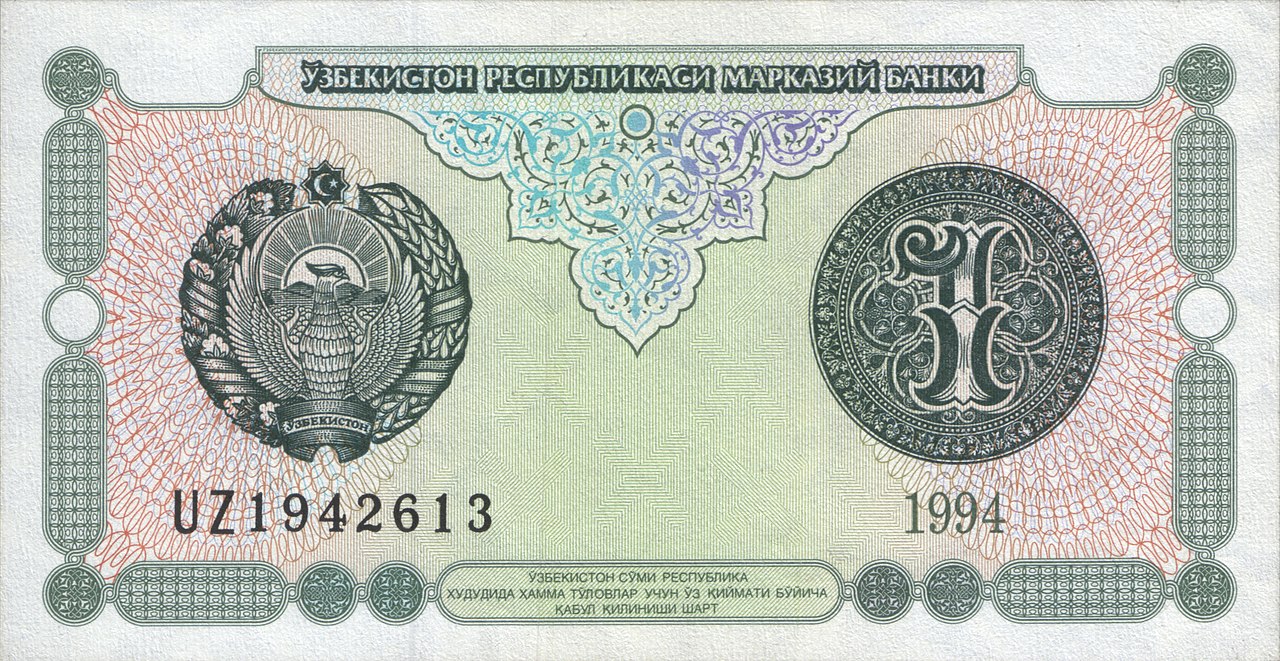 |  | 1 sum | Green and pink | National emblem of Uzbekistan | Alisher Navoi Opera and Ballet Theater in Tashkent | 1994 | 1 July 1994 | 1 March 2020[6] |
 |  | 3 sum | Red | Chashma-Ayub Mausoleum in Bukhara | ||||
 |  | 5 sum | Blue and orange | National emblem of Uzbekistan and Islamic pattern | Alisher Navoi Monument in Tashkent | |||
 |  | 10 sum | Purple | Gur-e Amir in Samarkand | ||||
 |  | 25 sum | Blue and pink | Shah-i-Zinda Complex in Samarkand | ||||
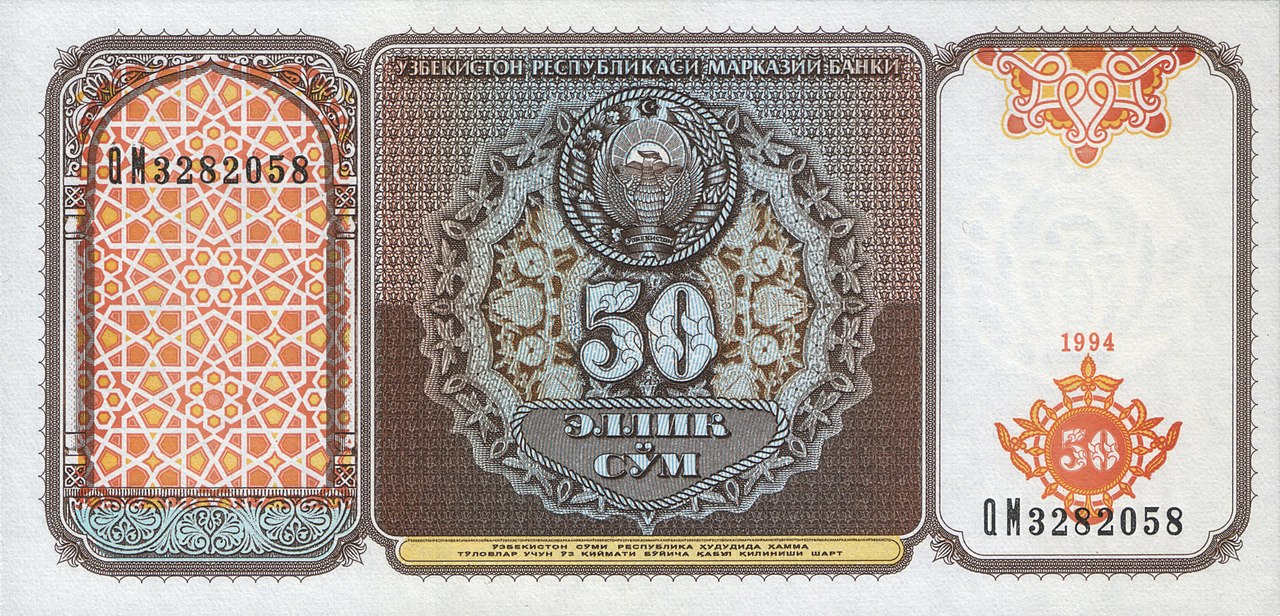 |  | 50 sum | Brown | The three Madrasahs of the Registan in Samarkand | 1 July 2019[10] | |||
 |  | 100 sum | Purple | Palace of Friendship of Peoples in Tashkent | ||||
 |  | 200 sum | Green | National emblem of Uzbekistan | Detail of a tiger mosaic (Shir o Khorshid) on the Sherdor Madrasah at the Registan in Samarkand | 1997 | 1 March 1997[11] | 1 July 2020[6] |
|  | 500 sum | Red and some green | Statue of Amir Temur (Tamerlane) in Tashkent | 1999 | 1 June 2000[11] | ||
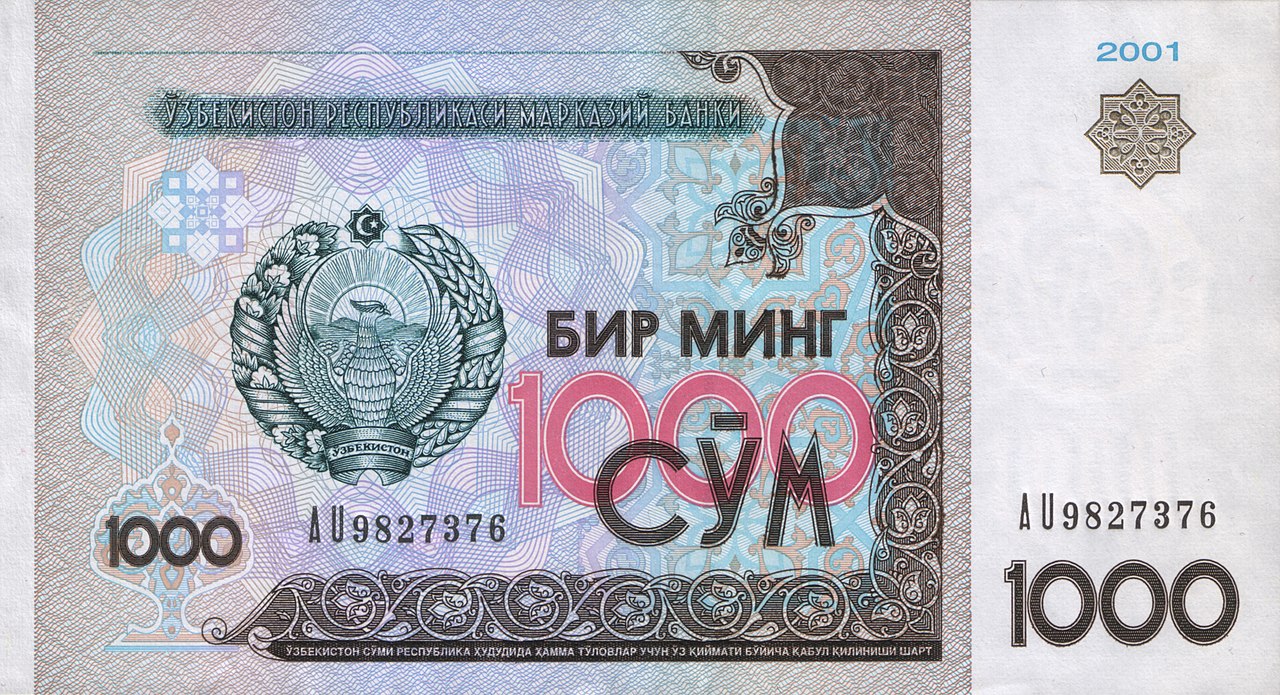 |  | 1,000 sum | Grey | Amir Timur Museum in Tashkent | 2001 | 1 September 2001[11] | Current | |
 |  | 5,000 sum | Green | National Assembly (Oliy Majlis) in Tashkent | 2013 | 1 July 2013 | ||
_obvers.jpg/1280px-10000_soms_of_Uzbekistan_(2017)_obvers.jpg) | _reverse.jpg/1280px-10000_soms_of_Uzbekistan_(2017)_reverse.jpg) | 10,000 sum | Blue | Senate (Senat) in Tashkent | 2017 | 10 March 2017 | ||
_obverse.jpg/1280px-50000_soms_of_Uzbekistan_(2017)_obverse.jpg) | _reverse.jpg/1280px-50000_soms_of_Uzbekistan_(2017)_reverse.jpg) | 50,000 sum | Violet | National emblem of Uzbekistan; top of the “Ezgulik” ark in Independence Square in Tashkent | Palace of Conventions (Anjumanlar Saroyi) in Tashkent | 22 August 2017 | ||
 |  | 100,000 sum | Orange and light brown | National emblem of Uzbekistan; Mirzo Ulugbek; solar system | Mirzo Ulugbek Observatory in Samarkand; map of Uzbekistan | 2019 | 25 February 2019 | |
| These images are to scale at 0.7 pixel per millimetre (18 pixel per inch). For table standards, see the banknote specification table. | ||||||||
| Image | Value | Dimensions | Main colour | Description | Date of | Ref. | |||||
|---|---|---|---|---|---|---|---|---|---|---|---|
| Obverse | Reverse | Obverse | Reverse | Watermark | printing | issue | |||||
 |  | 2,000 sum | 142 × 69 mm | Red | Bukhara Arch, caravan routes on map of Uzbekistan, Honatlas textile patterns, National emblem of Uzbekistan | Varahsha ruins of the ancient caravan route Poykend, clay pot and artifact, camel | Camel and "2000" | 2021 | 14 June 2021 | [12] | |
 |  | 5,000 sum | Green | Sherdor madrasasi in Samarkand, National emblem of Uzbekistan | Archaeological Monuments of Afrosiyob belonging to the 8th-5th centuries BC, Archeological find of a 10th-century pottery jug and an embossed ceramic bowl found in the ruins of Afrosiyob | Camel and "5000" | 20 August 2021 | [13] | |||
 |  | 10,000 sum | 147 × 69 mm | Blue | Great Silk Road, Architectural monument Kokaldosh madrasasi in Tashkent, National emblem of Uzbekistan | Oldest monument in the territory of Tashkent, which dates back to the 1st century BC - Shoshtepa archaeological monument, Ancient ceramics of Tashkent, pottery of 10th-12th century, and household utensils of the 10th century | Camel and "10000" | [14] | |||
 |  | 20,000 sum | Indigo | Koi Krylgan Kala archeology site, caravan routes on map of Uzbekistan, textile patterns, National emblem of Uzbekistan | 6th-century pottery from Aral and Caspian Seas, embroidery design | Camel and "20000" | 14 June 2021 | [15] | |||
 |  | 50,000 sum | Purple | Al-Hakim At-Termiziy Maqbarasi in Surxondaryo, caravan routes on map of Uzbekistan, National emblem of Uzbekistan | Fayoztepa Arxeologiya Yodgorligi ancient archaeological monument in Surxondaryo, flying dove, 17th-century pottery from Sopollitepa | Camel and "50000" | 22 December 2021 | [16] | |||
 |  | 100,000 sum | 152 × 69 mm | Orange | Ichan Qal’a museum in Khiva, Khorezm, caravan routes on map of Uzbekistan, National emblem of Uzbekistan | Angkaqal’a Archeologiya Yodgorligi fortress in Khorezm, 1st-century BC silver coin, 10th-century pottery from Khorezm | Camel and "100000" | [17] | |||
|  | 200,000 sum | Cyan | Xudoyorxon O’rdasi (Khan’s Palace) in Kokand, Fergana, caravan routes on map of Uzbekistan, National emblem of Uzbekistan | Axsikent Arxeologiya Yodgorligi (ancient archaeological monument) in ancient Fergana, pomegranate, double-headed snake and ceramic bowl | Camel and "200000" | 2022 | 15 July 2022 | [18] | ||
| These images are to scale at 0.7 pixel per millimetre (18 pixel per inch). For table standards, see the banknote specification table. | |||||||||||
Exchange rates
[edit]At its introduction on 1 July 1994, 1 US dollar was equal to 25 sum.
2017 reform
[edit]On 2 September 2017, President of Uzbekistan Shavkat Mirziyoyev issued a decree "On priority measures of liberalizing foreign exchange policy".[19] The reform took effect on 5 September 2017. The currency was untethered from its US dollar peg and started to float. As a result the sum's exchange rate to the US dollar increased from 4,210 Uzbek sum to 8,100 Uzbek sum. The new rate was even weaker than the sum's black-market convertibility of about 7,700 to the dollar. Restrictions on the amount of foreign currencies individuals and companies could buy were also abolished on the same day.[20]
| Current UZS exchange rates | |
|---|---|
| From Google Finance: | AUD CAD CHF CNY EUR GBP HKD JPY USD |
| From Yahoo! Finance: | AUD CAD CHF CNY EUR GBP HKD JPY USD |
| From XE.com: | AUD CAD CHF CNY EUR GBP HKD JPY USD |
| From OANDA: | AUD CAD CHF CNY EUR GBP HKD JPY USD |
See also
[edit]- Earlier currencies
Notes
[edit]References
[edit]- ^ a b "ISO4217 AMENDMENT NUMBER 76 - 1994-07-12" (PDF).
- ^ "The Global History of Currencies - Russia". Archived from the original on 4 January 2007. Retrieved 12 November 2017.
- ^ U.S. Department of State (February 1994). "Uzbekistan Economic Policy and Trade Practices". Archived from the original on 2010-07-10. Retrieved 19 September 2015.
- ^ a b c Schuler, Kurt. "Tables of Modern Monetary History: Asia".
- ^ Gray, Laura (26 February 2013). "The most worthless coin in the world". BBC News. Retrieved 12 November 2017.
- ^ a b c d e f g h "СТАРУЮ МЕЛОЧЬ МОЖНО ОБМЕНЯТЬ НА НОВУЮ ДО 1 МАРТА 2020 ГОДА".
- ^ a b c "В обращение выходят новые монеты". 28 June 2018.
- ^ a b "Монеты". www.cbu.uz. Archived from the original on 2019-04-24. Retrieved 2019-01-08.
- ^ "banknotes". Retrieved 12 November 2017.
- ^ "Центральный банк Республики Узбекистан — Сообщение Центрального банка Республики Узбекистан" (in Russian). cbu.uz. Archived from the original on 2022-05-17. Retrieved 2018-05-26.
- ^ a b c "Узбекскому суму исполнилось 20 лет" (in Russian). gazeta.uz. 30 June 2014. Retrieved 2019-01-05.
- ^ "2 000 soum". Central Bank of the Republic of Uzbekistan. Tashkent. 16 February 2022. Archived from the original on 27 December 2022. Retrieved 27 December 2022.
- ^ "5 000 soum". Central Bank of the Republic of Uzbekistan. Tashkent. 29 October 2021. Archived from the original on 27 December 2022. Retrieved 27 December 2022.
- ^ "10 000 soum". Central Bank of the Republic of Uzbekistan. Tashkent. 29 October 2021. Archived from the original on 27 December 2022. Retrieved 27 December 2022.
- ^ "20 000 soum". Central Bank of the Republic of Uzbekistan. Tashkent. 16 February 2022. Archived from the original on 27 December 2022. Retrieved 27 December 2022.
- ^ "50 000 soum". Central Bank of the Republic of Uzbekistan. Tashkent. 17 February 2022. Archived from the original on 27 December 2022. Retrieved 27 December 2022.
- ^ "100 000 soum". Central Bank of the Republic of Uzbekistan. Tashkent. 17 February 2022. Archived from the original on 27 December 2022. Retrieved 27 December 2022.
- ^ "200 000 soum". Central Bank of the Republic of Uzbekistan. Tashkent. 15 September 2022. Archived from the original on 27 December 2022. Retrieved 27 December 2022.
- ^ The Government portal of the Republic of Uzbekistan (2017-09-05). "Starting from 5 September 2017, the exchange rate of the Central Bank is set at 8100 UZS for 1 USD". Retrieved 8 September 2017.
- ^ Radio Free Europe/Radio Liberty (2017-09-05). "Uzbekistan Devalues Currency As It Emerges From Decades-Long Isolation". Radio Free Europe/Radio Liberty. Retrieved 8 September 2017.
Sources
[edit]- Krause, Chester L.; Clifford Mishler (2003). 2004 Standard Catalog of World Coins: 1901–Present. Colin R. Bruce II (senior editor) (31st ed.). Krause Publications. ISBN 0873495934.
- Cuhaj, George S., ed. (2005). Standard Catalog of World Paper Money: Modern Issues 1961-Date (11th ed.). Krause Publications. ISBN 0-89689-160-7.
External links
[edit].svg)


| Oʻzbek soʻmi Ўзбек сўми اۉزبېک سۉمى (Uzbek) | |
|---|---|
200,000 sum banknote (2022) | |
| ISO 4217 | |
| Code | UZS (numeric: 860) |
| Subunit | 0.01 |
| Plural | The language(s) of this currency do(es) not have a morphological plural distinction. |
| Denominations | |
| Subunit | |
| 1⁄100 | Tiyin |
| Banknotes | |
| Freq. used | 2,000, 5,000, 10,000, 20,000, 50,000, 100,000, 200,000 sum |
| Rarely used | 1,000 sum |
| Coins | |
| Freq. used | 50, 100, 200, 500, 1,000 sum |
| Rarely used | 50 sum |
| Demographics | |
| Date of introduction | 11 July 1994[1] |
| Replaced | Soviet ruble[1] |
| User(s) |  Uzbekistan Uzbekistan |
| Issuance | |
| Central bank | Central Bank of the Republic of Uzbekistan (Oʻzbekiston Respublikasi Markaziy Banki) |
| Website | www.cbu.uz |
| Valuation | |
| Inflation | 8.8% |
| Source | [1], November 2023 |
The sum[a] (ISO code: UZS) is the official currency of Uzbekistan. Uzbekistan replaced the ruble with the sum at par on 16 July 1994. No subdivisions of this sum were initially issued and only banknotes were produced, in denominations of 1, 3, 5, 10, 25, 50, 100, 200, 500, 1,000, 5,000, and 10,000 sum. Further series, however, have introduced coins and a subunit, the tiyin. Because it was meant to be a transitional currency, the original design used during the first years of the republic was rather simplistic.
Etymology
The official name of the Soviet currency in the Kazakh, Kyrgyz, Tajik, and Uzbek languages was the som, and this name appeared written on the back of banknotes, among the texts for the value of the note in all 15 official languages of the USSR. This word translates as 'pure' in several Turkic languages, and is derived from the Proto-Turkic *som, meaning 'pure' or 'solid'. The word implies pure silver or gold.
First sum
History
Like other republics of the former Soviet Union, Uzbekistan continued using the Soviet/Russian ruble after independence. On 26 July 1993, a new series of Russian ruble was issued and the old Soviet/Russian ruble ceased to be legal tender in Russia.[2][3] Some successor states had their national currencies before the change, some chose to continue using the pre-1993 Soviet/Russian ruble, and some chose to use both the pre-1993 and the new Russian ruble. Tables of modern monetary history: Asia[4] implies that both old and new rubles were used in Uzbekistan.
Uzbekistan replaced the ruble with the sum at par in on 15 November 1993.[4] No subdivisions of this sum were issued and only banknotes were produced, in denominations of 1, 3, 5, 10, 25, 50, 100, 200, 500, 1,000, 5,000, and 10,000 sum. Because it was meant to be a transitional currency, the design was rather simplistic. All notes had the Coat of arms on the obverse, and Sher-Dor Madrasah of the Registan in Samarkand on the reverse.
Coins
No coins were issued for the first sum.
Banknotes
The first banknotes were issued by the State Bank of Uzbekistan in 1993. All of the denominations share the same designs: the Coat of arms of Uzbekistan on the front and the madrasahs on Registan Square in Samarkand.
| Image | Value | Dimensions (mm) | |
|---|---|---|---|
| Obverse | Reverse | ||
| | 1 sum | 120×61 |
| | 3 sum | |
| | 5 sum | |
| | 10 sum | |
| | 25 sum | |
| | 50 sum | 144×69 |
| | 100 sum | |
| | 200 sum | |
| | 500 sum | |
| | 1,000 sum | |
| | 5,000 sum | |
| | 10,000 sum | |
Second sum
History
On 1 July 1994,[4] a second sum was introduced at a rate of 1 new sum = 1,000 old sum. This sum is subdivided into 100 tiyin.
Inflation
Until 2013, the largest denomination of Uzbek currency was the 1,000-sum banknote, then worth US$0.60, requiring Uzbeks to carry large bundles of notes for routine transactions.
Back in 2019, a new largest denomination was issued, the 100,000-sum banknote (as of October 2019 worth US$10.55), which made the situation easier. The smallest denomination, the 1 tiyin, is worth less than 1⁄9400 of a US cent making it the "world's most worthless coin" that was still legal tender until 1 March 2020. However, coins and banknotes smaller than 50 sum are rare now.[5]
The rampant inflation situation is considered a politically sensitive issue in Uzbekistan, which is why the Uzbek government is slow to acclimate the currency to its current value by issuing higher coin and note denominations. As a result, the current highest coin denomination in circulation is the 500 sum while the highest banknote denomination is the 200,000 sum. Official state figures put inflation as of the first half of 2011 at 3.6%, however accurate numbers are pinned far higher. Coins and banknotes below 50 sum are practically worthless now.
Coins
Three series of coins have been issued for the second sum. They can be easily distinguished by the script used for the Uzbek language. The first series was written in Cyrillic script, while the second and third series is written in Latin script.
First series (1994–2000)
| Image | Value | Technical parameters | Description | Date of | |||||||||||
|---|---|---|---|---|---|---|---|---|---|---|---|---|---|---|---|
| Diameter | Mass | Composition | Edge | Obverse | Reverse | minting | issue | withdrawal | lapse | ||||||
| 1 tiyin | 16,9 mm | 1,75 g | Brass-clad steel | Smooth | Coat of arms with 12 stars State title | Value, year of minting | 1994 | July 1994 | 1 March 2020[6] | 1 January 2021[6] | ||||
| 3 tiyin | 19,9 mm | 2,7 g | Reeded | |||||||||||
| 5 tiyin | 17 mm | 1,8 g | ||||||||||||
| 10 tiyin | 18,7 mm | 2,85 g | Nickel-clad steel | |||||||||||
| 20 tiyin | 22 mm | 4 g | Inscription: “ЙИГИРМА ТИЙИН ЙИГИРМА ТИЙИН” | |||||||||||
| 50 tiyin | 23,9 mm | 4,8 g | Inscription: “ЭЛЛИК ТИЙИН * ЭЛЛИК ТИЙИН * ЭЛЛИК ТИЙИН” | |||||||||||
| 1 sum | 19,8 mm | 2,72 g | Smooth | 1997, 1998, 1999 | 1997 | |||||||||
| 5 sum | 22,2 mm | 4 g | ||||||||||||
| 10 sum | 24 mm | 4,7 g | 1997, 1998, 1999, 2000 | |||||||||||
| These images are to scale at 2.5 pixels per millimetre. For table standards, see the coin specification table. | |||||||||||||||
Second series (2000–2004)
| Second Series | |||||||||||
|---|---|---|---|---|---|---|---|---|---|---|---|
| Image | Value | Technical parameters | Description | Date of minting | Withdrawal | ||||||
| Diameter | Mass | Composition | Edge | Obverse | Reverse | ||||||
| 1 sum | 18.4 mm | 2.83 g | Stainless steel | Reeded | Coat of arms without stars Bank title, year of minting | Value, map of Uzbekistan | 2000 | 1 March 2020[6] | ||
| 5 sum | 21.2 mm | 3.35 g | Brass-clad steel | Plain | Coat of arms without stars Bank title, year of minting | Value, map of Uzbekistan | 2001 | 1 March 2020[6] | ||
| 10 sum | 19.75 mm | 2.71 g | Nickel-clad steel | Plain | Coat of arms without stars Bank title, year of minting | Value, map of Uzbekistan | 2001 | 1 March 2020[6] | ||
| | 50 sum | 26.1 mm | 8 g | Plain and reeded sections | Coat of arms without stars Bank title, year of minting | Value, map of Uzbekistan | 2001 | 1 July 2019[7] | ||
 | 50 sum | 26.1 mm | 7.9 g | Value, statue and ruin of Shahrisabz | 2002 | 1 July 2019[7] | |||||
| | 100 sum | 26.9 mm | 7.9 g | Nickel-plated steel | Inscription | Coat of arms without stars Bank title, year of minting | Value, map of Uzbekistan, sunrays | 2004 | 1 July 2019[7] | |
| These images are to scale at 2.5 pixels per millimetre. For table standards, see the coin specification table. | |||||||||||
Third series (2018–2022)
In May 2018 the introduction of new coins valued 50, 100, 200 and 500 sum was announced. All previously issued banknotes and coins of those denominations were to be withdrawn from circulation by 1 July 2020. In December 2022, the Central Bank of the Republic of Uzbekistan introduced a 1,000 sum coin into circulation, notable as it is the first bi-metallic coin issued for circulation since the introduction of the Uzbek sum in 1994.
| Third series (2018)[8] | |||||||||||||||
|---|---|---|---|---|---|---|---|---|---|---|---|---|---|---|---|
| Image | Value | Technical parameters | Description | Date of | |||||||||||
| Diameter | Mass | Composition | Edge | Obverse | Reverse | minting | issue | withdrawal | lapse | ||||||
| 50 sum | 18.0 mm | 2.0g | Nickel-plated steel | Plain | Denomination | National emblem of Uzbekistan, year of minting | 2018 | 2 July 2018[6] | Current | |||||
| 100 sum | 20.0 mm | 2.5 g | Independence and Goodness monument, Tashkent | |||||||||||
| 200 sum | 22.0 mm | 3.3 g | Detail of a tiger mosaic on the Sher-Dor Madrasah at the Registan in Samarkand | |||||||||||
| 500 sum | 24.0 mm | 3.9 g | Palace of Conventions (Anjumanlar Saroyi) in Tashkent | |||||||||||
| These images are to scale at 2.5 pixels per millimetre. For table standards, see the coin specification table. | |||||||||||||||
| Third series (2022)[8] | |||||||||||||||
|---|---|---|---|---|---|---|---|---|---|---|---|---|---|---|---|
| Image | Value | Technical parameters | Description | Date of | |||||||||||
| Diameter | Mass | Composition | Edge | Obverse | Reverse | minting | issue | withdrawal | lapse | ||||||
| 1,000 sum | 26.27 mm | 7.3 g | Brass-plated copper center in a nickel ring | Plain | Center of Islamic Civilization (Islom Sivilzatsiyasi Markazi) in Tashkent | National emblem of Uzbekistan, year of minting | 2022 | 26 December 2022 | Current | ||||||
| These images are to scale at 2.5 pixels per millimetre. For table standards, see the coin specification table. | |||||||||||||||
Banknotes
The second and current series, issued by the Central Bank of the Republic of Uzbekistan, was released in 1994 in denominations of 1, 3, 5, 10, 25, 50, and 100 sum. A 200 sum banknote was issued in 1997, the 500 sum in 1999, the 1,000 sum in 2001, the 5,000 sum in 2013, the 10,000 sum on 10 March 2017, the 50,000 sum on 22 August 2017 and the 100,000 sum on 25 February 2019. The latter four denominations feature inscriptions in Latin-based Uzbek as opposed to Uzbek Cyrillic in banknotes of 1 to 1,000 Uzbek sum. On 14 June 2021, the Central Bank of the Republic of Uzbekistan issued the 2,000 and 20,000 sum banknotes to help bridge the gap between 1,000 and 5,000 sum as well as 10,000 and 50,000 sum. On 18 June 2021, the Central Bank of the Republic of Uzbekistan issued new 5,000 and 10,000 sum banknotes, utilizing the design templates of the 2,000 and 20,000 sum banknotes. In that same year, the Central Bank of the Republic of Uzbekistan issued new 50,000 and 100,000 sum banknotes as part of a new series of banknotes first introduced with the 2,000 and 20,000 sum banknotes. An entirely new 200,000 sum banknote was issued on 15 July 2022.
| 1994-2019 Series[9] | ||||||||
|---|---|---|---|---|---|---|---|---|
| Image | Value | Main Colour | Description | Date of printing | Date of first issue | withdrawal | ||
| Obverse | Reverse | Obverse | Reverse | |||||
| | 1 sum | Green and pink | National emblem of Uzbekistan | Alisher Navoi Opera and Ballet Theater in Tashkent | 1994 | 1 July 1994 | 1 March 2020[6] |
| | 3 sum | Red | Chashma-Ayub Mausoleum in Bukhara | ||||
| | 5 sum | Blue and orange | National emblem of Uzbekistan and Islamic pattern | Alisher Navoi Monument in Tashkent | |||
| | 10 sum | Purple | Gur-e Amir in Samarkand | ||||
| | 25 sum | Blue and pink | Shah-i-Zinda Complex in Samarkand | ||||
| | 50 sum | Brown | The three Madrasahs of the Registan in Samarkand | 1 July 2019[10] | |||
| | 100 sum | Purple | Palace of Friendship of Peoples in Tashkent | ||||
| | 200 sum | Green | National emblem of Uzbekistan | Detail of a tiger mosaic (Shir o Khorshid) on the Sherdor Madrasah at the Registan in Samarkand | 1997 | 1 March 1997[11] | 1 July 2020[6] |
| | 500 sum | Red and some green | Statue of Amir Temur (Tamerlane) in Tashkent | 1999 | 1 June 2000[11] | ||
| | 1,000 sum | Grey | Amir Timur Museum in Tashkent | 2001 | 1 September 2001[11] | Current | |
| | 5,000 sum | Green | National Assembly (Oliy Majlis) in Tashkent | 2013 | 1 July 2013 | ||
| | 10,000 sum | Blue | Senate (Senat) in Tashkent | 2017 | 10 March 2017 | ||
| | 50,000 sum | Violet | National emblem of Uzbekistan; top of the “Ezgulik” ark in Independence Square in Tashkent | Palace of Conventions (Anjumanlar Saroyi) in Tashkent | 22 August 2017 | ||
 |  | 100,000 sum | Orange and light brown | National emblem of Uzbekistan; Mirzo Ulugbek; solar system | Mirzo Ulugbek Observatory in Samarkand; map of Uzbekistan | 2019 | 25 February 2019 | |
| These images are to scale at 0.7 pixel per millimetre (18 pixel per inch). For table standards, see the banknote specification table. | ||||||||
| Image | Value | Dimensions | Main colour | Description | Date of | Ref. | |||||
|---|---|---|---|---|---|---|---|---|---|---|---|
| Obverse | Reverse | Obverse | Reverse | Watermark | printing | issue | |||||
| | 2,000 sum | 142 × 69 mm | Red | Bukhara Arch, caravan routes on map of Uzbekistan, Honatlas textile patterns, National emblem of Uzbekistan | Varahsha ruins of the ancient caravan route Poykend, clay pot and artifact, camel | Camel and "2000" | 2021 | 14 June 2021 | [12] | |
| | 5,000 sum | Green | Sherdor madrasasi in Samarkand, National emblem of Uzbekistan | Archaeological Monuments of Afrosiyob belonging to the 8th-5th centuries BC, Archeological find of a 10th-century pottery jug and an embossed ceramic bowl found in the ruins of Afrosiyob | Camel and "5000" | 20 August 2021 | [13] | |||
| | 10,000 sum | 147 × 69 mm | Blue | Great Silk Road, Architectural monument Kokaldosh madrasasi in Tashkent, National emblem of Uzbekistan | Oldest monument in the territory of Tashkent, which dates back to the 1st century BC - Shoshtepa archaeological monument, Ancient ceramics of Tashkent, pottery of 10th-12th century, and household utensils of the 10th century | Camel and "10000" | [14] | |||
| | 20,000 sum | Indigo | Koi Krylgan Kala archeology site, caravan routes on map of Uzbekistan, textile patterns, National emblem of Uzbekistan | 6th-century pottery from Aral and Caspian Seas, embroidery design | Camel and "20000" | 14 June 2021 | [15] | |||
| | 50,000 sum | Purple | Al-Hakim At-Termiziy Maqbarasi in Surxondaryo, caravan routes on map of Uzbekistan, National emblem of Uzbekistan | Fayoztepa Arxeologiya Yodgorligi ancient archaeological monument in Surxondaryo, flying dove, 17th-century pottery from Sopollitepa | Camel and "50000" | 22 December 2021 | [16] | |||
| | 100,000 sum | 152 × 69 mm | Orange | Ichan Qal’a museum in Khiva, Khorezm, caravan routes on map of Uzbekistan, National emblem of Uzbekistan | Angkaqal’a Archeologiya Yodgorligi fortress in Khorezm, 1st-century BC silver coin, 10th-century pottery from Khorezm | Camel and "100000" | [17] | |||
| | 200,000 sum | Cyan | Xudoyorxon O’rdasi (Khan’s Palace) in Kokand, Fergana, caravan routes on map of Uzbekistan, National emblem of Uzbekistan | Axsikent Arxeologiya Yodgorligi (ancient archaeological monument) in ancient Fergana, pomegranate, double-headed snake and ceramic bowl | Camel and "200000" | 2022 | 15 July 2022 | [18] | ||
| These images are to scale at 0.7 pixel per millimetre (18 pixel per inch). For table standards, see the banknote specification table. | |||||||||||
Exchange rates
At its introduction on 1 July 1994, 1 US dollar was equal to 25 sum.
2017 reform
On 2 September 2017, President of Uzbekistan Shavkat Mirziyoyev issued a decree "On priority measures of liberalizing foreign exchange policy".[19] The reform took effect on 5 September 2017. The currency was untethered from its US dollar peg and started to float. As a result the sum's exchange rate to the US dollar increased from 4,210 Uzbek sum to 8,100 Uzbek sum. The new rate was even weaker than the sum's black-market convertibility of about 7,700 to the dollar. Restrictions on the amount of foreign currencies individuals and companies could buy were also abolished on the same day.[20]
| Current UZS exchange rates | |
|---|---|
| From Google Finance: | AUD CAD CHF CNY EUR GBP HKD JPY USD |
| From Yahoo! Finance: | AUD CAD CHF CNY EUR GBP HKD JPY USD |
| From XE.com: | AUD CAD CHF CNY EUR GBP HKD JPY USD |
| From OANDA: | AUD CAD CHF CNY EUR GBP HKD JPY USD |
See also
- Earlier currencies
Notes
References
- ^ a b "ISO4217 AMENDMENT NUMBER 76 - 1994-07-12" (PDF).
- ^ "The Global History of Currencies - Russia". Archived from the original on 4 January 2007. Retrieved 12 November 2017.
- ^ U.S. Department of State (February 1994). "Uzbekistan Economic Policy and Trade Practices". Archived from the original on 2010-07-10. Retrieved 19 September 2015.
- ^ a b c Schuler, Kurt. "Tables of Modern Monetary History: Asia".
- ^ Gray, Laura (26 February 2013). "The most worthless coin in the world". BBC News. Retrieved 12 November 2017.
- ^ a b c d e f g h "СТАРУЮ МЕЛОЧЬ МОЖНО ОБМЕНЯТЬ НА НОВУЮ ДО 1 МАРТА 2020 ГОДА".
- ^ a b c "В обращение выходят новые монеты". 28 June 2018.
- ^ a b "Монеты". www.cbu.uz. Archived from the original on 2019-04-24. Retrieved 2019-01-08.
- ^ "banknotes". Retrieved 12 November 2017.
- ^ "Центральный банк Республики Узбекистан — Сообщение Центрального банка Республики Узбекистан" (in Russian). cbu.uz. Archived from the original on 2022-05-17. Retrieved 2018-05-26.
- ^ a b c "Узбекскому суму исполнилось 20 лет" (in Russian). gazeta.uz. 30 June 2014. Retrieved 2019-01-05.
- ^ "2 000 soum". Central Bank of the Republic of Uzbekistan. Tashkent. 16 February 2022. Archived from the original on 27 December 2022. Retrieved 27 December 2022.
- ^ "5 000 soum". Central Bank of the Republic of Uzbekistan. Tashkent. 29 October 2021. Archived from the original on 27 December 2022. Retrieved 27 December 2022.
- ^ "10 000 soum". Central Bank of the Republic of Uzbekistan. Tashkent. 29 October 2021. Archived from the original on 27 December 2022. Retrieved 27 December 2022.
- ^ "20 000 soum". Central Bank of the Republic of Uzbekistan. Tashkent. 16 February 2022. Archived from the original on 27 December 2022. Retrieved 27 December 2022.
- ^ "50 000 soum". Central Bank of the Republic of Uzbekistan. Tashkent. 17 February 2022. Archived from the original on 27 December 2022. Retrieved 27 December 2022.
- ^ "100 000 soum". Central Bank of the Republic of Uzbekistan. Tashkent. 17 February 2022. Archived from the original on 27 December 2022. Retrieved 27 December 2022.
- ^ "200 000 soum". Central Bank of the Republic of Uzbekistan. Tashkent. 15 September 2022. Archived from the original on 27 December 2022. Retrieved 27 December 2022.
- ^ The Government portal of the Republic of Uzbekistan (2017-09-05). "Starting from 5 September 2017, the exchange rate of the Central Bank is set at 8100 UZS for 1 USD". Retrieved 8 September 2017.
- ^ Radio Free Europe/Radio Liberty (2017-09-05). "Uzbekistan Devalues Currency As It Emerges From Decades-Long Isolation". Radio Free Europe/Radio Liberty. Retrieved 8 September 2017.
Sources
- Krause, Chester L.; Clifford Mishler (2003). 2004 Standard Catalog of World Coins: 1901–Present. Colin R. Bruce II (senior editor) (31st ed.). Krause Publications. ISBN 0873495934.
- Cuhaj, George S., ed. (2005). Standard Catalog of World Paper Money: Modern Issues 1961-Date (11th ed.). Krause Publications. ISBN 0-89689-160-7.
External links
- Coins of Uzbekistan at CISCoins.net
.svg/1280px-Asia_(orthographic_projection).svg.png)


_obvers.jpg)
_reverse.jpg)
_obverse.jpg)
_reverse.jpg)


