現代の物理学や高度な数学、さらには最新の機械学習において不可欠な概念となっているのがテンソルです。一見すると複雑な多次元配列のように見えますが、その本質は異なる数学的オブジェクト(スカラー、ベクトルなど)の間の「多重線形な関係」を記述する代数的な道具にあります。
テンソルは特定の座標系に依存せず、空間の性質を普遍的に表現できるため、一般相対性理論のような曲がった時空を扱う理論や、物質内部の応力を解析する連続体力学などで強力な武器となります。
Key Facts
- 本質的な定義:ベクトル空間に関連付けられたオブジェクト間の多重線形関係を記述する代数的な物体。
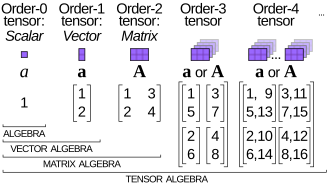
- 階数(オーダー):テンソルの次元を示す指標。0階はスカラー、1階はベクトル、2階は行列(線形写像)に相当する。
- 座標独立性:基底(座標系)を変更しても、特定の変換則に従うため、物理的な実体は不変に保たれる。
- 広範な応用:一般相対性理論の曲率テンソル、流体力学の応力テンソル、量子力学のテンソル積など。
テンソルの基礎概念と階数
テンソルを理解する最も簡単な方法は、それを「階数(オーダー)」という概念で分類することです。階数とは、そのテンソルを特定するために必要なインデックス(添え字)の数、あるいは多次元配列としての次元数に相当します。
- 0階テンソル:単なる数値であるスカラーです(例:温度、曲率スカラー)。
- 1階テンソル:方向と大きさを持つベクトルです(例:速度、勾配)。
- 2階テンソル:ベクトルを別のベクトルへ変換する線形写像であり、行列として表現されます(例:慣性モーメント、計量テンソル)。
このように、私たちが日常的に扱うスカラーやベクトルは、実はテンソルという大きな概念の最も単純なケースに過ぎません。
多重線形写像としての視点
数学的な厳密な定義では、テンソルは多重線形写像として捉えられます。これは、複数のベクトルを入力として受け取り、最終的に一つのスカラー(または別のテンソル)を出力する関数のようなものです。この写像は、各引数に対して線形であるという特性を持っています。
物理学における実用的な応用
テンソルが物理学で重宝される最大の理由は、空間のあらゆる点において異なる物理量が存在し、かつそれが方向によって変化する場合を簡潔に記述できるからです。このような、空間の各点にテンソルが割り当てられた状態をテンソル場と呼びます。
連続体力学と応力
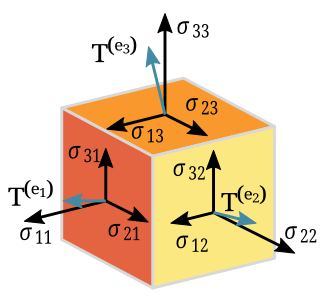
例えば、物体内部の「応力」を考える際、ある面にかかる力は、その面の向き(法線ベクトル)によって異なります。この関係を記述するのがコーシー応力テンソル(2階テンソル)です。これにより、物質内部の複雑な力の分布を数学的に正確に表現できます。
相対性理論と電磁気学
アインシュタインの一般相対性理論では、時空の歪みを表すリーマン曲率テンソルや、物質の分布を表すエネルギー・運動量テンソルが中心的な役割を果たします。また、電磁気学においても、電場と磁場を統合して扱う電磁テンソル(ファラデーテンソル)が利用されています。
テンソルの数学的性質と操作
テンソルを扱う上で重要なのが、座標変換に対する挙動です。テンソルは、基底が変更された際に特定の変換則(共変および反変の変換)に従います。これにより、観測者がどのような座標系を用いていても、物理的な現象としての本質が変わらないことが保証されます。
主な演算
- テンソル積:2つのテンソルを組み合わせて、より高い階数の新しいテンソルを作成する操作です。
- 縮約(コントラクション):特定のインデックスをペアにして足し合わせることで、テンソルの階数を下げる操作です。
| 階数 (Order) | 名称 | 数学的表現 | 物理的な具体例 |
|---|---|---|---|
| 0 | スカラー | 単一の数値 | 質量、温度、曲率スカラー |
| 1 | ベクトル | 1次元配列 | 速度、力、勾配 |
| 2 | 2階テンソル | 2次元行列 | 応力テンソル、計量テンソル |
| 3以上 | 高階テンソル | 多次元配列 | リーマン曲率テンソル、弾性テンソル |
歴史的背景
テンソル解析は、19世紀末にグレゴリオ・リッチ=クルバストロによって「絶対微分形式」として体系化されました。その後、トゥリオ・レヴィ=チヴィタらによって普及し、ベルンハルト・リーマンらの微分幾何学の成果を継承して発展しました。この数学的枠組みがあったからこそ、アインシュタインは一般相対性理論を構築することができたと言われています。
Frequently Asked Questions
テンソルと行列は何が違うのですか?
行列は単なる数値の2次元配列ですが、テンソルは「座標変換に対して特定のルールに従う」という性質を持つ数学的オブジェクトです。2階テンソルを行列形式で表現することはできますが、すべての行列がテンソルであるわけではなく、テンソルとしての変換特性を持つものだけがテンソルと呼ばれます。
「共変」と「反変」とはどういう意味ですか?
これは座標系を変更したときに、成分がどのように変化するかを示す区別です。基底の変化と同じ方向に変化する成分を「反変」、基底の変化と逆方向に変化する成分を「共変」と呼びます。これにより、異なる種類のベクトル(例:位置ベクトルと勾配ベクトル)を厳密に区別できます。
機械学習で使われる「テンソル」は数学的なテンソルと同じですか?
機械学習(TensorFlowなど)で使われるテンソルは、主に「多次元配列(n-dimensional array)」という意味で使われています。数学や物理学で定義される「座標変換則に従うオブジェクト」という厳密な定義とは異なる場合が多いですが、データ構造としての形式は共通しています。
テンソルの階数を上げるにはどうすればいいですか?
一般的に「テンソル積」という操作を行います。例えば、1階テンソル(ベクトル)と1階テンソルをテンソル積で結ぶと、2階テンソルが生成されます。これにより、より複雑な多重線形関係を構築することが可能です。
References
- The Einstein summation convention, in brief, requires the sum to be taken over all values of the index whenever the same symbol appears as a subscript and superscript in the same term. For example, under this convention
- The , for instance, is used to identify V with the double dual space V∗∗, which consists of multilinear forms of degree one on V∗. It is typical in linear algebra to identify spaces that are naturally isomorphic, treating them as the same space.
- Namely, the in a vector space.

📸 フォトギャラリー