物質の表面は、内部(バルク)とは全く異なる物理的特性を持つ特殊な領域です。結晶構造を持つ固体において、表面は周期的なポテンシャルの突然の終端を意味し、この不連続性が表面状態(Surface States)と呼ばれる特有の電子状態を生み出します。表面状態は、物質の最外層に近い原子層にのみ存在し、材料の化学的反応性や電気的特性に決定的な影響を与えます。
Key Facts
- 表面状態の定義:結晶の周期性が途切れる表面近傍にのみ局在する電子状態。
- 発生原因:バルクの周期的なポテンシャルから真空レベルへの急激な変化による。
- エネルギー位置:多くの場合、バルクのエネルギーバンドギャップ(禁制帯)内に位置する。
- 主要な分類:ほぼ自由電子近似に基づく「ショックレー状態」と、強結合近似に基づく「タム状態」がある。
- 観測手法:ARPES(角度分解光電子分光)やSTM(走査型トンネル顕微鏡)を用いて解析される。
結晶界面における電子状態の起源
完全な周期性を持つ結晶内部では、電子の状態はブロッホの定理に従い、ブロッホ波として記述されます。しかし、表面が形成されると、表面に垂直な方向の周期性が失われるため、境界条件が変化し、バルクとは異なる電子挙動が現れます。
理想的なモデルでは、結晶内部の周期的なポテンシャルが表面で急激に真空レベルへと跳ね上がるステップ関数として表現されます。実際には、表面双極子の形成や像電荷の影響により、ポテンシャルは緩やかに真空レベルへ移行します。
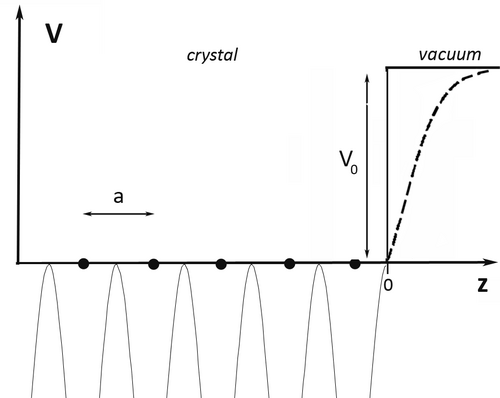
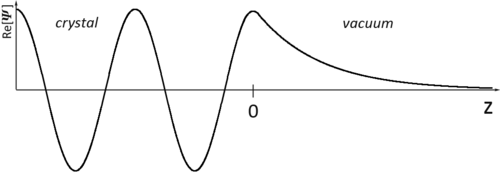
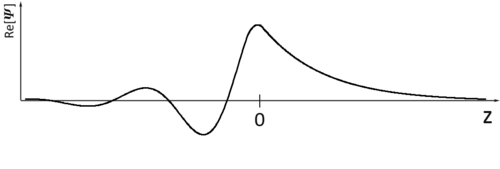
このポテンシャル条件下でのシュレーディンガー方程式の解は、大きく分けて2つのタイプに分類されます。一つはバルク内部まで広がっており、真空側へ指数関数的に減衰する「バルク状態」です。もう一つは、真空側だけでなくバルク内部方向へも指数関数的に減衰し、表面近傍にのみ閉じ込められた「表面状態」です。
ショックレー状態とタム状態の相違
表面状態は、その理論的アプローチによって主に「ショックレー状態」と「タム状態」に区別されます。厳密な物理的境界はありませんが、記述方法と適用対象が異なります。
ショックレー状態 (Shockley States)
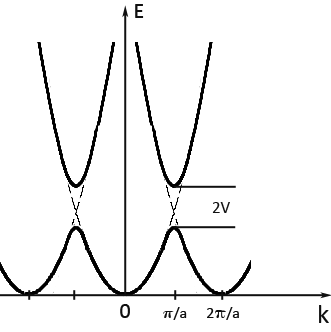
ほぼ自由電子近似を用いて導出される状態で、主に純粋で理想的な表面において、結晶の終端に伴うポテンシャル変化のみから生じます。これは通常の金属やバンドギャップの狭い半導体の記述に適しており、バルク内では指数関数的に減衰するブロッホ波のような性質を持ちます。
タム状態 (Tamm States)
強結合近似(Tight-binding model)に基づき、原子軌道の線形結合(LCAO)として記述される状態です。表面原子は片側の結合相手を失っているため、軌道の重なりが減少し、エネルギー準位がバルクとは異なる値にシフトします。これにより、遷移金属やワイドギャップ半導体のような系を適切に説明でき、局在化した原子軌道に近い性質を示します。
金属および半導体における表面状態の特性
金属表面では、電子の波関数が真空側へわずかに染み出すことで、表面直下に負電荷の不足し、直外に電荷が増加する「双極子二重層」が形成されます。これが金属の仕事関数を変化させる要因となります。
半導体においては、ブリルアンゾーン境界でのブラッグ反射によりエネルギーバンドが分裂し、禁制帯(バンドギャップ)が形成されます。表面状態のエネルギーがこのギャップ内に位置する場合、電子はバルク内部へ浸透できず、表面に強く局在します。
3次元結晶への拡張と表面共鳴
3次元結晶の場合、表面に平行な方向には周期性が維持されるため、表面状態は平行方向の波ベクトル $k_{||}$ を持つ2次元的なバンド構造を形成します。ここで、表面状態のエネルギーがバルク状態のエネルギーと重ならない場合は「真の表面状態」と呼ばれますが、両者が縮退して混ざり合った場合は表面共鳴(Surface Resonance)となり、表面で振幅が大きくなりつつもバルク深くまで浸透する性質を持ちます。
表面状態の分類と実験的観測
表面状態は、その由来によって以下のように分類されます。
- 固有表面状態(Intrinsic):清浄で秩序ある表面や、表面再構成によって生じる状態。
- 外因性表面状態(Extrinsic):欠陥、吸着物、異種材料との界面(半導体-酸化物など)、あるいは固液界面など、不完全な表面に起因する状態。
これらの状態を観測するための主要な手法として、電子の放出角とエネルギーを精密に測定するARPES(角度分解光電子分光)や、表面の電子密度分布を直接的に捉えるSTM(走査型トンネル顕微鏡)が用いられます。
最新の理論的知見
伝統的な理論(FowlerやSeitzら)では、有限長の1次元結晶の両端にペアで表面状態が現れると考えられてきました。しかし近年の研究では、周期的な微分方程式の数学的理論に基づき、各バンドギャップにおいて、結晶の両端合わせて「最大で1つ」の表面状態しか存在し得ないという新しい結論が導き出されています。これにより、表面状態の存在は周期性の切断位置に強く依存することが明らかになりました。
まとめ:表面状態の特性比較
| 比較項目 | ショックレー状態 | タム状態 |
|---|---|---|
| 理論的アプローチ | ほぼ自由電子近似 | 強結合近似 (LCAO) |
| 主な適用対象 | 単純金属、狭ギャップ半導体 | 遷移金属、ワイドギャップ半導体 |
| 物理的イメージ | ポテンシャル終端による波の反射 | 表面原子の未結合軌道(ダングリングボンド) |
| 局在性 | 表面近傍に局在 | 原子的に局在 |
Frequently Asked Questions
表面状態とは具体的にどのような状態ですか?
結晶の内部では周期的な電位(ポテンシャル)によって電子のエネルギー範囲が決まっていますが、表面ではその周期性が途切れます。この境界条件の変化により、バルク内部では存在できないエネルギー(禁制帯内)を持つ電子が、表面付近にのみ安定して存在できるようになります。これが表面状態です。
ショックレー状態とタム状態の決定的な違いは何ですか?
計算手法と視点の違いです。ショックレー状態は「電子がほぼ自由に動ける」という前提から、表面という壁による反射で生じると考えます。一方、タム状態は「電子は原子に強く束縛されている」という前提から、表面原子の結合相手がいないことによるエネルギー変化から生じると考えます。
表面共鳴とは何ですか?
表面状態のエネルギーが、たまたまバルク状態のエネルギー範囲と重なったときに起こる現象です。完全に表面に閉じ込められるのではなく、バルク内部へ漏れ出しますが、表面付近では依然として電子密度が高くなっている状態を指します。
表面状態をどのようにして測定しますか?
代表的な手法にARPESがあります。これは光を照射して飛び出してきた電子のエネルギーと角度を測ることで、表面電子のエネルギー分散(k空間での分布)を直接的にマッピングする手法です。また、STMを用いて表面の電子波の干渉パターンを観察することでも解析可能です。
ダングリングボンドとは何ですか?
タム状態の説明に関連して、半導体などの表面で結合相手を失い、表面外へ突き出した未結合の軌道のことです。これらは高いエネルギーを持ち、化学的に非常に活性であるため、表面の反応性に大きく寄与します。
References
- Sidney G. Davison; Maria Steslicka (1992). Basic Theory of Surface States. Clarendon Press. .
- C. Kittel (1996). . Wiley. pp. 80–150. .
- K. Oura; V.G. Lifshifts; A.A. Saranin; A. V. Zotov; M. Katayama (2003). "11". Surface Science. Springer-Verlag, Berlin Heidelberg New York.
- Feng Duan; Jin Guojin (2005). "7". Condensed Matter Physics:Volume 1. World Scientific. .
- W. Shockley (1939). "On the Surface States Associated with a Periodic Potential". Phys. Rev. 56 (4): 317–323. :1939PhRv...56..317S. :10.1103/PhysRev.56.317.
- I. Tamm (1932). "On the possible bound states of electrons on a crystal surface". Phys. Z. Sowjetunion. 1: 733.
- Hasan, M. Z.; Kane, C. L. (2010). "Colloquium: Topological insulators". Rev. Mod. Phys. 82 (4): 3045–3067. :1002.3895. :2010RvMP...82.3045H. :10.1103/revmodphys.82.3045. 0034-6861. 16066223.
- Frederick Seitz; Henry Ehrenreich; David Turnbull (1996). Solid State Physics. Academic Press. pp. 80–150. .
- Oka, H.; et al. (2014). "Spin-polarized quantum confinement in nanostructures: Scanning tunneling microscopy". Rev. Mod. Phys. 86 (4): 1127. :2014RvMP...86.1127O. :10.1103/RevModPhys.86.1127. Retrieved 3 September 2021.
- Fowler, R.H. (1933). "Notes on some electronic properties of conductors and insulators". Proceedings of the Royal Society of London. Series A, Containing Papers of a Mathematical and Physical Character. 141 (843): 56–71. :1933RSPSA.141...56F. :10.1098/rspa.1933.0103. 122900909.
📸 フォトギャラリー