Mathematical generalization of boundedness
数学 、特に 関数解析 において 、 集合 X上の ボルノロジー(boronology)とは、 有界性 の概念を一般化する公理を満たす X の部分集合の集合である 。ボルノロジーとボルノロジー解析の背後にある重要な動機の一つは、 ボルノロジー空間が関数解析における ホモロジー代数 の便利な設定を提供するという事実である 。これは 、[1] 9ページ によれば、ボルノロジー空間の 圏 が 加法的 、 完全 、 共完全であり、 内部ホモロジー代数 に 随伴する テンソル積を持つためであり 、これらはすべてホモロジー代数に必要な要素である。
歴史 ボルノロジーは関数解析 から派生した 。関数解析の問題を研究する自然な方法は2つある。1つは位相に関する概念( ベクトル位相 、 連続演算子 、 開集合 / コンパクト集合など)を研究することであり、もう1つは有界性 に関する概念 ( ベクトルボルノロジー 、 有界演算子 、 有界部分集合 など)を研究することである。
関数解析の起源となったノルム空間 では 、位相概念とボルノロジー概念は異なるが互いに補完し合い、密接に関連している。たとえば、原点を中心とする単位球は、 原点の近傍 であると同時に有界部分集合でもある。さらに、ノルム空間の部分集合が 原点の近傍 である(それぞれ、 は 有界集合 である )のは、まさにこの球の非ゼロのスカラー倍 を含む (それぞれ、 に含まれる )ときである。したがって、これは位相概念とボルノロジー概念が異なるが互いに補完し合っている(定義が と のどちらを使用するか によってのみ異なるという意味で )一例である。場合によっては、位相概念とボルノロジー概念の区別が不要なこともある。たとえば、ノルム空間間の線型写像では、 連続であること(位相概念)は 有界で あること(ボルノロジー概念)と同義である 。位相とボルノロジーの区別は、ノルム空間では曖昧であったり不要であったりすることが多いが、ノルム空間の一般化を研究するときにはより重要になる。それにもかかわらず、ボルノロジーとトポロジーは、一つの同じ現実の二つの必要かつ異なる、そして補完的な側面として考えることができます。 ⊆ {\displaystyle \,\subseteq \,} ⊇ {\displaystyle \,\supseteq \,}
位相ベクトル空間 の一般理論は 、まずノルム空間の理論から生まれ、次に位相ベクトル空間の一般理論からボルノロジー(位相ベクトル空間の概念)が生まれたが、ボルノロジーはその後、 関数解析 における基本概念として認識されるようになった。 ジョージ・マッキー ( マッキー空間は 彼にちなんで名付けられている)
の研究から生まれた 有界部分集合の重要性は、特に マッキー・アレンズ定理 と マッキー位相 によって、 双対性理論 において初めて明らかになった。
1950 年代頃から、位相ベクトル空間はある主要な問題の研究には不十分であることが明らかになった。
たとえば、いくつかの重要な 位相代数 の乗算演算は連続ではなかったが、多くの場合有界であった。
TVSが不十分であることが判明した他の主要な問題としては、より一般的な微分積分理論の開発、 (通常の)スカラー値分布からベクトル値分布や作用素値分布への 分布の一般化、そして ゲルファント の正則 関数解析 (主に バナッハ代数 や局所凸代数と連携している)をより広い作用素のクラス( スペクトルがコンパクトでないものも含む)に拡張することなどが挙げられる。ボルノロジーはこれらの問題やその他の問題、特に 代数幾何学 や 一般位相幾何学の 問題 を調査するための有用なツールであることが判明している 。
定義 集合上の 集合論 とは 、有限和集合と部分集合をとる集合の 被覆である。集合論の元は 有界集合 と呼ばれる。
明確に言えば、 ボルノロジー または 集合 の 有界 性 は 、 X {\displaystyle X} B ≠ ∅ {\displaystyle {\mathcal {B}}\neq \varnothing } X {\displaystyle X}
B {\displaystyle {\mathcal {B}}} 包含 または 下向きに閉じている : のあらゆる部分集合は の要素である B ∈ B {\displaystyle B\in {\mathcal {B}}} B {\displaystyle B} B . {\displaystyle {\mathcal {B}}.} 平易な英語 で言えば 、これは、有界集合のサブセットが有界であることを意味します。 B {\displaystyle {\mathcal {B}}} カバーする の すべての点は 何らかの要素である か、または同値である。 X : {\displaystyle X:} X {\displaystyle X} B ∈ B , {\displaystyle B\in {\mathcal {B}},} X = ⋃ B ∈ B B . {\displaystyle X={\textstyle \bigcup \limits _{B\in {\mathcal {B}}}B}.} (1)を仮定すると、この条件は次のように置き換えることができる: 簡単に言えば、これはすべての点が有界であることを意味する。 x ∈ X , {\displaystyle x\in X,} { x } ∈ B . {\displaystyle \{x\}\in {\mathcal {B}}.} B {\displaystyle {\mathcal {B}}} は 有限和集合に対して安定で ある: の有限個の元の 和集合は の元である。あるいは、 に属する任意の 2つの 集合の和集合 も に属する。 B {\displaystyle {\mathcal {B}}} B , {\displaystyle {\mathcal {B}},} B {\displaystyle {\mathcal {B}}} B . {\displaystyle {\mathcal {B}}.} 平易に言えば、2 つの有界集合の和集合は有界集合であるということです。 この場合、そのペア は ( X , B ) {\displaystyle (X,{\mathcal {B}})} 境界構造 または ボルノロジー集合 。
したがって、集合論は、二項和の 下で閉じている下向きの閉被覆として同値に定義できる 。有限和の下で閉じており、部分集合を取る(性質(1)および(3))空でない集合族は、 イデアル と呼ばれる(ブール代数 / すべての部分 集合からなる 集合体 における イデアル であるため )。したがって、集合上の集合論は、 以下を覆うイデアルとして同値に定義できる。 X {\displaystyle X} X . {\displaystyle X.}
の元 は - 有界集合 または単に B {\displaystyle {\mathcal {B}}} B {\displaystyle {\mathcal {B}}} が理解されていれば、 有界集合 s は 有界となる。性質(1)と(2)は、 のあらゆる単集合部分集合が s 上のあらゆる集合論の元となる 、性質(3)は、 のあらゆる有限部分集合についても同じことが成り立つことを保証する 。言い換えれば、点と有限部分集合は、あらゆる集合論において常に有界である。特に、空集合は常に有界である。 B {\displaystyle {\mathcal {B}}} X {\displaystyle X} X ; {\displaystyle X;} X . {\displaystyle X.}
が有界構造である 場合、 補集合 は(適切な) フィルタ と呼ばれ、 ( X , B ) {\displaystyle (X,{\mathcal {B}})} X ∉ B , {\displaystyle X\notin {\mathcal {B}},} { X ∖ B : B ∈ B } {\displaystyle \{X\setminus B:B\in {\mathcal {B}}\}} 無限遠フィルタ [ は、常に 自由フィルタ であり、定義により、空の交差/ 核を 。 なぜなら、 { x } ∈ B {\displaystyle \{x\}\in {\mathcal {B}}} x ∈ X . {\displaystyle x\in X.}
ベースとサブベース と が 上 の成育学 ... A {\displaystyle {\mathcal {A}}} B {\displaystyle {\mathcal {B}}} X {\displaystyle X} B {\displaystyle {\mathcal {B}}} より細かく、 または よりも 強く 、また 、 A {\displaystyle {\mathcal {A}}} A {\displaystyle {\mathcal {A}}} 粗い または より も 弱い B {\displaystyle {\mathcal {B}}} A ⊆ B . {\displaystyle {\mathcal {A}}\subseteq {\mathcal {B}}.}
集合の 族 は A {\displaystyle {\mathcal {A}}} ベース または ボルノロジーの 基本システム であり、 任意のボルノロジー に対して 、 B {\displaystyle {\mathcal {B}}} A ⊆ B {\displaystyle {\mathcal {A}}\subseteq {\mathcal {B}}} B ∈ B , {\displaystyle B\in {\mathcal {B}},} A ∈ A {\displaystyle A\in {\mathcal {A}}} B ⊆ A . {\displaystyle B\subseteq A.}
集合の族 は S {\displaystyle {\mathcal {S}}} 集合の有限和集合の集合が の基底を形成する 場合、 ボルノロジーの サブベースとなる。 B {\displaystyle {\mathcal {B}}} S ⊆ B {\displaystyle {\mathcal {S}}\subseteq {\mathcal {B}}} S {\displaystyle {\mathcal {S}}} B . {\displaystyle {\mathcal {B}}.}
誕生学のあらゆるベースは、そのサブベースでもあります。
生成された誕生学 上の(1つ以上の)ボルノロジーの集合の積は、 再び 上のボルノロジーとなる。
ボルノロジーのそのような積は を覆う。 なぜなら、 上のすべてのボルノロジーは のすべての有限部分集合を含むからである (つまり、 が 上のボルノロジーであり 、 が有限ならば )。そのような積は(部分集合の)包含と有限和に関しても閉じていることが容易に証明され、したがって 上のボルノロジーとなる。 X {\displaystyle X} X . {\displaystyle X.} X {\displaystyle X} X {\displaystyle X} X {\displaystyle X} B {\displaystyle {\mathcal {B}}} X {\displaystyle X} F ⊆ X {\displaystyle F\subseteq X} F ∈ B {\displaystyle F\in {\mathcal {B}}} X . {\displaystyle X.}
最小のボルノロジー の部分集合の 集合を与えられたとき、その 集合 は S {\displaystyle {\mathcal {S}}} X , {\displaystyle X,} X {\displaystyle X} S {\displaystyle {\mathcal {S}}} によって生成されたボルノロジー S {\displaystyle {\mathcal {S}}} 。 含む
上のすべてのボルノロジーの共通部分と等しい の 冪集合 は常に 上のボルノロジーである の部分集合 族はすべて 上の少なくとも1つのボルノロジーに必ず含まれる ため、この共通部分は明確に定義されている。 X {\displaystyle X} S {\displaystyle {\mathcal {S}}} ℘ ( X ) {\displaystyle \wp (X)} X {\displaystyle X} X , {\displaystyle X,} S {\displaystyle {\mathcal {S}}} X {\displaystyle X} X . {\displaystyle X.}
境界付き地図 とが有界構造である と仮定する 。写像 は ( X , A ) {\displaystyle (X,{\mathcal {A}})} ( Y , B ) {\displaystyle (Y,{\mathcal {B}})} f : X → Y {\displaystyle f:X\to Y} 局所的に境界のある地図 、あるいは単に 有界写像 とは、任意の - 有界集合 像 - 有界集合である場合である。つまり、任意の f {\displaystyle f} A {\displaystyle {\mathcal {A}}} B {\displaystyle {\mathcal {B}}} A ∈ A , {\displaystyle A\in {\mathcal {A}},} f ( A ) ∈ B . {\displaystyle f(A)\in {\mathcal {B}}.}
二つの局所有界写像の合成もまた局所有界なので、すべての有界構造のクラスは、 その 射が有界写像であるような 圏 を形成することは明らかである。 この圏における 同型は、 ボルノモルフィズム であり、その逆写像も局所的に有界 な である
境界付きマップの例 が2つの位相ベクトル空間(必ずしもハウスドルフ空間ではない)間の連続線型作用素である 場合、 および が フォン・ノイマン分布に 従うとき、それは有界線型作用素である。ここで、集合が有界となるのは、原点のすべての近傍に吸収されるときである(これらはTVSの部分集合であり、他の分布が明示的に指定されていない場合には通常、有界であると言われる)。逆は一般に偽である。 f : X → Y {\displaystyle f:X\to Y} X {\displaystyle X} Y {\displaystyle Y}
2つのTVS間の 連続 写像 は必然的に局所的に有界となる。 f : X → Y {\displaystyle f:X\to Y}
一般的な建設 離散的誕生学
任意の集合 の 冪 集合 は、と呼ばれる ボルノロジーである。 X , {\displaystyle X,} ℘ ( X ) {\displaystyle \wp (X)} X {\displaystyle X} X {\displaystyle X} 離散的ボルノロジー [ は の部分集合である ので、 離散的ボルノロジーは 上の最良ボルノロジーである。 が有界構造である場合、(ボルノロジーは下向きに閉じているため)
が 離散的ボルノロジーである場合、かつその場合のみ、 X {\displaystyle X} ℘ ( X ) , {\displaystyle \wp (X),} X . {\displaystyle X.} ( X , B ) {\displaystyle (X,{\mathcal {B}})} B {\displaystyle {\mathcal {B}}} X ∈ B . {\displaystyle X\in {\mathcal {B}}.}
不連続な誕生学
任意の集合に対して、 その有限部分集合全体の集合は、 と呼ばれる ボルノロジーである。 X , {\displaystyle X,} X {\displaystyle X} X {\displaystyle X} 非離散的ボルノロジー 。これは、あらゆるボルノロジーの部分集合 であることを意味する、最も粗いボルノロジーである。 X , {\displaystyle X,} X . {\displaystyle X.}
有界基数集合
の可算 部分集合 全体の集合は 、上のボルノロジーである。
より一般的には、任意の無限 基数 に対して、最大で以下 の基数を持つ の部分集合全体の集合は、 上のボルノロジーである。 X {\displaystyle X} X . {\displaystyle X.} κ , {\displaystyle \kappa ,} X {\displaystyle X} κ {\displaystyle \kappa } X . {\displaystyle X.}
逆イメージボルノロジー が写像で が 上のボルノロジーである 場合、 は によって生成されるボルノロジーを表し、これは 逆像ボルノロジー またはによって 上 に誘導される 初期ボルノロジー と呼ばれる f : S → X {\displaystyle f:S\to X} B {\displaystyle {\mathcal {B}}} X , {\displaystyle X,} [ f − 1 ( B ) ] {\displaystyle \left[f^{-1}({\mathcal {B}})\right]} f − 1 ( B ) := { f − 1 ( B ) : B ∈ B } , {\displaystyle f^{-1}({\mathcal {B}}):=\left\{f^{-1}(B):B\in {\mathcal {B}}\right\},} f {\displaystyle f} S . {\displaystyle S.}
を集合とし、 を有界構造の -添字族 とし 、を -添字族の写像 とし、
任意 の S {\displaystyle S} ( T i , B i ) i ∈ I {\displaystyle \left(T_{i},{\mathcal {B}}_{i}\right)_{i\in I}} I {\displaystyle I} ( f i ) i ∈ I {\displaystyle \left(f_{i}\right)_{i\in I}} I {\displaystyle I} f i : S → T i {\displaystyle f_{i}:S\to T_{i}} i ∈ I . {\displaystyle i\in I.} これらの写像によって決定される逆像ボルノロジー は 各写像を局所的に有界にすること に関する最も強いボルノロジーである に等しい。 A {\displaystyle {\mathcal {A}}} S {\displaystyle S} S {\displaystyle S} f i : ( S , A ) → ( T i , B i ) {\displaystyle f_{i}:(S,{\mathcal {A}})\to \left(T_{i},{\mathcal {B}}_{i}\right)} ⋂ i ∈ I [ f − 1 ( B i ) ] . {\displaystyle {\textstyle \bigcap \limits _{i\in I}\left[f^{-1}\left({\mathcal {B}}_{i}\right)\right]}.}
直接イメージ形成学 を集合とし、 を有界構造の -添字族 とし 、を -添字族の写像 とし、
任意 の S {\displaystyle S} ( T i , B i ) i ∈ I {\displaystyle \left(T_{i},{\mathcal {B}}_{i}\right)_{i\in I}} I {\displaystyle I} ( f i ) i ∈ I {\displaystyle \left(f_{i}\right)_{i\in I}} I {\displaystyle I} f i : T i → S {\displaystyle f_{i}:T_{i}\to S} i ∈ I . {\displaystyle i\in I.} これらの写像によって決定されるの 直接像ボルノロジーは 、それぞれを局所的に有界にする の最も弱いボルノロジーである 。各 に対して が によって生成されるボルノロジーを表す 、それぞれ と有限個を の形 の の すべての部分集合の集合に等しい 。 A {\displaystyle {\mathcal {A}}} S {\displaystyle S} S {\displaystyle S} f i : ( T i , B i ) → ( S , A ) {\displaystyle f_{i}:\left(T_{i},{\mathcal {B}}_{i}\right)\to (S,{\mathcal {A}})} i ∈ I , {\displaystyle i\in I,} A i {\displaystyle {\mathcal {A}}_{i}} f ( B i ) , {\displaystyle f\left({\mathcal {B}}_{i}\right),} A {\displaystyle A} S {\displaystyle S} ∪ i ∈ I A i {\displaystyle \cup _{i\in I}A_{i}} A i ∈ A i {\displaystyle A_{i}\in {\mathcal {A}}_{i}} A i {\displaystyle A_{i}}
亜空間誕生学 が有界構造で あり、その
部分 集合であるとする。 ( X , B ) {\displaystyle (X,{\mathcal {B}})} S {\displaystyle S} X . {\displaystyle X.} の部分空間ボルノロジー は の 包含写像 ( によって定義される に にすること に関する最も優れたボルノロジーである 。 A {\displaystyle {\mathcal {A}}} S {\displaystyle S} S {\displaystyle S} ( S , A ) → ( X , B ) {\displaystyle (S,{\mathcal {A}})\to (X,{\mathcal {B}})} S {\displaystyle S} X {\displaystyle X} s ↦ s {\displaystyle s\mapsto s}
製品誕生学 を有界構造の -添字族 とし 、 各に対して と を標準射影と する。 ( X i , B i ) i ∈ I {\displaystyle \left(X_{i},{\mathcal {B}}_{i}\right)_{i\in I}} I {\displaystyle I} X = ∏ i ∈ I X i , {\displaystyle X={\textstyle \prod \limits _{i\in I}X_{i}},} i ∈ I , {\displaystyle i\in I,} f i : X → X i {\displaystyle f_{i}:X\to X_{i}} 上の 積ボルノロジー は、正準射影によって決定される逆像ボルノロジーである。
つまり、 各正準射影を局所的に有界とした場合の最も強いボルノロジーである。積ボルノロジーの基底は X {\displaystyle X} f i : X → X i . {\displaystyle f_{i}:X\to X_{i}.} X {\displaystyle X} { ∏ i ∈ I B i : B i ∈ B i for all i ∈ I } . {\displaystyle {\textstyle \left\{\prod \limits _{i\in I}B_{i}~:~B_{i}\in {\mathcal {B}}_{i}{\text{ for all }}i\in I\right\}}.}
位相的構成
コンパクトなボルノロジー 位相空間 の部分集合は、 その閉包が の コンパクト部分空間であるとき、 相対的にコンパクト と呼ばれる。
任意の位相空間において、単独部分集合が相対的にコンパクトであるような位相空間 (例えば T1空間 )に対して、 のすべての相対的にコンパクト部分集合の集合は、 と呼ばれる ボルノロジーを形成する。 X {\displaystyle X} X . {\displaystyle X.} X {\displaystyle X} X {\displaystyle X} X {\displaystyle X} T1空間
間の連続写像はすべて、 それらのコンパクトボル ノロジーに関して 有界である。 X . {\displaystyle X.}
の比較的コンパクトな 部分集合 の集合は、 上の成育学である。この成育学の基底は、の 形 の閉区間すべてによって与えられる。 R {\displaystyle \mathbb {R} } R . {\displaystyle \mathbb {R} .} [ − n , n ] {\displaystyle [-n,n]} n = 1 , 2 , 3 , … . {\displaystyle n=1,2,3,\ldots .}
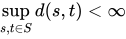
メトリックボーンロジー 距離空間 が与えられると、 距離 分布は、 最大値 が有限であるような すべての部分集合から構成されます 。 ( X , d ) , {\displaystyle (X,d),} S ⊆ X {\displaystyle S\subseteq X} sup s , t ∈ S d ( s , t ) < ∞ {\displaystyle \sup _{s,t\in S}d(s,t)<\infty }
同様に、 測度空間 が与えられた場合、有限測度(つまり )の すべての測定可能な部分集合の族は、 の上の成因学を形成する。 ( X , Ω , μ ) , {\displaystyle (X,\Omega ,\mu ),} S ∈ Ω {\displaystyle S\in \Omega } μ ( S ) < ∞ {\displaystyle \mu (S)<\infty } X . {\displaystyle X.}
閉鎖と内部のボルノロジー が位相空間 であり 、 が上のボルノロジーである とする。 X {\displaystyle X} B {\displaystyle {\mathcal {B}}} X . {\displaystyle X.}
の集合のすべての 位相的内部 の集合によって生成されるボルノロジー (つまり、によって生成されるボルノロジー は、 B {\displaystyle {\mathcal {B}}} { int B : B ∈ B } {\displaystyle \{\operatorname {int} B:B\in {\mathcal {B}}\}} の 内部は で表され、
ボルノロジー は B {\displaystyle {\mathcal {B}}} int B . {\displaystyle \operatorname {int} {\mathcal {B}}.} B {\displaystyle {\mathcal {B}}} 開く 場合 B = int B . {\displaystyle {\mathcal {B}}=\operatorname {int} {\mathcal {B}}.}
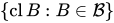
の集合のすべての 位相閉包 の集合によって生成される (つまり、 によって生成される )ボルノロジーは、 B {\displaystyle {\mathcal {B}}} { cl B : B ∈ B } {\displaystyle \{\operatorname {cl} B:B\in {\mathcal {B}}\}} の 閉包は で表され、
必然的に B {\displaystyle {\mathcal {B}}} cl B . {\displaystyle \operatorname {cl} {\mathcal {B}}.} int B ⊆ B ⊆ cl B . {\displaystyle \operatorname {int} {\mathcal {B}}\subseteq {\mathcal {B}}\subseteq \operatorname {cl} {\mathcal {B}}.}
ボルノロジー は B {\displaystyle {\mathcal {B}}} 以下の同等の条件のいずれかを満たす場合は 閉じられます。
B = cl B ; {\displaystyle {\mathcal {B}}=\operatorname {cl} {\mathcal {B}};} の閉部分集合は 生成する ; X {\displaystyle X} B {\displaystyle {\mathcal {B}}} あらゆる閉鎖は に属する B ∈ B {\displaystyle B\in {\mathcal {B}}} B . {\displaystyle {\mathcal {B}}.} ボルノロジー は B {\displaystyle {\mathcal {B}}} が開状態と閉状態の両方を持つ 場合が 適切である B {\displaystyle {\mathcal {B}}}
位相空間 は X {\displaystyle X} 局所的に 有界 B {\displaystyle {\mathcal {B}}} 、または単に 局所的に有界 とは、 近傍が に属する 。局所的に有界な位相空間のすべてのコンパクト部分集合は有界である。 x ∈ X {\displaystyle x\in X} B . {\displaystyle {\mathcal {B}}.}
位相ベクトル空間のボルノロジー が位相ベクトル空間 (TVS)である 場合、 のすべての 有界 部分 集合の集合は 上のボルノロジー(実際には ベクトルボルノロジー でさえ)を形成し 、 と呼ばれる。 X {\displaystyle X} X {\displaystyle X} X {\displaystyle X} のフォン・ノイマン 系統 X {\displaystyle X} 学 通常のボルノロジー 、または単に の 誕生学 は、 X {\displaystyle X} 自然な有界性 。 任意の局所凸 TVS
において、 円板 の集合は、 の基底を形成する。 X , {\displaystyle X,} X . {\displaystyle X.}
2 つのボルノロジー空間 間の線型写像は、 それが(通常のボルノロジーに関して)有界である場合に 限り連続 である。
位相環 が可換位 相環 であるとする。 の 部分 集合は X {\displaystyle X} S {\displaystyle S} X {\displaystyle X} 有界集合 とは、原点の 各近傍に対して、 原点の 近傍が存在し 、 U {\displaystyle U} X , {\displaystyle X,} V {\displaystyle V} X {\displaystyle X} S V ⊆ U . {\displaystyle SV\subseteq U.}
参照
参考文献 ^ Block, Jonathan; Daenzer, Calder (2009-01-09). 「接続のあるガーベのMukai双対性」. arXiv : 0803.1529 [math.QA]. ホグベ=ンレンド、アンリ (1977). ボルノロジーと関数解析:双対性位相幾何学理論入門コース-ボルノロジーと関数解析におけるその応用 . ノースホランド数学研究. 第26巻. アムステルダム, ニューヨーク, ノースホランド. ISBN 978-0-08-087137-0 . MR 0500064. OCLC 316549583. Hogbe-Nlend、Henri (1971)。 「近代動物の歴史」 (PDF) 。 Séminaire Choquet: Initiation à l'analyse (フランス語)。 10 (1): 1–7 . MR 0477660。 カレルラ, SM (1982). 位相ベクトル空間における反例 . 数学講義ノート . 第936巻. ベルリン, ハイデルベルク, ニューヨーク: シュプリンガー・フェアラーク . pp. 29– 33, 49, 104. ISBN 978-3-540-11565-6 . OCLC 8588370。 クリーグル、アンドレアス、ミコール、ピーター・W. (1997). 大域解析の便利な設定 (PDF) . 数学概説とモノグラフ. 第53巻. プロビデンス、ロードアイランド州: アメリカ数学会 . ISBN 978-0-8218-0780-4 . OCLC 37141279。 ナリシ, ローレンス; ベッケンシュタイン, エドワード (2011). 『位相ベクトル空間 』 純粋数学と応用数学(第2版) ボカラトン, フロリダ州: CRC Press. ISBN 978-1584888666 . OCLC 144216834. Schaefer, Helmut H. ; Wolff, Manfred P. (1999). Topological Vector Spaces . GTM . Vol. 8 (Second ed.). New York, NY: Springer New York Imprint Springer. ISBN 978-1-4612-7155-0 . OCLC 840278135。
基本概念 主な結果 地図 セットの種類 集合演算 TVSの種類





![{\displaystyle \left[f^{-1}({\mathcal {B}})\right]}](https://wikimedia.org/api/rest_v1/media/math/render/svg/3b3cf6fe02cecac84879199f71a00f3541ec7f4d)




![{\displaystyle {\textstyle \bigcap \limits _{i\in I}\left[f^{-1}\left({\mathcal {B}}_{i}\right)\right]}.}](https://wikimedia.org/api/rest_v1/media/math/render/svg/5f47083343a30d3bf2ce1c58a945b9f08bcd738e)











![{\displaystyle [-n,n]}](https://wikimedia.org/api/rest_v1/media/math/render/svg/89ffac59008711e9f5013abd9f65f23426f893b5)