タグ

機械学習

18 件の記事

📖

特徴量エンジニアリング機械学習の精度を最大化するデータ変換技術

特徴量エンジニアリング機械学習データ前処理次元削減
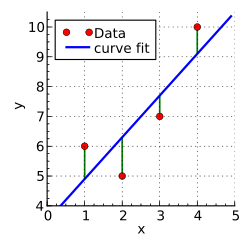
In linear regression, the observations (red) are assumed to be the result of random deviations (green) from an underlying relationship (blue) between a dependent variable (y) and an independent variable (x).

線形回帰分析の基礎から応用までデータ間の関係性を解き明かす統計手法

線形回帰分析最小二乗法単回帰分析重回帰分析
In single variable calculus, a function is typically graphed with the horizontal axis representing the independent variable and the vertical axis representing the dependent variable.[1] In this function, y is the dependent variable and x is the independent variable.

独立変数と従属変数の基礎知識数学・統計学における役割と違い

独立変数従属変数統計学数学
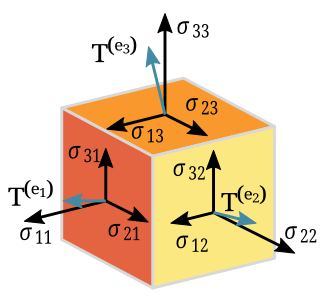
The second-order Cauchy stress tensor T {\displaystyle \mathbf {T} } describes the stress experienced by a material at a given point. For any unit vector v {\displaystyle \mathbf {v} } , the product T ⋅ v {\displaystyle \mathbf {T} \cdot \mathbf {v} } is a vector, denoted T ( v ) {\displaystyle \mathbf {T} (\mathbf {v} )} , that quantifies the force per area along the plane perpendicular to v {\displaystyle \mathbf {v} } . This image shows, for cube faces perpendicular to e 1 , e 2 , e 3 {\displaystyle \mathbf {e} _{1},\mathbf {e} _{2},\mathbf {e} _{3}} , the corresponding stress vectors T ( e 1 ) , T ( e 2 ) , T ( e 3 ) {\displaystyle \mathbf {T} (\mathbf {e} _{1}),\mathbf {T} (\mathbf {e} _{2}),\mathbf {T} (\mathbf {e} _{3})} along those faces. Because the stress tensor takes one vector as input and gives one vector as output, it is a second-order tensor.

テンソルとは何か数学的定義から物理学・機械学習への応用まで

テンソル線形代数多重線形写像物理学
📖

Semantic ScholarAIが加速させる次世代の学術論文検索エンジン

Semantic ScholarAI 論文検索Allen Institute for AI自然言語処理
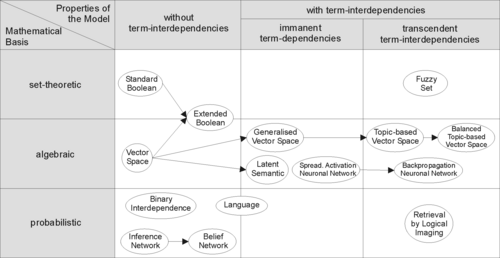
Categorization of IR-models (translated from German entry, original source Dominik Kuropka)

情報検索(IR)の進化とメカニズム古典的モデルから深層学習まで

情報検索IRPageRankBERT