タグ

Beer-Lambert法

3 件の記事

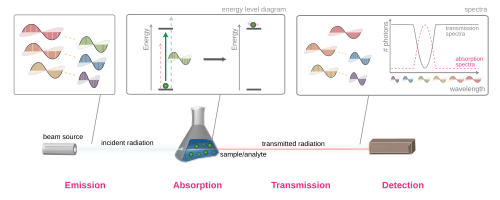
An overview of electromagnetic radiation absorption. This example discusses the general principle using visible light. A white beam source – emitting light of multiple wavelengths – is focused on a sample (the complementary color pairs are indicated by the yellow dotted lines). Upon striking the sample, photons that match the energy gap of the molecules present (green light in this example) are absorbed in order to excite the molecule. Other photons transmit unaffected and, if the radiation is in the visible region (400–700 nm), the sample color is the complementary color of the absorbed light. By comparing the attenuation of the transmitted light with the incident, an absorption spectrum can be obtained.

吸収分光法光の吸収から物質の正体を突き止める分析技術

吸収分光法電磁波分光分析Beer-Lambert法
An overview of absorption of electromagnetic radiation. This example shows the general principle using visible light as a specific example. A white light source—emitting light of multiple wavelengths—is focused on a sample (the pairs of complementary colors are indicated by the yellow dotted lines). Upon striking the sample, photons that match the energy gap of the molecules present (green light in this example) are absorbed, exciting the molecules. Other photons are scattered (not shown here) or transmitted unaffected; if the radiation is in the visible region (400–700 nm), the transmitted light appears as the complementary color (here red). By recording the attenuation of light for various wavelengths, an absorption spectrum can be obtained.

電磁波吸収のメカニズムと科学的応用

電磁波吸収光子減衰吸収係数
An overview of electromagnetic radiation absorption. This example discusses the general principle using visible light. A white beam source – emitting light of multiple wavelengths – is focused on a sample (the complementary color pairs are indicated by the yellow dotted lines). Upon striking the sample, photons that match the energy gap of the molecules present (green light in this example) are absorbed in order to excite the molecule. Other photons transmit unaffected and, if the radiation is in the visible region (400–700 nm), the sample color is the complementary color of the absorbed light. By comparing the attenuation of the transmitted light with the incident, an absorption spectrum can be obtained.

吸収分光法物質の正体を明かす光の解析技術

吸収分光法電磁波分光分析量子状態