BPF Party
Jump to content


BPF Party Партыя БНФ | |
|---|---|
 | |
| Abbreviation | PBNF ПБНФ |
| Leader | Vadzim Sarančukoŭ[1][2][3] |
| Founder | Zianon Pazniak |
| Founded | 30 May 1993 |
| Banned | 14 August 2023 |
| Preceded by | Belarusian Popular Front "Adradžeńnie" |
| Headquarters | 3-39th Building, Čarnyšeŭskaha St, Minsk, Belarus |
| Newspaper | Пагоня, Svaboda |
| Youth wing | BPF Youth |
| Membership (2009) | 1,819 |
| Ideology | |
| Political position | Centre-right[8] to right-wing[4] |
| National affiliation | Belarusian Independence Bloc United Democratic Forces of Belarus |
| European affiliation | European Conservatives and Reformists Party (global partner)[9] |
| International affiliation | International Democracy Union[10] |
| Colours | Red White |
| Slogan | "Long Live Belarus!" (Belarusian: «Жыве Беларусь!») |
| House of Representatives: | 0 / 110 |
| Council of the Republic: | 0 / 64 |
| Party flag | |
_with_Arms_(2020).svg) | |
| Website | |
narodny | |
| Part of a series on |
| Belarusian nationalism |
|---|
 |

The BPF Party[a] (Belarusian: Партыя БНФ, romanized: Partyja BNF; Russian: Партия БНФ, romanized: Partiya BNF) is a banned political party in Belarus. It was de facto established after the split of the social movement Belarusian Popular Front (abbr. BPF; Belarusian: Беларускі Народны Фронт "Адраджэньне", romanized: Bielaruski Narodny Front "Adradžeńnie", БНФ) in 1999. The Belarusian Popular Front was founded during the Perestroika era by members of the Belarusian intelligentsia, including Vasil Bykaŭ. Its first and most charismatic leader was Zianon Pazniak.
After a 2005 decree by president Alexander Lukashenko on the restriction of the usage of the words Беларускі ("Belarusian") and Народны ("National", "Popular", "People's") in the names of political parties and movements,[11] the party had to change its official name to "BPF Party".
Early history
[edit]The Belarusian Popular Front was established in 1988 as both a political party and a cultural movement, following the examples of the Popular Front of Estonia, Popular Front of Latvia and the Lithuanian pro-democracy movement Sąjūdis. Membership was declared open to all Belarusian citizens as well as any democratic organization.
Its alleged goals are democracy and independence through national rebirth and rebuilding after the dissolution of the Soviet Union. The main idea of the Front was the revival of the national idea, including a revival of the Belarusian language. Initially, its orientation was pro-Western with a great deal of scepticism towards Russia.[citation needed]
The party was in favour of removing Russian as an official language in Belarus. Russian became an official language following the 1995 Belarusian referendum, at the beginning of Lukashenko's rule, when a proposal for making Russian a state language received 83.3% support from the turnout.
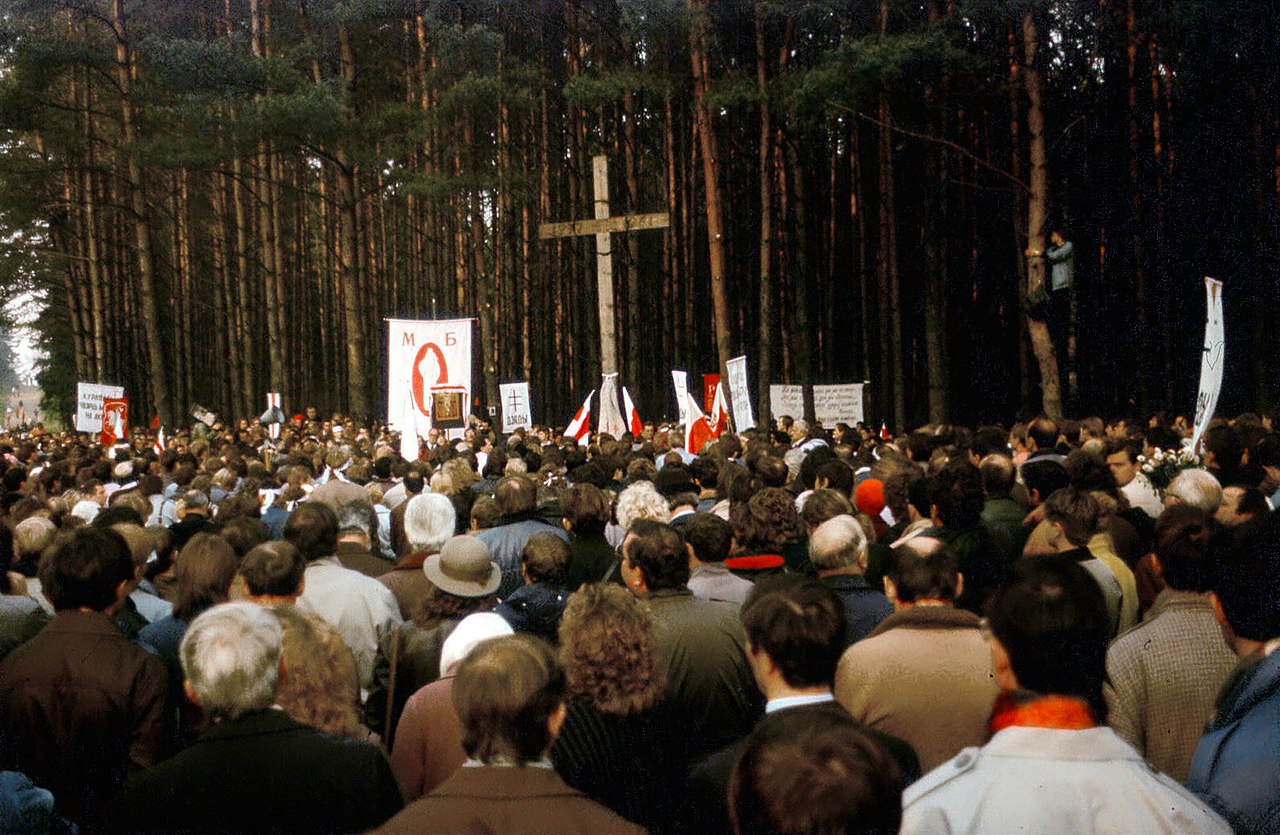
Among the significant achievements of the Front was the uncovering of the burial site of Kurapaty near Minsk. The Front claims that the NKVD performed extrajudicial killings there.
Initially, the Front had significant visibility because of its numerous public actions that almost always ended in clashes with police and KGB. It was BPF parliamentarians who convinced the Supreme Council of Belarus (the interim Belarusian parliament) to restore the previously used Belarusian symbols: the white-red-white flag and the Pahonia coat of arms, modelled after the Coat of arms of Lithuania.[citation needed] During Soviet-times people faced arrest in the streets for displaying white-red-white symbols in Belarus.[citation needed]
In 1994 the BPF formed a so-called "shadow" cabinet consisting of 100 BPF intellectuals. Its first Prime Minister was Vladimir Zablotsky. It originally contained 18 commissions that published ideas and proposed laws and plans for restructuring the government and economy. Its last economic reform proposal was published in 1999. In opposition to Alexander Lukashenko's government, the party supports Belarus' entry into NATO and the European Union.[12]
1999 split
[edit].svg)
In the late 1990s, the Popular Front split into two parties, both of which claim to be the legitimate continuation of the original BPF. The party's conservative wing under Zianon Pazniak became the Conservative Christian Party – BPF (Belarusian: Кансэрватыўна-Хрысьціянская Партыя - БНФ, romanized: Kanservatyŭna-Chryścijanskaja Partyja BNF) while the moderate majority became today's BPF Party.
Modern history, participation in elections
[edit]At the 2004 legislative election the party was part of the People's Coalition 5 Plus (Narodnaja Kaalicyja Piaciorka Plus), which did not secure any seats. These elections fell (according to the OSCE/ODIHR Election Observation Mission[13]) significantly short of OSCE commitments. Universal principles and constitutionally guaranteed rights of expression, association and assembly were seriously violated, calling into question the Belarusian authorities’ willingness to respect the concept of political competition on a basis of equal treatment. According to this mission, the principles of an inclusive democratic process, whereby citizens have the right to seek political office without discrimination, candidates to present their views without obstruction, and voters to learn about them and discuss them freely, were largely ignored.[citation needed]
In October 2005 Alaksandar Milinkievič, a candidate proposed by the BPF and Zialonyja (Belarusian Green Party) was elected the common democratic candidate for the 2006 Presidential election.[citation needed]
During the 2010 presidential election the BPF Party nominated its own candidate for the presidency, Ryhor Kastusiou, who was then the Deputy Chairman of the BPF Party. According to the official results, he gained 1.97% of the votes.[citation needed]
In 2011, following an internal conflict, more than 90 further members left BPF Party, including several prominent veterans of the original Belarusian Popular Front, such as Lyavon Barshchewski, Jury Chadyka, Vincuk Viačorka. This was sometimes described as a "second split" of the Belarusian Popular Front.[14][15]
In the Congress in September 2017, the new party leader Ryhor Kastusioŭ has been elected. The Congress decided also to nominate Alaksiej Janukievič and Belarusian-American attorney Juraś Ziankovič to the presidential office in the next elections. The final decision about the only candidate has to be made in the future.
On 12 April 2021, Kastusiou was reported to have been arrested[16][17] by the Belarusian KGB as part of its crackdown on protestors following the results of the 2020 Belarusian presidential election. Officially Kastusiou and BPF members were accused of trying to organise an illegal coup (in which president Alexander Lukashenko was to be assassinated); the Russian FSB together with the KGB have claimed their arrests did prevent the coup to happen.[18] On 5 September 2022, Kastusiou was sentenced to 10 years in jail by the Minsk Regional Court.[19]
On 14 August 2023 the BPF Party was banned by the Supreme Court of Belarus.[20]
Presidential elections
[edit]| Election | Candidate | First round | Second round | Result | ||
|---|---|---|---|---|---|---|
| Votes | % | Votes | % | |||
| 1994 | Zianon Pazniak | 757,195 | Lost  | |||
| 1999 | Zianon Pazniak | No winner announced | ||||
| 2001 | Endorsed Uładzimir Hančaryk[21] | 965,261 | Lost | |||
| 2006 | Endorsed Alaksandar Milinkievič | 405,486 | Lost | |||
| 2010 | Ryhor Kastusioŭ | 126,999 | Lost | |||
| 2015 | Did not contest | |||||
| 2020 | Alaksiej Janukievich | Not admitted to the elections | ||||
Legislative elections
[edit]| Election | Leader | Performance | Rank | Government | ||||
|---|---|---|---|---|---|---|---|---|
| Votes | % | +/– | Seats | +/– | ||||
| 1995 | Zianon Pazniak | 0 / 260 | New | 17th | Extra-parliamentary | |||
| 2000 | Vincuk Viačorka | Did not contest | Extra-parliamentary | |||||
| 2004 | 200,033 | New | 0 / 110 |  0 0 |  5th 5th | Extra-parliamentary | ||
| 2008 | Lyavon Barshchewski | 72,770 |  1.98 1.98 | 0 / 110 | 0 | 5th | Extra-parliamentary | |
| 2012 | Alaksiej Janukievich | 2,789 | 1.30 | 0 / 110 | 0 | 8th | Extra-parliamentary | |
| 2016 | 88,511 | 1.67 | 0 / 110 | 0 | 6th | Extra-parliamentary | ||
| 2019 | Ryhor Kastusioŭ | 82,403 | 0.16 | 0 / 110 | 0 | 7th | Extra-parliamentary | |
International relations
[edit]The party became an associate member of the International Democracy Union in 2007.
It was an observer member of the European People's Party until 2017. Since 7 April 2017 the party is a member of the Alliance of Conservatives and Reformists in Europe.[9] Its youth wing, BPF Youth, is a member of the European Young Conservatives.
Chairman
[edit]- 2021–Current Vadzim Sarančukoŭ
- 2017–2021: Ryhor Kastusioŭ
- 2009–2017: Alaksiej Janukievich
- 2007–2009: Lyavon Barshchewski[22]
- 1999–2007: Vincuk Viačorka
See also
[edit]- Rada of the Belarusian Democratic Republic - the Belarusian government in exile
- Conservative Christian Party – BPF
Notes
[edit]- ^ "BPF" is derived from a translation of its former name, namely the "Belarusian Popular Front",[8] and not the romanization of the Belarusian acronym БНФ (which is romanized "BNF").
References
[edit]- ^ Старшыня i намесьнiкi старшыні Партыi БНФ Archived 19 July 2018 at the Wayback Machine(in Belarusian)
- ^ "Вадзім Саранчукоў: Партыя БНФ працягвае працаваць".
- ^ "Партыя БНФ працягвае працаваць у Беларусі — Саранчукоў". Archived from the original on 20 November 2022. Retrieved 20 November 2022.
- ^ a b Korosteleva, Elena (2005). "The Emergence of a Party System". Postcommunist Belarus. Rowman & Littlefield. p. 38. ISBN 0-7425-3555-X.
- ^ Tarnauski, Andrei (2005), "The Peculiarities of Party Politics in Belarus, Moldova, and Ukraine: Institutionalization or Marginalization?" (PDF), Political Parties in Post-Soviet Space, Praeger, p. 45, ISBN 9780275973445
- ^ Bugajski, Janusz (2002). Political Parties of Eastern Europe: A Guide to Politics in a Post-Communist Era. Center for Strategic and International Studies. pp. 23–24. ISBN 978-1-56324-676-0.
- ^ Nordsieck, Wolfram (2008). "Belarus". Parties and Elections in Europe. Archived from the original on 9 July 2011.
- ^ a b Bollier, Sam (24 September 2012). "Belarus ballot box boycott divides opposition". Al Jazeera.
- ^ a b "Welcome to our new member parties". Archived from the original on 26 May 2019. Retrieved 11 April 2017.
- ^ "Members | International Democracy Union". 1 February 2018.
- ^ http://pravo.by/webnpa/text_txt.asp?RN=P30500247 О дополнительных мерах по упорядочению использования слов «национальный» и «белорусский»
- ^ Свабода, Радыё (16 January 2013). "БЕЛАРУСЬ ПАВІННА СТАЦЬ СЯБРОМ НАТО І ЭЎРАЗЬВЯЗУ, — МЯРКУЕ БНФ" – via www.svaboda.org.
- ^ "REPUBLIC OF BELARUS PARLIAMENTARY ELECTIONS 17 October 2004 OSCE/ODIHR Election Observation Mission Final Report" (PDF). Organization for Security and Co-operation in Europe. Archived from the original (PDF) on 8 January 2006. Retrieved 9 September 2023.
- ^ "Янукевіч: Пазбегнуць расколу Партыі БНФ было немагчыма". Euroradio.fm. 2011. Retrieved 2 June 2017.
- ^ "У партыі БНФ раскол". Narodnaja Volia. 2011. Retrieved 2 June 2017.[permanent dead link]
- ^ "BPF Party Head Ryhori Kastusiou Detained".
- ^ "Ex-presidential candidate Kastusiou arrested in Shklou, taken to KGB prison".
- ^ (in Ukrainian) One of the defendants in the "assassination attempt on Lukashenko" case is seeking refugee status in Ukraine, Ukrayinska Pravda (6 May 2021)
- ^ "Philosopher Aliaksandr Fiaduta sentenced to 10 years in jail". Viasna Human Rights Centre. 2011. Retrieved 8 September 2022.
- ^ Вярхоўны Суд зліквідаваў Партыю БНФ
- ^ http://ediro.ru/istoriya-partii/istoriya-partii/istoriya-partiya-bnf.html История Партия БНФ
- ^ "Belarusian Popular Front elects new chairman" Archived 6 July 2011 at the Wayback Machine
External links
[edit]- Official website
 (in Belarusian and English)
Parliamentary group: European Conservatives and Reformists Group | |||||
| Parties |
| ||||
| Party President | |||||
| European Parliament Joint Group Chairpersons |
| ||||
| European Commissioners (2024–2029) | |||||
| Heads of government at the European Council |
| ||||


| International | |
|---|---|
| National | |
- 1988 establishments in Belarus
- 1988 establishments in the Soviet Union
- European Conservatives and Reformists Party member parties
- Banned political parties in Belarus
- Belarusian opposition
- Belarusian nationalism
- Conservative parties in Belarus
- International Democracy Union member parties
- Political parties established in 1988
- Political parties disestablished in 2023
- Political parties in Belarus
- Political parties in the Byelorussian Soviet Socialist Republic
- Popular fronts in the Soviet Union
- Pro-independence parties in the Soviet Union
- Pro-European political parties in Belarus
- Right-wing parties in Europe
- Right-wing politics in Belarus
- Liberal conservative parties
BPF Party Партыя БНФ | |
|---|---|
 | |
| Abbreviation | PBNF ПБНФ |
| Leader | Vadzim Sarančukoŭ[1][2][3] |
| Founder | Zianon Pazniak |
| Founded | 30 May 1993 |
| Banned | 14 August 2023 |
| Preceded by | Belarusian Popular Front "Adradžeńnie" |
| Headquarters | 3-39th Building, Čarnyšeŭskaha St, Minsk, Belarus |
| Newspaper | Пагоня, Svaboda |
| Youth wing | BPF Youth |
| Membership (2009) | 1,819 |
| Ideology | |
| Political position | Centre-right[8] to right-wing[4] |
| National affiliation | Belarusian Independence Bloc United Democratic Forces of Belarus |
| European affiliation | European Conservatives and Reformists Party (global partner)[9] |
| International affiliation | International Democracy Union[10] |
| Colours | Red White |
| Slogan | "Long Live Belarus!" (Belarusian: «Жыве Беларусь!») |
| House of Representatives: | 0 / 110 |
| Council of the Republic: | 0 / 64 |
| Party flag | |
_with_Arms_(2020).svg/1280px-Flag_of_Belarus_(w-r-w)_with_Arms_(2020).svg.png) | |
| Website | |
| narodny.org | |
| Part of a series on |
| Belarusian nationalism |
|---|
 |
The BPF Party[a] (Belarusian: Партыя БНФ, romanized: Partyja BNF; Russian: Партия БНФ, romanized: Partiya BNF) is a banned political party in Belarus. It was de facto established after the split of the social movement Belarusian Popular Front (abbr. BPF; Belarusian: Беларускі Народны Фронт "Адраджэньне", romanized: Bielaruski Narodny Front "Adradžeńnie", БНФ) in 1999. The Belarusian Popular Front was founded during the Perestroika era by members of the Belarusian intelligentsia, including Vasil Bykaŭ. Its first and most charismatic leader was Zianon Pazniak.
After a 2005 decree by president Alexander Lukashenko on the restriction of the usage of the words Беларускі ("Belarusian") and Народны ("National", "Popular", "People's") in the names of political parties and movements,[11] the party had to change its official name to "BPF Party".
Early history
The Belarusian Popular Front was established in 1988 as both a political party and a cultural movement, following the examples of the Popular Front of Estonia, Popular Front of Latvia and the Lithuanian pro-democracy movement Sąjūdis. Membership was declared open to all Belarusian citizens as well as any democratic organization.
Its alleged goals are democracy and independence through national rebirth and rebuilding after the dissolution of the Soviet Union. The main idea of the Front was the revival of the national idea, including a revival of the Belarusian language. Initially, its orientation was pro-Western with a great deal of scepticism towards Russia.[citation needed]
The party was in favour of removing Russian as an official language in Belarus. Russian became an official language following the 1995 Belarusian referendum, at the beginning of Lukashenko's rule, when a proposal for making Russian a state language received 83.3% support from the turnout.
Among the significant achievements of the Front was the uncovering of the burial site of Kurapaty near Minsk. The Front claims that the NKVD performed extrajudicial killings there.
Initially, the Front had significant visibility because of its numerous public actions that almost always ended in clashes with police and KGB. It was BPF parliamentarians who convinced the Supreme Council of Belarus (the interim Belarusian parliament) to restore the previously used Belarusian symbols: the white-red-white flag and the Pahonia coat of arms, modelled after the Coat of arms of Lithuania.[citation needed] During Soviet-times people faced arrest in the streets for displaying white-red-white symbols in Belarus.[citation needed]
In 1994 the BPF formed a so-called "shadow" cabinet consisting of 100 BPF intellectuals. Its first Prime Minister was Vladimir Zablotsky. It originally contained 18 commissions that published ideas and proposed laws and plans for restructuring the government and economy. Its last economic reform proposal was published in 1999. In opposition to Alexander Lukashenko's government, the party supports Belarus' entry into NATO and the European Union.[12]
1999 split
.svg/1280px-Coat_of_arms_of_Belarus_(1991%E2%80%931995).svg.png)
In the late 1990s, the Popular Front split into two parties, both of which claim to be the legitimate continuation of the original BPF. The party's conservative wing under Zianon Pazniak became the Conservative Christian Party – BPF (Belarusian: Кансэрватыўна-Хрысьціянская Партыя - БНФ, romanized: Kanservatyŭna-Chryścijanskaja Partyja BNF) while the moderate majority became today's BPF Party.
Modern history, participation in elections
At the 2004 legislative election the party was part of the People's Coalition 5 Plus (Narodnaja Kaalicyja Piaciorka Plus), which did not secure any seats. These elections fell (according to the OSCE/ODIHR Election Observation Mission[13]) significantly short of OSCE commitments. Universal principles and constitutionally guaranteed rights of expression, association and assembly were seriously violated, calling into question the Belarusian authorities’ willingness to respect the concept of political competition on a basis of equal treatment. According to this mission, the principles of an inclusive democratic process, whereby citizens have the right to seek political office without discrimination, candidates to present their views without obstruction, and voters to learn about them and discuss them freely, were largely ignored.[citation needed]
In October 2005 Alaksandar Milinkievič, a candidate proposed by the BPF and Zialonyja (Belarusian Green Party) was elected the common democratic candidate for the 2006 Presidential election.[citation needed]
During the 2010 presidential election the BPF Party nominated its own candidate for the presidency, Ryhor Kastusiou, who was then the Deputy Chairman of the BPF Party. According to the official results, he gained 1.97% of the votes.[citation needed]
In 2011, following an internal conflict, more than 90 further members left BPF Party, including several prominent veterans of the original Belarusian Popular Front, such as Lyavon Barshchewski, Jury Chadyka, Vincuk Viačorka. This was sometimes described as a "second split" of the Belarusian Popular Front.[14][15]
In the Congress in September 2017, the new party leader Ryhor Kastusioŭ has been elected. The Congress decided also to nominate Alaksiej Janukievič and Belarusian-American attorney Juraś Ziankovič to the presidential office in the next elections. The final decision about the only candidate has to be made in the future.
On 12 April 2021, Kastusiou was reported to have been arrested[16][17] by the Belarusian KGB as part of its crackdown on protestors following the results of the 2020 Belarusian presidential election. Officially Kastusiou and BPF members were accused of trying to organise an illegal coup (in which president Alexander Lukashenko was to be assassinated); the Russian FSB together with the KGB have claimed their arrests did prevent the coup to happen.[18] On 5 September 2022, Kastusiou was sentenced to 10 years in jail by the Minsk Regional Court.[19]
On 14 August 2023 the BPF Party was banned by the Supreme Court of Belarus.[20]
Presidential elections
| Election | Candidate | First round | Second round | Result | ||
|---|---|---|---|---|---|---|
| Votes | % | Votes | % | |||
| 1994 | Zianon Pazniak | 757,195 | Lost  | |||
| 1999 | Zianon Pazniak | No winner announced | ||||
| 2001 | Endorsed Uładzimir Hančaryk[21] | 965,261 | Lost | |||
| 2006 | Endorsed Alaksandar Milinkievič | 405,486 | Lost | |||
| 2010 | Ryhor Kastusioŭ | 126,999 | Lost | |||
| 2015 | Did not contest | |||||
| 2020 | Alaksiej Janukievich | Not admitted to the elections | ||||
Legislative elections
| Election | Leader | Performance | Rank | Government | ||||
|---|---|---|---|---|---|---|---|---|
| Votes | % | +/– | Seats | +/– | ||||
| 1995 | Zianon Pazniak | 0 / 260 | New | 17th | Extra-parliamentary | |||
| 2000 | Vincuk Viačorka | Did not contest | Extra-parliamentary | |||||
| 2004 | 200,033 | New | 0 / 110 |  0 0 |  5th 5th | Extra-parliamentary | ||
| 2008 | Lyavon Barshchewski | 72,770 |  1.98 1.98 | 0 / 110 | 0 | 5th | Extra-parliamentary | |
| 2012 | Alaksiej Janukievich | 2,789 | 1.30 | 0 / 110 | 0 | 8th | Extra-parliamentary | |
| 2016 | 88,511 | 1.67 | 0 / 110 | 0 | 6th | Extra-parliamentary | ||
| 2019 | Ryhor Kastusioŭ | 82,403 | 0.16 | 0 / 110 | 0 | 7th | Extra-parliamentary | |
International relations
The party became an associate member of the International Democracy Union in 2007.
It was an observer member of the European People's Party until 2017. Since 7 April 2017 the party is a member of the Alliance of Conservatives and Reformists in Europe.[9] Its youth wing, BPF Youth, is a member of the European Young Conservatives.
Chairman
- 2021–Current Vadzim Sarančukoŭ
- 2017–2021: Ryhor Kastusioŭ
- 2009–2017: Alaksiej Janukievich
- 2007–2009: Lyavon Barshchewski[22]
- 1999–2007: Vincuk Viačorka
See also
- Rada of the Belarusian Democratic Republic - the Belarusian government in exile
- Conservative Christian Party – BPF
Notes
- ^ "BPF" is derived from a translation of its former name, namely the "Belarusian Popular Front",[8] and not the romanization of the Belarusian acronym БНФ (which is romanized "BNF").
References
- ^ Старшыня i намесьнiкi старшыні Партыi БНФ Archived 19 July 2018 at the Wayback Machine(in Belarusian)
- ^ "Вадзім Саранчукоў: Партыя БНФ працягвае працаваць".
- ^ "Партыя БНФ працягвае працаваць у Беларусі — Саранчукоў". Archived from the original on 20 November 2022. Retrieved 20 November 2022.
- ^ a b Korosteleva, Elena (2005). "The Emergence of a Party System". Postcommunist Belarus. Rowman & Littlefield. p. 38. ISBN 0-7425-3555-X.
- ^ Tarnauski, Andrei (2005), "The Peculiarities of Party Politics in Belarus, Moldova, and Ukraine: Institutionalization or Marginalization?" (PDF), Political Parties in Post-Soviet Space, Praeger, p. 45, ISBN 9780275973445
- ^ Bugajski, Janusz (2002). Political Parties of Eastern Europe: A Guide to Politics in a Post-Communist Era. Center for Strategic and International Studies. pp. 23–24. ISBN 978-1-56324-676-0.
- ^ Nordsieck, Wolfram (2008). "Belarus". Parties and Elections in Europe. Archived from the original on 9 July 2011.
- ^ a b Bollier, Sam (24 September 2012). "Belarus ballot box boycott divides opposition". Al Jazeera.
- ^ a b "Welcome to our new member parties". Archived from the original on 26 May 2019. Retrieved 11 April 2017.
- ^ "Members | International Democracy Union". 1 February 2018.
- ^ http://pravo.by/webnpa/text_txt.asp?RN=P30500247 О дополнительных мерах по упорядочению использования слов «национальный» и «белорусский»
- ^ Свабода, Радыё (16 January 2013). "БЕЛАРУСЬ ПАВІННА СТАЦЬ СЯБРОМ НАТО І ЭЎРАЗЬВЯЗУ, — МЯРКУЕ БНФ" – via www.svaboda.org.
- ^ "REPUBLIC OF BELARUS PARLIAMENTARY ELECTIONS 17 October 2004 OSCE/ODIHR Election Observation Mission Final Report" (PDF). Organization for Security and Co-operation in Europe. Archived from the original (PDF) on 8 January 2006. Retrieved 9 September 2023.
- ^ "Янукевіч: Пазбегнуць расколу Партыі БНФ было немагчыма". Euroradio.fm. 2011. Retrieved 2 June 2017.
- ^ "У партыі БНФ раскол". Narodnaja Volia. 2011. Retrieved 2 June 2017.[permanent dead link]
- ^ "BPF Party Head Ryhori Kastusiou Detained".
- ^ "Ex-presidential candidate Kastusiou arrested in Shklou, taken to KGB prison".
- ^ (in Ukrainian) One of the defendants in the "assassination attempt on Lukashenko" case is seeking refugee status in Ukraine, Ukrayinska Pravda (6 May 2021)
- ^ "Philosopher Aliaksandr Fiaduta sentenced to 10 years in jail". Viasna Human Rights Centre. 2011. Retrieved 8 September 2022.
- ^ Вярхоўны Суд зліквідаваў Партыю БНФ
- ^ http://ediro.ru/istoriya-partii/istoriya-partii/istoriya-partiya-bnf.html История Партия БНФ
- ^ "Belarusian Popular Front elects new chairman" Archived 6 July 2011 at the Wayback Machine
External links
- Official website (in Belarusian and English)
Parliamentary group: European Conservatives and Reformists Group | |||||
| Parties |
| ||||
| Party President | |||||
| European Parliament Joint Group Chairpersons |
| ||||
| European Commissioners (2024–2029) | |||||
| Heads of government at the European Council |
| ||||