Coarsest topology making certain functions continuous
一般位相幾何学および 数学 の関連分野 において 、 集合 上の関数族 に関する 初期位相 (または 誘導位相 [1] [2] 、 強位相 、 極限位相 、 射影位相 )は 、
それらの関数を 連続に する 上の 最も 粗い位相 である X , {\displaystyle X,} X , {\displaystyle X,} X {\displaystyle X}
部分 空間位相 と 積位相の 構成はどちらも初期位相の特殊なケースです。実際、初期位相の構成はこれらを一般化したものと考えることができます。
双対 概念は 最終位相 であり、これは、集合にマッピングされる特定の関数の族に対して、 それら の関数を連続にする 上の 最善の位相 です 。 Y {\displaystyle Y} Y {\displaystyle Y}
定義 集合 と、 関数を含む 位相空間 の 添え字付き族 が与えられたとき、上の 初期位相は、 それぞれ
が 連続と なる ような 上の 最も粗い位相 である X {\displaystyle X} ( Y i ) i ∈ I {\displaystyle \left(Y_{i}\right)_{i\in I}} f i : X → Y i , {\displaystyle f_{i}:X\to Y_{i},} τ {\displaystyle \tau } X {\displaystyle X} X {\displaystyle X} f i : ( X , τ ) → Y i {\displaystyle f_{i}:(X,\tau )\to Y_{i}}
開集合による定義
がでインデックスされた 位相の族である 場合、これらの位相の 最小 上界 位相 は、各 よりも細かい 上の最も粗い位相である。この位相は常に存在し、 によって生成される位相 と等しい。 ( τ i ) i ∈ I {\displaystyle \left(\tau _{i}\right)_{i\in I}} X {\displaystyle X} I ≠ ∅ , {\displaystyle I\neq \varnothing ,} X {\displaystyle X} τ i . {\displaystyle \tau _{i}.} ⋃ i ∈ I τ i . {\textstyle \bigcup _{i\in I}\tau _{i}.}
任意のに対して が上 の位相を表す 場合、 は 上の位相であり 、の 写像 による初期位相は、 ( に対して) 添え字付き位相族 の最小上界位相である 。
明示的に、初期位相は、有限交差と任意の和の下で、 いくつかに対して における 開 集合 である形式のすべての集合によって 生成される 開集合のコレクションである 。 i ∈ I , {\displaystyle i\in I,} σ i {\displaystyle \sigma _{i}} Y i , {\displaystyle Y_{i},} f i − 1 ( σ i ) = { f i − 1 ( V ) : V ∈ σ i } {\displaystyle f_{i}^{-1}\left(\sigma _{i}\right)=\left\{f_{i}^{-1}(V):V\in \sigma _{i}\right\}} X {\displaystyle X} Y i {\displaystyle Y_{i}} f i {\displaystyle f_{i}} I {\displaystyle I} f i − 1 ( σ i ) {\displaystyle f_{i}^{-1}\left(\sigma _{i}\right)} i ∈ I {\displaystyle i\in I} f i − 1 ( U ) , {\displaystyle f_{i}^{-1}(U),} U {\displaystyle U} Y i {\displaystyle Y_{i}} i ∈ I , {\displaystyle i\in I,}
形式の集合はしばしば 円筒集合 と呼ばれる 。 がちょうど1つの要素 を含む場合 、初期位相のすべての開集合 は円筒集合となる。 f i − 1 ( V ) {\displaystyle f_{i}^{-1}(V)} I {\displaystyle I} ( X , τ ) {\displaystyle (X,\tau )}
例 いくつかの位相的構成は、初期位相の特殊なケースとみなすことができます
部分 空間位相は、 包含写像 に関する部分空間上の初期位相です 。 積 位相は、 投影マップ のファミリーに関する初期位相です 。 任意の空間および連続写像の逆システム の 逆 極限は 、標準射によって決定される初期位相と集合論的逆極限を組み合わせたものである。 局所凸空間 上の 弱 位相は 、その 双対空間の 連続線型形式 に関する初期位相である 。 固定された集合上 の位相の 族 が与えられたとき、 関数に関する 上の初期位相は、 上 の位相の格子 における位相の 上限 (または結合) である。 つまり、初期位相は 位相の和 集合 によって生成される位相である。 { τ i } {\displaystyle \left\{\tau _{i}\right\}} X {\displaystyle X} X {\displaystyle X} id i : X → ( X , τ i ) {\displaystyle \operatorname {id} _{i}:X\to \left(X,\tau _{i}\right)} { τ i } {\displaystyle \left\{\tau _{i}\right\}} X . {\displaystyle X.} τ {\displaystyle \tau } { τ i } . {\displaystyle \left\{\tau _{i}\right\}.} 位相空間が 完全に正則であるためには、その位相空間が( 有界な )実数値連続関数 の族に関して初期位相を持つ必要がある。 あらゆる位相空間には、 から シェルピンスキー空間 へ の連続関数の族に関する初期位相があります 。 X {\displaystyle X} X {\displaystyle X}
プロパティ
特性プロパティ 上の初期位相は、 次のような特性によって特徴付けられる: ある空間から への 関数が 連続であるとき、かつその場合に限り、 各に対して連続である X {\displaystyle X} g {\displaystyle g} Z {\displaystyle Z} X {\displaystyle X} f i ∘ g {\displaystyle f_{i}\circ g} i ∈ I . {\displaystyle i\in I.}
初期位相の特性 見た目は非常に似ていますが、これは 普遍的な特性 ではないことに注意してください。以下にカテゴリ別の説明を示します。
フィルタ が 点 に収束する 場合、 プレフィルタ は 任意の に対して収束する。 B {\displaystyle {\mathcal {B}}} X {\displaystyle X} x ∈ X {\displaystyle x\in X} f i ( B ) {\displaystyle f_{i}({\mathcal {B}})} f i ( x ) {\displaystyle f_{i}(x)} i ∈ I . {\displaystyle i\in I.}
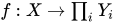
評価 積位相 の普遍性により 、任意の連続写像の族は 一意の連続写像を決定すること
が分かっています f i : X → Y i {\displaystyle f_{i}:X\to Y_{i}} f : X → ∏ i Y i x ↦ ( f i ( x ) ) i ∈ I {\displaystyle {\begin{alignedat}{4}f:\;&&X&&\;\to \;&\prod _{i}Y_{i}\\[0.3ex]&&x&&\;\mapsto \;&\left(f_{i}(x)\right)_{i\in I}\\\end{alignedat}}}
この地図は 評価マップ 。 [ 要出典 ]
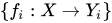
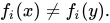
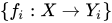
マップのファミリー は、 { f i : X → Y i } {\displaystyle \{f_{i}:X\to Y_{i}\}} 内の 点を分離する 場合、内の すべての点に対して となる ものが存在し、 関連付け られている評価マップが 単射で ある 。 X {\displaystyle X} x ≠ y {\displaystyle x\neq y} X {\displaystyle X} i {\displaystyle i} f i ( x ) ≠ f i ( y ) . {\displaystyle f_{i}(x)\neq f_{i}(y).} { f i } {\displaystyle \{f_{i}\}} f {\displaystyle f}
評価写像は、 写像によって決定された初期位相を持ち 、この写像族が点を分離する 場合に限り 、位相的埋め込み となる。 f {\displaystyle f} X {\displaystyle X} { f i } {\displaystyle \{f_{i}\}} X . {\displaystyle X.}
ハウスドルフ性 が によって誘導される初期位相を持ち 、すべての がハウスドルフであるとき 、 が ハウスドルフ空間 であることは、これらの写像が 上の点を分離することと同値である X {\displaystyle X} { f i : X → Y i } {\displaystyle \left\{f_{i}:X\to Y_{i}\right\}} Y i {\displaystyle Y_{i}} X {\displaystyle X} X . {\displaystyle X.}
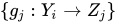
初期位相の推移性 が - インデックス付き写像族 により誘導される初期位相を持ち 、任意の に対して上 の位相が ( 上 の範囲として) ある - インデックス付き写像族により誘導される初期位相である場合、 により誘導される 上の初期位相は 上の範囲として 、 上の範囲 として、 - インデックス付き写像族 により誘導される初期位相に等しい
この事実のいくつかの重要な系がここで示されている。 X {\displaystyle X} I {\displaystyle I} { f i : X → Y i } {\displaystyle \left\{f_{i}:X\to Y_{i}\right\}} i ∈ I , {\displaystyle i\in I,} Y i {\displaystyle Y_{i}} J i {\displaystyle J_{i}} { g j : Y i → Z j } {\displaystyle \left\{g_{j}:Y_{i}\to Z_{j}\right\}} j {\displaystyle j} J i {\displaystyle J_{i}} X {\displaystyle X} { f i : X → Y i } {\displaystyle \left\{f_{i}:X\to Y_{i}\right\}} ⋃ i ∈ I J i {\displaystyle {\textstyle \bigcup \limits _{i\in I}J_{i}}} { g j ∘ f i : X → Z j } {\displaystyle \left\{g_{j}\circ f_{i}:X\to Z_{j}\right\}} i {\displaystyle i} I {\displaystyle I} j {\displaystyle j} J i . {\displaystyle J_{i}.}
特に、 の場合、 を継承する 部分空間位相は、 によって定義される 包含写像 によって誘導される初期位相に等しい 。したがって、 が によって誘導される初期位相を持つ場合、 を継承する 部分空間位相は、 の 制約によって に誘導される初期位相に等しい 。 S ⊆ X {\displaystyle S\subseteq X} S {\displaystyle S} X {\displaystyle X} S → X {\displaystyle S\to X} s ↦ s {\displaystyle s\mapsto s} X {\displaystyle X} { f i : X → Y i } {\displaystyle \left\{f_{i}:X\to Y_{i}\right\}} S {\displaystyle S} X {\displaystyle X} S {\displaystyle S} { f i | S : S → Y i } {\displaystyle \left\{\left.f_{i}\right|_{S}:S\to Y_{i}\right\}} f i {\displaystyle f_{i}} S . {\displaystyle S.}
上の 積 位相 は、上の範囲 として 標準射影によって誘導される初期位相に等しい したがって、によって誘導される 上の初期位相は、 評価写像による 上の積位相の逆像に等しい さらに、写像が 上の点を分離する場合、 評価写像は 積空間の 部分空間への 同相写像である ∏ i Y i {\displaystyle \prod _{i}Y_{i}} pr i : ( x k ) k ∈ I ↦ x i {\displaystyle \operatorname {pr} _{i}:\left(x_{k}\right)_{k\in I}\mapsto x_{i}} i {\displaystyle i} I . {\displaystyle I.} X {\displaystyle X} { f i : X → Y i } {\displaystyle \left\{f_{i}:X\to Y_{i}\right\}} ∏ i Y i {\displaystyle \prod _{i}Y_{i}} f : X → ∏ i Y i . {\textstyle f:X\to \prod _{i}Y_{i}\,.} { f i } i ∈ I {\displaystyle \left\{f_{i}\right\}_{i\in I}} X {\displaystyle X} f ( X ) {\displaystyle f(X)} ∏ i Y i . {\displaystyle \prod _{i}Y_{i}.}
閉集合から点を分離する 空間 に位相が備わっている場合、 上の位相が 上 の写像の何らかの族によって誘導される初期位相であるかどうかを知ることは、多くの場合有用です 。このセクションでは、十分な(ただし必要ではない)条件を示します。 X {\displaystyle X} X {\displaystyle X} X . {\displaystyle X.}
写像の族が の閉集合から点を分離する 場合 、 およびのすべての 閉集合 に対して、 となるような ものが存在し、 ここで は 閉包演算子 を表します 。 { f i : X → Y i } {\displaystyle \left\{f_{i}:X\to Y_{i}\right\}} X {\displaystyle X} A {\displaystyle A} X {\displaystyle X} x ∉ A , {\displaystyle x\not \in A,} i {\displaystyle i} f i ( x ) ∉ cl ( f i ( A ) ) {\displaystyle f_{i}(x)\notin \operatorname {cl} (f_{i}(A))} cl {\displaystyle \operatorname {cl} }
定理 。連続写像の族が閉集合から点を分離する場合、かつその場合のみ、 上の 開 円筒集合は 上の 位相の基底と なる。 { f i : X → Y i } {\displaystyle \left\{f_{i}:X\to Y_{i}\right\}} f i − 1 ( V ) , {\displaystyle f_{i}^{-1}(V),} V {\displaystyle V} Y i , {\displaystyle Y_{i},} X . {\displaystyle X.} したがって、 点を閉集合から分離するときはいつでも、空間には 写像によって誘導される初期位相があることになります 。逆は、一般に円筒集合は初期位相のサブベース (ベースではない) のみを形成するため、失敗します。 { f i } {\displaystyle \left\{f_{i}\right\}} X {\displaystyle X} { f i } . {\displaystyle \left\{f_{i}\right\}.}
空間が T 0 空間 である場合、 その中の閉集合から点を分離する 写像の集合は、 同様に点を分離しなければならない。この場合、評価写像は埋め込みとなる。 X {\displaystyle X} { f i } {\displaystyle \left\{f_{i}\right\}} X {\displaystyle X}
が で添え字付けされ た 上の ユニフォーム構造 の族である 場合、 の 最小 上界 ユニフォーム構造 は、 上の各 よりも細かい 最も粗いユニフォーム構造です。このユニフォーム構造は常に存在し、 フィルタ部分基底 生成された 上の フィルタ に等しいです。 がユニフォーム構造によって誘導される 上の位相である
場合、 の最小上界ユニフォーム構造に関連付けられた 上の位相は 、 の最小上界位相に等しいです ( U i ) i ∈ I {\displaystyle \left({\mathcal {U}}_{i}\right)_{i\in I}} X {\displaystyle X} I ≠ ∅ , {\displaystyle I\neq \varnothing ,} ( U i ) i ∈ I {\displaystyle \left({\mathcal {U}}_{i}\right)_{i\in I}} X {\displaystyle X} U i . {\displaystyle {\mathcal {U}}_{i}.} X × X {\displaystyle X\times X} ⋃ i ∈ I U i . {\displaystyle {\textstyle \bigcup \limits _{i\in I}{\mathcal {U}}_{i}}.} τ i {\displaystyle \tau _{i}} X {\displaystyle X} U i {\displaystyle {\mathcal {U}}_{i}} X {\displaystyle X} ( τ i ) i ∈ I . {\displaystyle \left(\tau _{i}\right)_{i\in I}.}
ここで が 写像の族であり、任意の に対して が 上の一様構造であるとする と、の 写像 による初期の一様構造は 、上で 唯一の最も粗い一様構造となり、 すべてが 一様連続となる 。 これは、一様構造の -添え字族 ( に対して) の最小上限一様構造に等しい 。 [6] によって誘導される
上の位相は、 すべてが連続となる 上 の最も粗い位相である 。
初期の一様構造は、 恒等写像が 一様連続となる最も粗い一様構造にも等しい。 { f i : X → Y i } {\displaystyle \left\{f_{i}:X\to Y_{i}\right\}} i ∈ I , {\displaystyle i\in I,} U i {\displaystyle {\mathcal {U}}_{i}} Y i . {\displaystyle Y_{i}.} Y i {\displaystyle Y_{i}} f i {\displaystyle f_{i}} U {\displaystyle {\mathcal {U}}} X {\displaystyle X} f i : ( X , U ) → ( Y i , U i ) {\displaystyle f_{i}:\left(X,{\mathcal {U}}\right)\to \left(Y_{i},{\mathcal {U}}_{i}\right)} I {\displaystyle I} f i − 1 ( U i ) {\displaystyle f_{i}^{-1}\left({\mathcal {U}}_{i}\right)} i ∈ I {\displaystyle i\in I} X {\displaystyle X} U {\displaystyle {\mathcal {U}}} X {\displaystyle X} f i : X → Y i {\displaystyle f_{i}:X\to Y_{i}} U {\displaystyle {\mathcal {U}}} id : ( X , U ) → ( X , f i − 1 ( U i ) ) {\displaystyle \operatorname {id} :\left(X,{\mathcal {U}}\right)\to \left(X,f_{i}^{-1}\left({\mathcal {U}}_{i}\right)\right)}
ハウスドルフ性 :初期一様構造によって誘導される 上の位相が ハウスドルフ である ための必要十分条件は、 に対して が異なる場合 ( )、 のいくつ かの側近 が存在し、 を満たすことである
。さらに、 任意のインデックスに対して によって 誘導される 上の位相が ハウスドルフであるための必要十分条件は、 が の点を分離する 場合である (または、評価写像 が単射である場合である)。 X {\displaystyle X} U {\displaystyle {\mathcal {U}}} x , y ∈ X {\displaystyle x,y\in X} x ≠ y {\displaystyle x\neq y} i ∈ I {\displaystyle i\in I} V i ∈ U i {\displaystyle V_{i}\in {\mathcal {U}}_{i}} Y i {\displaystyle Y_{i}} ( f i ( x ) , f i ( y ) ) ∉ V i . {\displaystyle \left(f_{i}(x),f_{i}(y)\right)\not \in V_{i}.} i ∈ I , {\displaystyle i\in I,} Y i {\displaystyle Y_{i}} U i {\displaystyle {\mathcal {U}}_{i}} X {\displaystyle X} U {\displaystyle {\mathcal {U}}} { f i : X → Y i } {\displaystyle \left\{f_{i}:X\to Y_{i}\right\}} X {\displaystyle X} f : X → ∏ i Y i {\textstyle f:X\to \prod _{i}Y_{i}}
一様連続性 : 写像によって誘導される初期の一様構造が である場合、 ある一様空間から への 関数が 一様連続で あるためには、 が 各 に対して一様連続である必要 があります U {\displaystyle {\mathcal {U}}} { f i : X → Y i } , {\displaystyle \left\{f_{i}:X\to Y_{i}\right\},} g {\displaystyle g} Z {\displaystyle Z} ( X , U ) {\displaystyle (X,{\mathcal {U}})} f i ∘ g : Z → Y i {\displaystyle f_{i}\circ g:Z\to Y_{i}} i ∈ I . {\displaystyle i\in I.}
コーシーフィルタ : 上の フィルタ が上の コーシーフィルタ である 場合、かつ が任意の に対して 上のコーシープレフィルタである場合に限ります。 B {\displaystyle {\mathcal {B}}} X {\displaystyle X} ( X , U ) {\displaystyle (X,{\mathcal {U}})} f i ( B ) {\displaystyle f_{i}\left({\mathcal {B}}\right)} Y i {\displaystyle Y_{i}} i ∈ I . {\displaystyle i\in I.}
初期の均一構造の推移性 : 上記の「初期のトポロジーの推移性」の記述で「トポロジー」という単語を「均一構造」に置き換えると、結果の記述も真になります。
圏論的記述 圏論 の言語では 、初期の位相構成は次のように記述できます。 離散圏 から 位相 空間の圏 への 関手を とします 。 を から への 通常の 忘却関手 とします。すると、写像はから への 錐 として考えることができます。 つまり、 は から へ の錐の圏 の 対象です。 より正確に は、この錐は における 構造化された余弦 を定義します Y {\displaystyle Y} J {\displaystyle J} T o p {\displaystyle \mathrm {Top} } j ↦ Y j {\displaystyle j\mapsto Y_{j}} U {\displaystyle U} T o p {\displaystyle \mathrm {Top} } S e t {\displaystyle \mathrm {Set} } f j : X → Y j {\displaystyle f_{j}:X\to Y_{j}} X {\displaystyle X} U Y . {\displaystyle UY.} ( X , f ) {\displaystyle (X,f)} C o n e ( U Y ) := ( Δ ↓ U Y ) {\displaystyle \mathrm {Cone} (UY):=(\Delta \downarrow {UY})} U Y . {\displaystyle UY.} ( X , f ) {\displaystyle (X,f)} U {\displaystyle U} S e t . {\displaystyle \mathrm {Set} .}
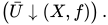
忘却関手は 関手 を誘導する 。初期位相の特性は、 から への 普遍 射 、つまり カテゴリ の 終端 オブジェクトが存在するという命題と同値である。具体 的には、これは のオブジェクトと の射から成り、 の 任意の オブジェクトと の射に対して 、 次の図式が可換となるような 唯一の射が存在する。 U : T o p → S e t {\displaystyle U:\mathrm {Top} \to \mathrm {Set} } U ¯ : C o n e ( Y ) → C o n e ( U Y ) {\displaystyle {\bar {U}}:\mathrm {Cone} (Y)\to \mathrm {Cone} (UY)} U ¯ {\displaystyle {\bar {U}}} ( X , f ) ; {\displaystyle (X,f);} ( U ¯ ↓ ( X , f ) ) . {\displaystyle \left({\bar {U}}\downarrow (X,f)\right).} I ( X , f ) {\displaystyle I(X,f)} C o n e ( Y ) {\displaystyle \mathrm {Cone} (Y)} ε : U ¯ I ( X , f ) → ( X , f ) {\displaystyle \varepsilon :{\bar {U}}I(X,f)\to (X,f)} ( Z , g ) {\displaystyle (Z,g)} C o n e ( Y ) {\displaystyle \mathrm {Cone} (Y)} φ : U ¯ ( Z , g ) → ( X , f ) {\displaystyle \varphi :{\bar {U}}(Z,g)\to (X,f)} ζ : ( Z , g ) → I ( X , f ) {\displaystyle \zeta :(Z,g)\to I(X,f)}
初期位相を に配置する 割り当ては 、忘却関手の 右 随伴 関手に拡張されます。 実際、 は の右逆です 。なぜなら は の恒等関手だからです。 ( X , f ) ↦ I ( X , f ) {\displaystyle (X,f)\mapsto I(X,f)} X {\displaystyle X} I : C o n e ( U Y ) → C o n e ( Y ) {\displaystyle I:\mathrm {Cone} (UY)\to \mathrm {Cone} (Y)} U ¯ . {\displaystyle {\bar {U}}.} I {\displaystyle I} U ¯ {\displaystyle {\bar {U}}} U ¯ I {\displaystyle {\bar {U}}I} C o n e ( U Y ) . {\displaystyle \mathrm {Cone} (UY).}
参照
参考文献
参考文献
外部リンク











![{\displaystyle {\begin{alignedat}{4}f:\;&&X&&\;\to \;&\prod _{i}Y_{i}\\[0.3ex]&&x&&\;\mapsto \;&\left(f_{i}(x)\right)_{i\in I}\\\end{alignedat}}}](https://wikimedia.org/api/rest_v1/media/math/render/svg/e0f0cd8dd89010c665fbff019d98df7a58ce9ed8)