Collection of subsets that generate a topology
数学の位相 幾何学において 、 位相空間 ( X , τ ) の 位相 τの 部分基底 (または 部分基底 、 前基底 、 前基底 )とは、を開集合として 含む最小の位相 という意味で を生成する の 部分集合である 。一部の著者は若干異なる定義を用いており、この定義には他の有用な同等の定式化が存在する。これらについては以下で論じる。 B {\displaystyle B} τ {\displaystyle \tau } τ , {\displaystyle \tau ,} τ {\displaystyle \tau } B {\displaystyle B}
サブベースは、トポロジの ベース の概念よりも弱い概念です。
意味 を位相 空間とし、 の位相 Aの 部分基底 は通常、次の 3 つの同値条件のいずれかを満たす の 部分 集合として定義されます。 X {\displaystyle X} τ . {\displaystyle \tau .} τ {\displaystyle \tau } B {\displaystyle B} τ {\displaystyle \tau }
τ {\displaystyle \tau } は を含む最小の位相である。 を含む任意の 位相 には も含まれている必要がある。 B {\displaystyle B} τ ′ {\displaystyle \tau ^{\prime }} X {\displaystyle X} B {\displaystyle B} τ . {\displaystyle \tau .} τ {\displaystyle \tau } を含む すべての位相の 交差 である X {\displaystyle X} B . {\displaystyle B.} の開集合の集合と の 元の有限 交点 の集合は、 の 基底 を 形成する。 [注 1] これは、 のすべての適切な 開集合 はの元の有限交点の 和集合 として表すことができることを意味する。明示的に、 開集合内の 点が与えられたとき、 これらの集合の交点が を含み 、 に含まれるような の集合が 有限個存在する。 X {\displaystyle X} B {\displaystyle B} τ . {\displaystyle \tau .} τ {\displaystyle \tau } B . {\displaystyle B.} x {\displaystyle x} U ⊊ X , {\displaystyle U\subsetneq X,} S 1 , … , S n {\displaystyle S_{1},\ldots ,S_{n}} B , {\displaystyle B,} x {\displaystyle x} U . {\displaystyle U.} さらに が をカバーする と仮定するか、または 零項交差 規則を使用する場合は 、3 番目の定義に を含める必要はありません 。 B {\displaystyle B} X {\displaystyle X} X {\displaystyle X}
が のサブベースである 場合、 が 位相を 生成する と言います。この用語は 、上記の 2 番目または 3 番目の定義を使用して を 明示的に構築することに由来します。 B {\displaystyle B} τ {\displaystyle \tau } B {\displaystyle B} τ . {\displaystyle \tau .} τ {\displaystyle \tau } B {\displaystyle B}
部分基底の元は部分基底(開)集合 と呼ばれる 。部分基底集合からなる 被覆は 部分基底(開)被覆 と呼ばれる 。
冪集合 の任意 の部分 集合 に対して 、 を部分基底と する位相が一意に存在します。これは、 を 含む 上のすべての位相の共通部分です 。しかし、一般に逆は成り立ちません。つまり、与えられた位相に対して一意の部分基底は存在しません。 S {\displaystyle S} ℘ ( X ) , {\displaystyle \wp (X),} S {\displaystyle S} X {\displaystyle X} S {\displaystyle S}
このように、固定された位相から始めてその位相の部分基底を求めることもできるし、また、冪集合の任意の部分集合から始めて 、その部分集合によって生成される位相を形成することもできる。上記のどちらの等価な定義も自由に用いることができる。実際、多くの場合、3つの条件のうちの1つが他の条件よりも有用である。 ℘ ( X ) {\displaystyle \wp (X)}
代替定義 あまり一般的ではないが、サブベースのわずかに異なる定義が与えられており、サブベースが を覆うことを要求する 。この場合、 は に含まれるすべてのセットの和集合である 。これは、定義におけるヌル集合の交差の使用に関して混乱が生じないことを意味する。 B {\displaystyle {\mathcal {B}}} X . {\displaystyle X.} X {\displaystyle X} B . {\displaystyle {\mathcal {B}}.}
しかし、この定義は必ずしも上記の3つの定義と等価ではありません。 位相 の 部分集合を持つ位相空間が存在し、そのような位相 空間で は を含む最小の位相です が、 は をカバーしません 。例えば、 と に対してを持つ位相空間を考えてみましょう。 明らかに は の部分基底ですが 、 が少なくとも 個の元を持つ 限りは はカバーしません 。実際には、これはまれなケースです。例えば、少なくとも2つの点を持ち、 T 1 分離公理を 満たす空間の部分基底は、その空間のカバーでなければなりません。 ( X , τ ) {\displaystyle (X,\tau )} B ⊆ τ {\displaystyle {\mathcal {B}}\subseteq \tau } τ {\displaystyle \tau } B {\displaystyle {\mathcal {B}}} B {\displaystyle {\mathcal {B}}} X {\displaystyle X} ( X , τ ) {\displaystyle (X,\tau )} τ = { ∅ , { p } , X } {\displaystyle \tau =\{\varnothing ,\{p\},X\}} B = { { p } } {\displaystyle {\mathcal {B}}=\{\{p\}\}} p ∈ X . {\displaystyle p\in X.} B {\displaystyle {\mathcal {B}}} τ {\displaystyle \tau } B {\displaystyle {\mathcal {B}}} X {\displaystyle X} X {\displaystyle X} 2 {\displaystyle 2}
例 任意の部分集合(空集合を含む) によって生成される位相は 、自明な位相と等しい。 S ⊆ { ∅ , X } {\displaystyle {\mathcal {S}}\subseteq \{\varnothing ,X\}} S := ∅ {\displaystyle {\mathcal {S}}:=\varnothing } { ∅ , X } . {\displaystyle \{\varnothing ,X\}.}
が上の位相で がの 基底である 場合、 によって生成される位相は である。したがって、 位相の任意の 基底 は の部分基底でもある。 が の任意の部分集合である
場合 、 によって生成される位相は の部分集合となる。 τ {\displaystyle \tau } X {\displaystyle X} B {\displaystyle {\mathcal {B}}} τ {\displaystyle \tau } B {\displaystyle {\mathcal {B}}} τ . {\displaystyle \tau .} B {\displaystyle {\mathcal {B}}} τ {\displaystyle \tau } τ . {\displaystyle \tau .} S {\displaystyle {\mathcal {S}}} τ {\displaystyle \tau } S {\displaystyle {\mathcal {S}}} τ . {\displaystyle \tau .}
実数 上の通常の位相は、 または の形式の 半無限 開区間すべてからなる部分基底を持つ。 ここで 、 と は 実数である。これらを合わせると通常の位相が生成される。なぜなら、 の共通部分は通常の位相を生成するからである 。2つ目の部分基底は 、 と が 有理数で ある部分族を取ることで形成される。2つ目の部分基底も通常の位相を生成する。なぜなら、 が有理数 である 開区間は 通常のユークリッド位相の基底となるからである。 R {\displaystyle \mathbb {R} } ( − ∞ , a ) {\displaystyle (-\infty ,a)} ( b , ∞ ) , {\displaystyle (b,\infty ),} a {\displaystyle a} b {\displaystyle b} ( a , b ) = ( − ∞ , b ) ∩ ( a , ∞ ) {\displaystyle (a,b)=(-\infty ,b)\cap (a,\infty )} a ≤ b {\displaystyle a\leq b} a {\displaystyle a} b {\displaystyle b} ( a , b ) {\displaystyle (a,b)} a , {\displaystyle a,} b {\displaystyle b}
の形の半無限開区間全体からなる部分基底 (ただし は実数)は、通常の位相を生成しない。結果として得られる位相は、 を含む すべての 開集合 が も含む 場合、 T 1 分離公理を満たさない。 ( − ∞ , a ) {\displaystyle (-\infty ,a)} a {\displaystyle a} a < b {\displaystyle a<b} b {\displaystyle b} a . {\displaystyle a.}
各関数が 位相を持つ 関数の族によって定義される 上の 初期 位相は 、各 が 連続 となるような 上の最も粗い位相である。連続性は開集合の 逆像 によって定義できるため 、これは 上の初期位相が、 のすべての開部分集合上の範囲となる すべての を部分基底 として取ることによって与えられることを意味する 。 X {\displaystyle X} f i : X → Y i , {\displaystyle f_{i}:X\to Y_{i},} Y i {\displaystyle Y_{i}} X {\displaystyle X} f i {\displaystyle f_{i}} X {\displaystyle X} f i − 1 ( U ) , {\displaystyle f_{i}^{-1}(U),} U {\displaystyle U} Y i , {\displaystyle Y_{i},}
Two important special cases of the initial topology are the product topology , where the family of functions is the set of projections from the product to each factor, and the subspace topology , where the family consists of just one function, the inclusion map .
The compact-open topology on the space of continuous functions from X {\displaystyle X} Y {\displaystyle Y} V ( K , U ) = { f : X → Y ∣ f ( K ) ⊆ U } {\displaystyle V(K,U)=\{f:X\to Y\mid f(K)\subseteq U\}} K ⊆ X {\displaystyle K\subseteq X} compact and U {\displaystyle U} Y . {\displaystyle Y.}
Suppose that ( X , τ ) {\displaystyle (X,\tau )} Hausdorff topological space with X {\displaystyle X} X = R {\displaystyle X=\mathbb {R} } Euclidean topology ). Let Y ∈ τ {\displaystyle Y\in \tau } open subset of ( X , τ ) {\displaystyle (X,\tau )} Y {\displaystyle Y} R {\displaystyle \mathbb {R} } ν {\displaystyle \nu } subspace topology on Y {\displaystyle Y} Y {\displaystyle Y} ( X , τ ) {\displaystyle (X,\tau )} ν ⊆ τ {\displaystyle \nu \subseteq \tau } ν {\displaystyle \nu } on X {\displaystyle X} is equal to the union { X } ∪ ν {\displaystyle \{X\}\cup \nu } [note 2] where { X } ∪ ν ⊆ τ {\displaystyle \{X\}\cup \nu \subseteq \tau } ( X , τ ) {\displaystyle (X,\tau )} Y = X {\displaystyle Y=X} Y {\displaystyle Y} proper subset of X , {\displaystyle X,} { X } ∪ ν {\displaystyle \{X\}\cup \nu } on X {\displaystyle X} containing ν {\displaystyle \nu } ν {\displaystyle \nu } X {\displaystyle X} ⋃ V ∈ ν V = Y {\displaystyle \bigcup _{V\in \nu }V=Y} X {\displaystyle X}
Results using subbases One nice fact about subbases is that continuity of a function need only be checked on a subbase of the range. That is, if f : X → Y {\displaystyle f:X\to Y} B {\displaystyle {\mathcal {B}}} Y , {\displaystyle Y,} f : X → Y {\displaystyle f:X\to Y} if and only if f − 1 ( B ) {\displaystyle f^{-1}(B)} X {\displaystyle X} B ∈ B . {\displaystyle B\in {\mathcal {B}}.} net (or sequence ) x ∙ = ( x i ) i ∈ I {\displaystyle x_{\bullet }=\left(x_{i}\right)_{i\in I}} x {\displaystyle x} sub basic neighborhood of x {\displaystyle x} x i {\displaystyle x_{i}} i ∈ I . {\displaystyle i\in I.}
Alexander subbase theorem The Alexander Subbase Theorem is a significant result concerning subbases that is due to James Waddell Alexander II .[3] The corresponding result for basic (rather than subbasic) open covers is much easier to prove.
Alexander subbase theorem :[3] Let ( X , τ ) {\displaystyle (X,\tau )} S {\displaystyle {\mathcal {S}}} τ . {\displaystyle \tau .} X {\displaystyle X} S {\displaystyle {\mathcal {S}}} X {\displaystyle X} compact .この定理の逆も成り立つ( の元によるの被覆はすべて の 開被覆であるため ) X {\displaystyle X} S {\displaystyle {\mathcal {S}}} X {\displaystyle X}
を位相空間とし、 を のサブベースとします。 が コンパクトであれば、 からの要素によるのすべてのカバーには 有限のサブカバーが存在します。 ( X , τ ) {\displaystyle (X,\tau )} S {\displaystyle {\mathcal {S}}} τ . {\displaystyle \tau .} X {\displaystyle X} X {\displaystyle X} S {\displaystyle {\mathcal {S}}} 証拠
矛盾を避けるために、空間は コンパクトではない(つまり 無限集合はコンパクトではない)と仮定するが、 からのすべての部分基底被覆は 有限部分被覆を持つ。の 有限部分被覆を持たない の 開被覆全体の集合を と表記する。 は 部分集合包含によって
部分的に順序付けられ、 ゾルンの補題 を用いての最大元となる 元を求める
。以下の点に注意する。 X {\displaystyle X} X {\displaystyle X} S {\displaystyle {\mathcal {S}}} S {\displaystyle \mathbb {S} } X {\displaystyle X} X . {\displaystyle X.} S {\displaystyle \mathbb {S} } C ∈ S {\displaystyle {\mathcal {C}}\in \mathbb {S} } S . {\displaystyle \mathbb {S} .}
の定義により は の開被覆であり、 が 被覆する の有限部分集合は存在しない (したがって特に は 無限である)。 C ∈ S , {\displaystyle {\mathcal {C}}\in \mathbb {S} ,} S , {\displaystyle \mathbb {S} ,} C {\displaystyle {\mathcal {C}}} X {\displaystyle X} C {\displaystyle {\mathcal {C}}} X {\displaystyle X} C {\displaystyle {\mathcal {C}}} における の最大性は、 が の開集合であって 、 が有限部分被覆を持つ 場合 、 の 有限部分集合に対して という 形式になること を意味している (この有限部分集合は の選択に依存する )。 C {\displaystyle {\mathcal {C}}} S {\displaystyle \mathbb {S} } V {\displaystyle V} X {\displaystyle X} V ∉ C {\displaystyle V\not \in {\mathcal {C}}} C ∪ { V } {\displaystyle {\mathcal {C}}\cup \{V\}} { V } ∪ C V {\displaystyle \{V\}\cup {\mathcal {C}}_{V}} C V {\displaystyle {\mathcal {C}}_{V}} C {\displaystyle {\mathcal {C}}} V {\displaystyle V} まず、 が の被覆で は ない ことを示す。 がの被覆であると
仮定する。 特に が の元による の 被覆であることを意味する
。 の定理の仮定は 、 の有限部分 集合が存在し、 が の元による の有限部分被覆でもあることを意味する ( より)。しかし、これは が を被覆しない ことを証明する と 矛盾する。 C ∩ S {\displaystyle {\mathcal {C}}\cap {\mathcal {S}}} X . {\displaystyle X.} C ∩ S {\displaystyle {\mathcal {C}}\cap {\mathcal {S}}} X , {\displaystyle X,} C ∩ S {\displaystyle {\mathcal {C}}\cap {\mathcal {S}}} X {\displaystyle X} S . {\displaystyle {\mathcal {S}}.} S {\displaystyle {\mathcal {S}}} C ∩ S {\displaystyle {\mathcal {C}}\cap {\mathcal {S}}} X , {\displaystyle X,} X {\displaystyle X} C {\displaystyle {\mathcal {C}}} C ∩ S ⊆ C {\displaystyle {\mathcal {C}}\cap {\mathcal {S}}\subseteq {\mathcal {C}}} C ∈ S , {\displaystyle {\mathcal {C}}\in \mathbb {S} ,} C ∩ S {\displaystyle {\mathcal {C}}\cap {\mathcal {S}}} X . {\displaystyle X.}
は をカバーしない ので 、 によってカバーされない (つまり、 のどの元にも含まれない ) が存在する。しかし、 は をカバーするので、 のような も存在する。
従って が成り立つ 。そうでなければ は の有限部分被覆、つまり と矛盾する部分被覆を持つ こと に なるからである。 と は の位相(と共に) を生成する部分基底なので 、 によって生成される位相の定義から、 を持つ 部分基底開集合の有限集合が存在し、 そのような 集合が存在するはずである。 C ∩ S {\displaystyle {\mathcal {C}}\cap {\mathcal {S}}} X , {\displaystyle X,} x ∈ X {\displaystyle x\in X} C ∩ S {\displaystyle {\mathcal {C}}\cap {\mathcal {S}}} x {\displaystyle x} C ∩ S {\displaystyle {\mathcal {C}}\cap {\mathcal {S}}} C {\displaystyle {\mathcal {C}}} X , {\displaystyle X,} U ∈ C {\displaystyle U\in {\mathcal {C}}} x ∈ U . {\displaystyle x\in U.} U ≠ X {\displaystyle U\neq X} C {\displaystyle {\mathcal {C}}} X {\displaystyle X} { U } = { X } , {\displaystyle \{U\}=\{X\},} C ∈ S . {\displaystyle {\mathcal {C}}\in \mathbb {S} .} U ≠ X , {\displaystyle U\neq X,} S {\displaystyle {\mathcal {S}}} X {\displaystyle X} X {\displaystyle X} S , {\displaystyle {\mathcal {S}},} S 1 , … , S n ∈ S {\displaystyle S_{1},\ldots ,S_{n}\in {\mathcal {S}}} n ≥ 1 {\displaystyle n\geq 1} x ∈ S 1 ∩ ⋯ ∩ S n ⊆ U . {\displaystyle x\in S_{1}\cap \cdots \cap S_{n}\subseteq U.}
ここで、背理法により、任意の について、 が で ある
場合 、 も となるため 、 が によってカバーされる ことを 意味し、これ は がどのように が選択されたかと矛盾します ( は によってカバーされないように特別に選択されたことを思い出してください )。 S i ∉ C {\displaystyle S_{i}\not \in {\mathcal {C}}} i = 1 , … , n . {\displaystyle i=1,\ldots ,n.} i {\displaystyle i} S i ∈ C , {\displaystyle S_{i}\in {\mathcal {C}},} S i ∈ C ∩ S {\displaystyle S_{i}\in {\mathcal {C}}\cap {\mathcal {S}}} x ∈ S i {\displaystyle x\in S_{i}} x {\displaystyle x} C ∩ S , {\displaystyle {\mathcal {C}}\cap {\mathcal {S}},} x {\displaystyle x} x {\displaystyle x} C ∩ S {\displaystyle {\mathcal {C}}\cap {\mathcal {S}}}
前述のように、 におけるの最大性は、任意のに対して 、の 有限部分集合が存在し、 それがの 有限被覆を形成する ことを意味する。の 有限部分集合であると
定義する
。任意のに対しては の有限被覆である
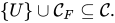
ことに注目し、したがって、任意のを次 のように 置き換える。 C {\displaystyle {\mathcal {C}}} S {\displaystyle \mathbb {S} } i = 1 , … , n , {\displaystyle i=1,\ldots ,n,} C S i {\displaystyle {\mathcal {C}}_{S_{i}}} C {\displaystyle {\mathcal {C}}} { S i } ∪ C S i {\displaystyle \left\{S_{i}\right\}\cup {\mathcal {C}}_{S_{i}}} X . {\displaystyle X.} C F := C S 1 ∪ ⋯ ∪ C S n , {\displaystyle {\mathcal {C}}_{F}:={\mathcal {C}}_{S_{1}}\cup \cdots \cup {\mathcal {C}}_{S_{n}},} C . {\displaystyle {\mathcal {C}}.} i = 1 , … , n , {\displaystyle i=1,\ldots ,n,} { S i } ∪ C F {\displaystyle \left\{S_{i}\right\}\cup {\mathcal {C}}_{F}} X {\displaystyle X} C S i {\displaystyle {\mathcal {C}}_{S_{i}}} C F . {\displaystyle {\mathcal {C}}_{F}.}
( の開部分集合 )の すべての集合の和集合を で表し、 が における の補集合を で表すものとします。
任意の部分集合に対して が を覆う ことと、その場合に限ります
。特に、 任意
のに対して が を覆う という事実は、 が任意である ことを意味します。 が成り立つ
ことを思い出してください。 したがって は の被覆である ことと同等です
。
さらに、 は の有限被覆です。したがって には の有限部分被覆があり、 は という事実と矛盾します。
したがって、 がコンパクトではないという最初の仮定は 間違っているはずであり、これは がコンパクトであることを証明しています。 ∪ C F {\displaystyle \cup {\mathcal {C}}_{F}} C F {\displaystyle {\mathcal {C}}_{F}} X {\displaystyle X} Z {\displaystyle Z} ∪ C F {\displaystyle \cup {\mathcal {C}}_{F}} X . {\displaystyle X.} A ⊆ X , {\displaystyle A\subseteq X,} { A } ∪ C F {\displaystyle \{A\}\cup {\mathcal {C}}_{F}} X {\displaystyle X} Z ⊆ A . {\displaystyle Z\subseteq A.} i = 1 , … , n , {\displaystyle i=1,\ldots ,n,} { S i } ∪ C F {\displaystyle \left\{S_{i}\right\}\cup {\mathcal {C}}_{F}} X {\displaystyle X} Z ⊆ S i . {\displaystyle Z\subseteq S_{i}.} i {\displaystyle i} Z ⊆ S 1 ∩ ⋯ ∩ S n . {\displaystyle Z\subseteq S_{1}\cap \cdots \cap S_{n}.} S 1 ∩ ⋯ ∩ S n ⊆ U , {\displaystyle S_{1}\cap \cdots \cap S_{n}\subseteq U,} Z ⊆ U , {\displaystyle Z\subseteq U,} { U } ∪ C F {\displaystyle \{U\}\cup {\mathcal {C}}_{F}} X . {\displaystyle X.} { U } ∪ C F {\displaystyle \{U\}\cup {\mathcal {C}}_{F}} X {\displaystyle X} { U } ∪ C F ⊆ C . {\displaystyle \{U\}\cup {\mathcal {C}}_{F}\subseteq {\mathcal {C}}.} C {\displaystyle {\mathcal {C}}} X , {\displaystyle X,} C ∈ S . {\displaystyle {\mathcal {C}}\in \mathbb {S} .} X {\displaystyle X} X {\displaystyle X} ◼ {\displaystyle \blacksquare }
この証明はツォルンの補題 を用いているが 、選択原理の完全な適用を必要としない。代わりに、中間的な 超濾過原理 に依拠している。 [3]
この定理を上記の部分基底と組み合わせることで 、 における有界閉区間が コンパクトであることを非常に簡単に証明できます。より一般的には、空でないコンパクト空間の積がコンパクトであることを述べる ティコノフの定理は 、アレクサンダー部分基底定理を用いれば簡単に証明できます。 R {\displaystyle \mathbb {R} } R {\displaystyle \mathbb {R} }
参照
注記 ^ ルディンの定義は我々の定義よりも一般性に欠ける。なぜなら、事実上、 が を 覆うことを要求しているからで ある(以下の「代替定義」の節を参照)。ここではこの要求を省略し、 が の任意の部分集合であると仮定する。 B {\displaystyle B} X {\displaystyle X} B {\displaystyle B} P ( X ) {\displaystyle {\mathcal {P}}(X)} ^ は 上の位相であり 、 は の開部分集合であるため、 が 上の位相である ことは容易に証明できます 。特に、は である ため、和集合と有限集合交差に関して閉じています 。しかし 、は 上 の位相ではないため、 は を 含む 上 の最小の位相であることは明らかです 。 ν {\displaystyle \nu } Y {\displaystyle Y} Y {\displaystyle Y} ( X , τ ) , {\displaystyle (X,\tau ),} { X } ∪ ν {\displaystyle \{X\}\cup \nu } X {\displaystyle X} ν {\displaystyle \nu } τ {\displaystyle \tau } X ∉ ν {\displaystyle X\not \in \nu } ν {\displaystyle \nu } X {\displaystyle X} { X } ∪ ν {\displaystyle \{X\}\cup \nu } X {\displaystyle X} ν {\displaystyle \nu }
引用 ^ abc Muger, Michael (2020). 働く数学者のための位相幾何学 .
参考文献