タグ

天体力学

27 件の記事

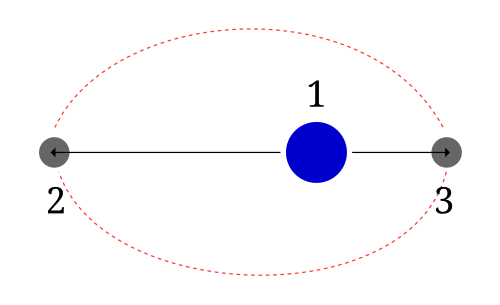
The apsides refer to the farthest (2) and nearest (3) points reached by an orbiting planetary body (2 and 3) with respect to a primary, or host, body (1)

近点と遠点(アプシス)天体軌道の極値とそのメカニズム

アプシス近点遠点近日点
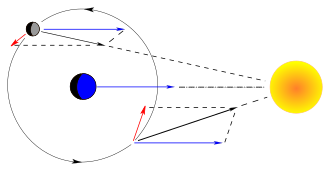
Vector diagram of the Sun's perturbations on the Moon. When the gravitational force of the Sun common to both the Earth and the Moon is subtracted, what is left is the perturbations.

軌道摂動天体の複雑な動きを支配する力と計算手法

軌道摂動天体力学二体問題n体問題
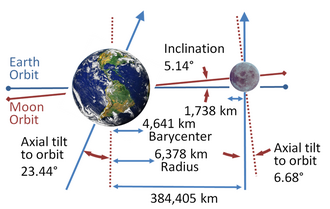
Orbital inclination and rotation. When the Moon is 5.14° north of the ecliptic, its north pole is tilted 6.68° away from the Earth. The orientation of the plane containing the vectors normal to the orbits and the Moon's rotational axis rotates 360° with a period of about 18.6 years, whereas the Earth's axis precesses with a period of around 26,000 years, so the line-up of this illustration (a major lunar standstill) occurs only once every 18.6 years.

カッシーニの法則月の自転軸と公転軌道の不思議な関係

カッシーニの法則月の自転公転軌道カッシーニ状態
Figure 1: Tidal interaction between the spiral galaxy NGC 169 and a smaller companion[1]

潮汐力とは何か?天体を歪ませる重力の差とその影響

潮汐力重力勾配ロッシュ限界潮汐ロック
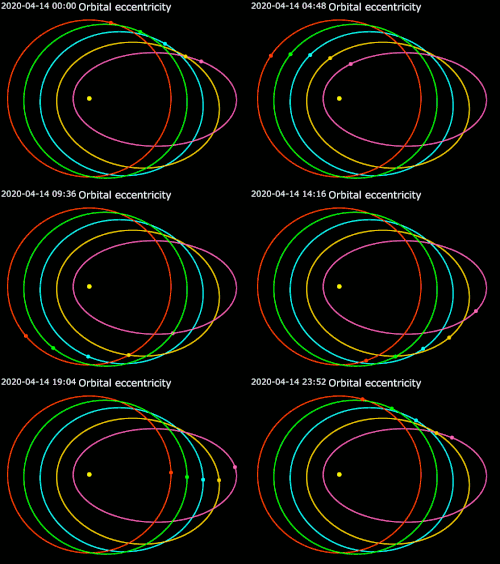
Variation of orbital eccentricity 0.0 0.2 0.4 0.6 0.8

軌道力学の基礎天体の運行を支配する物理法則

軌道力学ケプラーの法則ニュートン力学一般相対性理論
The apsides refer to the farthest (2) and nearest (3) points reached by an orbiting planetary body (2 and 3) with respect to a primary, or host, body (1)

近点と遠点(アプシス)天体軌道の極値とそのメカニズム

アプシス近点遠点近日点
Precession of a gyroscope[clarification needed]

歳差運動のメカニズム物理学から天文学まで徹底解説

歳差運動ジャイロスコープ角運動量春分点歳差
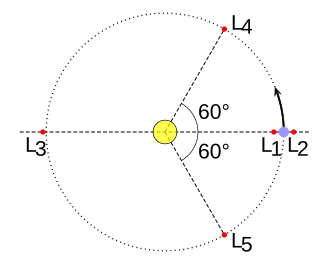
A diagram showing the five Lagrange points in a two-body system

ラグランジュ点とは?宇宙探査の戦略的拠点となる5つのポイント

ラグランジュ点L1L2ジェイムズ・ウェッブ宇宙望遠鏡
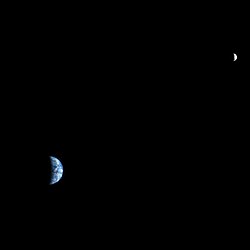
A picture of Earth and the Moon from Mars. The presence of the Moon (which has about 1/81 the mass of Earth), is slowing Earth's rotation and extending the day by a little under 2 milliseconds every 100 years.

潮汐加速と地球・月系のダイナミクス回転の鈍化と軌道の変化

潮汐加速潮汐ブレーキ地球の自転月の公転
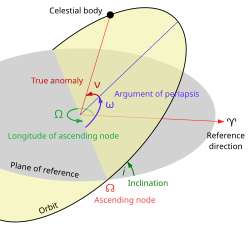
Fig. 1: Orbital inclination represented by i (dark green), along with other fundamental orbital parameters

軌道傾斜角の基礎知識天体メカニクスにおける角度の定義と影響

軌道傾斜角軌道要素順行軌道逆行軌道
The apsides refer to the farthest (2) and nearest (3) points reached by an orbiting planetary body (2 and 3) with respect to a primary, or host, body (1)

アプシス(近点・遠点)とは天体軌道の極点とそのメカニズム

アプシス近点遠点軌道要素
An orbital plane as viewed relative to a plane of reference.

軌道面(Orbital Plane)の基礎知識と天体力学における役割

軌道面天体力学軌道傾斜角昇交点