Hosohedron
Jump to content


| Set of regular n-gonal hosohedra | |
|---|---|
 Example regular hexagonal hosohedron on a sphere | |
| Type | regular polyhedron or spherical tiling |
| Faces | n digons |
| Edges | n |
| Vertices | 2 |
| Euler char. | 2 |
| Vertex configuration | 2n |
| Wythoff symbol | n | 2 2 |
| Schläfli symbol | {2,n} |
| Coxeter diagram |     |
| Symmetry group | Dnh [2,n] (*22n) order 4n |
| Rotation group | Dn [2,n]+ (22n) order 2n |
| Dual polyhedron | regular n-gonal dihedron |

In spherical geometry, an n-gonal hosohedron is a tessellation of lunes on a spherical surface, such that each lune shares the same two polar opposite vertices.
A regular n-gonal hosohedron has Schläfli symbol {2,n}, with each spherical lune having internal angle 2π/nradians (360/n degrees).[1][2]
Hosohedra as regular polyhedra
[edit]For a regular polyhedron whose Schläfli symbol is {m, n}, the number of polygonal faces is :
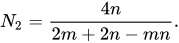
The Platonic solids known to antiquity are the only integer solutions for m ≥ 3 and n ≥ 3. The restriction m ≥ 3 enforces that the polygonal faces must have at least three sides.
When considering polyhedra as a spherical tiling, this restriction may be relaxed, since digons (2-gons) can be represented as spherical lunes, having non-zero area.
Allowing m = 2 makes

and admits a new infinite class of regular polyhedra, which are the hosohedra. On a spherical surface, the polyhedron {2, n} is represented as n abutting lunes, with interior angles of 2π/n. All these spherical lunes share two common vertices.
 A regular trigonal hosohedron, {2,3}, represented as a tessellation of 3 spherical lunes on a sphere. |  A regular tetragonal hosohedron, {2,4}, represented as a tessellation of 4 spherical lunes on a sphere. |
| Space | Spherical | Euclidean | |||||
|---|---|---|---|---|---|---|---|
| Tiling name | Henagonal hosohedron | Digonal hosohedron | Trigonal hosohedron | Square hosohedron | Pentagonal hosohedron | ... | Apeirogonal hosohedron |
| Tiling image |  |  |  |  |  | ... |  |
| Schläfli symbol | {2,1} | {2,2} | {2,3} | {2,4} | {2,5} | ... | {2,∞} |
| Coxeter diagram | | |  |  |  | ... |  |
| Faces and edges | 1 | 2 | 3 | 4 | 5 | ... | ∞ |
| Vertices | 2 | 2 | 2 | 2 | 2 | ... | 2 |
| Vertex config. | 2 | 2.2 | 23 | 24 | 25 | ... | 2∞ |
Kaleidoscopic symmetry
[edit]The digonal spherical lune faces of a -hosohedron, , represent the fundamental domains of dihedral symmetry in three dimensions: the cyclic symmetry , , , order . The reflection domains can be shown by alternately colored lunes as mirror images.


![{\displaystyle [n]}](https://wikimedia.org/api/rest_v1/media/math/render/svg/a26847bfc29bbeb4d6ef62ac3fd076378c0fd1db)

Bisecting each lune into two spherical triangles creates an -gonal bipyramid, which represents the dihedral symmetry , order .


| Symmetry (order ) | Schönflies notation | |||||||
|---|---|---|---|---|---|---|---|---|
| Orbifold notation | ||||||||
| Coxeter diagram | | |  | | | |  | |
| -gonal hosohedron | Schläfli symbol | |||||||
| Alternately colored fundamental domains |  |  |  |  |  |  | ||


![{\displaystyle [\,\,]}](https://wikimedia.org/api/rest_v1/media/math/render/svg/2fa4c06a6c3b5a7bee90e2c44f7530e3f2a46bf8)
![{\displaystyle [2]}](https://wikimedia.org/api/rest_v1/media/math/render/svg/aa32363c093f4cfd50ecba68068bcfd396ea8bff)
![{\displaystyle [3]}](https://wikimedia.org/api/rest_v1/media/math/render/svg/f671027d56f9c24d65c03a4a26eb0d3b933f4f15)
![{\displaystyle [4]}](https://wikimedia.org/api/rest_v1/media/math/render/svg/3d865272ff436d713d5069ae3066bbe07a000a99)
![{\displaystyle [5]}](https://wikimedia.org/api/rest_v1/media/math/render/svg/958ef87021d704de46ad116821bc677e07d9a5fe)
![{\displaystyle [6]}](https://wikimedia.org/api/rest_v1/media/math/render/svg/162951515fcb56919dffe17b119f4a0aa7e9dae6)


Relationship with the Steinmetz solid
[edit]The tetragonal hosohedron is topologically equivalent to the bicylinder Steinmetz solid, the intersection of two cylinders at right-angles.[3]
Derivative polyhedra
[edit]The dual of the n-gonal hosohedron {2, n} is the n-gonal dihedron, {n, 2}. The polyhedron {2,2} is self-dual, and is both a hosohedron and a dihedron.
A hosohedron may be modified in the same manner as the other polyhedra to produce a truncated variation. The truncated n-gonal hosohedron is the n-gonal prism.
Apeirogonal hosohedron
[edit]In the limit, the hosohedron becomes an apeirogonal hosohedron as a 2-dimensional tessellation:

Hosotopes
[edit]Multidimensional analogues in general are called hosotopes. A regular hosotope with Schläfli symbol {2,p,...,q} has two vertices, each with a vertex figure {p,...,q}.
The two-dimensional hosotope, {2}, is a digon.
Etymology
[edit]The term “hosohedron” appears to derive from the Greek ὅσος (hosos) “as many”, the idea being that a hosohedron can have “as many faces as desired”.[4] It was introduced by Vito Caravelli in the eighteenth century.[5]
See also
[edit]
References
[edit]- ^ Coxeter, Regular polytopes, p. 12
- ^ Abstract Regular polytopes, p. 161
- ^ Weisstein, Eric W. "Steinmetz Solid". MathWorld.
- ^ Steven Schwartzman (1 January 1994). The Words of Mathematics: An Etymological Dictionary of Mathematical Terms Used in English. MAA. pp. 108–109. ISBN 978-0-88385-511-9.
- ^ Coxeter, H.S.M. (1974). Regular Complex Polytopes. London: Cambridge University Press. p. 20. ISBN 0-521-20125-X.
The hosohedron {2,p} (in a slightly distorted form) was named by Vito Caravelli (1724–1800) …
- McMullen, Peter; Schulte, Egon (December 2002), Abstract Regular Polytopes (1st ed.), Cambridge University Press, ISBN 0-521-81496-0
- Coxeter, H.S.M, Regular Polytopes (third edition), Dover Publications Inc., ISBN 0-486-61480-8
External links
[edit]


| Set of regular n-gonal hosohedra | |
|---|---|
 Example regular hexagonal hosohedron on a sphere | |
| Type | regular polyhedron or spherical tiling |
| Faces | n digons |
| Edges | n |
| Vertices | 2 |
| Euler char. | 2 |
| Vertex configuration | 2n |
| Wythoff symbol | n | 2 2 |
| Schläfli symbol | {2,n} |
| Coxeter diagram | |
| Symmetry group | Dnh [2,n] (*22n) order 4n |
| Rotation group | Dn [2,n]+ (22n) order 2n |
| Dual polyhedron | regular n-gonal dihedron |
In spherical geometry, an n-gonal hosohedron is a tessellation of lunes on a spherical surface, such that each lune shares the same two polar opposite vertices.
A regular n-gonal hosohedron has Schläfli symbol {2,n}, with each spherical lune having internal angle 2π/nradians (360/n degrees).[1][2]
Hosohedra as regular polyhedra
For a regular polyhedron whose Schläfli symbol is {m, n}, the number of polygonal faces is :
The Platonic solids known to antiquity are the only integer solutions for m ≥ 3 and n ≥ 3. The restriction m ≥ 3 enforces that the polygonal faces must have at least three sides.
When considering polyhedra as a spherical tiling, this restriction may be relaxed, since digons (2-gons) can be represented as spherical lunes, having non-zero area.
Allowing m = 2 makes
and admits a new infinite class of regular polyhedra, which are the hosohedra. On a spherical surface, the polyhedron {2, n} is represented as n abutting lunes, with interior angles of 2π/n. All these spherical lunes share two common vertices.
 A regular trigonal hosohedron, {2,3}, represented as a tessellation of 3 spherical lunes on a sphere. |  A regular tetragonal hosohedron, {2,4}, represented as a tessellation of 4 spherical lunes on a sphere. |
| Space | Spherical | Euclidean | |||||
|---|---|---|---|---|---|---|---|
| Tiling name | Henagonal hosohedron | Digonal hosohedron | Trigonal hosohedron | Square hosohedron | Pentagonal hosohedron | ... | Apeirogonal hosohedron |
| Tiling image |  |  |  |  |  | ... |  |
| Schläfli symbol | {2,1} | {2,2} | {2,3} | {2,4} | {2,5} | ... | {2,∞} |
| Coxeter diagram | | | | | | ... | |
| Faces and edges | 1 | 2 | 3 | 4 | 5 | ... | ∞ |
| Vertices | 2 | 2 | 2 | 2 | 2 | ... | 2 |
| Vertex config. | 2 | 2.2 | 23 | 24 | 25 | ... | 2∞ |
Kaleidoscopic symmetry
The digonal spherical lune faces of a -hosohedron, , represent the fundamental domains of dihedral symmetry in three dimensions: the cyclic symmetry , , , order . The reflection domains can be shown by alternately colored lunes as mirror images.
Bisecting each lune into two spherical triangles creates an -gonal bipyramid, which represents the dihedral symmetry , order .
| Symmetry (order ) | Schönflies notation | |||||||
|---|---|---|---|---|---|---|---|---|
| Orbifold notation | ||||||||
| Coxeter diagram | | | | | | | | |
| -gonal hosohedron | Schläfli symbol | |||||||
| Alternately colored fundamental domains |  |  |  |  |  |  | ||
Relationship with the Steinmetz solid
The tetragonal hosohedron is topologically equivalent to the bicylinder Steinmetz solid, the intersection of two cylinders at right-angles.[3]
Derivative polyhedra
The dual of the n-gonal hosohedron {2, n} is the n-gonal dihedron, {n, 2}. The polyhedron {2,2} is self-dual, and is both a hosohedron and a dihedron.
A hosohedron may be modified in the same manner as the other polyhedra to produce a truncated variation. The truncated n-gonal hosohedron is the n-gonal prism.
Apeirogonal hosohedron
In the limit, the hosohedron becomes an apeirogonal hosohedron as a 2-dimensional tessellation:

Hosotopes
Multidimensional analogues in general are called hosotopes. A regular hosotope with Schläfli symbol {2,p,...,q} has two vertices, each with a vertex figure {p,...,q}.
The two-dimensional hosotope, {2}, is a digon.
Etymology
The term “hosohedron” appears to derive from the Greek ὅσος (hosos) “as many”, the idea being that a hosohedron can have “as many faces as desired”.[4] It was introduced by Vito Caravelli in the eighteenth century.[5]
See also

References
- ^ Coxeter, Regular polytopes, p. 12
- ^ Abstract Regular polytopes, p. 161
- ^ Weisstein, Eric W. "Steinmetz Solid". MathWorld.
- ^ Steven Schwartzman (1 January 1994). The Words of Mathematics: An Etymological Dictionary of Mathematical Terms Used in English. MAA. pp. 108–109. ISBN 978-0-88385-511-9.
- ^ Coxeter, H.S.M. (1974). Regular Complex Polytopes. London: Cambridge University Press. p. 20. ISBN 0-521-20125-X.
The hosohedron {2,p} (in a slightly distorted form) was named by Vito Caravelli (1724–1800) …
- McMullen, Peter; Schulte, Egon (December 2002), Abstract Regular Polytopes (1st ed.), Cambridge University Press, ISBN 0-521-81496-0
- Coxeter, H.S.M, Regular Polytopes (third edition), Dover Publications Inc., ISBN 0-486-61480-8
External links
- Weisstein, Eric W. "Hosohedron". MathWorld.
| |||||||||||||
| |||||||||||||


