Antiderivative of the secant function
正割関数(赤)とその不定積分(青)のグラフ 微積分学 では 、 正割関数の積分は 様々な方法で評価でき、 不定積分を表現する複数の方法がありますが、それらはすべて 三角関数の恒等式 によって同値であることが示されます 。
∫ sec θ d θ = { 1 2 ln 1 + sin θ 1 − sin θ + C ln | sec θ + tan θ | + C ln | tan ( θ 2 + π 4 ) | + C {\displaystyle \int \sec \theta \,d\theta ={\begin{cases}{\dfrac {1}{2}}\ln {\dfrac {1+\sin \theta }{1-\sin \theta }}+C\\[15mu]\ln {{\bigl |}\sec \theta +\tan \theta \,{\bigr |}}+C\\[15mu]\ln {\left|\,{\tan }{\biggl (}{\dfrac {\theta }{2}}+{\dfrac {\pi }{4}}{\biggr )}\right|}+C\end{cases}}} この式は、様々な三角関数 の積分を評価するのに役立ちます 。特に、 一見特殊に見えますが、応用分野ではかなり頻繁に登場する正 割の3乗の積分を評価するのに使用できます。 [1]
から始まる正割関数の定積分は、 逆 グーデルマン関数 です。 数値応用では、上記のすべての式は、いくつかの引数に対して 有意性を失います。 逆双曲正弦 arsinh を用いた別の表現は、 実引数に対して数値的に良好に動作します 。 [2] 0 {\displaystyle 0} gd − 1 . {\textstyle \operatorname {gd} ^{-1}.} | ϕ | < 1 2 π {\textstyle |\phi |<{\tfrac {1}{2}}\pi }
gd − 1 ϕ = ∫ 0 ϕ sec θ d θ = arsinh ( tan ϕ ) . {\displaystyle \operatorname {gd} ^{-1}\phi =\int _{0}^{\phi }\sec \theta \,d\theta =\operatorname {arsinh} (\tan \phi ).} 正割関数の積分は、歴史的に積分学の発展のほとんど以前に、その種の積分として最初に評価されたものの1つでした。これは、 一定のコンパス方位を持つ海洋航海 に使用される メルカトル図法 の垂直座標であるため重要です。
異なる原始微分が同等であることの証明
正割の積分の3つの一般的な式は、
∫ sec θ d θ = 1 2 ln 1 + sin θ 1 − sin θ + C = ln | sec θ + tan θ | + C = ln | tan ( θ 2 + π 4 ) | + C , {\displaystyle {\begin{aligned}\int \sec \theta \,d\theta &={\dfrac {1}{2}}\ln {\dfrac {1+\sin \theta }{1-\sin \theta }}+C\\[5mu]&=\ln {{\bigl |}\sec \theta +\tan \theta \,{\bigr |}}+C\\[5mu]&=\ln {\left|\,{\tan }{\biggl (}{\frac {\theta }{2}}+{\frac {\pi }{4}}{\biggr )}\right|}+C,\end{aligned}}} は同等です。なぜなら
1 + sin θ 1 − sin θ = | sec θ + tan θ | = | tan ( θ 2 + π 4 ) | . {\displaystyle {\sqrt {\dfrac {1+\sin \theta }{1-\sin \theta }}}={\bigl |}\sec \theta +\tan \theta \,{\bigr |}=\left|\,{\tan }{\biggl (}{\frac {\theta }{2}}+{\frac {\pi }{4}}{\biggr )}\right|.} 証明:3つの形式のそれぞれに接線半角置換を 個別に適用し 、それらが に関して同じ式と同等であることを示すことができます 。この置換 と t = tan 1 2 θ {\displaystyle t=\tan {\tfrac {1}{2}}\theta } t . {\displaystyle t.} cos θ = ( 1 − t 2 ) / ( 1 + t 2 ) {\displaystyle \cos \theta =(1-t^{2}){\big /}(1+t^{2})} sin θ = 2 t / ( 1 + t 2 ) . {\displaystyle \sin \theta =2t{\big /}(1+t^{2}).}
第一に、
1 + sin θ 1 − sin θ = 1 + 2 t 1 + t 2 1 − 2 t 1 + t 2 = 1 + t 2 + 2 t 1 + t 2 − 2 t = ( 1 + t ) 2 ( 1 − t ) 2 = | 1 + t 1 − t | . {\displaystyle {\begin{aligned}{\sqrt {\dfrac {1+\sin \theta }{1-\sin \theta }}}&={\sqrt {\frac {1+{\dfrac {2t}{1+t^{2}}}}{1-{\dfrac {2t}{1+t^{2}}}}}}={\sqrt {\frac {1+t^{2}+2t}{1+t^{2}-2t}}}={\sqrt {\frac {(1+t)^{2}}{(1-t)^{2}}}}\\[5mu]&=\left|{\frac {1+t}{1-t}}\right|.\end{aligned}}} 第二に、
| sec θ + tan θ | = | 1 cos θ + sin θ cos θ | = | 1 + t 2 1 − t 2 + 2 t 1 − t 2 | = | ( 1 + t ) 2 ( 1 + t ) ( 1 − t ) | = | 1 + t 1 − t | . {\displaystyle {\begin{aligned}{\bigl |}\sec \theta +\tan \theta \,{\bigr |}&=\left|{\frac {1}{\cos \theta }}+{\frac {\sin \theta }{\cos \theta }}\right|=\left|{\frac {1+t^{2}}{1-t^{2}}}+{\frac {2t}{1-t^{2}}}\right|=\left|{\frac {(1+t)^{2}}{(1+t)(1-t)}}\right|\\[5mu]&=\left|{\frac {1+t}{1-t}}\right|.\end{aligned}}} 第三に、接線加法の恒等式を使用して tan ( ϕ + ψ ) = ( tan ϕ + tan ψ ) / ( 1 − tan ϕ tan ψ ) , {\displaystyle \tan(\phi +\psi )=(\tan \phi +\tan \psi ){\big /}(1-\tan \phi \,\tan \psi ),}
| tan ( θ 2 + π 4 ) | = | tan 1 2 θ + tan 1 4 π 1 − tan 1 2 θ tan 1 4 π | = | t + 1 1 − t ⋅ 1 | = | 1 + t 1 − t | . {\displaystyle {\begin{aligned}\left|\,{\tan }{\biggl (}{\frac {\theta }{2}}+{\frac {\pi }{4}}{\biggr )}\right|&=\left|{\frac {\tan {\tfrac {1}{2}}\theta +\tan {\tfrac {1}{4}}\pi }{1-\tan {\tfrac {1}{2}}\theta \,\tan {\tfrac {1}{4}}\pi }}\right|=\left|{\frac {t+1}{1-t\cdot 1}}\right|\\[5mu]&=\left|{\frac {1+t}{1-t}}\right|.\end{aligned}}} したがって、3つの式はすべて同じ量を表します。
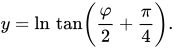
メルカトル図法 の縦座標の従来の解は、 緯度が と の間にあるため、絶対値記号 なし で 書く こと ができます。 φ {\displaystyle \varphi } − 1 2 π {\textstyle -{\tfrac {1}{2}}\pi } 1 2 π {\textstyle {\tfrac {1}{2}}\pi }
y = ln tan ( φ 2 + π 4 ) . {\displaystyle y=\ln \,{\tan }{\biggl (}{\frac {\varphi }{2}}+{\frac {\pi }{4}}{\biggr )}.}
とします
ψ = ln ( sec θ + tan θ ) , e ψ = sec θ + tan θ , sinh ψ = e ψ − e − ψ 2 = tan θ , cosh ψ = 1 + sinh 2 ψ = | sec θ | , tanh ψ = sin θ . {\displaystyle {\begin{aligned}\psi &=\ln(\sec \theta +\tan \theta ),\\[4pt]e^{\psi }&=\sec \theta +\tan \theta ,\\[4pt]\sinh \psi &={\frac {e^{\psi }-e^{-\psi }}{2}}=\tan \theta ,\\[4pt]\cosh \psi &={\sqrt {1+\sinh ^{2}\psi }}=|\sec \theta \,|,\\[4pt]\tanh \psi &=\sin \theta .\end{aligned}}} したがって、
∫ sec θ d θ = artanh ( sin θ ) + C = sgn ( cos θ ) arsinh ( tan θ ) + C = sgn ( sin θ ) arcosh | sec θ | + C . {\displaystyle {\begin{aligned}\int \sec \theta \,d\theta &=\operatorname {artanh} \left(\sin \theta \right)+C\\[-2mu]&=\operatorname {sgn}(\cos \theta )\operatorname {arsinh} \left(\tan \theta \right)+C\\[7mu]&=\operatorname {sgn}(\sin \theta )\operatorname {arcosh} {\left|\sec \theta \right|}+C.\end{aligned}}}
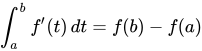
歴史 正割関数 の積分 は 「 17世紀半ばの未解決問題」の一つであり、1668年に ジェームズ・グレゴリー によって解決されました。 [3] 彼はその結果を航海図に関する問題に適用しました。 [1] 1599年、 エドワード・ライトは 数値的手法 (今日では リーマン和と 呼ばれるもの)によって積分を評価しました 。 [4] 彼は 地図 作成、特に正確な メルカトル図法 の構築のためにその解を求めていました。 [3] 1640年代、航海、測量、その他の数学の教師であるヘンリー・ボンドは、ライトが数値的に計算した正割関数の積分の値の表と正接関数の対数の表を比較し、その結果、次のように 推測 しました 。[3]
∫ 0 φ sec θ d θ = ln tan ( φ 2 + π 4 ) . {\displaystyle \int _{0}^{\varphi }\sec \theta \,d\theta =\ln \tan \left({\frac {\varphi }{2}}+{\frac {\pi }{4}}\right).} この予想は広く知られるようになり、1665年には アイザック・ニュートンも それを知っていました。 [5]
評価
標準的な置換(グレゴリーのアプローチ) 様々な参考文献で提示されている正割積分の標準的な評価方法は、分子と分母に sec θ + tan θを掛け、 u = sec θ + tan θ を代入することです。この代入は、正割と正接の 導関数 を加算することで得られます 。これらの導関数は、正割を共通因数としています。 [6]
から始めて
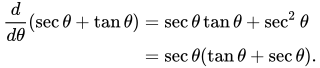
d d θ sec θ = sec θ tan θ and d d θ tan θ = sec 2 θ , {\displaystyle {\frac {d}{d\theta }}\sec \theta =\sec \theta \tan \theta \quad {\text{and}}\quad {\frac {d}{d\theta }}\tan \theta =\sec ^{2}\theta ,} 加算すると
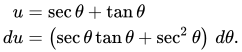
d d θ ( sec θ + tan θ ) = sec θ tan θ + sec 2 θ = sec θ ( tan θ + sec θ ) . {\displaystyle {\begin{aligned}{\frac {d}{d\theta }}(\sec \theta +\tan \theta )&=\sec \theta \tan \theta +\sec ^{2}\theta \\&=\sec \theta (\tan \theta +\sec \theta ).\end{aligned}}} したがって、和の導関数は、和に sec θ を掛けたものに等しくなります。これにより、分子と分母にsec θ に sec θ + tan θ を掛け 、以下の代入を行うことができます。
u = sec θ + tan θ d u = ( sec θ tan θ + sec 2 θ ) d θ . {\displaystyle {\begin{aligned}u&=\sec \theta +\tan \theta \\du&=\left(\sec \theta \tan \theta +\sec ^{2}\theta \right)\,d\theta .\end{aligned}}} 積分は次のように評価されます。
∫ sec θ d θ = ∫ sec θ ( sec θ + tan θ ) sec θ + tan θ d θ = ∫ sec 2 θ + sec θ tan θ sec θ + tan θ d θ u = sec θ + tan θ = ∫ 1 u d u d u = ( sec θ tan θ + sec 2 θ ) d θ = ln | u | + C = ln | sec θ + tan θ | + C , {\displaystyle {\begin{aligned}\int \sec \theta \,d\theta &=\int {\frac {\sec \theta (\sec \theta +\tan \theta )}{\sec \theta +\tan \theta }}\,d\theta \\[6pt]&=\int {\frac {\sec ^{2}\theta +\sec \theta \tan \theta }{\sec \theta +\tan \theta }}\,d\theta &u&=\sec \theta +\tan \theta \\[6pt]&=\int {\frac {1}{u}}\,du&du&=\left(\sec \theta \tan \theta +\sec ^{2}\theta \right)\,d\theta \\[6pt]&=\ln |u|+C\\[4pt]&=\ln |\sec \theta +\tan \theta |+C,\end{aligned}}} 主張されているとおりです。これはジェームズ・グレゴリーによって発見された式です。 [1]
部分分数と代入(バローのアプローチ)によって グレゴリーは1668年に著書 『幾何学論』 [ 7] でこの予想 を証明しました が、その証明は現代の読者が理解するのがほぼ不可能な形で提示されていました。一方、 アイザック・バロー は1670年の 著書『幾何学論』 [8] で 初めて「わかりやすい」証明を与えましたが、それも「当時の幾何学用語で表現されていた」ものでした。 [3] バローによるこの結果の証明は、 積分における 部分分数の最も初期の使用でした。 [3] 現代の記法に適応させたバローの証明は、次のように始まりました。
∫ sec θ d θ = ∫ 1 cos θ d θ = ∫ cos θ cos 2 θ d θ = ∫ cos θ 1 − sin 2 θ d θ {\displaystyle \int \sec \theta \,d\theta =\int {\frac {1}{\cos \theta }}\,d\theta =\int {\frac {\cos \theta }{\cos ^{2}\theta }}\,d\theta =\int {\frac {\cos \theta }{1-\sin ^{2}\theta }}\,d\theta } u = sin θ 、 du = cos θ dθ を代入すると 、積分は
∫ 1 1 − u 2 d u = ∫ 1 ( 1 + u ) ( 1 − u ) d u = ∫ 1 2 ( 1 1 + u + 1 1 − u ) d u partial fraction decomposition = 1 2 ( ln | 1 + u | − ln | 1 − u | ) + C = 1 2 ln | 1 + u 1 − u | + C {\displaystyle {\begin{aligned}\int {\frac {1}{1-u^{2}}}\,du&=\int {\frac {1}{(1+u)(1-u)}}\,du\\[6pt]&=\int {\frac {1}{2}}\!\left({\frac {1}{1+u}}+{\frac {1}{1-u}}\right)du&&{\text{partial fraction decomposition}}\\[6pt]&={\frac {1}{2}}{\bigl (}\ln \left|1+u\right|-\ln \left|1-u\right|{\bigr )}+C\\[6pt]&={\frac {1}{2}}\ln \left|{\frac {1+u}{1-u}}\right|+C\end{aligned}}} したがって、
∫ sec θ d θ = 1 2 ln 1 + sin θ 1 − sin θ + C , {\displaystyle \int \sec \theta \,d\theta ={\frac {1}{2}}\ln {\frac {1+\sin \theta }{1-\sin \theta }}+C,} 予想どおりです。絶対値を取る必要はありません。なぜなら、の実数値に対して 、 と は常に非負だからです。 1 + sin θ {\displaystyle 1+\sin \theta } 1 − sin θ {\displaystyle 1-\sin \theta } θ . {\displaystyle \theta .}
正接半角置換によって
標準 正接半角置換 [9] の下では t = tan 1 2 θ , {\textstyle t=\tan {\tfrac {1}{2}}\theta ,}
sin θ = 2 t 1 + t 2 , cos θ = 1 − t 2 1 + t 2 , d θ = 2 1 + t 2 d t , tan θ = sin θ cos θ = 2 t 1 − t 2 , sec θ = 1 cos θ = 1 + t 2 1 − t 2 , sec θ + tan θ = 1 + 2 t + t 2 1 − t 2 = 1 + t 1 − t . {\displaystyle {\begin{aligned}&\sin \theta ={\frac {2t}{1+t^{2}}},\quad \cos \theta ={\frac {1-t^{2}}{1+t^{2}}},\quad d\theta ={\frac {2}{1+t^{2}}}\,dt,\\[10mu]&\tan \theta ={\frac {\sin \theta }{\cos \theta }}={\frac {2t}{1-t^{2}}},\quad \sec \theta ={\frac {1}{\cos \theta }}={\frac {1+t^{2}}{1-t^{2}}},\\[10mu]&\sec \theta +\tan \theta ={\frac {1+2t+t^{2}}{1-t^{2}}}={\frac {1+t}{1-t}}.\end{aligned}}} したがって、正割関数の積分は
∫ sec θ d θ = ∫ ( 1 + t 2 1 − t 2 ) ( 2 1 + t 2 ) d t t = tan θ 2 = ∫ 2 ( 1 − t ) ( 1 + t ) d t = ∫ ( 1 1 + t + 1 1 − t ) d t partial fraction decomposition = ln | 1 + t | − ln | 1 − t | + C = ln | 1 + t 1 − t | + C = ln | sec θ + tan θ | + C , {\displaystyle {\begin{aligned}\int \sec \theta \,d\theta &=\int \left({\frac {1+t^{2}}{1-t^{2}}}\right)\!\left({\frac {2}{1+t^{2}}}\right)dt&&t=\tan {\frac {\theta }{2}}\\[6pt]&=\int {\frac {2}{(1-t)(1+t)}}\,dt\\[6pt]&=\int \left({\frac {1}{1+t}}+{\frac {1}{1-t}}\right)dt&&{\text{partial fraction decomposition}}\\[6pt]&=\ln |1+t|-\ln |1-t|+C\\[6pt]&=\ln \left|{\frac {1+t}{1-t}}\right|+C\\[6pt]&=\ln |\sec \theta +\tan \theta |+C,\end{aligned}}} 前と同じように。
非標準 積分は、接線半角置換のやや非標準的なバージョンを使用して導くこともできます。この特定の積分の場合、より単純であり、2013年に発表された [10] は次のとおりです。
x = tan ( π 4 + θ 2 ) 2 x 1 + x 2 = 2 tan ( π 4 + θ 2 ) sec 2 ( π 4 + θ 2 ) = 2 sin ( π 4 + θ 2 ) cos ( π 4 + θ 2 ) = sin ( π 2 + θ ) = cos θ by the double-angle formula d x = 1 2 sec 2 ( π 4 + θ 2 ) d θ = 1 2 ( 1 + x 2 ) d θ d θ = 2 1 + x 2 d x . {\displaystyle {\begin{aligned}x&=\tan \left({\frac {\pi }{4}}+{\frac {\theta }{2}}\right)\\[10pt]{\frac {2x}{1+x^{2}}}&={\frac {2\tan \left({\frac {\pi }{4}}+{\frac {\theta }{2}}\right)}{\sec ^{2}\left({\frac {\pi }{4}}+{\frac {\theta }{2}}\right)}}=2\sin \left({\frac {\pi }{4}}+{\frac {\theta }{2}}\right)\cos \left({\frac {\pi }{4}}+{\frac {\theta }{2}}\right)\\[6pt]&=\sin \left({\frac {\pi }{2}}+\theta \right)=\cos \theta &&{\text{by the double-angle formula}}\\[10pt]dx&={\frac {1}{2}}\sec ^{2}\left({\frac {\pi }{4}}+{\frac {\theta }{2}}\right)d\theta ={\frac {1}{2}}\left(1+x^{2}\right)d\theta \\[10pt]d\theta &={\frac {2}{1+x^{2}}}\,dx.\end{aligned}}} 置換:
∫ sec θ d θ = ∫ 1 cos θ d θ = ∫ 1 + x 2 2 x ⋅ 2 1 + x 2 d x = ∫ 1 x d x = ln | x | + C = ln | tan ( π 4 + θ 2 ) | + C . {\displaystyle {\begin{aligned}\int \sec \theta \,d\theta =\int {\frac {1}{\cos \theta }}\,d\theta &=\int {\frac {1+x^{2}}{2x}}\cdot {\frac {2}{1+x^{2}}}\,dx\\[6pt]&=\int {\frac {1}{x}}\,dx\\[6pt]&=\ln |x|+C\\[6pt]&=\ln \left|\tan \left({\frac {\pi }{4}}+{\frac {\theta }{2}}\right)\right|+C.\end{aligned}}}
2回の連続した置換により 積分は、 被積分関数 を操作し、2回置換することでも解くことができます。定義 sec θ = 1 / cos θ と恒等式 cos 2 θ + sin 2 θ = 1 を用いると、積分は次のように書き直すことができます。
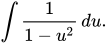
∫ sec θ d θ = ∫ 1 cos θ d θ = ∫ cos θ cos 2 θ d θ = ∫ cos θ 1 − sin 2 θ d θ . {\displaystyle \int \sec \theta \,d\theta =\int {\frac {1}{\cos \theta }}\,d\theta =\int {\frac {\cos \theta }{\cos ^{2}\theta }}\,d\theta =\int {\frac {\cos \theta }{1-\sin ^{2}\theta }}\,d\theta .} u = sin θ 、 du = cos θ dθ を代入する と、積分は次のように 簡約されます。
∫ 1 1 − u 2 d u . {\displaystyle \int {\frac {1}{1-u^{2}}}\,du.} 簡約された積分は、 u = tanh t 、 du = sech 2 t dt を代入し、恒等式 1 − tanh 2 t = sech 2 t を
用いて評価できます
∫ sech 2 t 1 − tanh 2 t d t = ∫ sech 2 t sech 2 t d t = ∫ d t . {\displaystyle \int {\frac {\operatorname {sech} ^{2}t}{1-\tanh ^{2}t}}\,dt=\int {\frac {\operatorname {sech} ^{2}t}{\operatorname {sech} ^{2}t}}\,dt=\int dt.} 積分は単純積分に簡約され、逆置換すると
∫ d t = t + C = artanh u + C = artanh ( sin θ ) + C , {\displaystyle {\begin{aligned}\int dt&=t+C\\&=\operatorname {artanh} u+C\\[4pt]&=\operatorname {artanh} (\sin \theta )+C,\end{aligned}}} これは積分の双曲形式の一つです。
同様の戦略を用いて、 コセカント関数 、 双曲正割関数 、 双曲コセカント 関数を積分することができます。
再び便利な項を掛けて割ることで、他の2つの双曲形式を直接求めることもできます
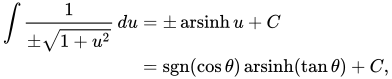
∫ sec θ d θ = ∫ sec 2 θ sec θ d θ = ∫ sec 2 θ ± 1 + tan 2 θ d θ , {\displaystyle \int \sec \theta \,d\theta =\int {\frac {\sec ^{2}\theta }{\sec \theta }}\,d\theta =\int {\frac {\sec ^{2}\theta }{\pm {\sqrt {1+\tan ^{2}\theta }}}}\,d\theta ,} ここで は を表します。 なぜなら 、 u = tan θ 、 du = sec 2 θ dθ を代入すると 、標準積分に簡約されます。 ± {\displaystyle \pm } sgn ( cos θ ) {\displaystyle \operatorname {sgn}(\cos \theta )} 1 + tan 2 θ = | sec θ | . {\displaystyle {\sqrt {1+\tan ^{2}\theta }}=|\sec \theta \,|.}
∫ 1 ± 1 + u 2 d u = ± arsinh u + C = sgn ( cos θ ) arsinh ( tan θ ) + C , {\displaystyle {\begin{aligned}\int {\frac {1}{\pm {\sqrt {1+u^{2}}}}}\,du&=\pm \operatorname {arsinh} u+C\\&=\operatorname {sgn}(\cos \theta )\operatorname {arsinh} \left(\tan \theta \right)+C,\end{aligned}}} ここで、 sgn は 符号関数 です 。
同様に、
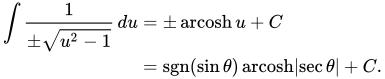
∫ sec θ d θ = ∫ sec θ tan θ tan θ d θ = ∫ sec θ tan θ ± sec 2 θ − 1 d θ . {\displaystyle \int \sec \theta \,d\theta =\int {\frac {\sec \theta \tan \theta }{\tan \theta }}\,d\theta =\int {\frac {\sec \theta \tan \theta }{\pm {\sqrt {\sec ^{2}\theta -1}}}}\,d\theta .} u = | sec θ | 、 du = | sec θ | tan θ dθ を代入する と、標準積分に簡約されます。
∫ 1 ± u 2 − 1 d u = ± arcosh u + C = sgn ( sin θ ) arcosh | sec θ | + C . {\displaystyle {\begin{aligned}\int {\frac {1}{\pm {\sqrt {u^{2}-1}}}}\,du&=\pm \operatorname {arcosh} u+C\\&=\operatorname {sgn}(\sin \theta )\operatorname {arcosh} \left|\sec \theta \right|+C.\end{aligned}}}
代入の下で z = e i θ , {\displaystyle z=e^{i\theta },}
θ = − i ln z , d θ = − i z d z , cos θ = z + z − 1 2 , sin θ = z − z − 1 2 i , sec θ = 2 z + z − 1 , tan θ = − i z − z − 1 z + z − 1 , sec θ + tan θ = − i 2 i + z − z − 1 z + z − 1 = − i ( z + i ) ( 1 + i z − 1 ) ( z − i ) ( 1 + i z − 1 ) = − i z + i z − i {\displaystyle {\begin{aligned}&\theta =-i\ln z,\quad d\theta ={\frac {-i}{z}}dz,\quad \cos \theta ={\frac {z+z^{-1}}{2}},\quad \sin \theta ={\frac {z-z^{-1}}{2i}},\quad \\[5mu]&\sec \theta ={\frac {2}{z+z^{-1}}},\quad \tan \theta =-i{\frac {z-z^{-1}}{z+z^{-1}}},\quad \\[5mu]&\sec \theta +\tan \theta =-i{\frac {2i+z-z^{-1}}{z+z^{-1}}}=-i{\frac {(z+i)(1+iz^{-1})}{(z-i)(1+iz^{-1})}}=-i{\frac {z+i}{z-i}}\end{aligned}}} したがって、積分は
∫ sec θ d θ = ∫ 2 z + z − 1 − i z d z z = e i θ = ∫ − 2 i z 2 + 1 d z = ∫ 1 z + i − 1 z − i d z partial fraction decomposition = ln ( z + i ) − ln ( z − i ) + C = ln z + i z − i + C = ln ( i ( sec θ + tan θ ) ) + C = ln ( sec θ + tan θ ) + ln i + C {\displaystyle {\begin{aligned}\int \sec \theta \,d\theta &=\int {\frac {2}{z+z^{-1}}}\,{\frac {-i}{z}}dz&&z=e^{i\theta }\\[5mu]&=\int {\frac {-2i}{z^{2}+1}}dz\\&=\int {\frac {1}{z+i}}-{\frac {1}{z-i}}\,dz&&{\text{partial fraction decomposition}}\\[5mu]&=\ln(z+i)-\ln(z-i)+C\\[5mu]&=\ln {\frac {z+i}{z-i}}+C\\[5mu]&=\ln {\bigl (}i(\sec \theta +\tan \theta ){\bigr )}+C\\[5mu]&=\ln(\sec \theta +\tan \theta )+\ln i+C\end{aligned}}} 積分定数は任意の値にすることができるため、追加の定数項はそれに吸収されます。最後に、 theta が実 数値の場合、これを絶対値の括弧で示すことで、最も馴染みのある形式にすることができます。
∫ sec θ d θ = ln | tan θ + sec θ | + C {\displaystyle \int \sec \theta \,d\theta =\ln \left|\tan \theta +\sec \theta \right|+C}
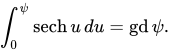
グーデルマン型とランベルト型 グーデルマン関数は、 共通の 立体射影 を介して、円扇形の 面積 と 双曲 扇形 の面積を関連付けます。青い双曲扇形の面積の2倍を ψ とすると、赤い円扇形の面積の2倍は ϕ = gd ψ です。紫色の三角形の面積の2倍は、立体射影 s = tan です 。 1 / 2 ϕ = tanh 1 / 2 ψ 。 青い点は座標 (cosh ψ , sinh ψ ) です。赤い点は座標 (cos ϕ , sin ϕ ) です。 紫色の点は座標 (0, s ) です。 双曲正割関数の積分は、 グーデルマン関数 を定義します。
∫ 0 ψ sech u d u = gd ψ . {\displaystyle \int _{0}^{\psi }\operatorname {sech} u\,du=\operatorname {gd} \psi .} 正割関数の積分は、 グーデルマン関数の 逆関数であるランベルト関数を定義します。
∫ 0 φ sec t d t = lam φ = gd − 1 φ . {\displaystyle \int _{0}^{\varphi }\sec t\,dt=\operatorname {lam} \varphi =\operatorname {gd} ^{-1}\varphi .} これらの関数は地図投影の理論で用いられます。 経度 λ 、緯度 ϕの 球面 上の点の メルカトル図法は [11] のように 表されます。
( x , y ) = ( λ , lam φ ) . {\displaystyle (x,y)={\bigl (}\lambda ,\operatorname {lam} \varphi {\bigr )}.}
参照
注釈 ^ abc スチュワート、ジェームズ (2012). 「セクション7.2:三角関数の積分」. 微積分学 - 初級超越関数 . Cengage Learning. pp. 475–6 . ISBN 978-0-538-49790-9 。 ^ 例えば、この形式は Karney, Charles FF (2011). 「数ナノメートルの精度を持つ横メルカトル図法」. Journal of Geodesy . 85 : 475–485 で使用されています。 ^ abcde V. Frederick RickeyとPhilip M. Tuchinsky著『地理学の数学への応用:正割の積分の歴史』 Mathematics Magazine 、第53巻第3号、1980年5月、162–166ページ。 ^ エドワード・ライト著 『 航海におけるある種の誤り、海図、コンパス、十字の杖、太陽の赤緯表、そして恒星の検出と修正』 、バレンタイン・シムズ、ロンドン、1599年 ^ HWターンブル編『 アイザック・ニュートンの書簡』 、ケンブリッジ大学出版局、1959~1960年、第1巻13~16ページ、第2巻99~100ページ DTホワイトサイド 編『 アイザック・ニュートン数学論文集』 ケンブリッジ大学出版局、1967年、第1巻、466~467ページおよび473~475ページ
^ Feldman, Joel. 「sec x と sec3 x の積分」 (PDF) 。 ブリティッシュコロンビア大学数学科 。 「正割の積分」 。MIT OpenCourseWare
^ グレゴリー、ジェームズ (1668). 「Analogia Inter Lineam Meridianam Planispherii Nautici & Tangentes Artificiales Geometricè Demonstrata, &c.」[海図早見球の子午線と幾何学的に証明された人工接線の類似性、など]。Exercitationes Geometricae [ 幾何学演習 ](ラテン語)。モーゼス・ピット。pp. 14– 24. ^ バロー、アイザック (1674) [1670]. 「Lectiones geometricae: XII, Appendicula I.」 Lectiones Opticae & Geometricae (ラテン語)。Typis Guilielmi Godbid。pp. 110– 114 英語版 「講義XII、付録I」。 アイザック・バローの幾何学講義 。ジェームズ・マーク・チャイルド訳。オープンコート。1916年。165 ~ 169ページ。 ^ ジェームズ・スチュワート(2012年)「第7.4節:部分分数による有理関数の積分」。 微積分学:超越関数入門 (第7版)。ベルモント、カリフォルニア州、米国:Cengage Learning。493ページ。ISBN 978-0-538-49790-9 。 ^ マイケル・ハーディ(2013年) 「正割関数の反微分化における効率性」 。 アメリカ数学月刊誌 。120 ( 6 ):580 ^ Lee, LP (1976). 楕円関数に基づく等角投影 .Cartographica Monographs .第16巻.トロント:BV Gutsell、ヨーク大学.ISBN 0-919870-16-3 。 『The Canadian Cartographer 13』補遺第1号
参考文献 Maseres, Francis編 (1791). Scriptores Logarithmici; Or, A Collection of several Curious Tracts on the Nature and Construction of Logarithms. 第2巻.J. Davis. Strauss, Simon W. (1980). "The Integrals and Revisited". Journal of the Washington Academy of Sciences . 70 (4): 137– 143. JSTOR 24537231. ∫ sec x d x {\textstyle \int \sec x\,dx} ∫ csc x d x {\textstyle \int \csc x\,dx}

![{\displaystyle \int \sec \theta \,d\theta ={\begin{cases}{\dfrac {1}{2}}\ln {\dfrac {1+\sin \theta }{1-\sin \theta }}+C\\[15mu]\ln {{\bigl |}\sec \theta +\tan \theta \,{\bigr |}}+C\\[15mu]\ln {\left|\,{\tan }{\biggl (}{\dfrac {\theta }{2}}+{\dfrac {\pi }{4}}{\biggr )}\right|}+C\end{cases}}}](https://wikimedia.org/api/rest_v1/media/math/render/svg/6ef0daef62b58ec148141975776cb17d917a11f6)



![{\displaystyle {\begin{aligned}\int \sec \theta \,d\theta &={\dfrac {1}{2}}\ln {\dfrac {1+\sin \theta }{1-\sin \theta }}+C\\[5mu]&=\ln {{\bigl |}\sec \theta +\tan \theta \,{\bigr |}}+C\\[5mu]&=\ln {\left|\,{\tan }{\biggl (}{\frac {\theta }{2}}+{\frac {\pi }{4}}{\biggr )}\right|}+C,\end{aligned}}}](https://wikimedia.org/api/rest_v1/media/math/render/svg/ea330e4e4a16e6fd28b0799f7db89b7a41797a31)





![{\displaystyle {\begin{aligned}{\sqrt {\dfrac {1+\sin \theta}{1-\sin \theta}}}&={\sqrt {\frac {1+{\dfrac {2t}{1+t^{2}}}}{1-{\dfrac {2t}{1+t^{2}}}}}={\sqrt {\frac {1+t^{2}+2t}{1+t^{2}-2t}}}={\sqrt {\frac {(1+t)^{2}}{(1-t)^{2}}}}\\[5mu]&=\left|{\frac {1+t}{1-t}}\right|.\end{aligned}}}](https://wikimedia.org/api/rest_v1/media/math/render/svg/1933a9d9e701521bddd362c2596a7a1206104271)
![{\displaystyle {\begin{aligned}{\bigl |}\sec \theta +\tan \theta \,{\bigr |}&=\left|{\frac {1}{\cos \theta }}+{\frac {\sin \theta }{\cos \theta }}\right|=\left|{\frac {1+t^{2}}{1-t^{2}}}+{\frac {2t}{1-t^{2}}}\right|=\left|{\frac {(1+t)^{2}}{(1+t)(1-t)}}\right|\\[5mu]&=\left|{\frac {1+t}{1-t}}\right|.\end{aligned}}}](https://wikimedia.org/api/rest_v1/media/math/render/svg/8cb6ce304a9d36791b331ac1a32633237aa01f28)

![{\displaystyle {\begin{aligned}\left|\,{\tan }{\biggl (}{\frac {\theta }{2}}+{\frac {\pi }{4}}{\biggr )}\right|&=\left|{\frac {\tan {\tfrac {1}{2}}\theta +\tan {\tfrac {1}{4}}\pi }{1-\tan {\tfrac {1}{2}}\theta \,\tan {\tfrac {1}{4}}\pi }}\right|=\left|{\frac {t+1}{1-t\cdot 1}}\right|\\[5mu]&=\left|{\frac {1+t}{1-t}}\right|.\end{aligned}}}](https://wikimedia.org/api/rest_v1/media/math/render/svg/b4f63ea519a2dcd1432f733b1cc2f51e54537ccc)


![{\displaystyle {\begin{aligned}\psi &=\ln(\sec \theta +\tan \theta ),\\[4pt]e^{\psi }&=\sec \theta +\tan \theta ,\\[4pt]\sinh \psi &={\frac {e^{\psi }-e^{-\psi }}{2}}=\tan \theta ,\\[4pt]\cosh \psi &={\sqrt {1+\sinh ^{2}\psi }}=|\sec \theta \,|,\\[4pt]\tanh \psi &=\sin \theta .\end{aligned}}}](https://wikimedia.org/api/rest_v1/media/math/render/svg/580c676469be618f62334b92c4014d96510ee7a5)
![{\displaystyle {\begin{aligned}\int \sec \theta \,d\theta &=\operatorname {artanh} \left(\sin \theta \right)+C\\[-2mu]&=\operatorname {sgn} (\cos \theta )\operatorname {arsinh} \left(\tan \theta \right)+C\\[7mu]&=\operatorname {sgn} (\sin \theta )\operatorname {arcosh} {\left|\sec \theta \right|}+C.\end{aligned}}}](https://wikimedia.org/api/rest_v1/media/math/render/svg/7b0815ac7bce2c83d20a161f6c6132b5fcf2dd99)


![{\displaystyle {\begin{aligned}\int \sec \theta \,d\theta &=\int {\frac {\sec \theta (\sec \theta +\tan \theta )}{\sec \theta +\tan \theta }}\,d\theta \\[6pt]&=\int {\frac {\sec ^{2}\theta +\sec \theta \tan \theta }{\sec \theta +\tan \theta }}\,d\theta &u&=\sec \theta +\tan \theta \\[6pt]&=\int {\frac {1}{u}}\,du&du&=\left(\sec \theta \tan \theta +\sec ^{2}\theta \right)\,d\theta \\[6pt]&=\ln |u|+C\\[4pt]&=\ln |\sec \theta +\tan \theta |+C,\end{aligned}}}](https://wikimedia.org/api/rest_v1/media/math/render/svg/63a71a975c969e532f8426f7cda347791484b026)

![{\displaystyle {\begin{aligned}\int {\frac {1}{1-u^{2}}}\,du&=\int {\frac {1}{(1+u)(1-u)}}\,du\\[6pt]&=\int {\frac {1}{2}}\!\left({\frac {1}{1+u}}+{\frac {1}{1-u}}\right)du&&{\text{部分分数分解}}\\[6pt]&={\frac {1}{2}}{\bigl (}\ln \left|1+u\right|-\ln \left|1-u\right|{\bigr )}+C\\[6pt]&={\frac {1}{2}}\ln \left|{\frac {1+u}{1-u}}\right|+C\end{aligned}}}](https://wikimedia.org/api/rest_v1/media/math/render/svg/ace0e7306360dd7790226da4051f1bd7ecbab734)



![{\displaystyle {\begin{aligned}&\sin \theta ={\frac {2t}{1+t^{2}}},\quad \cos \theta ={\frac {1-t^{2}}{1+t^{2}}},\quad d\theta ={\frac {2}{1+t^{2}}}\,dt,\\[10mu]&\tan \theta ={\frac {\sin \theta}{\cos \theta}}={\frac {2t}{1-t^{2}}},\quad \sec \theta ={\frac {1}{\cos \theta}}={\frac {1+t^{2}}{1-t^{2}}},\\[10mu]&\sec \theta +\tan \theta ={\frac {1+2t+t^{2}}{1-t^{2}}}={\frac {1+t}{1-t}}.\end{aligned}}}](https://wikimedia.org/api/rest_v1/media/math/render/svg/ff2533b1b8fe71634c059d523299ec6d75cb1f5a)
![{\displaystyle {\begin{aligned}\int \sec \theta \,d\theta &=\int \left({\frac {1+t^{2}}{1-t^{2}}}\right)\!\left({\frac {2}{1+t^{2}}}\right)dt&&t=\tan {\frac {\theta }{2}}\\[6pt]&=\int {\frac {2}{(1-t)(1+t)}}\,dt\\[6pt]&=\int \left({\frac {1}{1+t}}+{\frac {1}{1-t}}\right)dt&&{\text{部分分数分解}}\\[6pt]&=\ln |1+t|-\ln |1-t|+C\\[6pt]&=\ln \left|{\frac {1+t}{1-t}}\right|+C\\[6pt]&=\ln |\sec \theta +\tan \theta |+C,\end{aligned}}}](https://wikimedia.org/api/rest_v1/media/math/render/svg/66808458f2ff27ad9e449f9a98d1cf7d5cccc253)
![{\displaystyle {\begin{aligned}x&=\tan \left({\frac {\pi }{4}}+{\frac {\theta }{2}}\right)\\[10pt]{\frac {2x}{1+x^{2}}}&={\frac {2\tan \left({\frac {\pi }{4}}+{\frac {\theta }{2}}\right)}{\sec^{2}\left({\frac {\pi }{4}}+{\frac {\theta }{2}}\right)}}=2\sin \left({\frac {\pi }{4}}+{\frac {\theta }{2}}\right)\cos \left({\frac {\pi }{4}}+{\frac {\theta }{2}}\right)\\[6pt]&=\sin \left({\frac {\pi }{2}}+\theta \right)=\cos \theta &&{\text{倍角の公式により}}\\[10pt]dx&={\frac {1}{2}}\sec ^{2}\left({\frac {\pi }{4}}+{\frac {\theta }{2}}\right)d\theta ={\frac {1}{2}}\left(1+x^{2}\right)d\theta \\[10pt]d\theta &={\frac {2}{1+x^{2}}}\,dx.\end{aligned}}}](https://wikimedia.org/api/rest_v1/media/math/render/svg/15f9e2fdbd2f74d26f0a95d51f5dbb8d9ff7fe71)
![{\displaystyle {\begin{aligned}\int \sec \theta \,d\theta =\int {\frac {1}{\cos \theta }}\,d\theta &=\int {\frac {1+x^{2}}{2x}}\cdot {\frac {2}{1+x^{2}}}\,dx\\[6pt]&=\int {\frac {1}{x}}\,dx\\[6pt]&=\ln |x|+C\\[6pt]&=\ln \left|\tan \left({\frac {\pi }{4}}+{\frac {\theta }{2}}\right)\right|+C.\end{aligned}}}](https://wikimedia.org/api/rest_v1/media/math/render/svg/25bb45668aec3b9a77eb873946046e6b164c34fa)


![{\displaystyle {\begin{aligned}\int dt&=t+C\\&=\operatorname {artanh} u+C\\[4pt]&=\operatorname {artanh} (\sin \theta )+C,\end{aligned}}}](https://wikimedia.org/api/rest_v1/media/math/render/svg/0a8de628ac60fe65d573ad8149965f5e4f26e4d0)






![{\displaystyle {\begin{aligned}&\theta =-i\ln z,\quad d\theta ={\frac {-i}{z}}dz,\quad \cos \theta ={\frac {z+z^{-1}}{2}},\quad \sin \theta ={\frac {zz^{-1}}{2i}},\quad \\[5mu]&\sec \theta ={\frac {2}{z+z^{-1}}},\quad \tan \theta =-i{\frac {zz^{-1}}{z+z^{-1}}},\quad \\[5mu]&\sec \theta +\tan \theta =-i{\frac {2i+zz^{-1}}{z+z^{-1}}}=-i{\frac {(z+i)(1+iz^{-1})}{(zi)(1+iz^{-1})}}=-i{\frac {z+i}{zi}}\end{aligned}}}](https://wikimedia.org/api/rest_v1/media/math/render/svg/576571e5d16d5a35dbda060480eb9b0a0a12b97e)
![{\displaystyle {\begin{aligned}\int \sec \theta \,d\theta &=\int {\frac {2}{z+z^{-1}}}\,{\frac {-i}{z}}dz&&z=e^{i\theta }\\[5mu]&=\int {\frac {-2i}{z^{2}+1}}dz\\&=\int {\frac {1}{z+i}}-{\frac {1}{zi}}\,dz&&{\text{部分分数分解}}\\[5mu]&=\ln(z+i)-\ln(zi)+C\\[5mu]&=\ln {\frac {z+i}{zi}}+C\\[5mu]&=\ln {\bigl (}i(\sec \theta +\tan \theta ){\bigr )}+C\\[5mu]&=\ln(\sec \theta +\tan \theta )+\ln i+C\end{aligned}}}](https://wikimedia.org/api/rest_v1/media/math/render/svg/f86508f38d8df57d3acd64d08b99a4c472a67a18)